The "Only" Empress of France

Comment

The "Only" Empress of France

Long before she would become Empress of France, Joséphine de Beauharnais lived another life and even escaped death. Born on June 23, 1763 in Les-Trois-Ilets Martinique to a wealthy sugar plantation owning family. Marie-Josèphe-Rose as she was known before Napoleon was the eldest daughter but wasn’t the first to be married off. Her aunt Desirée was the mistress of Francois-Marquis de Beauharnais and as he became ill in order to help the family that's plantation had been heavily damaged in a hurricane she offered her youngest niece in marriage to his son. Catherine at just 12 years old would die before she could leave for France.

Joséphine in turn would take her sister's place and travel with her father to Paris. On December 13, 1779 in Noisy-le-Grand Joséphine would marry Alexandre de Beauharnais. It was a tough marriage from the start. Alexandre was frequently gone and spent days in brothels.Their first child, Eugene was born in 1781 and in 1806 a daughter, Hortense. With him being away so much he accused Joséphine of adultery and after a return from visiting family in Martinique he had her sent to the Penthemont Abbey.

Joséphine was able to appeal to the commissioner who sided with her and forced her release and for her husband to pay her a pension.

At the Revolution Alexandre was suspected of being an aristocratic sympathiser and was arrested and sent to prison. While they rarely spent time together Joséphine was also arrested.

Alexandre was sentenced to death and on July 23, 1794 he met the guillotine on the Place de la Revolution. Shortly after the fall of Robespierre, Joséphine was released and now a widow.

A year later on October 15, 1795 at a dinner party at the home of Paul Barras she was introduced to the young military officer, Napoleon Bonaparte. Instantly captivated by her, they would spend time together and while he was away on a campagne he would send endless letters filled with love, jealousy and infatuation. On March 9, 1779 at the l’Hotel de Mondragon the two would marry in a civil ceremony. Joséphine was the great love of his life, although they wouldn’t grow old together.

Josephine wasn’t the “only” empress of France, there was also Marie-Louise the second wife of Napoleon and Eugene, the wife of Napoléon III. However Josephine takes the cake as the best. A woman that held her own and made it through the Revolution and life after Napoleon. Can’t wait to do a few episodes of La Vie Creative - Paris History Avec a Hemingway all about this lovely lady.

Comment

The One Man Who Saved the Louvre

Comment

The One Man Who Saved the Louvre

One man did more for the art of France during WWII than any other, Jacques Jaujard. As the deputy director of the National Museums on his own he decided they needed to evacuate the art of the Louvre. He had already done it once before in 1938. As the Spanish Civil War raged in Madrid, the Prado Museum asked Jaujard to assist with saving their art. Seventy one trucks packed with crates of the Prado collection traveled to Switzerland.

When the Germans moved towards Paris he did it once again, this time on a much larger scale. On August 25, 1939 the Louvre “closed” for cleaning but behind the walls the staff was pulling every painting from the wall and statue and packing them away. Three days later they were placed in 203 vehicles and raced to the unoccupied region of France.

While the art was safely away from their grasp, German Count Franz Wolff Metternich, an aristocrat, appointed by Hitler to oversee the art collection of France with a secret motive to handpick what he wanted. Metternich wasn’t a Hitler loyalist and actually sided with Jaujard on the protection of the art. In August 1940 when he first arrived at the Louvre he was relieved to see the art was already gone.

Not only did Jaujard have to fend off the Germans he also had to keep the art out of the hands of the Vichy French government that wanted to hand the art over to the Germans. It wasn’t just the national collection, it was also the private collections of Jewish gallery owners and collectors. Maurice de Rothschild’s works were protected and acquired by the state and saved.

Jaguar worked the rest of his life for the art of France. In 1959 he served as secretary general of the newly formed Ministry of State for Cultural Affairs overseeing the exhibitions of France and beyond. On this date in 1967 at 71 years old, he suddenly died of a pulmonary embolism.

He is remembered at the Louvre at the Porte Jaujard of the École du Louvre, that he worked to revamp. Two of the Cain Linonesses stand guard for the man that protected the art of the Louvre. Jacques died on this day in 1967 and there isn’t a day that I’m in the Louvre that I don’t think and thank him.

To learn more about this amazing story read Gerri Chanel’s book Saving Mona Lisa . it is so great I have read it twice, it is impossible to put down, and you will fall in love with Jaujard, Rose Valland and so many heroes that put their life on the line to save the art of France.

Comment

Le Premier Jour de l'Été

Comment

Le Premier Jour de l'Été

The first day of summer, it felt like it would never come. The longer days lead to warm nights under the stars with glasses of rosé toasting friendships even if thousands of miles apart. Everything seems to slow down a bit in the summer as we all take our time catching those warm sun rays. 

Today in Paris they celebrate the longest day of the year with La Fête de la Musique. Music is everywhere in Paris, flowing out of restaurants, in parks and in the middle of the street in every corner of the city. However, if you want to beat the summer heat in Paris, seek out the walls of the museums of Paris, where summer can always be found.

Alphonse Mucha, the Czech artist created in 1896 & 1898 two separate series depicting the season and the Arts.  The sultry gaze of summer is depicted with her flowing hair resting against vines on what appears to be a warm summer day as she dangles her feet in the water. The transition of colors give you the feeling of a hazy heavy day with vines that surround her and the pop of red poppies serve as a crown to the queen of summer. 

In the Musée du Louvre where summer continues with two statuette women representing the season. Two separate sets of statues, both commissioned to be placed in the gardens of the kings, Saint-Cloud and Tuileries. Here Summer is depicted as a woman holding a wheat sheaf, and draped ever so lightly in fabric. Summer is represented by the Roman goddess of the harvest Ceres with a crown of flowers and wheat. Created by Guillaime Coustou, Summer with her basket was originally in the Jardin des Tuileries, finally arriving at the Louvre in 1972. The other by Pierre Laviron is seen in also holding a wheat, was originally in the Orangery of the Parc de Saint-Cloud, finally arriving at the Louvre in 1872.


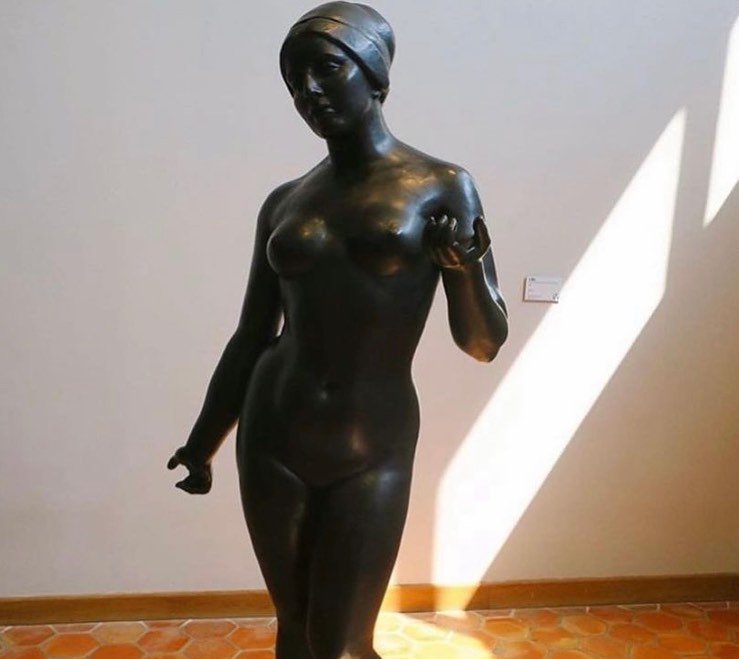
Aristide Maillol in 1911 also created a series of his bronze statues representing each of the seasons. Here l’été hands do most of the talking, her facial expression is distant, perhaps she is asking “where is my glass of rosé”, I hear ya sister!

The Louvre is filled with more than 35,000 pieces on display and there is a set of four paintings that always draw attention. 

In 1573 Giuseppe Arcimboldo created four paintings based on the seasons of the year for Emperor Maximilian II of Habsburg; it was to be a gift for Augustus of Saxony. Four paintings, one for each season, created with the harvest of that season.  Winter, Spring, Summer and Autumn are each very different from the last, and are one of the most popular sets of paintings in the Grand Galerie in the Musée du Louvre. Like the statues of the seasons each also represents a stage in life, spring is childhood, summer is adolescents, autumn is maturity and winter is always the old man. 

The versions in the Louvre are copies of the originals that are found in the Kunsthistorisches Museum in Vienna. Summer features the best fruits and vegetables that ripen on these long sunny days. Flowers were added to the edges of the paintings in the 17th century long after Archimboldo’s death. 

Comment

Les Amoureux de la Bastille

Comment

Les Amoureux de la Bastille

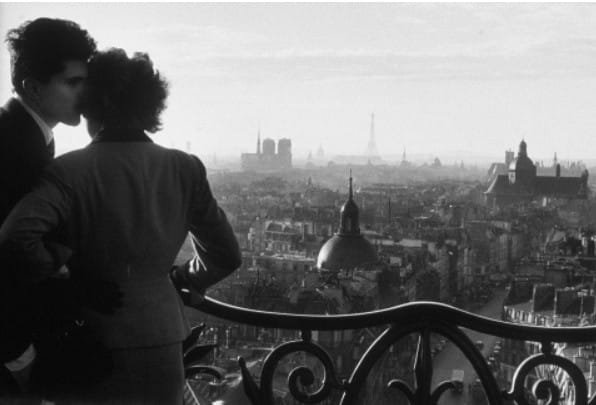
There are a few iconic images of Paris and most seem to be captured by Robert Doisneau, Henri Cartier-Bresson or Willy Ronis. Those crisp silver toned black and white images that still stand the test of time and are etched in our memories for generations. Les Amoureux de la Bastille might be more iconic than Le Baiser de l'Hôtel de Ville

The father of Willy Ronis was born in Odessa, Ukraine and fled to Paris where he set up a photography studio. Willy had other ideas of being a composer but when his father got sick he took over the business. Willy liked the streets of Paris much better than sitting in a studio capturing portraits. One day in 1957 he decided to climb the July Column of the Place de la Bastille. While up there snapping a few pictures he saw a young couple on the edge looking down the Rue Saint Antoine. You can see Notre Dame de Paris, Eglise Saint Paul Saint Louis and other landmarks immortalized in black and white.

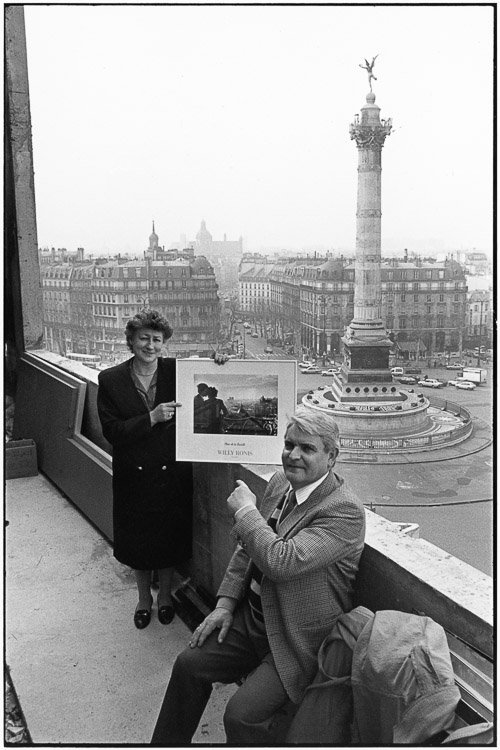
Willy took one photo and walked back down and went on with his day. The image was later reproduced in magazines and postcards and spread across the world. However, Ronis never knew who the young lovers were until 31 years later. At a Valentine’s Day exhibition at the Comptoir de la Photographie in the Marais where his famous painting was on display a young man walked up with a book for him to autograph.

Talking with Ronis he told him that he knew the young lovebirds that stood so high over Paris. Willy couldn’t believe it, and it got better. “They own a restaurant just around the corner at 10 rue Saint Antoine, I can take you there.”

Riton and Marinette came to Paris just from Alsace and on that day they climbed to the top this one and only time. Three years later they were married and had opened a restaurant and later had a poster of the photo framed in their bistro in the shadows of the statue of Beaumarchais; the couple had remained for 29 years since that photo.

As they stood up there that day in 1957, they would be immortalized forever, but they had no idea that the restaurant they would own the rest of their life was also immortal. Just down the street and in the photo it can be seen in the corner of the photo.

Comment

Marie Antoinette's Most Famous Hair Style

Comment

Marie Antoinette's Most Famous Hair Style

In 1765 a new French ship was born, the Belle Poule, a frigate of 26 guns. The Belle Poule would sail to Antilles, the Indian Ocean and in 1778 would return Benjamin Franklin to America after a trip to France.

On June 17, 1778 between the coast of Plouescat, Brittany and the Cornwall Cape Lizard a battle began between the French and the British. The Belle Poule was in the thick of it against the HMS Arethusa. Canons were fired at each ship, the mast of the Arethusa was destroyed and fell and for the first time since 1756 the French were victorious in a maritime battle. With this act Louis XVI declared war on his cousin King George III.

France was united and caught up in national patriotism that would even inspire the queen’s hairdresser. Léonard-Alexis Autié, arrived in Paris in 1769 and first worked with actresses of the theater. Catching the attention of Madame du Barry, word spread through the court of Versailles of the talented stylist. At the time Marie Antoinette already had an official hairdresser, but would still see Léonardo for special designs as he liked to be called. With Léonard & Rose Bertin who designed her clothes, Marie Antoinette funded one of the very first fashion magazines, Journal des Dames.

In 1774, he created the “pouffe” hair style which became all the rage, all the ladies wanted it.

After the victorious voyage of the Belle Poule in 1778, Léonardo designed a hair design never seen before. With a wire frame structure under hair pieces he recreated the multi mast ship on top of the queen’s head. Wearing it only once for a party at Versailles, Marie Antoinette made quite the statement. Léonardo would go on to create all sorts of lavish hair styles, including flowers, baskets of fruits, bird cages and even the signs of the zodiac. Many of which would be more than three feet high and weighing over 12 pounds and could cost a small fortune.

During the Revolution Léonardo escaped France like anyone else associated with the queen. Living in Russia until he could return to Paris in 1820, he was a very wealthy man that was able to die of old age instead of the guillotine

Comment

The first stone of Sacre Coeur

Comment

The first stone of Sacre Coeur

High above the busy cobblestone streets and the hustle and bustle of the right bank sits the white gleaming Byzantine basilica of Sacre Coeur. It is hard to imagine the hill without its limestone wedding cake topper but we actually don’t have to go back that far to a time before it existed. In 1870, it was decided that a basilica “of the National Vow” was to be built in Paris, but where was the question.

It was proposed that it be built where the unfinished Opera Garnier was and even at Chaillot which would have ended up looking at the Eiffel Tower a few years later. None of these locations held any religious meaning, and it would be the Archbishop of Paris, Joseph-Hippolyte Guibert that suggested it be built on Montmartre saying “it is here where the martyrs rest, it is her that the Sacre Coeur must reign in order to draw all to it”.

The building was funded by everyday people, donating anything they could even if it was only a few cents and later subscriptions of stones to dioceses and towns. On June 16, 1875 the first stone was laid and the construction began. Much of the gypsum filled hill needed to be reinforced with deep shafts which added cost and time to the completion. It would be 1914, before it was mostly finished, but the start of WWI delayed the opening. On October 15, 1919 at 7:30am the Archbishop of Paris Cardinal Amette purified the outside of the church while inside on the center of the floor a cross of Saint Andrew was drawn in ashes signifying Christ and Cardinal Amette said a blessing.

At 10am, chairs were brought in and the faithful followed. A parade of the relics of Saint Denis and his fellow martyred Eleutherius and Rusticus were carried down through the nave, finally returning home to the high altar. As the congregation gathered amongst the candle light, above the largest bell in France, the Savoyarde rang out. My grandparents made many trips to visit Sacre Coeur and my grandpa always had his trusty Konica snapping away on an early morning and climbing the steps to get the unbelievable view of Paris below

Comment

Sylvia Beach and Ulysses

Comment

Sylvia Beach and Ulysses

Sylvia Beach met James Joyce in the summer of 1920 at a party at French poet André Spires home. When she and Adrienne arrived they were told James Joyce was there. Sylvia worshipped the Irish writer and loved his work and was instantly terrified.

Her friend Ezra Pound brought Joyce to the party, so she mustered up the courage and went to say hi. Over dinner she told him about her bookshop on Rue de Dupuytren, Joyce laughed at the name but said he would pay it a visit.

The very next day the author walked through her door, swinging his cane in dirty tennis shoes. “Joyce was always a bit shabby” Sylvia said, “but his manner was so distinguished that one scarcely noticed what he had on”. After that first day Joyce would be found just about every day sitting in the window at a small table writing. His mail was sent there, as many of the expats did and days were spent frustrated at his lack of a publisher for Ulysses.

Pieces of it would appear in the Little Review. As each issue was released the authorities in the US confiscated them and declared it was banned.

Distraught at the outcome of his book Sylvia offered to publish it. It was not an easy task and cost her a ton of money. She almost lost everything taking on the publishing of Ulysses. Joyce wanted to change every edition as it was published.

Still banned in the US, Sylvia shared her frustration to Hemingway. “Give me 24 hours” he said. The next day he had a solution. He would ship books to a friend in Canada who would smuggle them in a few copies at a time down his pants into NYC via the ferry.

Thanks to Hem Ulysees arrived in the US. Today the loyal followers celebrate Bloomsday all over the world, the day the entire book took place, June 16, 1904, all thanks to Sylvia and Hemingway

For more about Sylvia, listen to the episode we did about this amazing, spitfire of a lady here.

Comment

Lisa di Antonio Gheradini Giocondo, aka Mona Lisa

Comment

Lisa di Antonio Gheradini Giocondo, aka Mona Lisa

She is one of the most famous paintings in the world. The first lady of the Louvre has become a mythical creature far past the painting.  However, did you know there was an entire story of the woman before she hung on the walls of the kings? 


Lisa di Antonio Gherardini was born in Florence on June 15, 1479 to a noble landowning Tuscan family. Not far from The Palazzo Pitti where the Medici family lived was the home of Antonmaria Gherardini and Lucrezia del Caccia. The family lived on the corner of the via Maggio and via Squazza when Lisa was born and then moved to the other side of the river in 1494. Near Santa Croce between via del Pepi and via Ghibellina they discovered their new neighbors, the Giocondo’s. 

On March 5, 1495, at 15 years old, Lisa married the son of her neighbors,  Francesco del Giocondo. Francesco was from a rich family that made their money in the silk business, A widow, a father  and fourteen years older than Lisa who also had a somewhat famous family as a neighbor. Living just a few doors down from Ser Piero da Vinci, the father of Leonardo. 

 A year later they welcomed their first child, Piero, quickly followed by Piera in 1497, Camilla in 1499, Marietta in 1500, Andrea in 1502 and finally Giocondo in 1507. Sadly only two survived past adolescents. 

Francesco became a civil servant and was elected to one esteemed post after another from 1499 to 1512. Once thought to be working for the exiled Medici family he was tossed into prison until the Medici’s returned and bailed him out.  Contracting the plague in 1539 Francesco died and Lisa left Florence to live with her daughter in the Sant’Orsola convent where she died July 15, 1542. 

In 1502, Francesco commissioned Leonardo da Vinci to paint a portrait of his wife. Leonardo was at the height of his fame at the moment after just completing the Last Supper but was also in need of money so accepted the job. Having just given birth to her son Andrea she sat for the portrait, considered quite large at the time for its subject matter. 

She never saw the unfinished painting that Francesco had never paid for after he was sent to jail. Leonardo liked to “meditate” on his paintings, work a little on a painting then take a break to ponder what he would do next. So it wasn’t out of the norm that the painting of Lisa wasn’t finished. In 1508 he carried the painting with him to Milan, then onto Rome in 1513. 

On October 13, 1515 Francois I was in Bologna  for a meeting with Pope Leo X  that Leonardo was also in attendance. Francois already knew of the master and wanted him to create a mechanical elephant for him. He offered his chateau in the Loire to Leonardo but at the time Leonardo declined. On March 17, 1516 Julien de Medici died, it was his last protection and funding he had and he decided to take the French king up on his offer. 

A few months later he made his way to France on a donkey with his unfinished canvas in hand including the Mona Lisa. In his new home, Leonardo was named the first painter of the king as well as engineer and architect but also the party planner to the king. Yes, Leonardo was an event planner. As a recovering event planner I can say his ability to do many things at once came in handy, but the fact he took 20 years to finish a painting I have my doubts on how those parties turned out. 

Leonardo was old, his arm was partially parilized and he spent more time instructing students then painting on his own in his final years. On October 10, 1517 he met with the cardinal d’Aragon at the Clos Lucé and presented him with a few paintings including the lovely lady of Florence. On April 23, 1519, in poor health he had his will drawn up. The paintings he had with him had been given to or purchased by Francois I upon his death.

The basis of that royal collection of Francois I would become the Musée du Louvre. The Louvre owns 6 of the paintings of Da Vinci, more than any country or museum, and Italy is still mad about that. She stayed in the company of the kings and emperors until 1793 when the Louvre was opened to the public. 

Known in Italy as  La Gioconda, and France as La Joconde, her English name, Mona Lisa comes from a shortened version of Madonna, meaning my lady. Madame Lisa or Lady Lisa, either way she has become the most captivating face and smile in the world. As for that smile, Gioconda in Italian, means playful or happy. So the next time you hear the argument if that is a smile or not, you can say, OUI! 


Comment

Jeanne d'Albert, the Nemesis of Catherine de Medici

Comment

Jeanne d'Albert, the Nemesis of Catherine de Medici

Jeanne d’Albret, is one of the 20 ladies of the Jardin du Luxembourg. You may pass right by her and not even know what a strong woman and ahead of her time she was. Jeanne d’Albret was born in 1528 to Henri II d’Albret, king of Navarre. At a very young age her father wanted her to marry the son of Charles V uniting them with Spain, but her uncle, King Francois I disagreed. Taking her away from her parents when she was 10, but would also suggest a marriage.

On June 9, 1541 at just 12 years old she was to marry Guillume, the Duke of Cleves. This time she refused up until the day of the wedding when she had to be literally pushed down the aisle. She didn’t give up the fight and refused to consummate the marriage. After four years she finally was granted an annulment by Pope Paul III in 1545.

In October 1548 after her uncle had died she was able to marry the man she wanted to, Antoine de Bourbon. After her father died in 1555 she and her husband took the throne of Navarre.

In 1553, she would have a son, Henri III, future king of Navarre and later known as Henri IV, king of France. After 5 children she would kick her husband out after she learned he had a son with another woman. She was really ahead of her time!

Growing up as Cathoic she later converted to Protestantism, by 1568 she became the head of the Protestant movement. As the reign of the Valois was coming to an end, she persuaded Catherine de Medici to unite her daughter Marguerite and Henri III. Jeanne had to promise that she wouldn’t convert her. Catherine said the wedding must occur on August 18, 1572, but Jeanne wouldn’t live to see it.

The legend is that Catherine asked her perfumer to make a pair of gloves for Jeanne. Catherine is known to dabble in the dark arts, and the story goes that the gloves were poisoned and killed Jeanne.

She died of tuberculosis on June 9, 1572

Catherine would take a vital role in the St Bartholomew’s Day Massacre, killing thousands of protestants just days after the wedding. Jeanne stands on the eastern side of the upper terrace of the Luxembourg, designed by Jean Louis Brian in 1843.

Comment

The Frenchest of French Kisses

Comment

The Frenchest of French Kisses

On this date in 1950, Life magazine published what would become one of the most iconic photos of Paris. Le baiser de l'hôtel de ville, by Robert Doisneau.

I love this photo, but more for what is around the couple then the couple themselves. The essence of Paris comes so clearly across in this piece. Taken in front of the Hôtel de Ville in the 4th, the people walking by without even a glance toward the couple in a close embrace is what is so very Parisian. It is not uncommon to see this exact scene on one of the many picturesque bridges, in front of the Eiffel Tower or on a sidewalk terrace, it is as common to see as a Frenchman walking down the street with a baguette.

It is the romance of Paris that oozes out of everything that is so easy to be whisked away into, and there is nothing wrong with that at all. But back to this photo and where I will squash your romantic dreams of what looks like such a candid moment. By 1950 Robert Doiseneu had been documenting the streets of Paris for a few years after working for Vogue as a fashion photographer. He found his inspiration in the everyday life of Parisians and it was on one of these days he saw a couple kissing. For more than 40 years it was a great mystery who the young couple were, but in 1992 they were revealed. Jacques Carteaud and Françoise Bornet were dating and walking through Paris kissing away when Doisneau caught a glimpse of them. In 2005 Françoise said that, "He told us we were charming, and asked if we could kiss again for the camera. We didn't mind. We were used to kissing. We were doing it all the time then, it was delicious. Monsieur Doisneau was adorable, very low key, very relaxed."

So he took them to a few famous spots in Paris to recreate their kiss, but it was in front of the Hôtel de Ville that they struck gold and the iconic photo was created. When you are in Paris, go to this same spot and at the café across the square stand across from the "C" and kiss away and you can make your own version. I can promise you it is not hard to be swept away in the romance of Paris and you too can find out exactly why they call them French Kisses

Comment

The Disappearing Watteau from the Louvre

Comment

The Disappearing Watteau from the Louvre

We all know about the theft of the Mona Lisa from the Musée du Louvre, but there was in fact another painting that was snatched right off the wall. On June 11, 1939 Antoine Watteau’s painting L’Indifferent was quickly cut from its wires and left in the middle of the day from the full room dedicated to Dr. Louis La Caze collection. To make matters worse, they didn’t notice for a few days. Director of the Louvre, Henri Verne was let go the next day, unable to survive the embarrassment of the painting leaving in the middle of the day. The guard later said that a strange amount of people asked him questions about another painting on the other side of the room diverting his attention.

The painting by Watteau was rather small compared to his other paintings. Just 8x10 inches and painted on wood. It depicts a young man in light blue with a red cloak and his arms outstretched. In his hand was a diabolo toy, we will get to why that is now gone. Painted in 1716, it arrived at the Louvre in 1869 and hung there for 80 years.

On August 14 the media was alerted that something “sensational” was going to happen at the courthouse. When the tall lean Serge Claude Bougosslavsky walked in and declared that it was he that stole the painting they all gasped. Serge basking in the limelight went on to tell them that he went to the Louvre everyday for 15 days before he stole it. Each day lifting the painting and twisting the wire from which it hung.

On June 11, he cut the wire, put it under his coat and walked right out the door. The reason why he took it? Well that was because he felt it needed to be restored from errors that occurred in earlier restorations. In a small rental apartment on the Rue Saint Honoré where he “restored” the painting by washing it to bring out the colors and removing the diabolo which he felt wasn’t in the style of Watteau.

Why did he decide to return it? He felt the national police had enough to deal with the onset of WWII. Thirteen days later Watteau’s “retouched” L’Indifferent and the art of the Louvre was packed up and moved to the Loire valley before the Germans arrived in Paris.

Comment

World Gin Day and a Favorite

Comment

World Gin Day and a Favorite

On this world gin day, let’s revisit my favorite.

Behold the Soixante Quinze, otherwise known as the French 75, my very favorite cocktail, after all it has Champagne in it. The cocktail dates back to 1915 when it was first created at Harry’s New York Bar in Paris during World War I.

Harry’s New York Bar, steps away from the Ritz on “Sank Roo Doe Noo'' was opened on Thanksgiving Day in 1911 by American Jockey Tod Sloan. He took his New York bar apart piece by piece and shipped it to Paris. Sloan hired Scotish barman Harry MacElhone, who would run the bar and come up with many iconic cocktails we know today. Other than the French 75, the Monkey Gland, the Sidecar and the Bucket of Blood, later to be known as the Bloody Mary and many more.

In 1923 Harry would purchase the business, add his name to the marquee and greet everyone from Rita Hayworth to Hemingway. In 1928 George Gershwin composed An American in Paris in the piano room that sits downstairs.Now 119 years later, the walls are still covered with vintage felt pennants from American colleges and you can even get a tasty hot dog.

The French 75, was first created using gin, lemon juice, simple syrup and topped with Champagne was named for the French 75mm gun used in World War I. Harry said it gave just as big of a punch, Other variations are made with brandy, but the gin is prefered. The drink is very simple to make, gather your French gin and Champagne and let's get to it. You can of course use other substandard gin, but it's even better in your heart when it is French gin. Citadelle French gin, the first botanical gin of France was first created in 1996 and filled with 19 aromatics. It’s beautiful blue bottle also looks really nice on your bar.

Thirsty yet? Here we go,

2 oz Citadelle Gin

1 oz fresh lemon juice

1 oz simple syrup

Shake with ice to chill, strain into a glass and top with Champagne.

You can serve it in a flute, coupe or even a wine glass with a few ice cubes and a lemon twist, whichever you like.

75 is also the number of Paris, so just another reason to love this fresh and tasty cocktail.

Comment

Happy Rosé Day

Comment

Happy Rosé Day

There seems to be a “holiday” for everything now and some are quite silly. However, today there are TWO that are pretty great. 

First it is the National Rosé Day, that lovely light pink elixir that flows like water all over France and now throughout the corners of the world. It dates back to Ancient Greece when they would dilute the red wine and today winemakers can’t keep up with production. The wine of summer which is as official as this holiday just makes those long summer days even better and if you can have it on the banks of the Seine then you are really doing it right. 

It is also important to match your wine to your dress and shoes, another unofficial rule.  

PS. These will be making the move. 

Happy Rosé Day and stay tuned for the other special holiday today and maybe sober it up mid day for that one. 

santé! 


Comment

Gustave Courbet, the Bad Boy of the 19th Century Art World

Comment

Gustave Courbet, the Bad Boy of the 19th Century Art World

Gustave Courbet, the realist artist behind the Origin of the World and two stunning large scale paintings in the Orsay was born on this day in 1819.

Born to wealthy landowners in Ornans, he found his artistic talent at an early age. His first painting was a self portrait, today in the Carnavalet. Like many artists he would spend his days in the Louvre copying the masters. Preferring the Dutch, Spanish and Venetian paintings he was going to stand out from the other painters from early on.

Rejected over and over from the Salon for over ten years, he would keep marching to his own tune.

After yet another rejection, with the funding of Alfred Bruyas he built his own pavilion for the 1855 Universal Exhibition displaying more than 40 paintings.

In 1870 he was appointed President of the General Surveillance of French Museums. With a team of people they protected the museums and art as the Prussians neared Paris. In his new role he expressed his displeasure of the Napoleon statue on the top of the Vendome Column. He felt it “held no artistic value and represented the past imperial dynasty and its ideas of war”. As a member of the Commune he requested it be removed, the motion wasn’t adopted, but Courbet would take the matter into his own hands.

Scheduled for May 5, Napoleon's birthday but delayed until May 16, a group of men with ropes tied it to the bronze emperor and gave it a few good pulls. Falling to the ground covered with sand it broke in two and sent clay and dust darkening the sky. Courbet stood back and watched. He wanted it taken down, but not destroyed but it wouldn’t matter. Arrested and put on trial he would be convicted and sentenced to 6 months in prison. Once released only few in the art world accepted him and the salon rejected him again. With fellow artists they created their own, the Salon des Refuses in 1873. That same year President Mac Mahon passed a law that Courbet should pay for the new Column. To pay the 320,000 francs his paintings were taken and sold and he slipped into financial ruin.

Comment

Victor Baltard, the designer of Paris

Comment

Victor Baltard, the designer of Paris

In the “Men who Designed Paris” series, we take a look at Victor Baltard. Gustave Eiffel is known for his iron work but there were a few others that came before him.

Born on June 9, 1805, his most notable creation began in the mid 1840’s. While the structures around Les Halles were going up in classic stone structures, it all came to a halt when Napoleon had returned from London after viewing the new lighter metal structures. Napoleon asked Baltard to design something that he had already been thinking about for more than ten years. Overnight Baltard, sketched out a structure that would be built with cast iron, iron, glass and brick, in the much envied home on the corner of Place de Furstemberg and Rue de l’Abbaye.

It would take until 1854 for the building to begin but would finish somewhat quickly with the first few pavilions completed in 1857. In his design instead of using tie-bolts he designed corner brackets that were light and elegant. Sadly Les Halles would later be destroyed but one pavilion can be seen outside of Paris in Nogent-sur-Marne. Closer into Paris you can get an idea of what they looked like at the former cattle market at Villette. Today it is Les Halles de la Villette where large exhibitions are held. The same pretty corner brackets can be found. Two other markets in Paris were created by Victor that still stand today, the Marché Secrétan and the Marché La Chapelle.

When Baltard was a child he attended the Calvinist Temple du Marais with another young man that would leave a mark on Paris, Georges-Eugene Haussmann. When Haussmann began to redesign Paris he asked his old friend to help him out. Promoted to Architect of the Hotel de Ville & churches and then head of the architecture department of the city. As the architect of the churches he oversaw the repair, restoration and maintenance of some of the most beloved churches in Paris.

Saint Germain l’Auxerrois, Saint Eustache, Saint Etienne de Mont, Saint Germain des Prés, Saint Séverin and Saint Paul Saint Louis all benefited from the work of the artist architect. One church would really benefit from his talent, Saint Augustin.

Comment

Marie Antoinette's takes Paris

Comment

Marie Antoinette's takes Paris

Marie Antoinette arrived at the court of Versailles in May 1770. The young Austrian archduchess left her family and Vienna behind for the life of the Dauphine and future queen of France. For three years she only left Versailles to go to Château de Saint-Cloud, but longed to spend a day in the city of love. Very close with Louis XV who adored her was an easy target and after constant urging she finally wore him down. The royal family couldn’t just pop into Paris, it had to be organized and they needed to arrive with great fanfare on June 8, 1773.

The people of Paris hadn’t seen the Austrian beauty yet outside of portraits in pamphlets. Paris was abuzz with the news and couldn’t wait for her arrival. However, Marie Antoinette could hardly stand it and couldn’t wait to get there. A few days before she was able to convince her husband, Louis XVI and his brother that they sneak out of Versailles and go to a masked ball at the Paris Opera.

The party loving Marie loved it, Louis XVI would rather be at home playing with locks but he was still a good sport. It was at this party that she would meet a handsome Swedish count Axel von Fersen, the man who would become theThe people of Paris hadn’t seen the Austrian beauty yet outside of portraits in pamphlets. Paris was abuzz with the news and couldn’t wait for her arrival. However, Marie Antoinette could hardly stand it and couldn’t wait to get there. A few days before she was able to convince her husband, Louis XVI and his brother that they sneak out of Versailles and go to a masked ball at the Paris Opera.

The party loving Marie loved it, Louis XVI would rather be at home playing with locks but he was still a good sport. It was at this party that she would meet a handsome Swedish count Axel von Fersen, the man who would become the love of her life and would try to save her from her final demise. love of her life and would try to save her from her final demise.

She would dance the night away until the wee hours arriving back to Versailles just in time for them to sneak into mass. The king was never the wiser. On June 8, as the royal carriages arrived onto the Parisian streets the cheering crowd for the Joyeuse Entrée. It was quite the reception for the dauphine who loved every second of it. Cries of Vive le Dauphine filled the streets. Louis Hercule de Cossé, duc de Brissac and military governor of Paris greeted them upon their arrival. Arriving at the Palais des Tuileries to a crowd of thousands of people, the young couple stood on the balcony. Meeting Marie-Antoinette and Louis XVI he reportedly said “Madame, they are 200,000 of your lovers”. Sixteen years later, they would call her again to a balcony, this time wanting her death.

*the opera they attended has burnt down, but the Palais Garnier is still beautiful to imagine.

Comment

78 Years Ago Today

Comment

78 Years Ago Today

78 years ago today allied forces landed on the beaches of Normandy and would begin the drive of German forces out of France and given the name Operation Overlord.

Débarquement de Normandie as it is referred to in France, D-Day to many others around the world. General and future President Eisenhower consulted the weather and tides charts and picked the day that would be the best for landing on the coast. The greatest generation that morning took the beach by water and air, many of them never to step off the sand to return home. More than 125,000 American, British and Canadian soldiers were involved in the operation that began at midnight when they parachuted in and to the beach at dawn. The causalities were high, for all the allies, the highest numbers at Omaha beach.

My grandfather fought in WWII, arriving after D-Day in August 1944 and serving as a co-pilot in the Air Force flying B24’s. Stationed in Attlebridge England they would fly over the North of France and into Germany. It was something he never really talked about and a part of his life I have put together through his photos, notebooks of mission and his letters.

In 1983, my grandparents visited Normandy and the American cemetery at Colleville-sur-Mer. Located on a former battlefield the cemetery is covered with 9,388 white crosses that face west to the United States.

The memorial colonnade built in 1956, made of limestone from Burgundy holds the map of the operation of that infamous day. A large bronze sculpture by Donald de Lue represents The Spirit of American Youth Rising. What is meant to be an uplifting, hopeful image of a young soldier reaching to the sky is filled with sadness when you think of the young men that gave their life for the greater good on that day.

These photos are my grandfathers, taken on what was a very emotional day for him. I asked my grandmother years ago what she remembered of that day and she said my grandpa walked alone taking photos and shedding a tear for the many that had been lost. However, he felt it was important to be there and to see the final resting place of so many.

Comment

Tiber et Napoléon dans le Louvre

Comment

Tiber et Napoléon dans le Louvre

In 1972 the large allegory of the Tiber River brought to France by Napoleon once sat in the Cour du Sphinx where it was when my grandfather snapped this photo. It has since been moved to the end of the apartments of the queen mother Anne of Austria with the Seine flowing at his back.

Tiber dates back to the 1st century and was discovered in Rome in 1512 with its mirrored stature of the Nile. Moved to the papal collection in Rome following the discovery until Napoleon made his own discovery and wanted the two statues taken back to France.

In 1797 the Treaty of Tolentino, an agreement between the Papal State and the French Republic, the statues were transferred to the Musée Napoleon, what is now known as the Musée du Louvre. Following the defeat and removal of Napoleon in 1815, the Nile was returned to the Vatican, but Tiber was given as a gift from Pope Pius VII to the now King Louis XVIII and has remained in the Louvre until today.

The statue depicts the allegory of the Tiber holding an oar for navigation and in his right hand a cornucopia which symbolizes the nourishing of the river. Just below him on the left are the twins Romulus and Remus shown being breastfed by a she wolf, the symbol of the city of Rome. One of the most beautiful things of Paris is that all though years can pass, there are things that remain the same.

The building, bridges and art can span years and centuries but the people like the river keeps flowing and passing with time. I love the little gal in the lower left with her stripe shirt looking up at a statue. Maybe at this moment she fell in love with art. Also apparently the Louvre had a little more liberal rule of touching the statues with a guard in his snazzy uniform looking on.

Currently this entire area is closed off and under renovation, although they haven’t started as I peek through the door everyday to see if they are working.

Comment

Arc de Triomphe du Carrousel

Comment

Arc de Triomphe du Carrousel

Have you ever wondered why the area in front of the Musée du Louvre and the smaller Arc is called Carrousel? Well, here I am to fill you in on that fun little Paris fact.

360 years ago on June 5, 1662 Louis XIV held a giant party after he heard the news that his wife, Maria Theresa was with child. The future dauphin, Louis would be born in November, but we are getting ahead of ourselves.

Louis XIV was not shy about throwing grand fetes, many of which would be at Versailles, but this party would take place in the Tuileries. Multiple groups of riders, dressed head to toe in velvet, feathers and silk mounted their horses and chased each other performing drills and looping there lances in hoops and tossing balls from one to another.

This was at the time called a Carrousel, and from that day forward it was called Place de Carrousel. IN 1682, the Sun King would pack up the palace and take his court to Versailles leaving the Palais du Louvre behind, never to return.

The merry-go-round as we know it today is based on the carrousel of the 17th century. Originally it was for adults and over time it changed into a ride for children. Today you can find the original Paris carrousel in the Jardin du Luxembourg, designed by Charles Garnier of the Opera house fame. Sadly it doesn’t have the same golden grandeur of the opera but historic none the less.

Napoleon would keep the name in 1806 when he ordered the Arc de Triomphe Carrousel built to commemorate his recent victories. There was a short period when it was also the site of a guillotine during the Terror, but its best to think of fancy horses prancing around. Sadly, the Dauphin would die before his father and never take the throne. However, we still have the memory of that day left sitting on the Grand Axis of Paris.

Comment

A year with cancer

Comment

A year with cancer

This week's newsletter came out a few days late. I wanted to mark a significant occasion that hit my life a year ago today.

Sometimes I have moments when I just start to cry out of nowhere. Not because I have cancer but because I think of how relieved I am in the place I am, a year later. 

It was February 24, 2021 that I woke up and my eyes were so blurry I could barely see anything. In a panic I called the doctor who sent me to the eye clinic who couldn’t really help. For two weeks to the day,  I woke up every day to it being either a bit better or a bit worse, there wasn’t a rhyme or reason to it until March 10. 

That day I went to put out the green recycling bin and in pulling and turning I hurt my back. In the next few hours an immense and painful hematoma appeared. It went from my shoulder blade to my waist and was 3 inches across and was 2 inches deep and hard as a rock. Calling the doctor they said I just pulled it and prescribed a muscle relaxer. 

For eight days it got worse and worse. I couldn’t walk more than 4 steps without having to stop to catch my breath. I couldn't sleep, every position was horrible. I could barely eat, just chewing and swallowing cut off my breath.  Everyday I called the doctor's office multiple times and each time was told it wasn’t too serious. It was during Covid and having a hard time breathing was a big deal, but didn’t seem urgent to them. 

Finally I said “someone needs to physically look at me”. I would lay in bed and for 2 hours try to psyche myself up to walk to the kitchen. It was a task that would take 20 minutes with constant stops along the wall or to sit down. 

Early in the morning on March 18, my mom and sister took me to urgent care. Within minutes the doctor told me I needed to go to the emergency room. After many tests and a few hours an ER doctor rolled in a huge laptop and showed me xrays of my spleen and liver that were 4 times larger than they should be. It was at that moment around Noon on March 28, 2021  that he turned to me and said “we believe you have a form of blood cancer”. 

I don’t think you can ever prepare yourself for that moment. How you will react or how you even can absorb it. I had felt so horrible for eight days that all I could think at that moment was that I just wanted to feel better. 

When I arrived at the hospital and they wheeled me in on a stretcher I can remember clearly the moment when the paramedic gave them my name and said I was going to Oncology. Oncology, for cancer patients, how is this happening? 

The next 24 hours included an ambulance ride, a bone marrow biopsy, a blood transfusion, MRI and ultrasound to check for blood clots.  A normal person has a white blood count around 12,000. Mine was 577,000, to what my doctor said was the highest he had ever seen by more than 200,000. My blood was as thick as peanut butter, which is why I couldn’t see, which at this point was so bad everything was just a big blurry blob. 

Through a series of chemotherapy tablets over a week it dramatically came down and each morning I waited for the results of the 3am blood test anxious to get down to 100,000, the marker of when I was allowed to leave the hospital. It took 12 days and I had never been so happy to get out of a place. Many of the nurses were so kind and I still think of two ladies that were there from that first night I arrived, scared to death.

When the doctor came in after being there for 5 long days waiting for the results and told me it was confirmed, I had a form of Leukemia called CML, Chronic Myeloid Leukemia. It was the best news you could hope for in terms of Leukemia and it was then after 2 weeks of pain and being scared to death that I finally cried.  Laying in the hospital alone you think of every worse case scenario. What if I need a bone marrow transplant, what if I have to have a difficult treatment like radiation or chemotherapy, what if I die before I can get back to Paris. 

The doctor said to me “if there was a cancer to have, this is it”. Twenty years ago an amazing doctor, Dr Druker, just a few miles from me created the life saving drug that goes after the two chromosomes that cause CML. Before that date, I would have most likely been dead today instead of celebrating one year of living with it. 

It is now one year later. And everyday since February 24, 2022 I think of where I was a year ago. When I walk into the kitchen and back to my office in just a few seconds I remember when just the thought of taking a few steps seemed impossible. It seems like yesterday and at the same time forever ago. 

While the thought that you have cancer is never far from your mind, there are some strange side effects that come with it. You have a new feeling for life when you are told you were just a few days from death and faced your own mortality. Life is short and don't wait to follow your heart or your dreams. 

The goal that got me through the two weeks in the hospital

There is never a time I blow my nose that I am not scared for a half a second that I will find blood. Never a moment that I feel “off” that I don’t think it will lead to something worse. There is never a moment that I run into something and know it will lead to a bruise, that I am not worried it will turn into a giant hematoma. 

Many people that have cancer or are dealing with anything honestly might appear just fine on the outside but know that on the inside you never forget what you have had to go through or what you are fighting. It is far easier to put on a happy face and present that you are fine, but it is never more  than a second away from your thoughts and becomes a very lonely thing to live with.  For all the survivors out there and those living with cancer or really any difficult disease, don’t forget to check in with them every once in a while. 

Today, one year later my blood numbers are all in the normal range and my wonderful doctor just yesterday said we are 6 months ahead of where he wanted me to be at the one year mark. It will be years before we can think of reducing or stopping the medication but every day we get a little closer. 

Thank you to everyone this last year for all the support and not just because of a disease like cancer. Thank you for your likes, your comments and your mutual love of history and Paris. 

Comment