A Dark Chapter in French History

Comment

A Dark Chapter in French History

On July 16, 1942, one of the darkest moments of occupied Paris started early in the morning before anyone could open their eyes.

That morning at 4:00 am a mass roundup of Jewish families began, led by French soldiers under the order of German and Vichy officials. A few lucky families heard rumors in advance and were able to flee Paris but 13,152 family members weren’t so lucky. 44% of them were women and 31% were children that were taken to the Velodrome d’Hiver

The Velodrome d’Hiver was a sports arena built near the Eiffel Tower in 1900. In 1902, Henri Desgrange, editor of l’Auto and creator of the Tour de France took it over and turned it into a sporting arena. It held cycling races, roller skating, circuses and boxing matches that Hemingway would attend in the 1920’s. When the Germans arrived in Paris they demanded the keys to the building for what would become a very ugly page in the history of France.

The Germans painted the glass ceiling black, the windows were nailed shut and only five restrooms were in use. The conditions were horrible and frightening and little food was available. The next week they were shipped off to camps and certain death

Near the former location of the Velodrome is the Square de la Place des Martyrs Juif de Vélodrome d'Hiver. Renamed and dedicated by Mayor Jacques Chirac in remembrance to those lost to the hatred of WWII. Sculptor Walter Spitzer created the monument Memorial of the Victims of the Winter Velodrome. Spitzer was a Polish born artist who at 16 years old in 1943 was deported to the Gross-Rosen concentration camp in Poland then the Blechhammer, labor camp at Auschwitz.

After he was released during the death march he immigrated to France and enrolled in the Ecole des Beaux-Arts. Spitzer devoted his entire life to creating art dedicated to the remembrance of those lost in WWII at the hands of the Nazis.

On July 16, 1995 President Jacques Chirac at the yearly ceremony finally acknowledged the role France had in this horrible moment. In July 16.2017 President Macron took a harder stance saying “It was indeed France that organized this”.

Comment

Pieces of Voltaire

Comment

Pieces of Voltaire

In the beginning of 1778, Voltaire would return to Paris after the death of Louis XV who had banned him from entering. The Enlightenment writer and philosopher was returning to see his play Irene on the stage.

The five-day travel from Geneva almost killed the 83 year and he thought he would die. However, in true dramatic fashion fit for the stage, he made a full recovery.

Cheating death only meant pushing it off for a few months and on May 30, 1778; he would take his final breath. Upon his death, he had been with his friend the Marquis de Villette in Paris. Villette took charge and had M. Mitouart execute his embalmment and asked him to remove his heart. A vocal critic of the church he was secretly buried in Champagne, without his heart and one other organ.

Villette wanted to return the heart of his friend to the Chateau-de-Forney, near Switzerland where he had spent the last 20 years of his life. His former home would be turned into a shrine to him and his heart placed in his bedroom.

Napoleon had other ideas in 1864 and ordered his heart returned to Paris and the Bibliotheque Nationale de France on Rue de Richelieu. He had it placed inside the original plaster statue made by Jean-Antoine Houdon and inscribed "Heart of Voltaire given by the heirs of the Marquis de Villette".

When M. Mitouart performed the embalming and removed his heart, he also thought he would keep a little something for himself. He decided to keep the brain of the philosopher. Keeping it with him until the end of his life when his children thought it was a little odd and would give it to the Comedie Française in exchange for tickets to the historic theater. His heart would be placed in the original marble statue by Houdon, the twin of where his heart lays. His body, what was left was moved and buried in the Pantheon on this day in 1791 in a place of prominence just as you enter the lower tomb among the other great men and women of French History.

Although a foot and a tooth disappeared along the way, pour Voltaire, is all over the place.

Comment

La Fête Nationale du 14 juillet and the Bastille

Comment

La Fête Nationale du 14 juillet and the Bastille

Today is the French national holiday known as La Fête Nationale du 14 Juillet. In America, most people know it as Bastille Day, the day that they stormed the bastille prison to release the prisoners and tear them apart. In July 1789, while tensions were high in Paris due to people being fed up with the crisis hitting their pocketbooks people began to revolt.

They would seek out guns and ammunition along with food and stockpile it. An angry group broke into Hôtel des Invalides to gather all the weapons and gunpowder held inside, but they were outsmarted when over 250 barrels of gunpowder were moved the day before the Bastille.

On the morning of July 14, a crowd of over a thousand men took to the Bastille. Demanding the release of the prisoners and gunpowder the crowd began to grow angrier as these demands were not met. Gunfire rang out and the fight began. Cutting the drawbridge, killing people beneath it when the Royal Army arrived.

Over 100 people would die and in the end, the Bastille was emptied of all seven prisoners. Yes, you read that correctly, seven prisoners.

It would take almost two years to dismantle the Bastille prison and the stones would be used around France including being carved into tiny replicas of the prison.

Today in Paris, if you keep your eyes open you can find a few of these stones. In 1791, stones would be used to build the Pont de la Concorde. One hundred years later in 1899 while Paris was taken over with the building of the new Metro the base of the Bastille would reappear and be unearthed. Just off the banks of the Seine at the Square Henri Galli, the tower base would be rebuilt among the foliage.

A short walk away, in the Place de la Bastille where the prison once stood is a column in the center, although it commemorates the revolution in 1830. However, look down as you cross the street, the outline of the original prison remains today (some parts have been paved over and brass markers have now been added). As you take the metro below your feet, look around, you may just spot a few more stones.

Comment

The Masterpiece of a Tragedy

Comment

The Masterpiece of a Tragedy

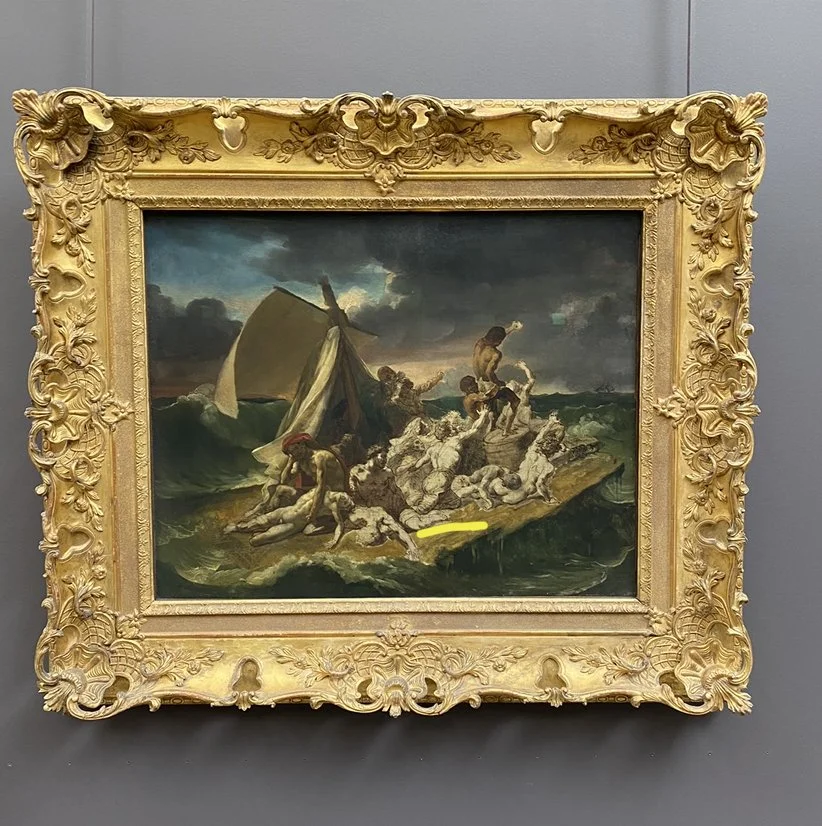
Many know the large painting hanging in the Salle Mollien of the Louvre by Théodore Géricault but did you know it was based on a true story? Le Radeau de la Méduse (The Raft of the Medusa) was painted in 1818 when Géricault was just 27 years old. It depicts the story of the French ship Medusa, a 40-gun Pallas frigate that was used during the Napoleonic Wars in 1810. On June 17 1816, the Medusa left the port of Aix  alongside three other ships in the fleet; the Loire, Argus and Echo. 

The Medusa captain Viscount Hugues Duroy de Chaumereys decided to make up some time and passed the other ships. A novice captain Chaumereys hasn't been on a ship in over twenty years and was chosen by Louis XVIII for his dedication to the Bourbons. 

 On 2 July, 1816 the Medusa hit a sandbar on the West African coast at the Banc d’Arguin, 80 km off the Mauritania coast. Following three days of trying to free the Medusa from its captivity in the sand, it was decided that the crew would abandon the ship. Only six small boats were available and would hold only half of its crew and were reserved mostly for the elite and high-ranking officers.  A raft was quickly built to hold the heavy items on board. Guns,casks of wine and water and food, tied the raft to the boats but when it was difficult to navigate the captain decided to cut the raft loose.  When the raft was set free 147 people clung to the partially submerged makeshift plank. 

With only biscuits, two casks of water and six casks of wine (gotta love the French) and floating under the hot sun the worst was to happen. As their raft mates died, they were eaten by the others to survive or pushed into the sea. Thirteen days later on June 17 only fifteen members remained when they were spotted by the Argus. 

The following February, Chamereys had to face the court and was sentenced to three years in prison. The story captured all of France and when a story was published in November 1817, the young Théodore Géricault was drawn in. The story interviewed two of the servers Henri Savigny and Alexandre Corréard recalling their harrowing tales. Géricault was enthralled and reached out to meet with the two men. WIth their help he began to sketch and even make a scaled model of the raft and captured the moment that was just two hours before they were saved. They even serve as models for a few of the men in the final painting. So dedicated to getting every detail correct, Géricault spent time at the morgue and even brought body parts to his studio to study how the body decayed. 


Géricault’s early sketches of the painting, two of which are in the Louvre, show a few slight differences from the final version. The first sketch shows the position of the raft off from the one we know so well. If you look closely at each of the figures you can see how they changed and why I love to find earlier sketches of these monumental works. It’s like getting a glimpse into the artist's mind. 

The piece became so large that Géricault had to rent a studio to hold the canvas that was 16 x 23 feet and added to its mystique. A good friend, Eugene Delacroix, paid a visit to the atelier  and after he saw the piece he ran home through the streets amazed and inspired and if you look at Liberty Leading the People you see Géricault’s influence. 

The large painting perfectly captures the fear and urgency of the effort to survive. When you look at it, it can bring all sorts of emotions. At the lower left side the older man draped in a red cloth holds his dead son's body at the edge of the raft with a look of total despair. In the foreground, the men look to be barely holding onto life and the raft and ready to be swept to sea from the high waves about to break over them. Géricault added twenty figures, when in truth it was fifteen historically at the time. If you look at the man in the bottom right corner, the one with his face down is his dear friend Delacroix. 

In the center of the painting the men have discovered a boat and are pointing it out to the others. At the top of the pyramid the model, discovered a few years ago in the amazing Black Model exhibit at the Musée d'Orsay, is Joseph. Joseph was a stunning model from Santo Domingo that arrived in Paris in 1804. Géricault loved to paint him and used him for three figures and is also the hero of the painting. Raising the red scarf high above him he signals the ship that will eventually save them. 

On August 25, 1819 The Raft of the Medusa was presented at the salon under the name Scene of the Shipwreck. Winning the gold medal but left without a buyer, it was deemed a failure. The painting returned to his studio where it stayed until the next year when he was paid 20,000 francs to bring it to London in the Egyption hall of Piccadilly then it was onto Dublin in 1821. 

The Louvre on the behalf of the director general  Count Auguste de Forbin purchased the painting on November 12, 1824 for 6,000 and since then it has hung in the Louvre. In 1859 the Louvre ordered a copy that you can see today in Amiens at the Picardy Museum. The copy was created by Pierre Desire Guillemet and Etienne Antoine Ronjat.


During the evacuation of the Louvre on September 3, 1939, the large canvas traveled through Versailles on a truck used to move stage scenery. As it went through the town it hit a power line and knocked the power out of the golden town. The Raft was hidden away during the war in the Chateau de Chambord. Since its return in 1945  it has hung on the first floor of the Denon wing in the red room of the Salle Mollien just a few steps from the Mona Lisa. Look at all of the paintings in this room including Delacroix and the other Romantic artists and see the way they each speak to each other. 


Théodore Géricault wouldn’t live much longer after he painted his masterpiece. Dying at just 32 years old on January 26, 1824. You can visit his tomb at the Pere Lachaise and find a bronze bas relief of the Raft done by Antoine Étex, but notice that they covered the naked naughty parts of the gentleman falling into the water. 

The painting is also a good test in how you see the world. Which parts strike you the most? Are you an optimist or a pessimist? Do you see the hope and elation at the top or is it the despair at the lower portion? Either way it is a masterpiece and I never get tired of sitting in front of it alone on an early morning before the room is filled with people. 


Comment

The Last Empress of France

Comment

The Last Empress of France

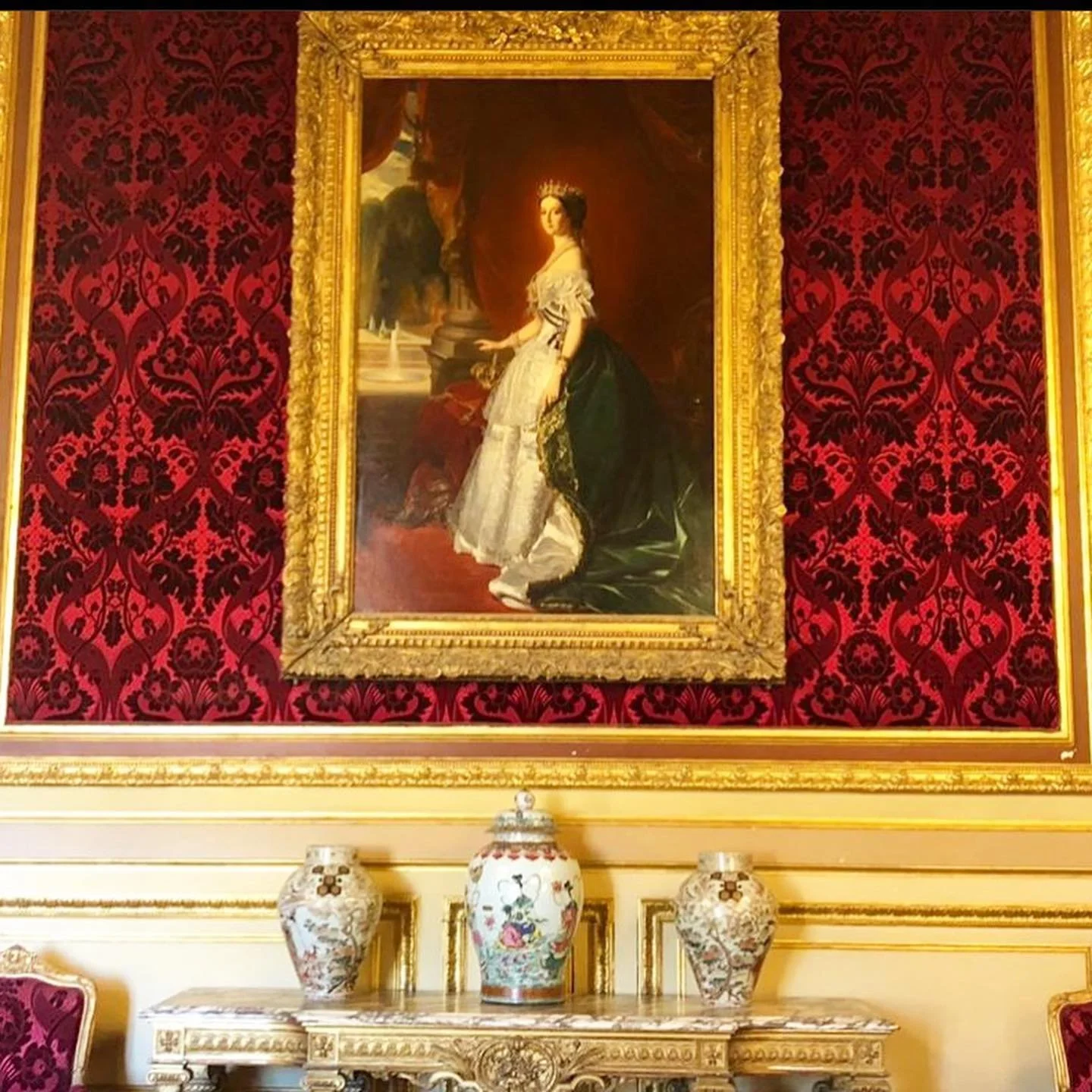
The Empress Eugénie, wife of Napoleon III, was born in Spain and at a very early age she and her family had to flee to France when her father decided to support the Napoleonic Wars. Educated at the Convent du Sacre Coeur for a year she would eventually go to the Royal York Crescent in Bristol to learn English where fellow students called her the “carrot” due to her red hair.

At 23 her mother took her to a party at the Elysees Palace on April 12, 1849 where Louis-Napoleon would see her for the first time. For two years he chased after her and she constantly pushed him away until she finally gave in. On January 30, 1853 the two were married in Notre Dame, after Viollet le Duc had to redecorate the facade and inside in the middle of construction. On March 16, 1856 they had their one and only child, Napoleon Eugene Bonaparte. Filling her role and giving an heir to the throne, she swore off ever sleeping with her husband again, a horrible and disgusting act, she said.

Eugénie was obsessed with Josephine and Marie Antoinette and designed her homes in the decor of her idols. She was also a huge supporter of women's equality and artists. It was Eugéne that gave girls the ability to take the baccalaureate. After years of trying she successfully managed to award the Legion d’Honor to artist Rosa Bonheur. Napoleon wanted nothing to do with it and wouldn’t allow a ceremony so Eugéne took the medal to Rosa herself.

While Napoleon went to battle during the Franco Prussian war, Eugéne stayed in Paris and served as regent working with the government and generals. When her husband surrendered to the Prussians she was so mad she told him he should have killed himself then to dishonor France like he did.

Eventually she had to flee France for England and would outlive her husband by almost 50 years, dying at 94 years old on this day, July 11, 1920.

Listen to her entire story and episode filled with fascinating life with many twists and turns.

Comment

The end of Henri II

Comment

The end of Henri II

King Henri II may not have his statue on the Pont Neuf or even inside Place des Vosges but he did leave a large lasting imprint on one famous Paris monument, the Musée du Louvre.

Henri II was never to be king, his older brother Francis was going to take the throne from his father Francis I, but would die after playing tennis at the age of 18 in 1536. Henri who would be in line to rule France with his bride and his mistress by his side.

Henri II at the age of 14 married Florentine, Catherine de Medici in 1533, and an effort to align the two powers. It would only be a year later that Henri II would take up with his longtime mistress and great love Diane de Poitiers, he was 15, and she was 35.

He would have 10 children with Catherine, 3 of which would be King of France and 2 daughters that would be Queen on France and Spain.

His heart was always with Diane and there are reminders of it all over the Louvre still today. The ceiling of the escalier Henri II in the Sully wing was designed by Pierre Lescot and is decorated with the image of Diane the Huntress, a nod to his lover. The ceiling was created to imitate nature, complete with vines, animals, Diane and the crescent moon the symbol of Henri. The crescent moon is also the symbol of Diane the Huntress and Poitiers also took it as hers as well.

They can also be seen in the Salle Henri II in the Sully wing on the ceiling with painting of Les Oiseaux by Georges Braque. On the façade where you will find the letter H with entwined C’s or D’s inside is something researchers and historians can not agree on. Many think it was D’s for Diane and some C’s for Catherine. My money is on Diane.

He was pretty bold to remember her everywhere, so why not there. It was on this day in 1559 that Henri would die after a jousting accident while dressed in the colors of Diane. At the Hôtel des Tournells, where Place des Vosges is today, a splinter from his opponents lance landed in his eye and he would die of sepsis. His lover was sent away, and Catherine would rewrite their great love wherever she could.

The two lie together at Saint Denis, in not just one tomb, but two.

Comment

The Chateau de Vuillerens

Comment

The Chateau de Vuillerens

The Tour de France today crossed over into Switzerland and I have waited for the moment for years. Looking at the route I noticed it came very close to the city of Vullierens and was giddy with excitement that I may get an aerial view of the Chateau de Vullierens. Sure the landscape of Europe is dotted with one amazing chateau after another but this one holds a very special place in my heart. 

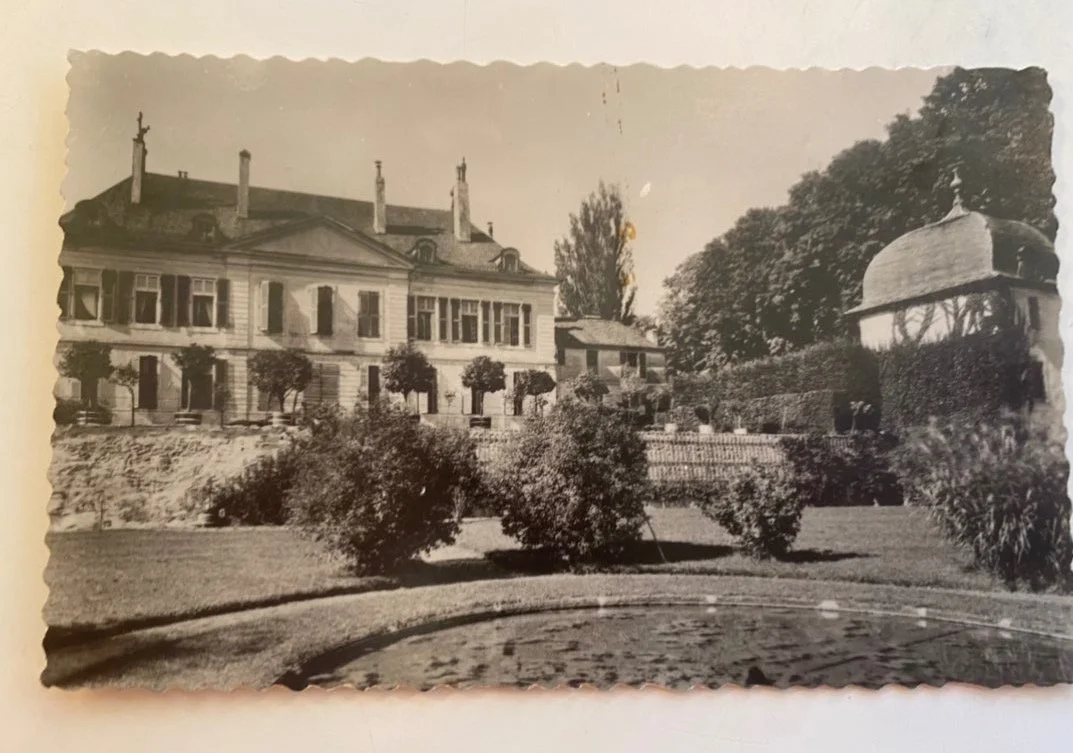
Postcard my great aunt Bess sent to my great grandma Sarah when she visited for the wedding in 1934.

The Chateau de Vullierens dates back to 1706 when Gabriel-Henri de Mestral had the current structure built where the original chateau of 1308 once stood. Designed by a student of Jules Hardouin-Mansart, architect to Louis XIV. Parts of the medieval retaining wall still remain today. In 1712 Gabriel had three tours added and it became one of the most envied homes for miles. 

Covering close to 250 acres, it was in 1955 when it started to transform into one of the largest gardens in the area. I should back up and tell you why this chateau means so much to me.  On January 24, 1934 my great aunt Doreen Taylor Meyer married Dr Robert Bovet here at the chateau. Dr Bovet was the descendant of Gabriel-Henri de Mestral and the owner of Vullierens and was a well known doctor in South Africa and Switzerland. 

Living in the chateau, Doreen and Robert decided they wanted to create a garden and cultivate just one flower, the iris. Working at Clinique La Prairie  in Montreux everyday he and Gaby Martignier at the chateau created new species but never the elusive bright red iris that he really wanted to create.  Doreen traveled back to the US to gather more bulbs including bringing hundreds from just outside of Portland on a visit to my grandparents.  Today you can still see those same Iris that my cousin Daria also added to. 

In the 70’s & 80’s my grandparents went to visit and I would hear the stories from my grandma of the “family chateau”. No central heating but still with all the charm of an 18th century chateau. The property itself has many buildings and even a winery that produces Grand Cru wine. In 1998 the tenant famer’s barn seen in a photo my grandpa took in April 1972 has now turned into a wedding and event space. 

The facade and structure hasn’t been changed in almost 400 years. As for those three towers, one was removed in the early 1900’s when Bernard's grandmother wanted a better view of Mont Blanc. The garden is also dotted with contemporary sculptures and open to visitors from April to October, 

My cousin Robert now looks over the chateau and I can’t wait to go and visit next year and spend some time in a place my grandparents loved to visit and hear more about the history and explore the property, oh and the wine. 

1930’s

1977

Great uncle Doctor Bernard Bovet in French Elle magazine summer 1980


Comment

The Begining of the Legend He Would Create

Comment

The Begining of the Legend He Would Create

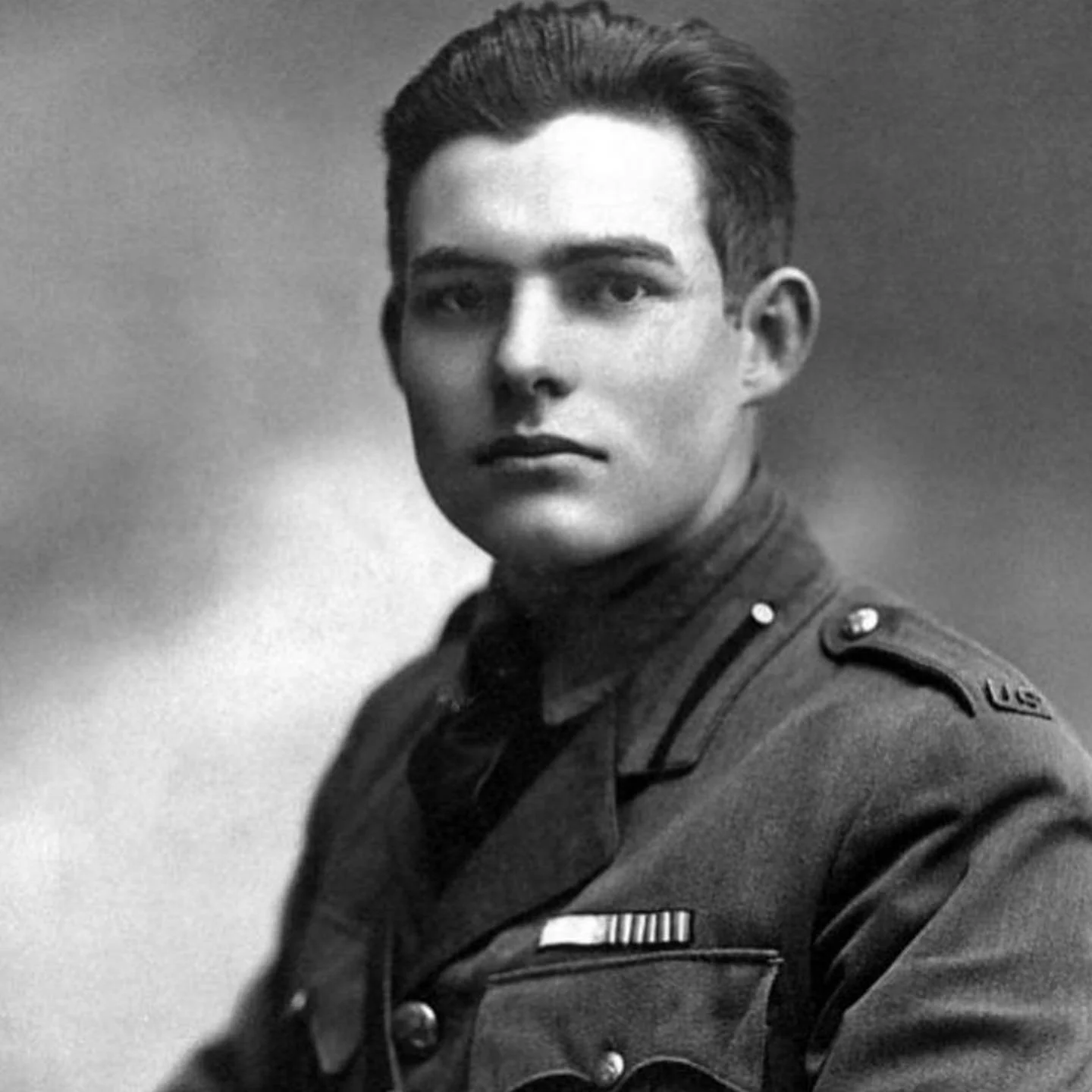
In March 1918, Ernest Hemingway voluteered for the Red Cross in what would be the final months of World War I. Departing at the end of May for France he arrived and had a few nights in Paris before heading to Milan. It was the first time Hem would step foot into Europe, and as we know it wouldn’t be the last.

On June 10, he would be assigned to drive an ambulance but the future war correspondant wanted to be closer to the action. Asking to work the canteen closer to the front near the Piave River he would hatch a plan that could have ended his life. Feeling like he could better serve the men he asked for a bicycle, so he can take goods straight to them. They agreed and with his bag filled with cigarettes, chocolate and cigars he would ride straight into the trenches.

For the first 6 days it was fine, on the 7th day at midnight an Austrian mortar was fired into the trech. On July 8, 1918 Hemingway would be wounded by over 200 pieces of shrapnal into his lower legs. In front of him, Italian soldier Fedele Temperini of Montalcino, only 26 years old would die instantly and another next to Hem would be terribly wounded. With the shrapnal in his leg and covered with blood he picked up the soldier and ran 150 yards taking him to safety.

As soon as he arrived at the hospital they attempted to remove the shrapnal and later the worst in his knee and right foot were finally retrieved. Hemingway would carry the tiny pieces in a coin purse with him the rest of his life.

It was during his stay at the American Red Cross Hospital in Milan that he would meet and fall in love with nurse Agnes Von Kurowsky. A woman that would forver mark his life and how he viewed relationships.

Ernest was the first American soldier that would survive his injuries. The Italian’s later awarded him with the Silver Medal and the Croce al Merito di Guerra. It was only weeks before his 19th birthday, and would forever change him as a man.

From here on out he chased the action and the story, he left before his heart was broken again and became the larger than life figure in his own books.

Comment

The Dreamiest Ceiling in Paris

Comment

The Dreamiest Ceiling in Paris

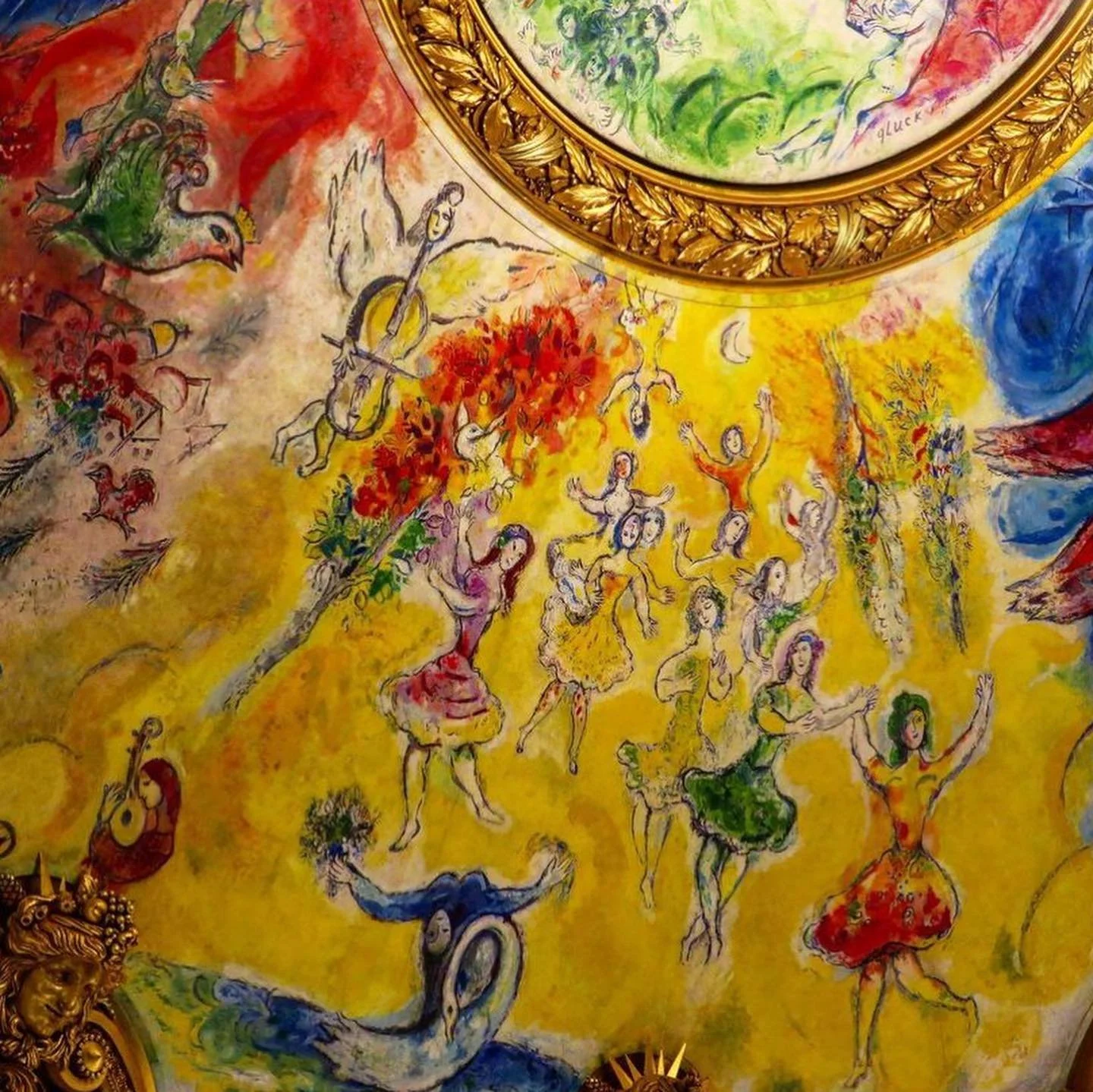
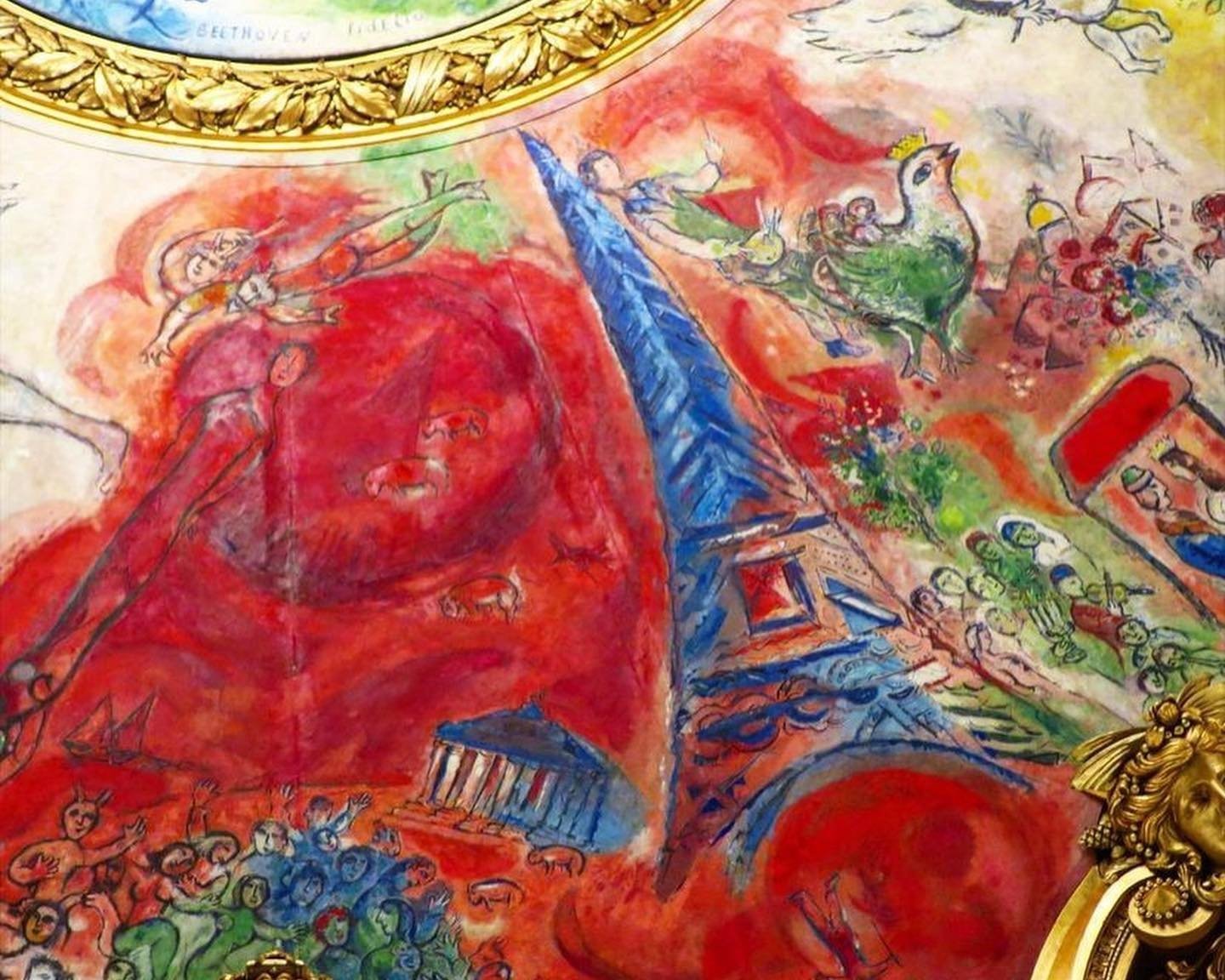
Marc Chagall is one of my favorite artists. I love his dreamy colorful paintings that can bring a smile to anyone's face. While his paintings are somewhat hard to find in the Paris museums, there is one place you can find one of his monumental pieces.

The Palais Garnier, one of the most beautiful buildings in Paris was inaugurated in 1875. In 1872 artist Jules Eugène Lenepveu painted the ceiling of the dome in the Salle de Spectacle. The Triumph of Beauty Charmed by Music, Among the Muses and the Hours of the Day & Night was on view over the spectators for almost 90 years. Created on copper plates and attached to a steel structure it would be damaged over time from the gas lighting used in the massive chandelier.

On February 20, 1960 at the gala for the President of Peru, Marc Chagall attended with friend and Minister of Cultural Affairs, André Malroux. Chagall had designed the stage sets for Ravel’s Daphnis et Chloé and Malroux loved it. While looking up at the ceiling he asked Chagall to design a new one for the opera house. For over a year at the age of 77 Chagall sketched out more than 50 designs using every medium he had. To take on the large format panels he used the Manufacture des Gobelins and his studio in the south of France.

His final design of 12 panels, like a large flower because “France is a rose” comprises scenes from 14 major composers. Mozart’s Magic Flute, Berlioz’s Romeo & Juliet, Bizet’s Carmen and Ravel’s Daphnis et Chloé are just a few.

It of course was met with many objections for its contemporary images against the classic Opera but like the Eiffel Tower and Pyramid people have grown to love it. As for the original one, it is still there. Chagall’s was installed seven inches below. You can see a small copy in the small museum in the Garnier, a striking difference to Chagall.

Inaugurated on September 20, 1964 the Chagall ceiling of the Palais Garnier and since then people have been able to see this beauty while attending a ballet or even on a visit. It’s a must see when in Paris. The great Marc Chagall was born on this day 135 years ago in 1887, Merci monsieur for leaving us such a dreamy world.

Comment

The Fashion Inventor of Paris

Comment

The Fashion Inventor of Paris

There are many designers that have shaped fashion in France. However, before there was Dior and Chanel there was Jeanne Lanvin. Lanvin was a designer that paved the way for all the others to come after her but few know her name.  

Jeanne was born on January 1, 1867 in Paris at 35 Rue Mazarine. She was the oldest of eleven children to parents Bernard Lanvin and Sophie Blanche Deshayes. Her mother was a seamstress and taught Jeanne at a very young age how to sew which came in very handy. With eleven mouths to feed, money was tight at the Lanvin home. Jeanne got a job working at a hat shop at the age of 13, where she was a natural fit. In just three years she served as apprentice milliner and in 1889 at 22 years old she opened her own shop in Paris on the Rue Boissy d'Anglas. Her hats were very popular with the Paris elite and she had a long waiting list for her custom hats, long before Coco Chanel ever touched a hat. That same year she created her fashion house which would become the oldest fashion house in the world. 

In 1893 she signed a lease on a larger store at 22 Rue de Faubourg Saint Honoré, where her store remains to this day. While her business was growing she took enough time out to get married. On February 20, 1896 she married Italian Count Emile de Pietro and the next year her greatest inspiration was born. On August 31, 1897 Marguerite Marie Blanche came into the world and changed Jeanne’s life and business. 

From hats she moved onto designing clothes for Marie Blanche. Jeanne creates custom dresses complete with lavish fabrics and embellishments for her daughter and for the “little girls about town”. When the two would walk through Paris they would garner all the attention by passers by including women that wanted the dresses for themselves. So many women begged her for the same designs that she pivoted her business and renamed it Lanvin (Mademoiselle Jeanne) Modes and began producing dresses for the women as well for little ladies. 

In 1909, she expanded the store again, taking up more of the block that included the young lady and women's department where mom and daughter could shop together. Unfortunately her marriage wasn’t as successful and ended with a separation in 1902 and divorce the next year. In 1907 she married again to French journalist Xavier Mélet, but her focus and love was always her daughter and her work, although she kept a very quiet and low profile in the Paris fashion scene. 

In 1918, she took over the entire building and added ten workrooms and a fur department. Always a clever business woman she also set up a system where women could store their fur coats for the summer months. It would get them into the store and would always leave with a few new frocks. After a weekend at the coast and a vacation in the mountains she saw a need for sportswear, long before ol Coco did it. Lanvin designed swimsuits, beach and tennis wear and everything you need for a weekend skiing. Jeanne also created an entire men's department, creating suits and casual fashion and becoming the first designer to dress the entire family. 

On a rare night out, she met decorator Armand Rateau at a Paris party. She was looking to branch out even more and the two began talking and decided to team up. With Armand they would create home goods including furniture, drapes and linens all in her custom colors that she loved. Her eye for colors was so specific in 1922 she opened her own dye factory in Nanterre. Her very specific colors included Lanvin blue she created after seeing the color on a Fra Angelico fresco in Florence in the 1920’s. Other colors included Rose Polignac named for her daughter and Vert Velazquez, but she also loved the chicness of black and used it in her designs frequently. 

Not wanting to follow trends she stayed with her own aesthetic, creating her own look that drew very loyal fans. The bouffant style was falling out of fashion but she stayed with it. The style was perfect for women of all shapes and sizes and they loved her for staying with it. Jeanne also created her own silhouette, the Robe de Style with its fitted bodice and wide skirt, today we also call it the fit and flare. 

In 1924, she decided she wanted her own fragrance. Only designer Paul Poiret had done this before her, long before Coco. Her first fragrance was called My Sin, which became a huge hit in the US. In 1927 as a gift to her daughter on her 30th birthday, her newest fragrance Arpége was released. Marie-Blanche was an accomplished opera singer and musician and when she first smelled the notes of jasmine, honeysuckle and lily of the valley she said “it smelled of the arpeggio notes played in succession on the piano. The fragrances were so popular in 1925 she had a factory built for the production of perfume where she was able to control the entire process.  

 Jeanne was happier staying in her office or at home with her family and reading her vast collection of art and history books. Many of the symbolism she saw in her travels and in books she would bring into her designs. She wasn’t found at salons and parties adding an air of mystery to her. Although she saw an early importance of spreading her brand to the United States. In 1915 when she presented at the International Exhibition in San Francisco which drew her a lot of attention which helped when her perfume debuted nine years later. 

In 1935, the maiden voyage of the SS Normandie was headed to New York. With the French elite trapped on the ship for days, she held a fashion show of her newest season selling out her entire collection. She may have been quiet but she was fierce.  During World War II when other houses closed she kept her workshops and store open employing over 800 people in her twenty-three ateliers. Her employees were her family and they were just as attached to her. 

On July 6, 1946 in her apartment overlooking the Musée Rodin at 16  Rue Barbet, Jeanne Lanvin took her last breath. Her beloved daughter would take over the fashion house and carry on her vision. The business stayed in the family until 1994 when it was purchased by L’Oreal and then sold in 2001 to a private individual. Today her store on Rue Saint Honoré is still there.

Today you can visit the beautiful rooms that she once lived in, now moved into the Musée des Arts Décoratifs. Friend and designer Armand Rateau transformed her apartment and it’s many rooms into the perfect expression of Jeanne in her signature colors. You can take in every detail of her boudoir, bedroom and bathroom. Donated to the museum in 1965 when the building she lived in was going to be demolished. The bedroom includes her Lanvin blue curtains that cover the wall. Each one was embroidered with white and light orange thread and copper wire and it is a sight to behold. Move me in now, please. 

Jeanne Lanvin’s name is not one that is as known as so many other designers and she was fine with that. Karl Lagerfeld later criticized her for her low-key persona and Coco Chanel looked at her as one of her greatest rivals. Today everyone thinks it was Coco that pioneered perfume, sportswear, hats and the color black, but just like everything else that many people know about Chanel, it is completely wrong. It is Jeanne Lanvin that we owe so much.

Today it is still the oldest fashion house in the world. Louis Vuitton opened in 1854 and Hermès in 1837, but neither started in fashion. It’s the House of Jeanne that just keeps going. 


Listen to the podcast episode all about her fantastic life.

Comment

The Mischievous Artist that captured Paris

Comment

The Mischievous Artist that captured Paris

The self taught painter that captured the people of Paris was born on this day in 1761. Louis-Leopold Boilly had a way of depicting the streets and gatherings between the Revolution and the Restoration. His first painting was shown at the Salon of 1791 and he quickly garnered the attention of the elite who wanted him to paint their portraits.

His paintings can be found in a small room in the Musée du Louvre but recently a fantastic exhibit dedicated to him was held at the Musée Cognac-Jay that I was thrilled to see. A few things that will catch your eye when it comes to his paintings as there is always a bit of humor, fashion and even a bit of naughtiness. Inspired by Frogonard, his paintings behind closed doors got him in a lot of trouble during the Revolution and was marked for a period as being too offensive and hurt his commissions.

Two of his most popular paintings The Public Viewing of David’s Coronation painted in 1810 after he saw the crowds gathered to see the monumental work and The Reunion d’artistes dans l’Atelier d’Isabey did what he did best, gathering large groups of notable figures. In the Atelier all of the great artists, architects and sculptors of the time are shown overlooking the canvas of Isabey.

He was also a master of tromp l’oeil, an idea rarely used at the time and he always had a little fun with it. A cat that broke through the back of a canvas or a broken glass frame usually comes with a small portrait of the artist himself. In many of his large crowd scenes he added his own face into most of them and it’s your very own 19th century Where’s Waldo.

With a knack for finishing a portrait in 2 hours, the artists is said to have captured over 5,000 faces, His small portraits of the creme de la creme of the time were on hand but even more can be found at the Musée Marmottan Monet all year. They really are amazing to see up close and as a total collection and makes you wonder what story each of these people held.

Be sure to visit his paintings in the Louvre on the 2nd floor of the Sully wing in salle 938, they will quickly become a new favorite.

Comment

The Founding Fathers in France

Comment

The Founding Fathers in France

F. Scott Fitzgerald said, “The best of America drifts to Paris. The American in Paris is the best American”. Millions of Americans have visited Paris and even some of the founding fathers. Don’t be surprised if you are strolling the cobblestones and run into one of these fellows remembered in bronze. Jefferson, Washington and Franklin all left a lasting impression on Paris and France, now let’s take a walk to find them.

Starting at the Trocadero in front of the fountain venture to the west away from all the tourists and to a peaceful park. Walk to the left along the building and follow the path to the street. There is good ol’ Ben Franklin sitting under a chestnut tree in the Square de Yorktown. A copy of the statue at the University of Philadelphia by John J. Boyle was a gift to Paris in 1906 by American businessman John Harjes. Harjes wanted to honor the bicentennial of the birth of Franklin with a statue placed near the former Minster to France home on Rue Raynouard.

Just a short walk away we are greeted by another American, at our feet on the Avenue President Wilson on the way to find George Washington. Located in the center of a busy street George Washington perched on top of his horse with his arm and sword raised high in the air. On his way to lead a charge into battle or maybe just to the nearest terrace, he stands majestically in the center of Place d’Iena. A gift to Paris from the Daughters of the American Revolution, the bronze statue by Daniel Chester French was inaugurated on July 3, 1900.

A long but beautiful walk towards the left bank at the end of the Passerelle Léopold-Sédar-Senghor we will meet Thomas Jefferson. Before he was president he served as the American representative to France for 5 years. He loved to walk along the River Seine and admired the Hotel de Salm on the Rive Gauche now home to the Musée de La Legion d'honneur. The dome of the building would inspire him for Monticeelllo where he would duplicate it. Today he stands and looks at the building he loved so much with the design written on the papers he holds.

Comment

The End of Marie de Medici

Comment

The End of Marie de Medici

The end of Marie de Medicis life wasn’t so wonderful. After the many disagreements and exiles from her son, King Louis XIII. In 1617, when he finally pulled the crown from her clutches he sent her into exile at the Chateau de Blois. Two years later she escaped out her window and eventually was allowed back into Paris. Happily returning to the building of her palace that was a reminder of her days growing up in Florence.

In 1612 she purchased the vast location on the left bank owned by the Duc de Luxembourg. Bringing in Italian artists she had a palace designed just for herself.

On April 2, 1615 she laid the first stone but would be exiled within two years. Upon her return in 1621 she poured herself into finishing and by 1625 moved into the first floor of the west end in the mostly unfinished palace.

Her days back at court were made difficult by the Cardinal Richelieu who had more of an influence over her son. Trying to get him ousted it would only backfire and once again she was sent away.

On her way to Germany she stopped for the night and unbeknownst to her, Louis XIII had set a trap for his mother. Stripped of her title and pension she would never return to Paris or her palace. On July 3, 1642 Marie de Medicis would die of pleurisy, leaving her palace and the land to her other son, Gaston Duc d’Orleans.

The palace would finally be finished and passed down within the family. During World War II the Germans took it over as a headquarter and is now the home of the French Senate. Opened once a year on the Journee de Patrimoine in September it is a must see if you are in Paris. Some of the rooms have been left unchanged since the days of Marie and you can see a rare slice of life in the early 17th century of Paris.

The Jardin du Luxembourg however is open for anyone to walk through. The Medicis fountain tucked away under the trees is different from what she originally envisioned but it is still one of the most beautiful places in all of Paris. Stretching out from the palace like a delicate pear necklace, the statues of the 20 women in French history of course includes Marie de Medicis. Check out the podcast episode we did all about her life

Comment

The Day We Lost the Voice of the Lost Generation

Comment

The Day We Lost the Voice of the Lost Generation

On this date 61 years ago at 7:30am in 1961, Ernest Hemingway woke up and decided to end his life. Living in Ketcham, Idaho with his fourth wife Mary after leaving Cuba for the last time in July 1960. Having lived a life of adventure, heavy drinking and plane crashes that lead to head injuries he was on the verge of a breakdown. While writing an article for Life magazine he was having a hard time arranging his thoughts and cutting down his copy and needed to bring A.E.Hotchner in to organize his thoughts. After Hotchner said Hem was “unusually hesitant, disorganized and confused, and suffering badly from failing eyesight”. Hemingway became depressed and paranoid thinking he was always being watched and would not leave the house.

Mary decided they needed to go to Idaho where his doctor would meet them. Doctor George Saviers felt the author needed to be admitted to the Mayo Clinic where he was given electroshock therapy 15 times in December 1960. Released in January 1961 he returned to Ketchum Idaho, a shell of who the larger than life man used to be.

Months later in April, Mary “found Hemingway holding a shotgun” one morning, this resulted in a return to the Mayo clinic and more electroshock. Back home in Ketchum on June 30, it would be only 36 hours later that he grabbed a shotgun and shot himself in the front entry of his house. Mary was home when it happened and would say his death was accidental while cleaning his gun.

A memorial built in Sun Valley and his own words were used to remember him. "Best of all he loved the fall. The leaves yellow on the cottonwoods. Leaves floating on the trout streams. And above the hills the high blue windless skies. Now he will be a part of them forever”. For a man that was larger than life, it is his early years in Paris that most know today and not the sad end. The author that embraced life in a way that would be told in the many pages of his books, losing that talent later in life may have been too much for him.

If you are in Paris this fall and want to walk in his footsteps with me reach out and book a tour.

Comment

The Lasting Legacy and Love of the Louvre

Comment

The Lasting Legacy and Love of the Louvre

When my grandparents went to Paris they always sent postcards back to friends and family. My grandma always wrote “save this postcard” on them and lucky for me we have many of them. I just found two the other day, sent a day apart and one from my grandpa to the kids and one from my grandma to her parents. It was April 1972 and it was their first visit to Paris.

It's their handwriting I know so well from all the journals and everything I have of theirs and it's comforting and a little sad when I see it. I can imagine the two sitting in a cafe filling out the cards with a few facts of their trip. These two really struck me because they mention the Louvre.

Grandpa’s postcard of Notre Dame

“Dearest kids…. Yesterday we did the Eiffel Tower. In AM I did Sorbonne, Notre Dame, etc. I love this beautiful city. Our hotel, real deluxe. Will do Louvre tomorrow.”

Grandma’s postcard with Mona Lisa

“Dearest family, we saw this world treasure - also the Venus de Milo. Still can’t believe we are here although we walked miles up the left bank to the Louvre and then the Champs Elysees to the Arc de Triomphe. Will hate to leave Paris - I love it, almost more than San Francisco. “

My grandpa also kept a steno pad filled with notes on what they did.

“First saw the Mona Lisa and other paintings in the Salle des États, then Galerie d’Apollon (beautiful) then walked through the Egyptian & Greek antiquities + the Venus de Milo. Walked through the Porte Henri II, Cour Carrée and the Port Egyptienne over and through Eglise Saint Germain l’Auxerrois.”

Seeing my grandpa write the exact name of the salle where the Mona Lisa is and his feelings of the Galerie d’Apollon makes me so happy. Even two generations later, it is the same love I have and it is all because of them. These are treasures I will keep with me forever.

I would give anything to have been able to visit the Louvre with them but I did share so much of it with my grandma. She loved to read my posts and articles and talk about how much she loved Paris and of course all the pastries and chocolate until the very end. In a few weeks I will take a bit of her back so she will always be a part of Paris.

Comment

Le jour de Petit Prince

Comment

Le jour de Petit Prince

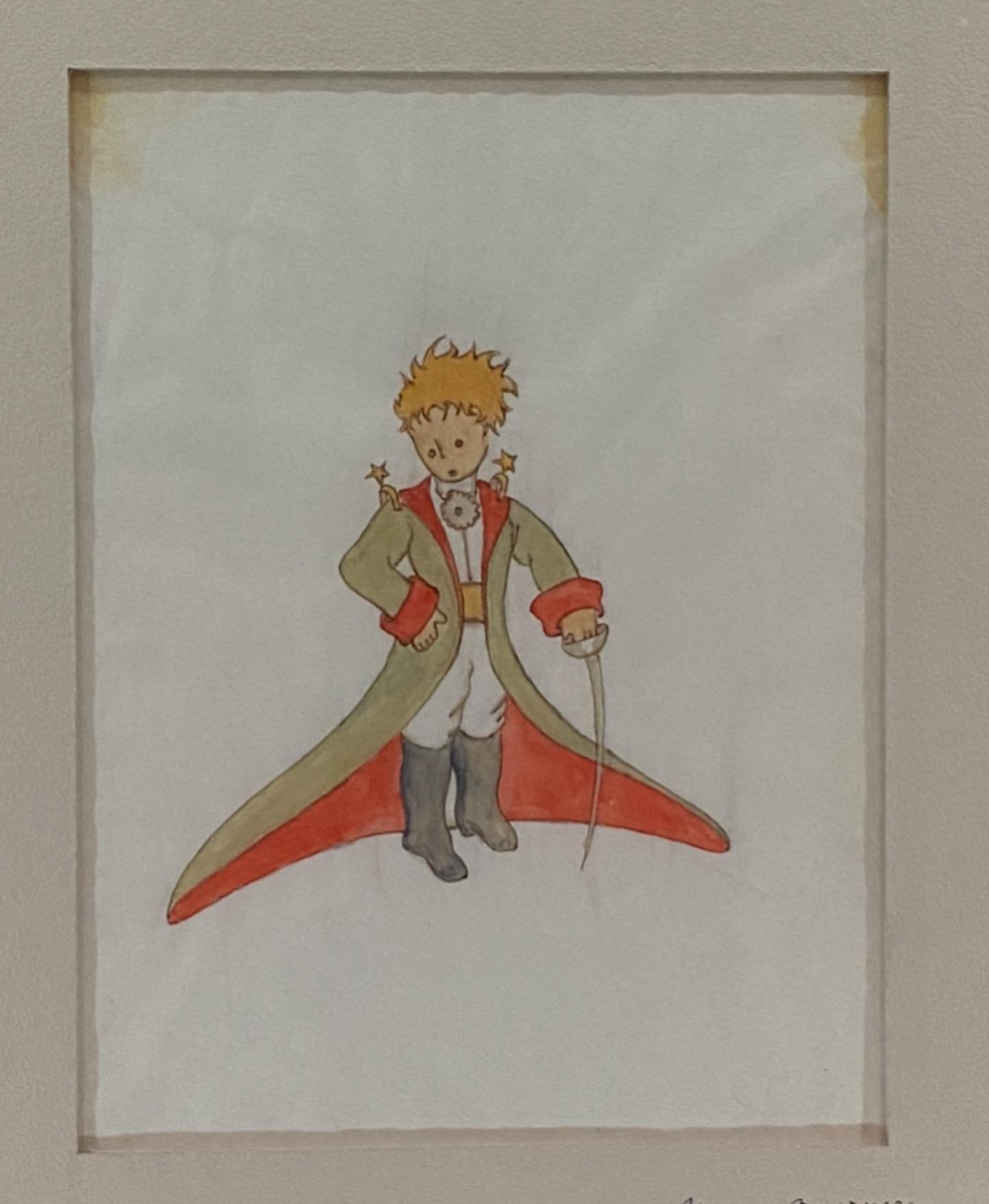
On June 29, 1900 Antoine de Saint-Exupéry was born in Lyon. His name is known all around the world to generations because of a little book he wrote, Le Petit Prince. Today is known as World Petit Prince day and is dedicated to the story of the young boy who was trying to figure out life by looking below the surface. It is much more than a children's book and is one that can teach us even as we grow older.

Antoine was a writer and a pilot and at the start of WWII he left for the US. In the summer of 1942 he wrote the story based a bit on him, his wife Consuelo and a few friends. At the same time he was writing he was drawing the story, the two inspired each other. In April of 1943 it was first published in English in the US, the French version couldn’t be published until after the Liberation of Paris.

Recently the Musée des Arts Decoratifs held an exhibit featuring the first manuscript of the story. Held in NY at the Morgan Library it left for France for the very first time last winter. The exhibit was amazing and looking at the original drawings and edits this amazing author did was one of those pinch me moments.

Saint-Exupéry died on July 31, 1944 when his P-38 went down near Corsica in the Mediterranean. The wreckage was found in 2000 but the cause is still unknown. Sadly, he never saw the publication in his native France before he died. Today it is the 2nd most translated book in the world after the Bible. In over 500 languages it’s sold more than 200 million copies with 5 million copies each year. It might be the most popular children's item to come out of France next to that giraffe.

I still have the copy my grandma gave me when I was a child and cherish it. Have you read it?

“The thing that is important is the thing that is not seen.”

“He sat down. I sat down next to him. And after a silence, he spoke again. 'The stars are beautiful because of a flower you don't see...' I answered, 'Yes, of course.”

"Make your life a dream, and a dream, a reality." Le Petit Prince

Comment

The Best Bridge in Paris

Comment

The Best Bridge in Paris

Like a beautiful iron balcony on a Haussmann building, the Pont des Arts crosses the Seine linking the rive gauche to the Louvre.

On this day in 1984, Mayor of Paris, Jacques Chirac christened the newest version of the bridge.

The first bridge or passerelle dates back to 1801 and was ordered by Napoleon. Engineers Lacroix and Dillon would design the first metal bridge in Paris, take that Eiffel. At the time the Louvre was the Palais des Arts, so the delicate passerelle was given the same beautiful name, bien sur. Originally with nine arches it was constructed to look like a hanging garden stretching across the Seine.

Lined with orange trees, rose bushes and flowers one could sit on one of the benches and contemplate their day. There was a small toll to cross it of 5 centimes until 1848, imagine that helped pay for the floral upkeep.

With it’s nine narrow arches the bridge was the constant victim of bumps and bruises. In 1852 they removed an arch on the left bank adding a little more space. During WWII German bombings continued the damage. In January 1961 when the levels of the Seine were at their winter height the mast of a tow boat ran into the bridge damaging 30 feet and the fifth arch. Ten years later a barge destroys the sixth arch and damages two more. Patched and repaired each time until 1979 when the final blow was too much. A barge hit it so hard, 195 feet of the bridge collapsed. This time it couldn’t be repaired.

The bridge was finally demolished, but pieces of the origin arch can be found in Nogent-sur-Marne. The passerelle des Arts de Nogent has the surviving arches of the 1804 span.

Architect Louis Arretche was asked to design a new bridge, however he kept it very close to the original. Reducing the arches to seven to avoid the past damage, the beautiful garden has been removed and today just a few benches line the center of the bridge.

The Mayor of Paris Jacques Chirac stood on the bridge on June 27, 1984 and inaugurated the new, just as beautiful as the old bridge. Today it is the spot I must walk over every day, no matter the time of the day it is one of the best views in all of Paris.

Comment

The Walls of the Musée d'Orsay that Tell a Story.

Comment

The Walls of the Musée d'Orsay that Tell a Story.

One of my favorite things about the smaller rooms of museums is how the curators organize 

the collection. Some rooms are dedicated to a single artist but the really cool ones are a mix of artists and when you really look you can see how each painting actually speaks to each other. 

There is one specific room in the Musée d’Orsay that I love and it is because of the paintings in the room and how each one has their own amazing story but together they tell another story.  On the ground floor of the Orsay in salle 12 you can find one of my favorite portraits, Berthe Morisot au Bouquet de Violettes by Manet.  I have a lot of favorites and if you have done a tour with me I will mention it about 1000 times but if I had to pick my top five favorite paintings, this would be one of them. 

I love the story of their friendship and how they met as she was a copyist in the Louvre and as soon as they met he wanted to paint her. Manet loved her dark looks and captured her for the first time in the painting just to the right. Le Balcon was painted in 1868 and Berthe is seen sitting holding a fan and looking off into the distance. 

The next wall, Manet’s Madame Manet au Piano, which is his wife Suzanne Leenhoff who arrived into his family as a piano teacher for the young Manet. Next to her is La Lecture also by Manet that shows a lovely Suzanne in a billowy white dress, that also resembles back to Le Balcon and in the background is her son, Léon who is also in Le Balcon. To the right is Monet’s painting of his wife also on a couch. 

James Tissot’s Portrait of Mademoiselle L.L. , another portrait of a very fashionable woman in her red jacket that pops from the wall. Back to the wall with Berthe that includes two Renoir’s Madame Darras and Jeune femme à la violette. Stand back and look at this wall and how they all are tied together and then look at the entire room and see how one theme leads to the next. 


Check out my video I made sharing this room as well as Manet’s Olympia and then up to the Impressionist gallery. And if you are coming to Paris this fall, reach out for a tour, days are filling up fast. Check ClaudineHemingway.com 

Also see video on my YouTube channel and subscribe


Comment

The Voice of Exploration

Comment

The Voice of Exploration

If you have ever read one of the best books there is A Moveable Feast by Ernest Hemingway, you will understand the concept of being able to “eat the words”. Hemingway had a way of describing the feeling of the street, the air and the specific warmth that overcomes you in Paris.
Anthony Bourdain was also able to tell a story in the same way, but with Bourdain we were lucky enough to also watch him as he discovered and enjoyed the simplicity of the perfect dumpling or a late night walk along the Seine. Moreover, much like Hemingway, Bourdain’s life ended the same way, at his own hand. There is great loneliness in greatness.

Maybe they both were only truly alive when they were exploring the corners of the world, and it was the loneliness of home that pushed them too far. In Paris, it is where I feel alive, and struggle to find that feeling every moment of the day when I am not there. How do you feed that constant feeling of exploration and excitement and enjoying the simple everyday moments that get lost when back “home”?

You no longer get to linger over a glass of wine or stroll the streets and chat with the cheese monger about the most perfect cheese plate. You cannot get those perfect moments anywhere else. People should be supportive and open to what other people want and dream of and maybe if they stopped long enough to listen they would see the world through new eyes. Today he would have been 65 years old.

While I can take some moments of solace in the fact that, I can now call some of his friends my own, I still miss his voice and wide eyed wonderment every day.

“Most of us are lucky to see Paris once in a lifetime. Please, make the most of it by doing as little as possible. Walk a little. Get lost a bit. Eat. Catch a breakfast buzz. Have a nap. Try and have sex if you can, just not with a mime. Eat again. Lounge around drinking coffee. Maybe read a book. Drink some wine. Eat. Repeat. See? It's easy."

“Okay: go to Paris, check into a nice hotel, and my plan is I'm going to eat some fucking cheese and I'm gonna get drunk." Anthony Bourdain we miss you and your voice every single day.

Comment

A Morning (or anytime)  Favorite

Comment

A Morning (or anytime) Favorite

Any morning that I go to the Musée du Louvre, which is many of them, it always starts with a petit dejeuner at Le Nemours. Sitting in the Place Colette just outside the Palais Royal with its view of the Comédie Francaise it may be one of the most photographed terraces in all of Paris. Angelina Jolie filmed a scene from the Tourist there, accidentally sitting in that spot was something I learned to never do again. The mornings are filled with locals having their café and catching up with the latest news in Le Monde. By lunchtime all the way through the day it becomes the hotspot of tourists, photography sessions, workers of the Louvre and apero in the sunny afternoon.

I always feel a bit like Snow White when the birds descend on me looking for a croissant crumb or to steal a chip in the afternoon. If you walk by in the later afternoon and see an open seat, snatch it as fast as you can. Especially on a beautiful day, they are a hot commodity in Paris.

Don’t miss Jean Michel Othoniel’s Kiosque des Noctambules, one of the most beautiful metro entrances in Paris. Installed for the new millennium in 2000 and constructed of six columns and two separate “domes” that are each topped with a glass figure. Its two separate themed arches, the cool tones of blue, purple, yellow and clear meaning night and the warm colors red, yellow and clear signifying the day.

A little clue to the one time life of nearby Palais Royale long before.

2 Place Colette 1e

Have a photo of the famous Le Nemours or Place Colette, please

Comment