

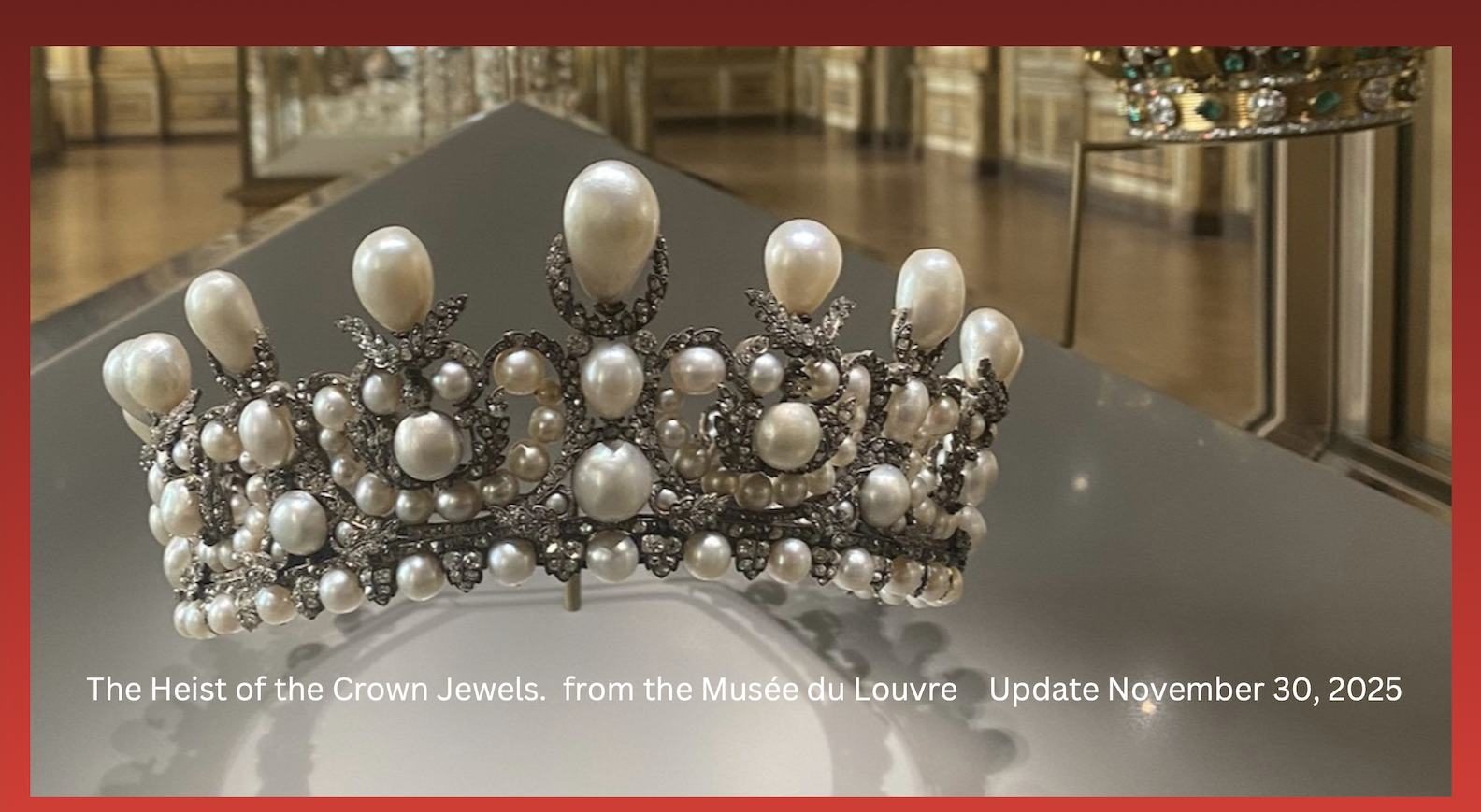
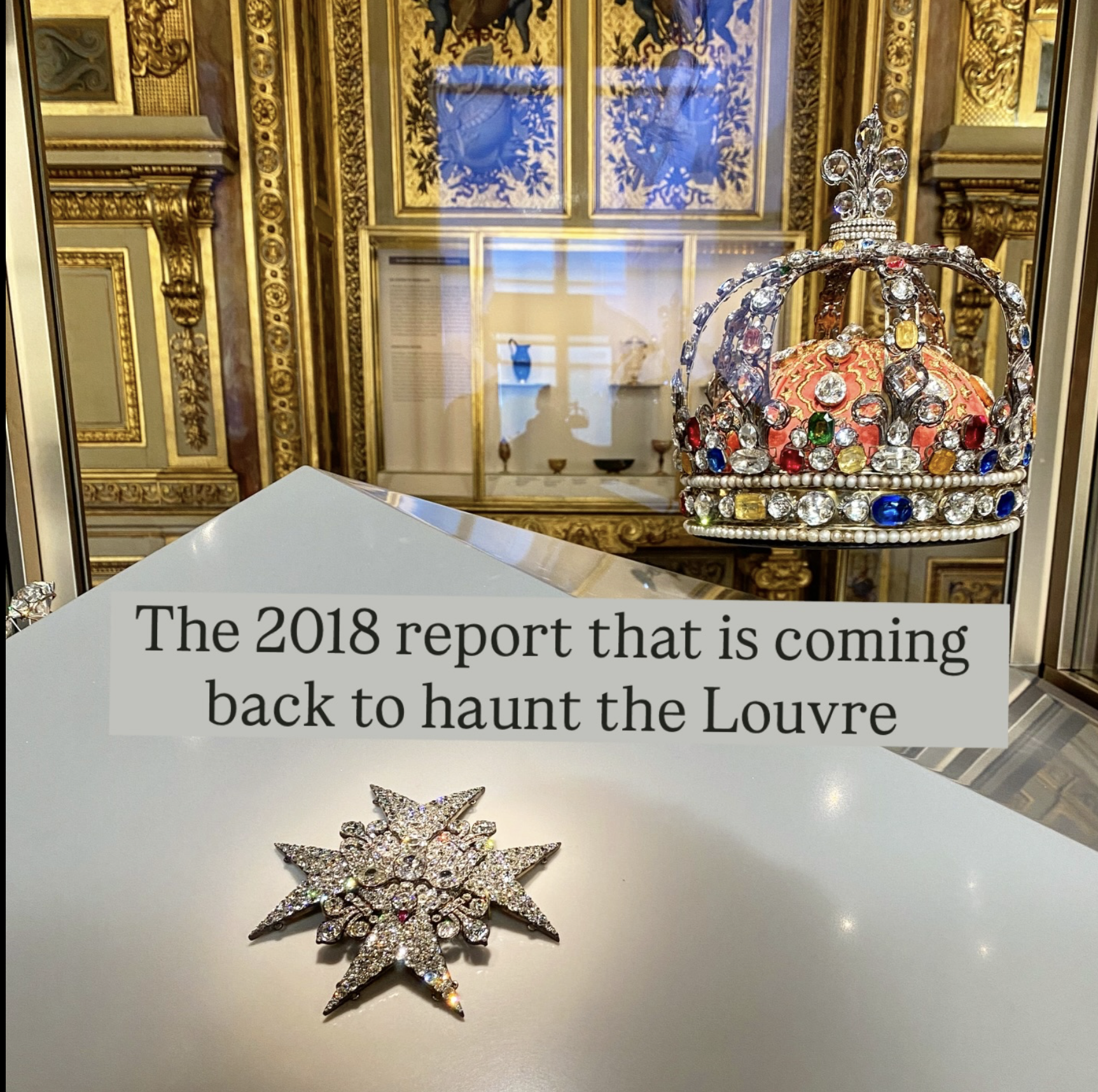
On Wednesday, less than 24 hours after the arrest of the fourth subject of the brazen attack on the Musée du Louvre, a shocking report has resurfaced.
In 2018, high-end luxury stores were experiencing a rise in theft. The Paris Prefecture urged businesses and museums to review their own security measures. President of the Louvre, Jean-Luc Martinez, and the security and safety team from Van Cleef & Arpels audited the security system of the Galerie d’Apollon.
The audit produced a two-page report that is now coming back to haunt the Louvre.
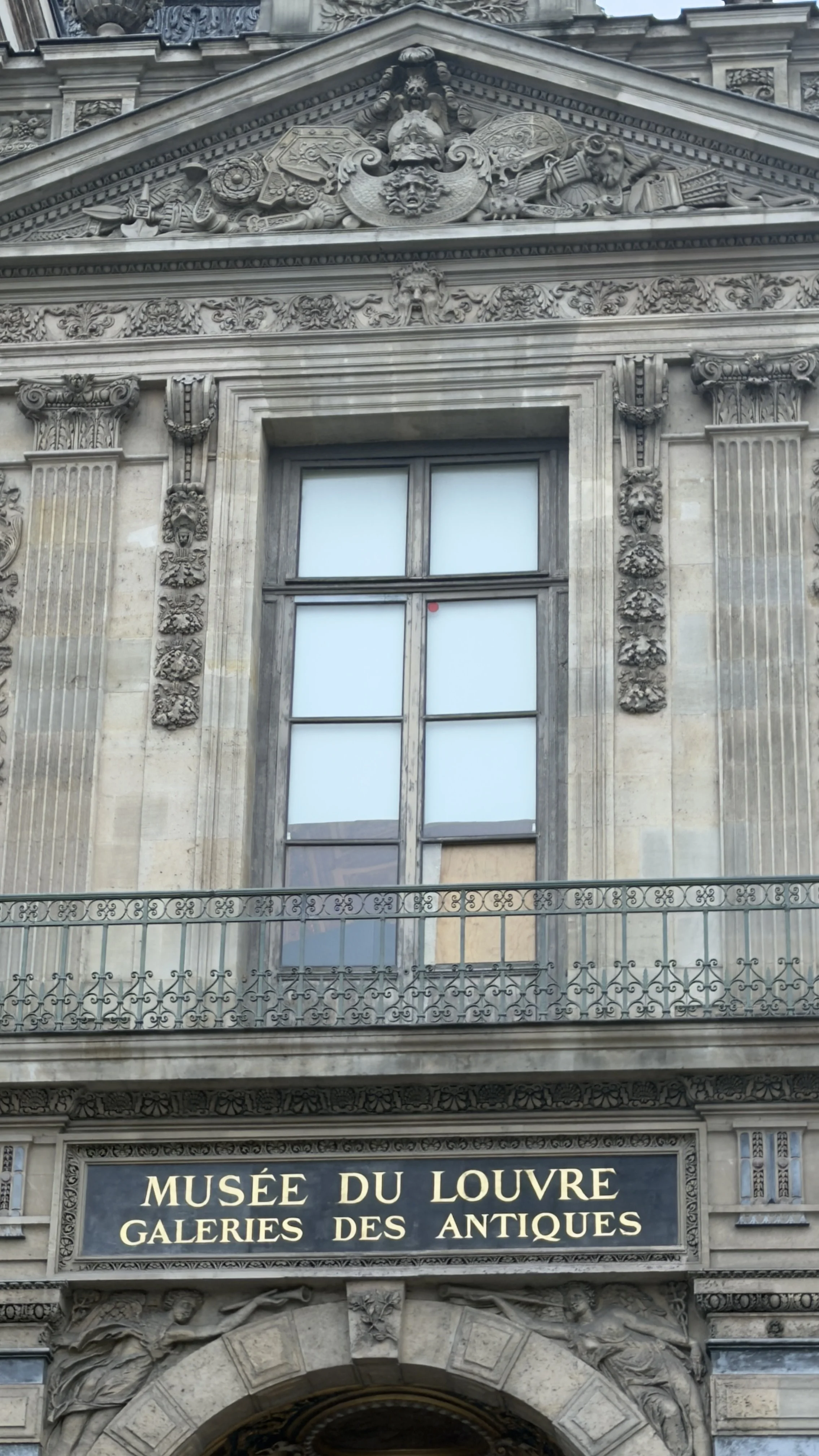
Van Cleef & Arpels security pointed out the vulnerability, specifically of the balcony of the gallery. To make matters worse, even mentioned that a nancelle, a furniture lift, could easily reach the balcony and the window.
In 2018, it was also noted that the security cameras on the facade were insufficient to cover the space.
On the day of the theft, the current president of the Louvre, Laurence des Cars, requested all documents related to construction work on the Galerie d’Apollon since 2000. This document has surfaced in Le Monde, and the security director of Van Cleef & Arpels has confirmed its authenticity, but nothing further has been confirmed.
It should be noted that in March of 2019, the gallery underwent a restoration, including the addition of new cases designed by Juan-Felioe Alarćon that fully met all security requirements.
The Louvre can’t catch a break these days, from the theft of the Crown Jewels to the structural issues of the 2nd floor of the south Sully wing to the report from the Cour des Comptes.
*** UPDATE
The hits just keep on coming. Today, RTL radio had access to a 35-page report dating from July 2007. Ordered by Marc Bascou, then curator of the Objets d’art department, and handled by security company CESG.
Rating the Galerie d’Apollon “high risk” and the “vulnerabilities of the windows”. This can all “facilitate the performance of malicious acts during the day and less busy hours.”
"It seems essential to put in place a real, specific safety/security policy adapted to the scale of the risks of the Apollon exhibition hall,"
CESG recommended moving the jewels to a new space away from windows. In 2007, 18 years ago.

Originally posted November 26 on Instagram
More information has been uncovered about the suspects and the hours leading up to the theft at the Louvre.
The two thieves who cut through the glass and entered the Galerie d’Apollon were friends before the crime. A.N. claimed he didn’t know he was robbing the Louvre as he cut into the glass. A. G. said he was asked to join the crime the day before. All the suspects have stayed silent about the location of the jewels.
The getaway scooter accomplices were Slimane and the newest arrest, a man investigators have called XH4. Two arrested individuals said the orchestrator had a Slavic accent and offered them 15,000 euros each. Investigators found a series of disposable phones used in planning. Phone data from September 22, 23, and 29 placed them around the Louvre, showing more premeditation than they admitted.
The furniture lift used to reach the Galerie d’Apollon balcony was stolen in Louvres. Through the phone data, it was discovered that on October 2, the thieves contacted multiple lift-rental agents around Paris. They set a meeting for October 10, where they threatened the owner, demanded the location of the lift’s tracker, and destroyed it.
A detailed timeline, based on public and private videos, reconstructs the morning of October 19. At 7:30 am, two thieves wearing helmets left Aubervilliers—one on a Suzuki Burgman scooter, the other in a white Citroën Berlingo van. They drove to Ivry-sur-Seine and left the van near the Seine. The van driver switched to the scooter and returned to Aubervilliers.
At 8:30 am, the Suzuki scooter and the Nacelle lift left Aubervilliers. At the same time, another thief rode a BMW scooter from Aubervilliers to Pantin, dumped it, and got on a Yamaha scooter driven by an accomplice. The four met in Bercy and headed to the Louvre.
New details confirm the crown of Empress Eugénie was dropped as they climbed down into the ditch, not because it broke during removal. Once on the ground, the jewel bags were passed to the scooter drivers, while the other two tried to set the lift on fire but were startled by approaching security.
The fourth suspect’s arrest on Tuesday also included his brother, sister, and a female friend.
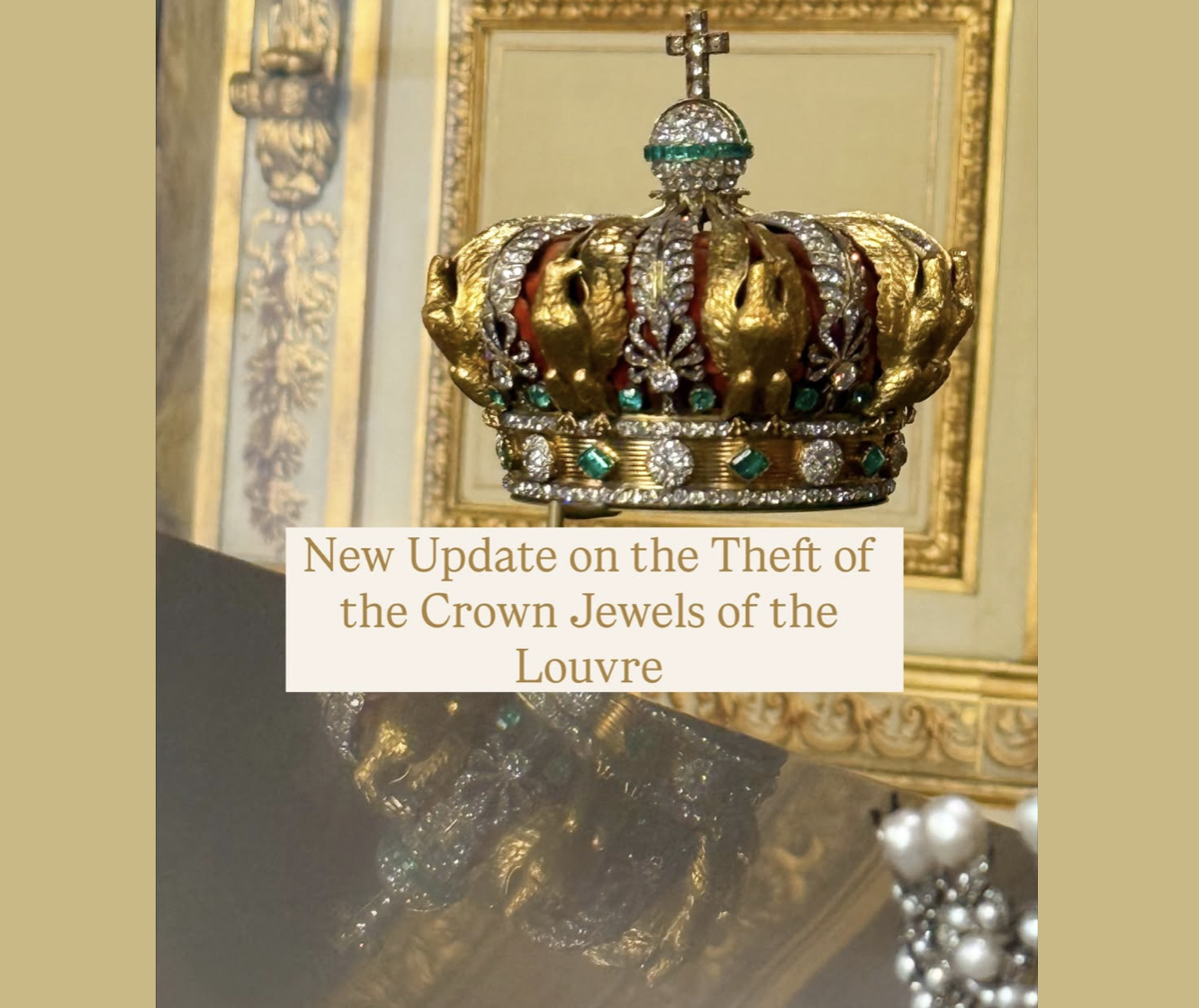
It’s been just over five weeks since the theft of the crown jewels from the Musée du Louvre, and the jewels are still missing. On Sunday morning, on October 19, at 9:30 am, two thieves cut into the window of the Galerie d’Apollon. Entering the room and cutting through two cases, stealing eight sets of the historic jewels of France.
For the last few weeks, the Paris prosecution office, headed by Laure Beccuau, has been very quiet. The last update was on November 13, when one of the suspects, a woman, was released but still under judicial control.
Hoping no news was good news and they were getting closer to finding the jewels and arrests, as things work differently here in France. The prosecutor’s office is a tight ship, and there hasn’t been a single leak, so we wait on the edge of our seats for news.
This morning, November 25, the fourth member of the heist team, the second driver of the getaway motorcycle, was arrested. Now all four actors have been arrested, and we can hope this gets them closer to the jewels and the orchestrator of the crime.
Three others were also detained: a 39-year-old man and two women, aged 31 & 40. Arrested in Mayenne in the small city of the Loire, 155 miles from Paris.
The prosecutor usually holds a press conference within the next two days to update on the arrests and, hopefully, provide more information on the jewels.
Stay tuned for all the up-to-date information

On Sunday, October 19, 2025, at 9:37 a.m., the life of the Musée du Louvre was forever altered.
*New details announced this evening added below
Just before 9:30 a.m., while much of Paris still slept, two individuals arrived along the quai François Mitterrand in a nacelle truck, the kind Parisians use to move bulky furniture through upper-story windows. The lift was raised to the corner balcony of the gilded Galerie d'Apollon. Wearing orange and yellow safety vests and carrying a large angle saw, the men climbed over the railing and cut through the lower right pane of glass on the door. In the next three minutes and fifty seconds, the unthinkable happened.
At 9:34 am, the alarm on the door was activated. At 9:35, the room was evacuated of the few tourists in the room, and the alarms in the cases were triggered.
The thieves cut into the cases with their saws, but the glass did not break or crack. Using their heavy tools, they were able to pry the glass apart enough to reach their hand inside and grab the jewelry.
At 9:35 and 33 seconds, the police of the 1st Arrondissement were alerted and on their way. At 9:38 am the thieves had fled through the window.
* New details given just now by the director at the Senate hearing
In the three days since the heist of the century, countless theories, questions, jokes, and AI-generated videos have flooded the internet. What we know so far is that four men were involved in a meticulously planned robbery targeting specific jewels housed in cases closest to the windows. Their operation was precise, as if working from a shopping list.
While two men carried out the theft, two others waited below on high-powered Yamaha TMax scooters, ready for a quick getaway. Police believe the plan was to destroy the truck and set it on fire to eliminate evidence, but the thieves were startled by security and fled, leaving behind multiple items—including one of the stolen jewels.

Many have wondered how such a brazen act could occur unnoticed. Sunday mornings in Paris are blissfully quiet, my favorite time to walk through the city. Before 11 a.m., only a few joggers or dog walkers cross your path. Construction on a Sunday is rare, so that alone might have raised suspicion. Some reports claimed that ongoing work at the Louvre masked the activity, yet renovations to the summer apartments of Anne of Austria had ended more than eighteen months ago. The area beneath the Galerie d'Apollon windows was empty. A woman reportedly called police after seeing the men cut into the window, but the act happened too quickly for intervention.
The thieves used an angle saw rather than smashing the glass—a quieter and faster approach. The same saw sliced open the first two display cases within seconds, allowing the gems to be removed swiftly.
The Galerie d'Apollon underwent a major restoration in 2019, funded by Cartier. The previous display cases, installed in the 1950s, once had a mechanism that would automatically lower the jewels into a safe if the glass was broken. That system had long been out of order. The new cases were of the highest quality—comparable to fine jewelry boutiques—but even they were no match for an industrial saw.
As for alarms, there should have been one on the balcony window and others on the display cases. Some reports claim the window alarm sounded; others, more troubling, suggest it had been deactivated. Culture Minister Rachida Dati publicly denied that claim, insisting the system was operational.
Gallery attendants confronted them but were threatened with saws. Their priority, as always, was visitor safety. Security personnel were quickly alerted, and their arrival startled the thieves, prompting their escape.
The incident has raised serious questions about the Louvre's security measures. The Galerie d'Apollon, though magnificent in its 17th-century splendor, sits just above the Seine with two sides of unbarred windows—an aesthetic vulnerability. In an age of sophisticated and highly motivated criminals, such access points have become liabilities.
In those three minutes and fifty seconds, nine pieces were taken while visitors posed for selfies before the Mona Lisa. The museum had opened just minutes earlier, and crowds were streaming past the Winged Victory toward the Salle des États, leaving the rest of the galleries almost empty. Early mornings in the Galerie d'Apollon are peaceful—a solitude I've often enjoyed in my research. It seems the thieves had studied that same rhythm.

Investigators later recovered several items from the getaway scene, including a helmet, glove, walkie-talkie, blanket, saw, gasoline, and torch—each potentially holding DNA that could lead to arrests.
What will become of the jewels remains uncertain. They are too famous to sell intact. History offers a chilling precedent: in 1785, the Affair of the Diamond Necklace—one of the final scandals that doomed Marie Antoinette—saw a necklace of 685 diamonds dismantled and sold piece by piece across Europe. We can only hope these treasures find their way to a collector who preserves them until they can be recovered.
The Galerie d'Apollon houses what are often called the “Crown Jewels” of France, a collection begun by François I in 1525. Nothing from his reign survives, and the oldest piece today is an eagle brooch dating to 1640. In 1887, over 7,700 jewels were auctioned off in a week-long sale, with proceeds going to the State. Over time, a few historic pieces resurfaced and rejoined the Louvre collection—most within the last forty years.
The eight stolen items once belonged to two queens and two empresses. Among them were the sapphire necklace, earrings, and tiara of Hortense de Beauharnais, daughter of Joséphine and mother of Napoleon III, later purchased by Queen Marie-Amélie, wife of Louis-Philippe.

The magnificent emerald necklace and earrings given by Napoleon Bonaparte to his second wife, Marie-Louise, were also taken. From the first case, the thieves seized pieces once owned by Empress Eugénie de Montijo—her large corsage bow brooch, pearl and diamond tiara, and reliquary brooch.
The only stroke of good fortune was that the Imperial crown of Empress Eugénie was dropped and left behind, a piece with a remarkable story I'll share next week.
** Just now, the director informed us that because of the limited slit in the glass to remove the items, the crown of Eugénie was crushed and then dropped during the escape. It was returned to the museum on Tuesday by the investigators and will be restored.
As I write, Louvre Director Laurence des Cars is addressing the French Senate about the theft, the investigation, and future security measures. I'll continue to update through Instagram, Facebook, and the podcast as more unfolds.
Listen to this week's new podcast episode for our immediate coverage of the theft and everything we knew in those first hours.

Rose Valland, one of the bravest women of WWII, spent her life in love with art until her last day on September 18, 1980.
If there is one woman who deserves a monument, parade, and her face on a euro, it is Rose Valland. She isn't a name that is widely known, and if I can do just one little thing in this life, it is for others to know her story. Rose Valland was born in 1898 in the Auvergne region, an only child who showed promise from a very early age. Her mother would apply for special grants that allowed her daughter to enroll in university, something that was hard for women to do at that time. Rose would excel in school, from the Fine Arts school in Lyon to the École des Beaux-Arts in Paris, where she would also teach, the University of Paris for Medieval Archaeology, and then the École du Louvre.
In 1932, she would take on a job that would alter the lives of thousands of people. As a volunteer to the curator of the Jeu de Paume, she would write and curate exhibitions to be sent internationally. In 1940, Jacques Jaujard, the director of the Musée Nationales, asked Rose to stay at the Jeu de Paume. It was 1940, and the Nazis had arrived and occupied France. Gorhing was looting the homes, galleries, and museums of Paris and needed a place to store the stolen goods. The Jeu de Paume, the freestanding building in the Jardin des Tuileries, became their depot. Transformed into their gallery, the paintings stolen from the Jewish gallery owners and homes lined the walls before being shipped to Germany.

Rose Valland was quiet & meek, who wore her hair in a bun and glasses and disappeared into the woodwork. She was a brilliant woman with a photographic memory and also spoke German. All these things combined made her one of the greatest assets France and the lovers of art ever had. Each and every night, Rose would return to her small apartment near the Jardin des Plantes and would write down every single detail of the day.
In her many ledgers, she noted the painting and its owner, the German code given to each one, the crate and destination, and even the date and train they were shipped out on. Through her notes, the allies knew which trains and routes to secure. She did this every day for the entire length of the war. They had no idea what this quiet, amazing woman was doing; if they knew, she would have been killed.

Following the war, her notes were used to recover thousands of looted art and personal possessions taken from Jewish homes. She would be sent to Italy and Germany to aid the Monuments Men in their recovery. The French government appointed her as a Fine Arts Officer, and she received awards from Italy, Germany, and the US.
Because of Rose Valland, more than 60,000 works of art were returned to Jewish families, museums, and galleries. Sadly, just as many, if not more, are still missing, and many sit in museums across France waiting to be returned to their rightful owners.
My love and respect for this woman and what she did is immense. She put her life on the line daily to protect France's treasures and the world. If it weren't for her heroic act, hundreds of thousands of pieces of art and the property of thousands of families would have been lost to the Nazi greed forever.

In her later years, she wrote Le Front de l'Art about her time during the war, and today her entire inventory and notes can be found online. Restitution workers all over Europe and America still use her notes daily in their attempt to reunite the many pieces recovered.
This year, the Monuments Men and Women Foundation published the first English translation of Rose's book. Order it today to help support the foundation, and you might even find my name in the book as well.

Listen to the amazing story of Rose Valland by clicking here for the episode.
Please sign the petition for the Pantheonization of Rose Valland. We have a long way to go for signatures, sign up, and share with everyone you have ever met :)

Before the Louvre housed one of the most significant art collections in the world, it was home to the kings and queens of France. Francois I began the palace we see today. His son Henri II continued his vision. Henri IV would mark the start of the Grande Louvre project that would be carried out for the next three hundred years.
However, regarding France and golden opulence, we can trace the start of Louis XIV. For most, the Chateau de Versailles comes to mind when thinking about the endless gilded halls, but one came first and even inspired Versailles: the Palais du Louvre.
Since 1547, the king and queen’s apartments shifted a few times within the Louvre, and Louis XIV and his mother Anne d’Autriche preferred the more modern Palais Cardinal across the street, today’s Palais Royal. On October 13, 1653, Louis XIV ordered the construction of the apartments for the holding of the Council in the Louvre in the new Lemarcier wing by the Pavillon de l’Horloge and the need to create new rooms for his mother, Anne d’Autriche. Ever the devoted son and original French mama’s boy, Louis was happy to do anything for her.

The Louvre had been abandoned for 9 years and desperately needed restoration. The king’s architect, Louis le Vau, was tasked with the project, with Louis XIV having complete design control. The Queen Mother’s winter apartments were on the ground level of the Sully wing, where you will find the Venus de Milo today, but lacked any cool air in the hot summer months. So, as one does, a new suite of rooms specifically for the summer months was created just a few steps away below the Petite Galerie.
With a window and balcony looking out to the Seine, a room that opens onto the garden on one side, and a courtyard on the other, it was perfect for the long, hot summer days. Over the next four years, Le Vau worked closely with artist Francesco Romanelli and sculptor Michel Anguier for every aspect of the ceilings of Anne d’Autriche.
Romanelli, a student of Pierre de Cortone in Italy, arrived in Paris after Pope Urban VIII recommended him to Cardinal Mazarin to paint the ceiling of his palace. Impressed by his work, which can still be seen in the Bibliotheque Nationale, Mazarin recommended Romanelli to the king.
Sculptor Michel Anguer and his brother Francois studied in Rome and created funerary monuments for the titled and elite. Michel’s success at Nicolas Fouquet’s Vaux le Vicomte led him to Anne of Austria’s Val de Grace, which would give him the advantage of being selected for the rooms of the Louvre.
The two artists worked together to seamlessly blend the stories of each room and express the vision and qualities of the queen mother.

The suite of rooms today begins at the Rotunde, which once served as the entrance to the Musée Central des Arts, the first name of the Louvre in 1793. The decor of this ceiling came seventy years after Anne's death, but the theme still follows that of her apartments.
The center of the ceiling is crowned by the painting of Man Formed by Prometheus and Animated by Minerva, first completed by Jean-Simon Barthelemy in 1801. The Goddess of wisdom, Minerva, holds an olive branch, spear, and shield above Prometheus, draped in red fabric, holding the fire he had taken from Jupiter. Below him is the first human reaching up towards the sky.
To the right is Time, always depicted as an old man pulling away from Man, the snake that bites its own tale, the symbol of eternity, knowing that Man would be the end of them in time. This being the entrance to the museum, above Time are allegories of the three arts: painting, sculpture, and architecture, each holding their respected tool.
On the left side of the painting are the three fates or Parques. The three sisters and daughters of Zeus and Hera can measure the span of life. Depicted with a gold thread Clotho, the oldest sister unrolls the thread. Lachésis, pulls the length if the thread and Atropos holds the scissors to cut the thread while she looks at the human.
In 1825, water damage from the upper floor severely damaged the ceiling. The original artist Barthelemy had passed away in 1811, and Jean-Baptiste Mauzaisse was asked to replicate the entire piece. By 1826, Mauzaisse had completed the full recreation in the style and details of the original.
The stucco reliefs created by Jean-Francois Lorta surround the central painting on four corners. They give a little nod to the entrance of the Salle des Antiquitès, which Napoleon placed in these rooms in 1800.
Each focuses on a notable piece by an artist representing one of four countries. On the upper left of the painting, we begin with France and Pierre Puget’s Milon de Crotone, which can also be found in the Cour Puget. Below France in the lower left corner is Italy, represented by Michel-Ange and his statue of Moses created for the tomb of Pope Julius II.

On the upper right, Egypt is captured by the Colossi of Memnon, a quartzite sandstone dating to 1350 BC. Finally, just below is Greece with the Apollo Belvedere, which briefly lived in these rooms after Napoleon Bonaparte took the statue from the Vatican in 1796 and lived at the Louvre until 1815.
Too many other medals sit on the north sides of the ceiling. On the north, the Genius of the Arts is over the former entrance, and on the south is the Union of the Three Arts.

Ceiling of the Salon
Let’s step into the first room, the Salon, which served as the entrance to the apartments, but the decor dates to the start of the 19th century. The center of the ceiling, by Charles Meynier, is The Land Receiving from Emperors Hadrian & Justinian, the code of Roman Laws Dictated by Nature, Justice & Wisdom. In the lower left, the two Roman emperors, Hadrian (76-138) and Justinian (482-565), hand a tablet to the allegory of the Earth surrounded by a lion and a cornucopia with the Earth's bounty.
The allegory of Rome dominates the center with a spear and globe topped with a winged victory next to a shield of Rome and two putts. On the left side is a genius with a torch lighting up Nature, with a few extra breasts. At the top, we find Minerva again with a sword and Thémis, the goddess of Justice, with scales, the two principals of Roman law.
Painted onto the ceiling in 1802 and 1803, it, along with the rest of the ceilings in these rooms, was fully restored in 2023, although a rather large crack is spotted across the top of the painting.
Below the painting are trompe l’oeil cameos by Victor Francois Biennourry. He was commissioned in 1865 and also asked to create a few others in the suite of rooms and the Grande Salon of the Apartments Napoleon III. On either side of the painting are two smaller cameos representing pitties as Science and Study.

Allegory of Greek Sculpture
Each painted to appear as a fine stone cameo, the top trompe l’oeil in the cornice represents France, Rome, and Greece, each holding a few fantastic little treasures. On the east side, the allegory of Greece is in the center, with a statue of Zeus at Olympia by Phidias in front of the Acropolis and on the right of the allegory, the Parthenon.
On the south side, above the entrance to the apartments, the allegory of Rome has her back turned with sculpting tools in hand. The Titus arch, the Pyramid of Cestius, and the Roman Forum can be seen in the lower right.
Of course, saving the best for last on the west side is the allegory of France, which holds the monument to Henri II created by Germain Pilon and can also be found in the Louvre. At the top are two initials. F for Francois I was surrounded by the Order of Saint Michel and the N of Napoleon III with the Order of the Legion of Honor. Below a geniuses inscribes the top French sculptors, Goujon, Pilon, Cousin and Puget. On either edge of the cameo are the roofs of the Louvre and the Palais des Tuileries

Allegory of French Sculpture
Listen to this weeks newest episode of the podcast out now and watch a special walk through the Anne of austria rooms below

Since my page has turned into my personal love fest for Notre Dame de Paris, let’s dive a little deeper into the south chapels of the nave.
Like the north side, they have changed each chapel’s layout, names, and contents. We walked the “Path of Promise” on the north side as we entered the church. The south side is dedicated to the Path of the Pentecost, although the chapels are dedicated to the saints close to the heart of Paris.
Starting from the transept, the first chapel and confessional are dedicated to Saint Joseph, the husband of Mary and patron saint of fathers, to whom Louis XIV gave a very special feast day in 1661.
The next chapel, Saint Thomas d’Aquin, whose spirit of intelligence was renowned, attended the University of Paris and Notre Dame in the 13th century. The chapel is decorated with a painting of the saint at the Fountain of Wisdom by Antoine Nicolas in 1648. Look closely to spot a young Louis XIV in the background.

One special thing about this chapel is the stained glass depicting the Tree of Jesse by Edouard Didron in 1864. The window, read from the bottom to the top, shows Jesse, father of King David, as the family tree of Christ, ending with the Virgin Mary at the top.
The next chapel is dedicated to former queen Sainte Clotilde. Daughter of Burgundian king Chiperic II, who would send her around France at eleven years old as his ambassador. Clovis, king of the Franks, heard about her and asked for her hand. As a very devout Catholic, she tried endlessly to convert Clovis, but he resisted until the Battle of Tolbiac. Praying to the “God of Clotilde,” he promised that if they were victorious, he would become Catholic. He was baptized on Christmas day in Notre Dame de Reims among 500 of his soldiers. Clotilde was very close to Geneviève, and she and Clovis had an abbey built at the top of Mons Luctitus. After the death of Clovis in 511, Clotilde spent her remaining years writing about the life of Geneviève, and it is due to Clotilde that we know the story of the Patron Saint of Paris we will meet in a few chapels.

St Vincent de Paul is known for his great charity and spirit of service. As the Chaplin of Queen Marguerite, the first wife of Henri IV, he had to be privy to many things that would make him blush. As the priest of Anne of Austria, Louis XIII, and Louis XIV, he earned his sainthood. On May 14, 1643, he held Louis XII in his arms as he took his last breath.

The next two are dedicated to my favorites and patron saints of Paris. Genevieve and Denys.
At just seven years old, the Patron Saint of Paris devoted her life to God and was blessed by Saint Germain of Auxerre. When Atilla the Hun was headed to destroy Paris, she gathered everyone at the banks of the Seine to pray. Atila and his men changed course and headed to Orleans. In 464, she saved hungry Parisians by navigating the blockades on the Seine to gather grain in Brie et Troyes to feed the citizens. Upon her death on January 3, 512, she was buried alongside King Clovis in the abbey Sainte Geneviève built for her.

The next chapel for the other Patron Saint of Paris, Saint Denis holds a figure of the saint rarely seen. Denis was the first bishop of Paris in the 3rd century. Originally from Italy, Denis was sent to Paris to convert people to catholicism. Rather successful, he upset other members who had him arrested and sentenced to death. With his two companions, Rustique and Éleuthère, the three were beheaded on the hill of Montmartre. Denis picked up his severed head and walked 6 kilometers to Catulliacus before he finally dropped to his feet and died. Today that is the site of the Basilique Saint Denis.
Saint Denis and Sainte Genevieve, in the form of their relics, are also found inside the rooster at the very top of the spire. They watch over the Cathedral and all of Paris.

The last chapel is dedicated to a saint few may know. Saint Paul Chen was a Chinese martyr who lived from 1838 to 1861. He entered the church against his family’s wishes. In 1861, during the Persecution of Catholics, he was arrested and beheaded in prison at 23 years old. Beatified in 1908, his remains were moved from China to Notre Dame and placed in the Chapel of the Holy Childhood of the north chapel. He was canonized by Pope Jean Paul II in 2000.

Each chapel is also given a sense of spirit, including Intelligence, counsel, service, strength, mission, and unity.
Six of the seven stained glass windows were created under Viollet le Duc by master glassman Alfred Gérente. Like the north side, they are primarily grayscale, but each is stunning. These are also the windows that will be removed in the future. Against popular opinion, and rightfully so, the windows have caused outrage among many. In 1964, the Venice Charter established that items part of a historic monument could not be removed unless they were damaged or for preservation. These windows are not damaged or in need of saving.
Bishop Ulrich, Macron, and the Ministry of Culture have narrowed down to one artist, Claire Tabnurel, who has designed six new windows that will reflect the chapels’ themes and give a nod to the last five years. The latest idea is lovely, but it is one more part of the 19th-century VLD restoration that will disappear.
While the Cathedral has to balance being a place of worship, a museum, and a tourist attraction, removing the unique details does not help its mission. Relics, crucifixes, and other items tied to each chapel have been hidden away. The chapels have been stripped of their character, but that being said I still love every inch of the historic Cathedral and the many hands over the last 860 years that have been a part of it.
To see and hear more check out this week's podcast and watch my up close YouTube video of each of the south chapels now.

Notre Dame de Paris has a history that stretches back 860 years. Since its construction in the 12th century, it has undergone many changes.
The inner walls of the chapels date to 1180-1200 and the outer to 1225-1270. They were not planned initially as they would be too dark and shielded from the major light entirely through the high nave windows. The major guilds, including the goldsmith guild, insisted and wealthy families were happy to pay for the opportunity of having their own chapel and access to a deacon.

Chapel of Noah
The cathedral reopened last month, and the physical footprint of the walls and vaults has remained. The interior of the church and its furniture are under the bishop’s watchful eye and have also undergone a few changes.
On this week’s newest podcast episode, we share the story of the north chapels of the nave, which have undergone a new rebranding and dedication to “the promise” of the Old Testament.
The first chapel you enter is dedicated to Noah and holds Eugene Viollet-le-Duc’s baptismal font. Bronzier Louis Bachelet created this beautiful piece topped with the statue of John the Baptist. Around the base are the apostles, holding up each of the legs, and the four evangelists hold each of their attributes: Luke with his bull, Mathew with his angel, John with his eagle, and Mark with his lion.

Chapel of Abraham
The next six chapels are dedicated to Abraham, Moses, Isaiah, David, Salomon, and Elijah in name only. Since their reopening, the chapels’ contents have slimmed down to paintings, sculptures, and tapestries. Sadly, the many reliquaries, crucifixes, or linens on the VLD altars have not returned.
Each of the seven chapels on the northern side includes grisaille stained glass windows created by Edouard Didron from Eugene Viollet-le-Duc’s drawing. Didron was born in 1836 and took over his uncle, Adolphe Didron’s, stained glass atelier in 1849. Chosen by VLD, he also created one of my favorite windows in Saint Etienne de Mont.

Stained glass of the chapel of Moses
Listen to this week’s newest episode and watch the YouTube video I made within the cathedral, walking you through each chapel and all its details.
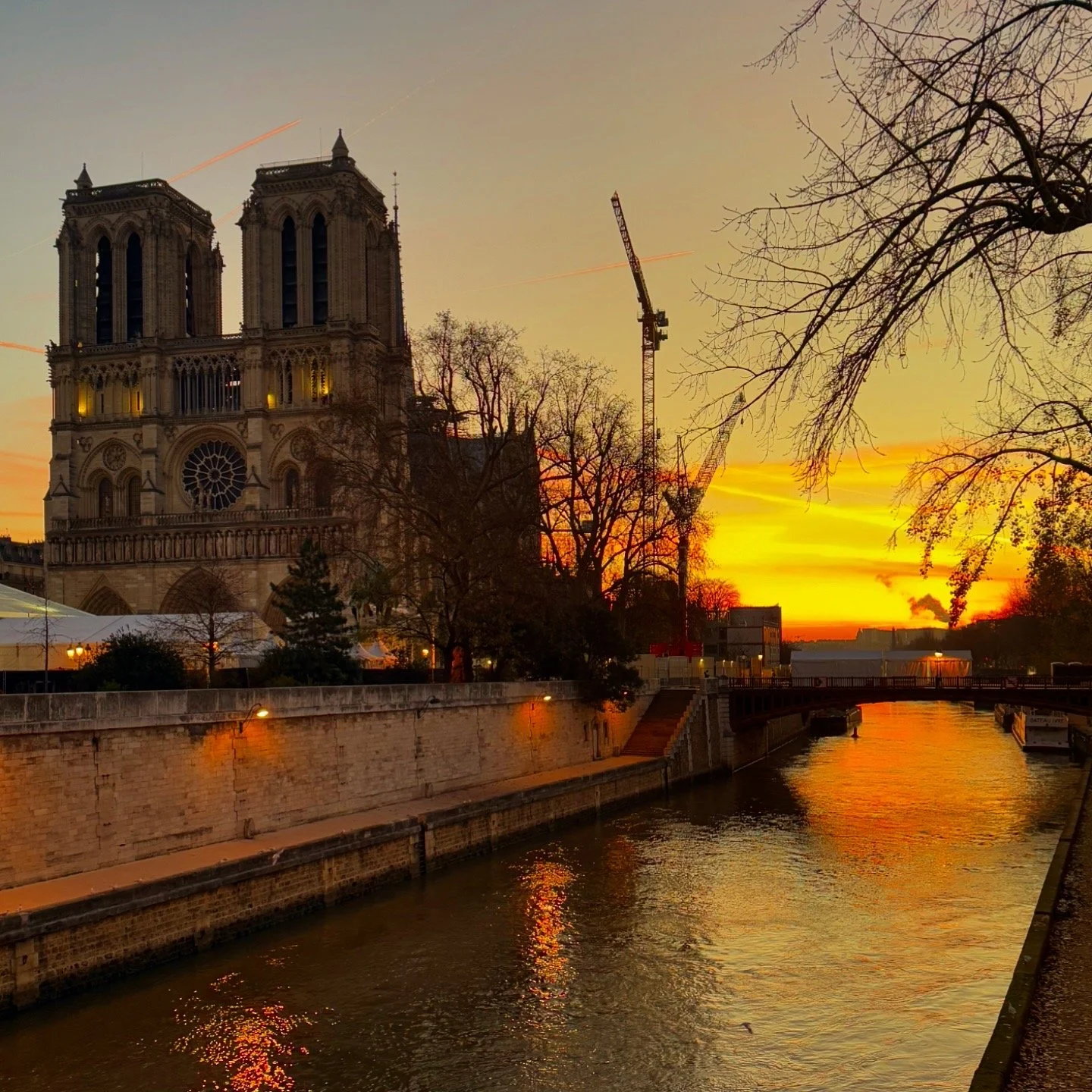
The time has finally come. I can now count on one hand how many days we are once again standing under the stone transept of the Cathedral Notre Dame de Paris.
We watched in disbelief two thousand and sixty days ago as the spire was engulfed in flames. We gasped as it fell into the church, thinking the rooster with Sainte Genevieve and Saint-Denis relics would be lost forever. We feared Our Lady would be no more when the fire ate through theed to the towers forest and head.
On April 16, 2019, we woke up to see Notre Dame standing tall, a little banged up but still standing. Although the fire was tragic, some good things came from it. The fire allowed for the first cleaning of the church in 160 years! In some spots, there were inches of dirt, dust, candle soot, incense residue, and lead dust that dulled the windows and statues. The upside was that it protected the paint, glass, and wood, and many of the spots just needed a cleaning instead of a complete restoration that was first seen in all its glory last week.

Five years and almost eight months is a long time. We lived through a global pandemic that halted the world, which feels unbelievable in retrospect. I was diagnosed with cancer and lost my most important person. I also packed up my entire life and moved to another country. It is incredible to think of all the things we have endured over the last five years.
And through it all, Notre Dame de Paris has stood, and with the love of over 2000 craftsmen and women, she has weathered her renaissance. Her roof and spire have once again risen from the ashes, and her familiar silhouette has returned.
Notre Dame transcends classification and religion and means something different to everyone. First and foremost, Notre Dame is a Cathedral and a place of worship. However, she is also a monument and even a museum, but to some people like head architect Philippe Villeneuve, it was a place he remembers going to as a child, and today, he has given every moment of the last eleven years to returning her to glory.
She is a family touchstone going back to the turn of the 20th century like no other place in Paris. My great-aunts came in 1902, purchased a gargoyle at the church, and wrote how overcome they were by the beautiful light inside the cathedral.

My grandparents always visited every trip and even walked up the tower to get photos of the city and gargoyles protecting the church. Every day, I sit at my desk and look at the photo of my grandfather in front of the church. It is a rare moment when he steps in front of the camera, next to a picture of my grandmother on top of the South Tower, who looked chic as always. They also picked up a gargoyle on that first trip, just like his aunts. I now have both of them and treasure each one.

Today, I live in Paris and walk down to check in on my girl, and spend countless hours pouring over every bit of information I can find on the restoration and history of the Cathedral, always with them next to me and in my thoughts.
Over the last five years, I have heard countless stories from all of you about the cathedral. Notre Dame de Paris doesn’t just belong to Paris or France; it belongs to the world. On this opening weekend, everyone who holds a special bond with her can again celebrate, even if those who feel a very special connection can’t make it to Paris.

If you are coming to Paris the next year, a visit to Notre Dame should be at the top of the list. There is so much information out there, some of which isn’t exactly accurate and quite confusing.
To ease the entry process for what is to be 40,000 people a day. That is 10,000 more per day than the Louvre allows, and the Louvre has 9 miles of galleries.
A free timed ticket can be booked one day in advance to help the traffic flow, but it is NOT the only way to visit. You can also line up each day during the opening hours. The wait may be long, but it will be worth it.
Beginning Monday, December 9, the cathedral will open each afternoon from 3:30 to 10 p.m. for the opening week, with a special themed mass at 6:30 p.m. each day. This schedule will run through Friday, December 13th.
On December 3, tickets for the evening masses went on sale and sold out in less than an hour. However, fear not: More tickets will be available for the hours outside of mass (3:30 to 5 pm and then after mass to closing).
Here is the MOST IMPORTANT part. So you know, tickets will only be available one day in advance, and this is going forward. If you are coming in January, April, June, etc., you can do nothing now.
On Saturday, December 7, the tickets for the 3:30 pm on Monday, December 9, will open online. What time on Saturday is anyone's guess but be ready at www.NotreDamedeParis.fr to grab them.
Tickets will also be monitored in real-time, so tickets can be obtained on the same day. After the first few weeks, they will also know more about traffic flow. Before the fire, the average time spent inside was 20 minutes; they believe that will double to 45 minutes per person. Wait until they see me there for five hours straight every day.
On December 14 & 15, the hours will be 3:30 pm to 8 pm each day.
On December 16 and in the future, the Cathedral will return to its daily formal hours of 7:45 a.m. to 7 p.m. Set your alarm and get there early; you won’t regret it.

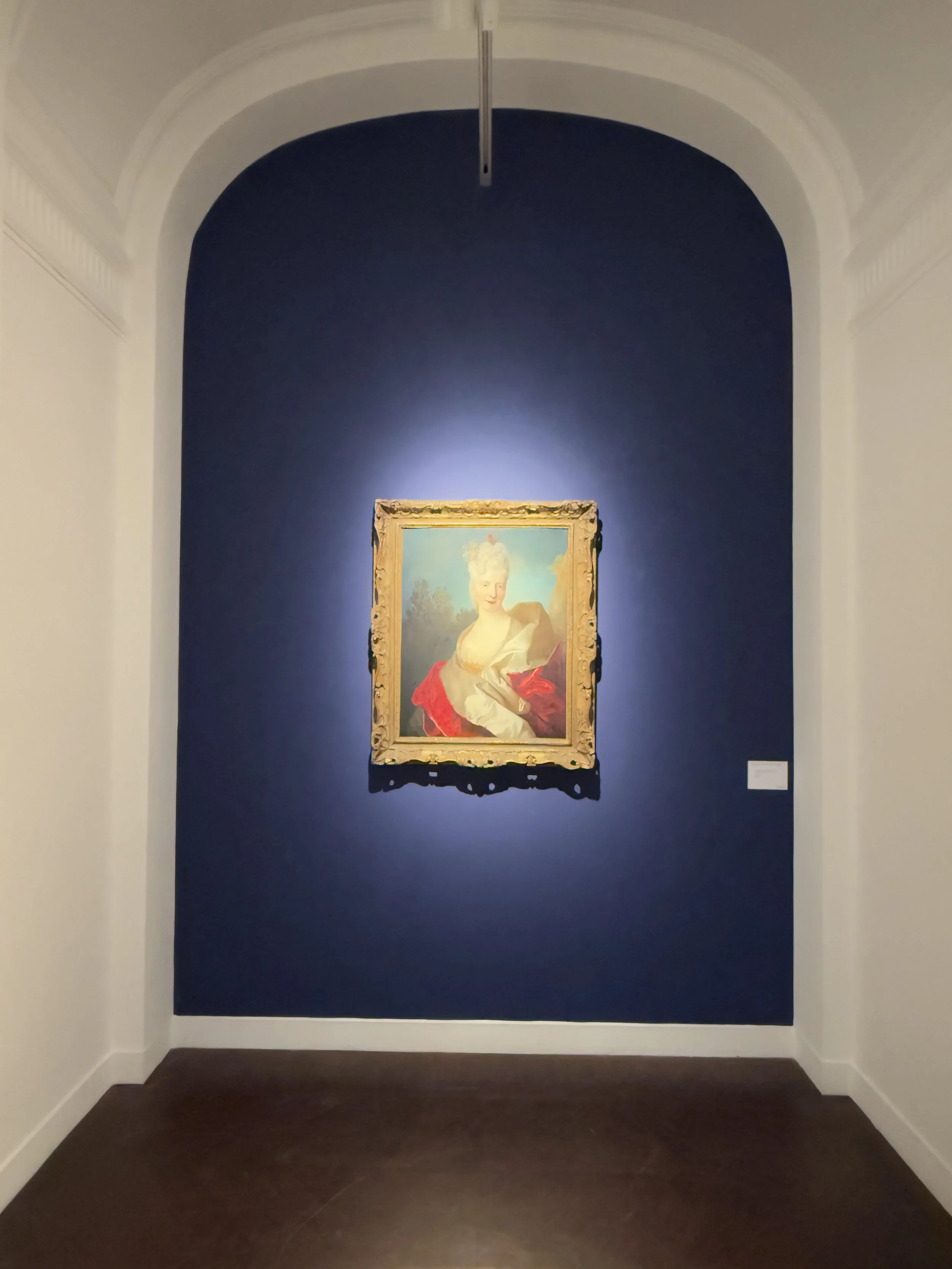
Last week, an essential piece of World War II history was auctioned at Christie’s in Paris. Around 1700, Nicolas de Largilliérre painted a bourgeoisie woman wrapped in lush red velvet sitting outside with a tree and rock cliff background. This is pretty much how I would look if I were also out in the wilderness, which won’t be happening.
We don’t know the early provenance of this painting, but in the early 1930s, it came into the possession of Henri de Rothschild. Eventually, it was passed to his son Philippe, who kept it at his winery in Bordeaux, the Chateau Mouton Rothschild. As Hitler moved through Europe, Philippe packed up his collection in November 1940 and placed it in the Societe General Bank in Arachon.
Many wealthy Jewish families in France thought their money would protect them during the war, but that was not the case. The three branches of the Rothschild family in Paris at the time had vast collections of art, much of which was at the top of Hitler’s wish list, including Vermeer’s Astronomer.

Sadly, money did not protect Philippe de Rothschild, and he was arrested in Algeria by the Vichy government. The Vichy government stripped him of his French citizenship, and his vineyard and collection were seized and shipped to the Jeu de Paume in Paris. My favorite, Rose Valland, watched over the German “gallery depot” where art was chosen for Hitler and Goring and carefully tracked each item at night in her volumes of ledgers.
In her book The Art Front, Rose Valland mentions that 1941 was “truly the Rothschild year” for the ERR. If they were going to steal the art of France, they would start with the best collections. The ERR did precisely that—they stole everything they could and arrested the family members.
Philippe was released on April 20, 1941, and left for London. Elisabeth, his wife, was sent to Ravensbruck Concentration camp, where she was killed. The only member of the prominent Jewish family to be killed by the Germans during the war.
At the Jeu de Paume, Rose Valland noted the paintings and their owner in her many ledgers, the German code given to each one, the crate and destination, and even the date and train they were shipped out on. Through her notes, the Allies knew which trains and routes to secure. She did this every day for the entire length of the war. They had no idea what this quiet, fantastic woman was doing. If they had known she would have been killed, they almost caught her twice.
The Rothschild’s collection was sent to King Ludwig II’s Neuschwanstein castle in Bavaria; ERR painting number R437 was stashed away until May 4, 1945, when Rose Valland’s notes led the Monuments Men directly to the castle to save the treasures of France. A year later, on May 3, 1946, it was back into the hands of the Rothschild family and remained until June 13, 1978, when it was sold to its current owner, who, like the model of the painting, is unknown.

Following the war, Valland’s notes were used to recover thousands of looted art and personal possessions taken from Jewish homes. She was sent to Italy and Germany to aid the Monuments Men in their recovery. The French government made her a Fine Arts Officer, and Italy, Germany, and the US awarded her.
Because of Rose Valland, more than 65,000 works of art were returned to Jewish families, museums, and galleries. Sadly, just as many, if not more, are still missing, and many sit in museums across France waiting to be returned to their rightful owners.
My love and respect for this woman and what she did is immense. She put her life on the line daily to protect the only thing left of many families and treasures of France. If it weren’t for her heroic act, hundreds of thousands of pieces of art and the property of thousands of Jewish families would have been lost to the Nazi greed forever.
The fact that this painting passed through the hands of Rose Valland is enough for me, but the painting is also well-known from a photograph.
On that day in May 1945, Sgt Tony Valim was on hand to assist James Rormier and the Monuments Men as they emptied the castle of its over 20,000 pieces of looted art. A photo was snapped with Sgt Valim holding the painting and Rorimer looking on. The image would be used on the cover of Robert Edsel’s fantastic book The Monuments Men and become the photo that defined the heroes who stepped into the most significant art heist in history.

I visited the painting last week at Christie’s, stood there, and thought about what and who she represents.
The auction occurred on November 21st and was estimated to sell for €50,000 to €80,000.
It sold for €529,200 by a private collector.

Just this week, the Monument’s Men Foundation released the first-ever English translation of Rose Valland’s book The Art Front. The translation took over three years, and the book was originally published in 1961 as Le Front de l’Art, Défense des collections Françaises 1939-1945.
The original version also includes a chronology and maps of art depots in Paris and France, but I may be the nerd who loves all those things.

You can purchase the book directly from the Monument’s Men and Women Foundation HERE for $45 and help support a fantastic organization dedicated to the many heroic stories of World War II. It is also available soon at Amazon.com HERE for $52.
While you are at it, please take a second to sign the petition to enter Rose Valland in the French Pantheon. We have a LONG way to go, and every signature helps if you can share it with everyone you know and everyone you don’t know. Pass people on the street, ask them too.
And when you do have the book, check out page XXV, you may find a name you know.
Last year, when the Monuments Men Foundation sent out a call for help in bringing this version to life, I couldn’t click fast enough. I was thrilled to be a part of it, even in the smallest way.


Last night in the Paris 2024 Olympic Opening Ceremony for the ages a few heads were spotted in the Seine just past the Louvre. Not just any figures, they belong to some amazing paintings you can find inside the Louvre.
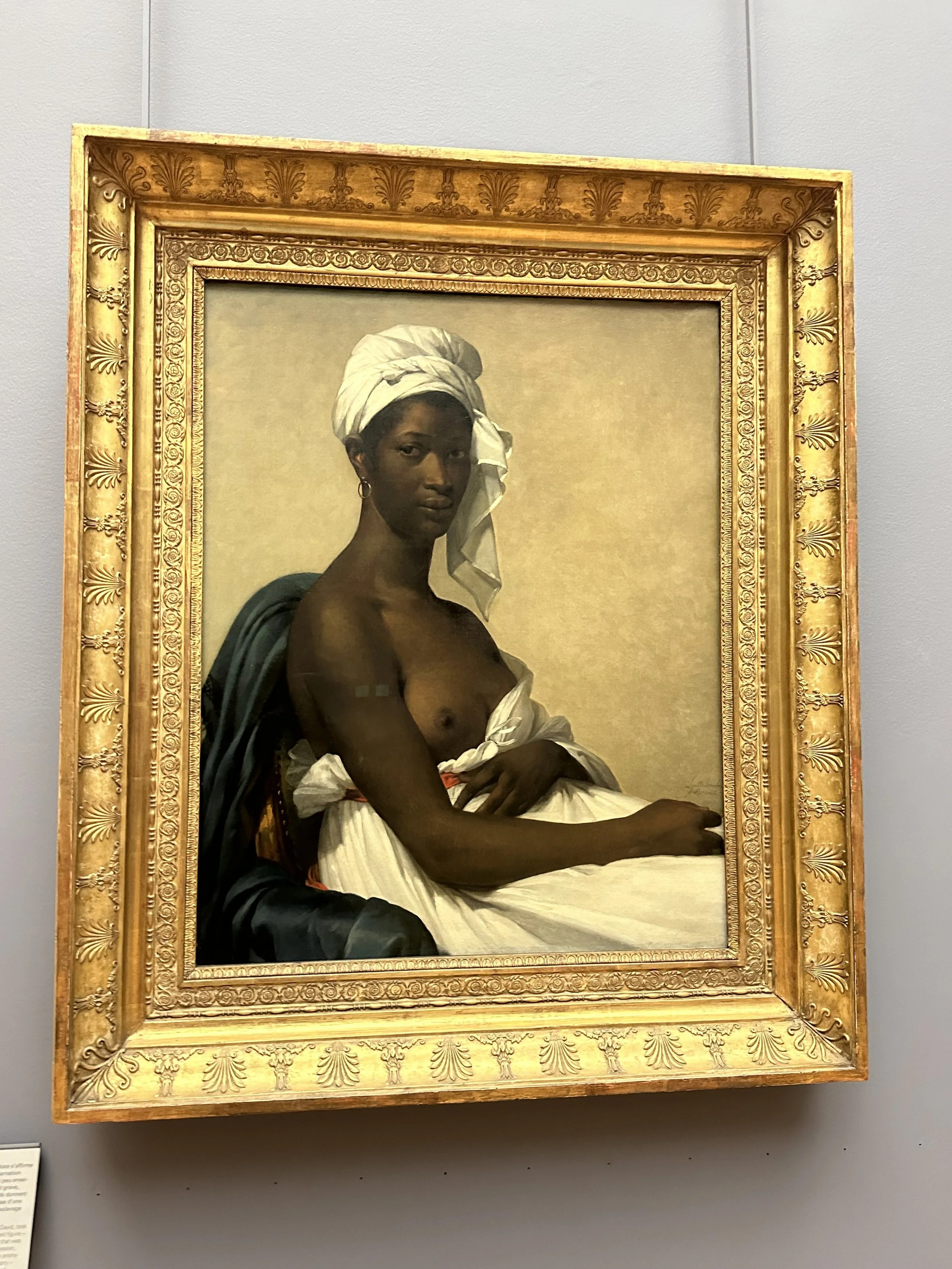
Starting from the Pont Royal is the stunning Madeline by Marie-Guilhelmine Benoist. The actual title of the piece is A Portrait of a Black Woman. Painted in 1800 it changed the landscape of art. Madeleine was a beautiful black woman who came from Guadalupe when Marie met her. Using the classic pose that she learned under J L David she placed Madeleine on a winged chair and draped her in white fabric with a touch of blue and red in the Empire style and suddenly transformed how black models were seen.
Marie Guillemine de Laville-Leroux Benoist is a mostly unknown artist. Born December 18, 1768, in Paris into a political family which would help her enter into one of the most prestigious ateliers in Paris.
At just 13 years old she began training with Elisabeth Vigee Le Brun who was the First Painter to Marie Antoinette. Her talent was noticed and in 1784 she exhibited for the first time at the Salon a painting of her father. The 18th century wasn’t kind to female painters but under the lead of Le Brun, she was able to traverse the art world and get noticed by a few of the biggest names.

In 1788, Marie was asked by Jacques Louis David to join his atelier. The king of the Neoclassical movement was happy to take women in as a way to get back at King Louis XVI who forbade women artists to train in the Louvre. At the time David lived and had his studio in the Louvre. Most women were relegated to painting flowers & landscapes, but David suggested she try her hand at historic subjects.
In 1800 she created a painting that changed the landscape of art. After a visit to her brother-in-law's home, she met Madeleine and decided to paint a subject that was rarely seen in art at the time. Madeleine was a beautiful black woman who came from Guadalupe when Marie met her. Using the classic pose that she learned under David she placed Madeleine on a winged chair and draped her in white fabric in the Empire style and suddenly transformed how black models were seen.
The model was unknown until a few years ago before an exhibit at the Orsay unveiled her name. On June 27, 1818, the Director of the Maison du Roi purchased the painting with three of her other paintings. Under Louis XVIII the painting was sent to the Louvre. I wish she was somewhere where more people could discover her but until that day, be sure to search for her when you visit the Louvre.
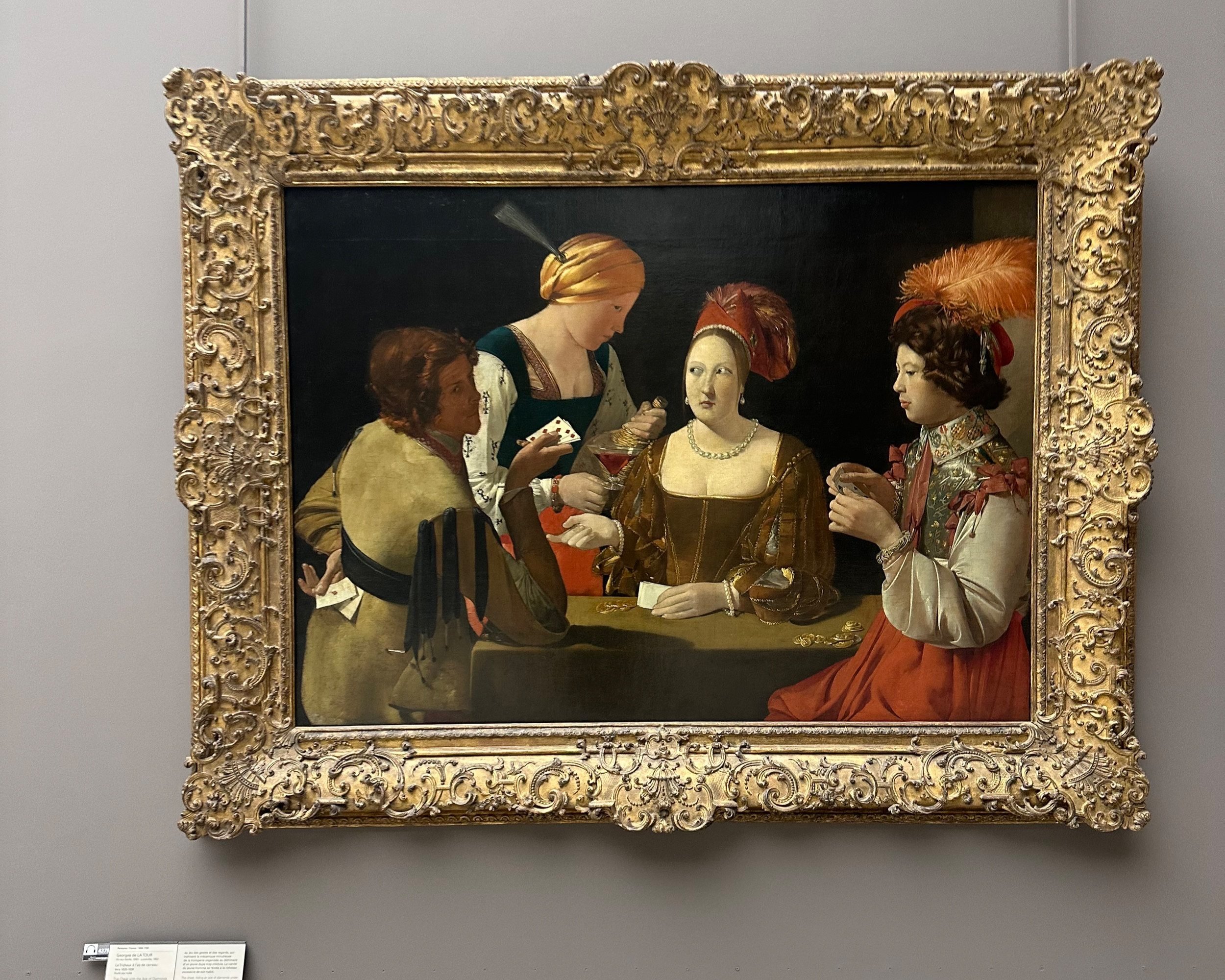
The next woman is featured in George de La Tours The Cheater with the Ace of Cards painted in 1636. Three grifters work together to steal the money of a rich young man by hiding an ace behind one of their backs. Our lady in the Seine is the Courtesan with a red hat decorated with an ostrich feather and pear drop earrings. The pearls are the giveaway that she is a prostitute.
And you thought pearls were so classy.

Next, we have Muhammad Qasim’s Portrait of Shah Abbas Ier drawn in 1627. Sadly not on display in the Louvre at this time. The painting is of the Shah and his page boy who clutches a wine flask near the elder’s lap. I’ll let you figure out that symbolism. On the painting is a quote:
“May life provide all that you desire from three lips: those of your lover, the river, and the cup.”
Rather fitting on the banks of the Seine.

My other favorite painting that is sure to always catch the visitor’s eye is the presumed portrait of Gabrielle d’Estrées and her sister the Duchess of Villars. There is still a lot that is unknown about this painting, including that of the subject and the artist. Attributed to the Fontainebleau School in 1594, it is believed to be Gabrielle and her sister, the Duchess of Villars who held her nipple between her fingers, which was a gesture symbolizing pregnancy. Gabrielle would have been five months pregnant with the future Duke of Vendome, Henri IV’s illegitimate son. In Gabrielle’s left hand, she holds a ring between her fingers, the coronation ring of Henri– a token of his love and loyalty. In the background sits a woman sewing, could it be baby clothes.
Gabrielle d’Estrées is a woman known more for her risque painting than for her life itself. Gabrielle was born around 1573, and daughter of Antoine d’Estrées, Baron de Boulonnois and Françoise de la Bourdaisieres. She was one of eleven children, seven of which were girls, and gave them the moniker “seven deadly sins” by the Marquis de Sevigné.
The union of Gabriele and Henri resulted in three children. Caesar in 1594, Catherine in 1596, and Alexandre in 1598. All three were legitimized in the eyes of the monarchy and the church as Henri’s children. In 1599 she became pregnant again. Each of her pregnancies was very easy, but this fourth was giving her a lot of issues. Sick every day she struggled for five months.
On April 6, 1599, she left Henri behind at Fontainebleau, it was just a few days before their wedding planned for April 11, Easter. She cried and sobbed and had to be pulled off of him, on what would be the last time she saw her love. On April 7 she dined with Sebastion Zamet, an Italian who had arrived in France with Catherine de Medici and was also close with Marie de Medici. That night at dinner when she said she wasn’t feeling well, Zamet gave her a frosted lemon. The next day she began having contractions and pains, she was only 5 months along.
The baby had already died and doctors tried to figure out what to do as she got worse. After a day her face and neck suddenly turned black leaving the doctors baffled. When word finally reached Henri at Fontainebleau he travelled to Paris as fast as he could but it would be too late. On April 10, at just 26 years old Gabrielle would die, the day before their intended wedding.
Distraught, Henri planned a lavish funeral at the Eglise Saint Germain l’Auxerrois fit for a queen. Henri dressed in black for months, shocking most as white was the normal color for royals in mourning. A lifelike effigy was created and placed in the room next to his where he would sit with her and eat his meals.
Gabrielle was buried at the Abbey de Maubuisson where her sister was a nun and her children stayed close to their father. Less than a year later Henri would marry Marie de Medici.
Listen to Gabrielle’s story here
Each one of the figures has a story. A mistress, a courtesan, a former slave, and a gay man. If they had shown the entire painting many viewers may have clutched their pearls but here, we see them as perfection.
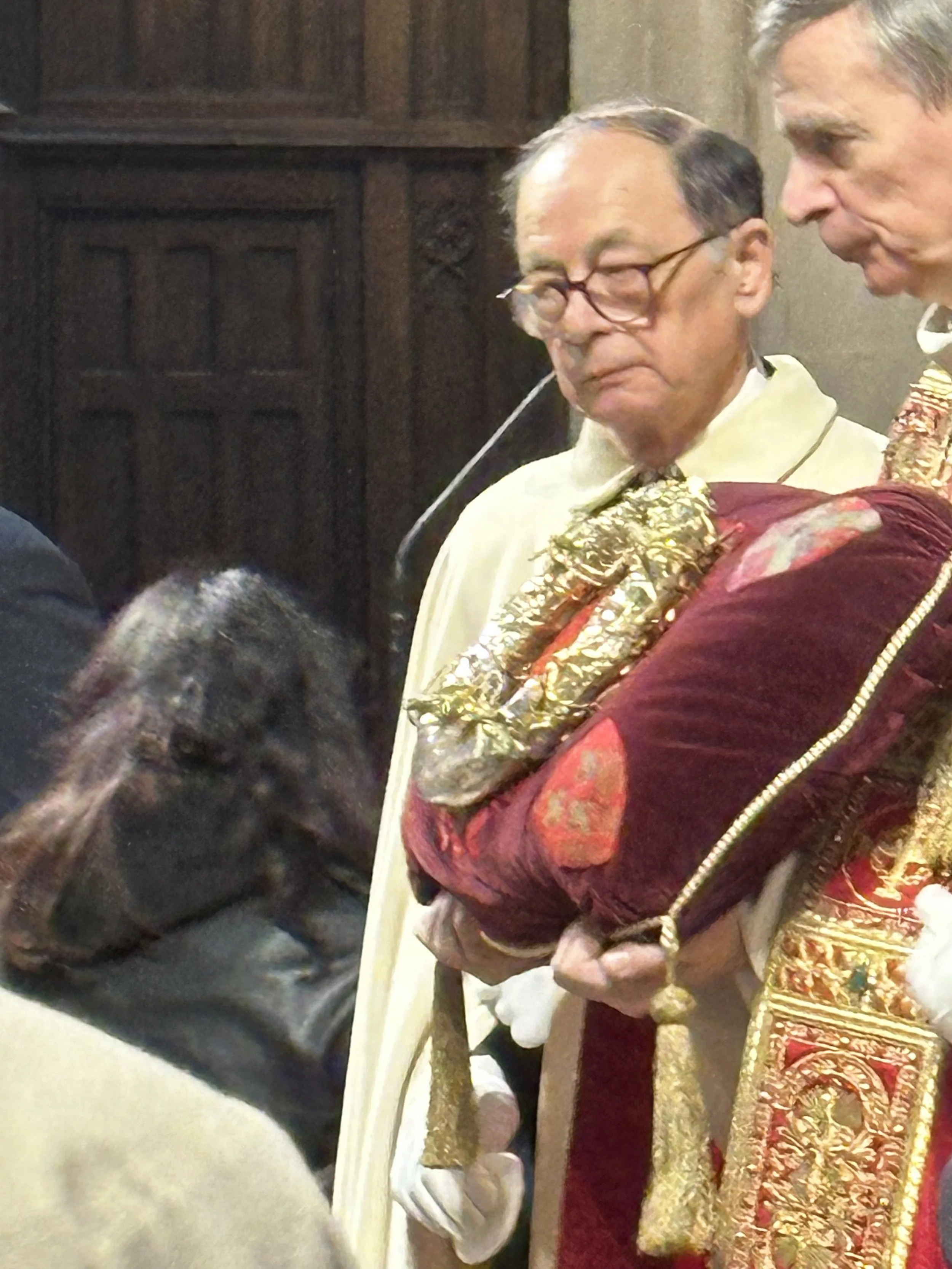
Each Friday afternoon until Easter the most important relic in the world makes an appearance for the faithful to see at the Eglise Saint Germain l’Auxerrois. Since the fire on April 15, 2019, the Crown of Thorns has been safely hidden away but does make an appearance on a few very holy days of the year until its grand return to its home, the Cathedral Notre Dame de Paris.
But why is it in Paris you ask? The Crown of Thorns and other instruments of the Passion were purchased in 1238 by King Louis IX, later known as Saint Louis, and brought to Paris. However, let’s back up a little further. The crown was said to have been discovered in the 4th century after Emperor Constantine ordered what was thought to be the tomb of Christ to be opened. His mother Sainte Hélène came along and found the Crown, True Cross, and Nails, parts of the Instruments of the Passion, and set up a chapel in Jerusalem to hold them.
Between 614 and 637 when the city of Jerusalem was captured the relics began their voyage to Constantinople. For centuries they stayed until the Byzantine city was conquered at the beginning of the 13th century and given to the Latin Emperor in hopes that it would protect the now fractured capital.
Cousin to Saint Louis, Boudoin II, Emperor of Constantinople came to France asking him to help with a massive debt he had incurred when he borrowed money from the Venetians and gave the crown as collateral. Boudoin II in return for his help would give Louis and France the Crown of Thorns.

This wasn’t an easy transaction, the Venetian barons were in such desperate need of money they borrowed against the relics and sped up the clock. The French envoy had to race to Venice to retrieve them in time or they would become the property of Venice. Saint Louis sent Dominicans, Jacques, and André right away to grab the relics as Jacques could also authenticate that they were the real items. The deadline was June 18 and the Feast of Saint Gervais and Protais, if not purchased by that day it would forever be the property of Venice.
Jaques and André arrived a day before on June 17, 1238, and were met with a new challenge and price tag.
Louis had already paid 21,000 pounds to free the Crown but as Jacques and André arrived they were given a new bill for 137,000 pounds! It was half of the budget of the French monarchy but Louis happily paid the fee and agreed to allow the Venetians to hold onto the Crown for the faithful to see one last time in Saint Marks. Negotiations took six months and in December 1238, the Crown finally made its way to overland to France to the small town of Villeneuve-l’Archeveque near Sens.
On August 10, 1239, Louis arrived and Archbishop Gauthier carried the relics out and placed them into his hands. The next day, Saint Louis, his mother Blanche de Castille, and brother Robert d’Artois left by boat on the Yonne River to Vincennes on the edge of Paris.

On August 18, Louis in a simple tunic and barefoot walked the Crown into Paris and to Notre Dame before taking the Crown to the Palais de la Cité and holding it in the Chapel of St Nicolas until the perfect reliquary could be created.
Not just any building would do for one of the most important relics in the world. Two years later in the autumn of 1241, the construction of the Sainte Chapelle began. The same year Louis acquired a large piece of the Holy Cross, a vial of the Holy Blood, and the Tombstone. The following year the Holy Sponge and Spear came into his possession and were all placed in Sainte Chapelle after it was finished and consecrated on April 26, 1248.
They would remain in the jewel box church until March 1787. In 1791 the Conseil d’Etat suppressed the church and sequestered the relics and on March 12 they were removed for safekeeping and taken to the Abbey of Saint-Denis in a cardboard box. In the dark of nigh between November 11 & 12, 1793 the relics were taken to the mint and melted down and destroyed. Only the Crown and piece of the True Cross survived.
In October 1804, just two months before his coronation, Napoleon had the relics transferred to Notre Dame on August 10, 1806, where they would remain until July 29, 1830. During the Three Glorious Days, Archbishop Hyacinthe Louis de Quélen fled the church with the relics under his arm while an angry mob broke into the Cathedral.

In 1855 they were safely back in Notre Dame and architect Violette-le-Duc created a perfect container for the Crown and Reliquary to hold them until April 15, 2019.
On the night of the fire in April 2019 after we watched the spire and the rooster fall from the sky the next fear was the relics of the Sacristy and the Crown. The very tight security that the crown is kept in made it difficult in that high-pressure moment. Tucked away into the floor of the back chapel is a series of combination key locks that require two keys. The keys are normally never together. That night in a state of panic the two key holders had to fight through the crowd to reach Notre Dame. The keys were handed to the chaplin of the Pompiers de Paris Jean-Marc Fournier put his life on the line and rushed into the cathedral to save the Crown of Thorns.
Since that night the Crown is safely locked away and comes out the first Friday of each month and each Friday of Lent in the Eglise Saint Germain l’Auxerrois from 3 pm to 5 pm. The veneration of the crown that occurs when the Crown of Thorns is shown was created by Saint Louis and not the Catholic church. The very specific ceremony and showing of the relic can only happen during Easter as put in place over 785 years ago to celebrate the resurrection.
Open to the faithful, historians, and anyone who wants to see the priceless relic. Standing nearby are the Knights of the Holy Sepulcher of Jerusalem who guard the crown and honor the wishes originally created in the 13th century.
I can’t wait for Easter 2025 when the ceremony will once again be held inside the walls of Notre Dame de Paris. Stay tuned for more about the reliquaries and Saint Louis and the Crown has been depicted in art and stained glass and where you can find them in Paris.

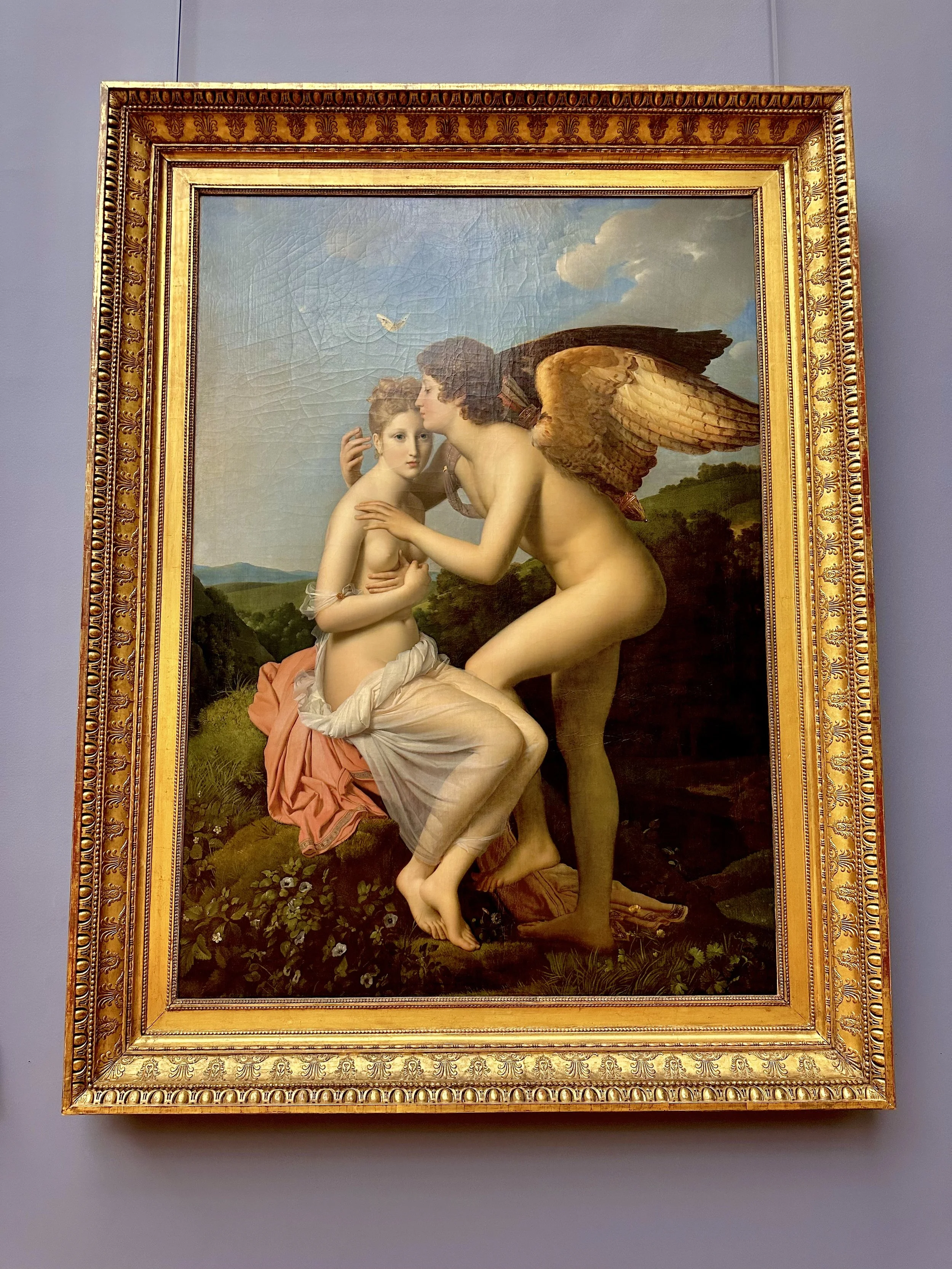
As you walk through the Musée du Louvre you may come across a few figures over and over captured in the paintings and statues and wonder who they are. Today being Saint Valentine’s Day it’s a perfect time to share the story of Psyché et l’Amour and how it is told in the art of my true love, the Musée du Louvre.
Pysché was the beautiful daughter of a Greek king and had two sisters. Her sisters were joined in marriage to other royalty but Psyché was so beautiful that the men only wanted to look at her and not ask for her hand. Her father was distraught and went to the Temple of Apollo to talk to the Oracle of Delphi who told him Psyché was destined to be married to a beast that even the gods would fear.
There was only one thing to do. She was to dress in funeral attire and go to the highest peak in the area and await her fate. Psyché and her father did just that and as they waited nothing happened. To end her pain she decided to jump to her death. As she fell Zephyr, the god of the West Wind arrived and carried her off to a meadow. When she awoke she wandered into a house of golden columns and cupboards filled with gold.

Zephyr enlevet Psyché par Heri-Joseph Rutxhiel
Drawn to the bedroom she lays on a beautiful bed and Cupid, in his god-like form that was invisible to her, begins to make love to her. Night after night this man that she can not see comes to her. When she tells her sister about her nightly visitor they tell her that she needs to see who he is and make sure it is not the beast the Oracle had promised. One night while her mysterious love slept she crawled from bed, picked up an oil lamp, and held it close to his face. As she leaned over to take a closer look she was stunned at how beautiful the god of love was. Backing away suddenly she pierced herself with one of his arrows, the oil dripped on the handsome god and he was awoken.

Psyché et Cupid par Francois Gérard
Cupid suddenly flees and is stunned by her betrayal. Psyché abandoned and distraught, goes to the temple of Ceres and asks for help to find her love. However, she is a mortal and the gods could not assist her, but Venus might be able to. Venus was the mother of Cupid and she was already well aware of the beautiful mortal that was stealing the heart of her son.
Venus wore the crown as the most beautiful woman in the world and wasn’t happy that her title was being threatened. She told Psyché she needed to complete four tasks and if she did that she would consider helping her, but these tasks were impossible and Venus figured she would be rid of her once and for all.

Cupid et Psyché par Francois Nicolas Delaistre ( i left them a little chocolate heart)
The first task was to separate a large pile of grains and beans. Psyché decided the task was too difficult and instead went to a wedding. That night when she returned rather drunk she was amazed to see the task was complete. The insects were drawn to her beauty and separated the grains and beans for her.

Psyché surprend l’Amour endormi par Louis Jean-Francois Lagrenée
Task number two was to return to Venus the golden wool of the sheep of Helios. These sheep were very violent and as she tried to get close they would run her off. Suddenly a strong wind came through and their golden wool was blown off and caught on the briars which she could easily gather. Venus couldn’t believe she completed each of these tasks.
The third was to collect the black water from the river Styx that fell from the high rocks guarded by dragons. Jupiter saw the young girl struggling and sent his eagle to combat the dragons and gather the water.

Psyché Abandonée par Augustin Pajou
The final task was the hardest and impossible in the eyes of Venus who needed to put an end to this girl that was charming the gods and creatures. Psyché must bring back the drops from Proserpina, the queen of the underworld that would promise every lasting beauty. Psyché felt there wasn’t any way she could survive this and climbed to a tall peak where she was going to end her life. Suddenly she heard a voice that told her what she needed to do to pass the tests of the underworld. She must remain silent, bring cakes for the three-headed dog Cerberus and two coins for Charon the ferryman and she would succeed.
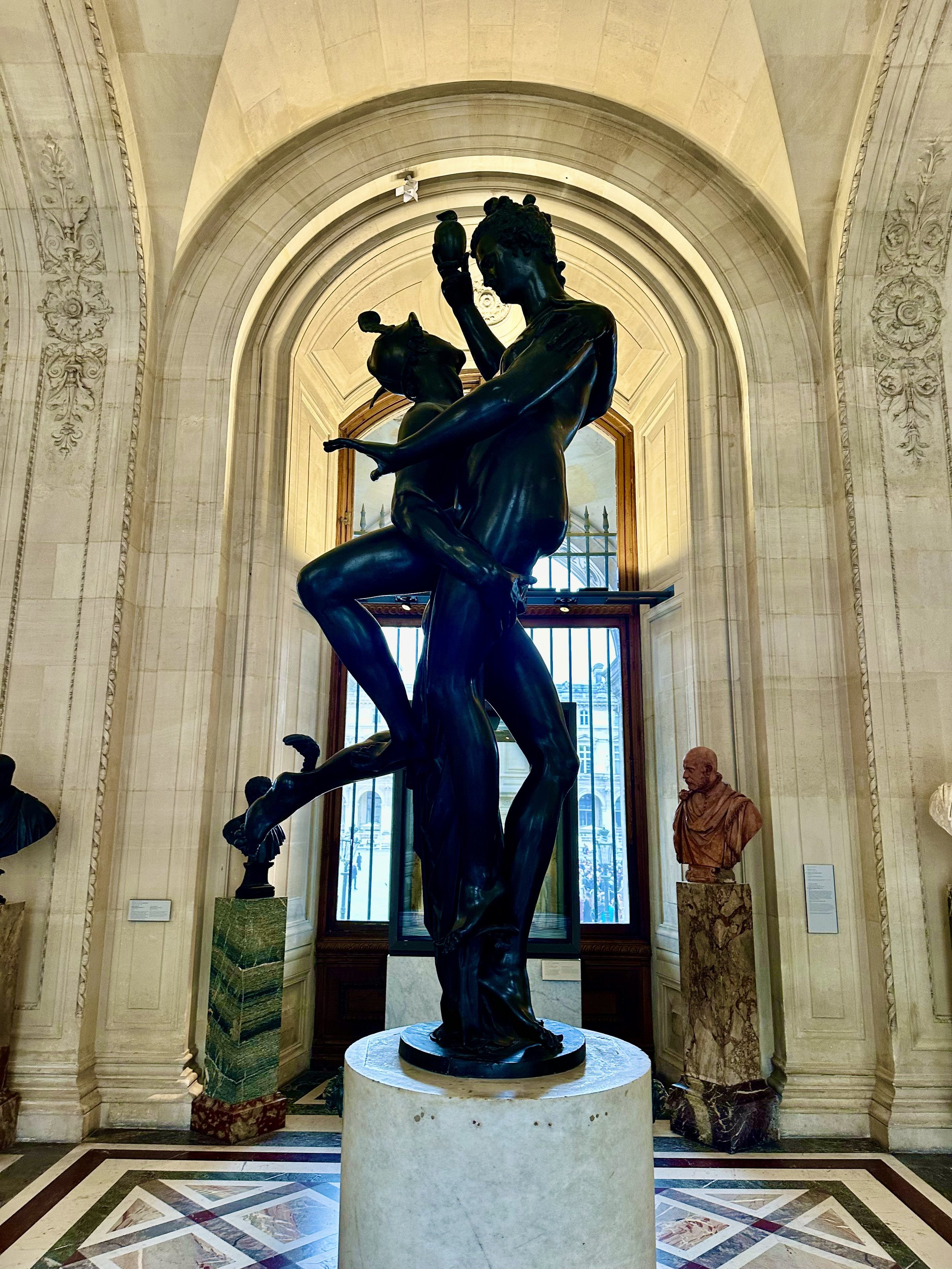
L’Enlevement de Psyché par Adriaen de Vries
She did just that and obtained the vial was instructed not to open it and began her return to Venus. Mercury takes her in his arms and flies to Venus but when she arrives her curiosity gets the best of her and she opens the vial. With one whiff she fell into a deep sleep. In a lovely meadow of flowers, Cupid discovered her and thought she had died. He picked her up and placed a kiss on her lips and she awakened. Knowing his mother was going to be a problem he took Psyché to Zeus and asked for his help and that he could marry her. He gathered the gods and they all agreed. Psyché was given a vial of Ambrosia to drink that would transform her into the Goddess of the Soul and Venus would have to accept her.

Psyché Ranimeé par le baiser de l’Amour par Antonio Canova

Rose Valland, the heroine of France died on September 18, 1980, at 82 years old. She devoted her entire life to art and the restitution that so many families sought. Rose was a very quiet child with a thirst for knowledge. Born in 1898 her mother had to apply for grants so she could attend university In 1918 she began at the Ecole des Beaux-Arts in Lyon which would take her to Paris where she would attend the Beaux-Arts, Sorbonne, and Ecole du Louvre.
Incredibly smart she was able to absorb everything she read and learned languages quickly. All of this would be useful in 1939 as Hitler and his thirst for art was moving across Europe. Rose spent the war years at the Jeu de Paume, cataloging everything with her photographic memory, noting every piece of art, where it was taken from, and where it was going. Quiet and rather plain looking they never saw her as a threat but she put her life in danger every day.

After the war, Rose was an integral part of the Ministry of Culture, and the Monuments Men to retrieve more than 60,000 pieces including paintings, statues & objets d’art.
In 1968 she officially retired but never stopped working. Just after the war, she met Joyce Heer a British translator working for the US Embassy. They lived together in her small apartment on Rue de Navarre until they moved to a cottage in Ris-Orangis. Rose continued to write and published three books dedicated to art and the race to save it. Joyce died in 1977 and Rose lived out her remaining years alone, surrounded by her notes and books until she died in 1980. The two are buried together in Saint-Étienne-de-Saint-Geoire, where she grew up.
One of my largest driving principles is that everyone knows how amazing Rose Valland was. I am thrilled to see that there is now a petition to have her interred in the Pantheon. The highest honor for any figure in French history and one she deserves more than anyone. Please sign the petition and share it with anyone you know.
We released a wonderful podcast about her in 2020 and if you haven’t listened to it yet please do so you can learn more about this amazing and brave woman. Links at Claudinehemingway.com #paris

Many know the large painting hanging in the Salle Mollien of the Louvre by Théodore Géricault but did you know it was based on a true story? Le Radeau de la Méduse (The Raft of the Medusa) was painted in 1818 when Géricault was 27 years old. It depicts the story of the French ship Medusa, a 40-gun Pallas frigate that was used during the Napoleonic Wars in 1810. On June 17, 1816, the Medusa left the port of Aix alongside three other ships in the fleet; the Loire, Argus, and Echo.
The Medusa captain Viscount Hugues Duroy de Chaumereys decided to make up some time and passed the other ships. A novice captain, Chaumereys hasn't been on a ship in over twenty years and was chosen by Louis XVIII for his dedication to the Bourbons.
On 2 July 1816 the Medusa hit a sandbar on the West African coast at the Banc d’Arguin, 80 km off the Mauritania coast. Following three days of trying to free the Medusa from its captivity in the sand, it was decided that the crew would abandon the ship. Only six small boats were available and would hold only half of its crew and were reserved mostly for the elite and high-ranking officers. A raft was quickly built to hold the heavy items on board. Guns, casks of wine, water, and food tied the raft to the boats but when it was difficult to navigate the captain decided to cut the raft loose. When the raft was set free 147 people clung to the partially submerged makeshift plank.
The worst was to happen with only biscuits, two casks of water, and casks of wine (gotta love the French) and floating under the hot sun. As their raft mates died, they were eaten by the others to survive or pushed into the sea. Many men dived directly into the sea to their death. Thirteen days later on July 17, only fifteen members remained when the Argus spotted them. Five more men died before they reached shore, and only ten men survived the two-week ordeal.
The following February, Chamereys had to face the court and was sentenced to three years in prison. The story captured all of France and when a story was published in November 1817, the young Théodore Géricault was drawn in. The story interviewed two of the servers Henri Savigny and Alexandre Corréard recalling their harrowing tales. Géricault was enthralled and reached out to meet with the two men. With their help, he began to sketch and even make a scale model of the raft and captured the moment that was just two hours before they were saved. They even serve as models for a few of the men in the final painting. So dedicated to getting every detail correct, Géricault spent time at the morgue and even brought body parts from the hospital to his studio to study how the body decays.

Survivor Alexandre Corréard was an engineer and journalist who wrote the eyewitness account of the tragedy and published it. That act had him fired from his job as an engineer which led him to seek a license on September 9, 1818, and open a bookstore at the Palais Royal. He named his shop, Au Naufrage de la Medusa, and people flocked to the store to buy the book and meet the author.
Doctor Henri Savigny, was one of three that volunteered to take the raft. On his arrival in Paris, he testified at the Ministry of the Navy against the captain. When he co-authored the detailed account with Corréard he found instant fame. One other man that was integral to the raft was carpenter Valery Touche-Lavilette. Born on April 26, 1789, he served in the Imperial Guard for two years and was asked to go to Senegal to hope for colonization. It was Valery that help create and build the raft that stayed afloat the entire voyage.
Their eyewitness accounts were the bases of Géricault’s early sketches of the painting. Two of which can be found in the Louvre, show a few slight differences from the final version. The first sketch shows the raft’s position off from the one we know so well. If you look closely at each of the figures you can see how they changed and why I love to find earlier sketches of these monumental works. It’s like getting a glimpse into the artist's mind.
The piece became so large that Géricault had to rent a studio to hold the canvas that was 16 x 23 feet and added to its mystique. A good friend, Eugene Delacroix, paid a visit to the atelier on the Rue Saint Honoré, and after he saw the piece he ran home through the streets amazed and inspired if you look at Liberty Leading the People you see Géricault’s influence in the lower left of the painting.
The large painting perfectly captures the fear and urgency of the effort to survive. When you look at it, it can bring all sorts of emotions. On the lower left side, the older man draped in a red cloth holds his dead son's body at the edge of the raft with a look of total despair. In the foreground, the men look to be barely holding onto life and the raft and ready to be swept to sea from the high waves about to break over them. Géricault added twenty figures when in truth it was fifteen historically at the time. If you look at the man in the bottom right corner, the one with his face down is his dear friend Delacroix.

In the center of the painting, the men have discovered a boat and are pointing it out to the others. At the top of the pyramid, the model discovered a few years ago in the amazing Black Model exhibit at the Musée d'Orsay, is Joseph. Joseph was a stunning model from Santo Domingo that arrived in Paris in 1804. Géricault loved to paint him and used him for three figures and is also the hero of the painting. Raising the red scarf high above him he signals the ship that will eventually save them.
On August 25, 1819, The Raft of the Medusa was presented at the salon under the name Scene of the Shipwreck. Winning the gold medal but being left without a buyer, it was deemed a failure. The painting returned to his studio until the next year when he was paid 20,000 francs to bring it to London in the Egyptian Hall of Piccadilly then it was onto Dublin in 1821.
The Louvre on behalf of the director general Count Auguste de Forbin purchased the painting on November 12, 1824, for 6,000 and since then it has hung in the Louvre. It was saldy 10 months after Gericault died. In 1859 the Louvre ordered a copy that you can see today in Amiens at the Picardy Museum. Pierre Desire Guillemet and Etienne Antoine Ronjat created the copy.
Gericault use a substance called bitumen which made the dark browns and black darker. Bitumen never fully dries and the painting could not be rolled or it would stick to each itself and tear. During the evacuation of the Louvre on September 3, 1939, the large canvas traveled through Versailles on a truck used to move stage scenery. As it went through the town it hit a power line and knocked the power out of the golden town. The Raft was hidden away during the war in the Chateau de Chambord. Since its return in 1945, it has hung on the first floor of the Denon wing in the red room of the Salle Mollien just a few steps from the Mona Lisa. Look at all of the paintings in this room including Delacroix and the other Romantic artists and see the way they each speak to each other.

Théodore Géricault wouldn’t live much longer after he painted his masterpiece. Dying at just 32 years old on January 26, 1824. You can visit his tomb at the Pere Lachaise and find a bronze basrelief of the Raft done by Antoine Étex, but notice that they covered the naked naughty parts of the gentleman falling into the water.
The painting is also a good test of how you see the world. Which parts strike you the most? Are you an optimist or a pessimist? Do you see the hope and elation at the top or is it the despair at the lower portion? Either way, it is a masterpiece and I never get tired of sitting in front of it alone on an early morning before the room is filled or sharing it with clients.


For the last week, we have been celebrating Notre Dame de Paris. We are finally closer to the reopening than the fire, and we are all thrilled. On Instagram, Facebook, and last weekend’s live video I have shared the many stories of the cathedral from the people that made her what she is today to the treasures that will return once it has opened its doors.
In the Trocadero a museum few people make it to where you can find a fantastic evolving exhibition that explores Notre Dame from the Builders to the Restoration. The
The Palais du Trocadero holds two museums, including one of my favorites the Cité de l’Architecture and the Musée de l’Homme. Each is rarely visited and holds amazing views of the Eiffel Tower. The Architecture Museum was created by Alexandre Lenoir who saved many of the monuments and tombs from destruction during the Revolution. Originally housed in the Ecole des Beaux-Arts it was another major figure in French architectural history that made the museum come to fruition. Eugene Viollet-le-Duc the master behind the renovation of Notre Dame not only created it but much of the inside is dedicated to the work he did and on Notre Dame itself.

The first pieces of Notre Dame were added in September 2019 when two of the former statues were put on display before they were restored. Of course, after that, we ran into a bit of a pandemic and the museum was closed for a bit but when it reopened in 2021 a wonderful addition was added. All 16 statues that once lined the roof including St Thomas as Viollet-le-Duc with his head turned and looking up at his spire.
As the restoration progresses so does the exhibit at the Cité de l’Architecture. At the start, it’s hard not to be reminded of that tragic day but also how lucky we were to still have the Cathedral standing. A large image that falls from the sky is a birdseye view into the cathedral the morning after the fire. Charged timber stacks in the center of the transept and in the back the pieta and golden cross shine as the witness to that unbelievable night.
As you walk through survivors of that night are on display. The burned reminders were one of the 13th forest that was the equivalent of 52 acres of trees and stones that fell from the ceiling onto the marble floor. Each one of those stones will be reused in the rebuilding if they are structurally sound. Surrounding the area are video monitors with interviews with Philippe Villeneuve, architect to Notre Dame since 2013, and other officials involved in bringing her back to life.

For the armchair engineer or architect, there are scientific specifics of the cathedral and how they are using technology today to advance the techniques that were used in the 12th and 19th centuries. Digital Date groups analyzed the entire structure for exact plans. Stone masons and engineers are using the fallen stones to locate each stone's makeup and where they can find the closest exact copy. Stained Glass technicians are able to use special cameras to look into the health of the glass including the two 13th-century rose windows.

Going back to the 19th-century restoration of Viollet-le-Duc and Lassous the drawings from the two architects hands as well as Adolphe-Victor Geoffroy-Dechaume Culvre's drawings of the rooster and many of the statues
The roof was known as the “forest” as it was made up of over 1300 trees, the equivalent of 52 acres. All of them were lost in the fire and within a few weeks 273 donations rolled in for more than enough timber coming from around France. Half of the donations came from private land and the other half from public forests. A team of devoted lumberjacks that know their land well we’re able to quickly find the perfect trees. They needed to be 4 feet wide and at least 88 feet high. Harvesting began within a year with the first tree cut on March 5, 2020, by Daniel Pichon of Pichon Freres.
On display is a fascinating example of each of the steps from a fallen tree to a shaped beam that will once again hold up the lead-covered roof. 1000 more are needed just for the spire that is being rebuilt to the exact specific plans of Viollet-le-Duc. There are drawing and the original 1860 model on hand for you to get an idea of just how many trees are used for the spire to rise from the roof once again.
Getting an in-depth and close-up look at this amazing adventure is something that you must see. Take the time to read each and every plaque and watch the videos featuring the skilled men and women bringing the world’s Notre Dame de Paris back to life.
The Cité de l’Architecture et du Patrimoine is open Wednesday thru Monday 11 am - 7 pm and on Thursdays until 9 pm. Tickets are 9€ and the exhibit runs until April 29, 2024.
If you are coming to Paris reach out for a special Notre Dame tour with me sharing all these details and so much more and visiting the four special exhibits this year and next in Paris,
When the fire spread through the roof of Notre Dame de Paris on April 15, 2019, we all looked on in horror. However as bad as it looked, it could have been far worse, and in the days following hopeful little signs appeared.
Statues, paintings, and the all important relics were saved as well as another treasure that few knew even existed. Rolled up and pushed away in a large box under some benches was a carpet so grand that it lay in the choir to baptize a prince. Over 80 feet long and rolled away it was drowned in two tons of water. When Herve Lemoine, director of the Mobilier National had a chance to see the carpet he was worried it would be damaged beyond repair.
Unrolled, dried, frozen, and deprived of oxygen to kill any insects they were pleased to see the carpet was in very good shape except for a few dark spots that can be seen in the photos. Named the Drap d'Or (cloth of gold), the carpet dates back to 1825 when King Charles X had it commissioned to be placed in the church when he was in attendance for mass. Created from the drawing by Jacques Louis de la Hamayde de Saint-Ange the carpet went through a few changes before it was ever finished.
The Manufacture Royale de la Savonnerie was tasked with the job of weaving the immense carpet. On September 15, 1825, at a former soap factory near the Trocadero that was large enough to hold the loom, the weaving began.
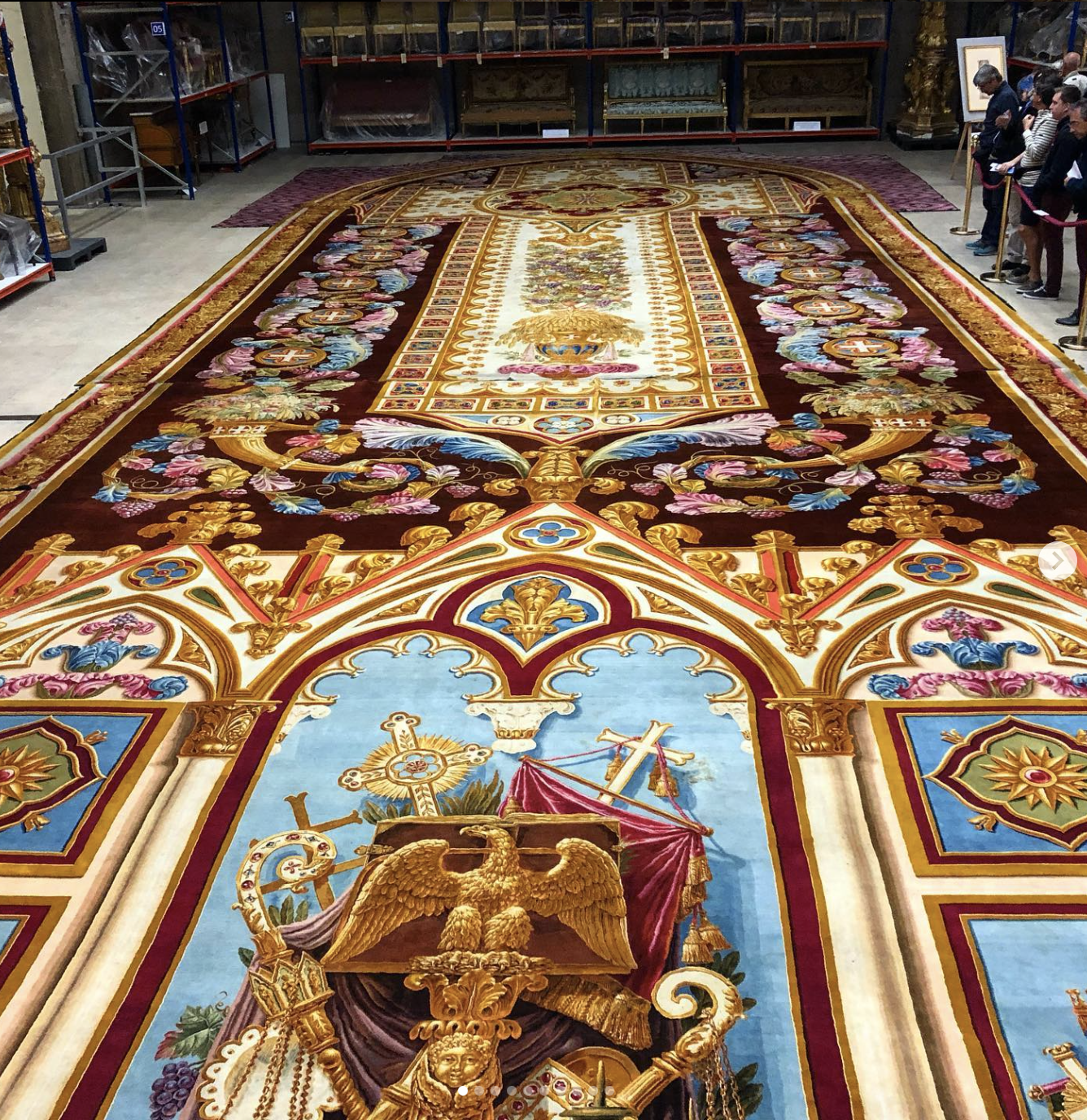
Saint-Ange design included a large white cross with the French coat of arms in the center and the monogram of Charles X. Fleur-de-Lis and the necklace of the order of St Michel and the Holy Spirit encircled the coat of arms. Golden vines with grapes and colorful leaves wind around the cornucopias with a neo-classical reliquary on the lower portion. Around a large candlestick are a miter and other attributes of the church that are around the symbols of the four evangelists. At the top an eagle of St John, the angel of St Matthews, the Lion of St Marc, and the Ox of St Luke.
The Three Glorious Days that marked the Revolution that ousted Charles X put a halt to the project and the design of the carpet. Under Louis-Phillippe the Bourbon symbols were removed and the fleur-de-lis and necklace as well as any markings of the former king. It was finally completed in 1833 and was placed in the Galerie d’Apollon of the Louvre for all to see it. On May 2, 1841, it would be used for the first event in Notre Dame, the baptism of the grandson of Louis-Philippe, Philippe d’Orleans.

Under Napoleon III, it was used for the baptism of his son, Price Louis Napoleon on June 14, 1856. Following the end of the 2nd empire, the carpet was used once more for a visit of Tsar Nicolas II until it was rolled away for over 80 years. A papal visitation by John Paul II was a great reason to use the colorful carpet once more on May 30, 1980. Mostly forgotten and rolled away it would return in 2017 for a 10-day exhibit open to the public just after Christmas on January 4th.
Following the fire and the months of treatment to rid it of insects, it was a real treat to see it in person at the 2019 Journée du Patrimoine in the Mobilier National. The colors are stunning and vibrant and all the emotions and tears came to the surface as soon as I saw it.
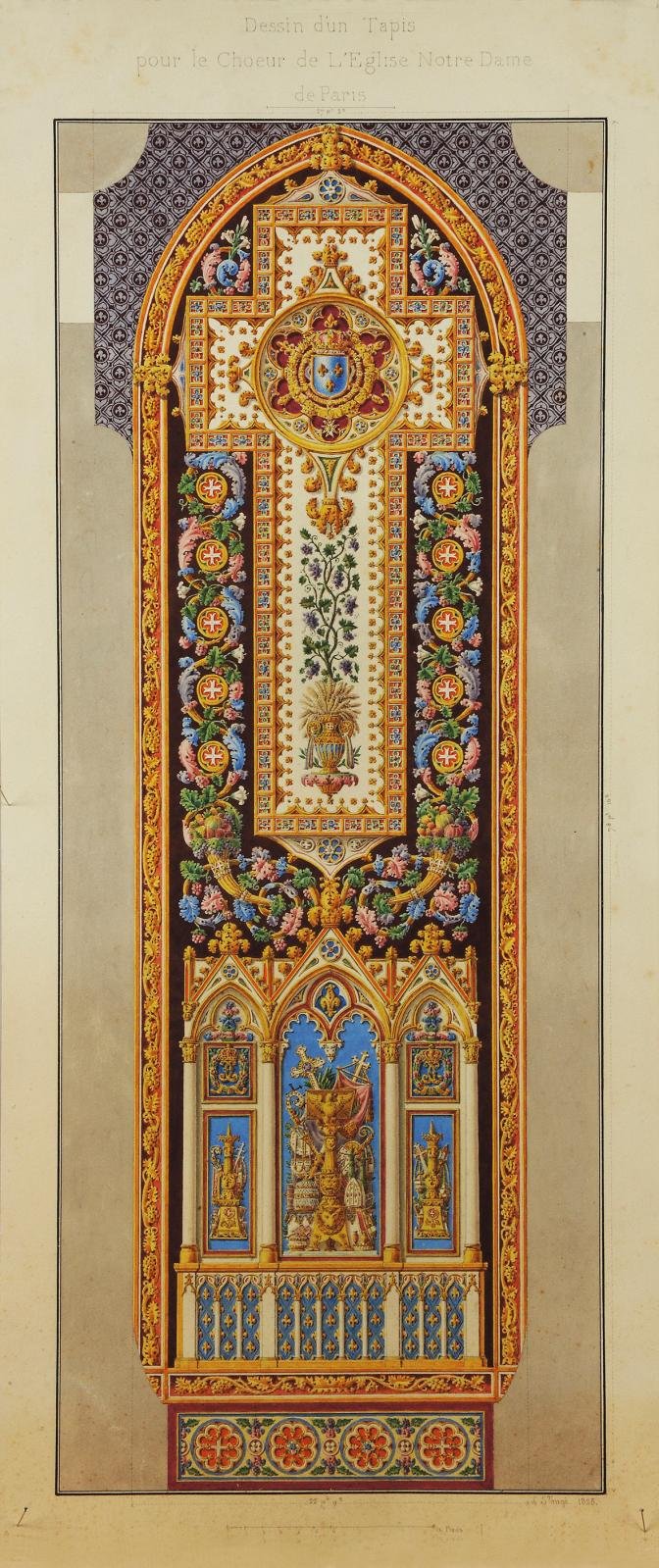
On July 7, 2022 the restoration of the carpet began by a highly skilled group of masters trained in historic repair began. In a large room with looms with massive windows so the natural light streams in they work for endless hours on each detail of the treasured carpet. The carpet itself weighs over a thousand pounds and a dozen men are needed to lift and shift it just a few more inches. Luckily the carpet was in amazing shape after the fire, although the lower portion at one point was glued to the canvas with fish skin adhesive in the 19th century and has hardened making it impossible to get a needle through.

They will replace the edging and any dark spots and next year it will return to Notre Dame for us all to see once more.
We will have to see if they will return it on display this September during the Journée du Patrimoine weekend but if you are in Paris plan a trip to the Mobilier National, just in case.
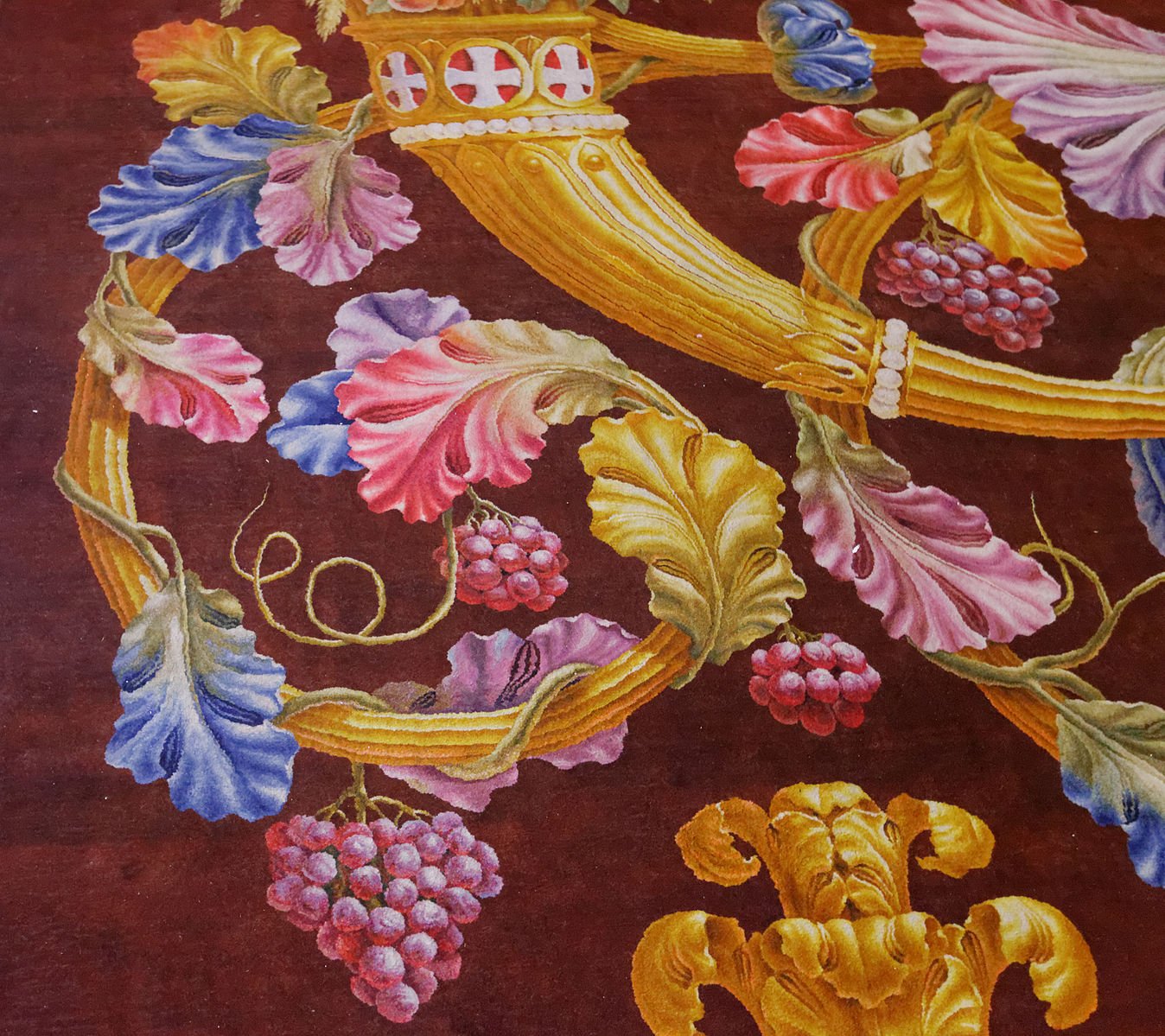

The Jardin du Luxembourg is the perfect oasis on the left bank of Paris. Recently we have shared a few of the more than 105 statues and monuments on the Paris History Avec a Hemingway on the La Vie Creative podcast. You can take these episodes with you as you explore the garden on your own, or better yet book a tour with me when you come to Paris.
I have a tough time narrowing down my “favorite” pieces of art in the Louvre and Orsay and the Jardin du Luxembourg is no different. It’s impossible but one that is very high on my favorites list is Le Marchand de Masques by Zacharie Astruc—located in the center of the southeast path under a canopy of trees.
Le Marchand de Masques, the mask seller, was created on February 17, 1883, in plaster and shown to the State that commissioned statues left and right for the garden. Astruc’s statue of a boy surrounded by the greats of the time was an instant favorite and ordered on the spot. It took almost three years and on February 20, 1886, the statue of a boy was inaugurated.
Zacharie Astruc was an artist and an art critic and very close with a rag-tag group of young guys shaking up the art scene in Paris. As an art critic, he defended Manet, Monet, and the Impressionists when very few did and was even immortalized with them in Henri Fantin-Latour’s Atelier aux Batignolles hanging in the Orsay.
I love to find group paintings and sculptures and deep dive into who they are all and this one is a real goodie. Buckle up and let’s jump in. The young boy is surrounded on the base by eight masks of contemporary figures of the time. Authors, composers, and artists, many of which aren’t as well known today, which always makes it so much fun for me to dig into.

When the sculpture was first unveiled in 1886 there were twelve masks, today we see only nine. First things first, In his left hand he holds high above his head the mask of the king of the Romantic authors Victor Hugo. Hugo died just one year before the statue was displayed in the Luxembourg but was no stranger at that point to statues dedicated to him at this point in his life. It’s rather fitting that he is seen at the top as each of the men below in one way or another.
At the base where you can get nice and close let’s jump into the eight men. Starting in the front we see author Jules Barbey d’Aurevilly. Born on November 2, 1808, in Normandy, Jules was a mystery writer that at times ventured into horror and obscure crimes. A defender of fellow artists Balzac and Baudelaire while he also criticized Zola and Hugo. Aurevilly died in Paris on April 23, 1889.

Next to Aurevilly is Alexandre Dumas fils, the illegitimate son of Alexandre Dumas, bien sûr. Born in 1824, the author used his time with courtesan Marie Duplessis as inspiration for La Dame aux Camélias in 1848. In the story, Marguerite would wear a camelia against her chest, white when she was available and red when she was taken. He spent much of his life working against the feelings he had of his childhood but made just as big of a name for himself as a writer as his father did.
Composer and writer Hector Berlioz was born on December 11, 1803. Largely unknown you can just watch France in the World Cup this week and hum along to a little piece he did. Berlioz updated and added the elaborately orchestrated flair to the French national anthem, La Marseillaise written by Rouget de Lisle. Written by Lisle in 1795 it was outlawed during the Restoration but returned in 1830.

Next to Berlioz is a name you may recognize as a devoted reader. Jean Baptiste Carpeaux, born May 11, 1827, studied under Francois Rude and became the darling of Napoleon III as he carved through the city. The Danse, which caused him much notoriety on the Palais Garnier was attacked with ink for its risque depiction of nudity. You can see the original now in the Musée d’Orsay along with the model for the Fontaine des Quatre-Parties de Monde and the Pavillon de Flore on the southwest corner of the Louvre.
Jean-Baptiste Faure was a composer and opera singer born in Moulins on January 15, 1830. His father served as a cantor at Notre Dame. As a young man, he worked as the assistant to the organist at Notre Dame and Notre Dame de Chardonnet. What he may be known a bit more for is his immense collection of Impressionist paintings. He first collected the works of Ingres, Duprey, and two gents on this monument, Delacroix and Corot. In 1878 Faure purchased a painting that shocked all of Paris, Manet’s Déjeuner sur l’herbe. Alongside more than 65 other Manets, he also had 16 by Degas, 37 by Pisarro, and 58 by Sisley. As well as many more amassing over 800 paintings held in his apartment. He frequently sold many thorough dealers Paul Durand-Ruel. After Manet’s death, Faure and Durand-Ruel organized a large exhibit but didn’t put him in a good light with the artist’s family that saw him as a vulture.

The man next to Faure needs no introduction at all. My main man Eugene Delacroix and if you are keeping count, it is the 3rd time he appears in the Jardin du Luxembourg. Born on April 26, 1798, the young Delacroix moved to Paris in 1806 and began to study in the atelier of Narcisse Guérin and at 24 years old he shared his first piece in the Salon. Delacroix believed that artists should contribute large pieces to public places as that is how they will be remembered. Hotel de Ville, Palais Bourbon, and the Palais du Luxembourg as well as multiple churches including the nearby Saint Sulpice. Delacroix moved to the Rue de Furstemberg on December 28, 1857, to be closer to Saint Sulpice where he was installing three paintings dedicated to angels. Commissioned in 1849 they were finally finished in 1861. In a letter to a friend, he said they would be the death of him. On August 13, 1863, the master died in his home not far from this spot.

Author Honoré de Balzac was the master of novels as we know them today. Born on May 20, 1799, he was immediately sent off to live with a nurse for the first four years of his life. The feelings he had of his early childhood would remain with him his whole life. Balzac lived all over Paris trying to outrun his creditors and writing at a breakneck speed. La Comedie Humaine paved the way for the writers of today. Written from 1830 to 1856, Balzac continues the stories from one book to the next, the first “series”. The image of Balzac is a little less frightening in Austruc’s version as opposed to Rodin’s which I am sure Balzac would be pleased with,
Lastly, we have artist Jean-Baptiste Camille Corot born on July 16, 1796, in Paris on the Rue du Bac. His parents ran a successful clothing and wig shop and wanted him to follow in their footsteps but art was on his mind. Traveling throughout Europe he was able to devote all his time to the landscapes and architecture of Italy and France, many of which can be seen in the Louvre. Corot is known as the Father of Impressionism and one only needs to walk to the end of the 2nd floor of the Sully wing in the Louvre to see how it went from Delacroix to Corot to the Impressionists.
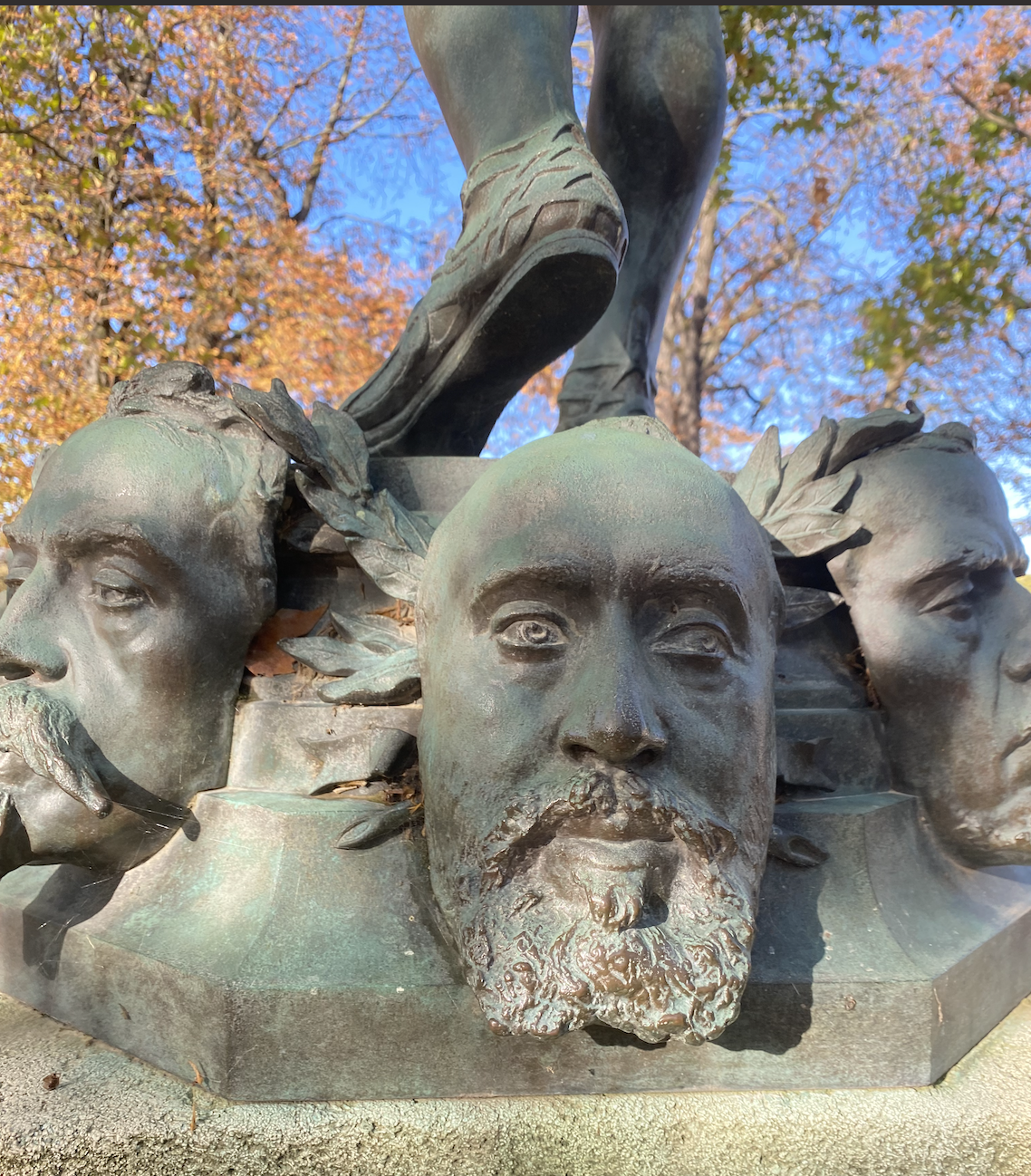
Originally three other masks hung from the seller’s right hand but disappeared over time. The mask of Léon Gambetta, politician and president of the French Council who was greatly opposed to Napoleon III and lover of Valtese de la Bigne. Today his heart is placed in a very large urn as you enter the crypt of the Pantheon and a monument once stood dedicated to him in the Cour Napoleon of the Louvre where the Pyramid now greets guests.
Charles Gounod, a composer of more than 500 pieces was born on the nearby Place Saint Andre des Arts on June 17, 1818, and also studied theology at Saint Sulpice.
And lastly a mask of Theodore de Banville, a poet and great friend to Victo Hugo and Arthur Rimbaud and urged the young poet to come to Paris.

I hope you venture a little deeper and closer at all the great statues in the Jardin du Luxembourg and all over Paris and even take this with you when you go.
Coming to Paris soon, book a tour with me and I will share all these and so many more with you, All tours are private and customized to what you want to see,
Check out ClaudineHemingway.com and even reply to this email. Dates in the spring are filling fast and would love to see you soon.
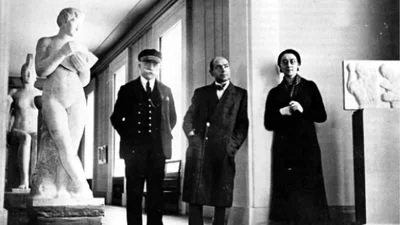
Today on this International Women’s Day is the perfect time to share a few of my favorite women from our podcast, La Vie Creative - Paris History Avec a Hemingway.
The first episode of Paris History Avec a Hemingway premiered on May 20, 2020, and since then we have shared 146 stories of the women of Paris and some of which I have become very attached to. Our first episode featured Suzanne Valadon who is widely known as a model for Renoir but became a prolific artist herself. Her life story is one of ups and downs and twists and turns but fascinating that she sat in front of the great artists and became one herself as a woman.
I have adored their stories of commitment and creativity and their wish to forge their own path and not be satisfied with being a wife, mother, or nun which were the only roles available for hundreds of years.

Rose Valland my favorite woman in French history is mostly unknown to many including the French. The heroine devoted her entire life to art and the restitution that so many families were looking for. Rose was a very quiet child with a thirst for knowledge. Born in 1898 her mother had to apply for grants so she could attend university. In 1918 she began at the Ecole des Beaux-Arts in Lyon which would take her to Paris where she would attend the Beaux-Arts, Sorbonne, and École du Louvre.
Incredibly intelligent she was able to absorb everything she read and learned languages quickly. All of this would come in handy in 1939 as Hitler and his thirst for art were moving across Europe. Rose spent the war years at the Jeu de Paume, cataloging everything with her photographic memory, noting every single piece of art, whom it was taken from, and where it was going. Quiet, fluent in German, and rather plain looking they never saw her as a threat but she put her life in danger every single day.
After the war, the French government, the Minister of Culture, and the Monuments Men would use her and her notes to retrieve more than 60,000 works including paintings, objets d’art, and Jewish religious pieces. Without Rose, most of this art would have been lost or destroyed.

Another amazing woman is Johanna van Gogh Bonger, the wife of Theo and sister-in-law to Vincent. Theo’s death came just six months after his brother Vincent and Johanna were left with an apartment full of art, a young baby, and boxes of letters.
Many told her to toss out the paintings, as they weren’t worth anything, but she loved her husband and her brother-in-law and wanted to do all she could to carry on Theo’s passion and support for his brother’s art. Saving every single letter from Vincent, many including sketches of paintings, these letters were a glimpse into his thoughts.
Theo had told her how to continue on after he was gone and when Johanna found the boxes of the letters she knew what she needed to do. Over time she transcribed each letter and publish them slowly. In a time when women were not art dealers, she began to exhibit Vincent’s paintings and sell them one by one. She built a sought-after market for his works by slowly entering them into the art world. As each letter was released the story of Vincent's short life began to take shape. If it wasn’t for Johanna van Gogh Bonger we may never know Vincent, his life, or even have any of his art. She worked on it until her very last day and that original collection became the van Gogh museum in Amsterdam.

There are many designers that have shaped fashion in France. However, before there were Dior and Louis Vuitton there was Jeanne Lanvin. Lanvin was a designer that paved the way for all the others but few know her name.
Jeanne was born on January 1, 1867, in Paris at 35 Rue Mazarine. She was the oldest of eleven children to parents Bernard Lanvin and Sophie Blanche Deshayes. Her mother was a seamstress and taught Jeanne how to sew which came in very handy. At the age of 13, Jeanne got a job working at a hat shop. In just three years she served as an apprentice milliner and in 1889 at 22 years old she opened her own shop in Paris on the Rue Boissy d'Anglas.
Her hats were very popular with the Paris elite and she had a long waiting list for one, long before Chanel ever touched a hat. That same year she created her fashion house which would become the oldest fashion house in the world, still to this day.
From hats, she moved on to designing clothes for her daughter Marie Blanche creating custom dresses complete with lavish fabrics and embellishments for the “little girls about town”. So many women begged her for the same designs that she pivoted her business and renamed it Lanvin Modes and began producing dresses for women as well for little ladies.
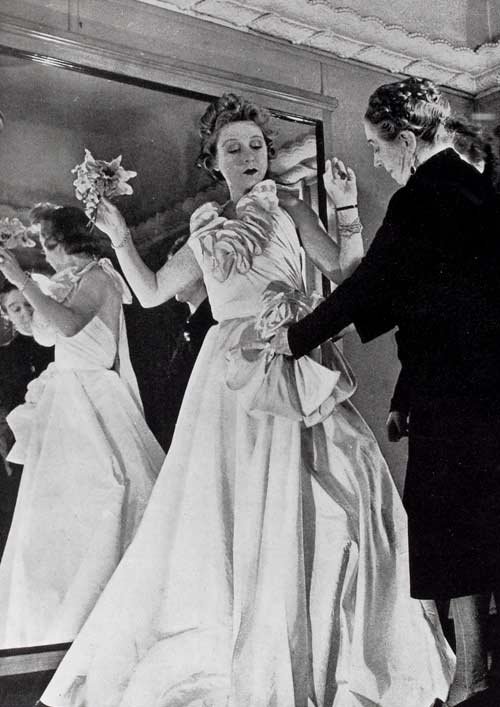
In 1909, she expanded the store again taking up more of the block that included the young lady and women's department. In 1918, after a weekend at the coast and a vacation in the mountains, she saw a need for sportswear, long before ol Coco. Lanvin designed swimsuits, beach and tennis wear, and everything you need for a weekend of skiing. Jeanne also created an entire men’s department, creating suits and casual fashion and becoming the first designer to dress the entire family.
In 1924, she created her own fragrance, My Sin. Only designer Paul Poiret had done this before her, again long before you know who.
Jeanne Lanvin’s name is one that is not as well known as so many other designers and she was fine with that. Karl Lagerfeld later criticized her for her low-key persona and Coco looked at her as one of her greatest rivals. Today everyone thinks it was Coco that pioneered perfume, sportswear, hats, and the color black, but just like everything else that many people know about Chanel, it is completely wrong. It is Jeanne Lanvin whom we owe so much.
To know more about the true story of who Coco Chanel really is, listen to this episode. The woman who so many around the world admire was a horrible human being. A woman that turned in her Jewish employees to the Nazis. “Shopped” from Jewish homes and funded anti-Semitic pamphlets years before WWII and that is just the start of it.

I can go on about these wonderful women and each one we have covered for days but the last one I will share today that you should know more about is Rosa Bonheur.
Rosa Bonheur was born on March 16, 1822, in Bordeaux into a large family of artists. Her mother Sophie Marquis married Raymond Bonheur who was also her drawing teacher who painted landscapes of Bordeaux and instilled a love of art in all his children.
As a child when Rosa was struggling at school her mother used her love of drawing to her advantage. Asking Rosa to draw an animal for each of the letters of the alphabet was just the trick she needed. Her mother died when she was young and her school life suffered. Expelled twice her father finally took her out of school and focused on teaching her how to paint.
Raymond specialized in Realism and to help Rosa he had their Paris home filled with animals. From squirrels and rabbits to ducks and sheep the young artist had all she needed to begin her life as a painter of animals. Once she needed more subjects she would visit farms in Levalois-Perret and the Bois de Boulogne. Rosa was lucky to have an artist as a father as few women were able to find teachers at the time. Spending her days in the Musée du Louvre as a copyist always being pulled to the master’s paintings of animals. At 19 years she was already showing her pieces at the Paris Salon and selling her paintings to avid collectors.
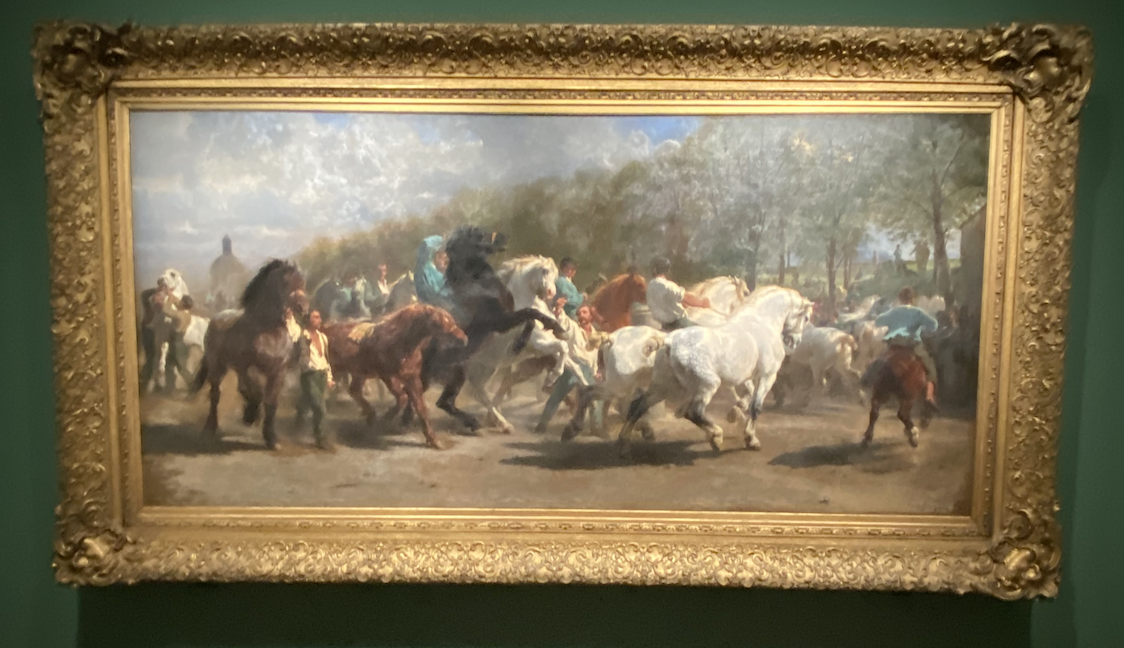
Wanting to expand her repertoire Rosa went places few women were allowed. A frequent visitor at the slaughterhouses of Paris and the Ecole Nationale Veterinaire with her sketchbook and canvases in hand. Traipsing through the mud wasn’t easy for a woman in a dress, Like George Sand who came before her, dressing in pants was much easier and allowed her to mix with the male-dominated world.
Everything would change for her in 1855 when she painted the large tableau The Horse Fair. The 8 x 16-foot painting depicted a scene from the Paris horse market on the Boulevard de l'hôpital. Art dealer Ernest Gambart fell in love with it and purchased the painting along with the rights of reproduction and also took Rosa on as his client. The painting was sent to the UK and garnered the attention of Queen Victoria, which also came with an invitation from the queen.
After the success of the Horse Fair, the French government commissioned her to paint another large painting. The Ploughing in the Nivernais of two teams of oxen pulling plows was painted in 1849. It’s a magnificent painting and lucky for us hangs in the Musée d’Orsay.
As a female painter in the 19th century, she was able to do something few other women did. She became an international star. The copies of the Horse Fair were selling all over England and the United States and Empress Eugenie was also an avid fan. In 1865 Eugenie urged her husband Napoleon III for quite some time to award Rosa the Legion of Honor for her work and for spreading French art around the world. He finally gave in with the stipulation that he would have nothing to do with it and it would be given without a formal ceremony. On June 10, 1865, Eugenie traveled to the Chateau de By and presented Rosa with the highest award a civilian could get.

This past fall the Musée d’Orsay held an amazing exhibit to mark the 200th anniversary of her birth and showed just how important she still is in French history.
Listen to all of the stories of the wonderful lives of each of these women and so many more. Know of one that we haven’t covered yet, let me know and we would love to add her to our list.