Louis XIV and the Place des Victoires

Comment

Louis XIV and the Place des Victoires

This past Sunday on our weekly live walk of Paris we shared the beautiful Place des Victoires and the history of the Louis XIV statue. We ran into a roadblock at the end when I wanted to share the fantastic pieces that were saved from the original 17th-century monument in the Louvre, but you are lucky here they are with even more details. 

In 1685 Marshal de la Feuillade decided to create a large square not far from the Palais du Louvre. The gem of an architect Jules-Hardouin Mansart was chosen to create the harmonious group of buildings that would encircle a monument to Louis XIV. 


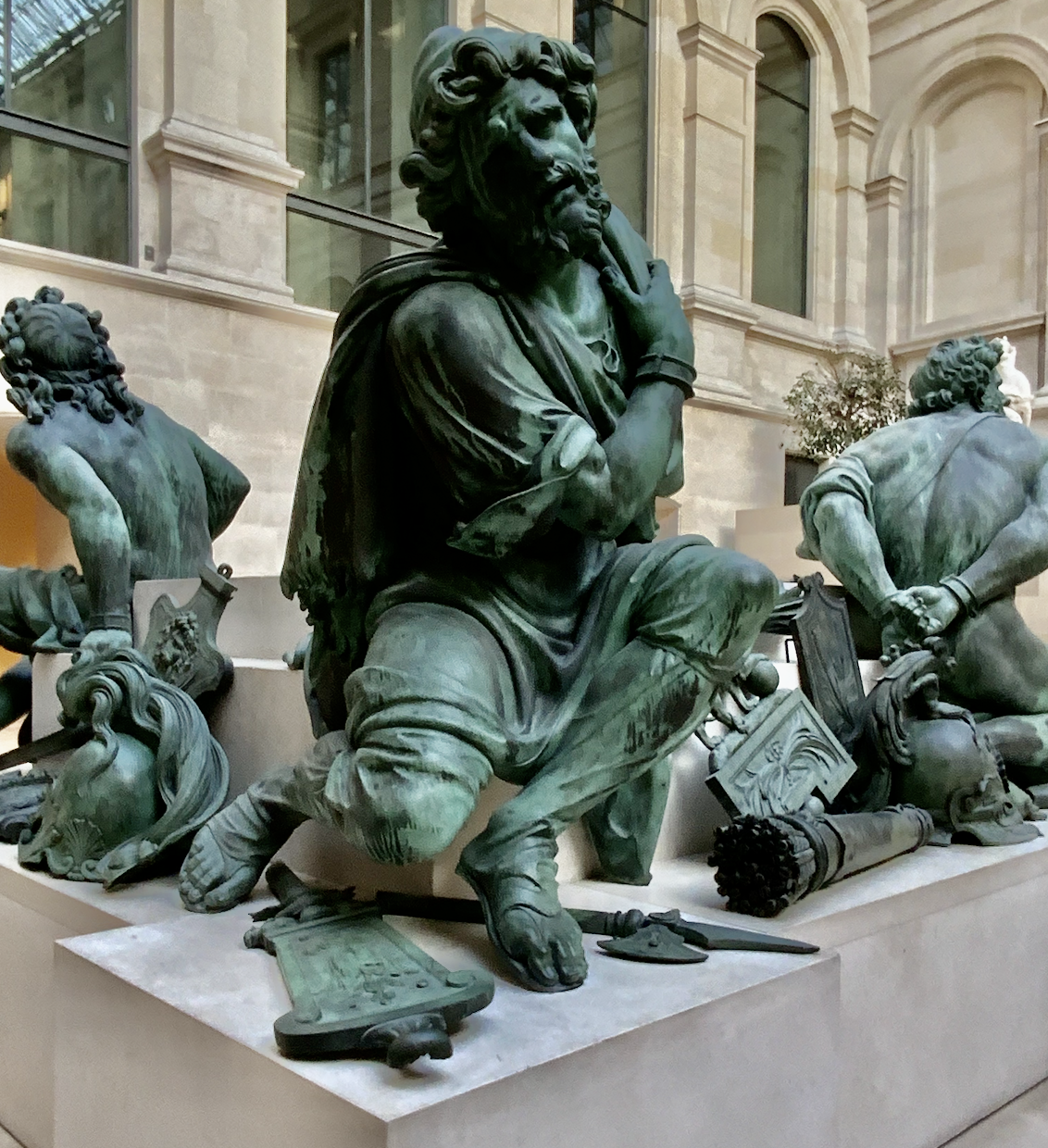
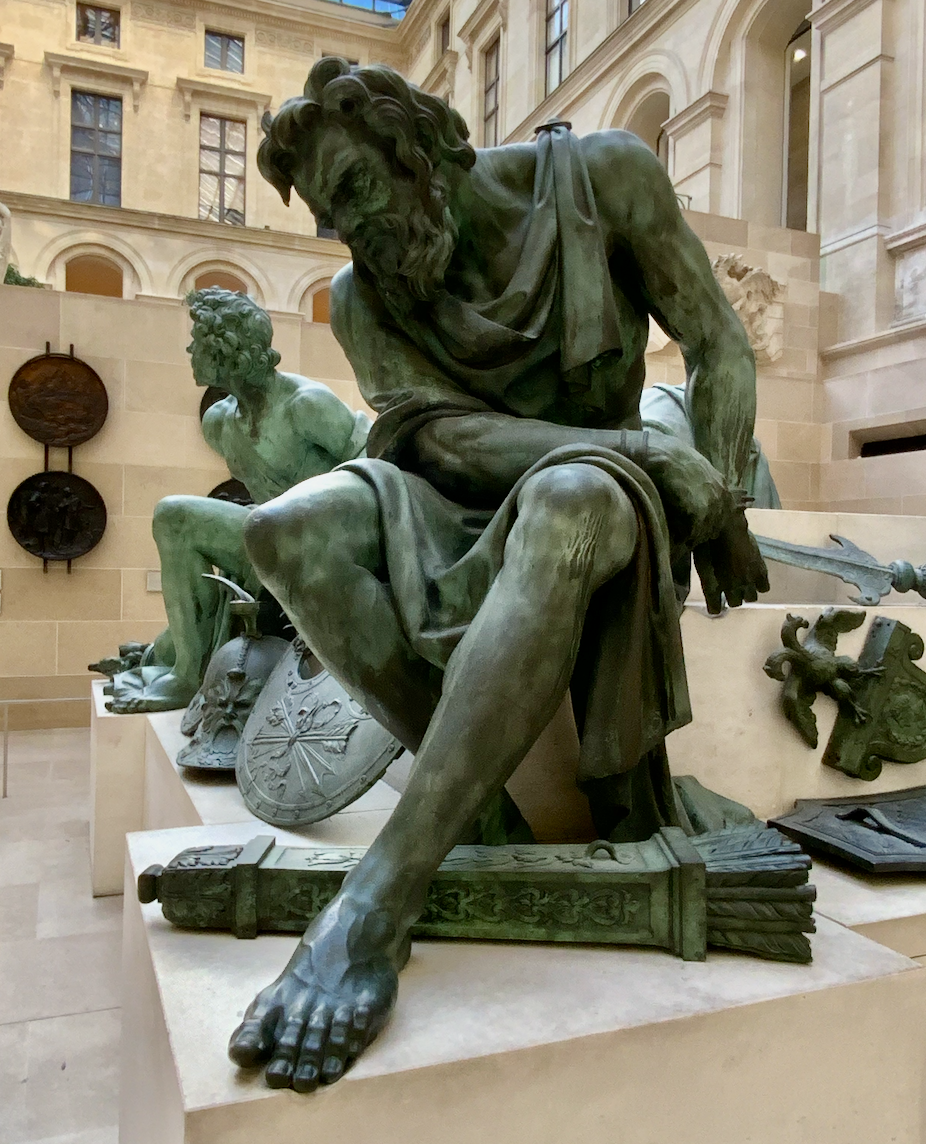
On August 10, 1678, the Treaty of Nijmegen was signed ending the Quadruple Alliance and the end of the Dutch war. France came out on the top by gaining control over Franche-Comté and many of the towns in northern France away from Spain. The original statue was created by Martin Van den Bogaert, known as Desjardins featured Louis XIV standing tall while victory crowns him with a laurel wreath. Below the statue were four bas-relief plaques created between 1681-1685 to commemorate the victories of Louis XIV on the base are the four captives that each represents each of the nations he defeated but each also shows a feeling and a stage of life. 
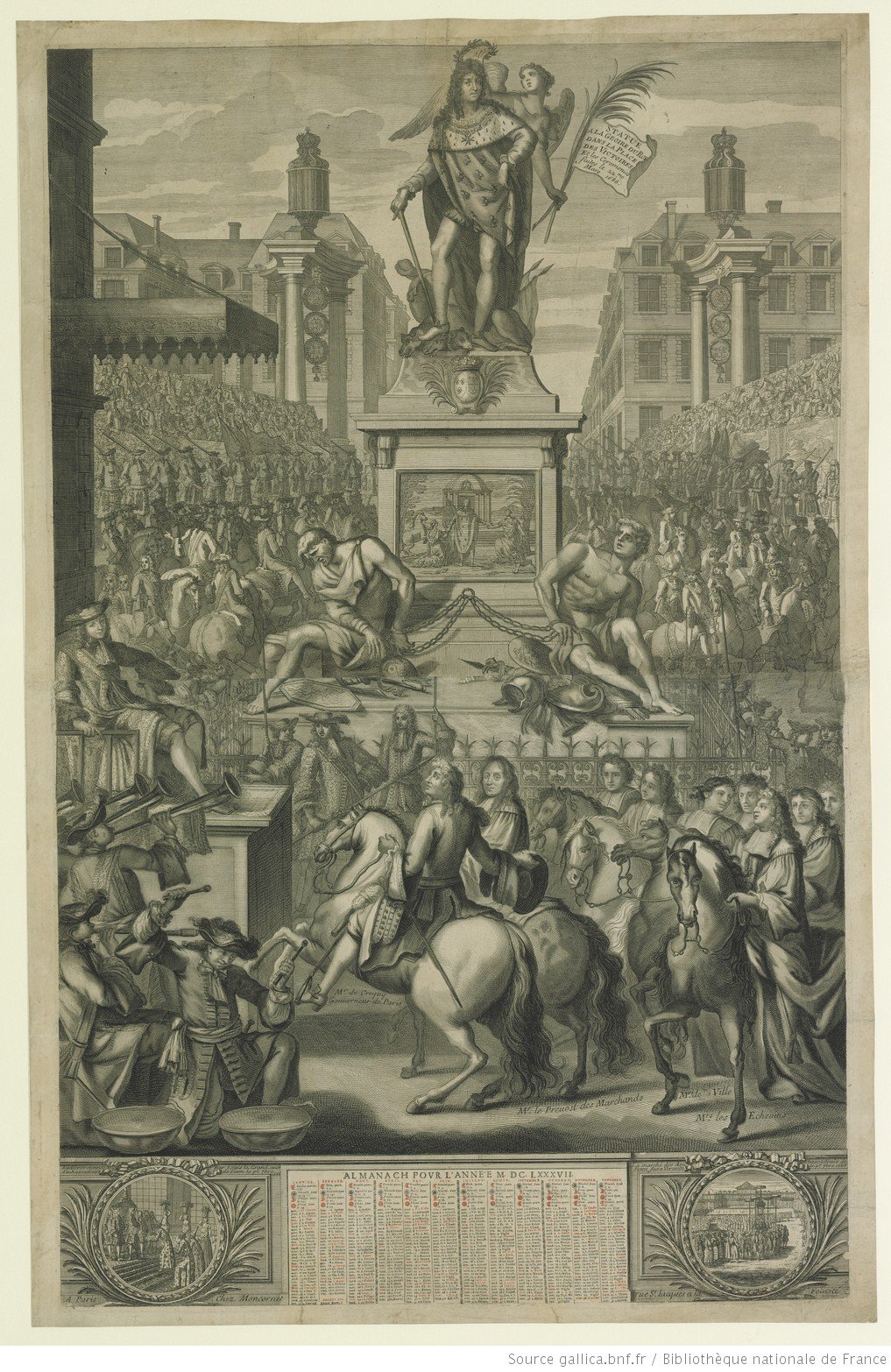
As most stories go, when we reach the Revolution a statue dedicated to a king would not survive. The Revolutionists shot down the statue in 1792 and the ol’ Sun King was melted down to create cannons. 

On August 10, 1792, the storming of the Tuileries that led to the absolving of the monarchy but also resulted in many deaths was then marked where Louis once stood with a pyramid covered with the names of those that died. The pyramid didn’t last long under the hot summer sun and fell apart. Under Napoleon, they decided to add another statue to General Claude Dejoux but the very tall nude statue was a bit shocking in all its, ummmm, glory and was partially covered to shield the eyes of the children. Louis XVIII had the statue of Dejoux melted down to recreate the statue of Henri IV on the Pont Neuf in 1814. 

Louis XVIII commissioned Francois-Joseph Bosio to create a statue of his great-great-grandfather Louis XIV that could once again be placed in the center of the Place des Victoires. Inaugurated on August 25, 1822, Louis XIV on his horse getting ready to charge into battle sits in the perfect position to catch the sun rising behind him on an early morning. 

The one thing that draws me to this statue is the history of the statue that came first because as with all things in my life, all roads lead to the Louvre. Technically the Rue Croix des Petits Champs just off Louis leads right to the Louvre. 

Inside the Richelieu wing in the lovely Cour Puget are 41 pieces of the former monument to the Sun King. While Louis himself didn’t make it past the Revolution they must have thought the captives, trophies, and bas-reliefs with the image of the king were ok to keep around, and for that I am grateful. 

As you walk into the Cour Puget it is hard not to be impressed by the immense size and detail of the men who are always the background of many selfies much to my chagrin.  As you walk to the right is the captive representing Spain but also a young man filled with hope. Going counterclockwise and behind Spain is Brandbourg who is an adult with the feeling of abetment, next to him is Holland in middle age and angry, and rounding out back to the front is the Empire, resigned to his old age. 
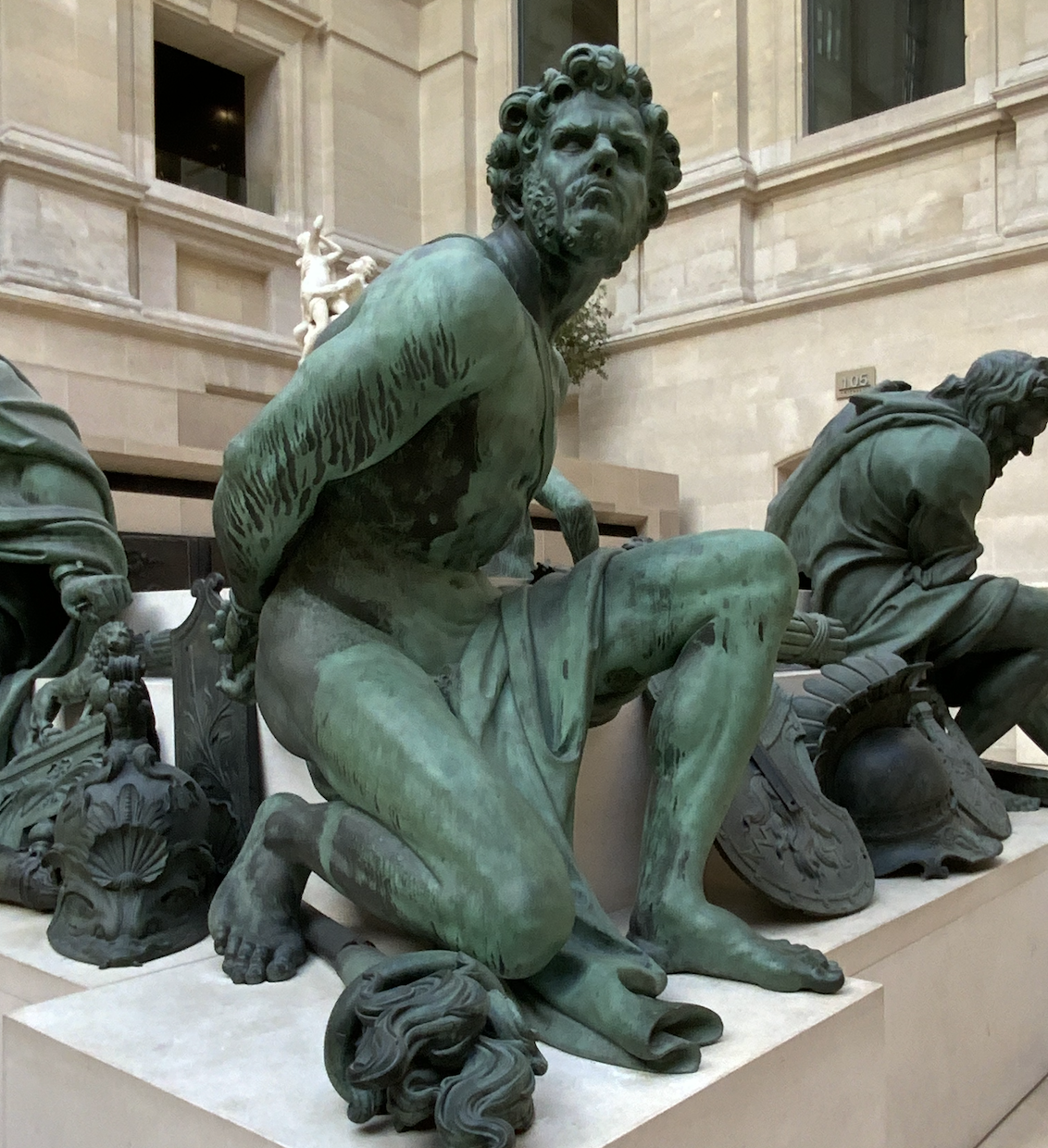
From left to right: Spain & Youth, Brandenburg & Adult, Holland & Anger, Empire & Old Age

In between each of the men are shields, signs, oars, quivers, and faisceau each done out of bronze with amazing detail. Get close to check out each and everyone as well as the hands and faces of the captives. 

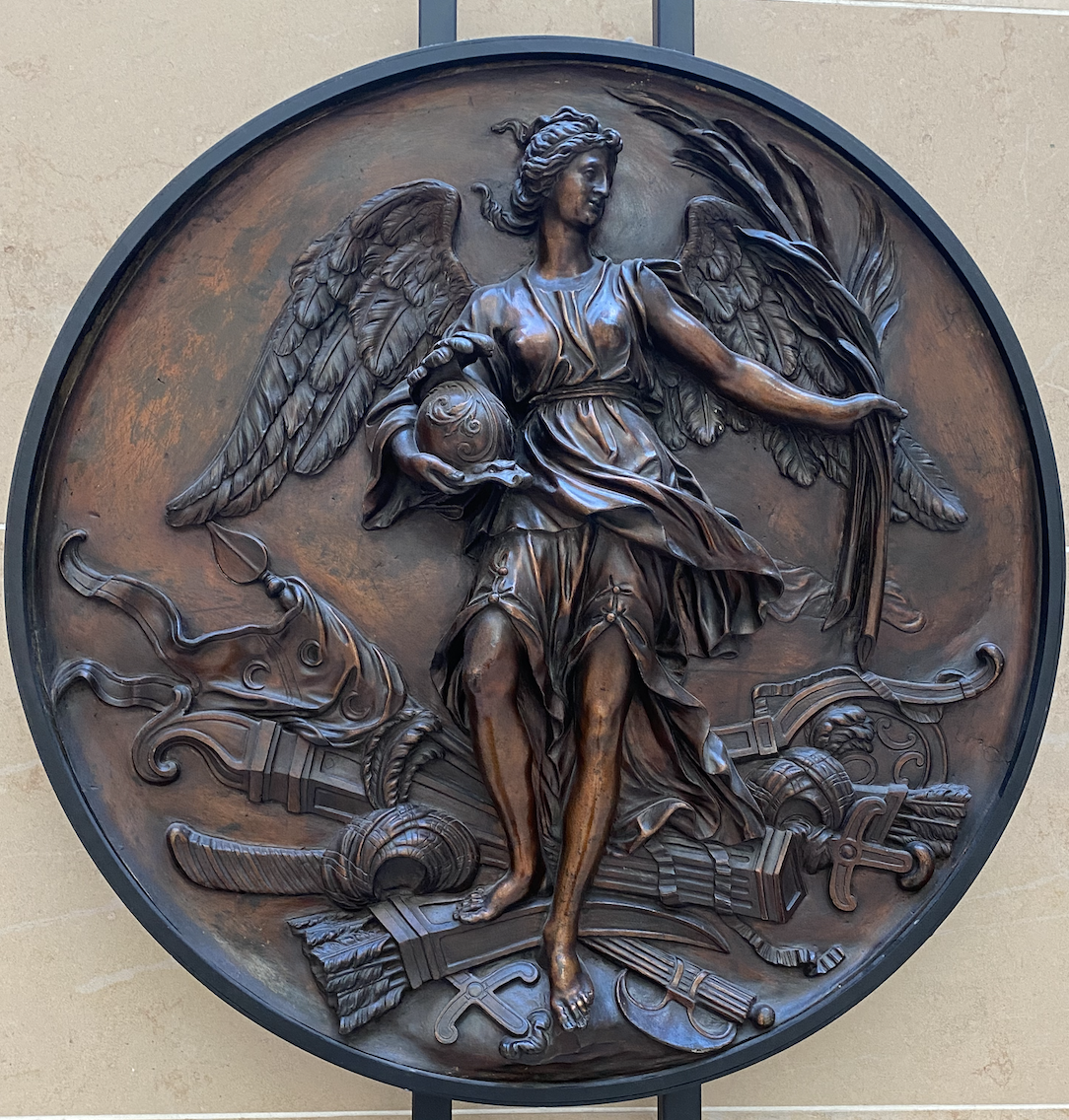
On the eastern wall just behind are the 11 medallions that were once on the four large lampposts around the statue created in jasper marble on red marble bases. Originally there were 24 but only 9 of the 11 are the originals that were intended for the monument. Seven of the medallions after they were removed in 1718 ended up in England in the possession of King George III but returned to the Louvre by George IV. 
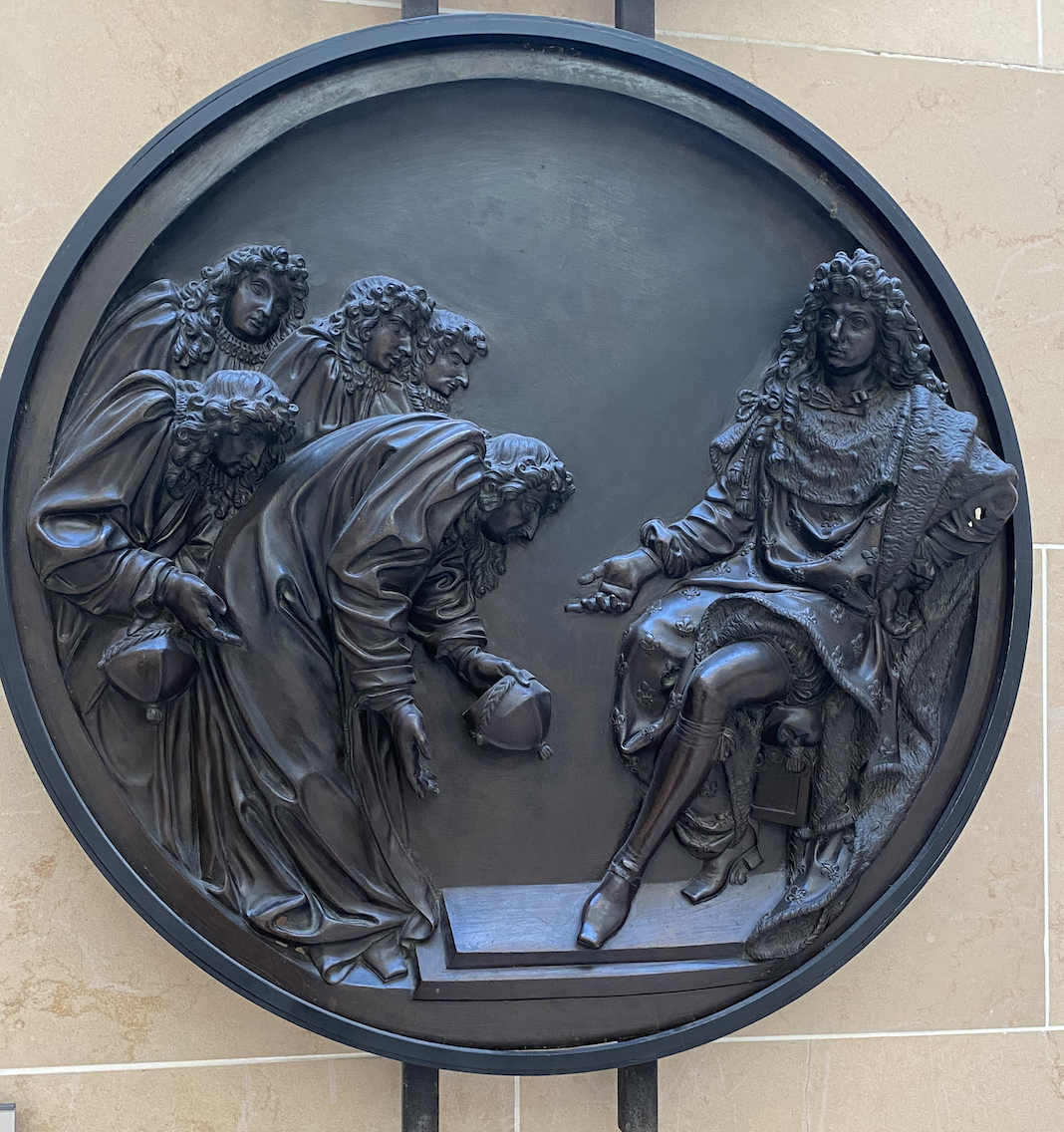
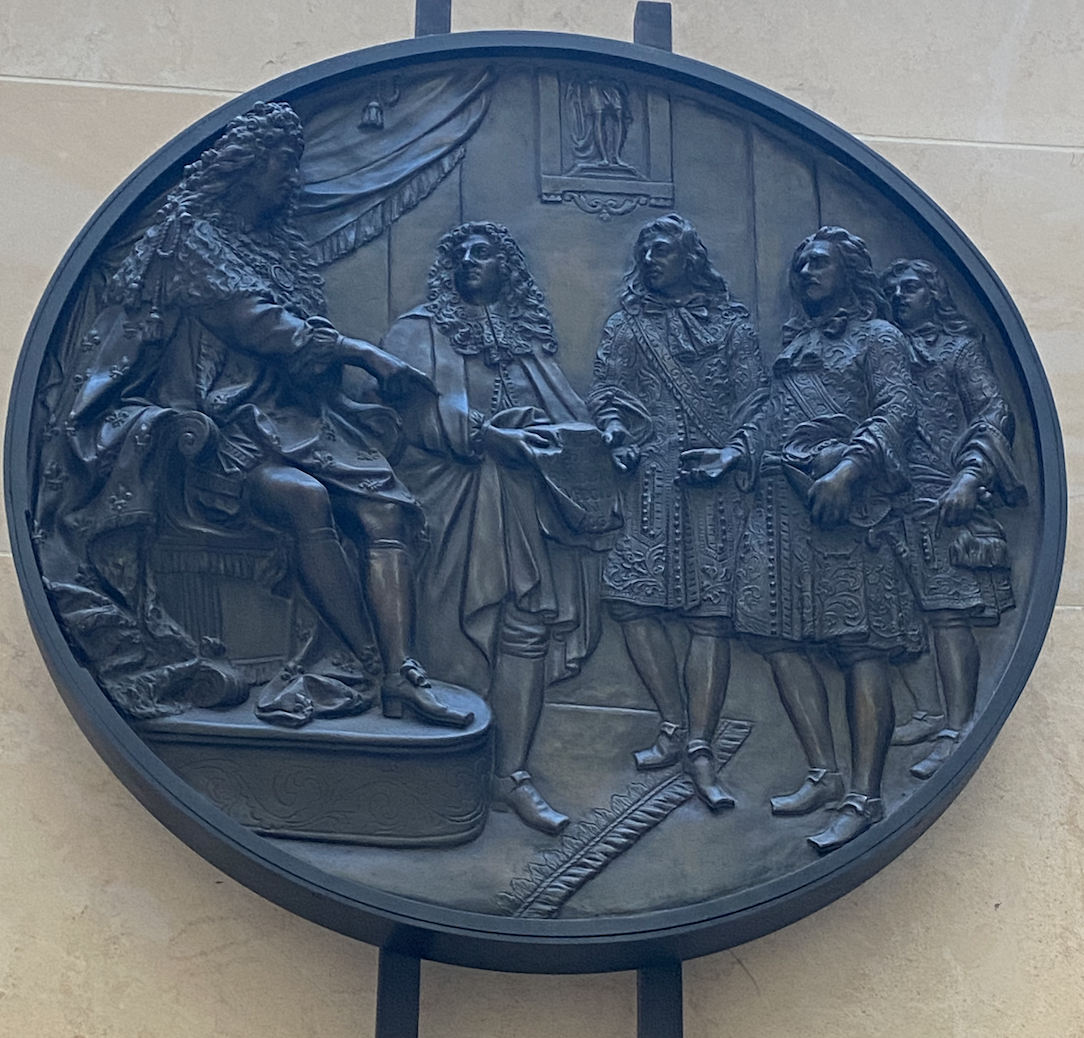
From left to right: The Submission of the Doge of Genoa by Desjardins. Set at Versailles bowing to Louis XIV he is being presented with the submission of his Republic after the French attack on Genoa. Louis XIV demanded he come to Versailles despite the fact he was forbidden to leave Genoa

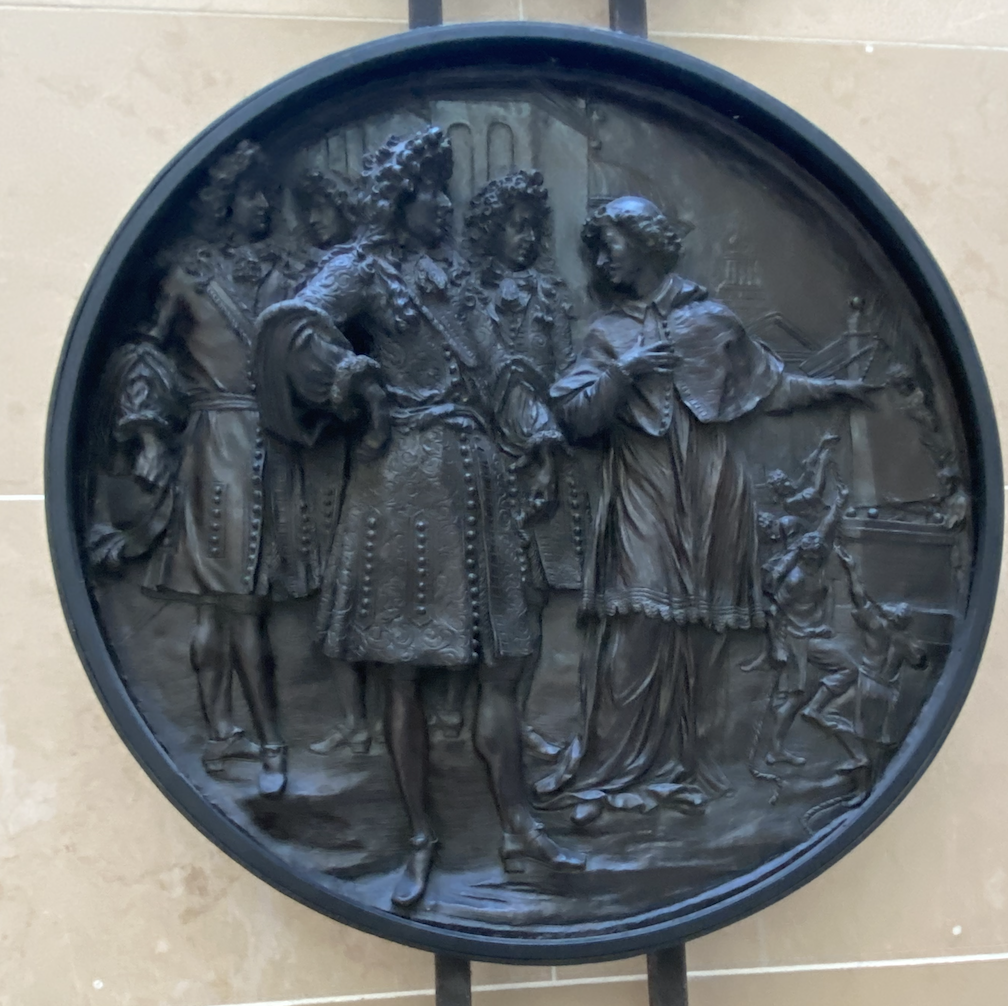
The Reestablishment of the Swedish in Germany by Desjardins. The restoration of Pomerania to the Swedish by the Elector of Brandenburg under their Treaty of Saint-Germain-en-Laye in 1679. Louis XIV thought this depiction was humiliating and demanded a new one made.

Victory of Saint Gotthard by Jean Arnould. Winged Victory is holding a palm leave and stands on trophies featuring oriental elements as crescents and turbans evoking the battle of 1665 between the Holy Roman Empire and aided by the king of France, and the turks near the monastery of Saint Gotthard in Hungary.

The Reestablishment of the Swedish in Germany by Jean Arnould The updated version that the king preferred.
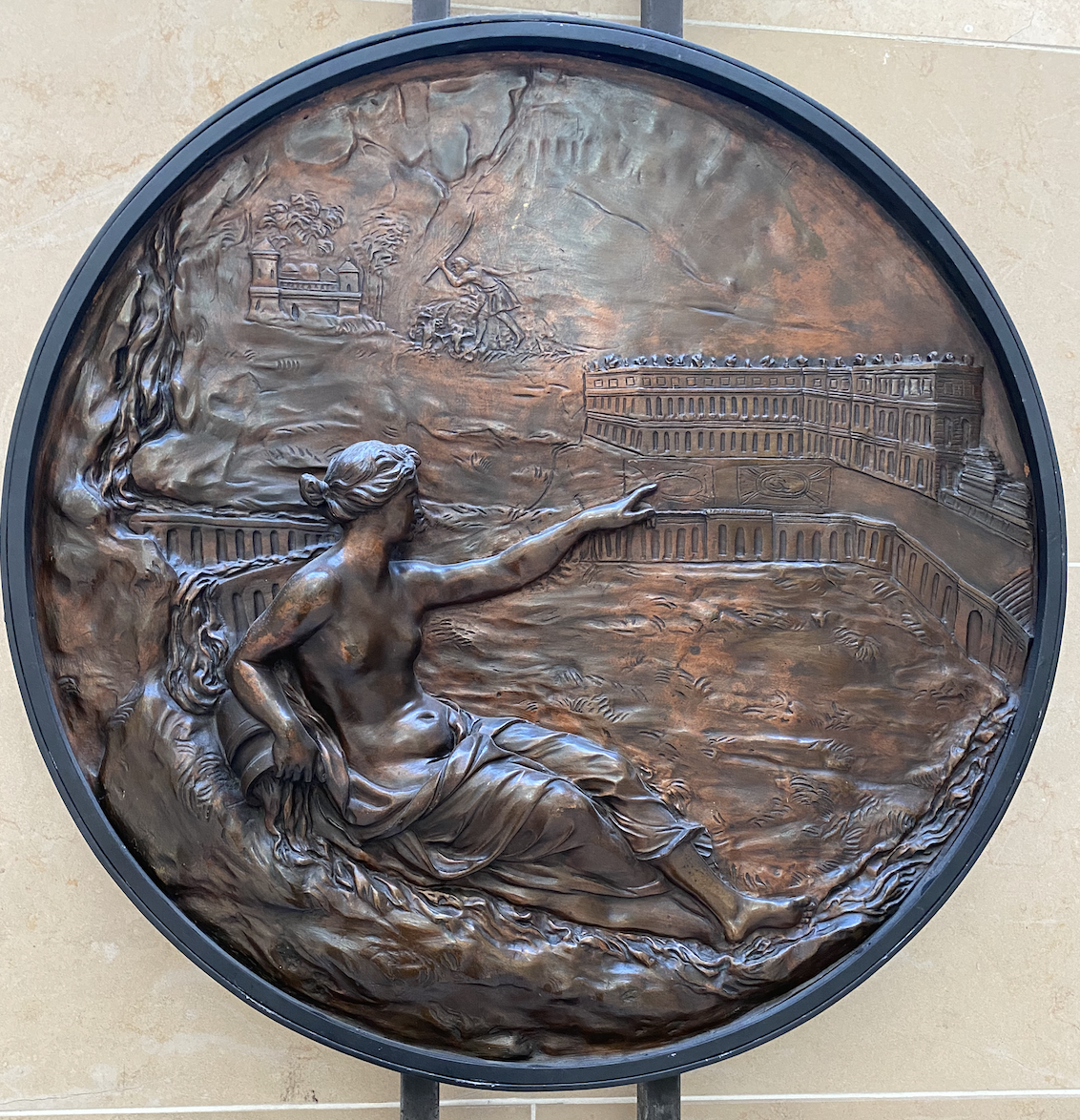
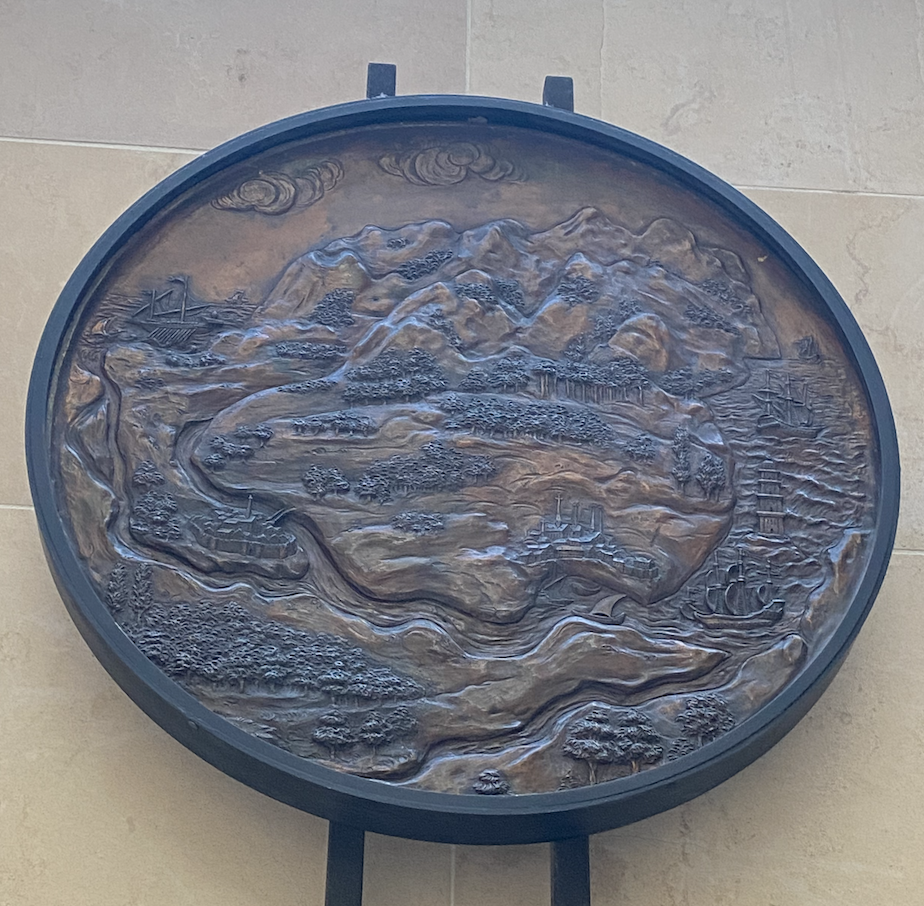
Left to Right: The Magnificent Buildings of Versailles by Jean Arnould. The Nymph of the fountains of Versailles points to the chateau of Louis XIV seen from the Orangery. Behind is the Maintenon aqueduct that brought water to the palace fountains

The Junction of the Two Seas by Jean Arnould. Depicting the digging of the Canal des Deux-Mers (Canal du Midi) a technical masterpiece by Pierre-Paul Riquet and carried out from 1666- 1681. The canal links the Mediterranean on the left as the port of Sète to the Atlantic on the right represented with the Cordouan lighthouse

The Pyramid of the Corsican Guard, Erected then Demolished in Rome by Jean Arnould. This medallion evokes the building of the expiatory pyramid in Rome in 1664 after a dispute between the French ambassador and the pope’s Corsican Guard. Louis XIV had the pyramid demolished in 1668


The Capture of a City by Jean Arnould.
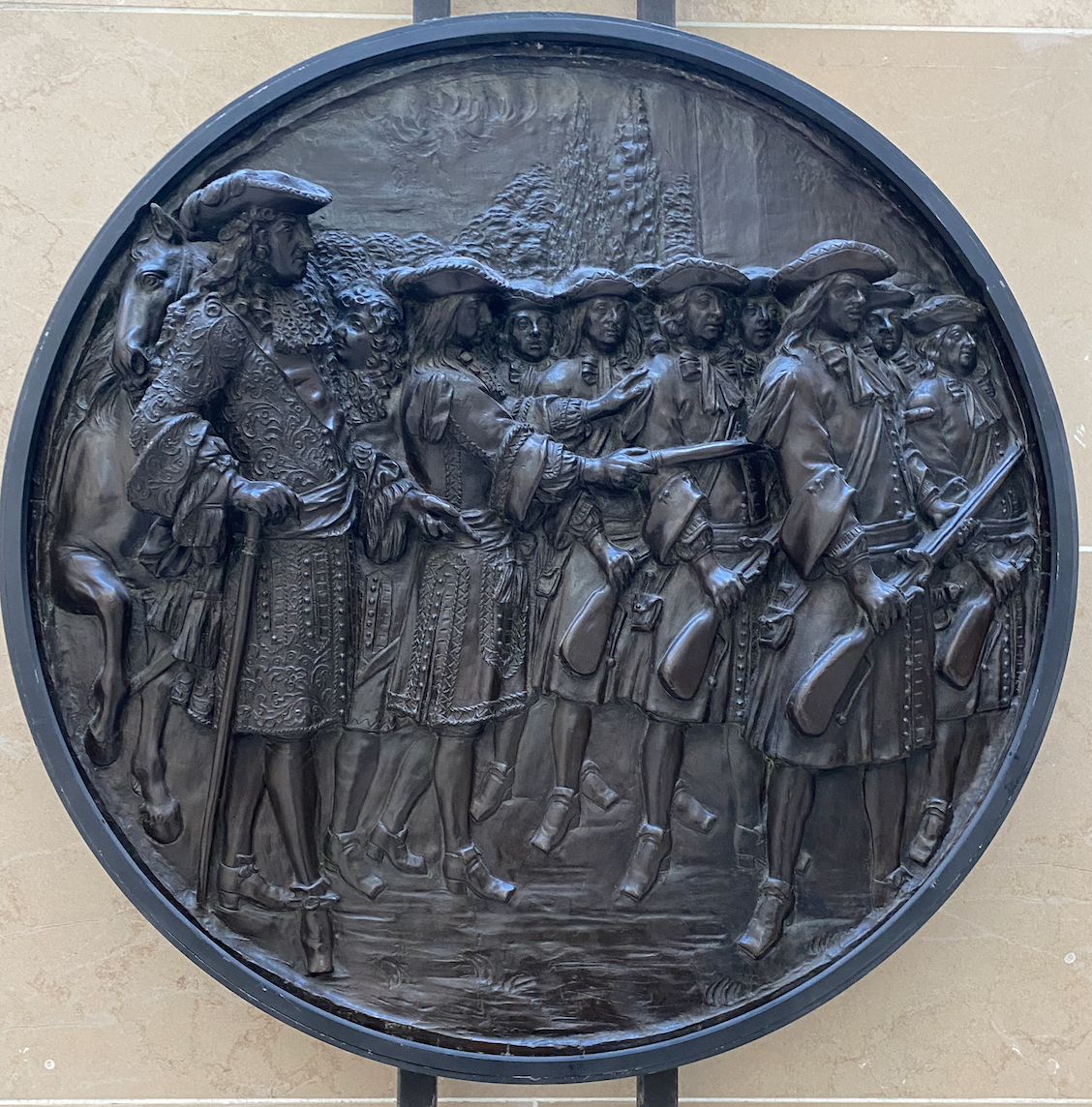
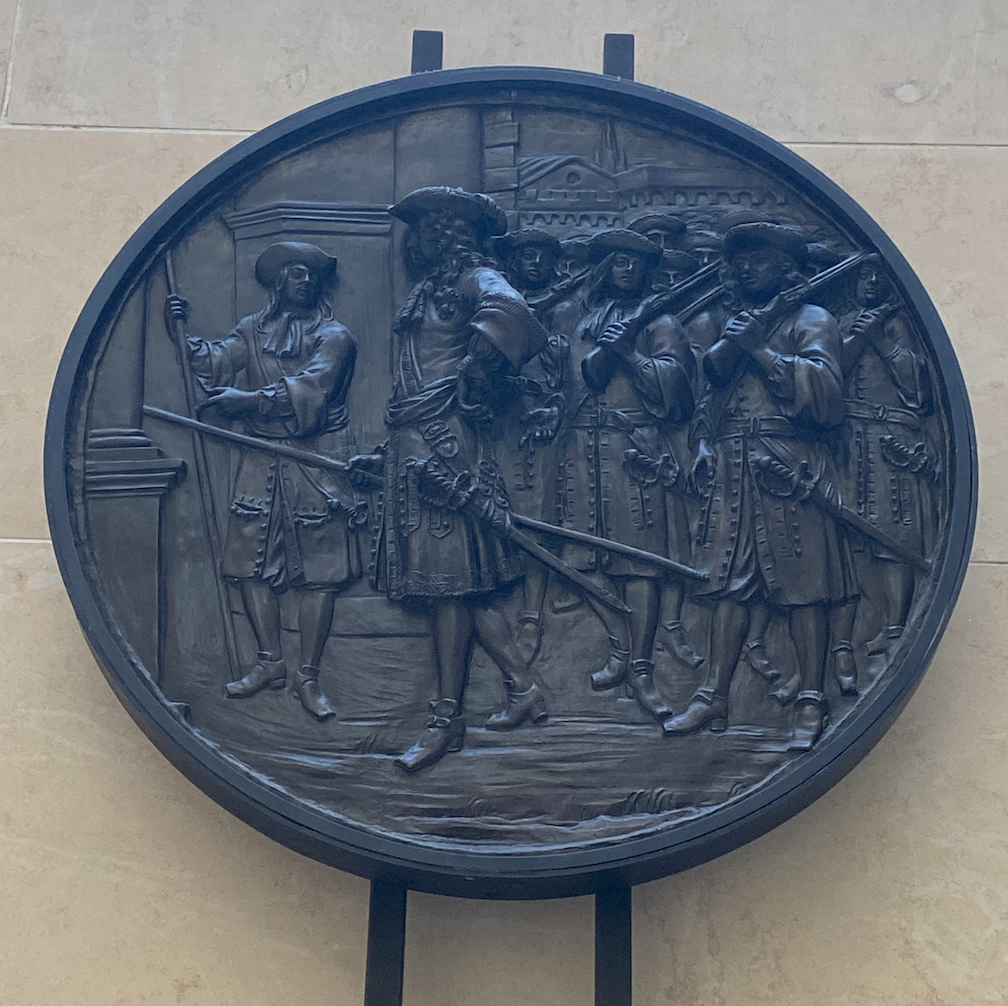
Left to right: The Restoration of Military Discipline by Jean Arnould. Louis XIV is depicted on the left attending military exercises. The scene evokes the reorganization of the army carried out by Michel Le Tellier and his son the Marquis de Louvois, secreataries of State for War.

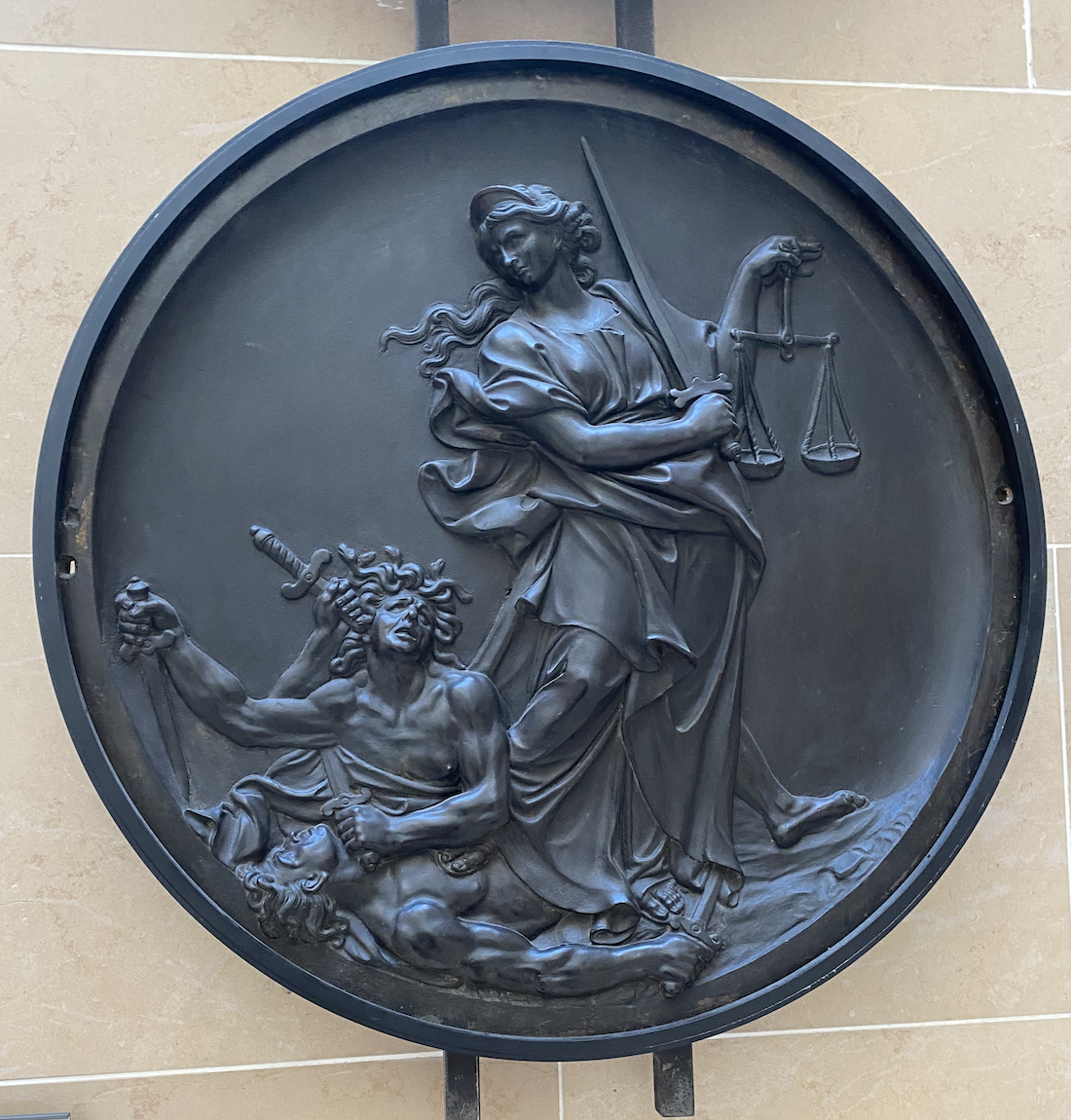
The Abolition of Dueling by Desjardins. Commemorating the king’s bank on dueling shows the figure of Justice holding her sword and scales while two men below her fight to the death

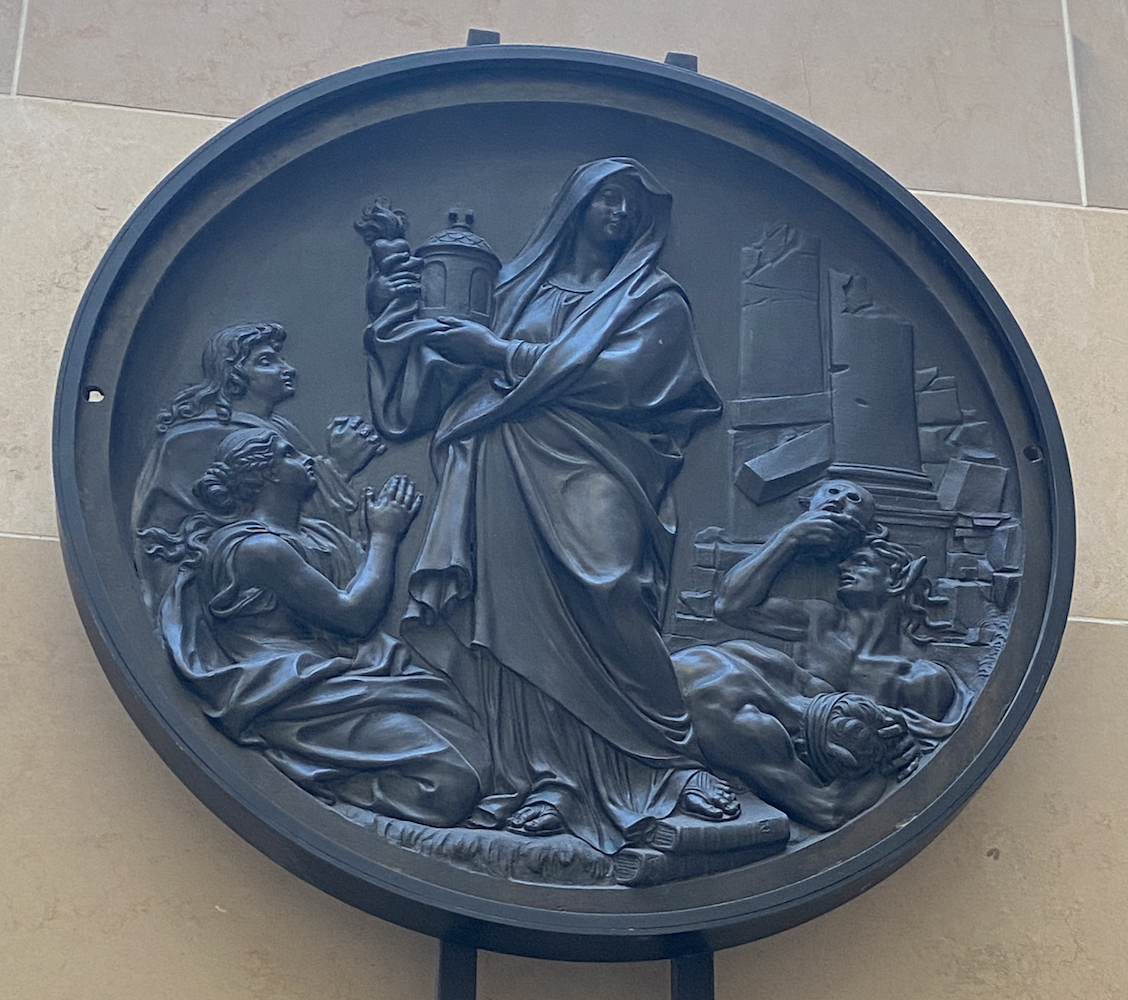
The Destruction of Heresy by Desjardins. Praying figures look up at the allegory of Religion holding a container of holy objects, while a heretic in the background removes his mask. Commissioned a few months before the revocation of the Edict of Nantes that put an end to religious freedom for Protestants

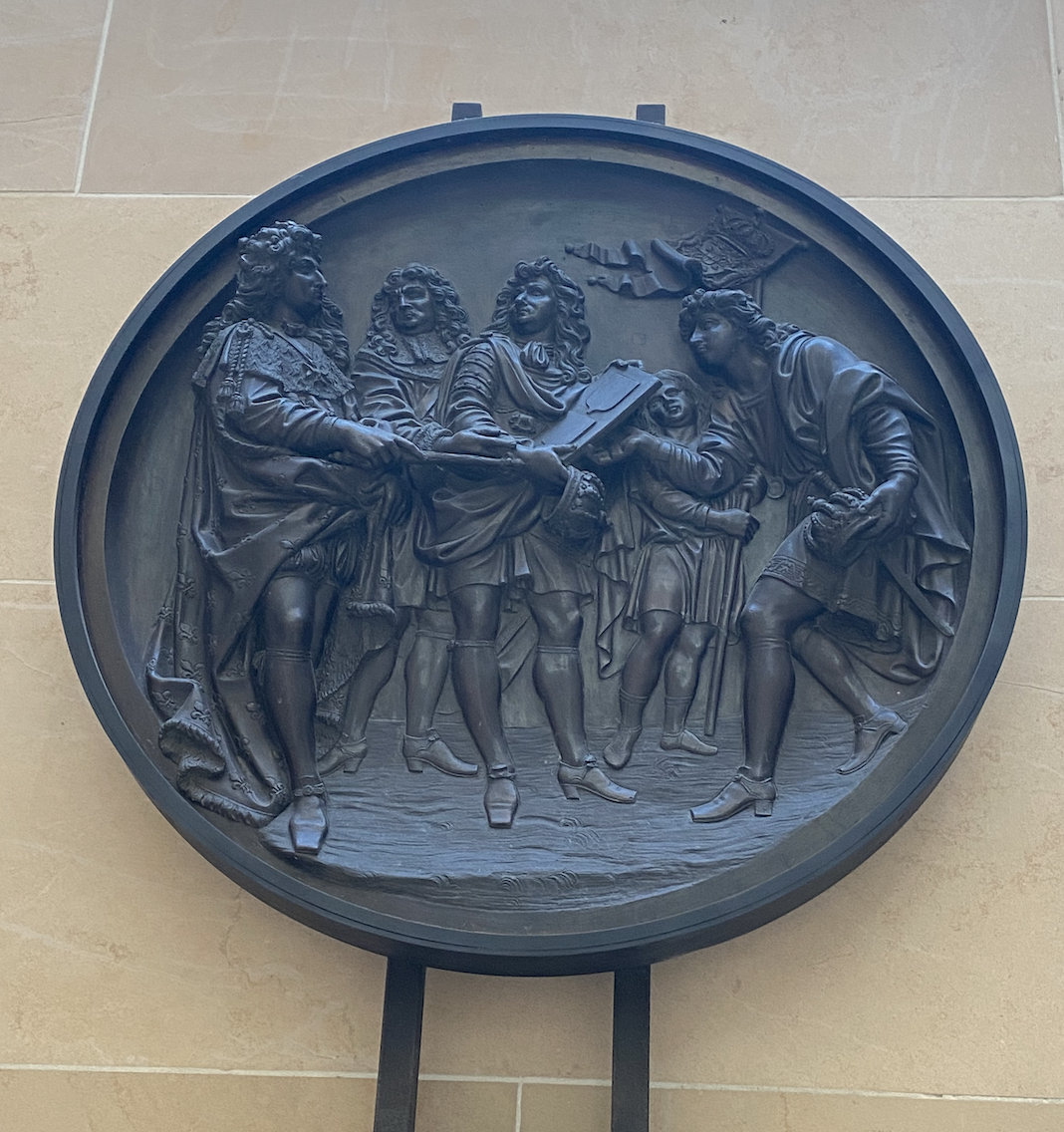
To the right on the south wall are the four bas-relief plaques that were on the base of the statue above the captives and from left to right represent, Spain Recognizing the Precedence of France, Conquest of Franche-Comté, Peach of Nijmegen and Crossing the Rhine. 

Left: Spain Recognizes the Precedence of France by Desjardins. The diplomatic victory of the young Louis XIV on March 24, 1662 is commemorated in the first plaque. The Spanish ambassador made a public apology to the king for having refused to stand next to the French ambassador at an official ceremony in London in 1661. The scene takes place in the Grand Cabinet in the Louvre in his coronation cloak.

Right: The Conquest of Franche-Comté by Desjardins. The second conquest of Franche-Comté in May & June 1674 a great military success from the start of his reign of Louis XIV, symbolized by the capture of the city of Besançon.
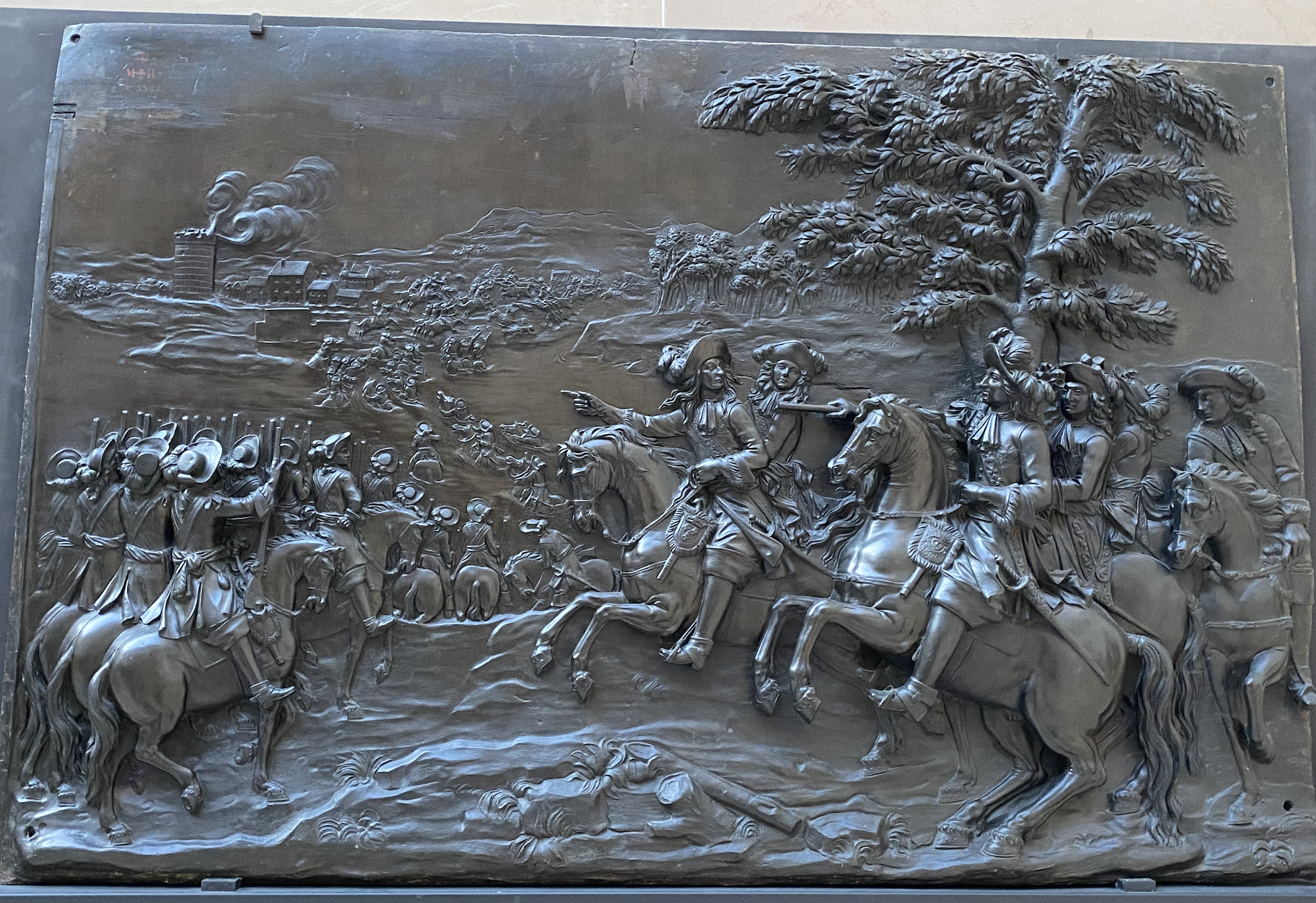
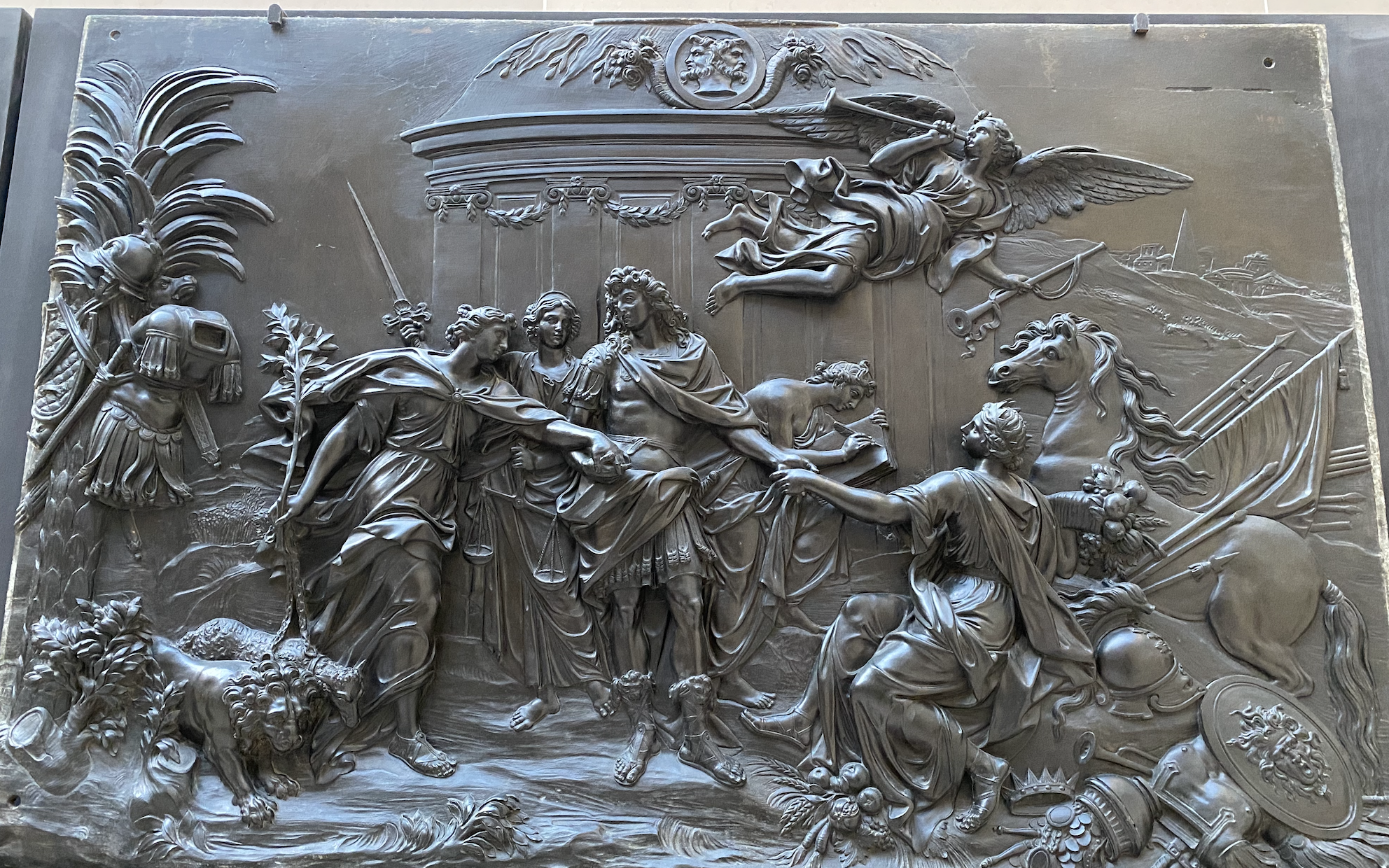
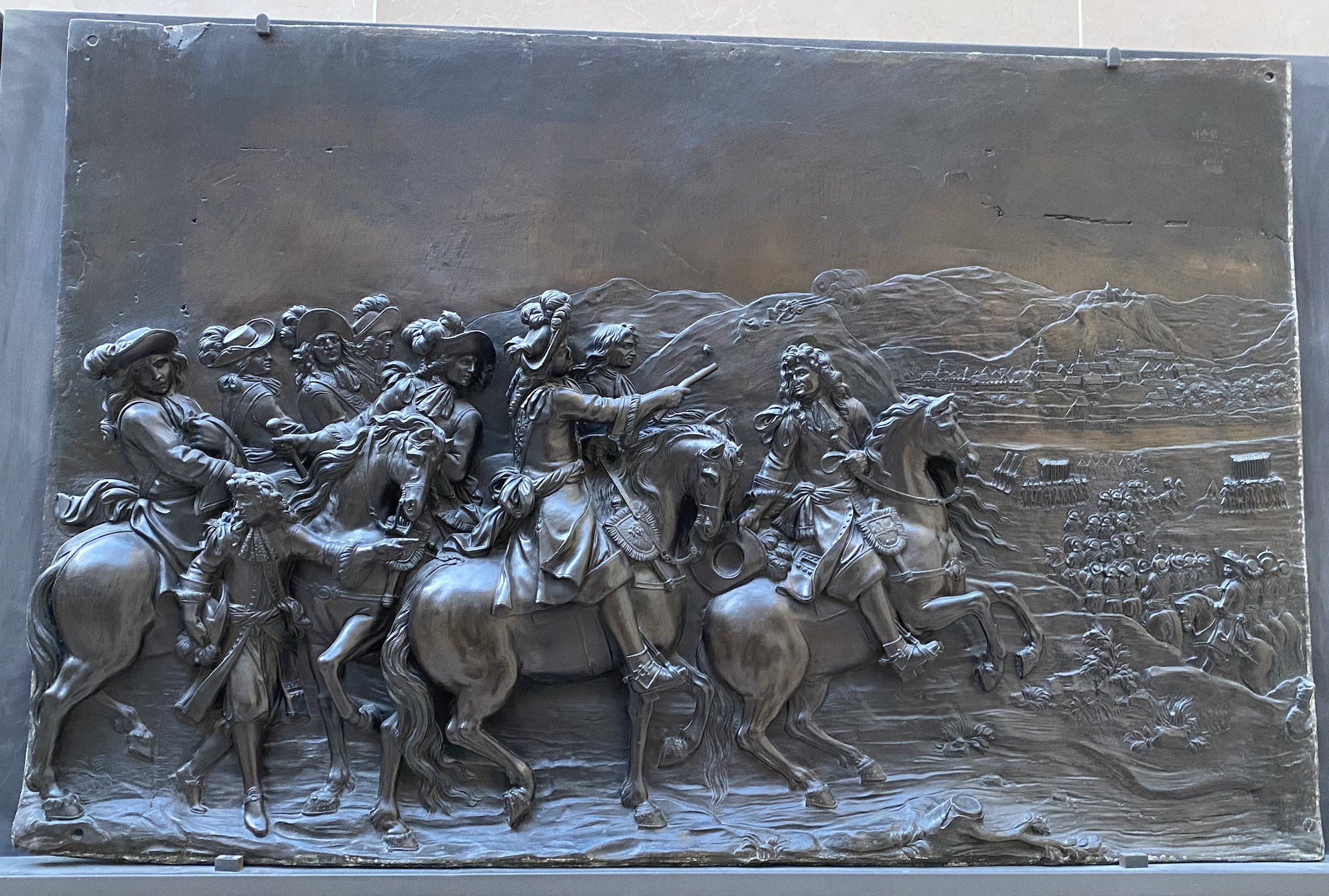
Left: Crossing the Rhine by Desjardins. The triumph from the begining of the Franco-Dutch War during the reign of Louis XIV. when the French army crossed the Rhine on June 12, 1672. Louis XIV and his cousin the Grand Condé are shown on their horses leading the army.

Right: The Peace of Nijmegen by Desjardins. The Treaties of Nijmegen (1678-1679) signed by France with the Dutch Republic, Spain, the Holy Roman Empire and Brandenburg put an end to the Franco-Dutch War. This is my favorite as it brings in allegories of Peace who is seated and represents Europe. The king is surrounded by the allegories of History writing the story, Justice with the scales and Fame blowing the trumpet above.

Together, even without Louis standing in the center it was once an amazing monument that can live on in these 41 pieces and in the etchings of the original dedication. 


Comment

Je t'aime

Comment

Je t'aime

I love you, je t’aime, ich liebe dich and ti amo, are just some of the ways to say I love you. In the Square Jehan-Rictus  a short walk down from Sacre Coeur lives the I Love You wall,  Le Mur des Je T’aime.

  The blue enameled lava tiles have only been there since 2000, but the story behind it dates back a few more years. Frédéric Baron in 1992 would wander the streets of Paris with a notebook in hand and would ask passersby of all nationalities how they would say, “I love you”. Filling page after page and notebook after notebook just to satisfy his curiosity. A friend told him that his project should be shared. Claire Kito, a calligraphy specialist, worked with Frédéric taking each of his pages and bringing them to life. In over 250 languages and 311 phrases, they would be recreated onto 612 enameled tiles, each the same size as the pages he recorded them all on

The royal blue tiles covered with the phrases written in white are dotted with specs of red. These are to represent a broken heart, if they were all gathered together they would become one solid heart. One thing is certain when you stand in front of this wall, while the phrase is so simple, it means the same thing in every corner of the world. All we all want is love, whether it be the love of another or the feeling of falling in love with a place that makes you feel alive.  And maybe we would all be better off if we remembered that.


Comment

Behind the closed doors of the Palais de la Légion d'Honneur

Comment

Behind the closed doors of the Palais de la Légion d'Honneur

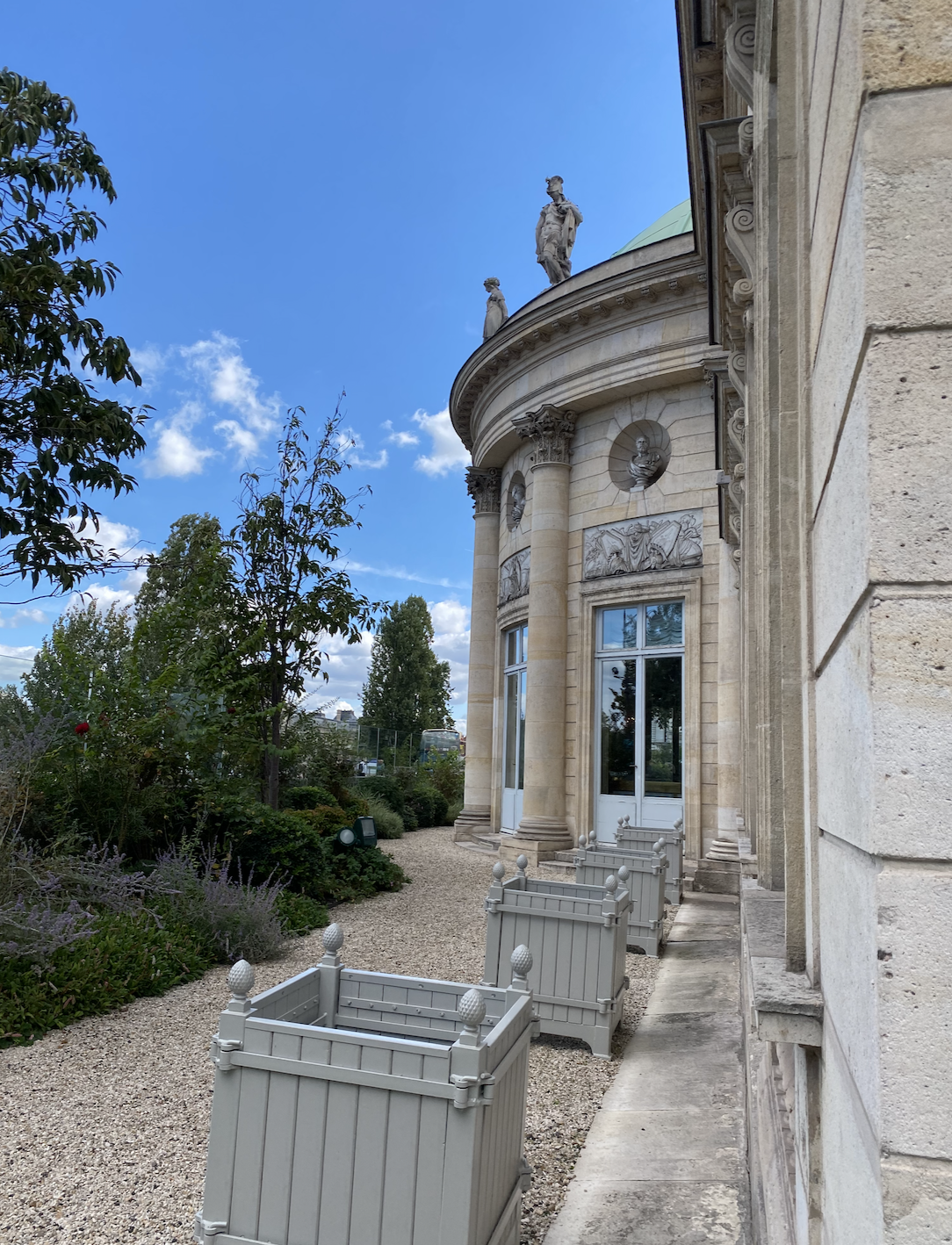
Le Palais de la Légion d’Honneur, hidden behind a high gate and grand arch is one of the many buildings of Paris that are only open once a year. The third weekend in September known as the Journées du Patrimoine is when a treasure trove of locations opens their doors. This past year I finally got into the beautiful building next to the Orsay that inspired both the United States White House and Thomas Jefferson’s Monticello.

Hotel de Salm was built in 1781 for Frederick III Prince of Salm-Kyrburg. Designed by Pierre Rousseau they would later live there for a period when the owner sealed his fate during the Revolution and his life ended by the guillotine in 1794. 

After the Revolution, Napoleon decided they needed something to honor the great members of France. On May 19, 1802, The Légion d’Honneur was established and the first award was given on July 15, 1804, in the chapel of Les Invalides. 

On May 13, 1804, the Comte de Lacepede the first Grand Chancellor, purchased the Hotel de Salm to house the administration of the  Légion d’Honneur. The rooms are lavishly decorated in the Empire fashion with furniture from palaces and chateaux that have since been destroyed. Including pieces from the Palais des Tuileries, Chateau de Saint-Cloud, and Chateau de Compiègne. The office of the Légion d’Honneur is still located here and events and receptions still occur under the dome. 

In 1868 after the creation of the Rue de Solferino the building was enlarged by architect Amédée-Alphonse Lejeune. Three years later much of the interior was destroyed on May 23, 1871, as the Commune burned its way through the heart of Paris. After the Commune, the interiors were completely destroyed leaving just the outer facade standing. Immediately after the fire, architect Anastase Mortier began to draw up plans for an updated version of the interior that we see today in all its Empire glory. 

The palace is the working office of the Legion d’Honneur that give out awards each year to deserving people from authors to high-ranking members of the French military and government. When you first enter the building you walk through the conference room and offices before you enter into the more lavish rooms used for events and receptions. 

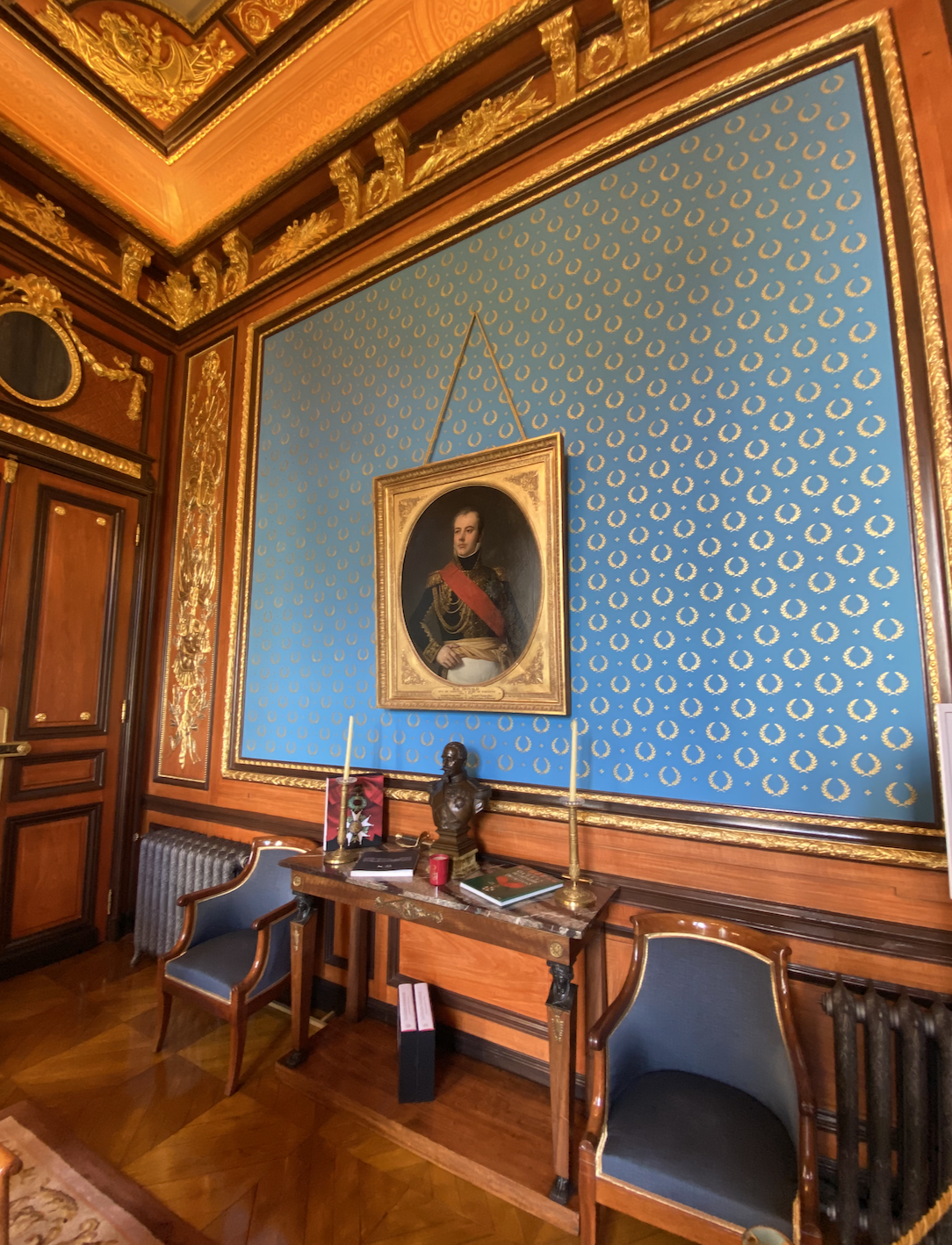
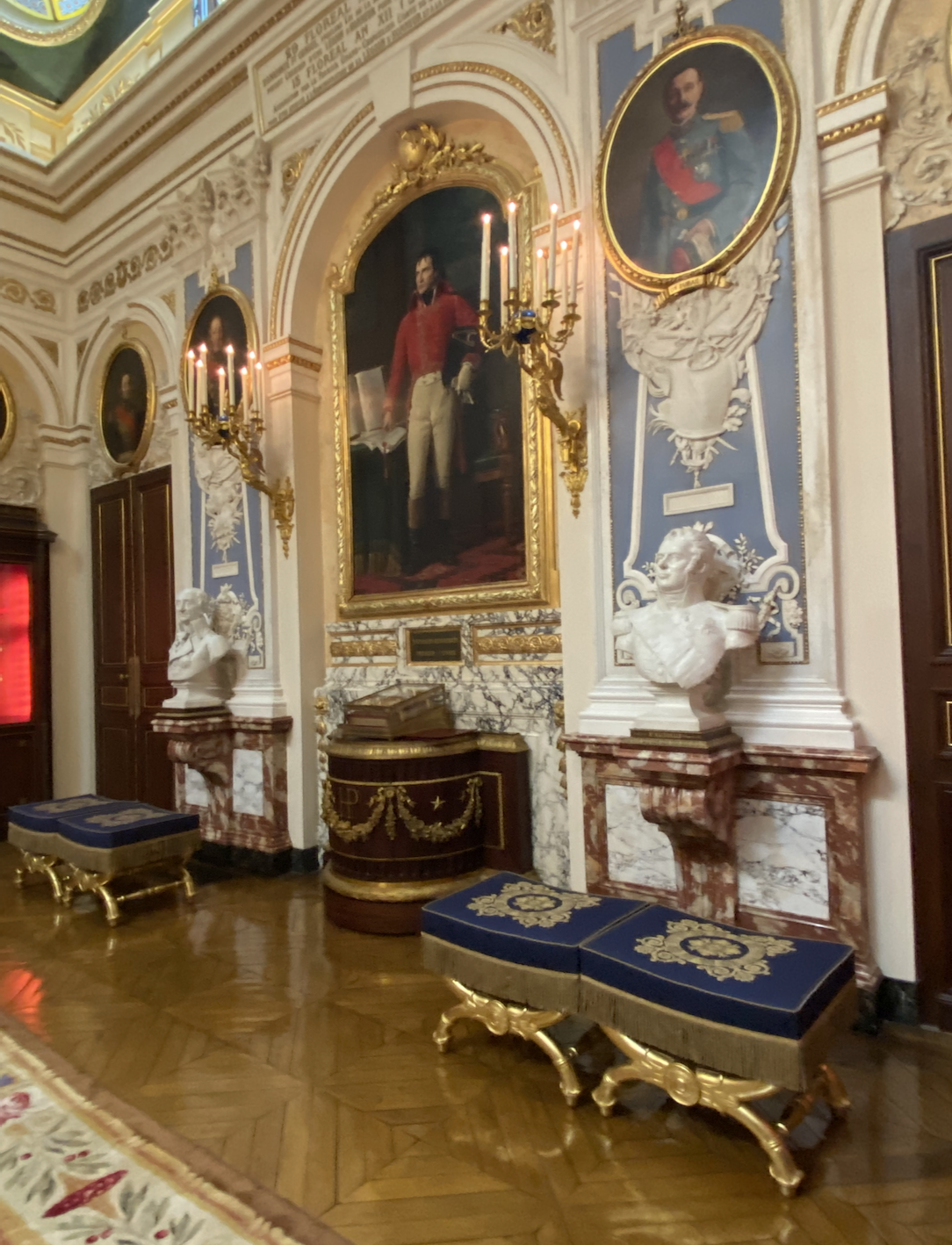
The Bureau du Grand Chancelier is lovely with its wood and guilt bronze perfectly framing the original painting Napoleon en costume de sacre by Robert Lefebvre. I adore the beautiful blue wallpaper with gold laurel wreaths, always a reminder of Napoleon. 

The next room is the Chambre de Madame was originally used for the wife of the Grand Chancelier, today distinguished guests can stay there. Where do I check in?  The ceiling was done by Faustin Besson and the gorgeous chandelier and fabric on the walls and bed is in the style of Louis XVI, always more lavish than the style of Louis XIV. The fireplace is one of the few things that survived the fire and has been lovingly restored. 

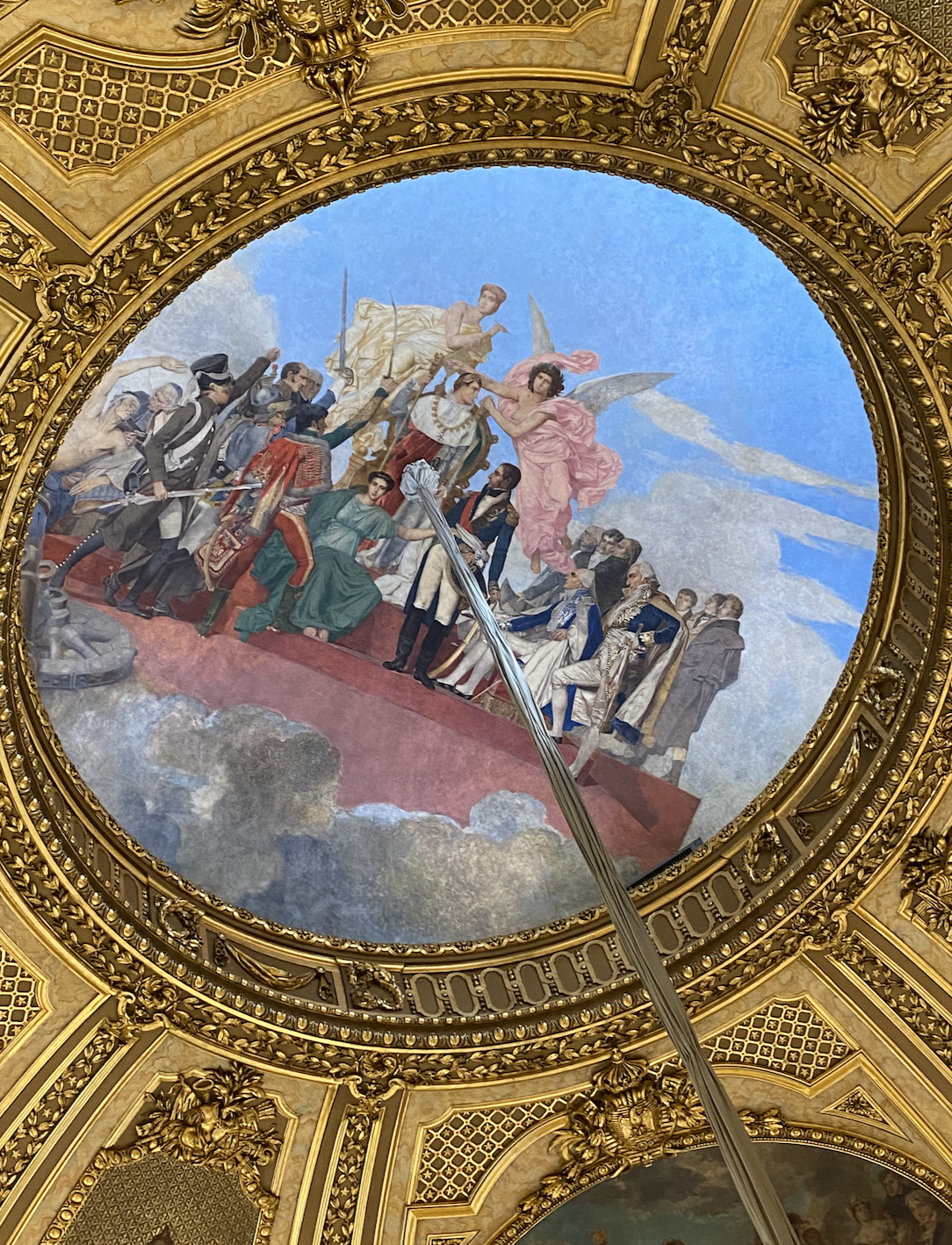
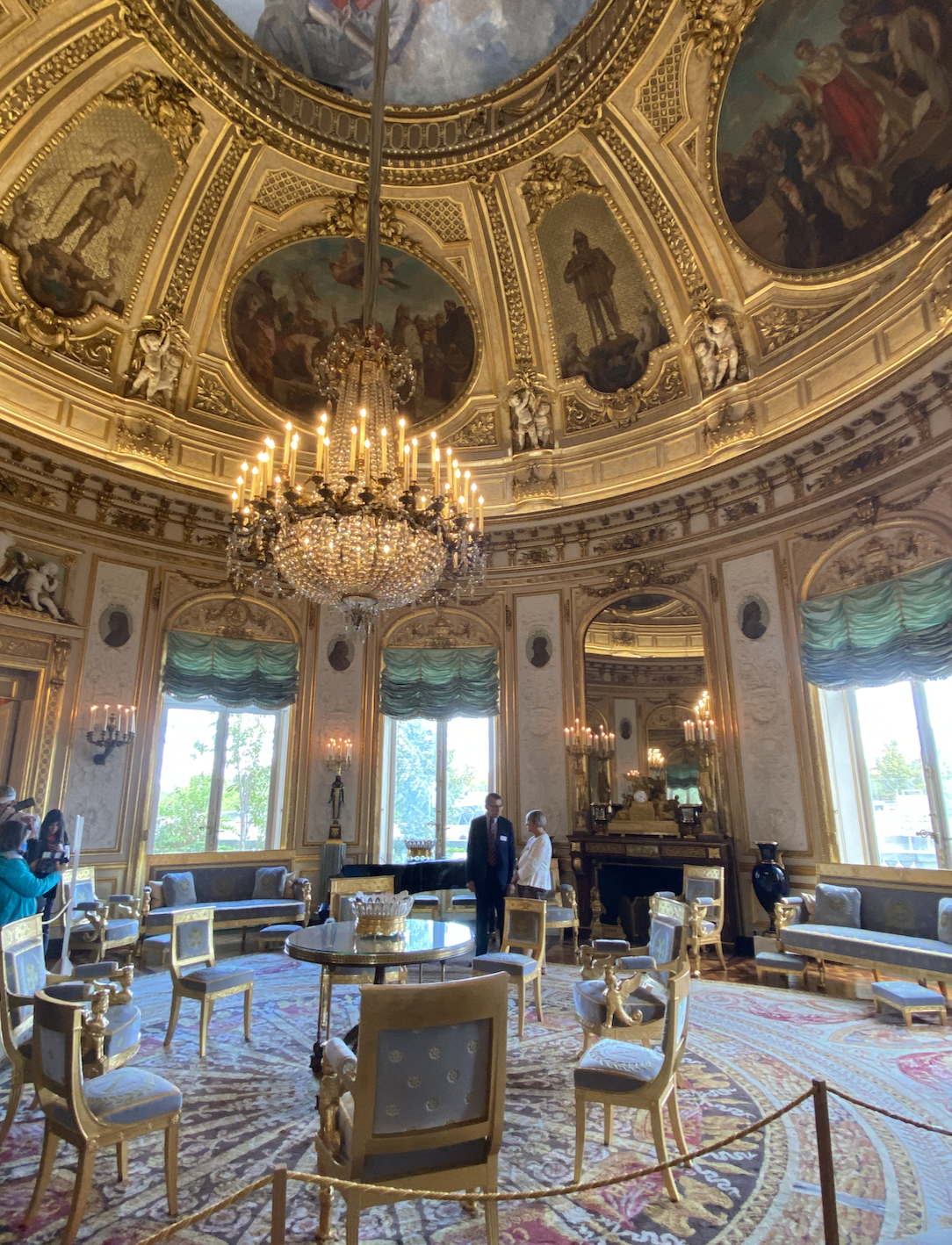
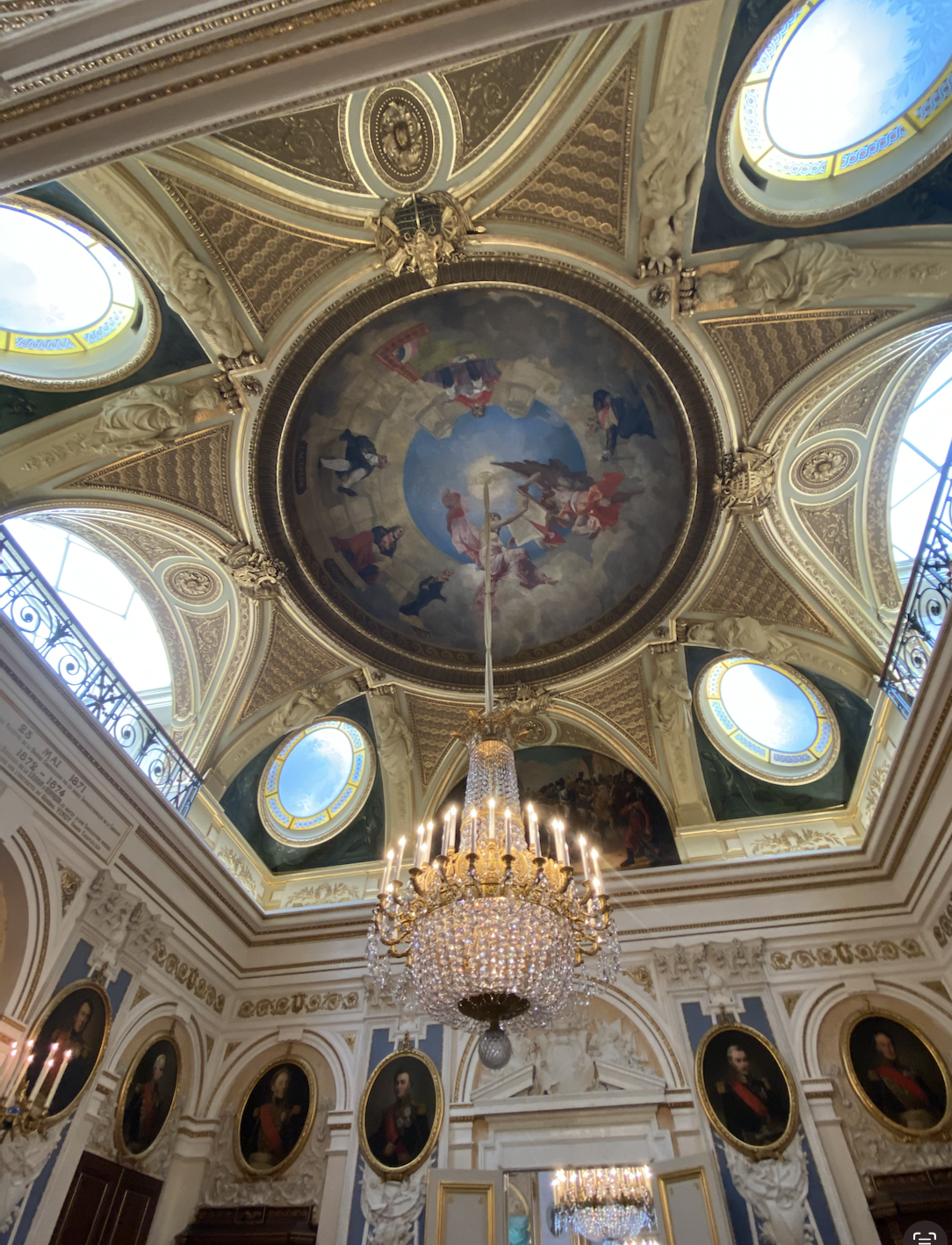
The real jaw-dropper of the building is the ceiling of the Rotunda below the dome that inspired Thomas Jefferson and has many of the greats in French history. In the center is Napoleon Bonaparte, in the form of his many ages. A younger general stands before him and a much older Emperor looks on at himself in his coronation garb. Just below in the oval medallions by Achille Sirouy are four of the great rulers of France. François Ier, Louis XIV, Charlemagne, and Napoleon and each is surrounded by important members and artists of their reign. Between each of those in grisaille we can spot Jeanne d’Arc and Sainte Geneviève. 

Bellow the room is filled with the furniture of Princess Élisa Bociocchi, sister of Napoleon. Surrounding the room in the alcoves are cabinets made by the Empire darlings the Jacob brothers who designed furniture for Josephine and Madame Recamier that you can also see in the Musée du Louvre. 

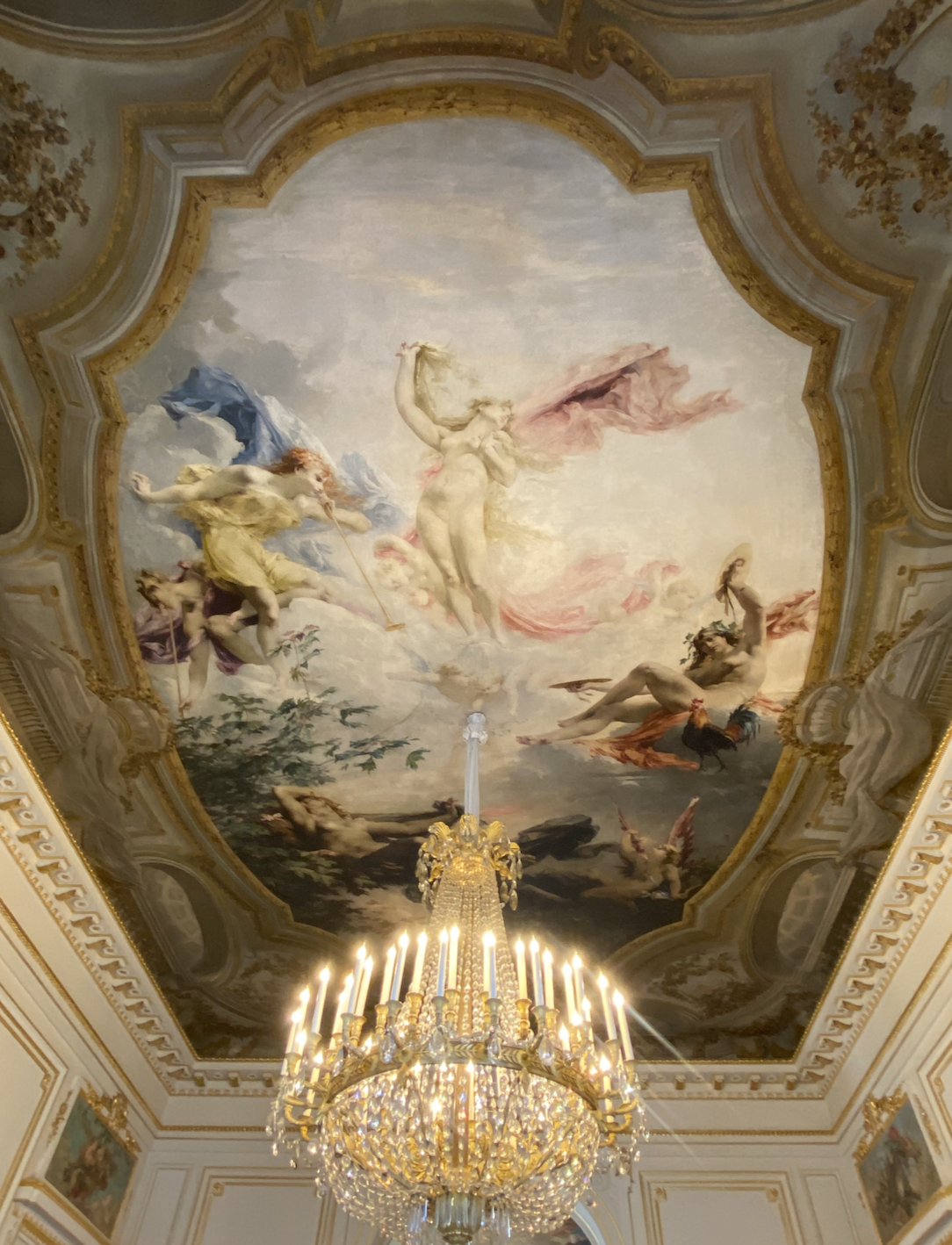
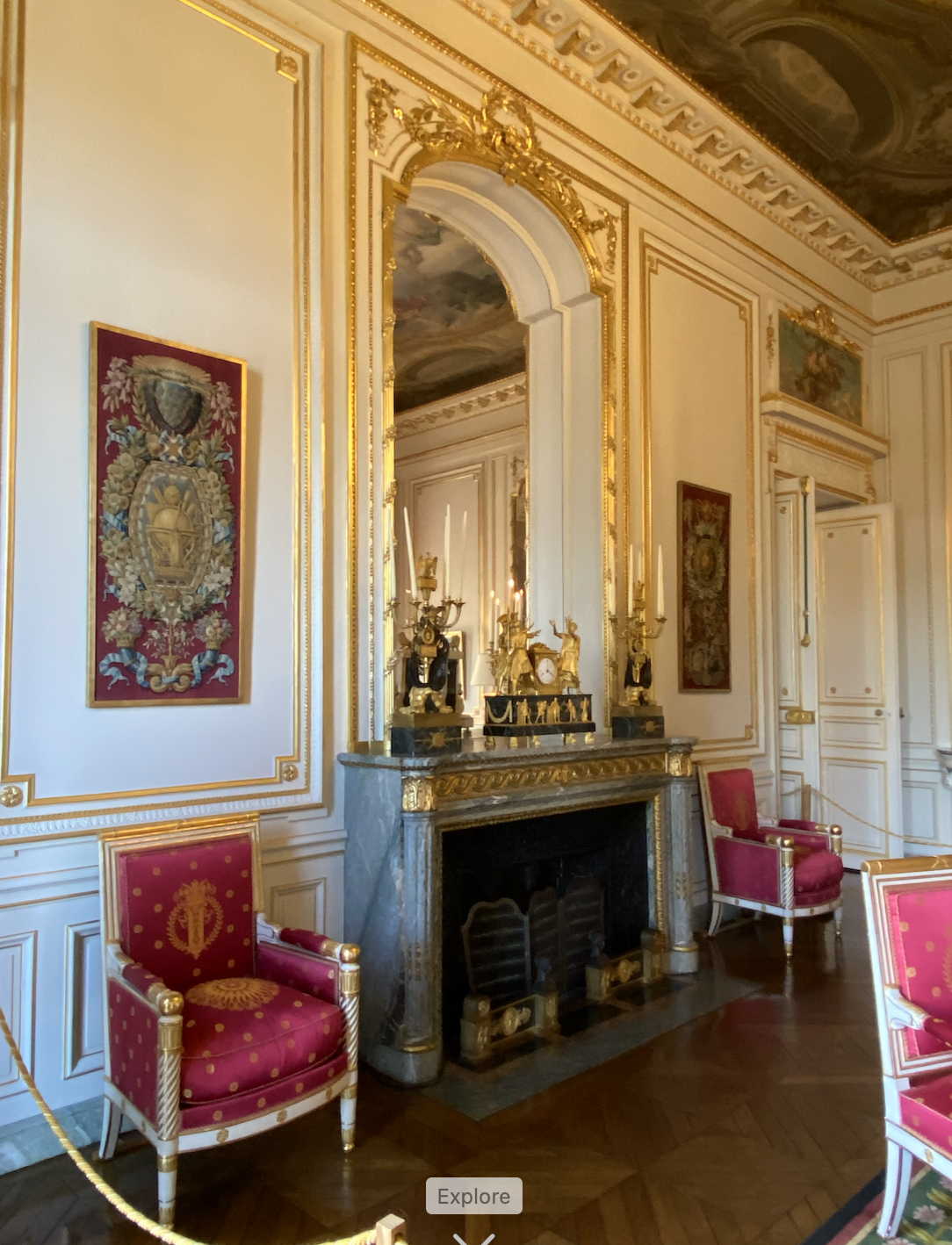
The Salon de l’Aurore, named after the ceiling L’Aurore chassant la nuit  by Joseph Ranvier. Look closely at the fireplace and the gilded clock. Jaques Louis David’s fantastic Oath of the Horatii. The monumental painting of the Louvre is brought to life here on the mantel and framed by screens once in the throne room of the Palais des Tuileries. 

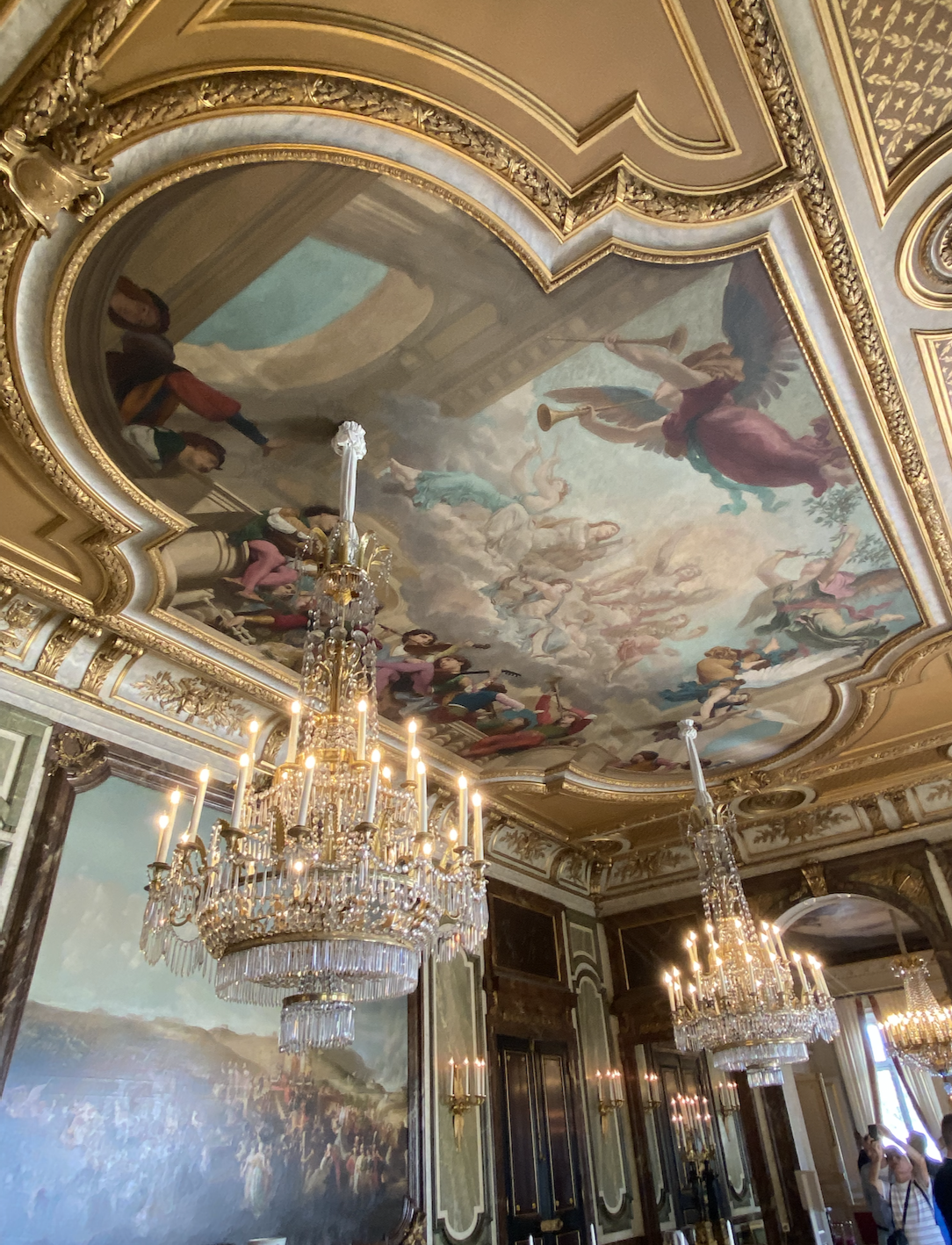
The Salon des Muses is dedicated to the nine muses of Zeus that are high above the ceiling. Apollo et les neuf muses by François Ehrmann. Furniture in the first empire fashion by Pierre-Antoine Bellangé from the Chateau de Compiègne

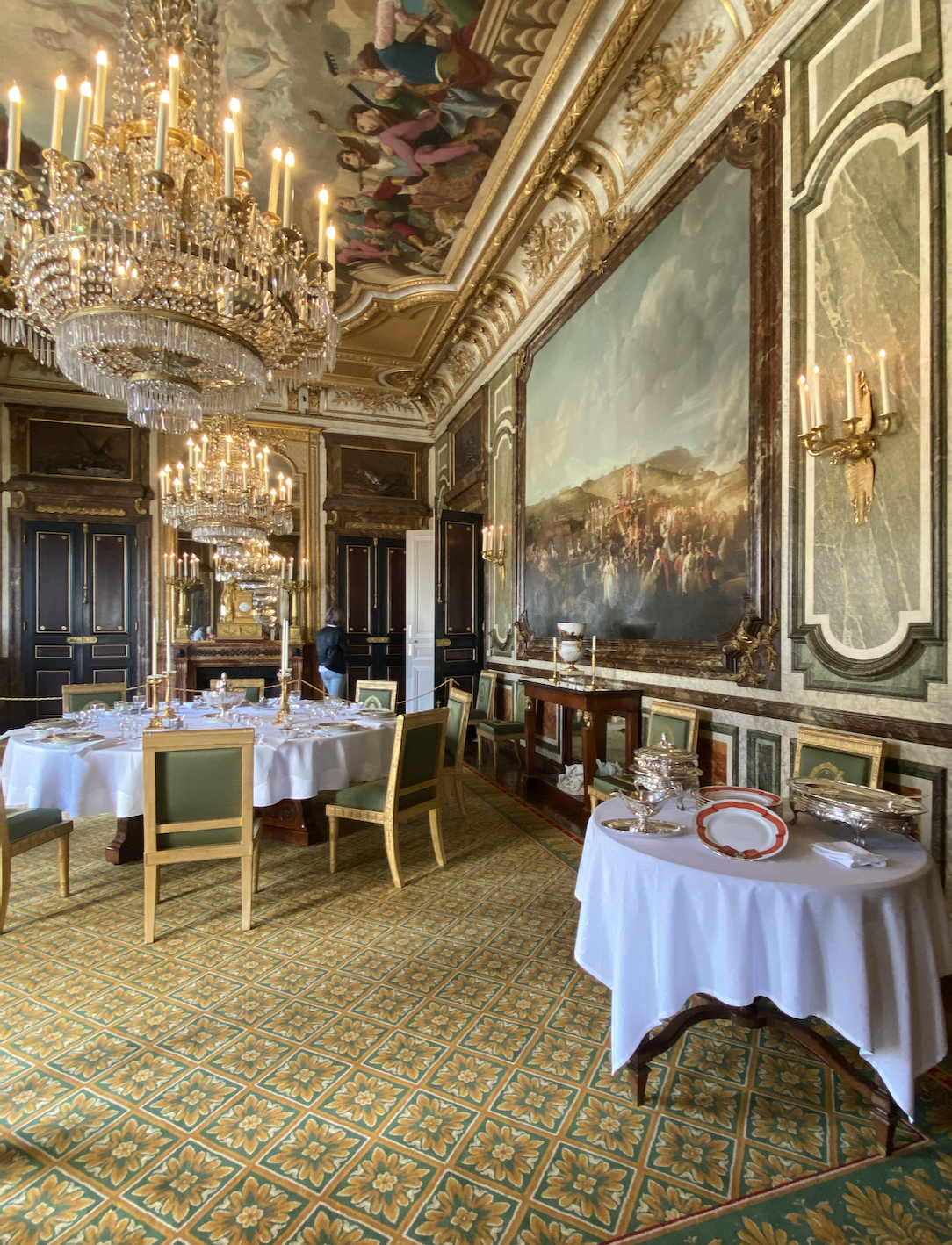
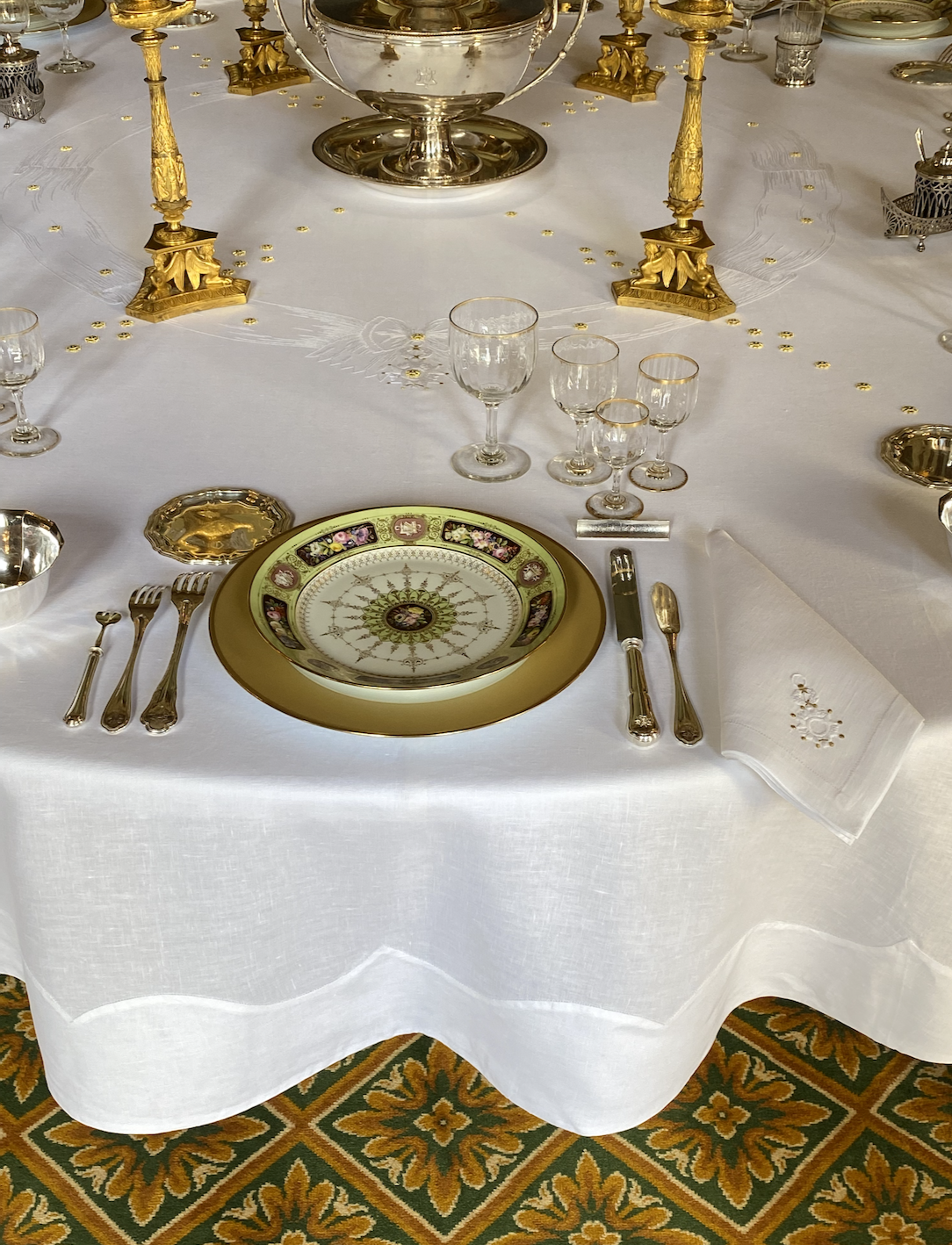
The focal point of the Salle à Manger is the large pedestal table in the center of the room. The table was once in the Salle Diane in the Chateau de Saint-Cloud and where Napoleon III had his last meal before he left Paris in 1870. The chandeliers and candelabra are from the Tuileries and the bronze clock once belonged to the King of Rome, Napoleon II. 

The Salon des Grands Chanceliers is the icing on the cake. The walls include carved woodwork, gilded features, and marble and stucco carvings of the military insignias. The large painting of young Napoleon sits below the important dates in the creation of the Legion d’Honneur and don’t miss the musician balconies above. 

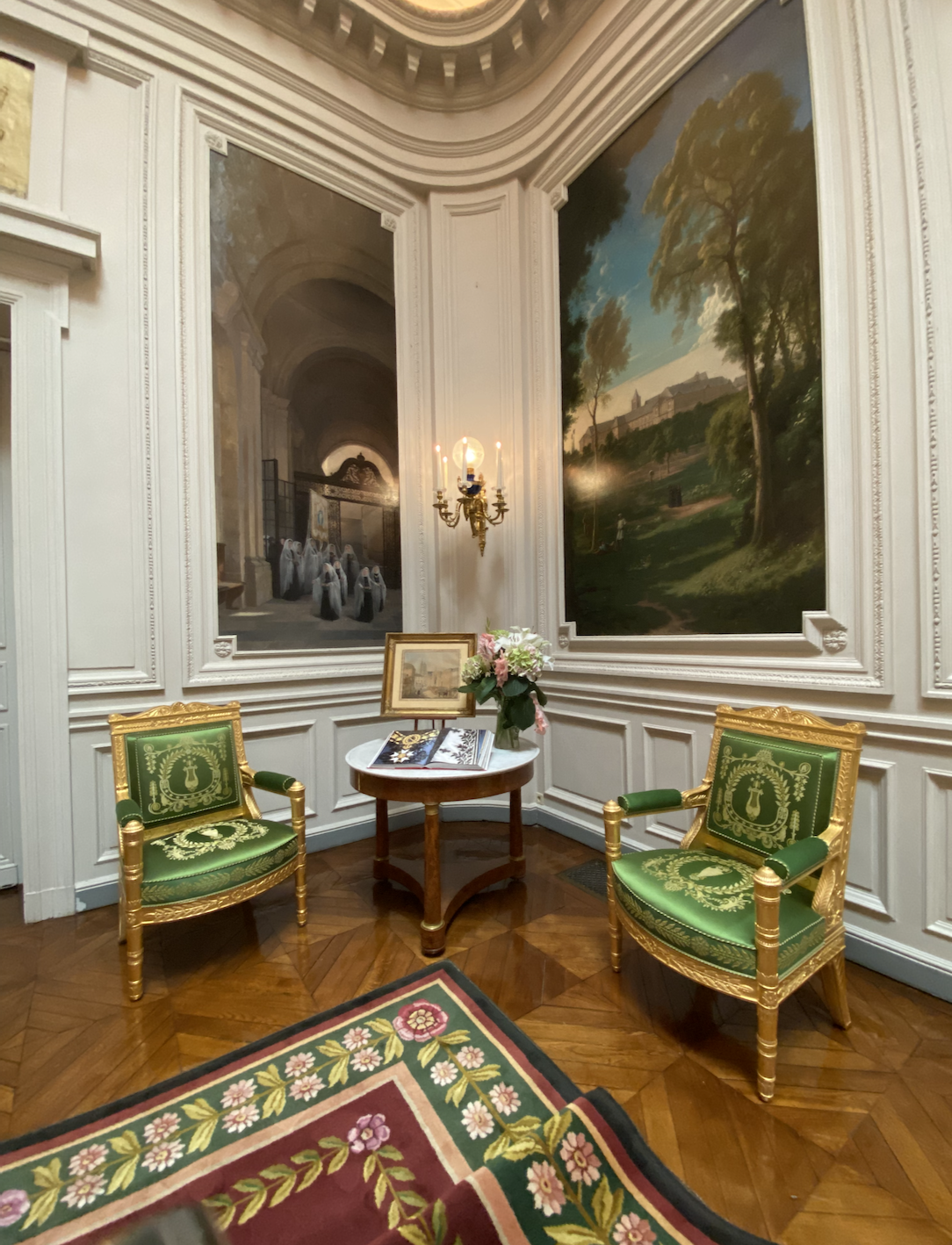
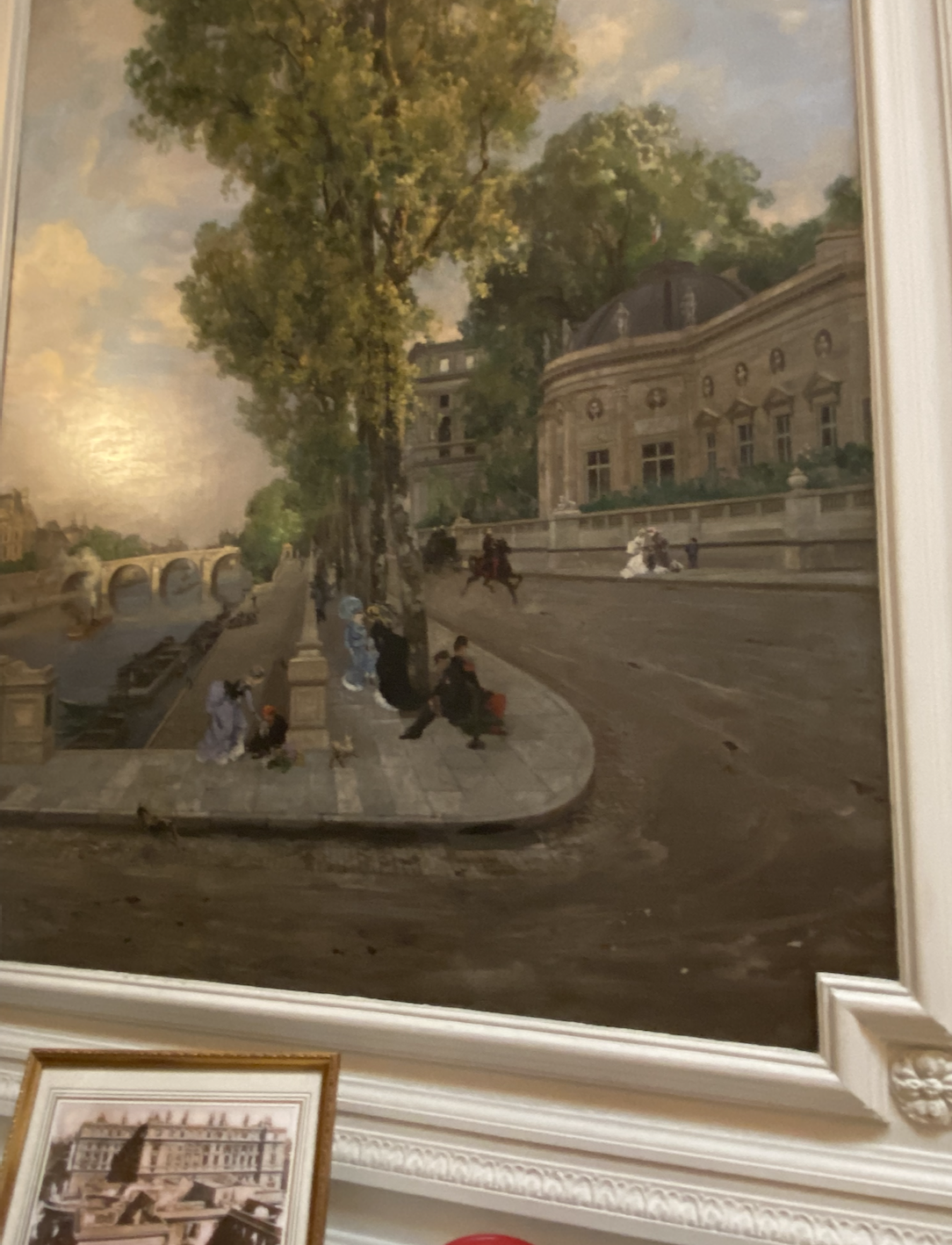
The Salon des Maisons is filled with furniture from the Chateau de Saint-Cloud covered in regal green fabric and gilded wood. I adore the large paintings including the image of the Hotel de Salm with the burned remains of the Palais d’Orsay in the distance. To the left is my love, the Louvre. 

The last room on the visit is the Vestibule topped with a painting of Général Vinoy, Grand Chancelier. High above are oval portraits of other grand chancelier officers since 1934. The statues of L’Odyssée and Pénélope by Taluet and Cavelier stand watch as you leave this wonderful slice of French history.

Comment

Henri Fantin-Latour a Dedication to his Friends

Comment

Henri Fantin-Latour a Dedication to his Friends

Henri Fantin-Latour is known by many for his beautiful still lifes of flowers and his group paintings. Born in Grenoble on January 14, 1836, he studied art from his father Theodore Fantin-Latour who worked in pastels.  In 1850 young Henri moved to Paris and enrolled at the Petite Ecole de Dessin de Paris then the Ecole des Beaux-Arts in Paris in 1854 where he met Degas, Whistler, and Legros.  Fantin-Latour also spent a few months in the studio of Gustave Courbet at 53 Rue Notre Dame des Champs on the edge of the Jardin du Luxembourg. 

Henri first honed his skills with numerous charcoal, oil, and chalk self-portraits. Whistler encouraged him to visit London and also learned to engrave from Edwin Edwards. His still-life paintings of flowers were highly regarded especially among London customers which was an early way for him to make a nice living. 

In 1873 he met fellow artist Victoria Dubourg in the Musée du Louvre where most women had to train with a chaperone of course. They married three years later and collaborated on many floral paintings. Some of my favorite paintings by Fantin-Latour are his group paintings.

I love a painting that holds a story that can be uncovered and group paintings, holy moly, it’s a dream.  Fantin-Latour created four between 1864 and 1885 and all are held in the Musée d’Orsay. A few are visiting Abu Dabi at the moment but they will be back soon. 


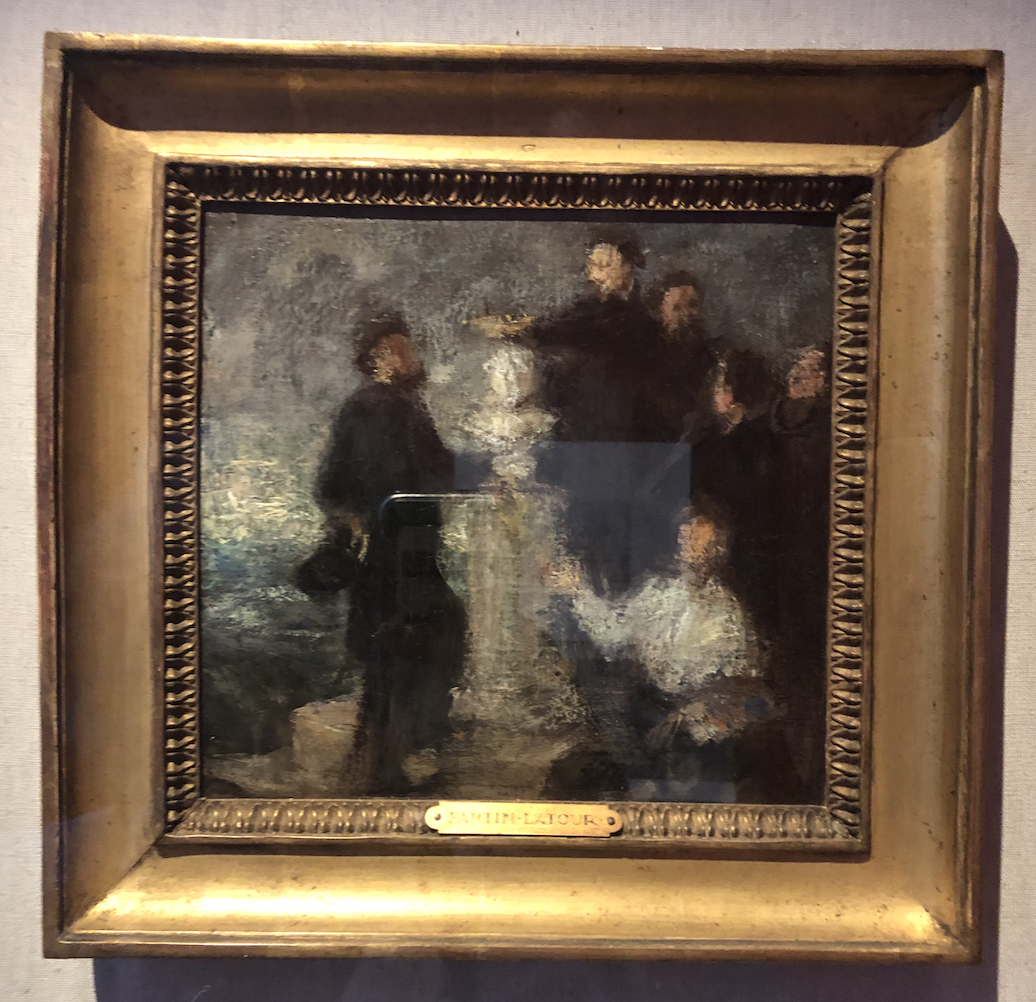
The first was done in 1864 and was created in response to the lack of attention my beloved Eugene Delacroix received after his death. The Romantic master’s funeral was held on August 17, 1863, in the Eglise Saint Germain des Prés. Henri, Manet, Whistler, Zola, Pissarro, Degas, and Baudelaire were all in attendance. Still, they were shocked that the man that influenced a generation of Impressionists and reinvent color had such a small turnout for his final moments. It was August after all and the Parisian went on vacation, but it was Delacroix!  Fantin-Latour watched as the funeral undertakers tossed aside Delacroix’s Institut de France academic robes in disgust. 

Fantin-Latour would paint a masterpiece dedicated to his friend and bring him the recognition he deserved. In Homage à Delacroix a painting of Delacroix takes center stage surrounded by friends and admirers. 

Seated from left to right we see art critic and writer Louis Edmond Duranty, Fantin-Latour in a white shirt, writer Jules Champfleury and on the lower right Charles Baudelaire who was always a supporter of Delacroix.  Standing left to right is Louis Cordier, art school friend Alphonse Legros and to the left of the painting of Delacroix, James Abbot McNeill Whistler, the American-born artist who arrived in Paris in 1855. At the other edge of the frame is the wonderful Édouard Manet who needs no introduction at all, and we round out with artist Felix Bracquemond who was a bit of a jerk and artist Albert de Balleroy. 

The painting was first displayed at the 1864 Salon to raving reviews. Purchased at the Salon by Ernest Gambart it would end up in the great collection of Etienne Moreau-Nealton which I will go into great detail about soon. Upon his death in 1906, it was given to the Louvre which would pass it to the Orsay in 1986. 


In 1870 Fantin-Latour painted Un Atelier aux Batignolles and brought together his friends in one painting centered around Manet’s atelier in Batignolles. The norm-pushing Édouard Manet sits at the easel most likely painting a naked lady that will flip the stodgy art world leaders out. Standing to his right is artist Otto Scholderer and just behind him is Pierre Auguste Renoir. Not such a bad group of guys. Next to Renoir is Émile Zola, Manet’s biggest champion, Edmond Maitre a musician and the tall chap is Drédéric Bazille, an artist that lived in the studio of Delacroix after his death with the chap in the corner, Claude Monet. Seated to Manet’s left is Zacharie Astruc, an artist that also created that fantastic sculpture of the mask seller in Jardin du Luxembourg I shared a few weeks ago.  So good right?! And we have two more to go. 

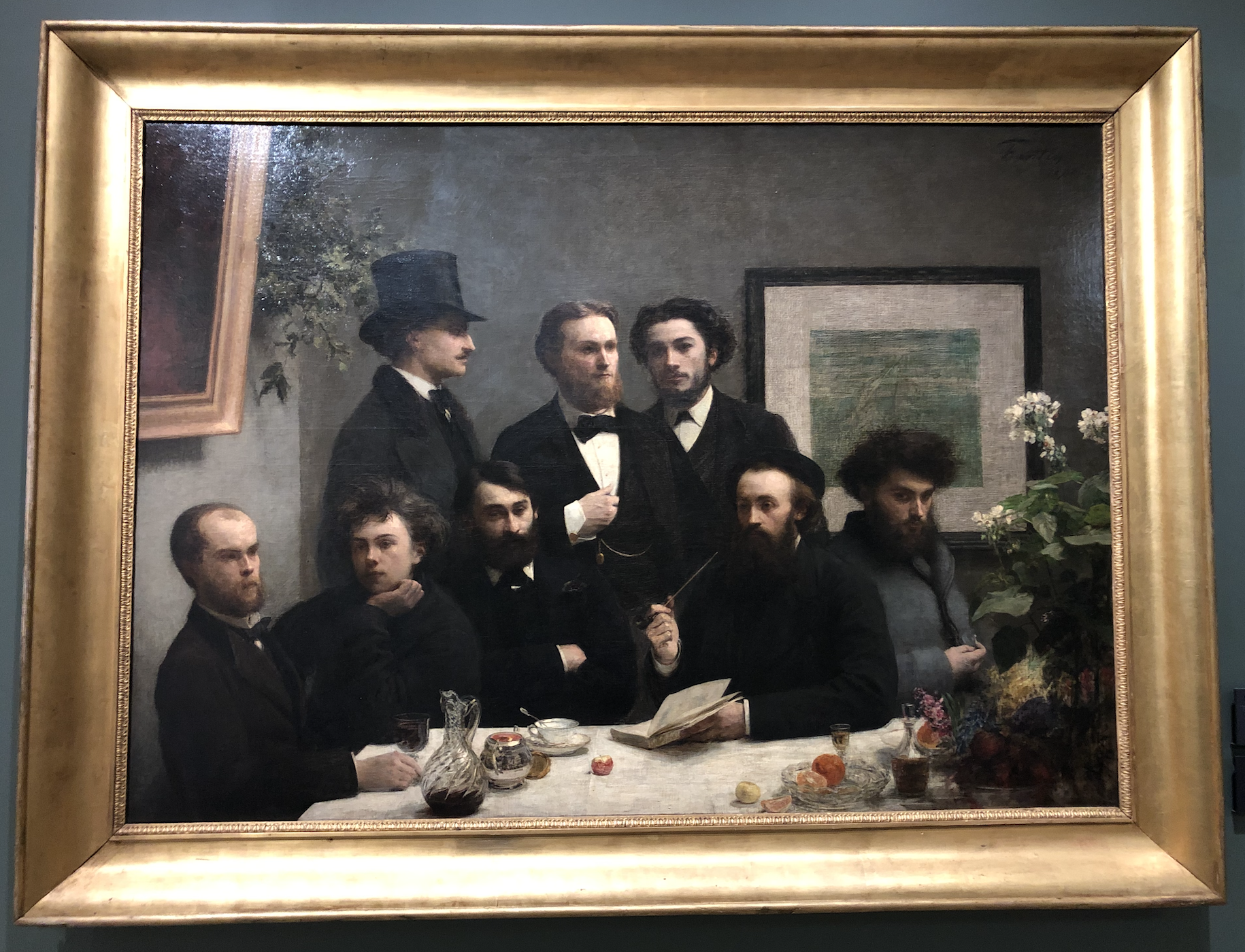
1872 was the writer’s turn in Coin de Table. Originally it was an idea to create a painting dedicated to Baudelaire for his 50th birthday but musician Edmond Maitre recommended they use the writers that gathered in the Place Saint Sulpice monthly, all of whom Maitre knew and could ask them to sit for him. 

Starting from left to right is Paul Verlaine and looking longingly at him is his lover Arthur Rimbaud this was painted a year into their relationship. Next to Arthur is poet and playwright Léon Valade, writer Ernest d’Hervilly and hiding in the corner Camille Pelletan a historian and journalist. Standing above in the top hat is poet Pierre Elzéar, Émile Blémont, and Jean Aicard all poets as well. Baudelaire may not be here but the flowers on the table are a nod to his most famous work, Fleur du Mal. 

The last piece was done much later in 1885 and dedicated to a group of musicians known as “Le Petit Bayreuth”. Seated at the piano is Emmanuel Chabrier, and next to him, are close friends Edmond Maitre and Amédée Pigeon. Standing left to right is Adolph Julien, Arthur Boisseau, Camille Benoit, Antoine Lascouc, and Vincent d’Indy with the fancy mustache. Each of the men was a composer and musician and devotee of Wagner and was part of the Wagnerists group.  

Of the four, the two are my favorite, anything with Delacroix and Manet will do that. 


For another fun, group check out Maurice Denis’ Hommage à Cezanne also in the Orsay


Comment

Exhibits not to miss in 2023

Comment

Exhibits not to miss in 2023

It’s a new year and that means new exhibits coming our way in Paris. If you are an art lover and a trip to Paris is on the agenda there are a few standouts you may want to plan around. 

We start with the Musée du Louvre, because well, it’s my favorite place in the world. 

Naples in Paris: the Louvre hosts the Museo di Capodimonte and brings together more than 60 masterpieces from the Capodimonte museum while it is going under renovation. The exhibit will stretch to three spaces in the Louvre including the Grande Galerie where the Capodimonte Italian masters will have a conversation with the masters of the Louvre. 
From 7 June to 22 January 2024 in the Salon Carré et Grande Galerie 

          7 June to 25 September Salle de l’Horlage Sully WIng 


The treasury of Notre Dame Cathedral from its origins to Viollet-Le-Duc

The one we have all been waiting for will be bringing two beloved monuments together. Notre Dame de Paris and the Louvre. On April 15, 2019, when we watched in shock the images of the beloved cathedral in flames I could only think of the treasures that are held inside. Shortly after they announced they would have them on exhibit, well 4 ½ years later we finally get to see them all once again.  


When Notre Dame was open many including Rick Steves told people to skip the Treasury just off the south transept but it is filled with many historical and beautiful pieces. Many of those pieces including the tunic of Saint Louis will be on view in the former Petite Galerie just past the entrance of the Richelieu wing. The exhibit also explores the Treasury before the Revolution and of Viollet-Le-Duc, the great architect that saved her in the 19th century. 19 October - 19 February 2024 

Included in your general Musée du Louvre tickets  


Musée d’Orsay 

The Orsay and its sister museum the Musée de l’Orangerie always do an exceptional job with their special exhibits. There is one that made me gasp as soon as I saw it come through and I know you will all want to book a flight as soon as possible. 

Van Gogh in Auvers-sur-Oise, The last few months

In the fall of this year opening on October 3 is the first exhibit to ever focus on the last two months in the life of Vincent van Gogh. His last two months in Auvers-sur-Oise were very prolific with 74 paintings and 33 drawings and many will be on display. It will be fantastic in conjunction with the van Gogh museum in Amsterdam.  This will be a very popular one and most likely the Orsay will require a timed ticket for the exhibit as well as the Orsay ticket. It is included in your ticket but just a heads up as it gets closer. 


3 October to 4 February, 2024 


Manet/Degas

If you are a lover of Manet or Degas like I am the Orsay, has another treat for you this year. Beginning on March 28 to July 23 a joint exhibit dedicated to these masters focusing on their similarities as well as their differences. Focusing on the 1870s when the two artists knew each other and how they influenced each other. I for one, am very excited to see so many of the Manet and Degas paintings return from the Louvre Abu Dhabi. 

28 March to 23 July, 2023 


For those in New York the exhibit will move to the Met this fall from September to January 2024

Musée de l’Orangerie 


Matisse. Art notebooks, the turning point of the 1930s

Another beloved master of color, Henri Matisse takes over the Orangerie this spring. The exhibit includes a few rarely seen in France since they were first in the artist’s collection of pieces painted in the 1930s. Starting with an impromptu trip to Tahiti, Matisse was inspired by the colors that were a bit different from the south of France. 

Exhibits in the Orangerie are always so well laid out and the audio guides are fantastic. I love to recommend the museum to clients as it has a mix of Impressionist and modern art and is very easy to navigate. 


Catch the Matisse exhibit from 1 March to 29 May. 


Also at the Orangerie, Modigliani, and Paul Guillaume

In the history of art, there are many duos that are so iconic we may never know of the artist if it wasn’t for their major supporters.  Art dealer Paul Guillaume was Modigliani’s greatest champion up until his death in 1920. It is also the collection of Guillaume that comprises the permanent collection of the Orangerie. I love to come across a Modigliani painting with long geometric faces and can’t wait to see an entire exhibit dedicated to the prolific master that died way too early. 

20 September to 15 January, 2024 


2023 also marks the 50th anniversary of the death of Pablo Picasso and there are special exhibits in Paris and around the world. A few to look forward to in Paris and beyond and see a full list (in French) here.


Gertrude Stein & Picasso, Invention of Language 

Musée du Luxembourg 

13 September to 21 January 2024 

Learn more about Gertrude in a past episode of our podcast here

Picasso & Pre-history 

Musée de l’Homme 

8 February to 12 June 

The Paris of Moderns 1905 to 1925 

Petit Palais 

14 November to 14 April 

Picasso Drawings 

Centre Pompidou 

18 October to 22 January, 2024 

In New York at the Guggenheim

Young Picasso in Paris 

12 May to 7 August 

Other exhibits not to miss

Leon Monet, brother of the artist, and the first time his personal collection and portrait are on display in Paris. 

Musée du Luxembourg 

15 May to 16 July 

Sarah Bernhardt, the queen of the Paris stage already shares the wall of the Petit Palais but an entire exhibit dedicated to her?! She was also a sculptor when not on stage or sleeping in a coffin. Listen to the episode we did about her in 2020 and you to will fall in love with her. 

Petit Palais 

14 April to 27 August 


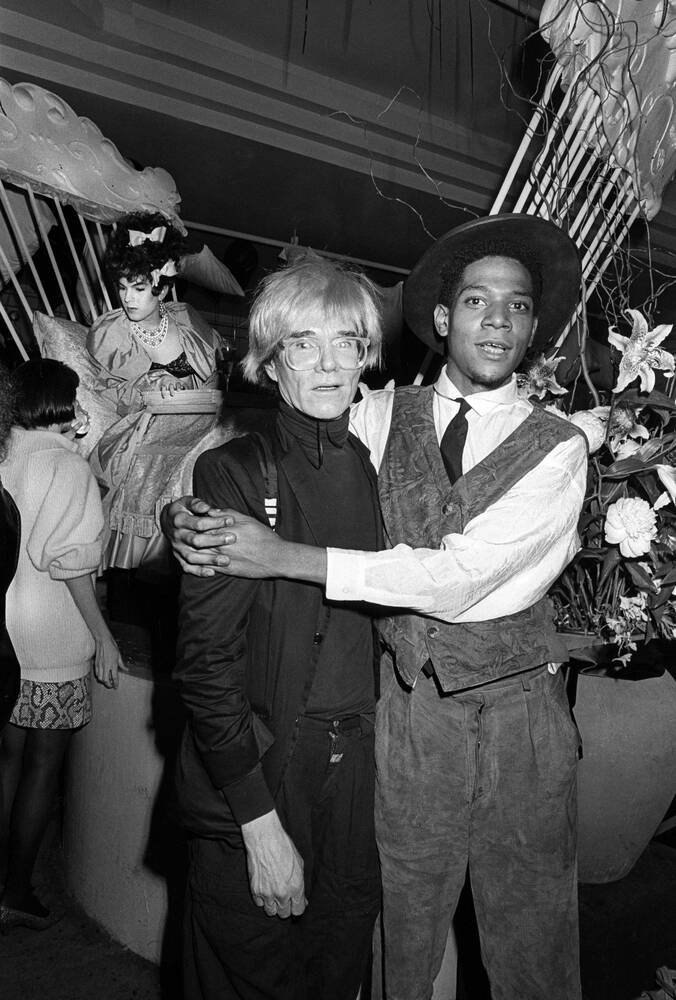
Basquait and Warhol, are two greats that are synonymous with New York. The two died just a year apart but both have a style that is each their own. Can’t wait to see how the Fondation Louis Vuitton puts this together. Do buy your tickets in advance for this one, the FLV always sells out days in advance. 

Fondation Louis Vuitton 

5 April to 28 August 

Coming to Paris this year, reach out for a tour with me. From historic tours in the steps of Hemingway with a Hemingway to the cobblestones and all their hidden stories to the best museum in the world and more. 


Comment

Best Exhibits of 2022

Comment

Best Exhibits of 2022

This year the museums of Paris and special exhibits were back on track after the interruption of the pandemic. Museums spend years or even a decade in preparation for exhibits that are dedicated to everyone from Leonard da Vinci to designer Thierry Mugler. When Covid hit, it was heartbreaking to see exhibits close to visitors and many never saw the light of day. 

Whether you made it to Paris or not, I would love to share a few of my favorite exhibits this year. 

The Musée d’Orsay always does a fantastic job with exhibits and 2022 saw quite a few dedicated to groundbreaking artists, Antoni Gaudi, Rosa Bonheur, Edvard Munch, and  Maillol. This spring, I was thrilled to get a deeper view and learn more about Aristide Maillol. The Musée Maillol in the 7th holds two exhibits a year but doesn’t go too deep into the story of the artist himself.  Born December 8, 1861, he arrived in Paris at 21 and enrolled in the Ecole des Beaux-Arts in 1885. Dabbling in ceramics, embroidery, carved wood, and painting he really found his medium in stone and bronze. 


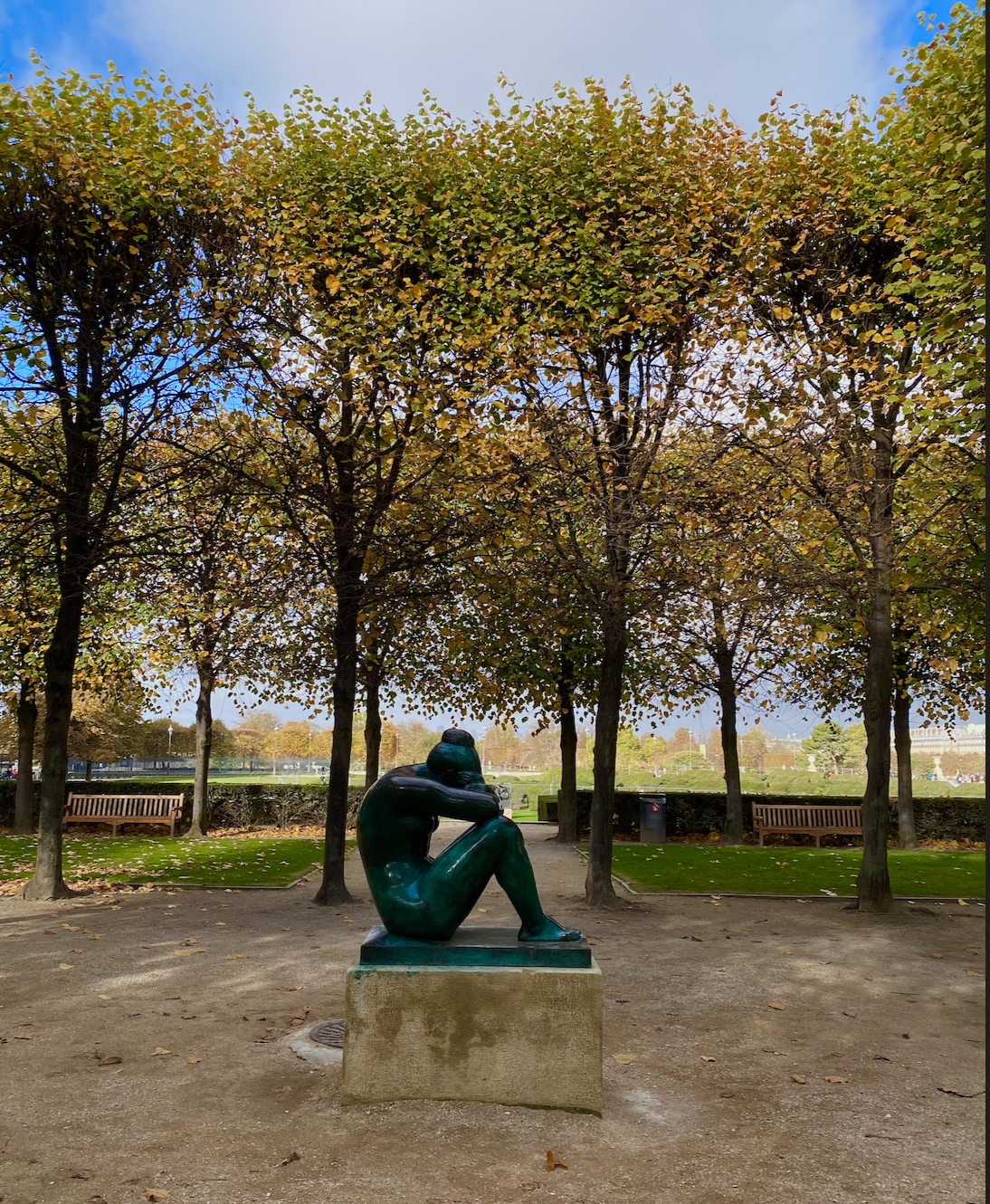
If you have spent any time walking through the upper Jardin des Tuileries then you have seen the great work of the artist. In 1964, twenty years after his death his last model Dina Vierny, gave 18 bronze statues to the city that now dot the landscape. It was these statues that made me want to learn more about the artist and who his models were. The exhibit was laid out chronologically and featured his three muses. His wife Clotilde, Spanish maid Therese, and Dina. Maillot believed in the female form as he could add to it and create his own shapes and poses. A more rounded version of Rodin also set him apart from his predecessors. 

I loved his paintings that were inspired by the Impressionists and also Whistler’s famous piece, Arraignment in Gray and Black better known as Whistler’s Mother. Maillot recreated his own version of his Tante Lucie,  a beloved aunt that cared for him growing up. It’s hard not to see the influence of Monet in Femme à l’ombrelle. 

Maillol died in 1944 just a month following the liberation of Paris in a car accident. Thankfully because of his last model Dina, we know who this incredibly versatile artist was. If you missed the exhibit walk through the Tuileries or visit the Musée Maillol. 

The Musée Picasso Paris opened in 1985 and was built from the collection of the artist himself. Following his death in 1973, his heirs gave over 4,000 pieces to offset French inheritance taxes due to a  law that had been put in place on December 31, 1968. The collection was so vast an entire museum could be created and is the largest of Picasso in the world. 


Last year his daughter and only legitimate heir Maya Ruiz-Picasso gave 9 pieces to the State. The dation includes 6 paintings, 2 sculptures, and a sketchbook.  Her mother, Marie Therese Walter met Picasso outside of Galerie Lafayette in 1927 and quickly began an affair. Maya was born on September 5, 1935, and spent much of her time growing up with her father who created games and drawings for her, many of which can be seen in the museum. 

The current exhibit that closes this week on December 31 showcases the 9 pieces as well as the relationship Picasso had with his children which weren’t always great. The great artist and his first daughter remained close until after the end of the war and Picasso spent more time in the south of France with Francoise Gilot.  The two were reunited in the summer of 1955 when she assisted her father with Henri-Georges Clouzot’s Mystere Picasso film. Shortly after filming the two rarely saw each other after she announced she was going to be married. 

At the time of his death in 1973, he had very little contact with his four children. His second wife Jacqueline kept everyone away from the gates of the Chateau de Vauvenargues in the south of France. Refusing to do a will there was a long legal fight in France trying to obtain the rights of the children as 3 of the 4 were illegitimate. 

A visit to the Musée Picasso is a must for all art lovers and if you have been before and think you can skip it, think again. The permanent collection is so vast that rooms are frequently changed out including the room dedicated to Picasso’s take on Manet’s Dejeuner sur l’Herb. 

A few of my favorite things from the exhibit include the combination of Jusepe de Ribera’s Le Pied-Bot next to Picasso’s El Bobo painted in 1959. 

The Portrait de Maya drawing was done on Christmas day 1943. Such a different style from what Picasso is normally known for,  but it is such a sweet sketch of the nine-year-old little girl. Of all the pieces in the exhibit, the photos of father and daughter are the most interesting. The two Picasso in profile has a striking resemblance and strong family lineage. I really loved the photo taken in 1955 alongside the Tete de femme  of Dora Maar that is now in the Square Laurent Prache in the shadows of Eglise Saint Germain des Prés. 


Maya was on hand in September 2021 at the presentation of the new collection to the Minister of Culture and again at the opening of the exhibit on April 16 of this year. Sadly she recently passed away on 20 December at 87 years old. I suspect a flurry of new donations should be coming soon to the French State. 

Of course, I had a list of over twelve exhibits to share but this is already long enough and this year I promise to share many of them as I see them, lastly I hope you were able to see the fantastic Musée du Luxembourg exhibit Pionnières that ran from March 2 to July 10. Focusing on women artists that came to study in Paris in the late 19th century and at the start of the 20th. At the time women were finally allowed to attend art classes and ateliers as well as dress how they wished. 


A visit to this exhibit was like sitting down with an old friend for a glass of wine. Many of the artists have been featured on the podcast and a handful of others are on my list to explore a bit deeper so we can share their own amazing life with you.   

I was happy to see two paintings by Jacqueline Marval on display and watch so many people taking photos of La Baigneuse au Maillot Noir 1923. Marval was born in 1866 near Grenoble and arrived in Paris in 1895. Living in Montparnasse she met Picasso, Matisse, and Flandrin all of which were attracted to her strong personality and artistic abilities. Less known outside of France, she is one to dig a bit deeper on. The Comité Jacqueline Marval that oversees her story and authentication is in the process of opening a new space in Paris that can be visited by appointment. Run by a dear friend and family I will be sure to share more and even take you all on a visit soon. 

A few of the ladies mentioned and on display included Anne de Rochechouart Duchesse d’Uzes. Great granddaughter of Madame Cliquot was one of the first women to obtain a driver’s license and get a speeding ticket as well as creating the Automobile Club de Feminine de France in 1926 when women weren’t allowed in the men’s club.  


Trailblazer and dancer Josephine Baker. Shakespeare and Company and publisher  Sylvia Beach. Author and boundary pusher Colette. Artists Marie Laurencin, Suzanne Valadon, and Sonia Delauney and female artist champion and the first woman to own a gallery Berthe Weill


Such a great year for exhibits in Paris and even more coming in 2023. Watch this space and better yet contact me to plan a fantastic trip to Paris to see all the best things and maximize your time. 


Comment

The Friendship of a French King and a Duke

Comment

The Friendship of a French King and a Duke

There are thousands of figures in French history, but a few of them stand out a little brighter and larger. Henri IV was just such a character and today we celebrate his birthday along with a very close friend of his. 


Of all the French kings, one face stands out among the rest as the most recognizable. Henri IV, the Vert Galant, the first Bourbon king always has a happy and almost goofy but lovable look to him whether he is on a horse overlooking the Pont Neuf or staring back at you in the Louvre. 


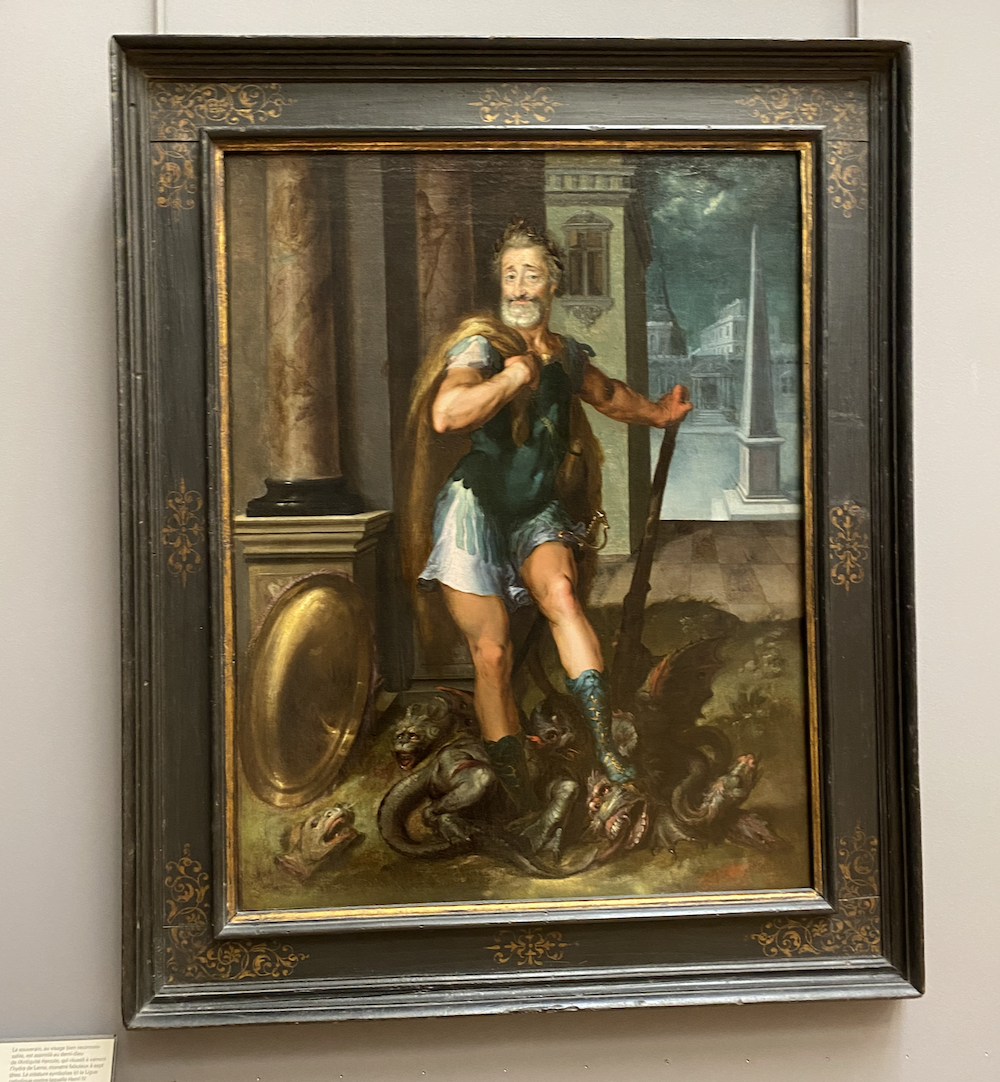
One of my favorite (yes I say that about some 5,000 paintings) in the Louvre is the one depicting Le Bon Roi Henri as Hercules with some rather lovely legs. PORTRAIT D’HENRI IV EN HERCULE TERRASSANT L’HYDRE DE LERNE, by the Entourage de Toussaint Dubreuil in 1600 shows the king as the mythological hero known for his strength. Seen with the pelt of a lion over his shoulders, a slight smile on his face, and holding a club in his hand as he stands over a multi-head monster. 

Henri IV born on this day in 1553, Henri III future King of Navarre and France was baptized a Catholic but raised as a Protestant by his mother Queen Jeanne d’Albret 

At the moment of his birth his grandfather King of Navarre Henri d’Albret took him from his daughter and rubbed his lips with garlic and gave him a small sip of wine grown from his own vineyard. Known as a Bearnais Baptism, it was to ward off any disease but to also indoctrinate him into their way of life. 

As the King of Navarre, Henri married Marguerite de Valois, daughter of Henri II and Catherine de Medici who were devout Catholics. Days after their wedding the St. Bartholomew Day massacre began killing thousands of Protestants and the War of Religion that would spread through France for thirty-six years.

The painting depicts the King standing triumphantly over the slain l’hydre de lerne, which represents the Catholic League that had big problems with the one-time Huguenot king. However, what stands out about this painting is his legs. I mean, really, oh la la Henri la Grande, the little flick of the hip adds to his pose and it is easy to see why he may have had so many mistresses. After all, he wasn’t nicknamed the Vert Galant for nothing.


Six years later on the same day in Rosny-sur-Seine Maximillian de Bethune, duc de Sully was born.  Maximilian met Henri in 1572 and became fast friend and one that Henri would lean on for the rest of his life. A fellow protestant he was able to flee Paris hours before the Saint Bartholomew days massacre and later encouraged Henri to convert to Catholicism to ease tensions in the country. 

Sully was always near Henri for every crusade and battle and later in the government. Starting in the State Council of Navarre to the Superintendent of Finance and the Governor of the Bastille and the Superintendent of the King’s buildings. In the government, he changed laws to tax the aristocracy and lowered taxes on the lower class who was loved by many. 

On May 14, 1610, just a day after the coronation of Marie de Medicis, Henri was leaving the Palais du Louvre and on his way to the Arsenal district to see his old friend. On the way, the king was murdered and as soon as the news reached Sully he hurried to his side. 


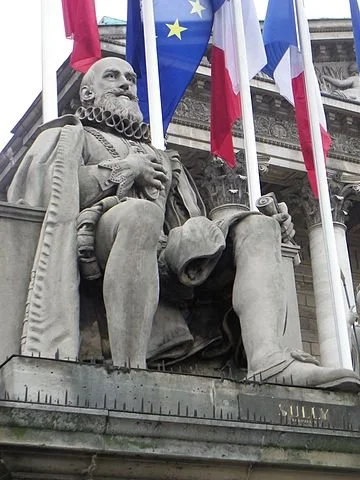
Today in Paris there are more reminders of Sully than there are of Henri IV. Henri has his statue on the Pont Neuf. However, Sully can be found in front of the Palais Bourbon, a street in the Arsenal where he once lived. The Hotel de Sully he purchased after the loss of his friend and at the Louvre. In the Cour Napoleon overlooking the pyramid stands Sully but the entire middle wing is dedicated to the statesman. The Sully wing is where you can find the French paintings but it is also the original section of the Palais we see today, built by his friend Henri IV. 


Comment

The Sunrise that Named a Movement

Comment

The Sunrise that Named a Movement

Last week I was happy to share the story behind one of my favorite Claude Monet paintings but did you know one of his most famous pieces is also linked to the Hoschede’s. If you missed last week you can find it on my website here. 

Now back to that famous painting and this is why I love history and the stories of art so much and while research on one thing sends me down a long and winding rabbit hole. 

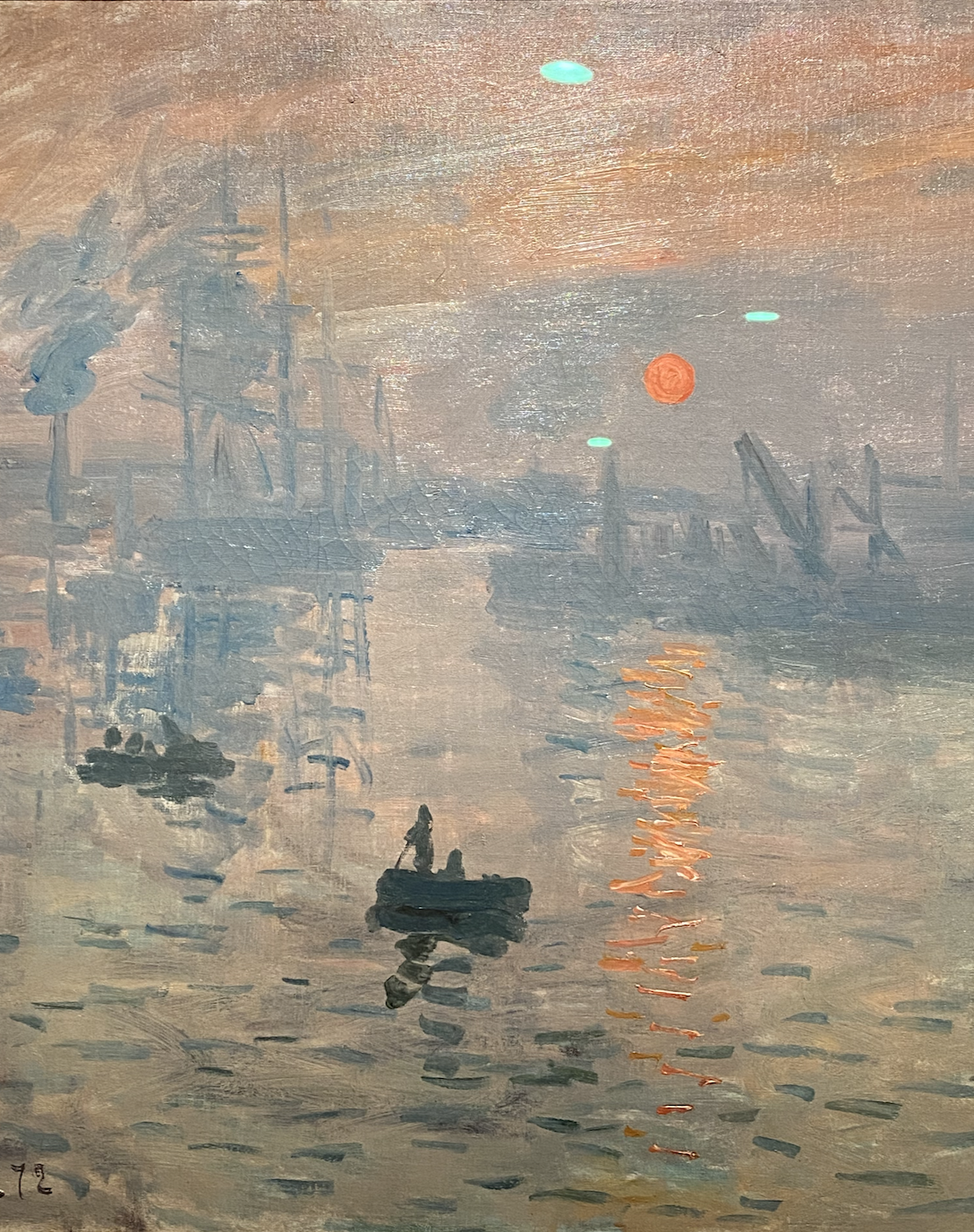
On November 13, 1872, in the harbor of Le Havre out the window of the Hotel de l’Armirauté Monet captured the sunrise. The glowing orange sun reflected across the water would go on to give the name to the entire movement we know as Impressionism. Before the first Impressionist exhibition in 1874 Monet named the painting Impression and when critic Louis Leroy saw it he transferred the name to the entire group. 

At the time the Academic world of art thought these ragtag group of artists that painted outside in the elements were nuts and the name didn’t help. 


The exhibit was held from April 15 to May 15, 1874, in the studio of photographer Nadar on the Boulevard des Capucines. One day Ernest Hoschede walked in and saw Monet’s Impression and purchased it for 800 francs. It hung in the Chateau de Rottembourg until it was seized by the authorities in 1877 and sold at auction for just 210 francs. Dr. Georges de Bellio was the lucky winner of such a bargain and passed it down to his daughter until she left it to the Musée Marmottan Monet in 1940 after her death. 


The Musee Marmottan Monet is a gem of a museum on the edge of Paris. Originally a hunting lodge to the Duc de Valmy it was purchased in 1882 by Jules Marmottan who had a large collection of items from the First Empire. His son Paul expanded the collection and upon his death, the home and collection were gifted to the Academie des Beaux-Arts.  


In 1934 it was opened as a museum and over the years would be greatly enhanced by two generous donations. In 1966, Michael Monet, the only surviving child of the great artists gave his entire collection which is the largest concentrated catalog of Monet in the world. In 1985 Nelly Duhem, daughter of artist Henri Duhem bequeathed her father’s vast Impressionist and Post-Impressionist paintings of the French masters. 


Another event happened that same year that made headlines around the world. It was an early Sunday morning just after 10 am on October 27, 1985, two ticket-holding gents strolled into the museum. A few minutes later, three masked men with guns pushed their way in, forced everyone to the ground, and quickly searched out 9 specific paintings they ripped from the wall. Two Renoirs, a painting by Berthe Morisot, and five Monets that also included Impression, Sunrise, and was gone in a matter of minutes. 


For two years there wasn’t a single lead until the commissioner of the art theft department Mirielle Balestrazzin tracked down four stolen Cortot paintings in Japan. Stolen from Eastern France in 1984 the paintings were linked to the head of the Japanese crime syndicate Yakuza, Shuinichi Fujikuma. Fujikuma had his hands in everything and in 1978 he was caught with over 7 kilos of heroin in France and sentenced to five years in a French prison. Locked away he met two other French prisoners locked away for art thefts, Philippe Jamin and Youssef Khimoun, and hatched a plan. 


Fast forward to 1987 and Balestrazzin paying him a visit in Japan.  The Cortots were recovered and a series of investigations of his phone records found some odd details. It didn’t help that they found the Marmottan museum catalog where he had circled each of the 9 paintings that were stolen. Somehow the paintings were taken from Paris to Japan and then sent to Corsica where they were discovered in an empty villa in Porto-Vecchio. However, it took three long years to put that all together and recover the treasured paintings. 

On April 17, 1991, after some minor restoration, they returned to the walls of the Marmottan and you can see them in all their glory. Impression, Sunrise sits downstairs on the lower level and you can’t miss it as you walk down the stairs. When I first laid eyes on it they didn’t allow photos but I snuck a quick very crooked pic now you can snap away all you want. However, make sure you sit there on the bench in front of it and take it all in. 


When it comes to art it’s not just the painting you see on the canvas that is so fascinating. It is the story with all its twists and turns that is so wonderful that the piece is just waiting for you to discover. 


Visit the Musée Marmottan Monet at 2 rue Louis Boilly 16e, open Tuesday-Sunday 10 am - 6 pm. They also hold two fantastic exhibits a year. 


Comment

Monet, the Turkeys and a Love Triangle

Comment

Monet, the Turkeys and a Love Triangle

Hanging within the Impressionist gallery of the Musée d'Orsay you will come across this gem. Claude Monet’s  Les Dindons (the turkeys) won't have a ton of people standing in front of it like Manet’s Le Déjeuner sur l'herbe  but it is one of my favorites. 

In 1876 after spending time in Argenteuil, Claude Monet wanted to find some new subject matter to paint. Wealthy French businessman and avid collector Ernest Hoschede had already invited Édouard Manet out to his chateau earlier in the year and commissioned him to paint a few pieces. Manet’s pieces would never be hung and kept in his atelier until his death.

Hoscehde met Claude Monet in the Parc Monceau he offered him the same opportunity and since Monet needed the money and Manet told him it was a pretty cushy job he took him up on the offer. . 

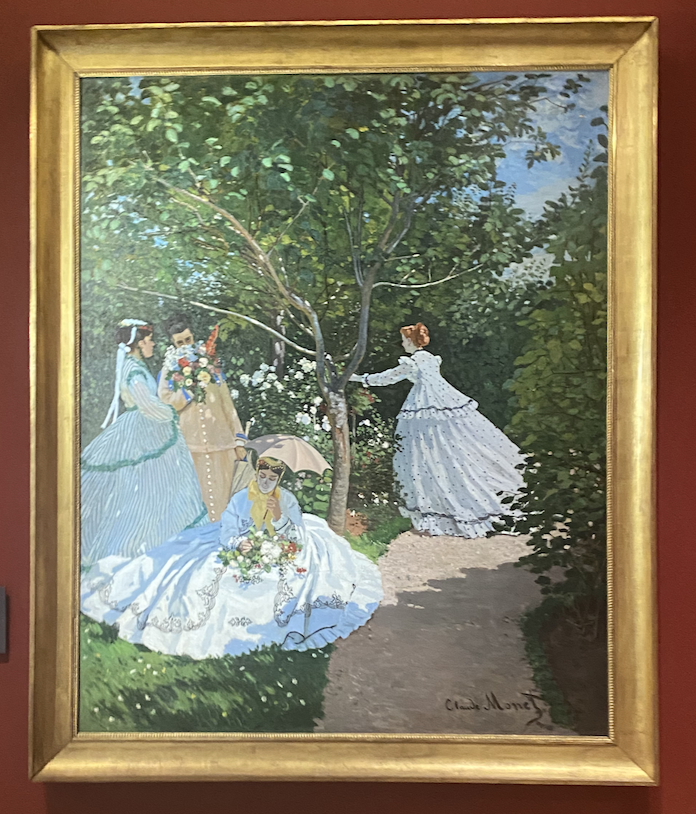
Femmes au Jardin 1866, all three women are Camille Monet

The Chateau de Rottembourg in Montgeron just 11 miles SE of Paris and located on vast grounds was where Monet would spend a few months there creating four large canvases intended to decorate the walls of the Chateau. Walking the grounds he came across a rafter of turkeys grazing in the grass on a sunny summer day and an image we can now see today.  He would never complete this work but it would be shown in the 3rd Impressionist Exposition in 1877. I love this painting by Monet, maybe because it isn't a haystack or a lily pond or some of the other images he did over and over, although I do love those too. The green grass and white turkeys with a touch of pink make for such a happy cheerful painting. 

However, there is so much more behind the painting. While Monet was staying at their chateau he began to have an affair with Ernest’s wife Alice. Ernest spent much of his time in Paris at his department store or hanging out at the Café Guerbois with the Impressionist. Alice had come from a wealthy family and had inherited the Chateay de Rottembourg and Ernest spent much of his time and all their money keeping up with the elite of Paris. 

Ernest burned through all their money and was forced to hold two annonymus auctions for a few dozen paintings by Sisley, Monet and Pissarro that didn’t reap the rewards he had hoped. In 1877 his chateau and collection was seized and sold. 138 pieces by Renoir, Sisley, Morisot, Pissarro, Manet and Monet were sold including one very famous painting that named the movement. More on that in a bit. 

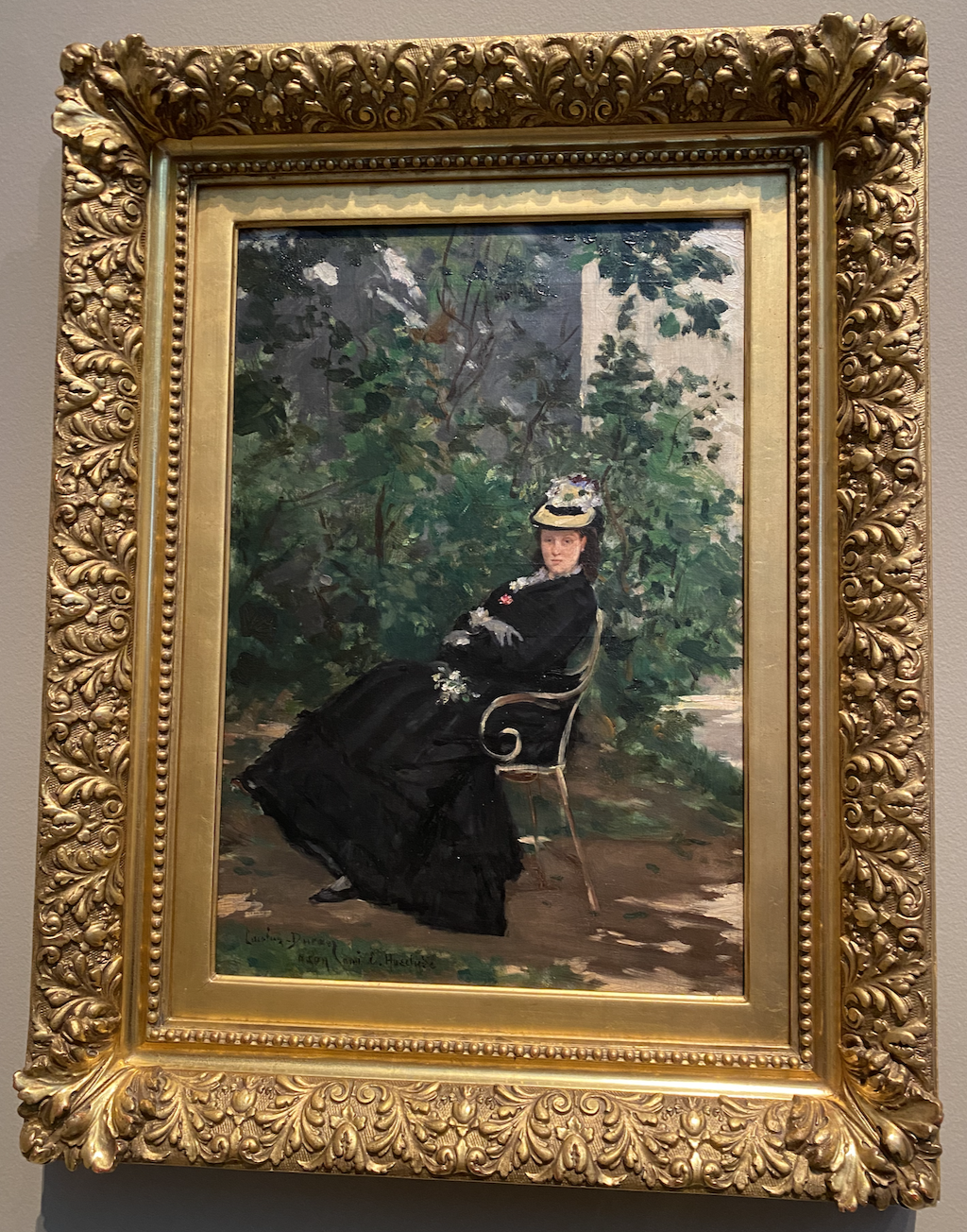
Alice Hoschedé Monet by Charles Carolus Durand 1872-1878

Ernest decided to flee France without his wife and six children. Monet invited Alice and her children to move out to Vetheuil with is wife Camille and two sons. Alice was also pregenant at the time and many think it was actually with the child of Monet and not Ernest. 


For years Alice hid behind the mask of a lovely lady helping nurse Camille Monet who was dying of cancer. Ever the ardent caretaker but really just waited for her rivals death. Camille took her last breath on September 5, 1879, and whole Monet was in deep mourning he picked up a canvas and  painted his wife on her deathbed. The painting can also be seen in the Musée d’Orsay.

Camille Monet at her death

As the family gathered for a funeral, Alice shouted out “burn it all”  Alice cleared the home of any and all memories of Camille. Every letter, photo, and painting was destroyed. In 1891 her husband died and the next year she and Monet married on July 16. 1892.

Alice died on May 19, 1911 and Monet would live until 1926 and cared for by the children of Alice. 


Last year we recorded an episode all about the the little love triangle and the ladies of Monet’s life that were also often used the subject of his many paintings. Take a listen now and come back in a few days for some more history on one of the more famous pieces by Monet and it’s long sordid tale. 

Comment

The Birth of the Musée du Louvre

Comment

The Birth of the Musée du Louvre

On May 26, 1791, a year and a half into the French Revolution the National Assembly of France declared a museum would be created “bringing together monuments of all science and arts”. For the next year, things would move slowly although art from the churches and emigrant families that left France were amassed. 


On August 9 the new government of Paris, the Paris Commune moved into the offices of the Hotel de Ville. During the night they met to come up with a plan to “save the state”. Meeting until 3 a.m. one side wanted to attack the king and the other fought against it. Louis XVI wasn’t playing along with the changes in the government and it was all about to end. 

At 8 am on August 10, 1792 thousands of men, women, and even children armed with weapons charged the Tuileries. Louis XVI had the 950 Swiss Guards moved inside the palace to guard the family and left 930 gendarmes and 2000 national guards outside to keep the angry mob at bay. One little issue, they had very little ammunition. The royal family was able to escape and ran through the garden to the Assembly for safety.


Louis XVI was treated to wine and food, while Marie was tossed in a locked room with her children. It was the end of the monarchy as the Legislative Academy ended all rights of the king. On the same day, they voted on the destruction of all items and properties tied to the monarchy. The next day on August 11 a commission was created to halt the process and to search and care for these items of the national heritage. 

It would go back and forth a few more times. On the 14th the cries for destruction outweighed all the others and then on the 22nd, it was declared again that the heritage must be saved. On October 1, 1792, a commission was made up of artists to create the layout of the National Museum that would be based on the collection of the king. 

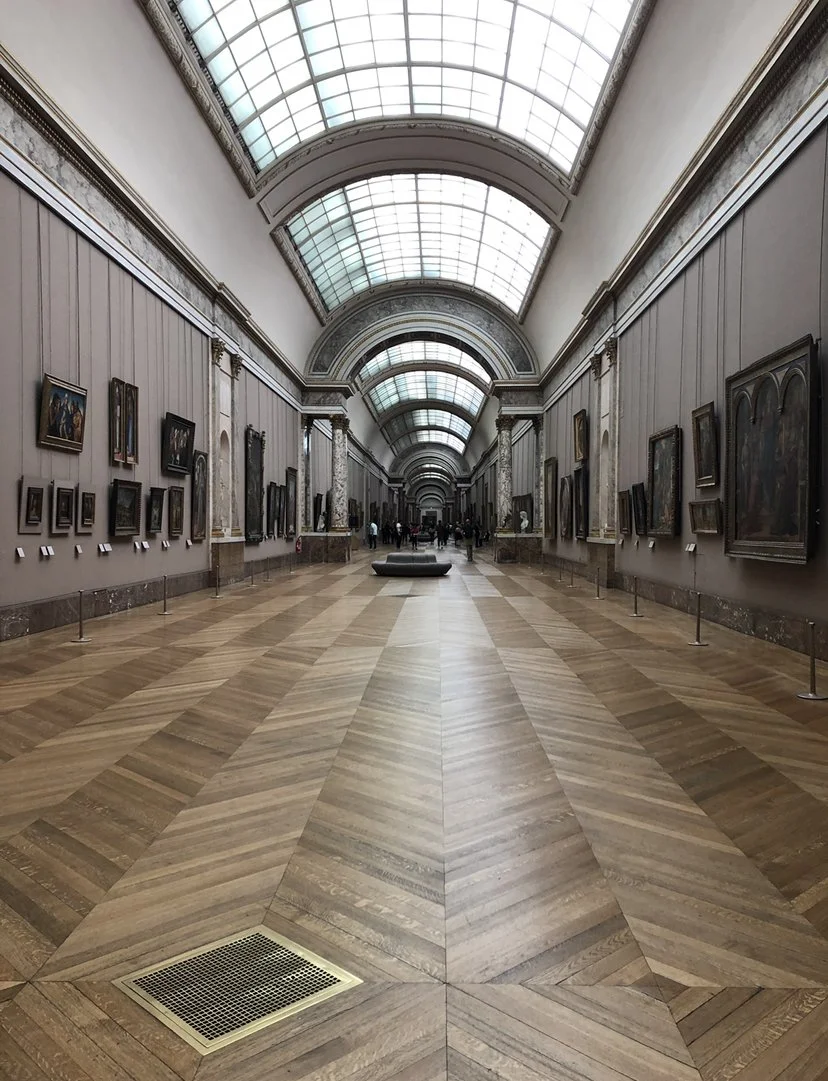
The date was chosen. On August 10, 1793, to honor the first anniversary of the fall of the monarchy the new Musée Central des Arts de la Republique was to open. You may know it as the Musée du Louvre. The original museum was much smaller and different from the stunning temple of art seen today. The Grande Galerie held 537 paintings and 184 objects that were mostly from the former rulers of France that began with Francois I. 


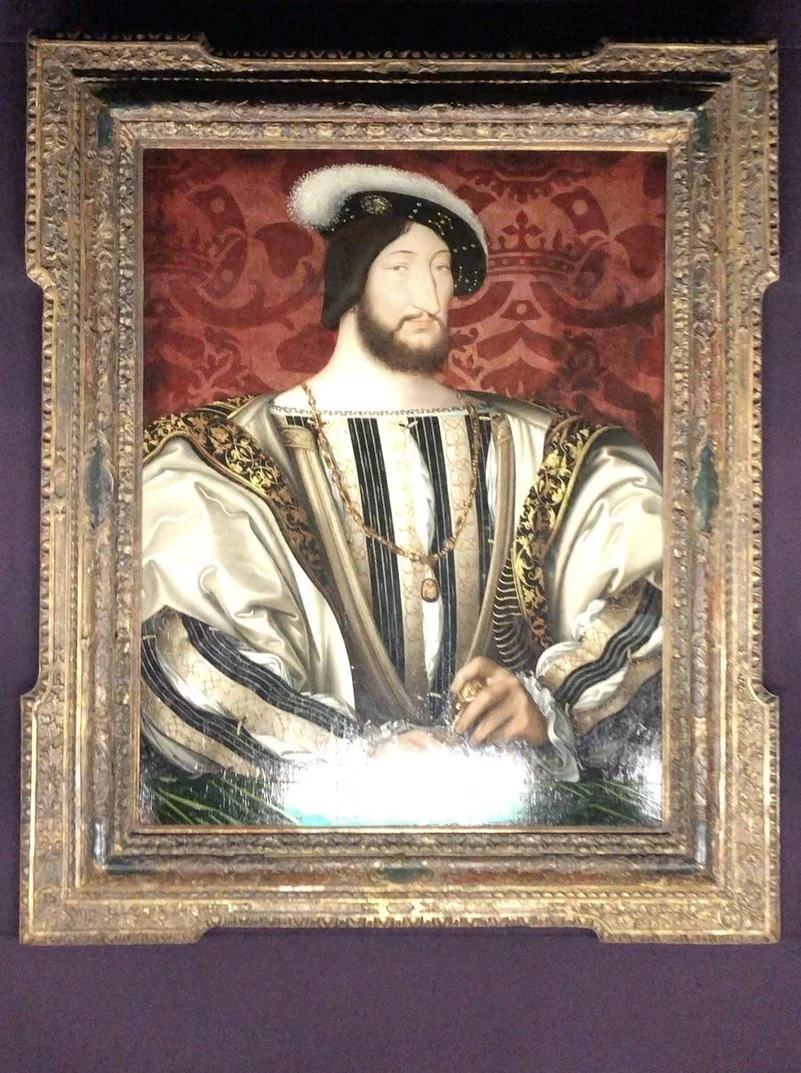
Francois I was raised with an appreciation of art and culture by his mother Louis de Savoie who was obsessed with the Italian Renaissance. It was Francois who decided to remake the Monarchy and bring it out of Medieval times and began to collect paintings from the Italian masters and one of the masters himself. After meeting Leonardo da Vinci, he invited him to move to France where he would put him up in a chateau and take care of everything. Leonardo eventually gave in and made his way to France via a donkey and in tow were a few paintings. 


In the short period of time before his death, Leonardo sold or gave a few of his paintings to Francois I including the Mona Lisa. 


His son, Henri II came along and didn’t have the collecting bug like his father did but did appreciate what they did have. Eventually, Henri IV would add a sizeable amount, and then the Sun King, Louis XIV broke the bank by acquiring as much as he could. By the time Louis XVI was ousted and the decision was made to create a museum three-quarters of the over 720 pieces had been in the hands of the kings of France. The rest were confiscated from churches and the families that chose to flee France. 


The long dark Grande Galerie saw the paintings hung frame to frame and floor to ceiling. Although it was opened as a gift to the citizens of France they were only allowed to visit one to three days a week. These were the Revolutionary years and the ten-day calendar was in place. For 2 days it was closed for cleaning, depending on the year the public only had one to three days a week to visit and the remaining six of the ten days were reserved only for the artists and copies. 


When Louis XIV decided to flee to Versailles in 1678 he gave up the Palais du Louvre to the artists and academics. Many including Jaques Louis David moved their atelier and homes into the Louvre and the artists were allowed to remain until Napoleon kicked them out. Over time it was the artists that would shake up the 19th century that would visit the galleries and copying the masters. Manet, Fantin Latour, Monet, and Berthe Morisot were often found in the Italian section and you can still find artists to this day doing the same thing. 


The museum had to close on November 8, 1793, when the building was falling in disrepair. It was one thing to have a public palace turning into a shrine to art it was another to dip into the purse of the government to keep it going. Over the next five years, it would open and close many times until July 14, 1801, it was once again fully open for everyone to visit. 

The Palais du Louvre survived the anger of the Revolution and Terror unscathed. The supreme figure of the royal family of Paris was left without a mark because it was given back to the people of France in the middle of one of its darkest times. 

As time went on more and more art was added to the museum. The Chateau de Versailles held all of the art and paintings of the French school while the Louvre focused those first few years on the International school mostly made up of Italian and Northern Europe artists. 

In November 1800 the Musée des Antiques moved into the summer apartments of Anne of Austria below the Galerie d’Apollon and was inaugurated by Napoleon. He would of course rename it the Musée Napoleon during his rule and even bring the Mona Lisa to his bedroom in the Palais des Tuileries. 

Today when you visit the Louvre, the Grande Galerie is still filled with the paintings that were picked and adored by the kings of France. However, on this date, August 10, 1793, 229 years ago today the birth of my beloved Musée du Louvre came to be and she continues to evolve and grow.

Want to explore the Louvre with me and uncover all its history and art when you are in Paris next? Reach out and schedule a tour with me. I love to share my favorite place and all the stories it holds. 


Comment

The End of the Monarchy

Comment

The End of the Monarchy

In the summer of 1792, almost a year after Marie Antoinette and Louis XVI’s failed escape, things were about to get worse. Locked away in the Palais des Tuileries and watched more closely, Louis XVI was still the king of France. In April, war was declared against Austria and the king of Bohemia, and was not going well, Prussia united with Austria against France which wouldn’t help Marie Antoinette’s image either. It was a disaster and the king was blamed for the mismanagement.

On June 20, the one-year anniversary of the escape, armed citizens entered the Tuileries and the bedrooms of the royal family. The Swiss Guards were able to control them after a few hours and the incident would rally Parisians behind the king. However, many in the government were beginning to turn away from him.

On August 9 the new government of Paris, the Paris Commune moved into the offices of the Hotel de Ville. During the night they met to come up with a plan to “save the state”. Meeting until 3 o’clock in the morning, one side wanted to attack the kingit and the other fought against it. Louis XVI wasn’t playing along with the changes in the government and it was all about to end.

At 8am on August 10, 1792 thousands of men, women and even children armed with weapons charged the Tuileries. Louis XVI had the 950 Swiss Guards moved inside the palace to guard the family and left 930 gendarmes and 2000 national guards outside to keep the angry mob at bay. One little issue, they had very little ammunition. The royal family was able to escape and ran through the garden to the Assembly for safety.

Louis XVI was treated to wine and food, while Marie was tossed in a locked room with her children. It was essentially the end of the monarchy as they ran through the Jardin des Tuileries, on September 21 it would formally end and four months later he would be killed at the Place de la Revolution.

Most of the Swiss Guards were killed in the conflict and would later be buried at the Chapelle Expiatoire, where they would guard the bodies of the king and queen until 1815 when they were moved to the Basilique Saint-Denis.

Comment

The Loss of a Childhood Icon

Comment

The Loss of a Childhood Icon

It’s odd how affected you can be when someone you had never met passes away. Today it was announced that Olivia Newton-John died and as soon as I saw it I gasped and began to cry.

Sometimes there are people who touch our lives in a way that we may not even realize and when we lose them it strikes us deeply. Everyone and all the media outlets in the same sentence of the announcement of her passing also mention Grease. I will never forget the first time I saw Grease. The songs & Olivia and Travolta, what wasn’t to love? I remember getting the album and I playing it endlessly knowing every single song and singing them day and night.

For some reason, after I saw it I was so inspired by Sandy (Olivia) that I came home and tried to recreate her outfit. Now, let’s get something straight, it was bad Sandy, the Sandy at the end of the movie. She strutted out in her high heels, red lips, black leather, and blond curly hair. It was all about bad Sandy, not boring Sandy.

So I grabbed my mom’s very high wedges, pulled on a pair of black jeans, and here is where the real stylist move came. I took my black long sleeve shirt and pulled up the hem, tucking it into the collar making a defacto long sleeve bikini top. Come on girls, we have all done it.

Then to really round out the bad Sandy look, I took a white color crayon and tore off the paper, and walked around the house saying “Tell me about it stud”.

In 1980 Olivia hit the silver screen again, in what is one of the greatest movies of all time, Xanadu. Oh I know, you laugh but this will always be my favorite. Olivia is Kyra one of the daughters of Zeus who is the muse of dance, Terpsichore. This movie has it all. Roller skating, Gene Kelly, Olivia in amazing clothes, and all the amazing songs.

When I think back to being a kid, there were quite of few really bad moments due to my father but when I think of the happy moments, many include Olivia. While she may now be gone, she will live forever in her movies and songs that shaped a generation.
Today it feels like losing a friend. Thank you Olivia for always being there and continuing to inspire how I dress today.

Comment


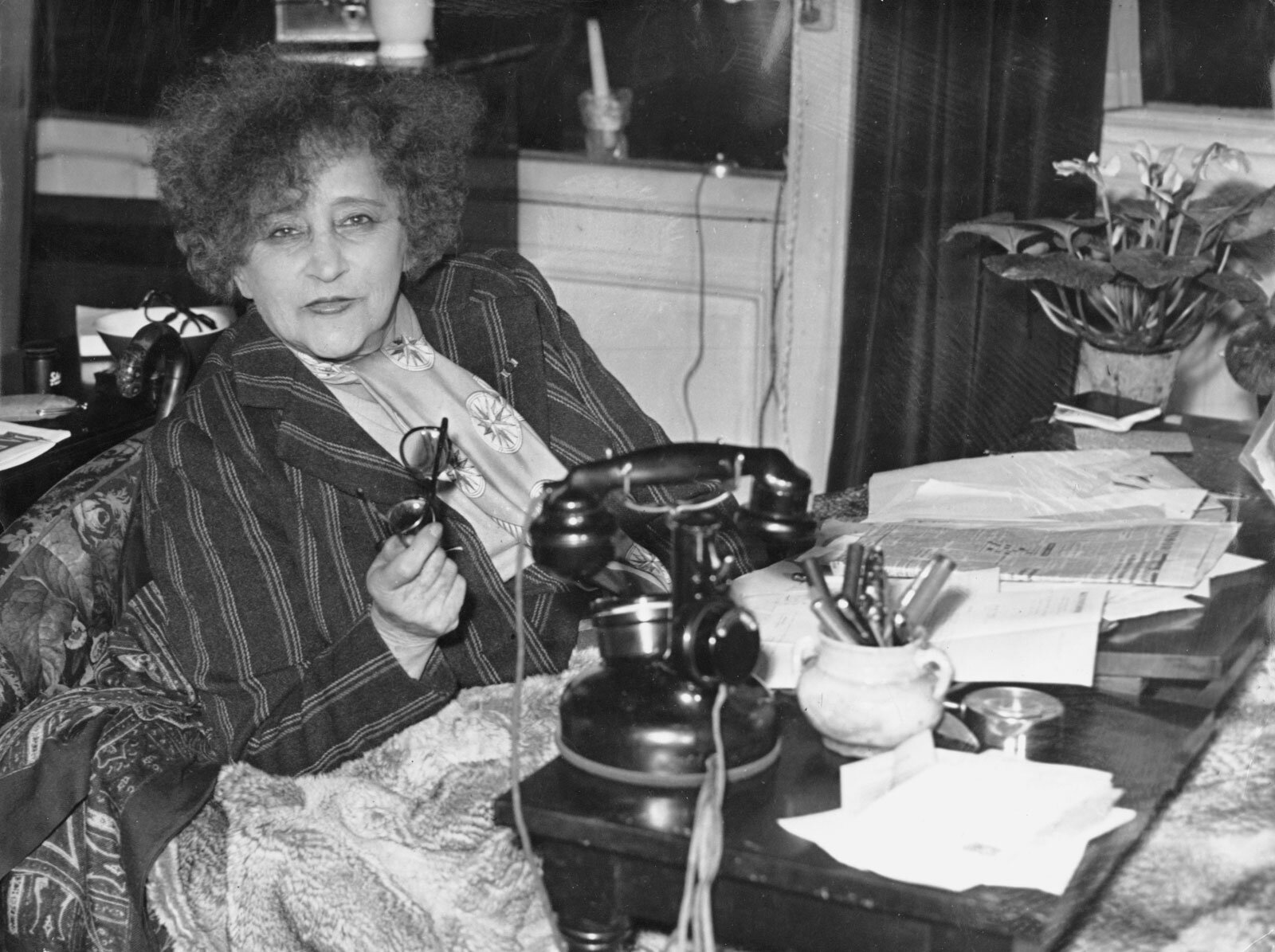
   French author Colette has been a household name in France for more than a hundred years. Sidonie-Gabrielle Colette was born on January 28, 1873, in the Burgundy region to Captain Jules-Joseph Colette and Adele “Sido”. The famed author too

Comment

French author Colette has been a household name in France for more than a hundred years. Sidonie-Gabrielle Colette was born on January 28, 1873, in the Burgundy region to Captain Jules-Joseph Colette and Adele “Sido”. The famed author took her last breath on August 3, 1954. 


One day her father's old friend Henri Gauthier-Villars “Willy” would stop by for a visit and return many times to visit the young Colette. Fourteen years old, he would take her to visit Paris showing her the theater, parties, and the glitz and glamour of the city of lights. On May 15, 1893, they would marry and move to Paris. Colette was in a hurry to get away from her overbearing mother but things would not turn out how she hoped. 


After a visit in 1895 to her former school in Saint-Sauveur-en-Puisaye Willy encouraged her to write down some of her stories from her school girl days. Willy was a music critic and writer, or he at least took credit for others writing as his own. Colette wrote the book and Willy tossed it into a drawer for four years. One day he found it and read it again but asked her to spice it up a bit. Colette did just that and in 1900 it would be published under Willy’s name only as Claudine at School. It was an immediate hit and Colette was forced to write another one. She didn’t like the writing process, so Wily would lock her in a room to write each day. In 1901 Claudine in Paris debuted.  


Willy was fast to capitalize on the success and had a stage adaptation created that premiered at the Theatre des Bouffes-Parisiens with the young actress Polaire starring as Claudine with her short dark hair and white collard shirts, that are known as a Claudine collar, or Peter Pan for those on the other side of the pond. Colette cut her hair short too and Willy would parade around Paris, basking in his literary glory with his “twins” at his side. He would let people know that Colette partially inspired the books “he wrote”. 


Colette went on to write two more, Claudine Married in 1902 and Claudine and Annie in 1903. By 1906 they separated, without any rights to her semi-autobiographical series of books. 


After the separation, Colette trained to be a mime, and one night on stage she would kiss Missy de Morny a woman who she was involved with shocking all of Paris. Remarried again in 1912 to Henri de Jouvenal, editor of Le Matin, they would have a daughter who would be given her name but would spend very little time with little Colette. During her marriage to Jouvenal, she began an affair with his 16-year-old son Bertrand that lasted for five years.


All of her writing was woven with the themes and stories of her life and her book Cheri was no exception and is laced with the theme of her marriage to Henri and her affair with Bertrand. The older woman and the much younger man relationship would head straight to her pages. Fun fact, he later was involved with Martha Gelhorn, the 3rd wife of Ernest Hemingway. 

In 1925 at 52 years old Colette met Maurice Goudeket, 16 years her junior, and their first few meetings were sexually charged and the excentric Colette captured his attention. Goudeket was born on this date, August 3, 1889, and was a very successful businessman and journalist. Two years later he moved into Colette’s apartment at the Palais Royal overlooking the trees. Colette was perfectly fine living together but in 1935 when they planned a trip to New York they were forced to marry so they can share a cabin on the oceanliner and a hotel room in New York. The two married on the Normandie on April 3, 1935, for what would be the most stable relationship of her life.  


Colette had lived in many places in Paris but her favorite was her home in the Palais Royal. In an article she mentioned how much she missed her former home, a few days later the current owner contacted her and asked if she would like it back. In 1940 she and Goudeket moved back in, just in time for WWII. Being Jewish her husband and a rather public figure, Goudeket was constantly trying to outsmart the Gestapo. 

In the dark of night on December 12, 1941, they arrived at their Palais Royal door and arrested him, and took him to the camp at Compiegne. Colette did all she could to free her husband. Luckily she was friends with the French wife of the German ambassador and was able to beg for his release and quickly fled to the South of France. Back in Paris, Colette stayed inside her apartment desperately missing her husband who made his way back to Paris and hid in the attic of the Palais Royal.  


Colette would look out her window every day as she wrote into the garden of the Palais Royal, hearing the gardener’s rakes scraping up the leaves and the birds singing. She and Maurice would live out the rest of her life here, being treated to wonderful meals from Raymond Oliver chef and owner of Le Grand Véfour, and popping bottles of Pommery champagne.  


Julia Child and her husband Paul would dine here and "first laid eyes on the Grande Dame Colette" where she would be carried through the restaurant to her saved corner seat and "avoid our eyes but observe what was on every plate”.


On my first visit to Paris, a trip to this historic restaurant was at the top of my list. The day I walked in and was greeted by the famed chef Guy Martin and was taken through the restaurant I gasped as I took my seat and looked at the brass plaque, it had just one name, Colette. At a very early age, Colette helped me love my name which was and still is so different from anyone else.

Colette would die on August 3, 1954, in her beloved home in the Palais Royale. Denied a Catholic funeral due to her multiple divorces she would be the first female writer to be given a

state funeral. More than 10,000 people paid their respects and a funeral was held in the courtyard and garden of the Palais Royal. She is buried in Père-Lachaise today with her daughter. 


In 1966 her daughter requested the Minister of Culture that the place in front of the Palais Royal and Le Nemours be named for her mother, near the home she loved so dearly.

Listen to her whole story with many more twists and turns on the newest episode of La Vie Creative - Paris History Avec A Hemingway. 


Comment

Pierre Lescot, Renaissance Architect of the Louvre

Comment

Pierre Lescot, Renaissance Architect of the Louvre

During the somewhat peaceful years in France during the reign of Charles VII to Louis XII, the kings spent most of their time in the chateaux of the Loire Valley. That all changed with Francois I announced on March 15 1528 that he was returning to Paris and will reside in the Palais du Louvre.

The Louvre of the 16th century was a far cry from what we see today. Falling in a bit of disrepair and wanting a palace that would impress his rivals, Francois I asked one man to complete his vision.

On August 2, 1546, Francois I ordered French architect Pierre Lescot to create a new Louvre. Lescott had studied law at the University of Paris but it was his love of painting and architecture that drew him away. Francois, I died the next year just as the work was started, but his son Henri II would continue with his father’s plan. Lescot and sculptor Jean Goujon were the dynamic duos of the Renaissance and their masterwork completed one of the most beautiful rooms in the Louvre.

On the west side of the Sully wing, the two planned a grand hall for the lavish celebrations of the court. However, it wasn’t always going to be so large. The original plan had a staircase running through it, but Henri II altered his dad's plan a bit. Today that grand hall is the Salle des Caryatides, Goujon would add the Caryatides at the end holding up the musician's balcony that would lend their name to the room we know today. As for the staircase, it now runs just beyond the caryatides and is named after Henri II. Its ceiling is sculpted with hunting themes and the figure of Diana, the goddess of hunting but also the name of his mistress.

Today it is the oldest remaining part of the Louvre that is still left in its original glory.

Outside the facade is decorated with an oculus surrounded by the allegories of art and architecture, corinthian and composite columns, and windows that look out in the Cour Carrée.

Walking through the Cour Carrée almost every day I head to the right bank is one of my favorite things. I love to walk around and look up at all the bas reliefs left behind for us that tell the story of what is most important to the culture of France. Merci Lescot

Comment

Delacroix and the Revolution of 1830

Comment

Delacroix and the Revolution of 1830

Eugène Delacroix is one of my very favorite artists. The man that devoted his life and all his love to art, captured one of the most recognized images of France. 

His most recognized painting is La Liberté Guidant le Peuple, painted in 1830 for the Salon of 1831 and is now proudly on display in the Musée du Louvre. But let’s rewind quite a bit and see what this painting is all about. 

The timeline of France is marked by more than one Revolution. Most know of the big one that resulted in the beheading of Marie Antoinette & Louis XVI which began in 1789. Four decades later the people would rise up again against the brother of Louis XVI. Charles X had taken the throne after the death of his brother Louis XVIII on September 16, 1824. Things would get worse for Charles in 1830 when on March 18 he dissolved the Parliament and as the press spoke up against him he censored them on July 25. 

On Monday, July 26 more than 50 newspapers were forced to stop the presses. The next morning the owners gathered and vowed to fight back. As the police arrived at the offices of the newspapers to take their presses and newspapers they found the workers waiting and screaming. By the afternoon one by one the editors, owners, journalists, and printers began to march into the center of Paris. The Place Vendome, Place de la Bastille and the Place du Carrousel saw large crowds of outraged citizens whom the police were no match for. 

On July 28 in front of the Hotel de Ville, the Garde Royal were quickly outnumbered. The angry crowd gathered every cobblestone and projectile to build barricades and also tossed them at the police force. It was at this moment that a 32-year-old Eugene Delacroix was just down the way at his studio at 15 Quai Voltaire and was moved to capture this penultimate moment of the Trois Glorieuses Jours. 

Delacroix’s good friend Théodore Gericault just three years earlier painted the monument Raft of the Medusa. The current event painting won plenty of fans and skeptics. History paintings in the lexicon of art were deemed the pinnacle of all art styles but rarely were painted so close to the moment of the event. Delacroix said “if I can’t fight for my country, I will paint for it”, and he did just that. 

For three months he sketched and painted from September 20 to mid-December 1830. An astonishingly quick period to create such a large piece and brought the entire moment to life. Displayed in the Salon of 1831, under the title Scenes de Barricades, it was met with a wide mix of criticism. Many thought the allegorical woman was dirty, displaying her hairy armpit and filthy feet while the nude man and his visible pubic hair were right at eye level. 

The entire scene was one of the lower and upper classes as well as men of all ages united. This was exactly why the three-day Revolution is marked as such a defining moment in French history as told in art and also remembered by the July Column in the Place de la Bastille. It was the mix of all classes that stood up against the monarchy. While the first Revolution began with the poor vs the monarchy, the July Revolution saw all classes in arms together. 

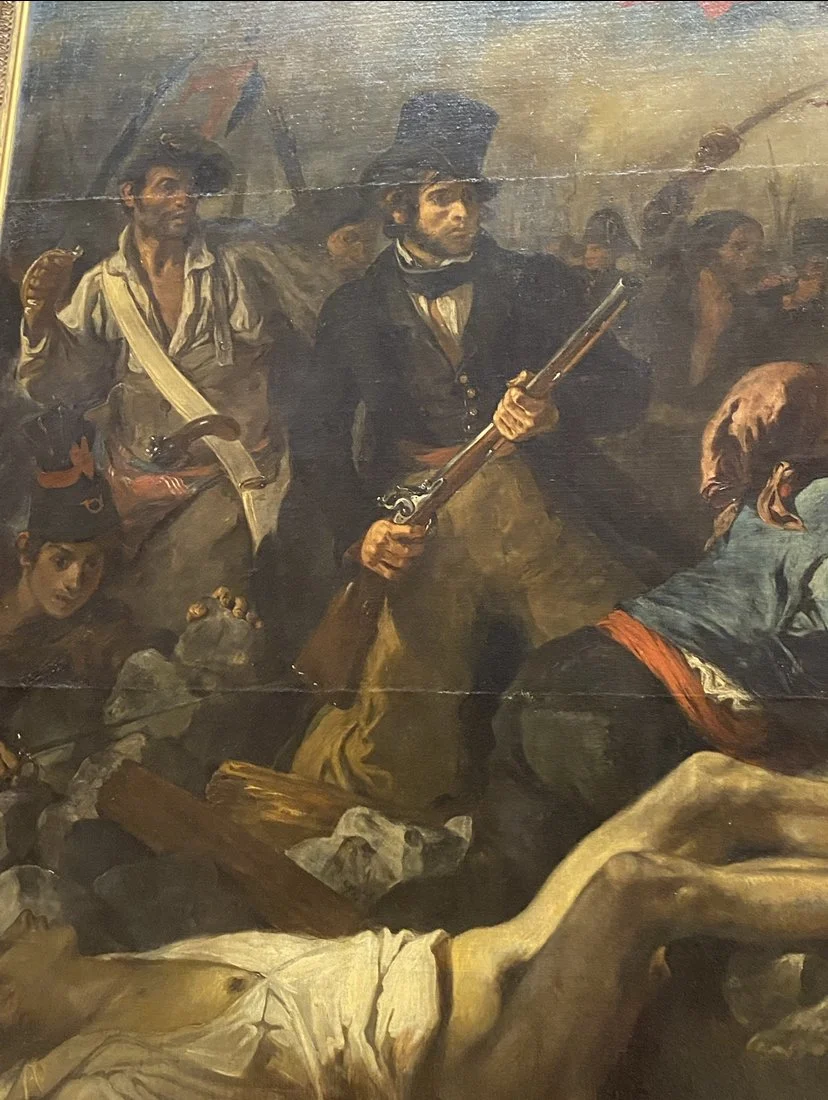
Delacroix perfectly captures that in his grand tableau. To the left of the center, we see what appears to be a wealthy man in his top hat. Many incorrectly identify it as a self-portrait of the artist but it’s most likely Delacroix’s close friend Frederic Villot, artist and curator of the dept of paintings at the Musée du Louvre. Next to him is a gentleman holding up an Infantry saber in his white shirt and the apron of a printer with a gun tucked into his waist. Behind these two men is a group of angry men that have one goal in mind, to follow Liberty. You can spot one wearing a tricorn hat and beret, a little hint that it was all walks of life and allegiances that stepped up. 

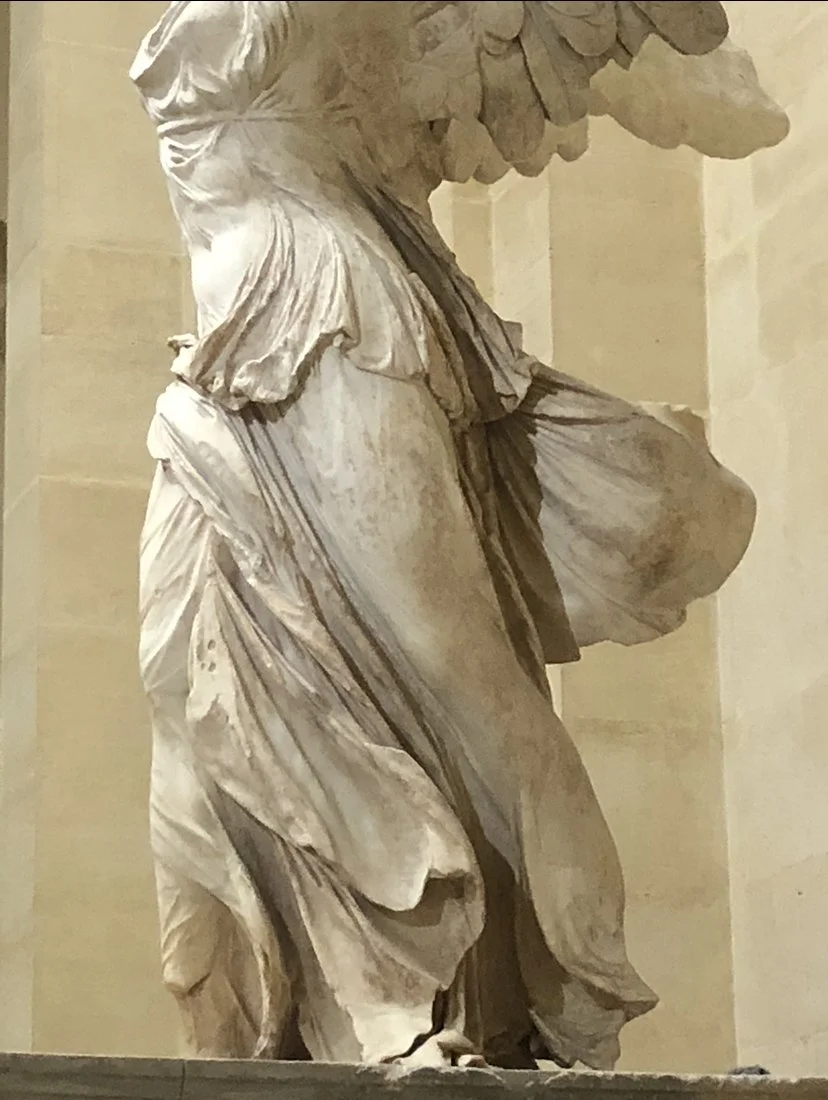
In the center, it is impossible to not be drawn to the lovely allegory of Liberty which is also known now as the symbol of the Republic, Marianne. In her yellow tinted cream dress, she exposes her breast which symbolizes motherhood and the birth of the nation. Inspired by the Greek statuary and the goddess Victoire, the beautiful draping of her dress is reminiscent of my other favorite in the Louvre, the Winged Victory of Samothrace. However, Delacroix never would have seen this beauty. Discovered in 1863, the same year of Delacroix’s death, only her surviving torso was on display from 1865 to 1871. 

Delacroix was the master of colors and uses them perfectly in this painting but with very few hues. Bleu, Blanc et Rouge stands out in this painting, exactly as they should. Using color and light he directs your eye to what he wants you to see first. The French flag as we know it today was first unveiled in 1794 and was prominent during the Revolution. In 1814 it was changed to the solid white flag of the Bourbon dynasty which lasted until three days in July of 1830. 

The image today is the one that is used to symbolize France, but he was foreshadowing in this snapshot of the barricades that the Tricolor would return to France. The flag of Paris at the time was blue and red, add the white in the center of the Bourbons and voila, the Drapeau of France was born. 

Delacroix also uses it on the man below who is crawling up the barricade and looking up at Liberty. The print worker in his blue shirt with a bit of white peeking out and his red sash also evoke the flag and that of the people devoting themselves to liberty.  

When the painting was first exhibited her red Phrygian cap was a much brighter red and he was asked to mute the color to a deeper shade in 1855. The cap itself dates back to Roman times when it was placed on the freed slaves and thus an image of freedom. Love a girl that accessories in red! In her left hand, she holds a rifle that brings the classic Greek & Roman image to the contemporary moment. 

While Liberty holds up the French Tricolor, she turns her perfectly sculpted face of a Roman coin back to the crowd that has gathered to follow her. At her side is a young boy with two pistols in the air, and an ammo bag around his torso he took off a guard and was ready to take up the fight today and into the future. 

The classic pyramid structure, much like Gericault’s Raft of the Medusa, is a mix of hope and despair. At the top of the pyramid, you have the flag and as your eye travels down at the base there is death. On the right are the Swiss guards outnumbered by the citizens and to the left, plucked out of Gericault’s masterpiece is the body of a man that was pulled from his home into the street by the police and killed as a message to others. Delacroix painted one blue sock onto the man as a nod to his friend who had a difficult time painting feet. 

In the top right, don’t miss the towers of Notre Dame de Paris. The symbol of France and the conservative monarchy was topped with a tiny French Tricolor you can see against the smoke as the rise of the French Republic was on its way. 

At the Salon of 1831, the painting was purchased by the State for 3000 francs but it was only briefly displayed in the Musée du Luxembourg. Adolphe Thiers was worried it would inspire another uprising and had it removed and returned to Delacroix in 1832. The painting hid away in the Val d’Oise with his aunt Felicité Riesener until 1848 when it returned to the Luxembourg but hidden away until the 1855 Universal Exhibition when he also had to darken her cap. Special permission had to be obtained for the exhibition and after the painting went back into storage. In 1863 when it was finally returned to the public it was too late for the master to see it hung, the father of the Romantic movement was gone. In 1874 it finally moved to the Salle Mollier of the Louvre where you can still see it today. 

One day another artist, Frederic Bartholdi visited the Louvre and saw our lovely Delacroix Liberty which inspired his design of his very own. Today Delacroix’s well-known painting has been copied onto clothes, reimagined in billboards, inspired other artists to adapt it as their own, projected onto the side of a plane and even my beloved Swatch watch. She is brought out every 14 juillet and any other moment of immense French pride and I always smile when I see her. 

Once a week on an early morning in the Louvre before the masses descend into the Denon wing to find Mona I find a few quiet moments to sit with her and worship the master of the Romantic period, and also my birthday buddy. 


Comment

Sand Dollars from Beyond

Comment

Sand Dollars from Beyond

Today, I had to go and get my monthly blood draw which always fills me with anxiety. As soon as my number was called I saw my favorite phlebotomist and she instantly put me at ease. My veins are small and they like to roll so it normally takes a few lovely jabs to catch one and she always makes me feel so much better. “When do you move to France”, she asked and when I told her she also said she was moving to a different hospital. It felt like leaving a friend as I said goodbye and thanked her for always making me feel so much better while going through Leukemia.

As soon as my Lyft arrived, the driver asked how my day was and instantly I said: “well now that my blood letting is done, great”. The driver Brian asked why I needed to have blood drawn and when I explained it to him he was very kind and within a few miles, we began talking about losing important people in our lives and how we deal with grief and also packing up your life.

He had served in Iraq and both loss and packing have played a huge part in his life. We lose people that were everything to us and you can’t imagine a day without them, so then we surround ourselves with the physical things that remind us of them. Those things that “spark joy” actually spark sadness until you can get past the grief. Mourning my grandma and purging my life has been overwhelming and liberating. She isn’t in all those dishes and the many keepsakes she left for me, she is in my heart and with me every single step I take.

I had almost wished the drive was longer as it was one of the most enlightening and understanding conversations I have had in months. As I thanked him and got out of the car I looked down and in the pocket of the door and saw three whole sand dollars.

Growing up and spending weekends at the family beach house with my grandparents I would spend hours walking down the beach collecting shells. Many of them were sand dollars and as soon as I saw them I knew it was a little wink from my grandparents.

Life takes us down strange roads, but somehow we have moments that put us exactly we are supposed to be. I can’t wait for my next chapter and know my grandparents are with me at every moment.

Comment

Happy Birthday Hem

Comment

Happy Birthday Hem

“There is never any ending to Paris and the memory of each person who has lived in it differs from that of any other. We always returned to it no matter who we were or how it was changed or with what difficulties, or ease, it could be reached. Paris was always worth it and you received return for whatever you brought to it”

Ernest Hemingway would be 123 years old today. Born in Oak Park, Illinois to a physician father and musician mother. The second of four children the young Ernest would spend summers in Michigan camping, hunting, and fishing. His father taught him how to fire a rifle at the age of 2 1/2; the kickback tossed him to the ground but instilled the love of shooting at a very young age that would sadly follow to his death.

In 1918, he would take his first trip to Paris, passing through on his way to Italy as an ambulance driver during World War I. At 18, wounded by mortar fire and both his legs were struck with shrapnel that would land him in a Milan hospital. While laid up in the hospital he would fall in love with his nurse, Agnes von Kurowski. The two planned to marry, but Hem would come back to the US in 1919 and three months later she would send him a letter that she was going to marry someone else.

Some say that Ernest never got over this, and it would follow his future marriages. His first three marriages would end with him leaving his wife, perhaps before they could leave him. His relationship with his mother was rocky at best, he has written many times about his strong dislike for her and his father would kill himself in 1928.

All these events shape our lives and even those that are bigger than life. Hemingway is painted at times as an uncaring callous man that went through women and friends quickly. However, in his collection of writing are letters he wrote to friends and children that were going through a hard time. In those letters are a kind man that wanted nothing more than to brighten the spirits of a young lad going through a medical crisis.

We build up people to be larger than life and most of the time they can never live up to that and it becomes a burden and can end in the worst way possible.

Comment


   One of my favorite things about the smaller rooms of museums is how the curators organize   the collection. Some rooms are dedicated to a single artist but the really cool ones are a mix of artists and when you really look you can se

Comment

One of my favorite things about the smaller rooms of museums is how the curators organize 

the collection. Some rooms are dedicated to a single artist but the really cool ones are a mix of artists and when you really look you can see how each painting speaks to each other. 

There is one specific room in the Musée d’Orsay that I love and it is because of the paintings in the room and how each one has its own amazing story but together they tell another story.  On the ground floor of the Orsay in salle 12, you can find one of my favorite portraits, Berthe Morisot au Bouquet de Violettes by Manet.  I have a lot of favorites and if you have done a tour with me I will mention it about 1000 times but if I had to pick my top five favorite paintings, this would be one of them. 

The painting came into the collection of Berthe Morisot in 1894 when she purchased it from Théodore Duret. Sadly, Morisot died the next year but it would remain in the family through her daughter Julie Manet and grandson Clement Rouart until it was purchased in 1998 through various foundations for the Musée d’Orsay. 

I love the story of their friendship and how they met as she was a copyist in the Louvre and as soon as they met he wanted to paint her. Manet loved her dark looks, although her eyes were very green and captured her for the first time in the painting just to the right. Le Balcon was painted in 1868 and Berthe is seen sitting holding a fan and looking off into the distance. 

The other figures standing on the balcony include Jean-Baptiste Antoine Guillemet who was also an artist and the lovely lady on the right is Fanny Claus who was a violinist and friend of Manet’s wife Suzanne which we will see next. In her arms, she cradles an umbrella, a little nod to her father’s business. Hiding in the shadows is Suzanne’s son Léon who may have been Edouard Manet’s son or maybe even his brother. 

The next wall is Manet's Madame Manet au Piano, which is his wife Suzanne Leenhoff who arrived into his family as a piano teacher for the young Manet. Next to her is La Lecture also by Manet which shows a lovely Suzanne in a billowy white dress, that also takes you back to Le Balcon and in the background is her son, Léon who is also in Le Balcon. To the right is Monet’s painting of his wife also on a couch. 

James Tissot’s Portrait of Mademoiselle L.L., another portrait of a very fashionable woman in her red jacket that pops from the wall. Painted in 1864, Tissot who was a master at portraits uses an unusual pose that harkens back to more of an academic painting of the past. I love how she is looking across the room directly at Berthe and Le Balcon. Back to the wall with Berthe which includes two Renoir, Madame Darras, and Jeune femme à la Violette Stand back and look at this wall and how they all are tied together, and then look at the entire room and see how one theme leads to the next. 

Check out the video I made sharing this room as well as Manet’s Olympia and then up to the Impressionist gallery. And if you are coming to Paris this fall, reach out for a tour, days are filling up fast. Check ClaudineHemingway.com


Comment

The Absinthe Drinkers of Degas

Comment

The Absinthe Drinkers of Degas

The top floor of the Musée d’Orsay is filled with the Impressionists that shook up the Paris art world. Manet, Monet, Morisot, and Renoir cover the walls along with the man who never wanted to be lumped into the movement. Degas did however join them in creating their exhibitions in 1874 after the Salon would not let them in.

From 1874-1886 the Anonymous Society of Painters, Sculptors, and Engravers would display their work in the studio of Nadar on the Blvd des Capucines. Preferring to be called a Realist, Degas ridiculed the en Plein air practice that was taking over and the basis of Impressionism. He preferred to worship at the feet of Delacroix and Ingres and spend time at the Opera capturing the musicians and dancers.

While Orsay holds many of his horse racing and ballet paintings, it’s one of a slightly darker subject that is my favorite. However, once you know the story, it is not that sad at all. In 1875 Edgar Degas painted Dans un Café, later titled L’Absinthe. In the painting of two people sitting in a café, the woman looks depressed and defeated with a glass of absinthe in front of her.

The man smokes his pipe and appears to be watching something off the canvas. I once heard someone describe a young woman as a prostitute, fashionably dressed down to her feet sitting with her date and a vacant look on her face. The truth is that Degas couldn’t find any people that looked depressed enough for his painting so he asked two friends to pose for him in the Café de la Nouvelle-Athènes. An actress that also posed for Manet, Ellen Andrée portrays the sad woman and painter Marcellon Desboutin as her companion. When the finished painting was shown in 1876, it was not received well.

One critic even said of the woman in the painting, “What a whore!” The painting was described by some as a cautionary tale of what will happen if you head down the road of the green fairy. The painting would end up in the collection of Isaac de Camondo until he donated it in 1911 to the Musée du Louvre where in 1986 would move to the Orsay. Happy 188th birthday, Monsieur Degas.

Comment

The Fortified City of Carcassonne

Comment

The Fortified City of Carcassonne

The Tour de France ended today in the walled city of Carcassonne that Eugene Viollet-le-Duc worked on while he restored Notre Dame de Paris. Dating back to the 3rd century and built by the Romans it had fallen into great disrepair and was going to be torn down. Mayor Jean-Pierre Cros-Mayrevielle was also an inspector of historical monuments and good friends with Prosper Mérimée, a fellow inspector, author, and historian. The two men worked together to

stop the state-sponsored destruction of Carcassonne and had the perfect man to help with the cause. Viollet-le-Duc was already working on restoring the Basilique Saint Nazaire within the city walls, restoring and updating the Romanesque church with some Gothic touches but keeping many of the 13th-century stained glass windows.

Since the 3rd century Carcassonne had gone from the hands of the Romans to the Visigoths, Charlemagne to Louis IX who would add a second rampart or wall for further protection. Later in calmer times more than a hundred homes were built between the walls that would later be demolished for restoration. Viollet-le Duc’s plans included finishing many of the 52 towers that had been left without roofs for centuries, reinforcing the almost two miles of ramparts and four gates. Keeping its medieval appearance and ancient defense platforms and shelters he stayed close to its initial intent. However, it wasn't without controversy when he decided to top the towers with conical-shaped roofs covered with slate and not terra-cotta. Stanch historians were upset with the choice, but Viollet had found slate in the excavation of the site and felt it was historical. He died in 1879 and his student Paul Boeswillwald took over. It took over 60 years to complete, long after his death.

In 1979 my grandparents took a very slow cruise down the Canal du Midi. On 2 October they stopped in Carcassonne and of course, took some photos. You can see the Viollet slate conical roofs next to terra-cotta roofs and something you will no longer see today, cars on the medieval streets. To think this beautiful place was going to be destroyed.

Comment