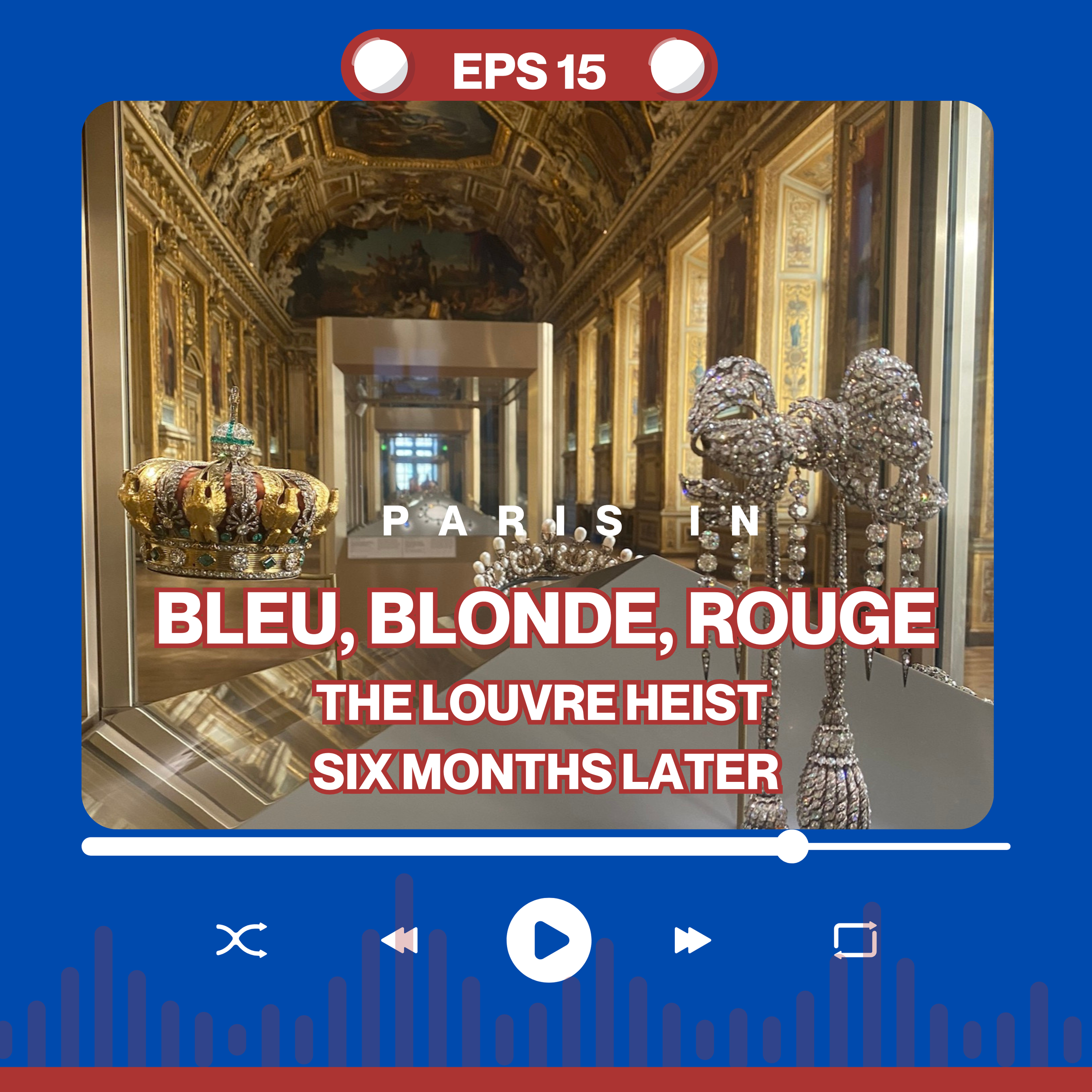
It was 6 months ago, on October 19, 2025, on a Sunday morning in Paris, that a brazen heist of the French Crown jewels struck the Musée du Louvre.
In this week’s episode of the Paris in Bleu Blonde Rouge podcast, we go deep into the details of the theft, the history of the stolen jewels, where they are in the investigation, and what has changed at the Louvre.
It’s 7:37 am in the north of Paris, while most people were still asleep, when four thieves began orchestrating the crime of the century. Two suspects left Aubervilliers in the Seine-Saint-Denis region, both wearing helmets: one driving a Burgman scooter, the other at the wheel of a white Citroën Berlingo utility vehicle. The two drove to Ivry-sur-Seine and parked the van on the quai along the Seine and returned on the
motorcycle together to Aubervillier.
At 8:30 am, back in Aubervillier, the Burgman scooter leaves, followed by the Nacelle lift truck, and heads to Bercy in the 12th
The third member on a BMW scooter travels from Aubervillier to Pantin, abandons the BMW, and jumps on a Yamaha scooter driven by a 4th man. All four take different routes, obeying the speed limits and all traffic signals.
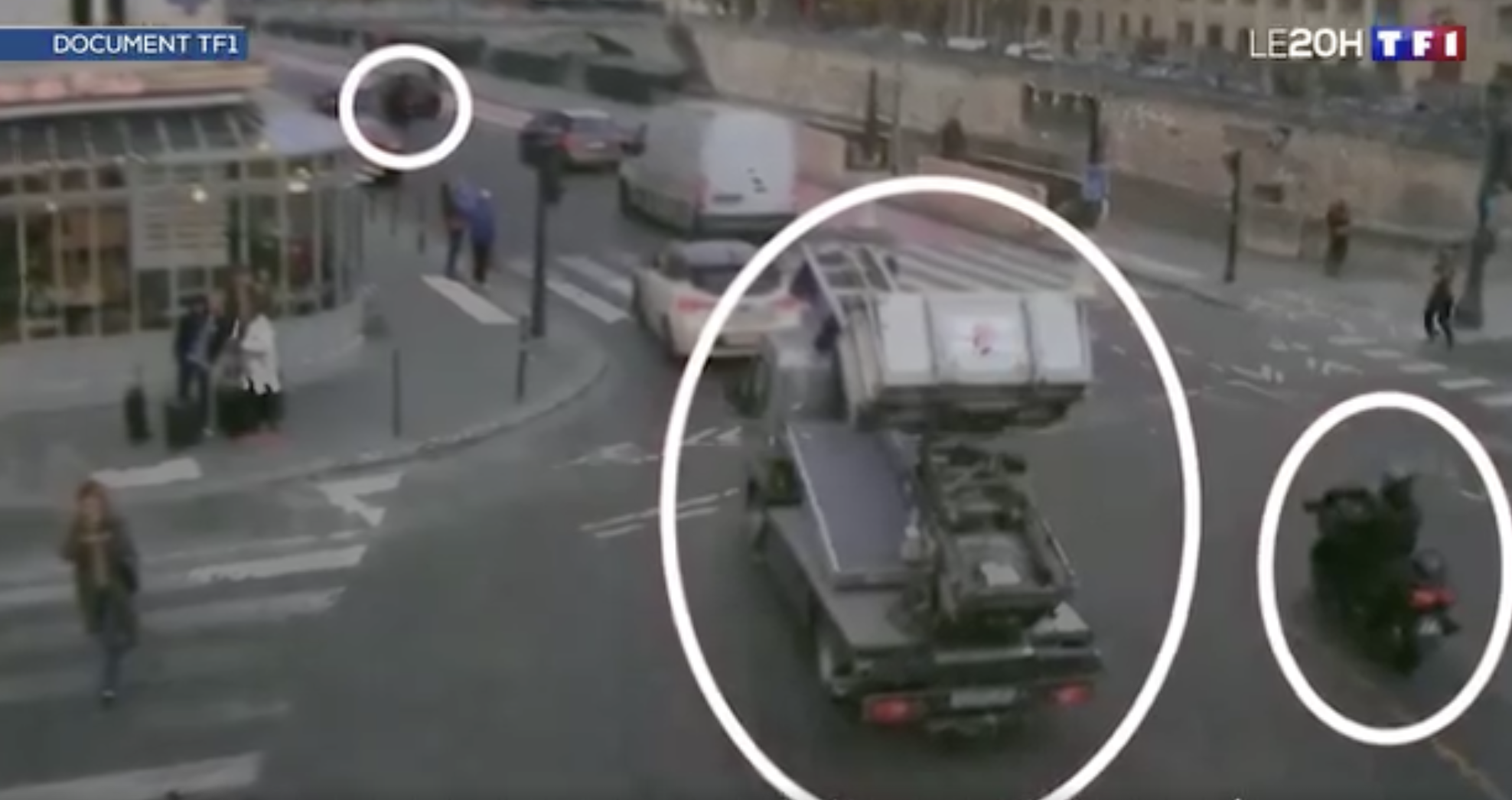
At 9:10 am, they all meet at the Avenue des Terroirs de France in Bercy and then head to the Louvre. The Nacelle and two scooters traveled along the quai of the left bank, past Notre Dame, the Fontaine Saint Michel, the Pont des Arts, and finally turning right on the Pont Royale.
Captured on CCTV cameras, the grainy images were released by TF1 news, showing the four thieves calmly walking the streets of Paris. With one scooter in front and one behind the truck, they drove alongside the Louvre as they headed to the scene of the crime.
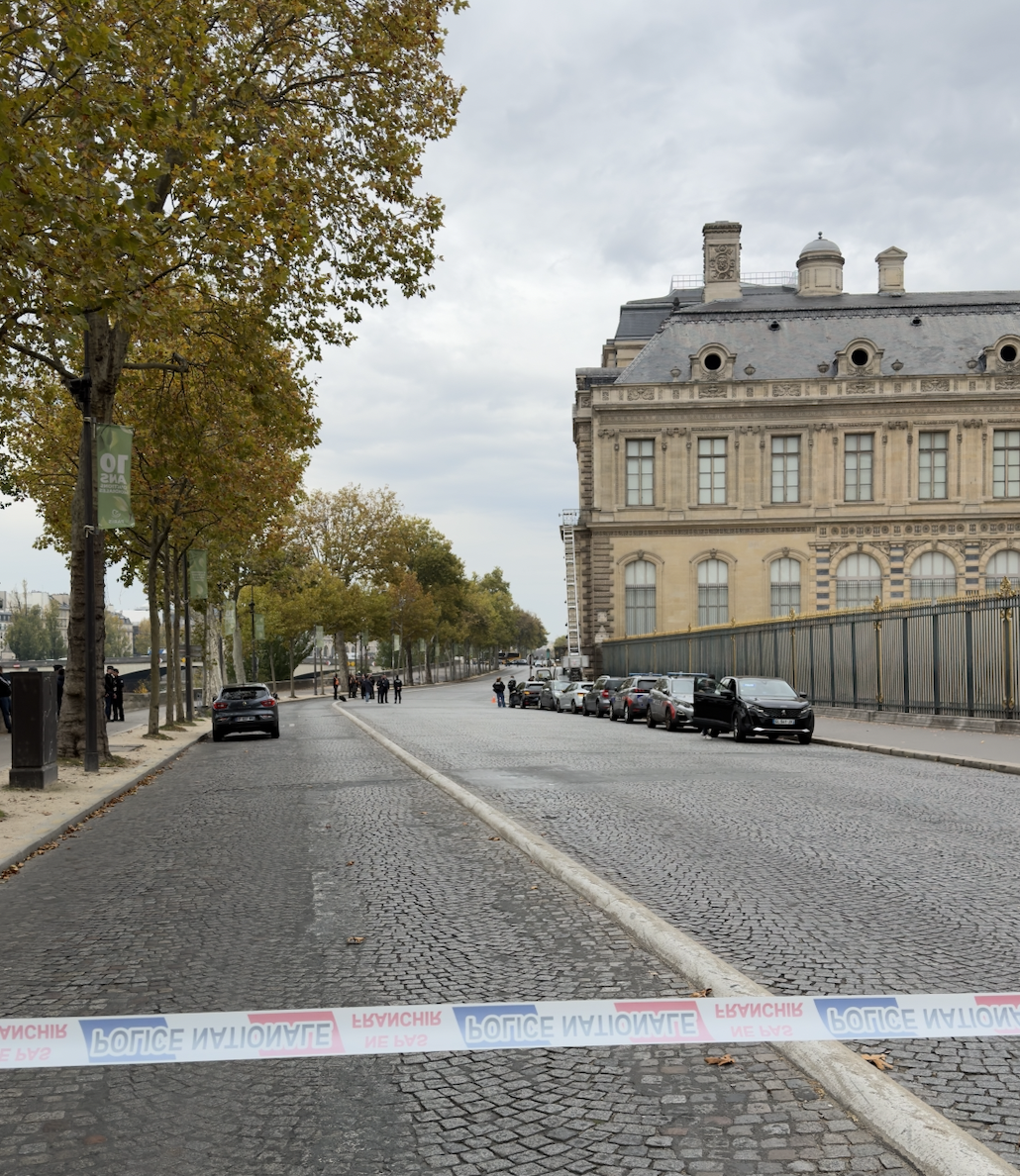
At 9:30 am, they arrive below the Petit Galerie, built in the 16th century as a connection from the King’s Pavilion of the Palais du Louvre. The two on the motorcycle block the light traffic on the Quai François Mitterand and place orange cones around the truck to add to the illusion of construction workers. Over the next 3 minutes, the driver of the truck turns around and parks on the sidewalk facing the oncoming traffic.
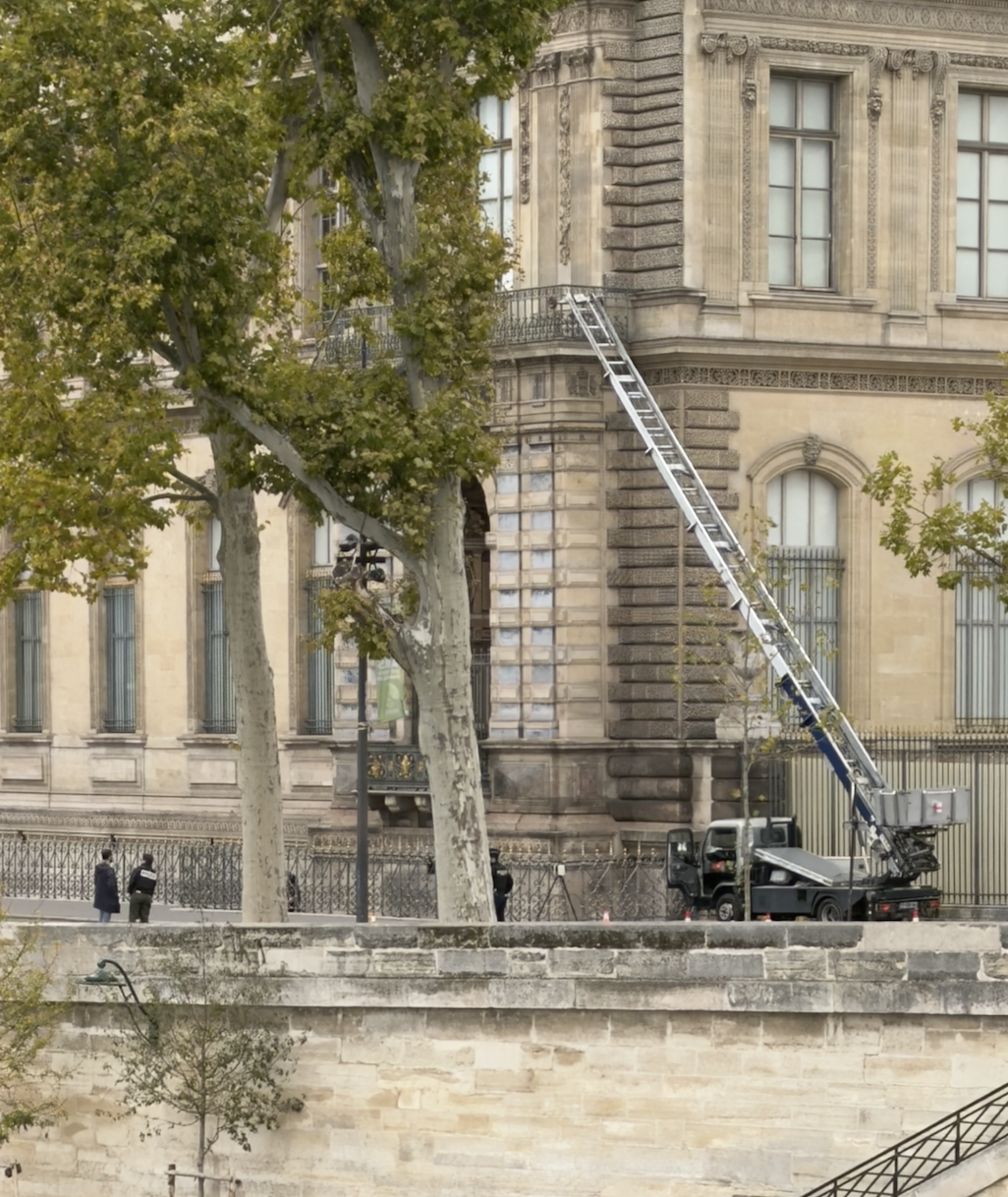
At 9:34 am, two thieves, we will come to known as Abdoulaye N, wearing a yellow vest, and Ayed G, dressed in black and wearing a grey motorcycle helmet, hop onto the flat lift of the truck, intended for furniture, not people. On the ground, Rachid operates the lift, taking them to the balcony of the Galerie d’Apollon.
At 9:34 and 11 seconds, the thieves attack the lower right window with the large angle saw and trigger alarm no. 13 that rings at the command post, and not aloud in the room or outside the building.
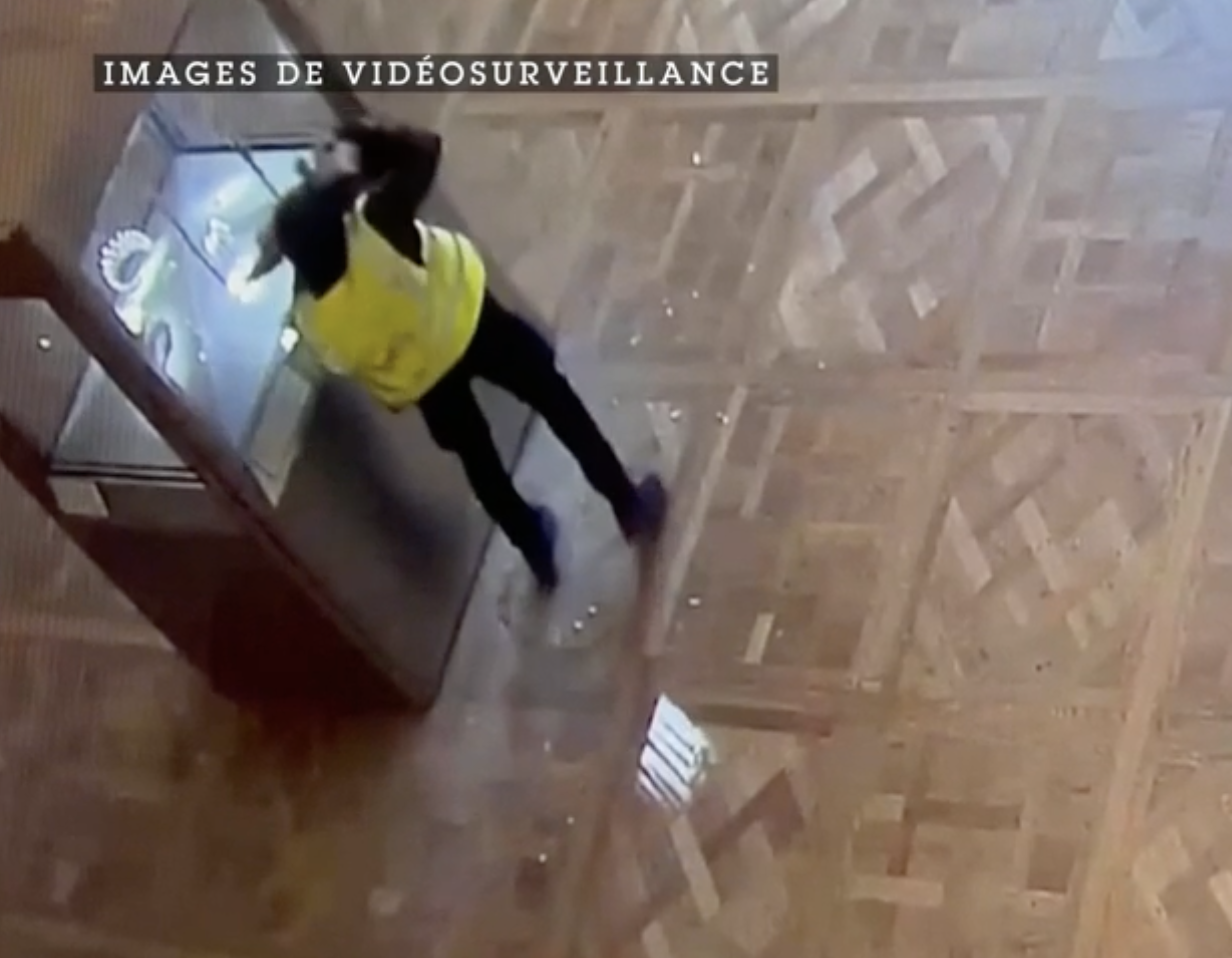
At 9:35 am, the two quickly enter through the window. Ayed G, in the grey helmet thief, pretends to rush toward the guards at the door to Salon Carré. The guards quickly get the few visitors out of the jewel box of a room, and one of them places the first radio call to the office as the thieves run to the first two cases.
9:35 am, call to police from Louvre security
At 9:35 and 11 seconds, the alarm of the first case of the jewels of Empress Eugenie rings within the room at Abdoulaye N., in the yellow vest, who attempts to cut a large rectangular hole in the case. The case fights back, and it takes several passes with the saw and a few hard blows to the shoulder to get inside. He violently grabs the beautiful bow brooch, then the true crown jewel, the Reliquary brooch, crushes the Imperial crown, and jumps a bit to reach the tiara. The only saving grace was the pearl and diamond brooch left behind, which he wasn’t able to reach.
At 9:35 and 20 seconds, Ayed G, with the second saw attacks the south end of the central case. The alarm rings out, but he has trouble breaking into the case.
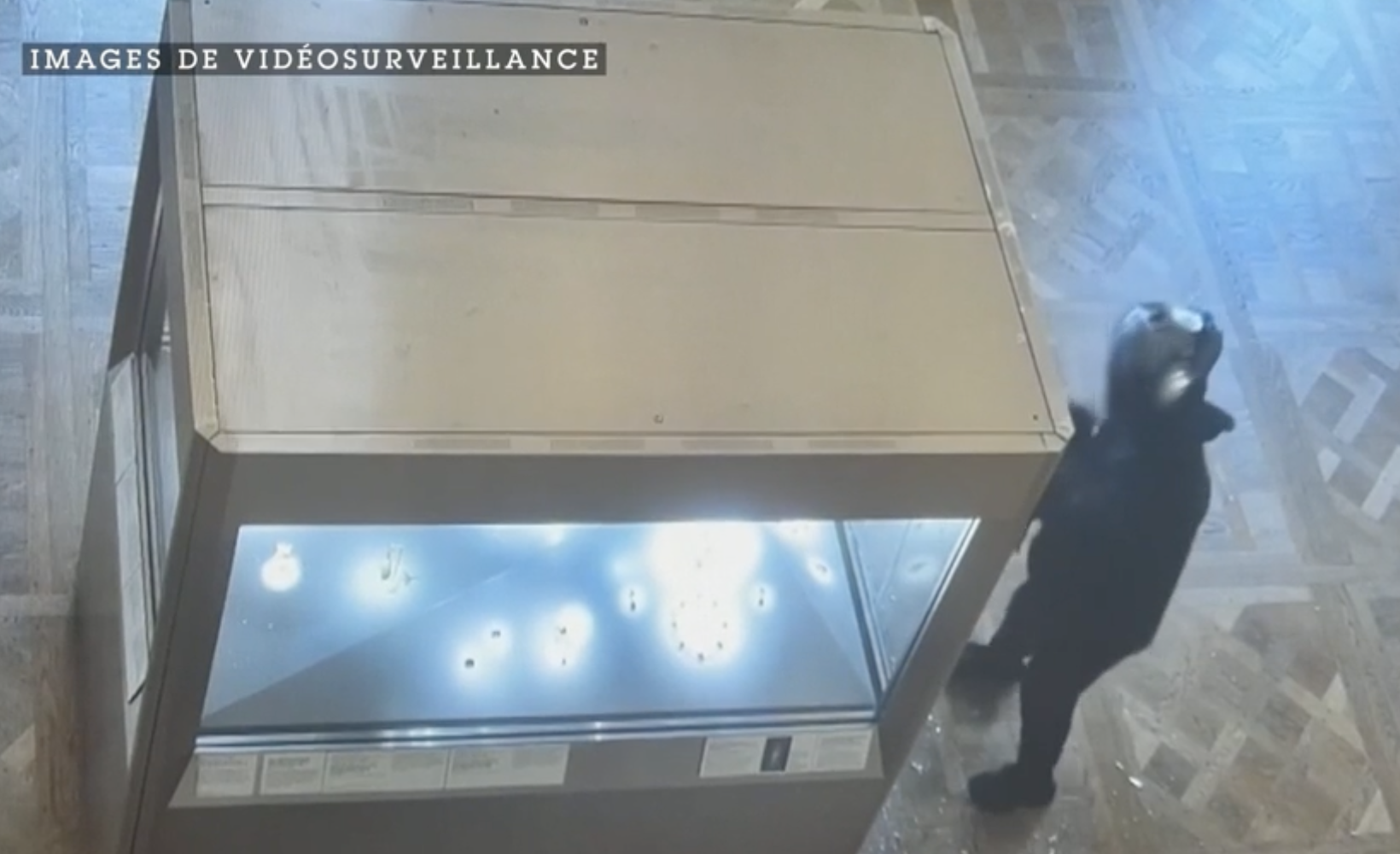
9:36 Police telesecurity, aka Ramses button, which is connected to the Ministry of the Interior. Agents at the Salon Carré door, one tries to advance towards the thieves with a stanchion pole
9:37 Internal theft procedure 33.33 initiated, and all doors closed. Many doors automatically release and shut.
9:37 As soon as Abdoulaye finishes the destruction of the first case, he helps smash through the glass and quickly grabs the set of emeralds and sapphires; thankfully, the pearl drops of Josephine are out of reach.
At 9:38, they begin fleeing in panic. Abdoulaye in the yellow vest, dropped a few of the jewels and a glove and stopped to pick up the gems, but left the glove behind.

9:38 they flee out the same window they entered and ride down the lift to the awaiting scooters. The thieves said they handed the jewels to the awaiting drivers as soon as they reached the ground.
On foot, Louvre security agents run down the quai, causing the thieves to flee and preventing them from setting fire to the lift and evidence, much to the advantage of investigators.
While the two thieves were inside, one of them punctured the gas tank below. Security agents arrived at the overwhelming smell of gas, discarded blow torch, circular saws, helmet, vest, and gloves, all covered with DNA.
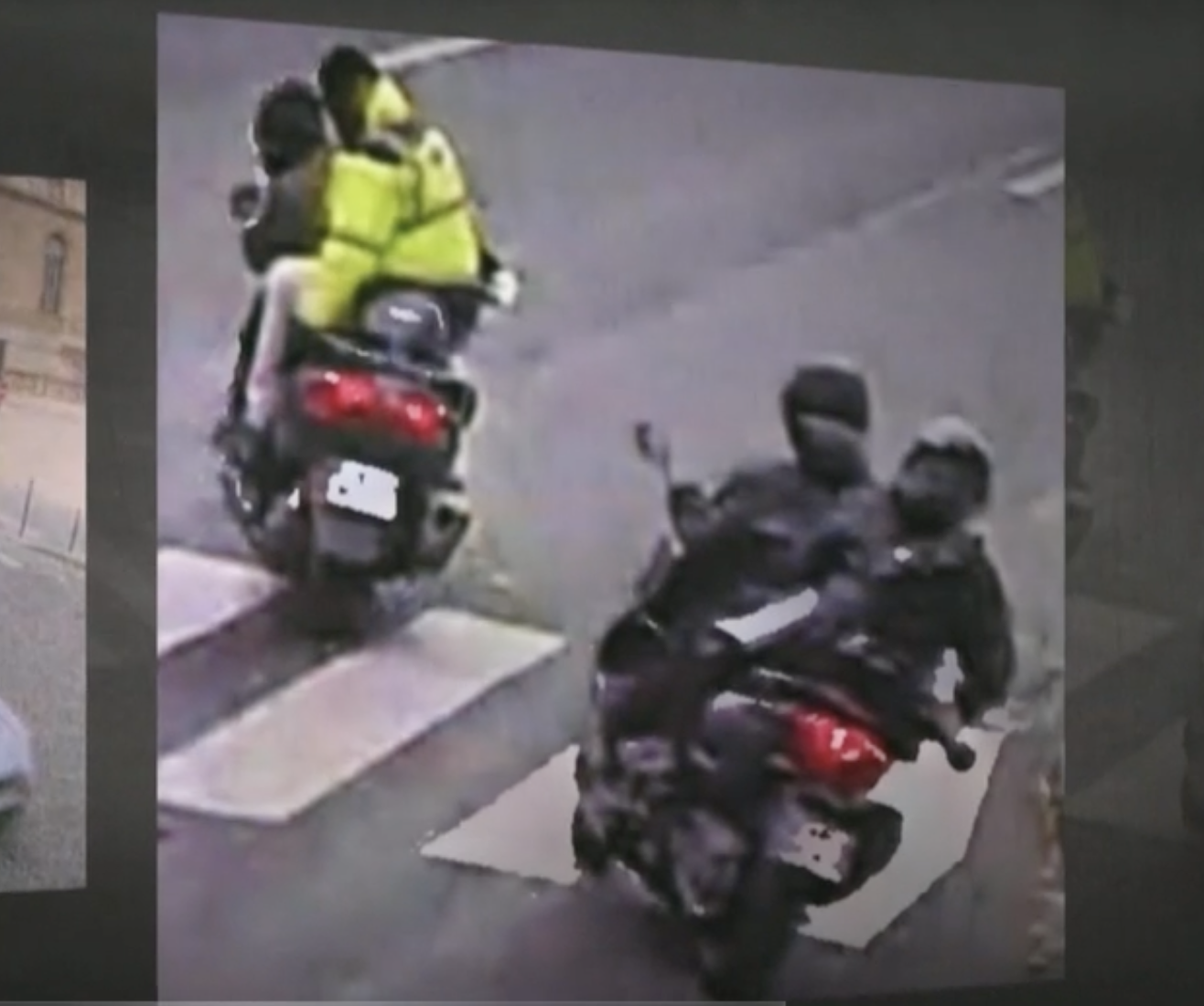
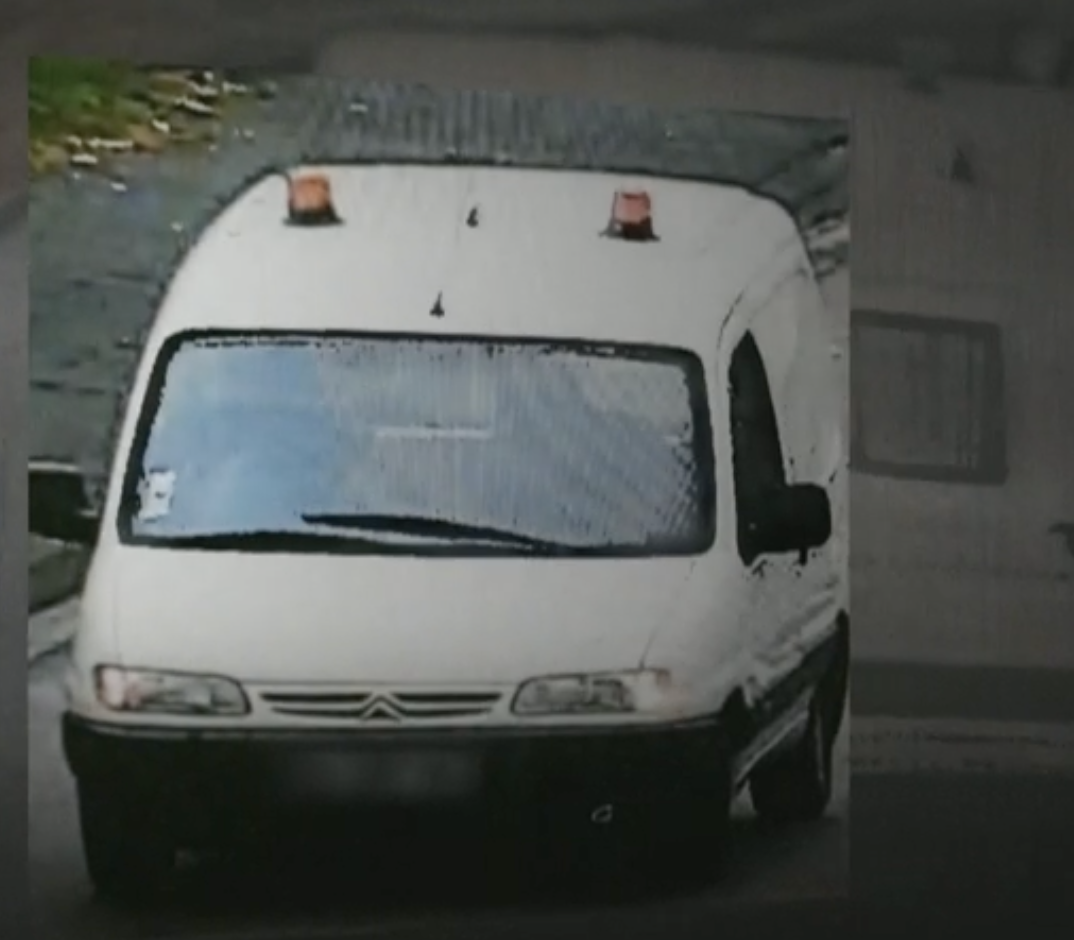
All four are now on two scooters and speeding away from the crime scene. If you have been in Paris, you know how the motorcycles bob and weave through traffic even as cars are at a standstill, including a police car that was not far behind. They head back to the Quai in Ivry-sur-Seine, where a white van is waiting. They separate into two groups. Two on scooters and two in a van with two rotating beacons. All go in separate directions.
At 10:27 am, the two scooters with Abdalaye N, who violently ripped the jewels from the cases in the Gallerie d’Apollon, and getaway driver Slimane K were seen entering an underground parking lot of an apartment building on the Rue Léopold Rechossière
in the Fort d’Aubervilliers district. Not realizing there was a camera they two thieves could be seen pulling out part of the stolen jewels and passing them to each other. Officials who view the video note that not all eight pieces appear to be there. “Holding a large jewel, a piece seems to be missing.”
The van was lost in Vexin, between the Yvelins and the Eure, and at 11:20 am, the white van arrived with Ayed G, the other Apollo intruder and getaway driver, Rachid H. Ayed attempted to hide the scooters, and they removed the orange lights from the van.
By 10:45 a.m., the news began spreading on social media and across every French news site. I had been visiting the Basilique Saint Denis with a friend, and we returned to walk around the Ile de la Cité when I happened to look at my phone and a message from a friend asking if I had seen the news. I opened Instagram, and the first thing that came up was the theft. At first, I thought the jewels in the gift shop had been stolen. How could they possibly steal the crown jewels?
Heading straight to the Louvre, the ladder of the truck could be seen from blocks away. Even watching the police working the crime scene and the numerous news cameras already in place, it was still unbelievable.
Hours later, the worst news arrived: the Ministry of Culture released the full list of items stolen. It’s unknown whether the specific items stolen were specifically targeted or if they were just the two closest cases to the window. Eight pieces that once belonged to a queen and two empresses of France.
The first case contained the pieces that belonged to the last Empress of France, Eugene, the wife of Napoleon III.
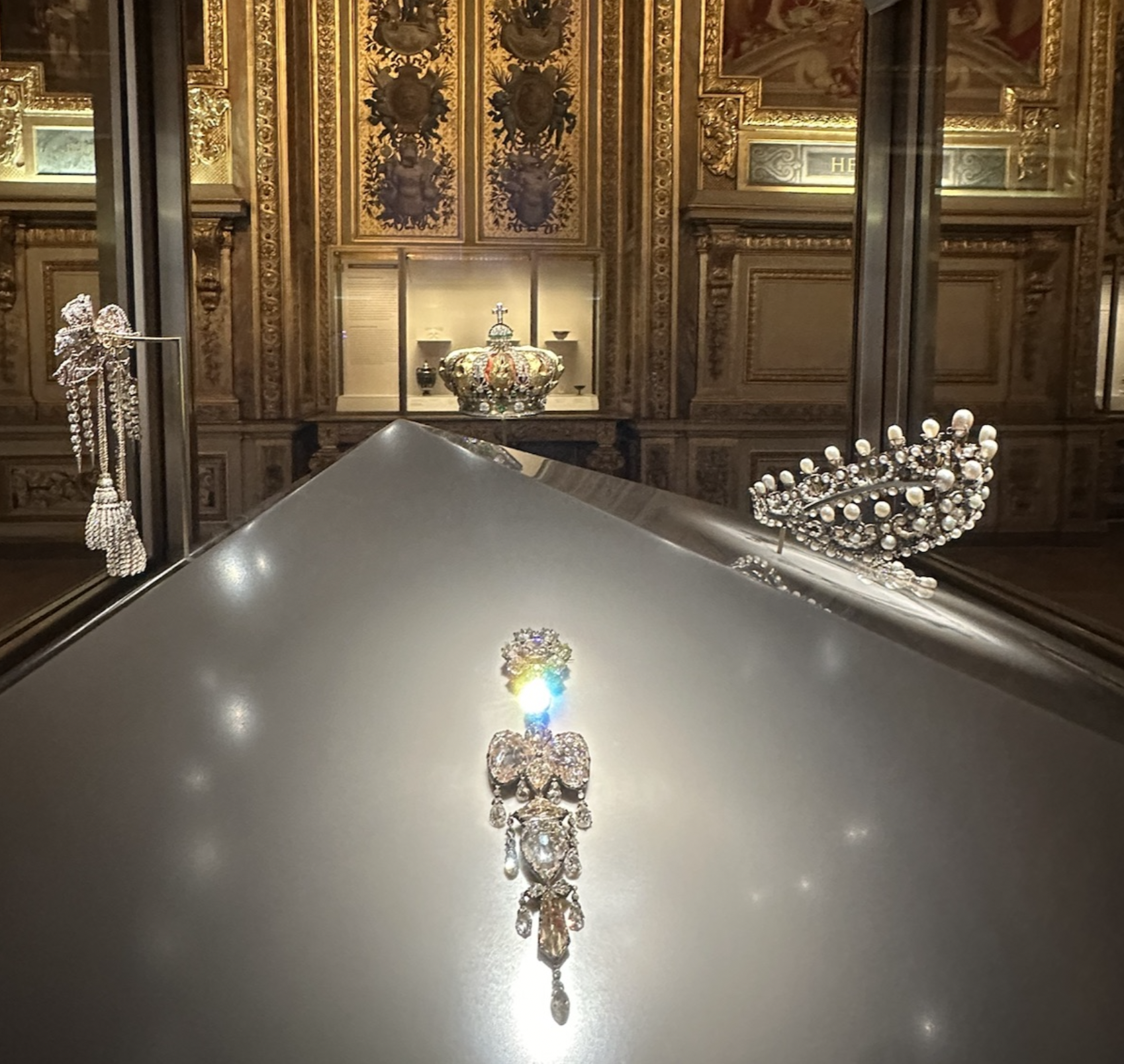
The Reliquary Brooch of Empress Eugénie is the only piece of the stolen loot that can also link itself back to Louis XIV. Rocaille in style to that of the time of Louis XV and inspired by an 18th-century brooch created by Paul-Alfred Bapst.
Called the Reliquary brooch in name only, and may have once been intended to hold a relic of a saint for the very pious Empress. The back side of the brooch is engraved with a floral motif. Just under the pin, the word “reliquaire” adds to the confusion.
Napoleon III ordered this, along with three other designs by Bapst, for the 1855 Universal Exposition. Created using 94 diamonds, some of which were purchased for the design, and many from the crown collection.
The two rose-cut diamonds in the center, pointed end to end, are the most historic. After Mazarin’s death on March 9, 1661, his entire collection of diamonds was given to Louis XIV with the caveat that they must be called the Mazarin diamonds. Many were recut and used in the settings of the royal gems.
Originally one large diamond it was split into two even 21 carats and known as the Mazarin 17 & 18. Many of the jewels were stolen in 1792, and most were recovered only to be sold off in 1887. Making the two held in the Reliquary brooch that much more special.
These diamonds were worn by Louis XIV in the buttonholes of his jacket, on the handle of the sword of Louis XVI, on a belt for Empress Josephine, in the baldric buckle of Napoleon, and in many others' settings.
The almond-shaped diamond below had a perfect twin at one point, each over 15 carats, and had been worn by Marie Antoinette as earrings and by Louis XIV in buttonholes—the lower diamond in a casket shaped with a slightly brown color.
Of the eight pieces stolen, this might be the hardest to come to terms with. Stunning in its design, from the historic diamonds to the engraved gold setting. Wherever they are today, I hope they are at least being appreciated for the beauty they hold.
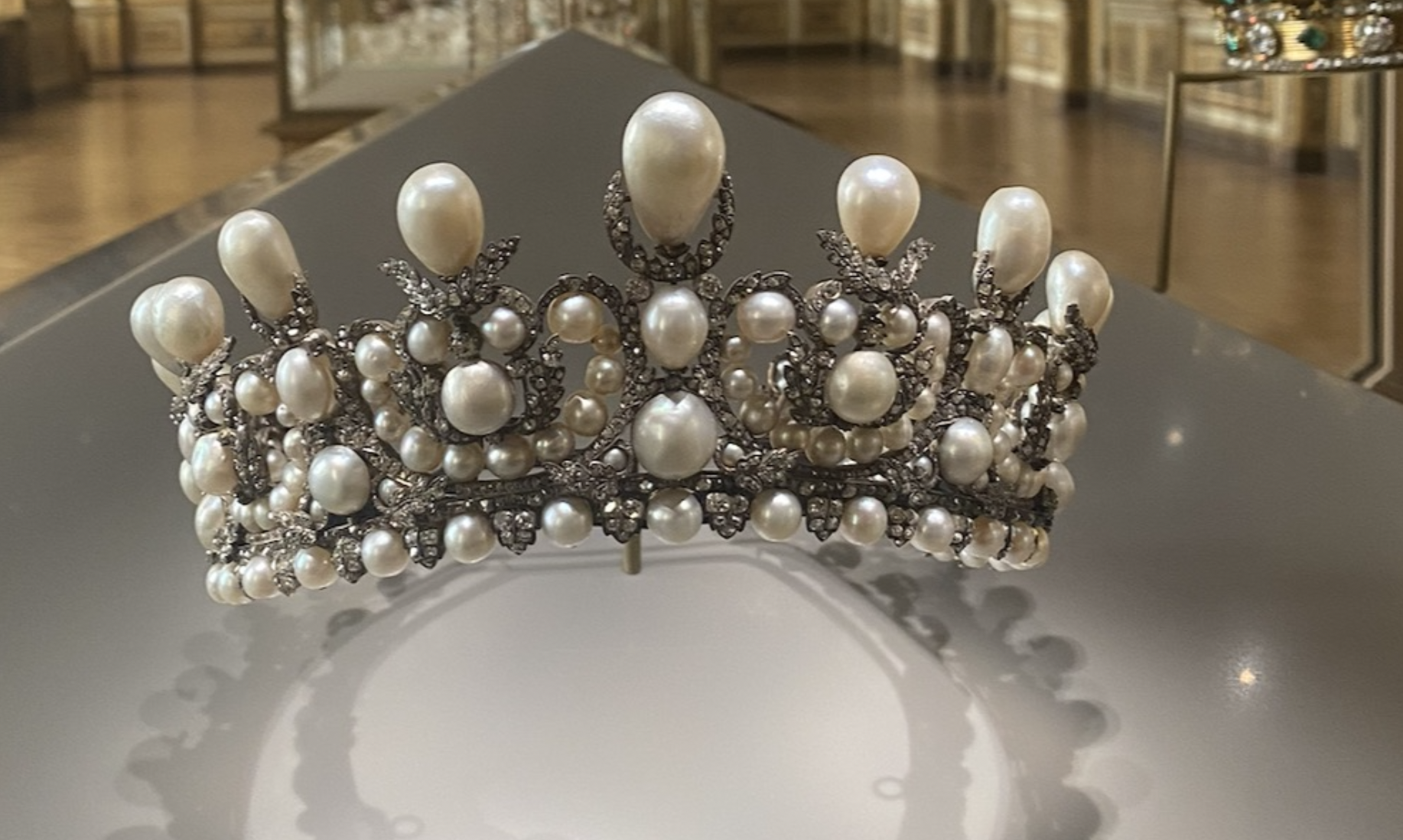
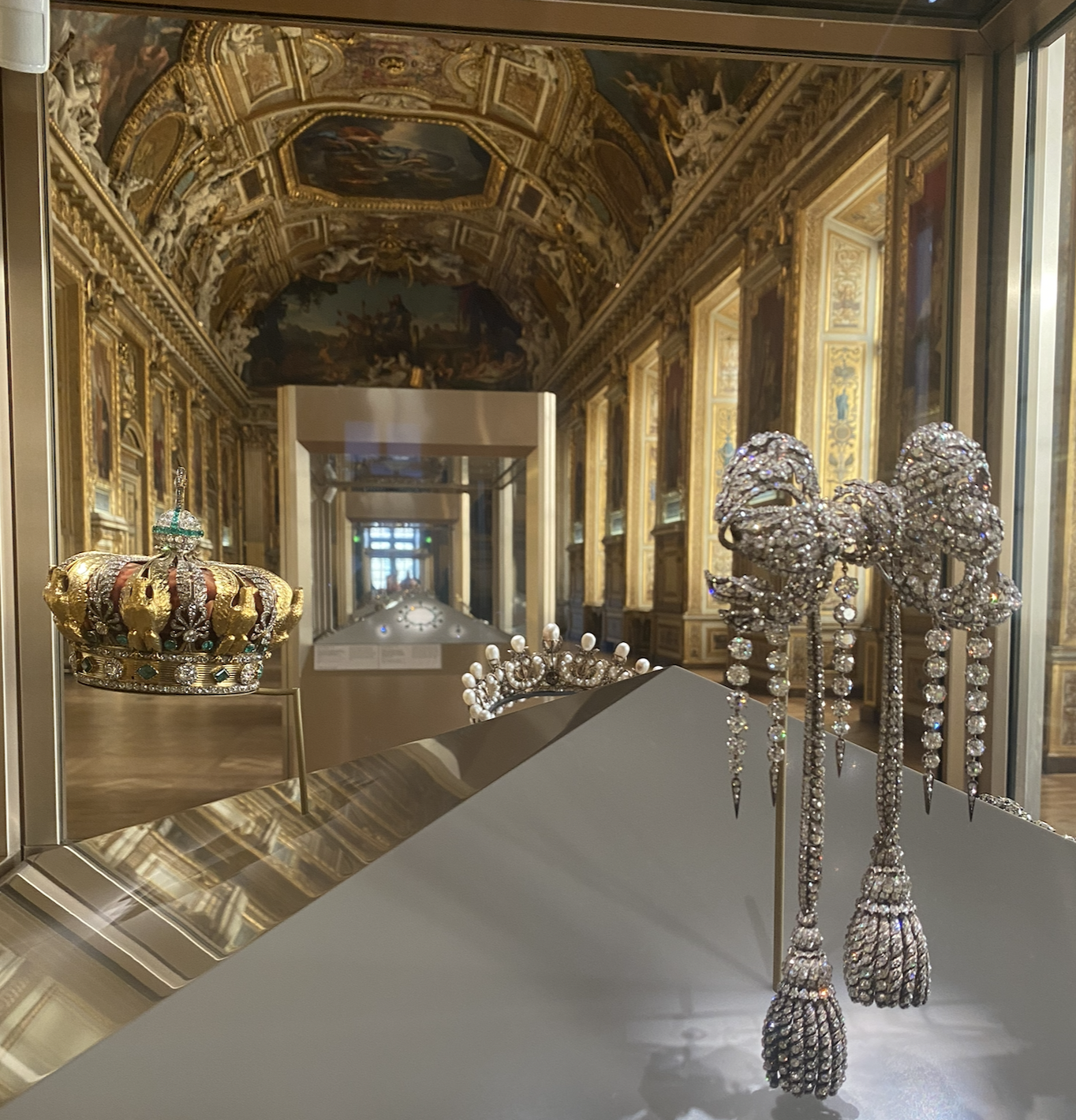
The gorgeous pearl-and-diamond tiara of Empress Eugénie, until six months ago, sat perfectly perched in a glass case under the gilded ceiling of the Galerie d’Apollon.
Created for Eugénie by Alexandre-Gabriel Lemonnier, who also made the Imperial Crown, which was luckily recovered. Commissioned in 1853, shortly after the wedding to Napoleon III. Designed using many of the Crown pearls from a tiara that once belonged to the Duchess d’Angouleme.
Lemonnier’s contemporary design of the time featured natural elements, including diamond-covered “leaves” and 17 large pear-shaped pearls, totaling 212 pearls and 1998 diamonds. Eugénie wore it often, including at the opening of the 1855 Universal Exhibition, where her other jewels, including the Imperial Crown, were on display.
While the tiara is gone and we await its return, you can still see Eugénie wearing it in the large portrait of the Empress by Pierre-Desire Guillemet, painted in 1857 and copied from the original by Franz Winterhalter, which hangs in the Appartements Napoleon III of the Louvre.
In 1855, the Imperial couple visited Queen Victoria at Windsor Castle, a moment captured by Edward Matthew Ward with Eugénie in her tiara. A beautiful 1860 bust of the Empress by Georges Diébolt, located in a small garden in Monaco, surrounded by flowers, looking out to sea.
The tiara was part of the sale of the Crown jewels of France on May 12, 1887, to jeweler Julius Jacoby, who sold it to Prince Albert of Thurn et Taxis. For over 100 years, it remained in the family until sold by Sotheby’s in 1992 and purchased by the Amis du Louvre.
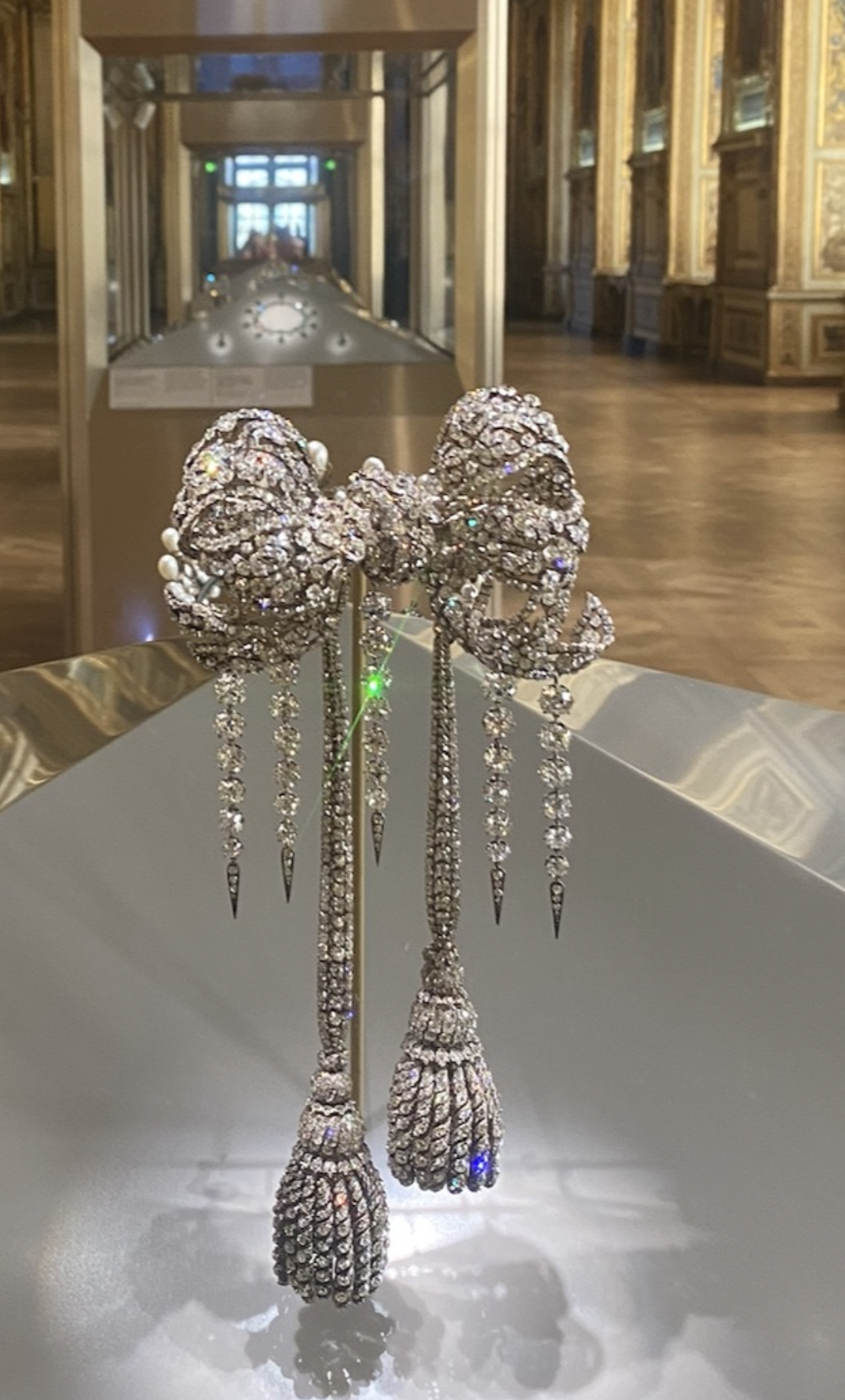
One of the jaw-dropping items was the Grand Corsage Bow Brooch of Eugénie. Napoleon III ordered four pieces from jeweler François Kramer to be completed for the 1855 Universal Exhibition and for his wife. However, the piece was originally designed as a belt, with a bow and tassels, and a staggering 4,790 diamonds totaling 386 carats.
Eugénie loved the history of Marie Antoinette, and the bow was designed to emulate the former queen's love of bows and ribbons.
Worn by the Empress for Queen Victoria's visit on August 25, 1855, she would later have it altered into the corsage bow we see today in 1864. The bow would attach to the bodice of a dress, and the tassels hanging down to her waist would be reduced to 2,438 diamonds and 196 rose-cut diamonds.
The bow was part of the sale of more than 77,000 crown jewels in May 1877 and was purchased for Caroline Astor and passed through many hands until purchased on April 16, 2008, by the Amis du Louvre with a large bequest from Mr. and Mrs. Rauffet.
Marie-Amélie de Bourbon-Siciles was born on April 26, 1782, in the Kingdom of Naples. She was one of the 18 children of King Ferdinand of Naples and Queen Marie-Caroline of Austria, sister of Marie Antoinette. On November 28, 1809, she married Louis-Philippe, duc d’Orleans and the last King of the French from 1830-1848.
Marie-Amélie never met her aunt Marie Antoinette or her husband Louis XVI, but after their deaths in 1793, she had a fear of dying a violent death. She rarely wore jewelry or did anything that would appear as outlandish or showy. As her husband decided to be the King OF the French and more a man of the people, she also wanted to be the anti-Marie, Antoinette.
Napoleon was very fond of and close to his adopted daughter, and he married her off to his brother, Louis Napoleon; she wasn’t so thrilled about the idea.
In 1814, when Napoleon went into his first exile and the empire fell, Hortense fled France and took her jewelry with her. Hortense acquired many jewels from her mother and her husband's family. When times were tight, she would sell off pieces to support herself and her two remaining sons.
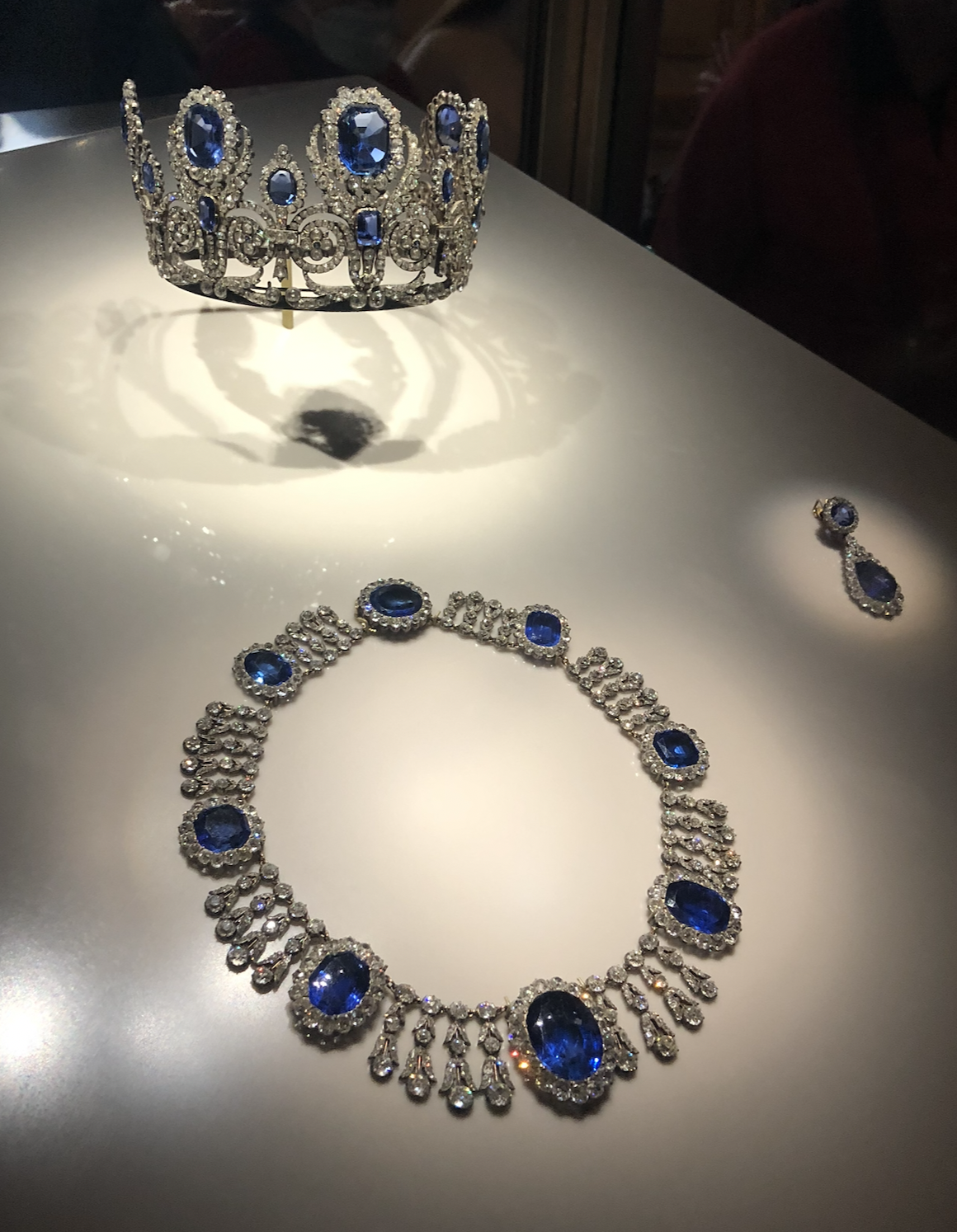
In 1821, Louis-Philippe was flush with cash and purchased a large set of sapphire jewelry from Hortense for 160,000 francs. A gift to his wife, Queen Marie-Amélie, who had the settings changed, including reducing the size of the tiara.
The set remained in the Orleans family until July 3, 1985, when purchased by the Amis du Louvre.
Forty-four sapphires surrounded by more than 2,500 diamonds in six pieces that glisten in the light. The Ceylon sapphires were not heated, so the blue is a tad lighter than the deep sapphires you see in current jewelry.
On Sunday, October 19, 2025, the thieves took the tiara, necklace, and one earring, but left the three brooches behind and another set of earrings.
At the south end of the middle case, next to the sapphires, was a stunning collar of diamonds and emeralds, one of my very favorites.
Napoleon’s first wife, Joséphine, was unable to produce the all-important heir to the throne; they were divorced in 1809.
Napoleon was on the hunt for a new wife. He wanted to marry the Grand Duchess Anna Pavlovna of Russia, sister of the Tsar Alexander I, but she was promised to someone else. In the next episode of the Emperor Bachelor, the Vienna Archduchess Marie-Louise, daughter of Archduke Francis of Vienna, was presented with a rose.
The grand niece of Marie Antoinette had spent many years despising the French for her death during the French Revolution. But the deal was set, and on March 11, 1810, Napoleon and Marie Louise were married by proxy, with her uncle standing in as the Emperor. A few weeks late, she arrived in France and met Napoleon at Compiegne, on April 2, the two traveled to Paris for their wedding at the Louvre in the Salon Carré, steps away from where her necklace once was.
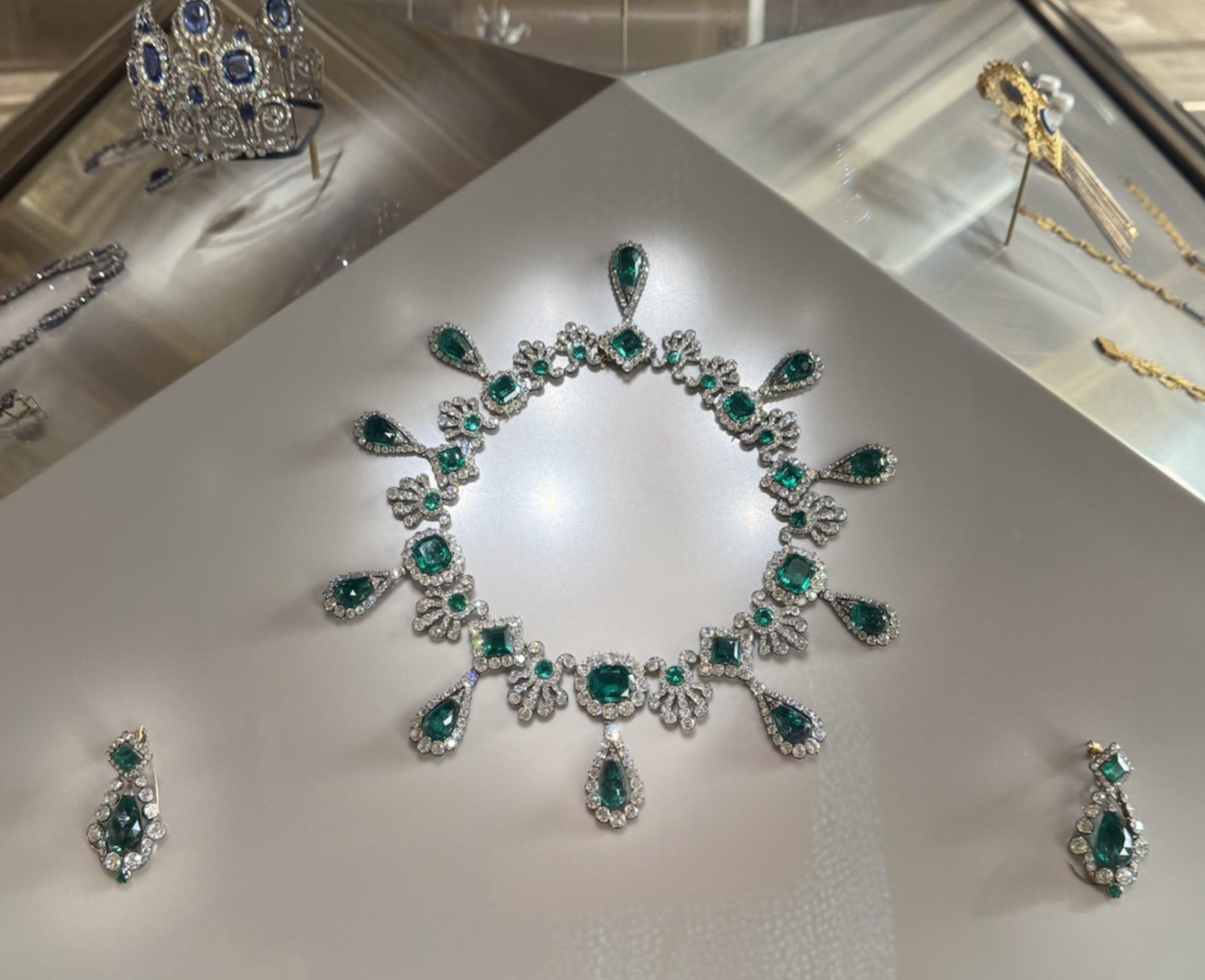
Napoleon Bonaparte wanted to shower his new bride with gifts and jewels and commissioned two sets from his personal jeweler, François-Regnault Nitot. Ten large Colombian pear-shaped drop emeralds were purchased by Nitot, specifically for the piece, and chosen by the Emperor for their exquisite quality. They were suspended in a diamond frame and surrounded by 1138 diamonds. 874 brilliant cut and 264 rose cut, which is one of the oldest cuts, going back to the 16th century. Beloved but rarely seen, cut with a flat base and a rounded top, with facets that give the illusion of a rose.
Matching earrings rounded out the initial set that later also included a tiara, comb, and belt plaque. They remained in the Empress's collection until they were passed to her cousin after her death in 1847, and eventually found their way to the American heiress Margie Merriweather Post in 1953, after being purchased from Van Clef & Arpels. In 2004, they were acquired by the Louvre, where they remained before the theft.
The tiara, also in Margie Merriweather Post's collection, replaced the emeralds with turquoises and later gave the piece to the Smithsonian in DC, where it can still be seen today.
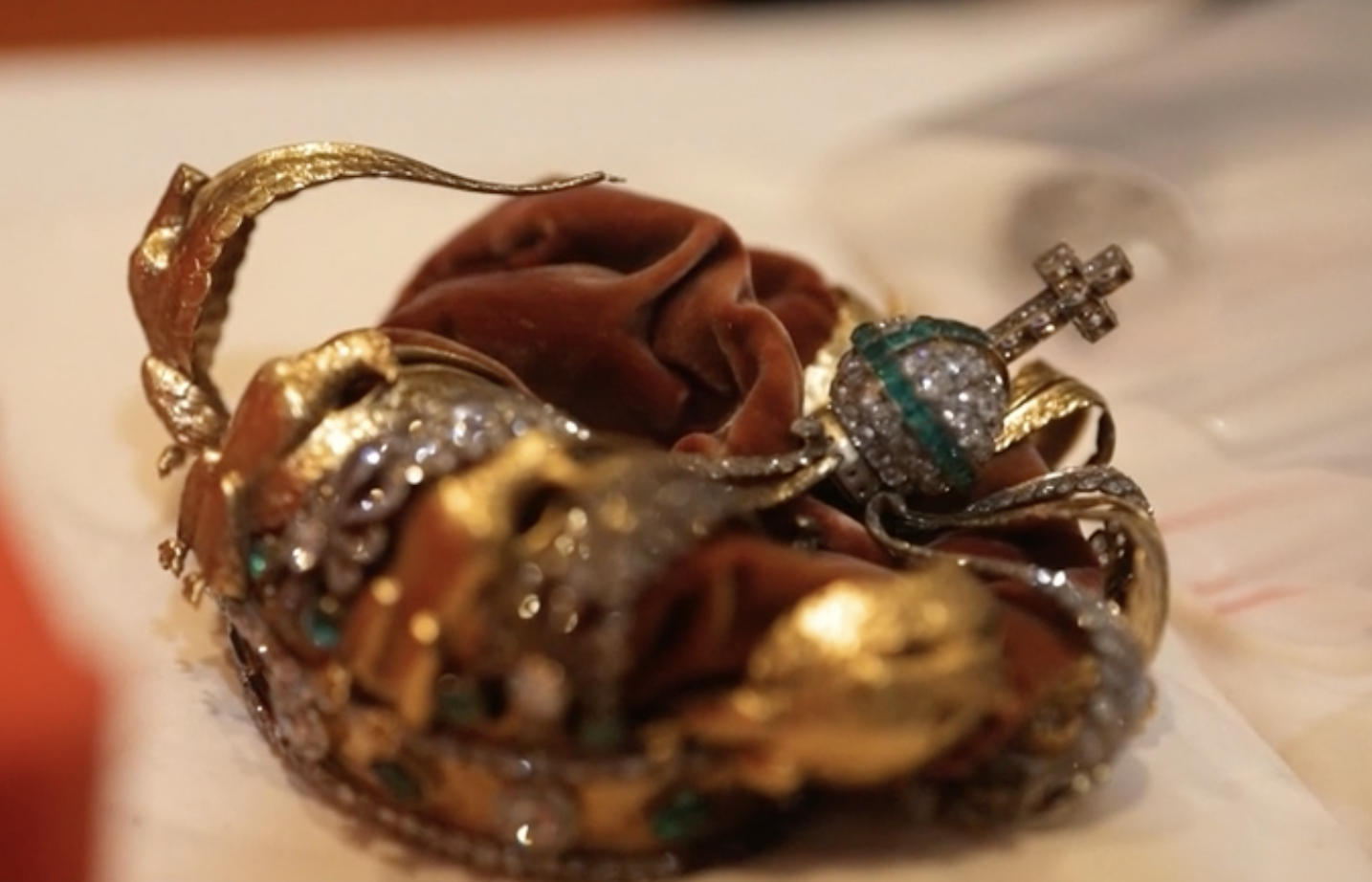
As the thieves fled the Galerie d’Apollon, Abdoulaye N dropped the Imperial Crown of Empress Eugenie in the ditch below the street. The crown had been crushed as it was pulled from its base, leaving it heavily damaged.
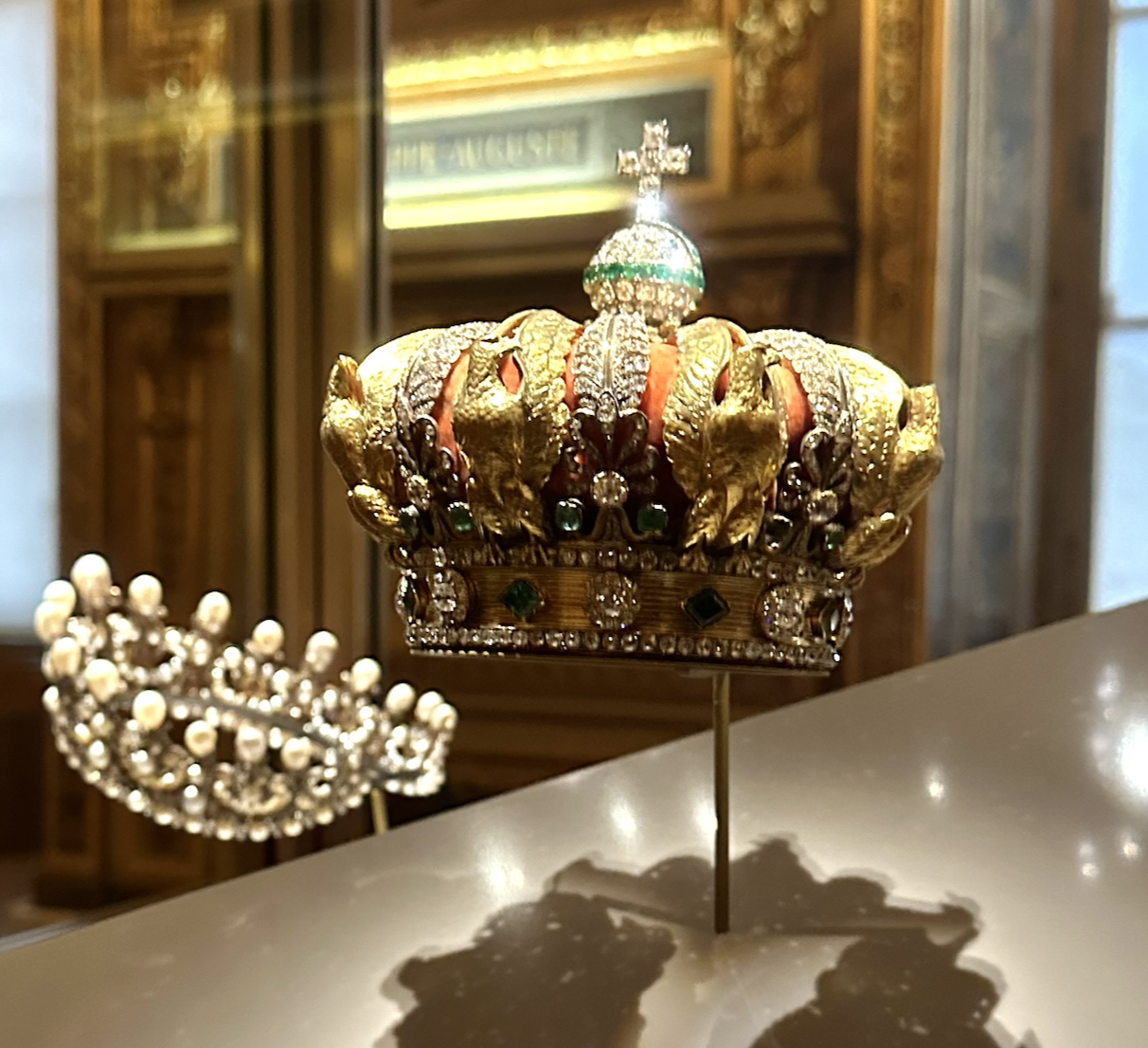
The Imperial Crowns were created in 1855 for the Universal Exhibition. What makes this crown so special is that the Emperor's crown was dismantled in 1887. Both crowns were created by Alexandre-Gabriel Lemonnier, working with sculptors Auguste & Joseph Fannière on the eight eagle ribbons of the Imperial coat of arms. Comprised of 1354 diamonds, 1136 rose-cut diamonds, and 56 emeralds in exquisite detail.
One of the eight diamond-encrusted palmettes fell off in the Galerie d’Apollon and was recovered, but one of the Imperial eagles is missing.
Of the 1354 diamonds, a “dozen” of the small stones along the band are missing. After the theft, many of France's historic jewelry houses reached out to the Louvre for assistance.
After a thorough investigation, the Imperial Crown can be restored. An advisory committee of Louvre officials, including Anne Dion, deputy director of the Objets d’Art department. They will decide between the houses of Chaumet, Cartier, Boucheron, Van Cleef & Arpels, and Maellerie.