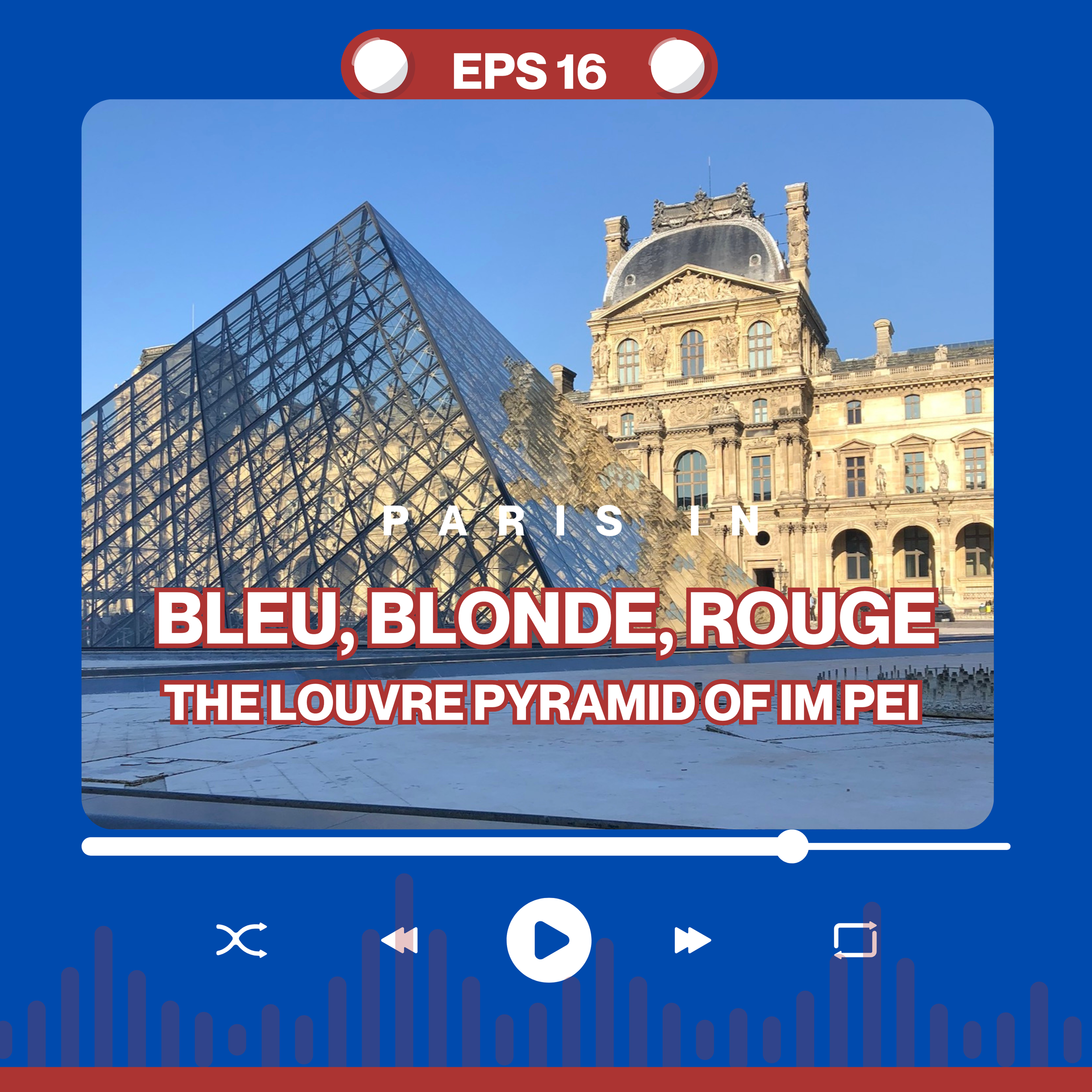
Today, the Pyramid of the Musée du Louvre is the museum's icon. From every exit sign, map, and photo used in the photo, the glass pyramid by IM Pei is the de facto image of the world's largest museum. Even one of the Crown Jewel thieves thought the pyramid was all the Louvre was.
There are still a handful of people who have strong feelings against the icon, but what doesn’t these days? However, compared to how many despised the idea when it was announced before a single pane of glass was created, it is quite beloved these days.
The 1980s saw an upheaval in the world of Parisian museums. The collection of the Louvre was expanding quickly from its small space, and the Impressionists of the Jeu de Paume were overflowing, resulting in the creation of a new museum of art beginning in 1848. The Musée d’Orsay opened in 1986, solving just a fraction of the problem.
The Louvre before the pyramid was spread across the 1st floor of the Denon wing, a small portion of its ground floor, and two floors of the Sully wing. A far cry from the Louvre we know today. Yet the collection of what was hidden from display was incredible. The Louvre had seven departments at the time. Paintings, Sculpture, Objets d’art, Prints & Drawings, Egyptian, Greek & Roman Antiquities.
What would be seven separate, incredible, large museums anywhere else were all housed in one historic palace. Admission to the Louvre had skyrocketed in the late 70s, and the former entrance under the Pavillon Denon became inadequate to handle the crowds, forcing people to take one route to reach everything.
During World War II, as art was scattered and hidden throughout France, curators and officials had time to consider the layout of the Louvre. Once the art returned, the paintings and sculptures area was rethought and designed within each room. Each director after would have lofty ideas of adding more space to the museum, but it took a French president to bring it to fruition.
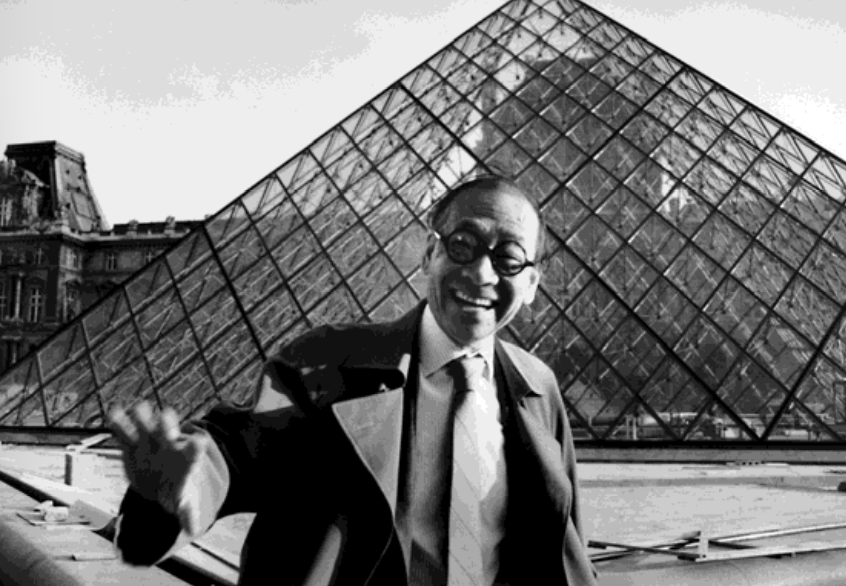
François Mitterand was elected on May 21, 1981, and came into office with the idea of redesigning and expanding Paris's architectural history. A scope that hadn’t been seen since Napoleon III and Baron Haussmann. Two months later, on July 27, 1981, the “Grand Project” of Paris was born, which would include the Arc of La Defense, Opera Bastille, Buren Columns of the Palais Royal, Library of Bercy, and of course, the Louvre Pyramid. “TonTonKhamon,” as Mitterand was nicknamed, did have a love of Egyptian history and antiquities, but he wasn’t behind the choice of a pyramid, which would be designed by the Chinese-American architect Ieoh Ming Pei.
Born on April 26, 1917, in China, IM Pei enrolled at the University of Pennsylvania to study architecture but later decided to go to MIT to study engineering. Noticing his talents for design, he is later convinced to return to his first vocation, but the two combined to create the amazing architect we know today. Through engineering, he learned how things worked and the intricate ways materials like glass and concrete can interact.
Projects undertaken by the French State must go through an open competition, with a committee picking the architect or designers. Each and every company used for Notre Dame had to go through the process, but Mitterand decided to skip this step when it came to his grand design of the Louvre.
Mitterand placed Emile Biasini in charge of overseeing the project, who spent his career within and around the Ministry of Culture. Biasini was familiar with Pei’s work on the JFK presidential library in Boston and the East Wing of the National Gallery of Art in DC, and liked Pei’s adaptation of a contemporary building in the heart of historic structures.
The Grand Louvre project was more than just the Pyramid and entry; it was a massive reorganization of the museum itself. For the monumental undertaking, Biasini brought in each of the head curators of the Louvre to draw up their wish list of everything they could want. A smart move to get them on the side of Biasini and Mitterand.
Pei made his first of numerous secret trips to Paris in November 1982. Shrouded in mystery, even the Louvre officials weren’t told of the clandestine visits. For days, Pei walked the Tuileries garden designed by Andre Le Notre and inside the Louvre following visitors as they made their way to the big hits of the museum.
The courtyard before the mid-19th century still includes houses along the Rue de Rivoli. Under Napoleon III, with architects Louis Visconti and Hector Lefuel, the Richelieu wing was built, the houses were all removed, and the courtyard became a parking lot for ministry officials and a garden. A statue to Leon Gambetta was erected in 1888, and in 1900, a statue to Lafayette, a gift from American schoolchildren, was erected in the Cours la Reine.
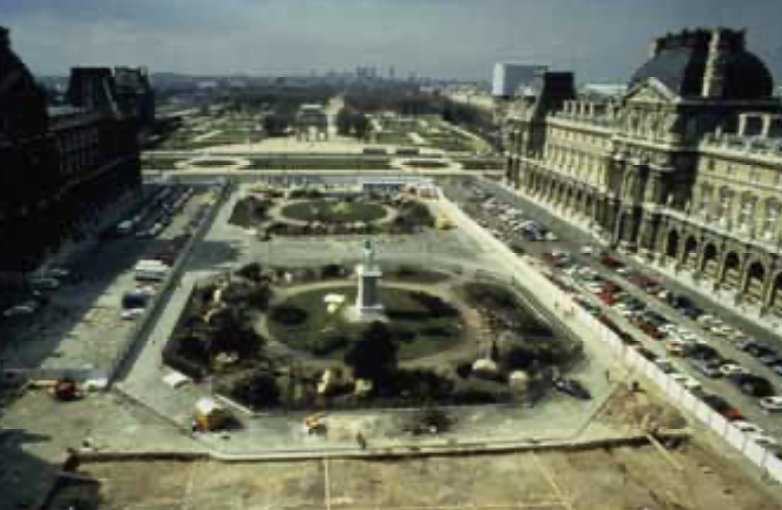
IM Pei had been involved in the competition to create La Défense in the early 1970s and lost out to Emile Aillaud. After that, he said he wouldn’t take on all that work and devote that much time again. Pei was in his 60s, and if he was wanted, he needed to be the first choice. Mitterand and Biasini knew who they wanted and would deal with the fallout later. The fact that the design would be so controversial outweighed the rogue choice, with just about every Parisian uniting behind one thing: hatred of the project.
Under strict secrecy, Pei worked out a few ideas that wouldn’t alter the historic structure. The building encompassing the Cour Napoleon dates to the mid-19th century, under Napoleon III, including his covering of the oldest remaining part of the Louvre, the Sully wing. I can’t even imagine the outrage people would have had if he had touched the building itself.
IM Pei saw himself as more of a landscape designer than an architect on this project. The structure needed to blend into the historic building, enhancing it while also bringing a modern use to address the issues of the time. It had been decided that the Louvre would take over more of the building, including the Richelieu wing, allowing the display area to double in size and potentially more than doubling daily admissions. To bring them all through the Denon entry would have been a disaster.
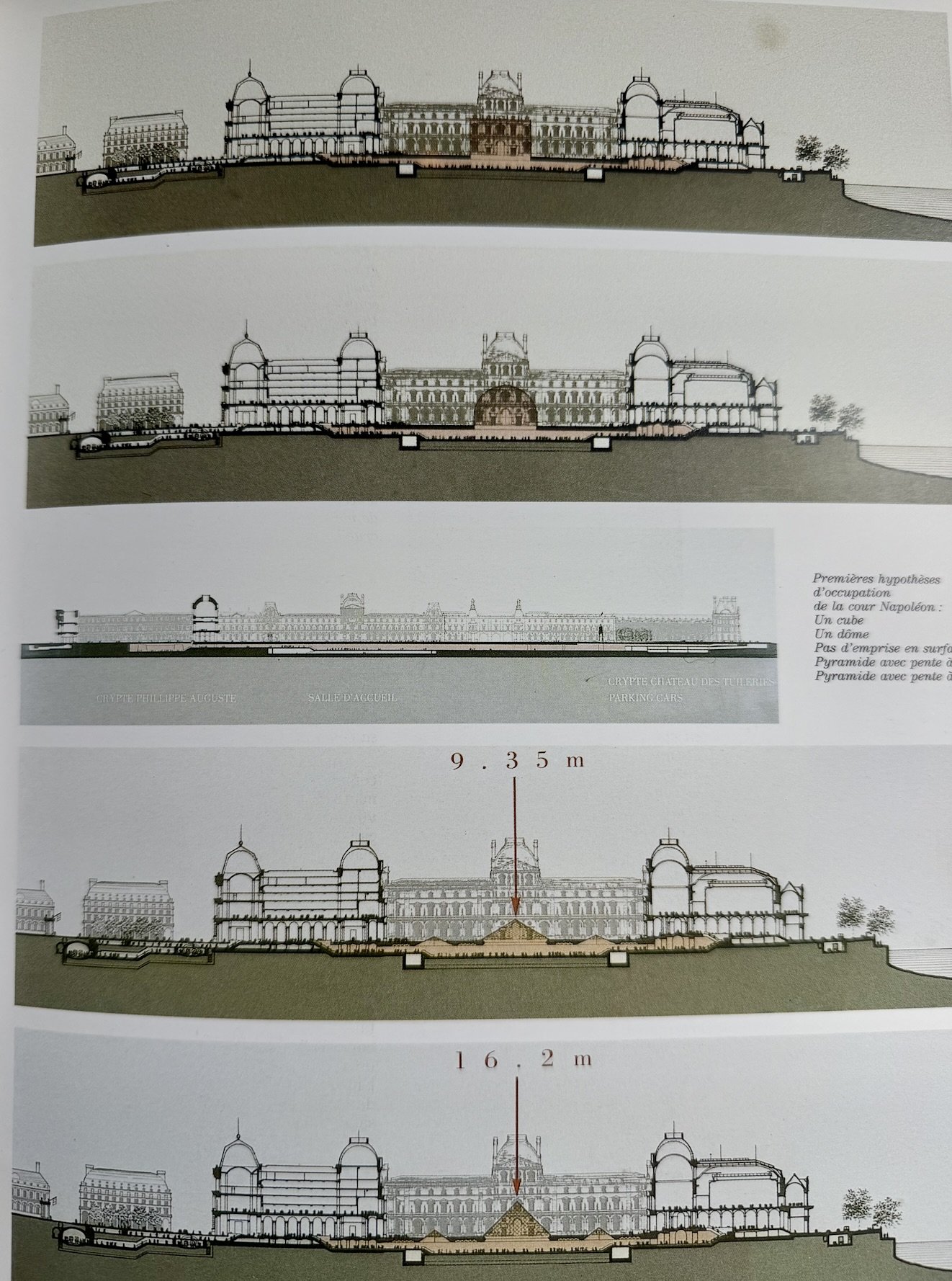
How would he do it? The courtyard was the best option, but it still met with major challenges. Being so close to the Seine was the largest factor and excluded Pei from going too deep into the earth before reaching the water table. Keeping any of these ideas to himself, he came up with a few options. The first was a glass cube, then a bubble-like dome, both of which looked odd. Then three pyramids in varying sizes. One with a 30° slope that reached the top of the first floor; a second, a bit higher, with a 45° slope, reaching the top of the second level; however, both appeared a bit too flat, and the museum itself loomed over them. The third and final was the pyramid we see today. Reaching to the tip of the timpanum of each of the three pavilions.
One of the biggest questions that many visitors have is why a pyramid? There are many reasons that I will share, but did you know that this wasn’t the first or even second pyramid built here at the Louvre?
In 1792, after the storming of the Tuileries, a celebration was held on August 25, the feast day of Saint Louis, and included a large wooden pyramid by architect Bernard Poyet. It was built just outside the Louvre, covered in black cloth, and set on fire.
150 years before Mitterrand launched his “Grands Travaux,” Napoléon III also had a wooden pyramid built. The nephew of Napoléon Bonaparte wanted a monument built for his uncle commemorating his Egyptian campaign. On August 15, 1839, it was once the feast day of “Saint Napoleon” (not a real thing) and was set afire in the shadows of the Louvre.
I’m sure many would have liked to set fire to Pei’s creation after it was announced, but luckily, that hasn’t happened.
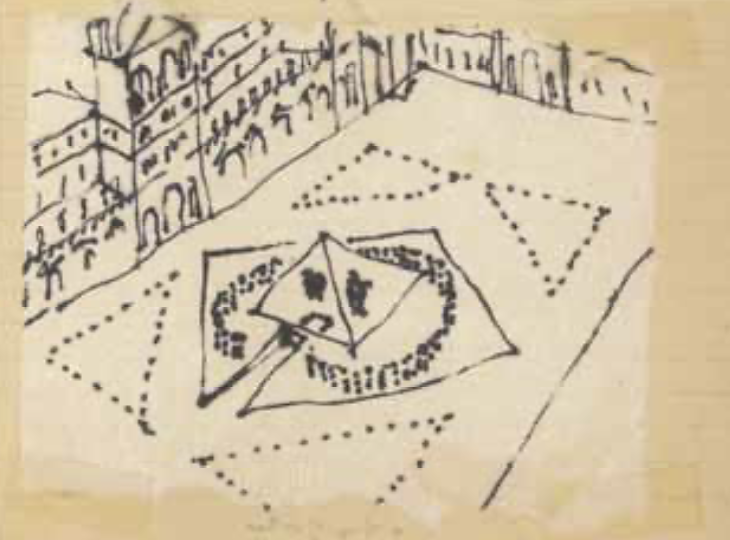
Pei first had the idea of a pyramid when he designed the John F. Kennedy Library in Boston, but decided against it. Incorporating glass and concrete into his many creations became his signature in the second part of his career, and his best work was still ahead.
The Louvre project wasn’t just about creating a new entrance. It would involve a massive underground city dedicated to exhibition space, offices, storage, workshops, and not to mention shops, restaurants, massive parking, an expo center, and auditoriums for the Ecole de Louver and an atelier for the greatest restoration group in the world. The pyramid, you can say, is just the tip of the iceberg.
When it came time for Pei to put pen to paper, he said he became more of a landscape architect than a building architect, and that is exactly where he got his inspiration. The Palais du Louvre sits in the center of Paris, at the time the first fortress was built at the end of the 12th century, it was just outside the wall of Philippe Auguste. Over the centuries, the building changed, was destroyed, and rebuilt in the 16th century. The Palais des Tuileries, built by Catherine de Medici in the 16th century, would eventually be joined by the Louvre and would include the large garden around it.
In the 18th century, Louis XIV had garden designer Andre Le Nôtre create a lovely park and, more importantly, lay out the Grand Axis point. A straight line that would cut through the center of the garden and later stretch to the outside of Paris and La Defense, and begin at the Arc du Triomphe de Carrousel.
One of the most important aspects of a French garden is its geometric lines, and every detail is carefully thought out. Le Notre would create the gardens of Vaux-le-Vicomte, Versailles, the Tuileries, and many more, all with his clean lines and design. It would be the biggest inspiration for Pei, who even extended the grand axis to link with his own project.
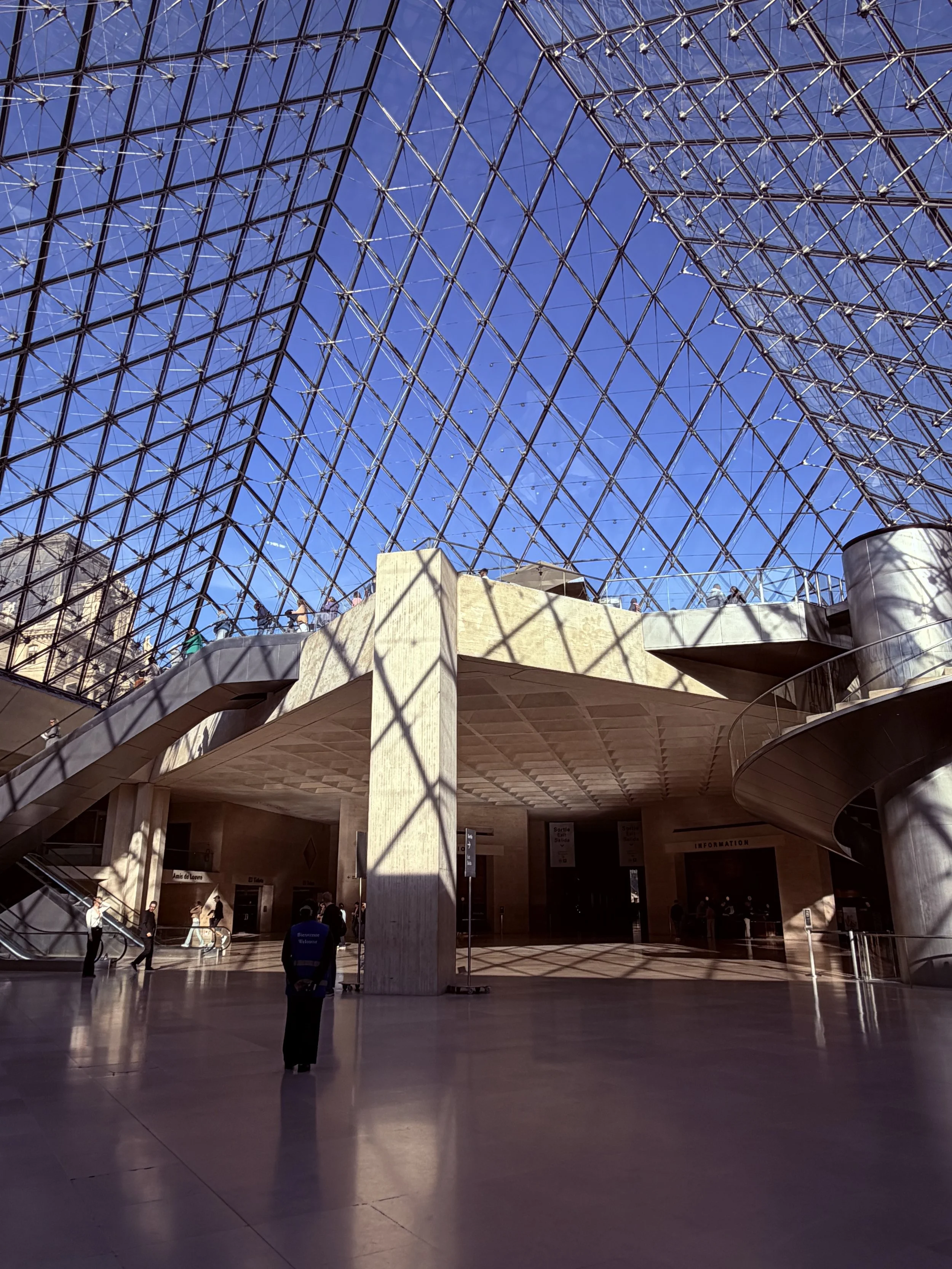
Pei’s creation would not only give the museum a new entrance but also bring the outdoors and light in, uniting the two once inside. How can one create a massive entrance that, at the time, would be used by a little over 4 million people a year and also highlight the building's history and beauty? Pei approached the project as a palace rather than a museum. Perhaps the greatest thing about the pyramid itself is how it can almost disappear, whether you are under it or just outside looking through it. From every angle, the building can be seen, and from behind the Jardin des Tuileries and the Arc de Triomphe de Carrousel. He also pulled in the “faceted plan of the roof” and the Luxor Obelisk that sits along the axis line.
Pei’s background in not only architecture but also engineering, along with some pretty big dreams, brought the structure to life.
Future president Jacques Chirac was the mayor of Paris at the time and hadn’t weighed in on the idea either way. Pei believed 90% of Parisians hated the idea, and as soon as the plan was presented on January 24, 1984, the headlines of every French paper were filled with their objections. Even the NY Times called it “an architectural joke.”
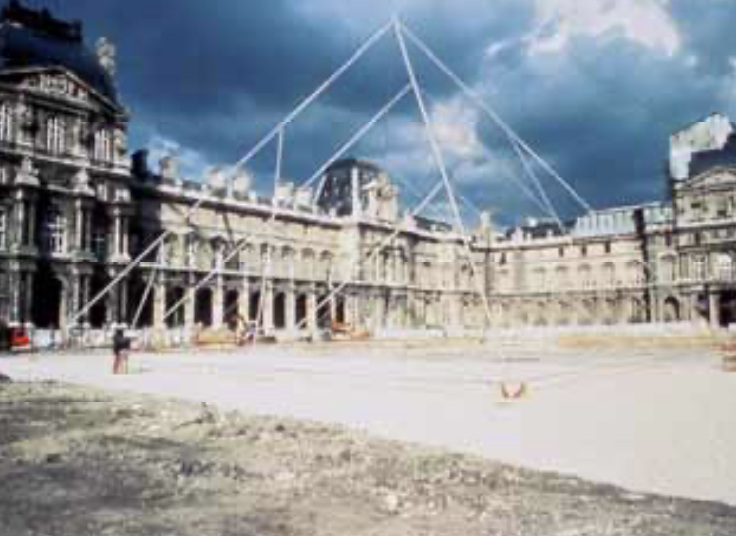
Chirac had the idea that if they showed what the pyramid would look like in the courtyard, maybe they could garner a bit of support. Just in time for the May 1st holiday in the Cour Napoleon, one of the largest cranes in France held teflon cables stretched out to each corner, forming the shape the actual pyramid would take. Without glass and using only cables, they showed that the structure itself would not block the beautiful buildings around it. Thousands of visitors arrived each of the four days it was in place, and in the end, many changed their minds, resulting in a 56% approval rating.
The next step was to bring Pei’s vision to life, all while adhering to his very exacting standards.
The most important part, the glass, took the most time to create. Pei wanted the glass to be perfectly clear and white. That is without any bubbles or color, and will not oxidize over time, turning yellow, then brown. Many companies were considered, but only one could pull off this daring job, which also has links to a rather famous mirrored hall.
In 1665, Jean Baptiste Colbert founded the Royal Manufacture of Mirror Glass to compete with Venice, which cornered the market in the craft. After all, a king couldn’t order glass from another country to cover the walls of his gallery. Between 1678 and 1684, the beautiful Gallery des Glaces was created at Versailles. Look closely and see how the mirrors are made of several pieces rather than one large piece. France still hadn’t created the ability to make large sheets of glass.
That same Royal Manufacture would become the Saint-Gobain company that still exists today, and one that was up to the technical challenges of Pei’s glass. Glass normally contains ferric oxide and other substances that can solarize and change its color. Pei also wanted the glass to be thicker at 21 mm (⅞ of an inch), which can help absorb heat. Tell that to the agents working at the door on a 90° sunny day; they may disagree.
675 diamond shapes make up the four outdoor pyramids with 118 triangles along the lower edges. Each piece of glass was stretched vertically, as they did long ago, rather than flattened in a machine, which would damage the fragile panes. After, the entire order was shipped to just outside of London to be polished.
The glass of the Pyramid, as well as the three small ones surrounding it, was placed inside aluminum frames that fit together tightly like a puzzle. Much like the creation of a Gothic Cathedral in the Middle Ages, Pei wanted to capture as much light as he possibly could with the least obstruction.
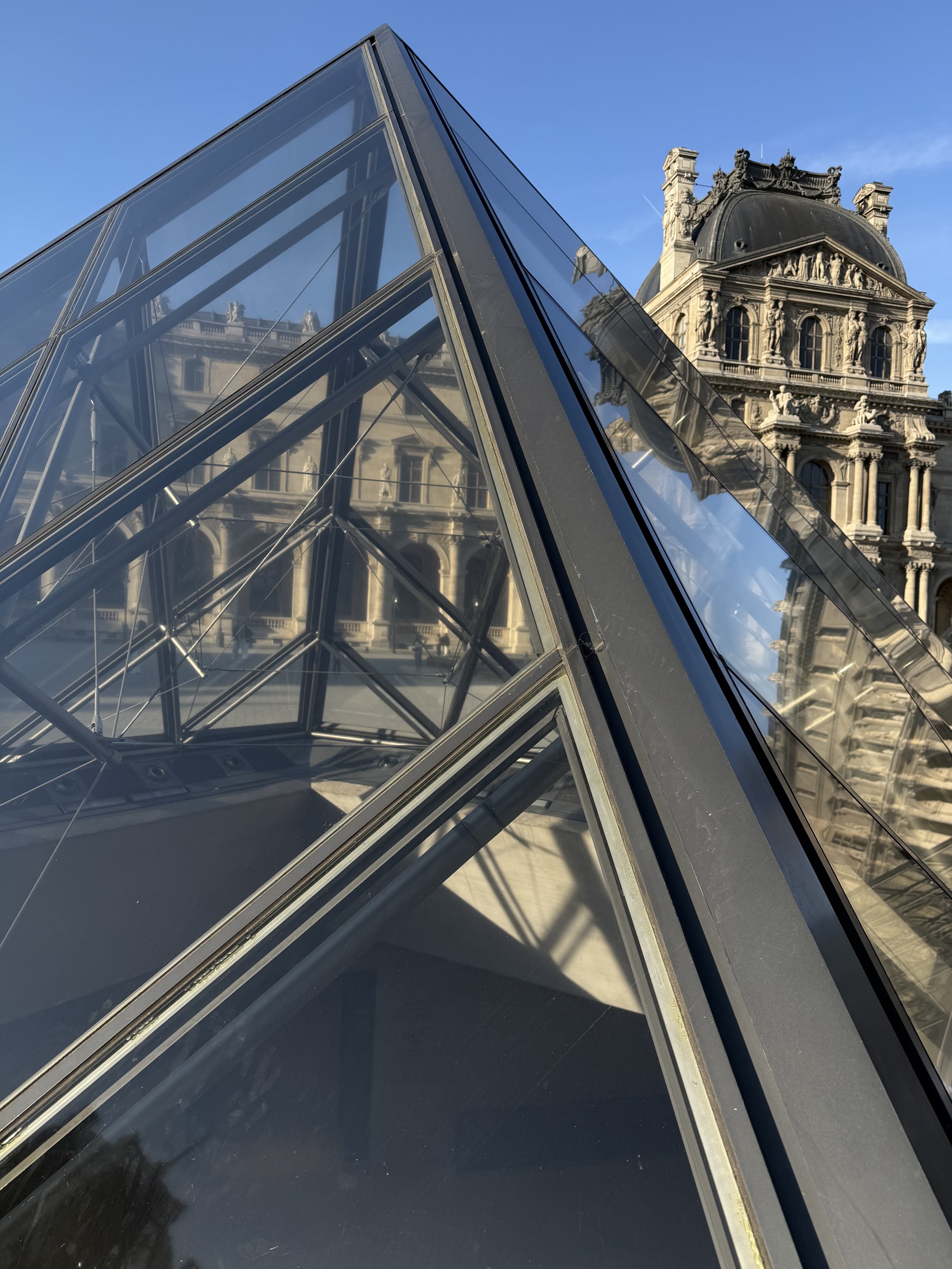
The glass defines the pyramid, but it's the intricate rigging system that holds it all together, creating a web-like structure. How to hold this all together was the big question. Pei found his answer on a sailboat of all places. 2,150 joints were created, much like you find in the rigging system of a sailboat. Wax molds were made that hot steel was poured into, then shot blasted to polish, and then dipped in a diluted miric acid chemical bath. The 6000 shiny tensile steel bars between could be adjusted to keep the entire structure in place. It’s quite a sight to see up close from outside the pyramid.
How to fit this massive structure of glass, aluminum, and steel, and have it almost float above the entrance was another story. Originally, Pei considered a long, sloping entry from the sidewalk straight into the lower entrance, but it would cast part of the space into darkness.
Because the Louvre is located so close to the Seine, they could only go down so far. It would be all about the ceiling itself that would hold up the pyramid. Pei loved working with concrete because he could shape it and control where it went. The pyramid itself covers 10,764 square feet and weighs over 220 tons. The edges of the pyramid are seated in a complex envelope that includes a supply vent and a shutter that can be opened to release the air, with suspension cables bracing the structure even deeper, all encased in concrete, but from below it looks like fine Burgundy marble.
The smooth concrete was mastered between Pei and the Dumez firm and was the same kind he used in other projects, including the National Gallery in DC and JFK Library. To create the design of deep-set boxes with angled walls, Jean-Pierre Aury, the concrete whisperer, used Oregon pine to create a mold. Oregon pine is loved for its hardwood that resists bending and can be sanded to a very smooth finish.
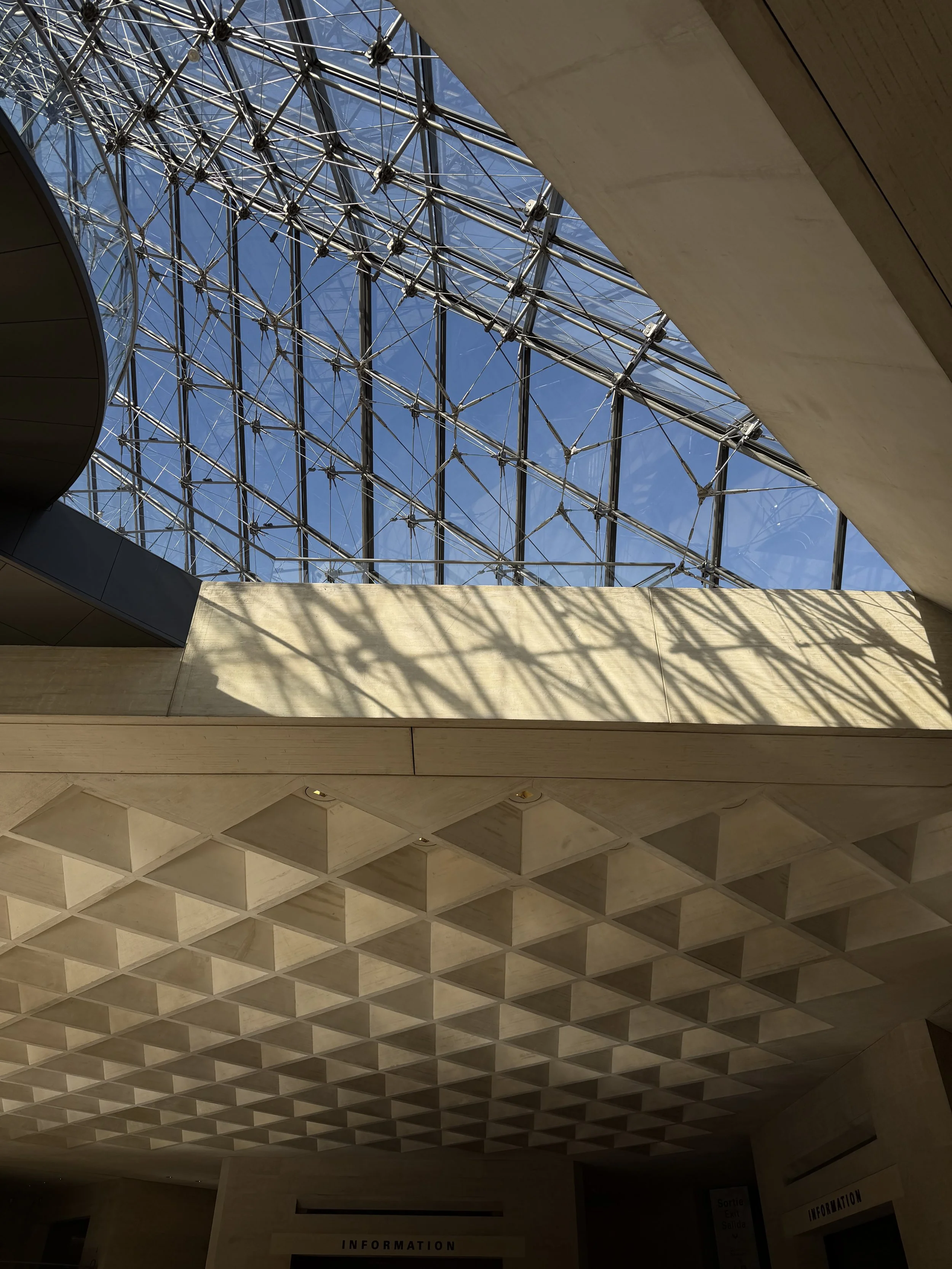
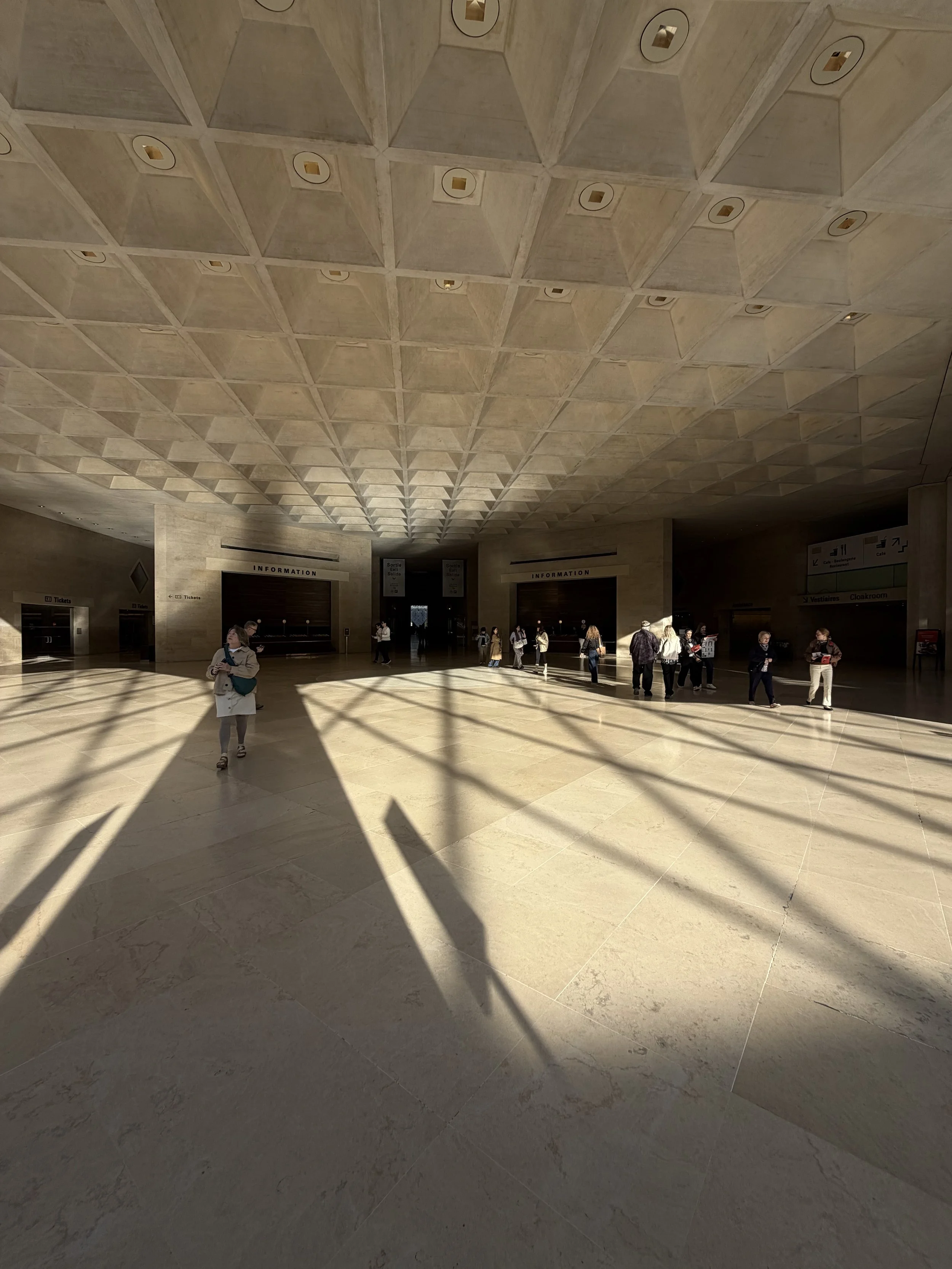
Carefully selected, the pine was free of knots or blemishes, cut into slender strips, and glued together. Once together, they were covered in resin, then white cement lacquer, before being sanded and stripped, becoming as smooth as glass. Each of the massive sections was filled with tinted concrete while workers hung from scaffolding to keep anything from shifting. Look up today after you enter the Louvre at this masterpiece, and a little wink to Oregon.
To hold the entire thing in place, Pei placed four large pillars under each corner of the pyramid that almost disappear. The entry through the pyramid is supported in the center with a truncated column that was intended to hold a sculpture, but the powers that be couldn’t decide on what it would be. Winged Victory was an option, thank goodness that never happened. Other ideas included the bronze Mercury Abducting Psyché, the lead Mercury by Pigalle, and even Rodin’s Thinker.
On the south side, a set of double escalators takes visitors to the center of the pyramid, but it's the spiral staircase that surrounds the elevator that is really a show stopper. Pei created an elevator whose shaft disappears into the floor as it comes down, and the beauty of the staircase is on full display. Once it rises to the top, the entire shaft is revealed, and a small platform pops out to connect to the upper floor, allowing visitors to enter.
For the inner walls, Pei used his favorite stone, a yellow Magny limestone that is now known as Magny Le Louvre stone. From the Côte d’Or - Burgundy region, 23 kilometers SE of Chatillon-sur-Seine. For the floors, Chassagne-Beauharnais stone is similar in color to that from the same region. All three blend perfectly together.
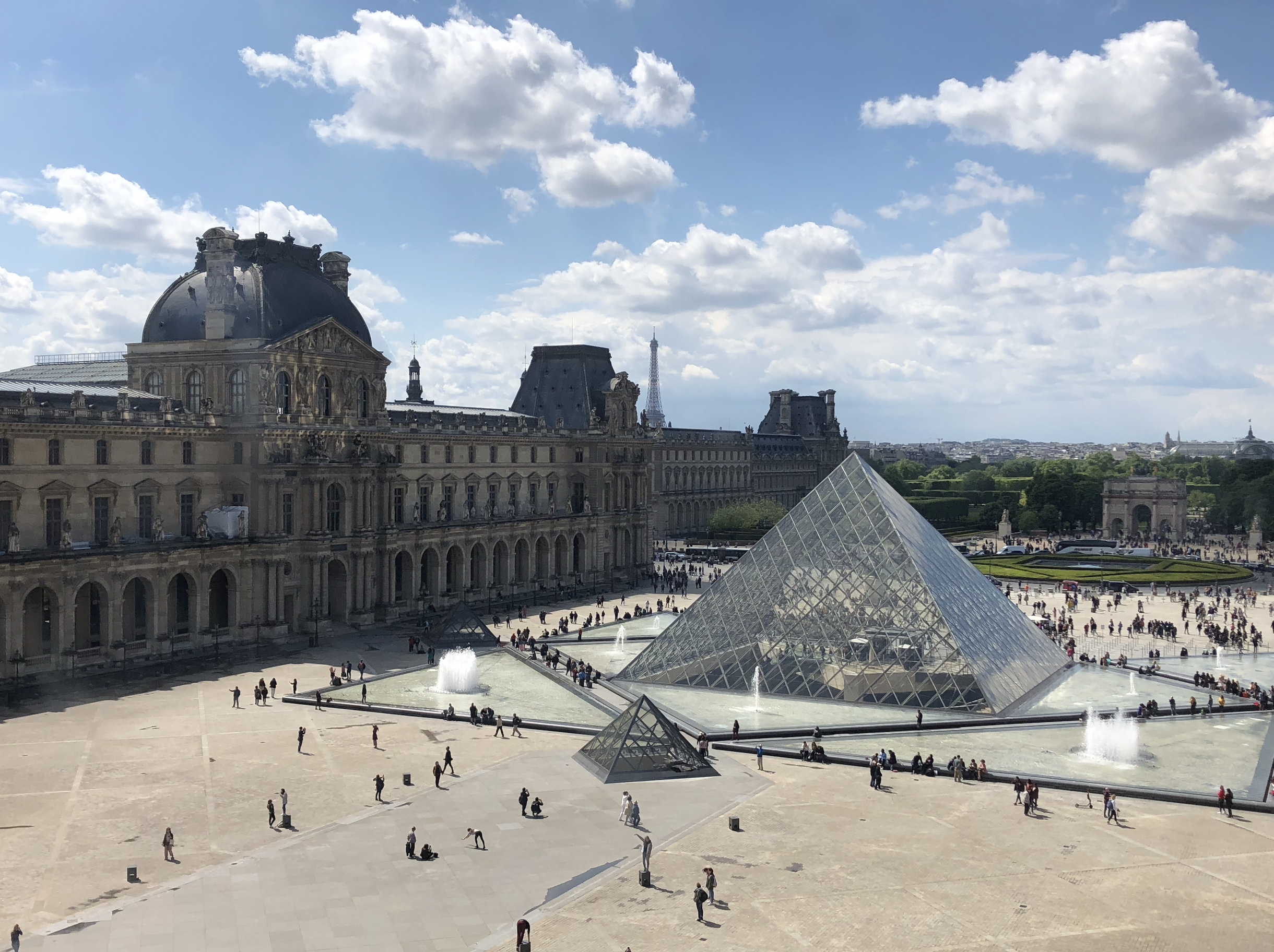
Surrounding the pyramid are three smaller three-sided pyramids that let light in and guide visitors to the entrance of each of the three wings. I love to stop under them and catch a view of the top of the Richelieu and Denon pavilions. Constructed with the same method minus the rigging, as they were easier to stabilize with only 10 panes of glass on each side.
Since the entire Grand Louvre project also included the vast underground area, Pei included another pyramid as you exit. An inverted pyramid made from the same glass but without the rigging system is balanced below by a small stone pyramid, almost as if it is peeking out, and the entire pyramid lies beneath.
You might know this pyramid from the end of the Da Vinci Code, as Tom Hanks runs through the streets of Paris to stand above and look down through the magic of Hollywood to find the final resting place of Mary Magdeline. Sorry to report that the only thing below is the parking lot. That scene filled me with the dream to do the same thing on my first trip to Paris, only to find there is no way to walk above unless I wanted to scale over the rat-infested bushes.
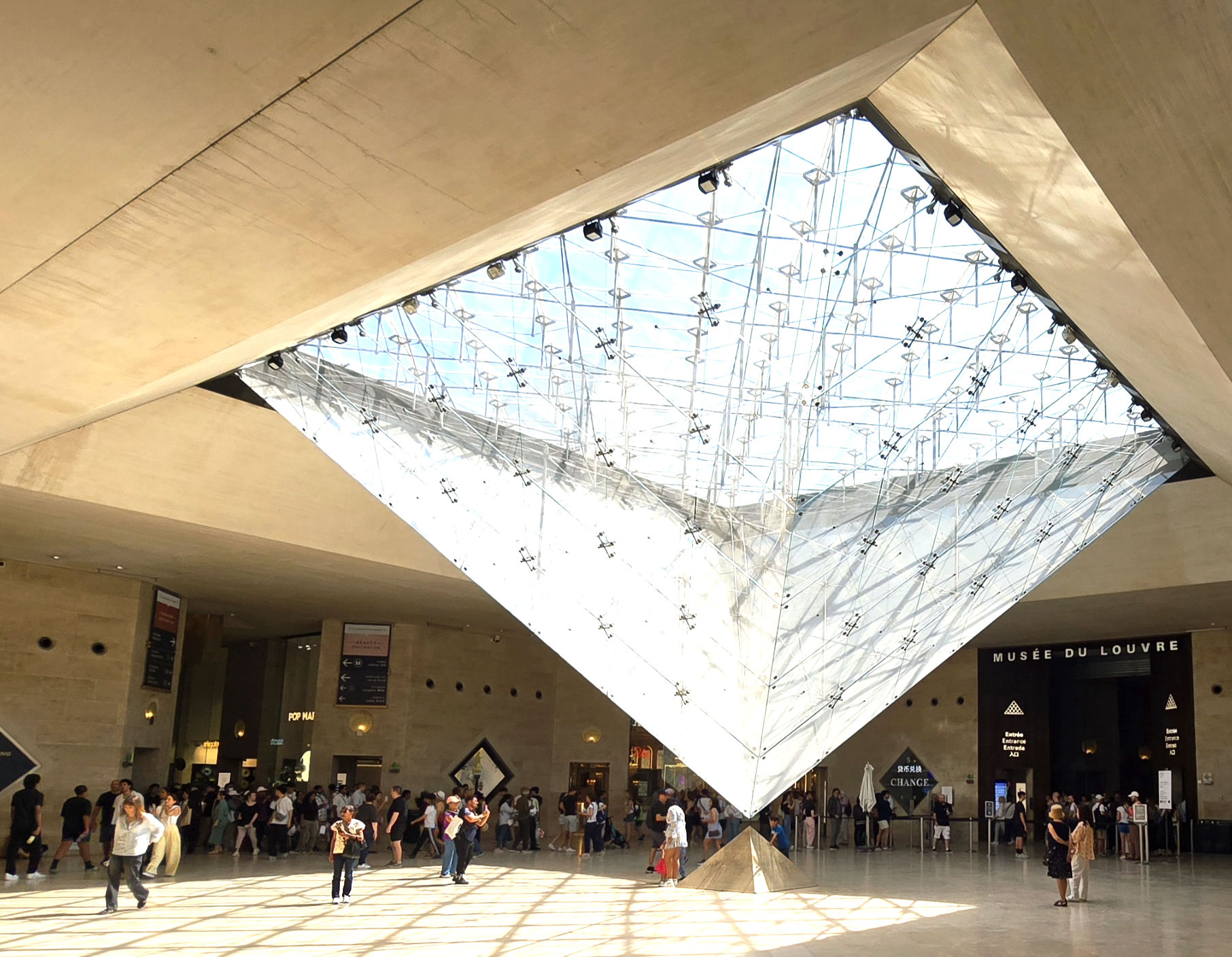
Last summer, one of those creatures found its way into the inverted pyramid and was captured on video trying to escape.
Did you know that there was, in fact, a sixth pyramid planned for the center of the Cour Carrée? To balance out and create Pei’s own axis line, the project was going to stretch deep under the far courtyard. However, when the archaeological dig revealed the medieval foundations of the original fortress and the 18th-century wall by Louis Le Vau, plans were altered.
Today, the pyramid is more loved than hated, but I still hear a few grumblings from time to time. I, for one, love it, and the pyramid is strongly imprinted on one of my most memorable moments. It was ten years ago, in September 2016, on my very first visit, when I went to the Louvre on a late Wednesday afternoon. Walking through the rooms alone with the beautiful art in front of me, I could have danced on air. When it was time to leave to meet a friend, I exited the Denon wing and entered the center of the pyramid. Looking up towards the Richelieu Pavillon, I saw it colored the most beautiful pinkish orange and knew I had to get out quickly. I left and rushed through the center of the Tuileries and found my way to the end with all of Paris laid out in front of me. The sky was stunning, and before me were the Eiffel Tower, Obelisk, Arc de Triomphe, and the Pegasus statues over the entrance. It was in that moment that I knew that everything that had turned in my life led me to that very moment, and this is where I belonged.
This past Sunday morning, on our birthday, I visited the Louvre and looked more closely at every detail of Pei’s creation. Loads of people were filing in through the pyramid door, making their way down the escalator and following the path to the Mona Lisa.
IM Pei died on May 16, 2019, at 102, just weeks after the 30th anniversary of the pyramid on March 29. Watching people take their photos in front of it or pretending to touch the tip brought a little tear to my eye. If only Pei could see the pyramid now.
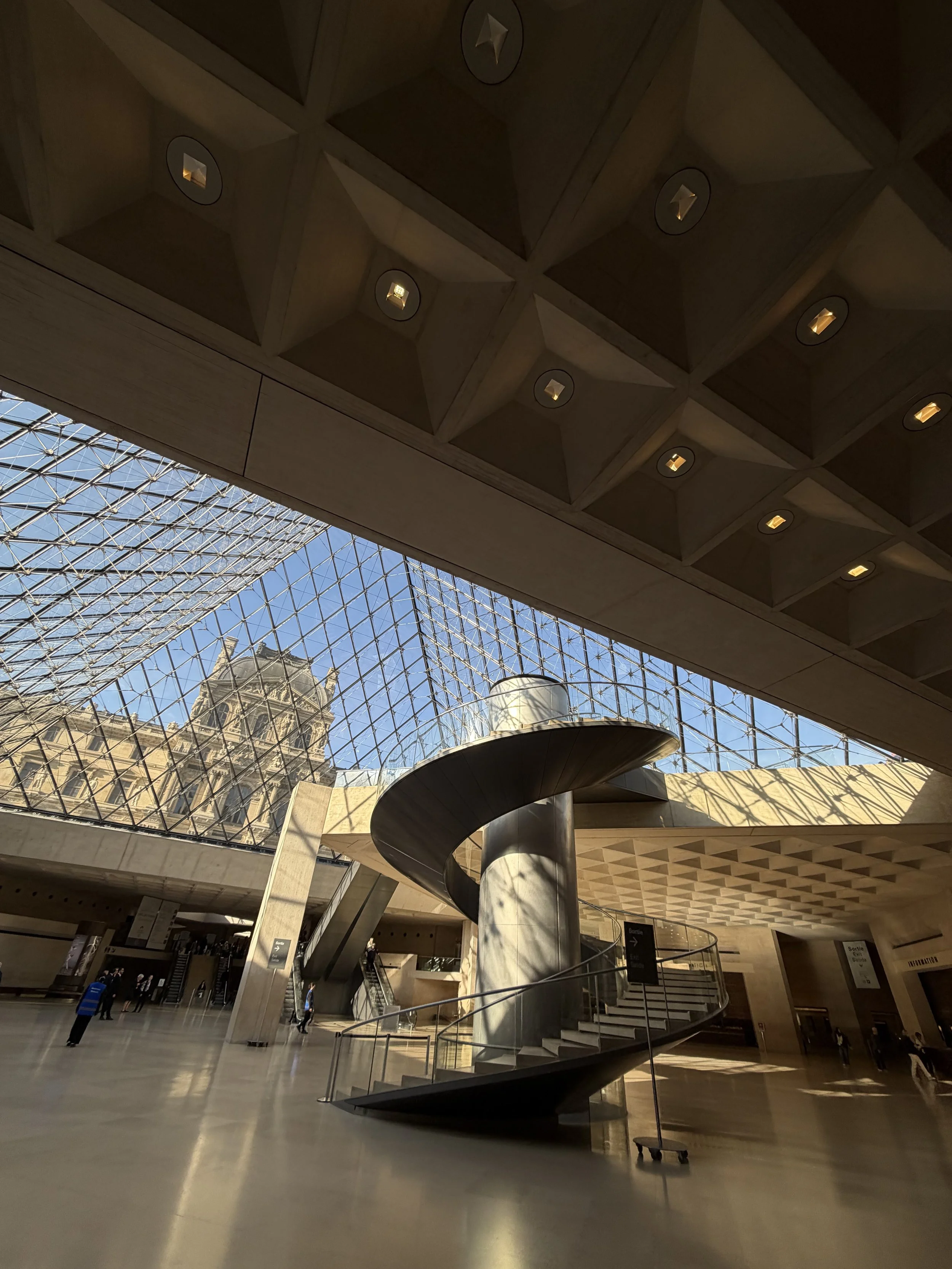
When created, it was intended to manage 5 million people a year; in over 35 years, that number has doubled.
One of my favorite things is arriving in the Cour Napoleon on the bi-monthly cleaning days of the pyramid. A special rhumba-like contraption connected to a hose slowly climbs up and down the pyramid, slowly washing and scrubbing the glass, while a few men stand below, watching and “driving” the little washer. It normally takes two days, and the front entrance is only done on the Tuesday closing day. I longed for years to see this, and now I know the slight humming of the cleaner before I enter the Cour Napoleon.
As for The Da Vinci Code, the opening and final scenes have incredible views of the pyramid and interior.