
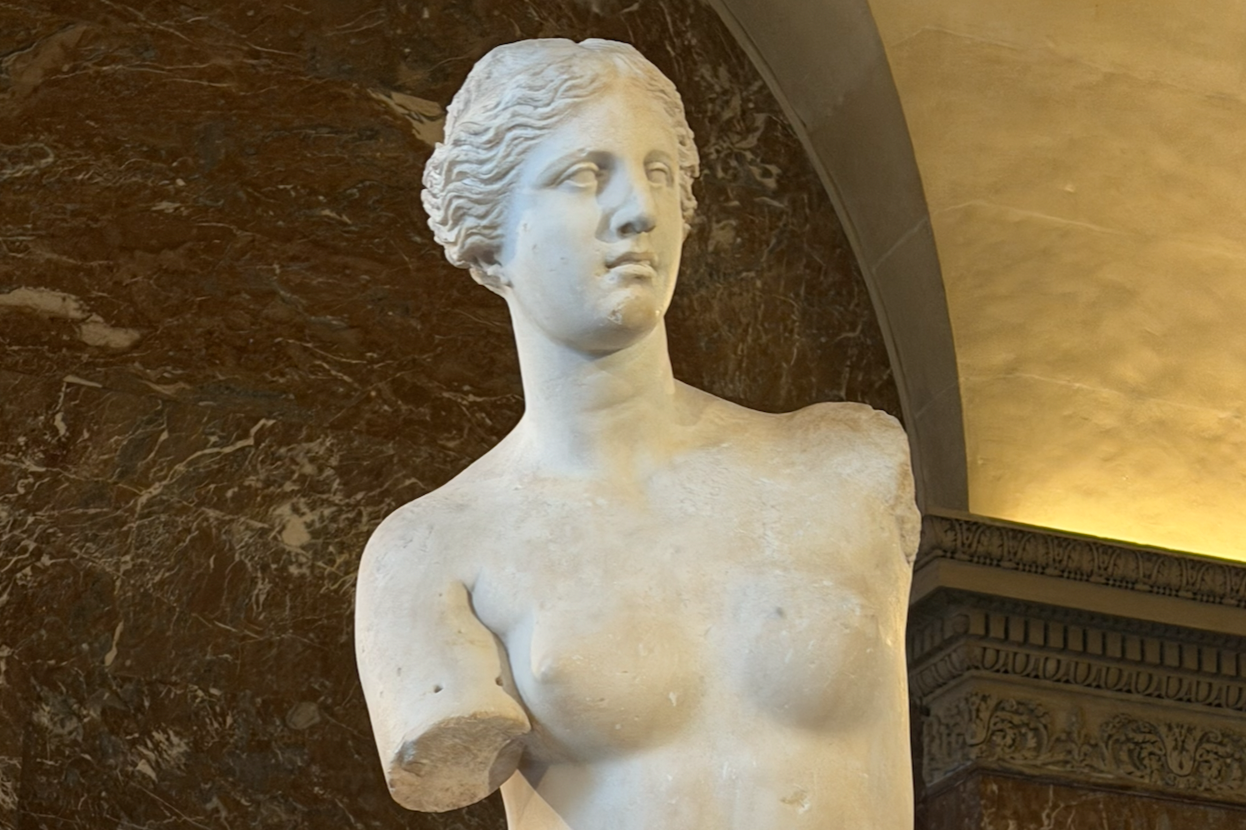
On April 8, 1820, Greek farmer Yorgos Kentrots was searching his property on the island of Mélos in the south Aegean Sea, part of the Cycladic archipelago, today’s Greece, when he uncovered the torso of a statue. Looking for some stones to build a fence, he made a discovery that would alter the attendance of the Louvre long before the Mona Lisa and became the first celebrity of the museum.
There are many questions that surround the statue to this day, over 200 years after her discovery. Sifting through the accounts to find the most accurate information of her discovery has been a struggle to say the least. Who created her, why is she so famous, and more importantly, who she actually is are even bigger questions we will dive into.
The small island of Mélos, which had been inhabited since 3000 BC, was known for its fine Obsidian marble. In 1820, the islands were still under Ottoman control, another important factor in how this scene will play out. What we know as Greece today was simmering, about to boil over into a Revolution that would begin on February 21, 1821, a year after the discovery of Venus.
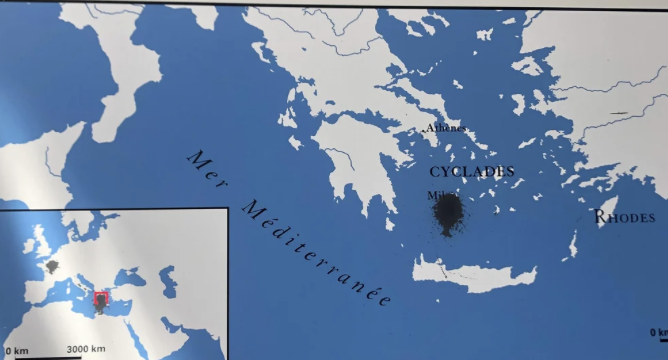
France and the Ottoman Empire had close ties since the early 16th century, nurtured by François I. The first Greek antiquities arrived in France in the 17th century, under Louis XIV, on behalf of the Marquis de Nointel. Under Louis XVI, the duc de Choiseul raided the many islands, taking anything he wanted. He didn’t get very far, and everything was confiscated and returned to the rightful owners.
Napoleon cut his way through Europe, taking anything that lay in his path and damaging relations between France and many European countries. He had stayed away from the islands but his damage was widespread.
Following the fall of Bonaparte, the French military presence in Greece and the fleet in the Cyclades after 1816 focused on a diplomatic mission and rebuilding relationships.
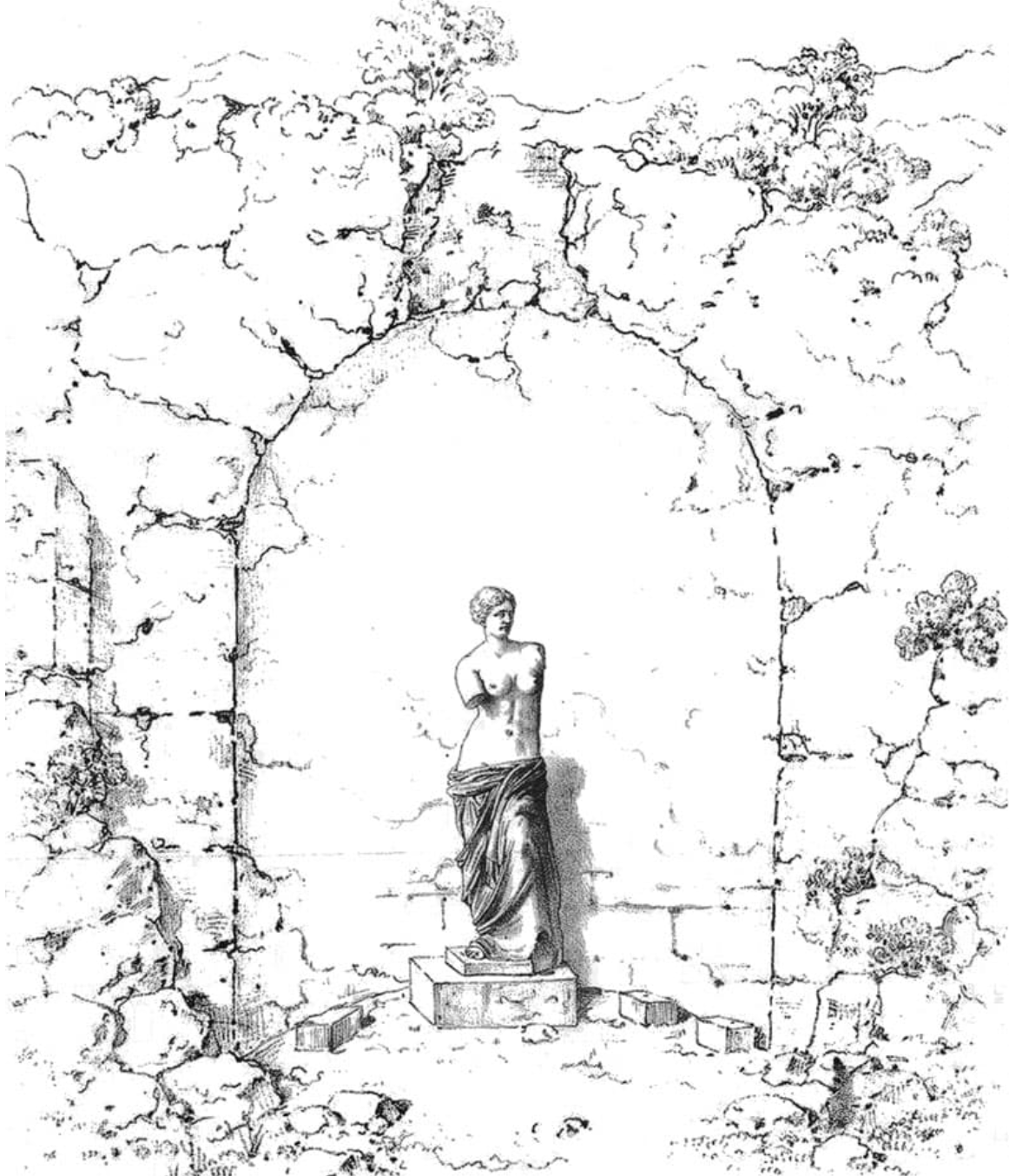
The island's location in the south Aegean Sea and the large harbor on the route from Malta and northern Africa brought great prosperity to Mélos beginning in the 4th century BC. In the northeastern upper edge of the harbor, a large amphitheater was built overlooking the sea, surrounded by pavilions, churches, porticos, and, of course, statues. In 1810, archaeological exploration began on the island of Mélos, and in 1814, Carl Haller von Hallerstein, on behalf of the Prince of Bavaria, excavated the amphitheater, but not the surrounding land.
On this spring day, Yorgos had walked a little over a thousand feet from his home and a short walk above the amphitheater in hopes of finding stones for a fence. Digging into the earth, he found a carved sculpture, heavily covered in dirt and a little over 3 feet tall. He took the statue home and kept it safely in his kitchen until he decided what to do.
There are many figures that play into this moment and the ones that follow, and there doesn’t seem to be a concise decision on which one is accurate. How easy it must have been to create your own story or description of events, especially when the publication and dissemination of the details didn’t reach very far.
Many men aligned themselves with the discovery of the Greek statue, from viewing its discovery, to purchasing and even transporting Venus to Paris. Some of the accounts weren’t released until decades after the discovery, and they were heavily embellished.
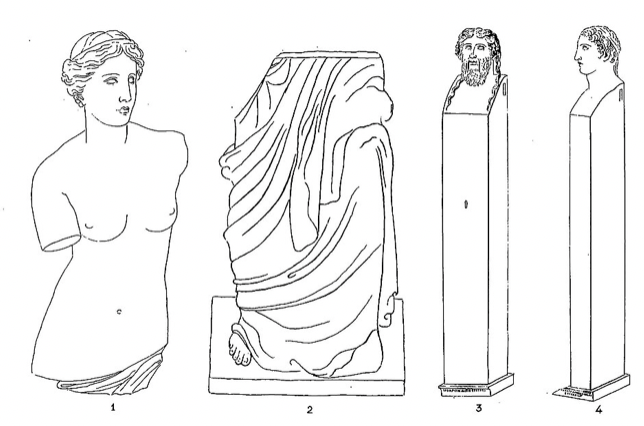
Our first, and the man most closely tied to the discovery, is Olivier Voutier, a young officer on the L’Estafette schooner that had been anchored in the Milo harbor since February 1820. He claimed to be digging not far from Yorgos and saw the very moment she was lifted from the earth and ordered the farmer to keep digging. While he watched, he sketched her torso, lower body, draping, and two pillars. Although these drawings never saw the light of day until 1892, more than seventy years after her discovery.
Louis Brest, vice-council of France, was told of the discovery immediately and wrote a letter to the French Ambassador of Constantinople, the Marquis de Riviére. Charles-François de Riffardeau de Riviére was chosen in February 1815 by Louis XVIII and appointed on June 4, 1816, to help rehabilitate the relationship between France and the Ottoman Empire. Falling out of favor and almost out of a job, he was ordered to return to France, and in fear of losing his job, he thought a little gift for the king would work in his favor.
Riviére asked his embassy secretary, Louis de Martin du Tyrac de Marcellus, who knew how to negotiate and deal with Ottoman officials, to broker a deal.
Our other player in the story, who claimed to play a large part in the discover is Jules Dumont d’Urville. In 1819, he joined the expedition to the Greek islands with Captain Pierre Henri-Gauttier du Parc. Dumont d’Urville claimed that he, not Louis Brest, was the one to alert the Marquise de Riviére of the discovery and advised him to purchase it immediately, as it would be of great glory for the French.
Dumont d’Urville described what he saw in great detail "The statue whose two separate parts I measured was about six feet high; it represented a naked woman, whose raised left hand held an apple, and the right supported a belt skillfully draped and falling carelessly from the kidneys to the feet: moreover, they were both mutilated, and are currently detached from the body. The hair is curled from behind and held by a headband. The figure is very beautiful and would be well preserved if the tip of the nose had not been damaged. The only foot that remains is bare: the ears were pierced and had to receive pendants[4]. "
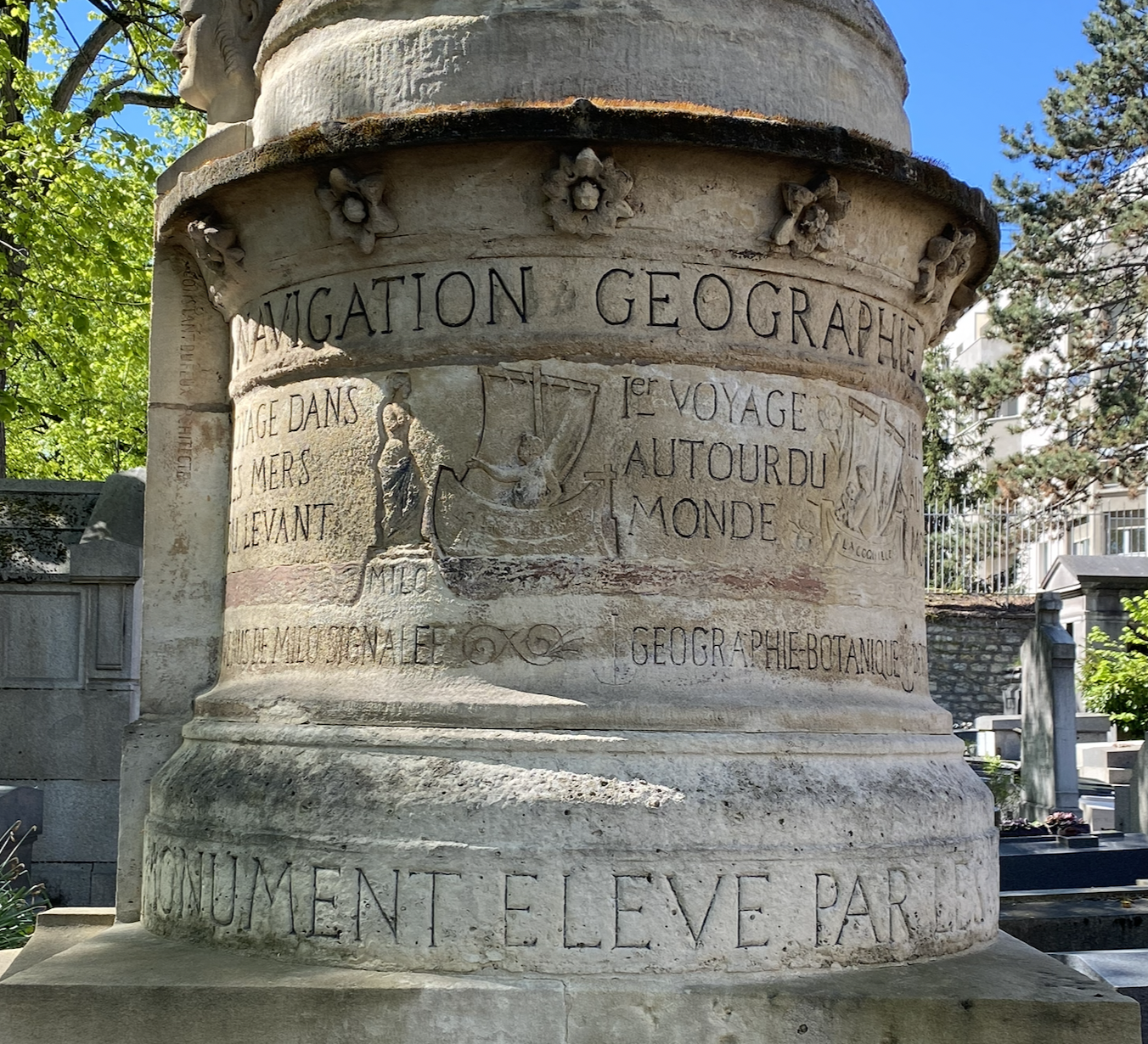
He rode the wave of this story until his death and into the afterlife. A visit to the Montparnasse cemetery in the 15th division, near the western edge, is the final resting place of the Dumont d’Urville family, who tragically died on the same day in a train accident in Meudon. I first spotted this grave years ago and noticed the Venus de Milo carved in relief on the side. She is there beside a ship with a lone figure who is pointing at the statue. Way to hold onto your story long after you are gone.
The fight to own Venus was down to the wire. Oikonomos Verghi, a monk from Milo, said he purchased the statue from Yorgos, who discovered it. Verghi had the statue loaded onto his ship, bound for Constantinople.
A storm rolled in and prevented the ship from leaving the harbor, and thus one of the tallest tales of her discovery.
In 1874, Victor Jean Aicard published a piece in the Paris Temps paper and later a book based on the account of embassy secretary Marcellus and Dumont d’Urville, and that when the statue was unearthed, she had both arms intact. His account reached the New York Times on April 28, 1874, claiming that the statue had been dragged across the rocks in a fight for control between Ottomans and the French. Aicard said that a battle between fifty Frenchmen against fifty Ottoman soldiers ended in a blood fight, some even say it was closer to over two hundred men that died.
Threatened that if Venus wasn’t given to the French officials immediately, they would invade and capture the island. In 1912, the entire episode was found to be made up, but that doesn’t stop it from being retold to this day.
After two days of negotiations, the Ottomans agreed to sell the statue to the French ambassador for 1,000 piastres; he tossed in another 300, bringing the price to less than $50, or about $2,000 today.
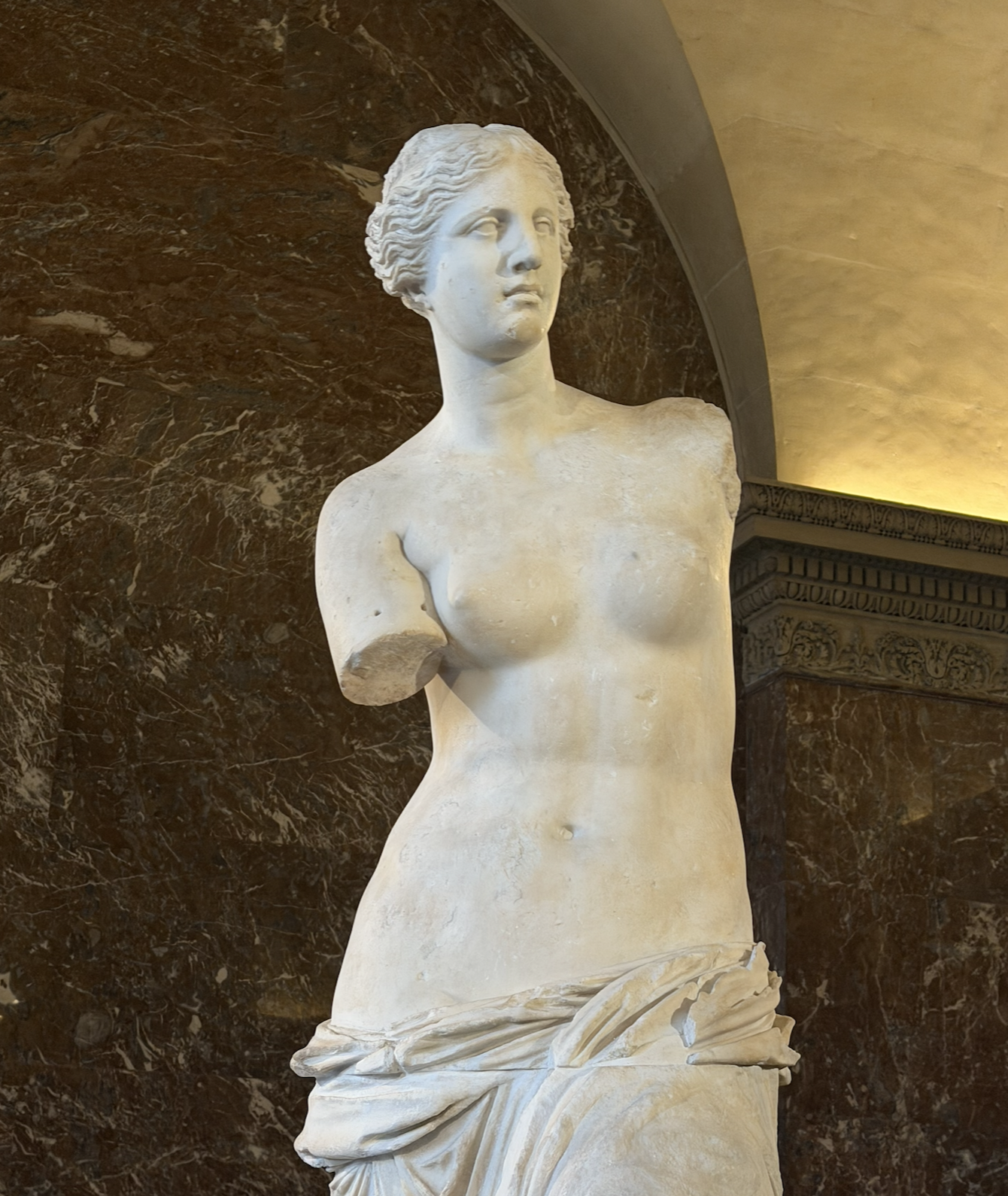
On May 25, 1820, the upper and lower bodies of Venus and a scattering of smaller pieces, including a hand holding an apple, the chignon of her hair, a forearm, and pillars, were packed and loaded onto the L’Estafette schooner and began its very slow journey to France.
Stops in Santorini, Rhodes, and Athens, where they remained for over a month and took every chance they could to show her off before changing and moving to a larger ship In Constantinople and picking up the Marquise Riviére.
On October 29, 1820, Venus and the Marquise left his post in Constantinople and headed to Paris via Toulon, finally arriving and presenting the statue to Louis XVIII on March 1, 1821, in the Palais des Tuileries.
The very next day, the pieces of Venus were placed in the Musée du Louvre. Now the question was how to restore her. 42 years later, when Winged Victory was discovered in more than 115 pieces, it was difficult to determine who the statue represented. They didn’t have the same problem with Venus, which was in two large pieces that could easily be placed together. Even the pieces were easy to understand, except for the hand.
The curator of antiquities, Charles de Clarac, and restorer Bernard Lange were the first to get their hands on the statue with a complete investigation into her condition as well as when she might have been created.
The rules of restoration, as far back as the 17th century was to fully restore any broken part of a statue. This would change drastically after 1860, but in 1821, with the arrival of Venus, it was a heavily debated question: how to repair and recreate the new Greek treasure.
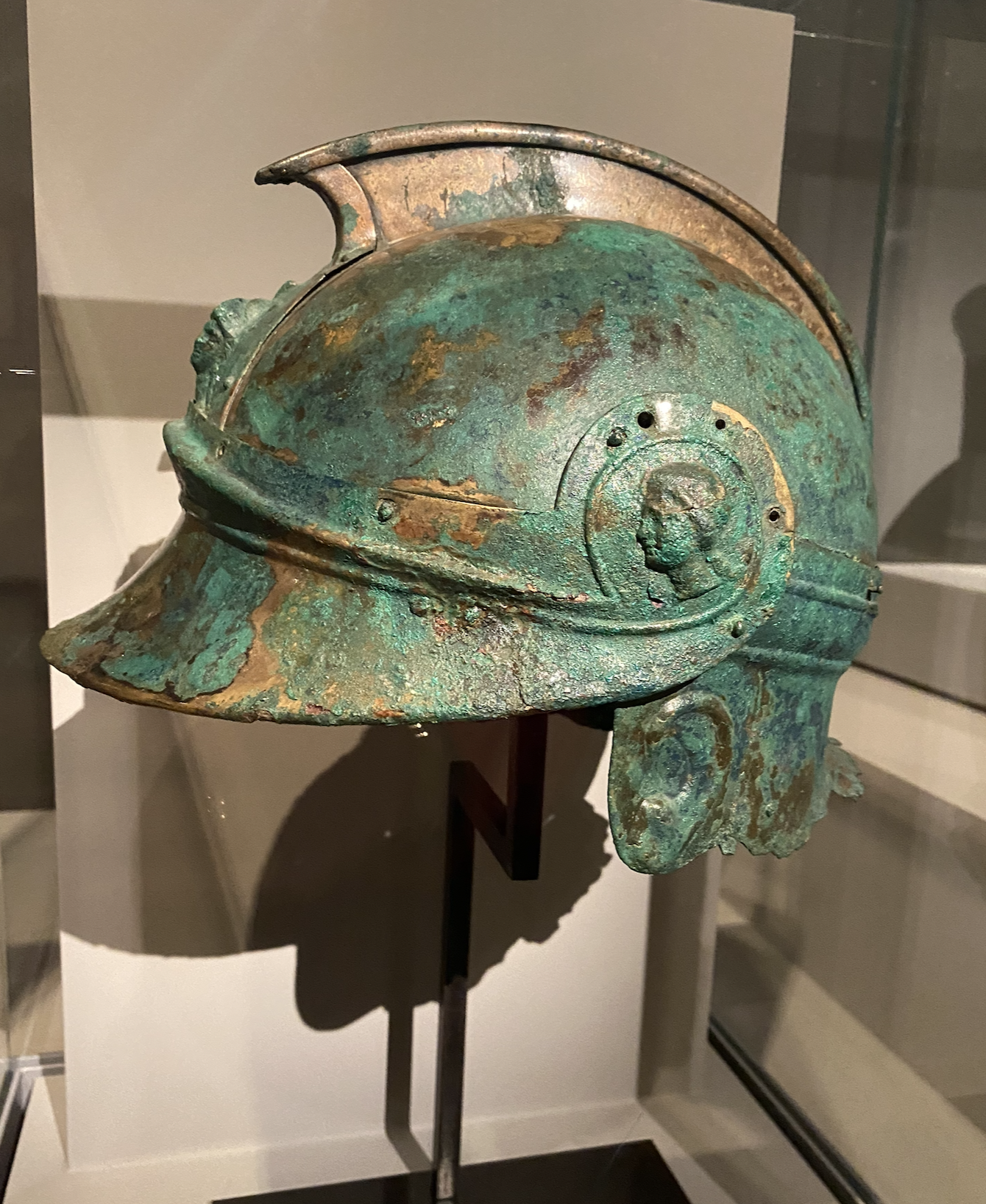
A fight between the curator Clarac and the director Forbin, who himself had visited Milo just a few years before, when he uncovered a helmet and vase that were brought to the Louvre. Exactly who was she, and how should she be restored?
Greek and Roman statuary of mythological figures can be very easy to decipher if they are created with their attributes. Zeus or Jupiter has an eagle and thunderbolt, Diane or Artemis has her tiara, bow, and arrow or dog, Juno or Hera has a peacock, Neptune or Poseidon has a triton, and Hermes or Mercury has a caduceus, winged shoes, and helmet.
Venus, the goddess of love and beauty, was known to be the most beautiful goddess in the world. The mother of Cupid was the personification of beauty and the image of the perfect woman. When she was first discovered, a hand holding an apple was unearthed within a few feet of the larger pieces. In the recount of Dumont d’Urville, he said: “It represented a naked woman, whose raised left hand held an apple”. And with that statement, they called her Venus.
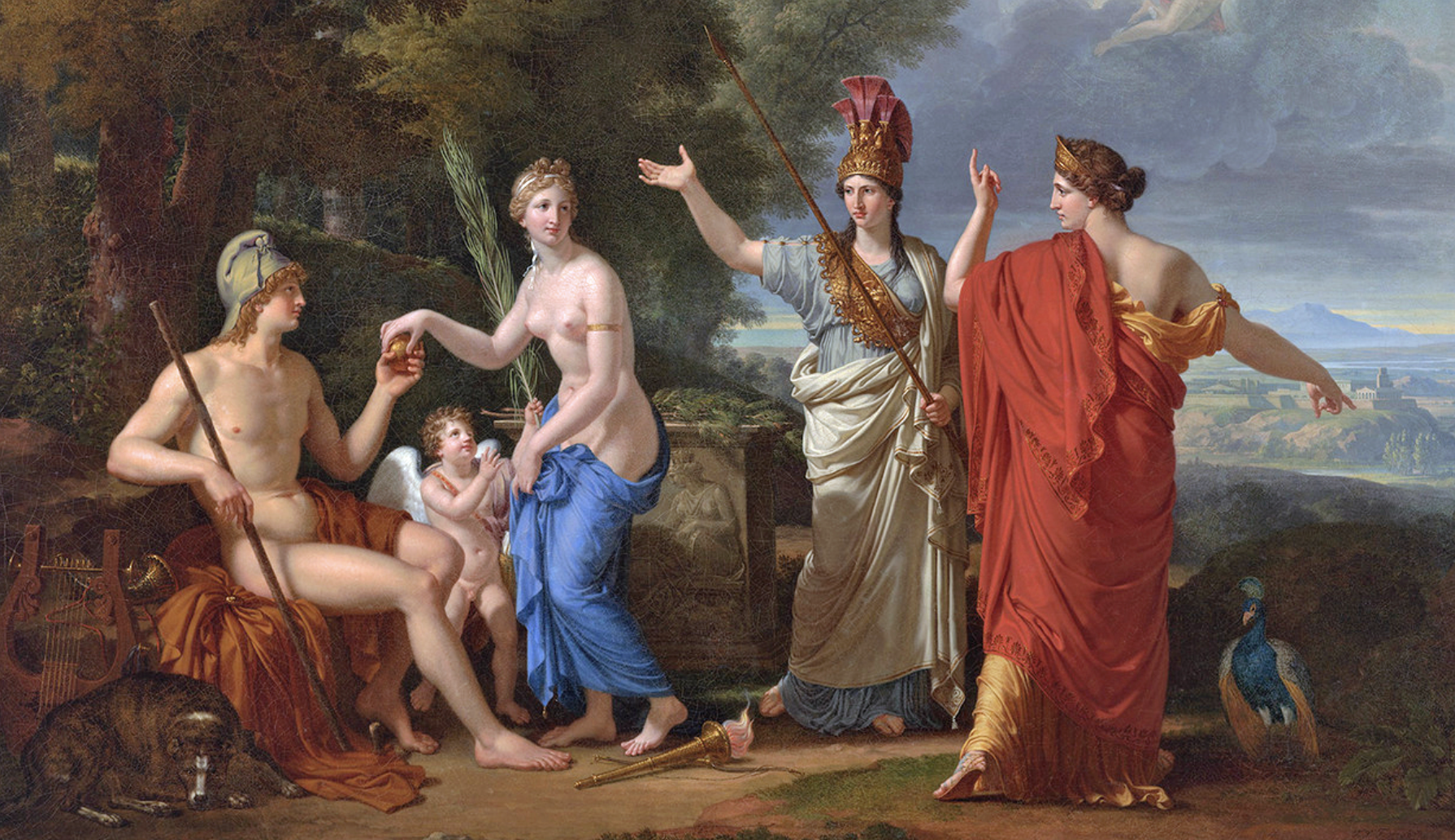
One of the more famous mythological tales of Aphrodite/Venus is the great contest between Aphrodite, Paris, Athena, and Hera. A wedding feast of the gods, a golden apple inscribed “to the fairest,” was tossed into the center of the table by Eris, the goddess of discord. She was upset that she wasn’t invited to the party.
Zeus wanted nothing to do with it and instead ordered Hermes/Mercury to take them all to Mount Ida with Paris, the Trojan prince who would have to decide which of the three goddesses was the most beautiful. He chose Aphrodite/Venus because she promised Paris that she would bring him the beautiful Helena to marry. The story is known as the Judgment of Paris and would be the impetus of the Trojan War.
Venus is often depicted holding the golden apple, which is why our beautiful statue was given this name. However, since she was found on a Greek island, shouldn’t she actually be Aphrodite?
Some scholars believe she actually represents Amphitrite, a Greek sea nymph and the wife of Poseidon. In 1877, a large statue of Poseidon was found in Milo, in the same area where Venus had been found 57 years earlier. Carved from the same Paros marble and roughly the same size, there is much more evidence pointing to her being Amphitrite.
We can date the sculpture to the Hellenistic period based on the marble used and the island's great prosperity at that time. The Hellenistic period covered over 300 years from the death of Alexander the Great to the death of Cleopatra in 30 BC. It was a period when the Greek islands and culture were at their peak. It is also the same period we were blessed with the creation of Winged Victory, the true queen of the Louvre.
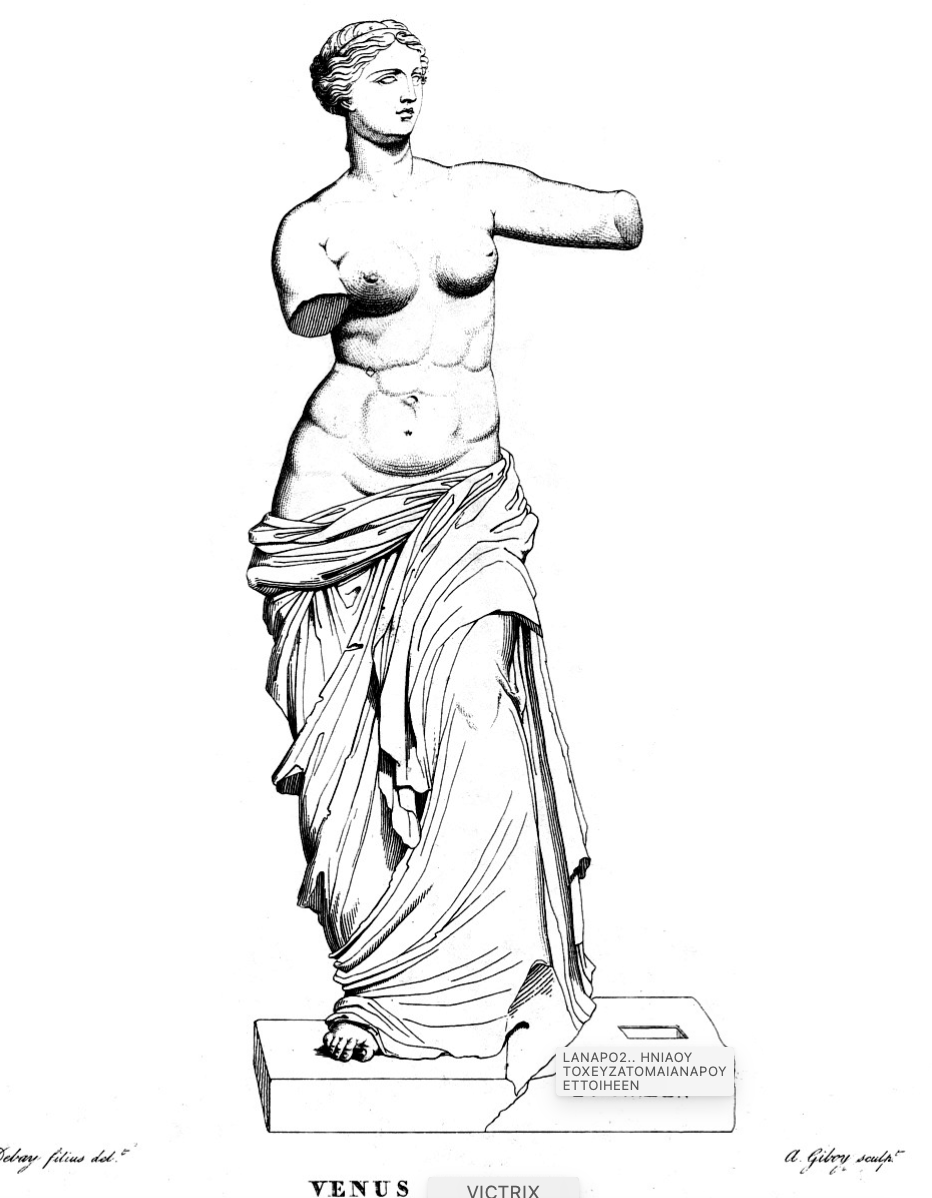
Further investigation dates her having been created between 150 and 125 BC. Winged Victory is a bit older to 200 to 175 BC.
Michelangelo is well known for saying the stone block would tell him what it wanted to become. Massive statues sculpted from one large piece, but long before the Renaissance, these large statues were created in pieces and joined together.
Venus was carved from two large blocks of Paros marble, a nearby island known for its translucent quality and one of the finest marbles in Greece. Her lower body was covered with draped fabric, and her upper body and head. The sculptors of the time conserved every inch of marble, which might give us some clues about her arms. Her right arm was sculpted and placed close to her body. As for her left arm, which is missing today, it would have been a separate piece attached to her shoulder with a mortise-and-tenon joint, creating a perfect fit without any glue or cement.
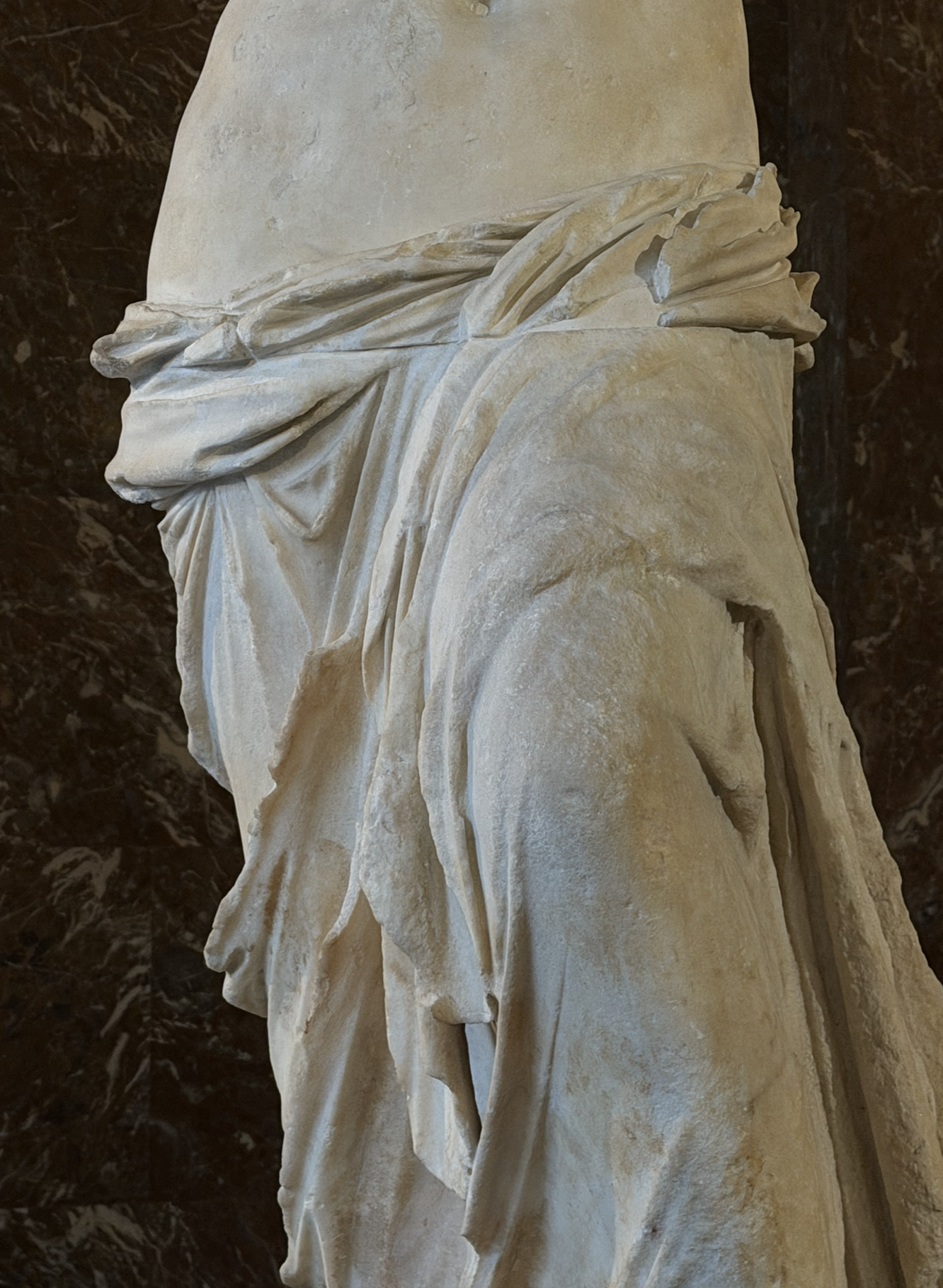
Using other statues of the goddess of love as a base, the restorers imagined different scenarios of what she would have looked like. Venus stands at 6”6’and was most likely placed inside a niche. She stands contrapposto, meaning her weight is on one leg, the other bent at the knee. This was an aesthetic choice to allow the fabric to drape and fold over her legs.
It’s thought that her right arm rested against her stomach, holding the drapes of the fabric between her fingers. If you look closely, southwest of her belly button, you can see a rough patch where her arm would have lain.
As for the other arm, there are many hypotheses. Was it holding the golden apple like in the portion discovered? Likely not, as the fragment is of lesser quality than the statue itself. Was it straight out to her side, holding a shield, that she was looking at her reflection? Also unlikely, as her head is looking straight and not down. Could it have been resting on one of the pillars discovered nearby as well? Doubtful, as each pillar is topped with a head, and the size doesn’t line up. Many ideas drawn from other statues of Venus/Aphrodite inform the scenario.
In the end, they showed great restraint in her restoration, an uncommon practice at the time. Instead of adding in their own interpretation of the statue, they left her as she was discovered with the smallest bit of surgery. The tip of her nose, lower lip, big toe of her left foot, a few of the edges on the folds, and her right foot were restored or replaced in record time. Louis XVIII wanted her on display as quickly as possible.
Held together in the center by metal rods of her upper body, which slide into two mortises of her lower body. Her body went through a lot between its discovery and transport to the various boats and arrival in Paris. Considering her age, she was in relatively good condition. Close up, you can really see the damage on her upper back and near her stomach of layers of stone that have disappeared.
A portion of a base with Greek lettering that was found near her was believed by the men who found her to include the name of the artist. Incomplete and missing the first letters, it reads “andros son Menides, from the city of Antioch of the Meander made.”
It wasn’t until quite recently in the scope of time that artists began to sign their work. Prior to the Renaissance, in art and architecture, it was more about the person who commissioned or donated it. This is why we still don’t know the name of the first architect of Notre Dame de Paris, but we know it was paid for by Maurice de Sully.
Obviously, the artist had to be talented, but it wasn’t about the celebrity of the artist. That all changed during the Renaissance, and it’s still difficult to find many paintings from that period with signatures. For statuary, signatures appeared in the 17th century.
In the 2nd century BC, Venus/Aphrodite wasn’t just the representation of beauty and the ideal woman; she was also decked out in jewelry. This might be my favorite part of the story. As far back as the 5th century BC, the figures weren’t just statuettes of white marble in a corner; they were painted and even bejeweled.
Rosy cheeks, red lips, blonde hair, and wrapped in red fabric? Was that what Venus looked like? We actually don’t know, but that’s how I would color her. Under even the most powerful xrays they have never found any remains of color.
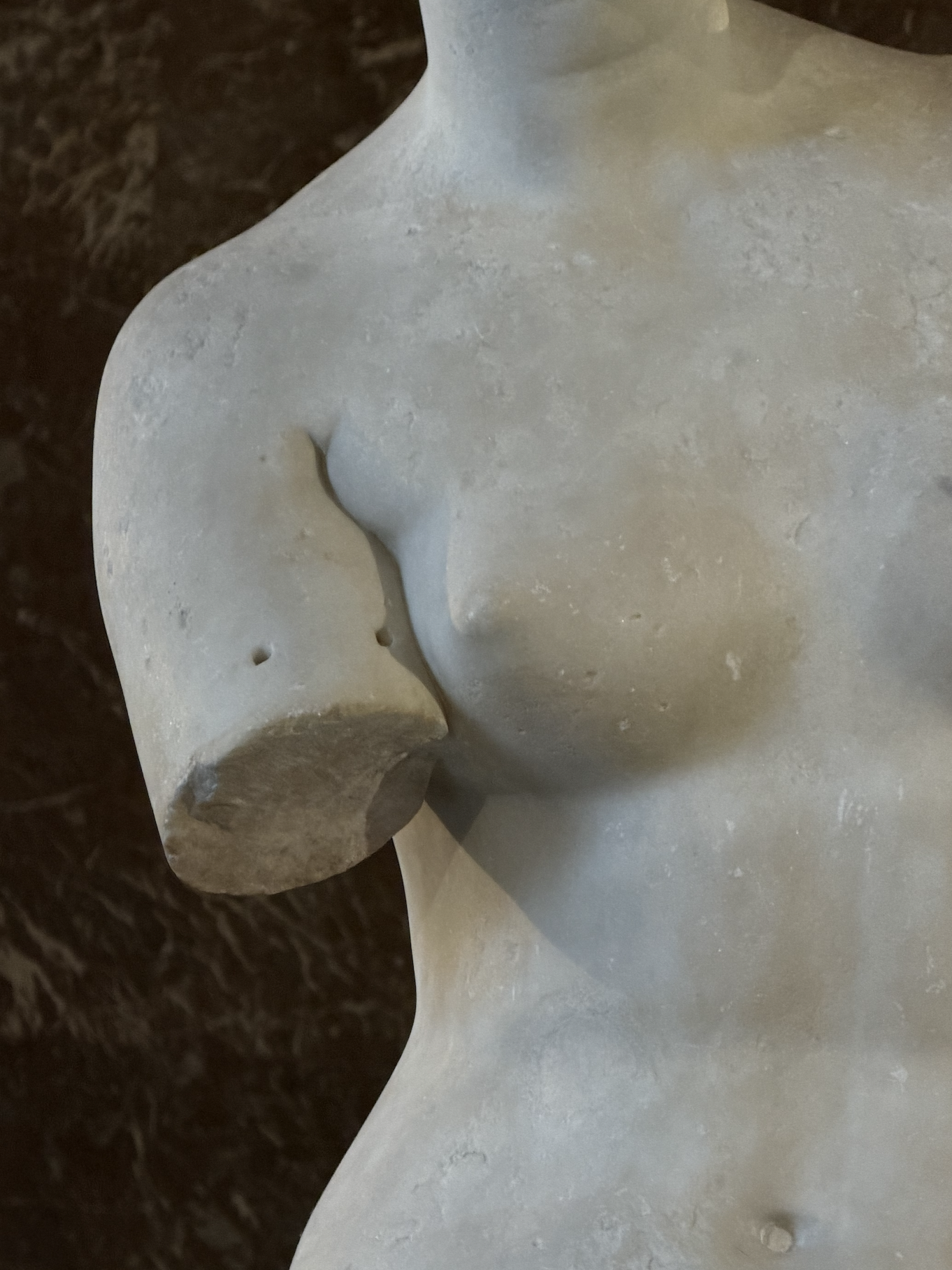
However, we can see that she loved a bit of jewelry. Hard to see from the ground, but her hair, pulled back into a chignon, is held by a thin headband. Four small holes suggest that gold or bronze jewelry was once attached, perhaps even a diadem tiara. Sadly, her earlobes are broken, but if you look closely at her left earlobe, you can see a hole where pendant earrings once hung. The easiest to see is on her right arm. Just above the cut of her arm, two distinct holes remain where an upper arm bracelet would have been attached.
The biggest question might be, Why is she so famous? Much like the Mona Lisa, it's based a bit more on circumstances than on the art itself.
There are many men who inserted themselves into her story, but it was one man who never laid eyes on her who, in a roundabout way, created the global celebrity that is Venus de Milo. As Napoleon Bonaparte rose in power and marched through Europe, he took anything he wanted. Paintings, sculptures, manuscripts, and books, anything and left treaties behind claiming it was on the up and up. In 1814, after his fall and before his return, the countries and the Pope came calling, demanding the return of their treasures.
In the following few years, 95% of the items he had taken were returned. The 5% that remained was given as a gift to France by Italy and the Pope, or traded for, like Vernoes’s Wedding Feast at Cana.
By 1821, the rumor had spread throughout the world that the Louvre was filled with stolen items, which wasn’t true by that time. Fast forward 90 years to 1911, and an Italian glass worker, spending his days at the Louvre placing glass over paintings, has an idea to take an Italian painting back to his homeland because he thinks all of them have been stolen. I have even had friends who thought this was true, and we are 200 years after the fact.
In 1821, people didn’t want to come to the Louvre because they thought everything was stolen, so the Louvre had a PR disaster on its hands. Oh, for it to be that simple again.
Greek antiquities, especially those of the Hellenistic period, were just beginning to see the light of day in museums. Roman copies of Greek statues had already been transported across Europe, including to Versailles and the Musée du Louvre. But an actual Greek sculpture, one left in the form in which she was discovered, was a big deal.
Suddenly, the Louvre realized this and, over the next thirty years, began creating copies of her in various sizes, selling photographs and books featuring her likeness, and sending them across Europe and the Western world. At the same time as the discovery of Venus in 1820, the era of transatlantic travel by ship from North America really began. A perfect storm of circumstances.
By 1874, the numerous altered versions of her story, especially those contributed by Victor Jean Aicard, spread far and wide, as in the NYT article of April 28, 1874. This gathered even more fame surrounding our armless heroin
The new star of the Louvre was hard at first to work into the collection of antiquities, mostly dedicated to Roman statuary. She was first placed in the Museum of Antiquities, created under Napoleon Bonaparte, and then in the summer apartments of Anne of Austria from May 1821 to April 1822. The rooms were far too crowded for our goddess, so she was moved to the Salle Diana, where she remained until her move to her forever home, the Salle Tiber, later renamed the Salle Venus de Milo. Once placed on a rotating base, she spun, allowing people to take her in without moving. T
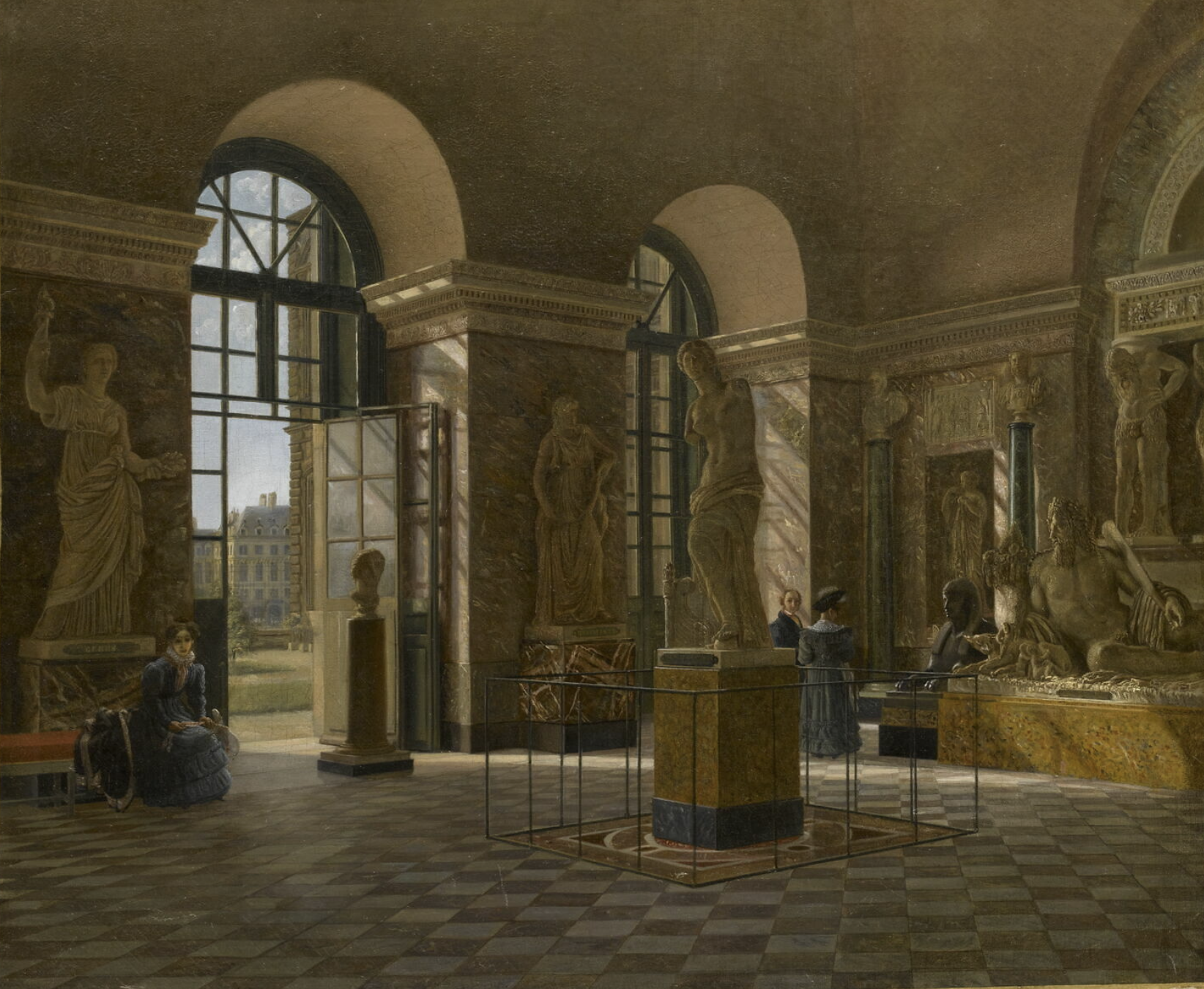
Today, she remains in this room, which gets natural light from the sun mid-morning, flooding the red Languduc marble walls. A few items also found on Milo are in a nearby case, including a hand holding an apple, part of an arm, and a foot with a sandal and three pillars.
Just past her is a fantastic painting by Joseph Warlencourt, painted in 1824, showing Venus in the room she remains in until this day.
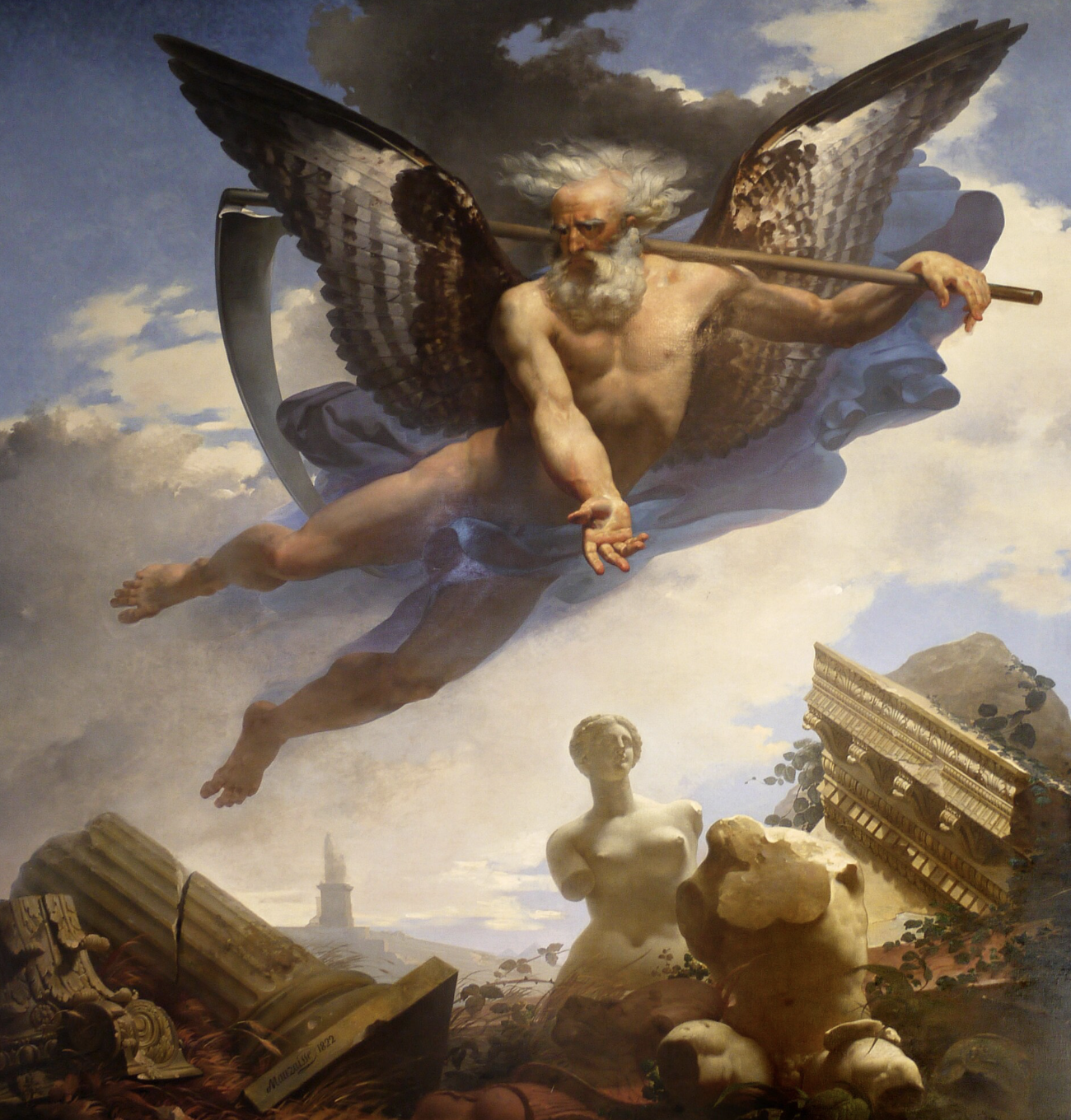
On the first floor in the Salle des Verres, just past the Gallerie d’Apollon, look up at the painting by Jean-Baptiste Mauzaisse, Le Temps, showing the ruins he brings and the masterpieces he leaves to discover, 1822.
She is found again in the ceiling of the Salon Denon, just outside of the Salle des États, home of the Mona Lisa. On the west side, the allegory of Taste holds Venus in her hand.
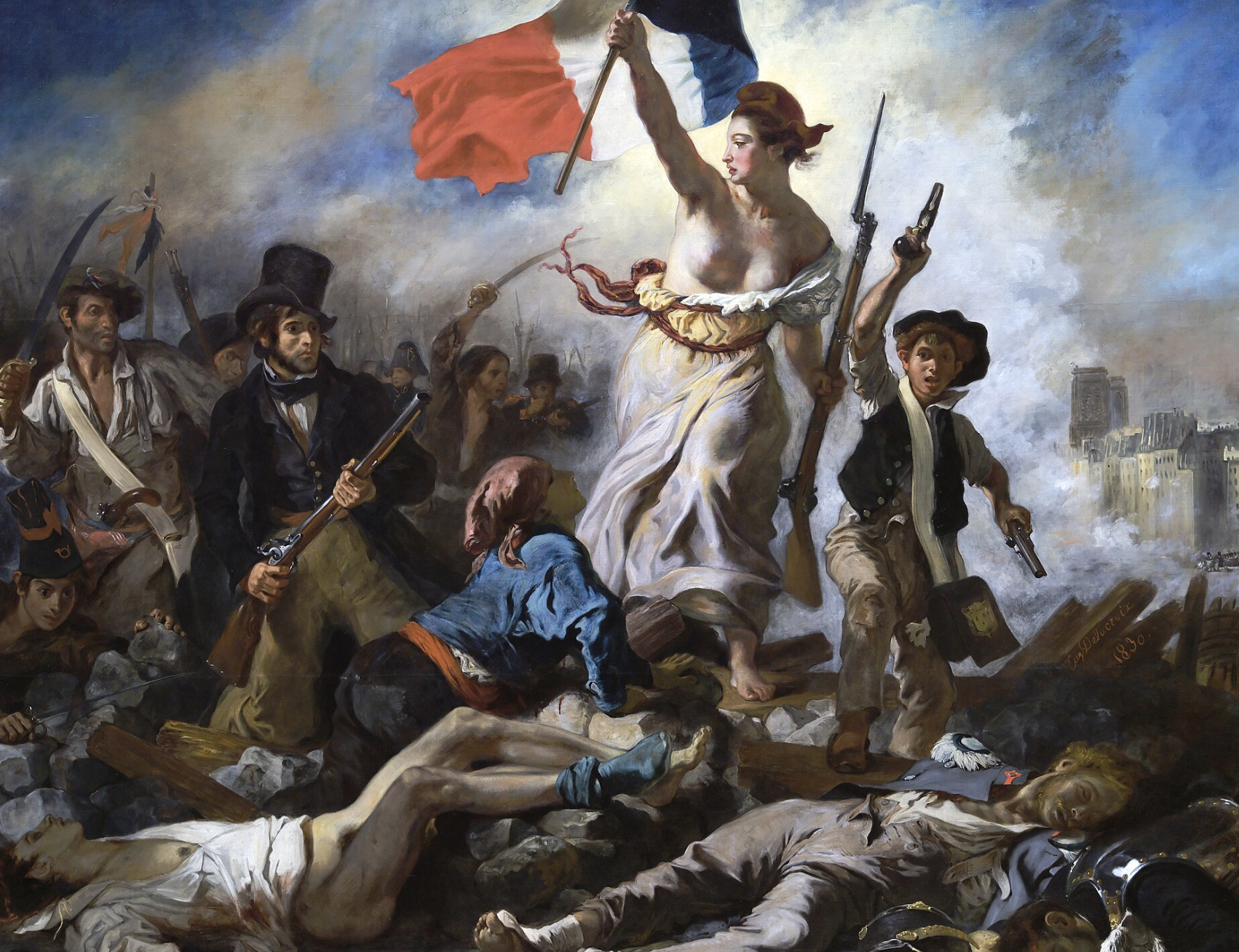
Venus has inspired many artists since her discovery. Theodore Chasseriau, Cézanne, and Eugène Delacroix are just a few who sketched her many times. Delacroix had never visited Greece, but the Revolution that began as soon as she arrived had everyone captivated and on the side of the Greek people. In 1823, he painted the large Massacre at Scio painting held in the Louvre just across from Liberty Leading the People. Look closely at Liberty. Does she remind you of anyone? Delacroix was inspired by the draping, stance, her strong face, and of course the bare breasts and idea of what her arm might be holding.
Napoleon III declared war on Prussia on July 18, 1870. By the end of August, the Louvre decided to remove the most important works from the museum for safety. In the first evacuation of its kind, but not the last. One hundred twenty-three crates were shipped to Brest in Brittany in the first convoy and would continue for months. Venus remained behind in the Louvre, but as the siege entered Paris and created chokepoints on all routes in or out, they had to find a new hiding place for Venus.
In the dark of night on January 6, 1871, Venus slowly made her escape from the Louvre to the nearby Prefecture at the Palais de Justice on ile de la Cité
Placed in a hidden coridor she was covered in plaster, and a brick wall was built to hide her. Clever workers rubbed the wall with garbage to look like it had always been there, stacked piles and boxes of documents, and then built another wall. The thought was that if they broke through the wall, they would discover the documents and then move on.
The Siege came to an end on January 28, and just when the art was about to return to the Louvre one of the most destructive periods in Paris history began. On May 21 and for the next ten days, the Communards set fire and destroyed many of the government buildings within the center of the city.
On May 23, the Palais des Tuileries was torched, and the fire reached the Grande Galerie and was quickly contained. In July, it was time to remove Venus from her hiding place at the Prefecture. During her seven-month slumber, a water pipe had been leaking over her head and had slowly softened the plaster that covered her as well as the plaster used to join her upper body to her legs in 1821 after her arrival in Paris.
Once she returned safely to the Louvre the 2nd restoration began, the base and the plaster left foot was removed but plaster and even two new large metal dowels were drilled into her body where she was attached. This would all be fixed in her 3rd restoration in 2009.
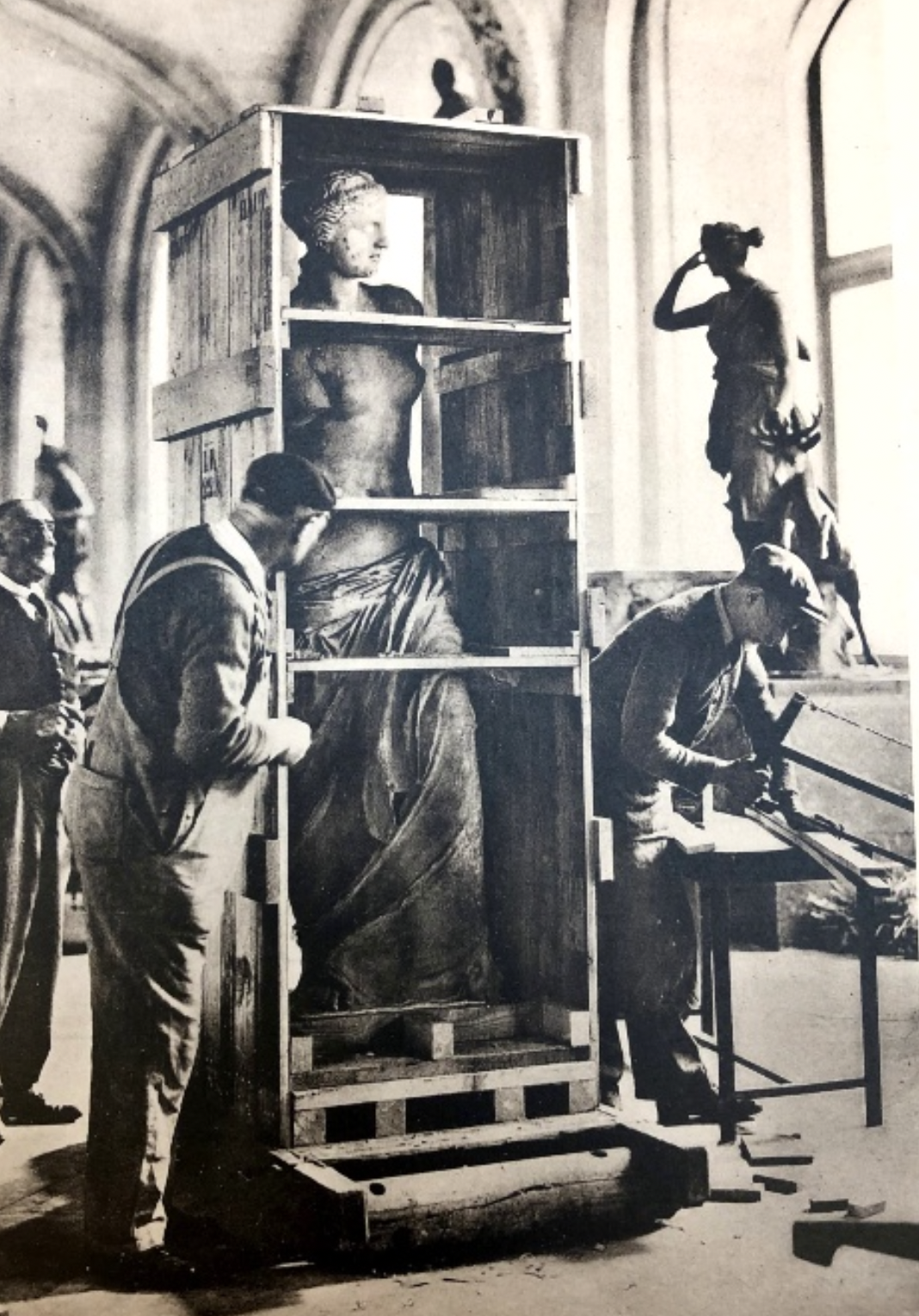
This was all a test run for what would happen again in 1914 with the advent of World War I. At the end of August, the most important pieces of art were once again packed up as the Great War began. Venus and more than 900 other works of art were packed in crates in a frenzied few days and taken to the Gare d’Austerlitz to be taken to the large Église de Jacobins in Toulouse as German planes flew above Paris. Venus returned once again in December 1918, but her biggest move was yet to come.
The evacuations of 1870 and 1914 paled in comparison to what the Louvre would go through in 1939. Once again, it was the last week of August when the Louvre would close, and hundreds of people from the École du Louvre, department stores, and the Louvre staff quickly removed the art from the walls and built crates for the statues. Beginning September 1, convoys left the Louvre day and night, but Venus and her friends, Winged Victory and the Dying Slaves, remained securely in the Louvre.
When they realized the intentions of Hitler and his greedy henchmen, they decided the rest of the Louvre needed to be emptied. At the end of October on the 29th, Victory, Venus, and the Slaves left in a convoy of 29 trucks for the Chateau de Valencay in the Loire. Former curator Gérald van der Kemp oversaw the precious items, including the Crown Jewels, stored in a hidden wall safe.
The week before the Liberation of Paris, the Venus de Milo and other works almost became the subject of a tragic event. Between August 10 and 16, the German SS officers and the Milice members, made up of extreme French and European members, came to a head with the FFI and resistance in front of the chateau. Curator André Leroi-Gourhan asked them to move on, but they didn’t take kindly to the suggestion. They eventually broke in and set fire to the stables located next to a small building where Venus was stored. The fire was quickly extinguished as it reached the roof. Four days later, they returned and entered the chateau to question Van der Kemp about his involvement with the FFI. He admitted they were hiding Venus here, and the FFI was helping to protect the treasures.
The Nazi soldier said they weren’t interested in art and went on their way. Had that been a year or two before, Venus, Victory, the Dying Slaves of Michel Ange, and the Crown Jewels could have been taken.
On June 29, 1945, Van der Kemp himself drove the truck holding the statues back to the Louvre and they were once again on display on July 10, 1945, within the Louvre.
Venus left the Louvre one more time, less than twenty years later, this time on a diplomatic mission. In 1963, the same year the Mona Lisa traveled across the Atlantic to DC and New York, Venus was going to visit Tokyo. André Malraux orchestrated the visit of the Greek statue in recognition of the Tokyo Summer Olympics.
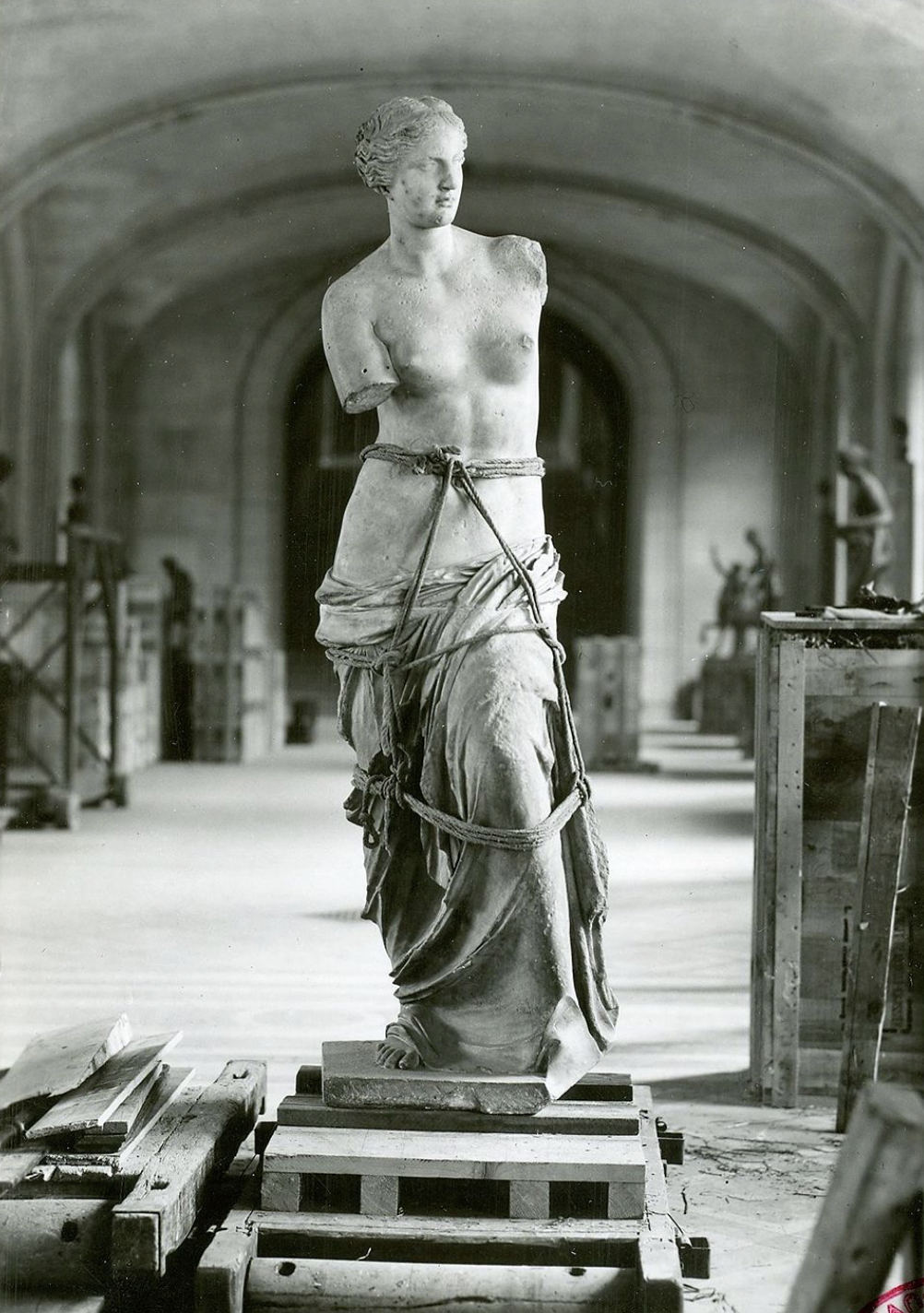
Packed carefully with straw, cardboard, rubber, and encased in lead in a wooden crate, she left Marseilles on the high seas. A month later, she arrived in Tokyo after a ship, train, and finally a truck. Upon arrival, four pieces had broken off: three were plaster from her 1821 reconstruction, and one was an original marble piece from her draped fabric. Displayed at the National Museum of Western Art in Tokyo starting April 8, 1964, and then to the National Museum in Kyoto. On August 3, 1964, she was safely back within the marble walls of the Louvre.