On May 13, 1610, after finally giving in, Henri IV watched his wife, Marie de Medici, be crowned as the queen of France in the Basilique Saint Denis.
The next day, his life would end
A matter of coincidence, or did Marie follow in her cousin Catherine's footsteps, who loved to dabble in poison? OR could it have been a religious zealot who had one goal in mind?
In the late afternoon of Monday, May 14, King Henri IV jumped into his open carriage inside the Cour Carrée of the Palais du Louvre and headed out to see his friend and minister, Maximilien de Béthune, Duc de Sully, at the hotel de l’Arsenal. The two men met before the Saint Bartholomew's Day massacre in 1572, and Sully became one of the king's closest advisors.
For the coronation, the streets of Paris had been decorated, lining the route to the Basilique Saint Denis. Temporary arches covered with plaster statues and flags filled Paris, and on this Monday afternoon, Henri wanted to take a look on his way to the Arsenal. In a tragic decision, they removed the shutters from the carriage's windows, leaving the king and his entourage sitting ducks.
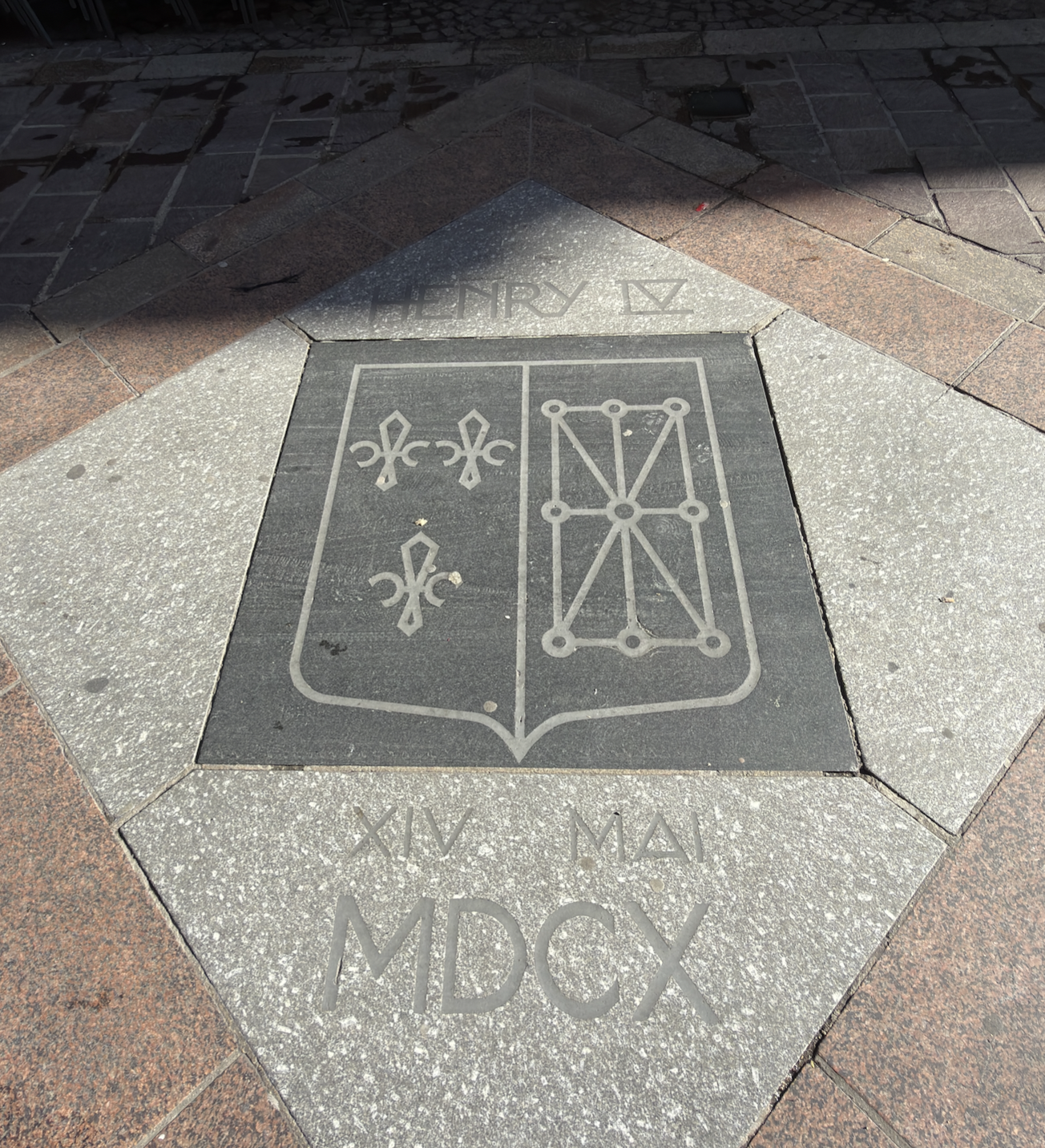
The Paris traffic of over 400 years ago was just as big a mess as it is today. Just after 3:30 p.m., the carriage left the palace. Turning first at the Croix du Trahoir ust outside the Louvre, to the Rue Saint Honoré, then onto the very narrow Rue de la Ferronnerie alongside the massive cemetery of Les Innocents and the large Les Halles market, the royal carriage ran into a traffic jam that severely narrowed the 13-foot-wide street. A large wagon of hay blocked traffic at the same time a cart of wine barrels filled much of the street. To help clear the way, the king's guards jumped from the carriage, and seconds later, the unthinkable happened.
In a split second, François Ravaillac stepped onto the right rear wheel of the carriage, leaned in, and stabbed the king twice with a knife he had taken from a tavern table and sharpened on the days leading up to the attack. Striking the king between his second and third rib and directly severing his aorta, and then in his stomach. Ravaillac had waited outside the Palais du Louvre and followed the carriage and mixed in with the crowd until he found his perfect moment to attack. Quickly, the carriage made its way back to the Louvre where they screamed out for the king's doctor, Antoine Petit, as they carried the king to the queen's bedroom on the ground floor. Henri blinked three times as the doctor arrived. Before he could be examined, he was gone. Henri IV was just 56 years old.
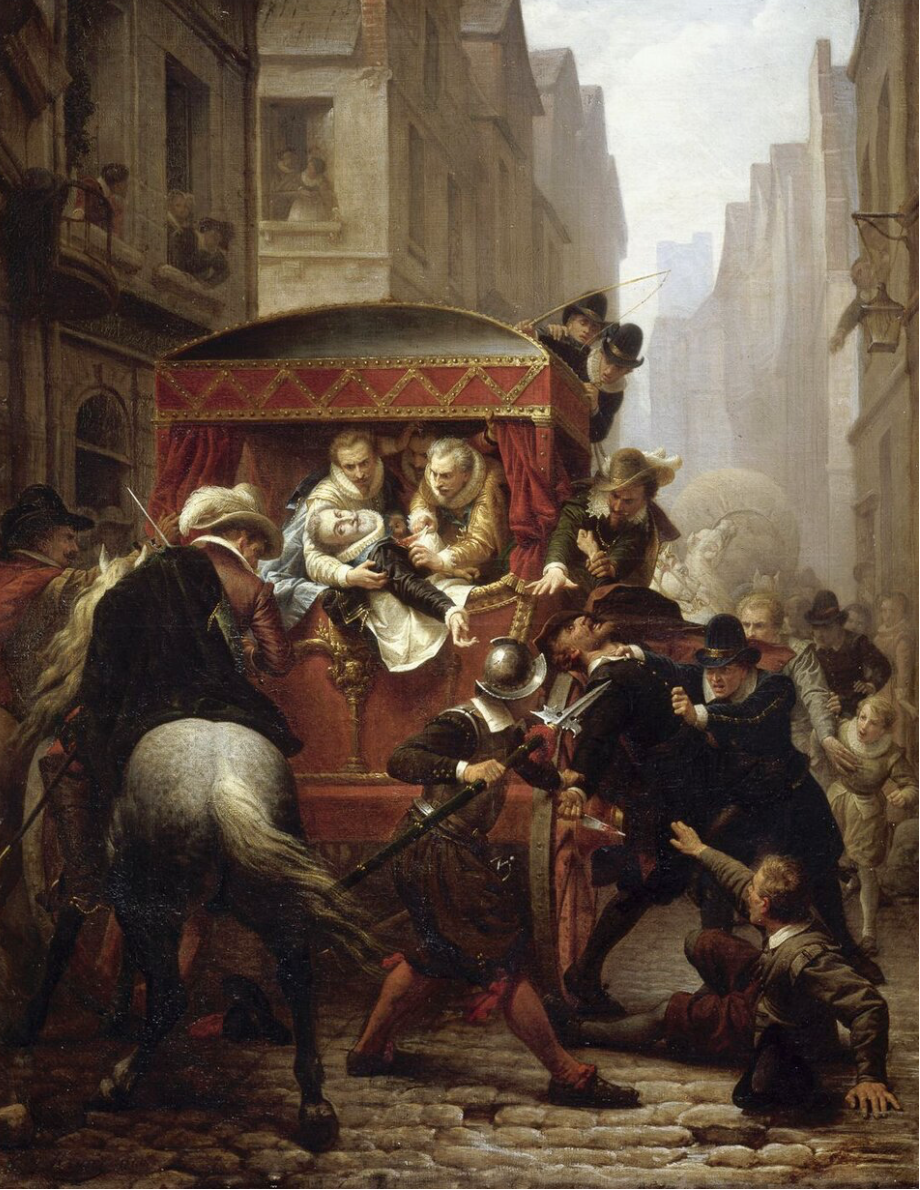
Assassination of Henry IV and arrest of Ravaillac on May 14, 1610 by Charles-Gustave Housez
Henri IV was born on December 13, 1553, and was baptized in the Catholic church but raised under the Protestant Reformation. In 1572, as the marriage to Marguerite de Valois was negotiated, his mother, Jean d’Albret, had to promise Catherine de Medici that they would never convert Marguerite. The wedding itself was used to bring hundreds of Protestants to Paris to be killed in the Saint Bartholomew's Day massacre just days later. That’s a long story coming in August.
Henri III, King of France, died on August 2, 1589. On his deathbed, he named his brother-in-law, Henri III, King of Navarre, as his successor, and was advised that he return to Catholicism. Henri III of Navarre was now Henri IV, king of France. As the Wars of Religion raged, Henri IV announced on April 4, 1592, that he would convert to Catholicism. Baptized on July 25, 1593, in the Basilique Saint Denis, it took a bit longer to win people over, especially one man who would never be convinced.
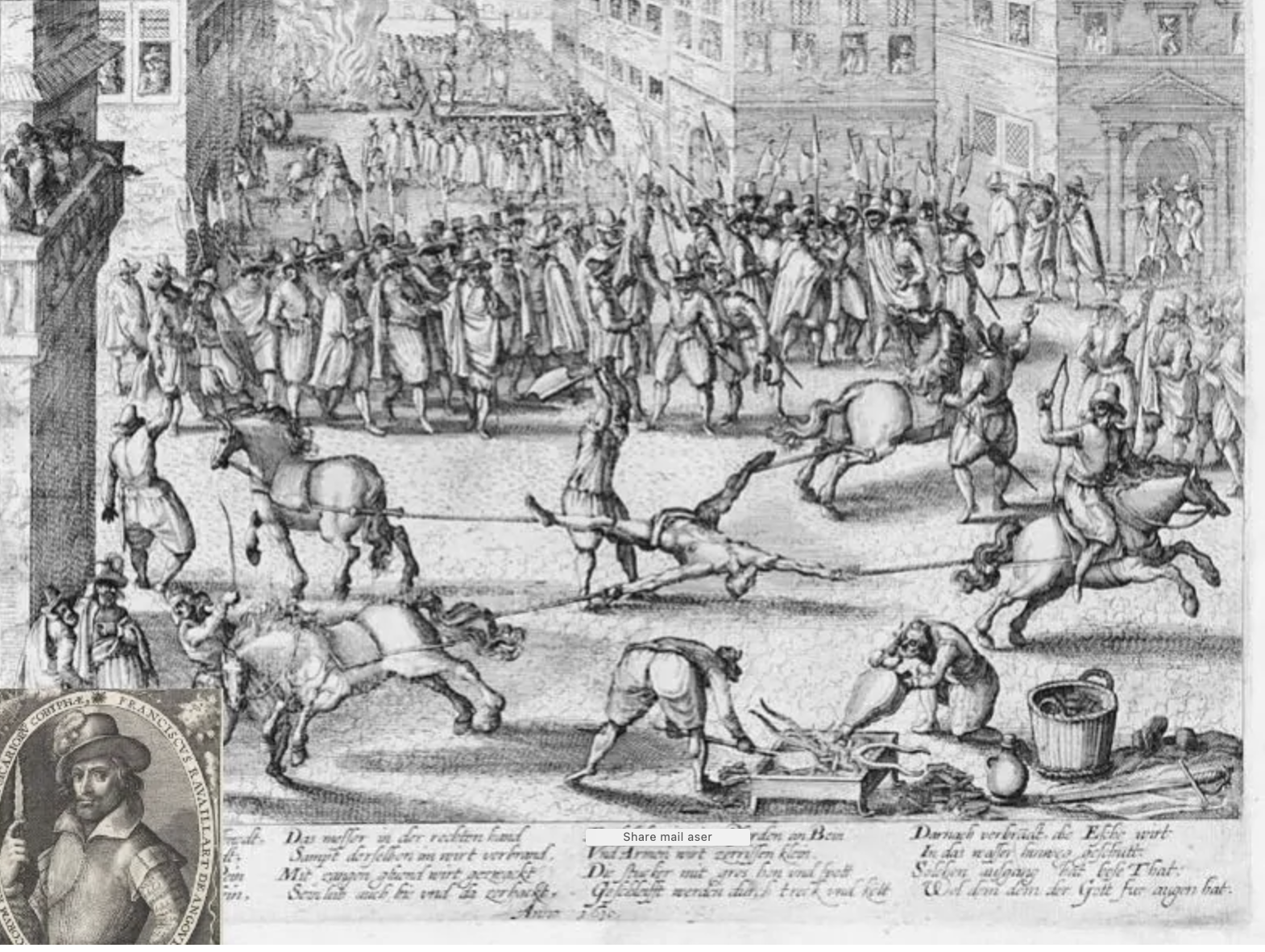
The assassin, François Ravaillac, was born in 1577 in Angouleme, France, on December 13, the same birthday as Henri IV and the duc de Sully. How about that for a strange twist. Ravaillac was raised under strict Catholic teaching with a chaser of strong distrust and dislike for Protestants.
At 29, Ravaillac followed his calling and joined the Cistercian order of the Feuillants, but lasted barely a month before he was asked to leave after his odd rantings were discovered. The next day, the Jesuit church wouldn’t even entertain the idea of admitting him. For a brief period, he taught catechism to children, and at the same time, his visions became more frequent and darker.
As a dedicated Catholic, Ravaillac felt that Henri IV hadn’t done enough for the church. Voices told him that the king was the Antichrist, opposed the Pope, and must be dealt with. In 1609, on two separate occasions, Ravailliac tried to reach out to the king directly to plead his case and advise him, but was, of course, turned away, all leading him to his final action on May 14th.
Immediately following the incident, Ravaillac didn’t run; he stood almost in shock while Henri’s guards apprehended him and took him to the Hotel de Retz. Upon his arrest, they found his pockets filled with scraps of paper inscribed with biblical passages and rantings. The next day, he was locked in the Conciergerie and questioned. For days, the assailant was tortured and interrogated on who else could be involved in this plot to kill the king, followed by a ten day trial.
The timing of the death brought the queen herself into question, after all, she was a Medici, and her distant cousin and former mother-in-law to the king loved to dabble in the dark arts and poisoning people. Marie was off the hook with this one, but this did work to her advantage.
On May 27, Ravaillace was found guilty of Regicide, which is the killing of the sovereign, and was sentenced to immediate death. He was taken to the cathedral Notre Dame, where he could make amends in front of the door of the Last Judgment and pray once more before his date with death. The same day, at the Place de Grave, today's Place de Hotel de Ville, public enemy number one would meet a rather grisly end in front of thousands of angry onlookers.
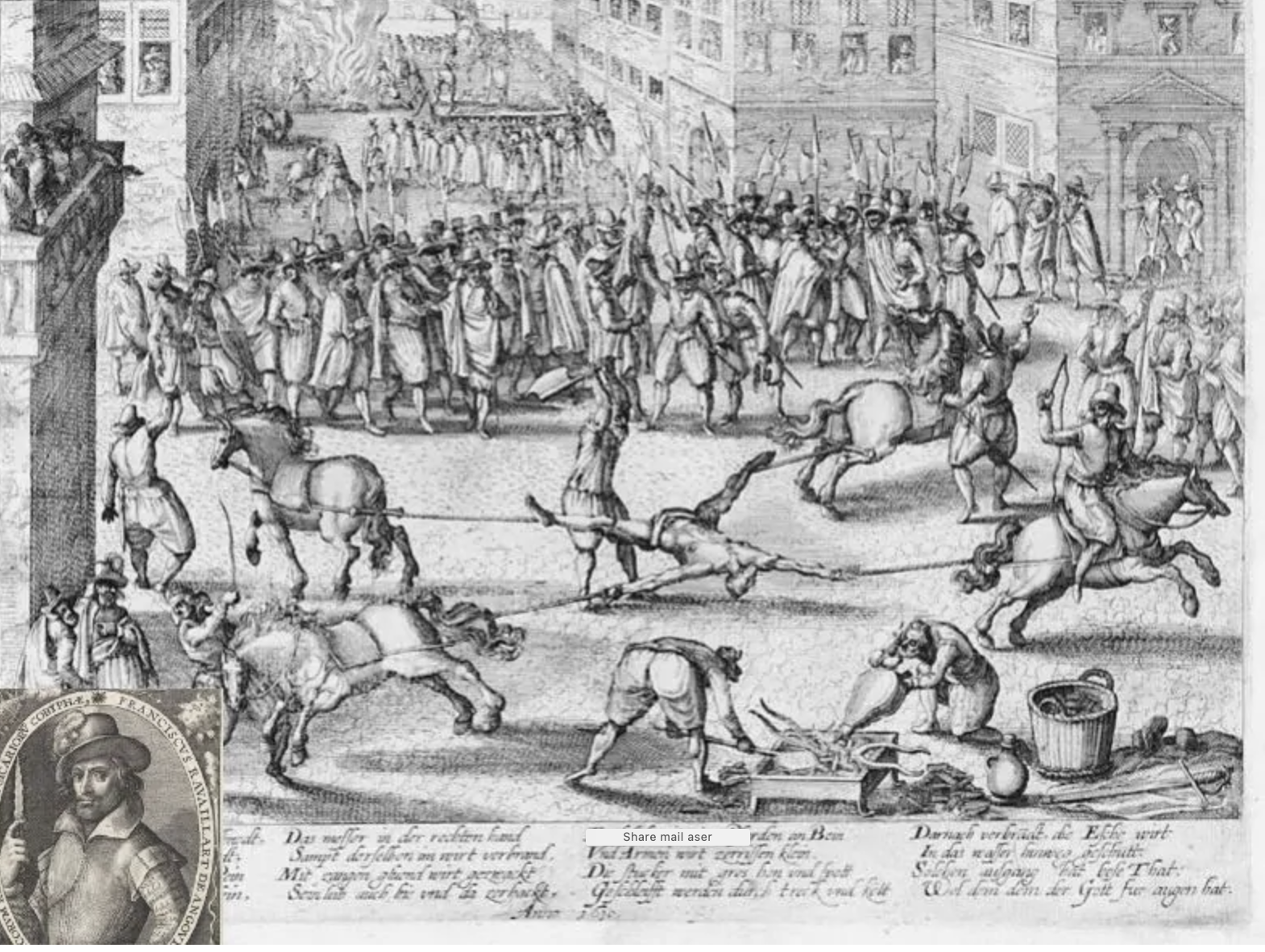
The official decree of the Parliament of Paris describes the method of his death. "[be] gripped to the udders, arms, thighs, and fat of the legs, his right hand, which held the knife with which he committed the said regicide, will be burned with sulfur fire, dipped in molten lead, boiling oil, urine, burning resin, the wax and sulfur melted together. Then his body will be pulled and quartered by four horses. The members of his body will be consumed by fire, reduced to ashes, and thrown to the wind"
On May 15, the autopsy of the king was performed, and his heart and entrails were removed to be sent to the Basilique Saint Denis and College de La Fleche. The king was embalmed, herbs stuffed into his mouth to mask any odors, wrapped in gold cloth, and placed in a hastily decorated chapel. For eighteen days, the family attended more than six masses a day with the body of the king.
On June 10th, the coffin was moved into the Salle des Caryatides, and a life-size straw figure of the king, topped with a wax effigy bust created from the death mask made within hours of his death by Matthew Jacquet. Two of these wax effigies survive today. In the Carnavalet museum, attributed to Michel Bourdin, the wax head sits on a terracotta sculpted body and dates to 1623, years after his death.
At the Chateau de Chantilly, I was so excited to find a handsome Henri looking back at me against a wall painted with fleur de lis and crowns. The effigy of Chantilly dates to the time of his death and was created by Guillaume Dupré. It’s unknown what happened to the one used in the Salle des Caryatides.
It is one of my favorite historical facts because it is so odd. For eleven days, dressed in his coronation robes, he was propped up, hands clasped in prayer, while ministers and those close to him ate their lunch and dinner with the king.
On June 29 and 30, the king was held in Notre Dame de Paris, where he was blessed by the bishop, and hundreds attended the multiple daily masses. On July 1, 1610, the king was entombed in the Basilique Saint Denis, where he would remain for the next 183 years.
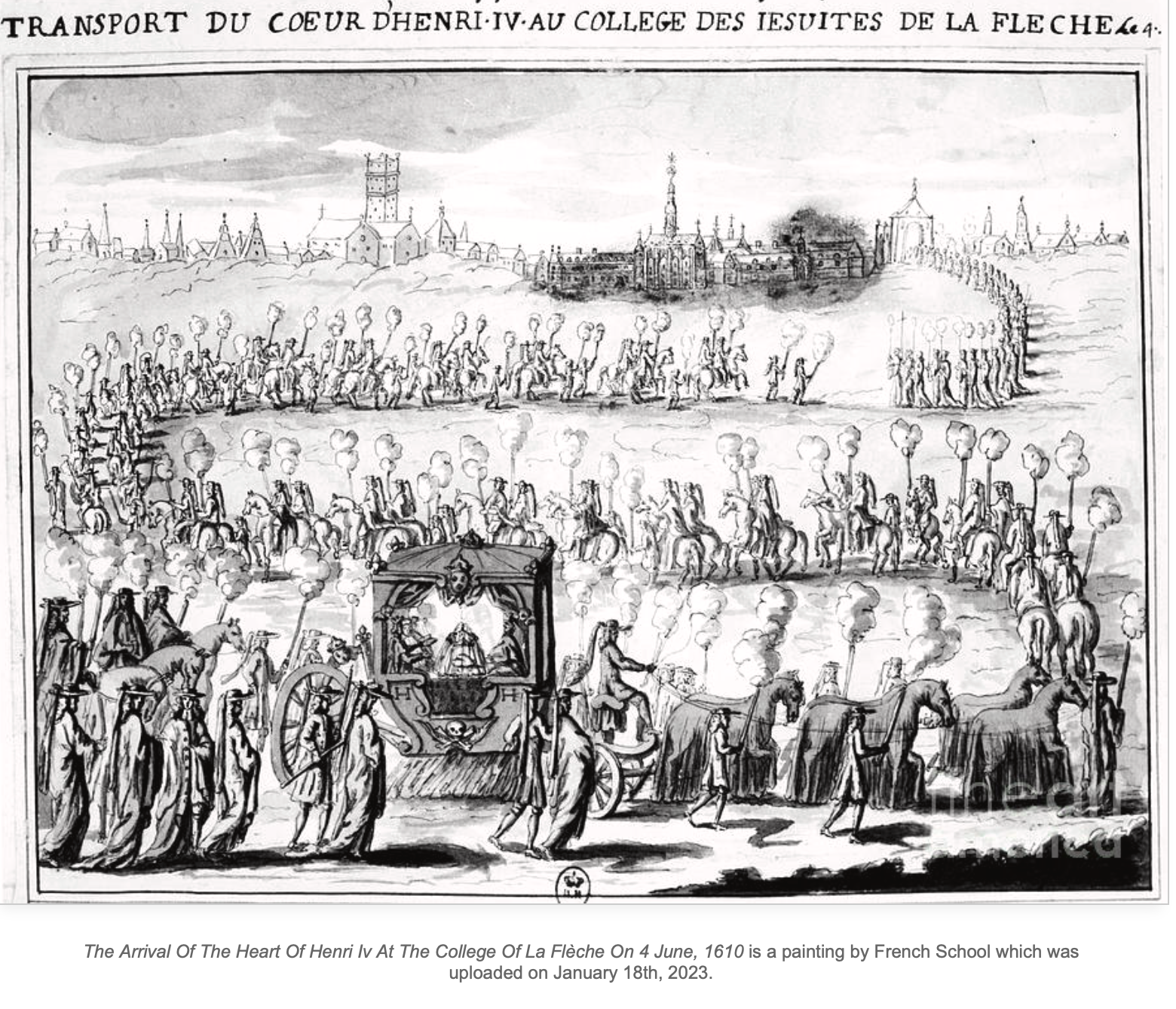
On June 5, as promised, the king had his heart sent to the College de La Fleche, which he founded in 1603. A lavish procession of over 400 men from Paris to La Fleche in the Sarthe department, southwest of Paris. The Duc de Montbazon, who was sitting next to the King on the fateful day, accompanied his heart to a place that was dear to him. Later in 1643, the queen’s heart would be added, but both were destroyed in the Revolution.
The loss of the beloved king was a blow to the people of France and, even more so, to his beloved children. Henri wasn’t the typical royal father who kept the kids away and treated the heir to the throne like an adult before they took their first step. Henri was a hands-on father who spent time with them, played with them, and even had his children call him 'father' rather than 'king'. Marie de Medici was not the loving and caring maternal figure in the least, which was also normal, but something that would come as a rather tough blow to the royal children after the loss of their father.
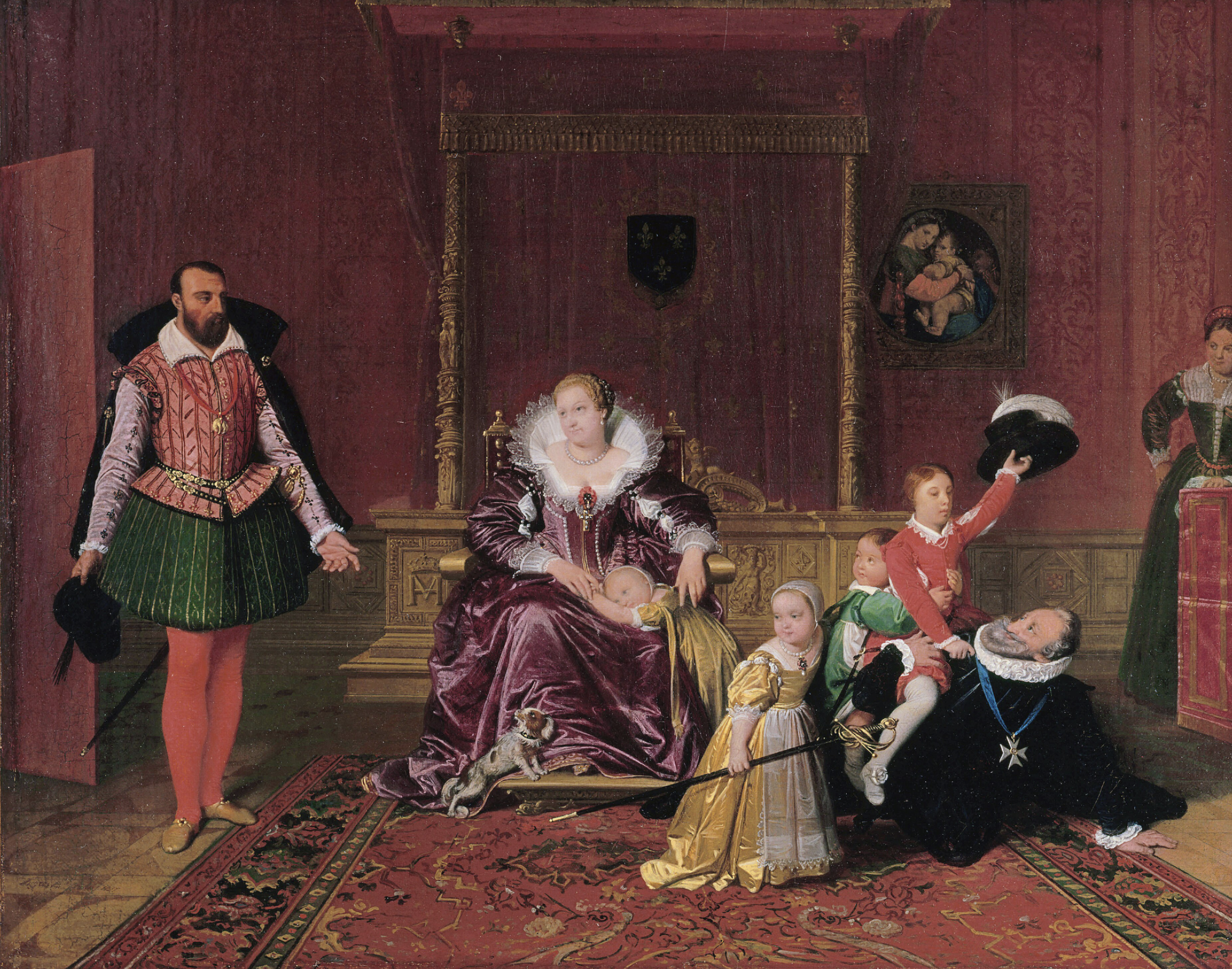
Henry IV Receiving the Spanish Ambassador by Ingres 1817
Louis XIII was just 8 years and 7 months old the day of his father's death and had been at the Order of the Knights of the Holy Spirit at the edge of the left bank on the Rue des Grands Augustins at the moment of his father's death. Advisors rushed to his side as he was now the king of France, even if he was still a child. Today, Le Relais Louis XIII restaurant is near the location that has the date inscribed on its wall, just opposite the former home of Pablo Picasso.
Crowned on October 17, 1610, at the Cathedral Notre Dame de Reims, he would need to wait until he turned 13 to actually rule. His mother, Marie de Medici, served as Regent, acting in his place and holding that power in her iron fist as long as she could. Deciding he was too weak to actually take the throne in 1614, she held on a little longer until the Coup de Force on April 24, 1617, and mommy dearest’s closest advisor, Concino Concini, was killed, and she was locked away in the Chateau de Bois for two years.
For almost two hundred years, Henri peacefully rested amongst his fellow former kings and queens in the Basilique Saint Denis until 1793. On August 1, the National Convention voted that all royal effigies and tombs needed to be destroyed. Partially to erase any memory of the former kings of France, and to also obtain all lead and metal to make bullets and cannons.
On October 12, 1793, the first grave opened was that of Good King Henri IV, as it was the crowd's favorite, and he was perfectly preserved. While he may have been gone since 1610, he looked fresh as a daisy. His wife, Marie de Medicis, was yelled at by workers, and her hair was torn out as they thought she was behind the death of Henri. Henri, so beloved, they propped him up for two days, much like the lithograph drawing printed on glass of the image of the king in the lower crypt of Saint Denis today.
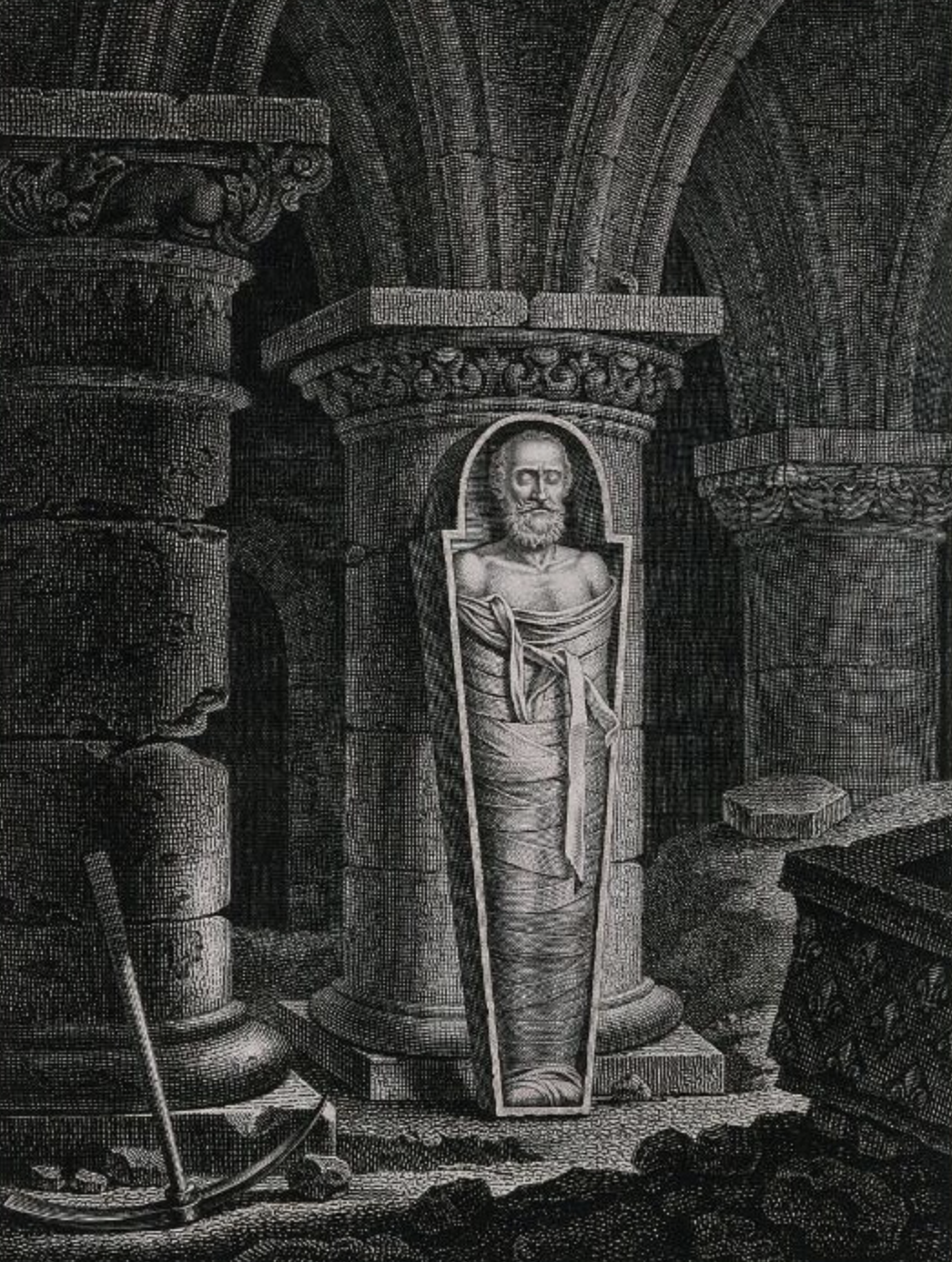
A few things surprised the onlookers as the tombs were opened. Louis XIII was easily recognizable by his still-perfect black mustache. Louis XIV, the Sun King, was now “black as ink”. Many of them kept little keepsakes. Fingernails, hair, the leg of Catherine de Medicis, and maybe even the head of Henri IV.
The history and validity of Henri IV's skull raise many questions, but it remains interesting nonetheless. The head of the king was removed at some point between 1793 and 1817. When the large pits were opened in 1817 by Louis XVIII, the head was gone.
Fittingly, on October 31, 1919, at the Hotel Drouot, photographer Joseph Emile Bourdais purchased three mummified skulls from the estate of artist Emma Nallet-Poussin, no relation to Nicolas Poussin, but she did take lessons from Susan Valadon. Joseph had no idea who the skulls might belong to, but for 3 francs (about 450 euros today), it was a pretty good deal. In 1924, Joseph came across an article in La Gazette des Arts that led him to believe he might have the head of the beloved king. For twenty years, he spent a fortune on X-rays and research and even tried to donate it to the Musée du Louvre, which declined the offer.
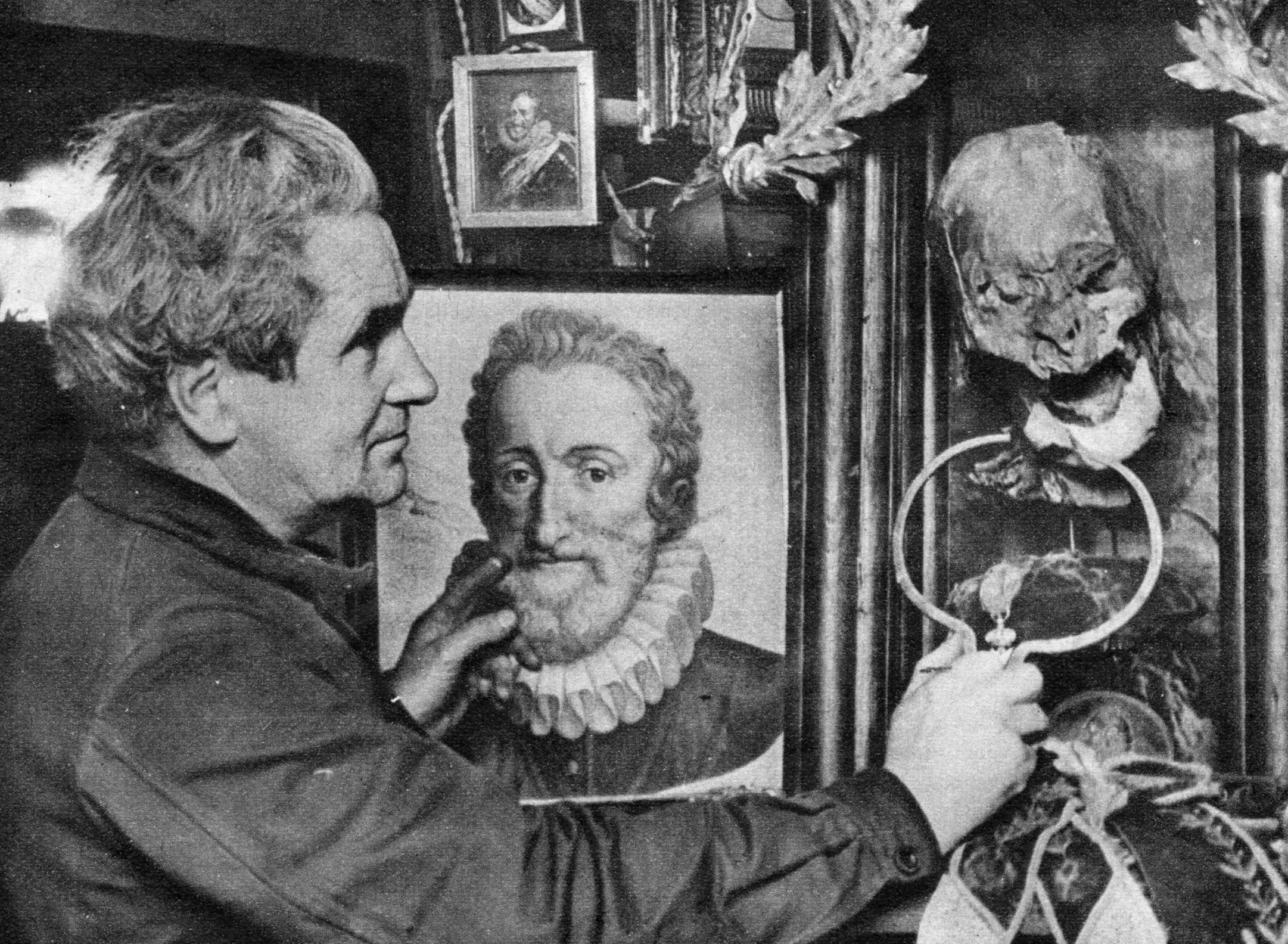
After his death in 1946, Madame Gaillard, Bourdais's sister, inherited his estate, including the skulls. In 1955, Gaillard sold the skull believed to be Henri IV to Jacques Bellanger, a retired tax collector, for 5,000 francs (13,000 € today). For 55 years, Bellanger and his wife kept the skull of the “monarch,” as they called him, a secret. Even their own children had no idea the head of the king was kept in their parents' closet.
Bellanger thought he would investigate the skull's provenance on his own but decided to share the story with two journalists, Pierre Belet and Stéphane Gabet, on January 22, 2010. Henri’s head was taken to Dr. Philippe Charlier and historian Jean-Pierre Babelon. The skull still had a few red and white hairs of his beard intact, which could be tested against other hairs of the king held at the Pau museum. On close inspection, his nose was broken, and his right ear had been pierced. One of the most telling marks was the damage to his jaw when stabbed by Jean Chatel on December 27, 1594. Henri was no stranger to assassination attempts.
On December 15, 2010, four hundred years after his death, scientists matched the skull to the Bourbon line. One scientist says it was a 99.9% match, yet others think that .01% is a big deal. Tested as well against the blood of Louis XVI on a napkin from the day of his execution. Bellanger gave it to the descendant of the former king, Louis-Alphonse de Bourbon, duc d’Anjou. After the head was confirmed as belonging to one of France's most beloved kings, it was to be returned to the Basilique Saint Denis in 2012 in a special ceremony, but that still hasn’t happened. As far as we know, poor Henri is locked away in a bank vault awaiting his return to the rest of his remains.
Years ago, I met the handsome descendant at a mass for Louis XVI, and I sure wish I knew this story then so I could ask him where the head is.
The streets and monuments of Paris include many famous figures, but one is easier to find than any others. Henri IV had a very distinct, pointed chin and beard, and he usually has a somewhat goofy yet adorable expression.
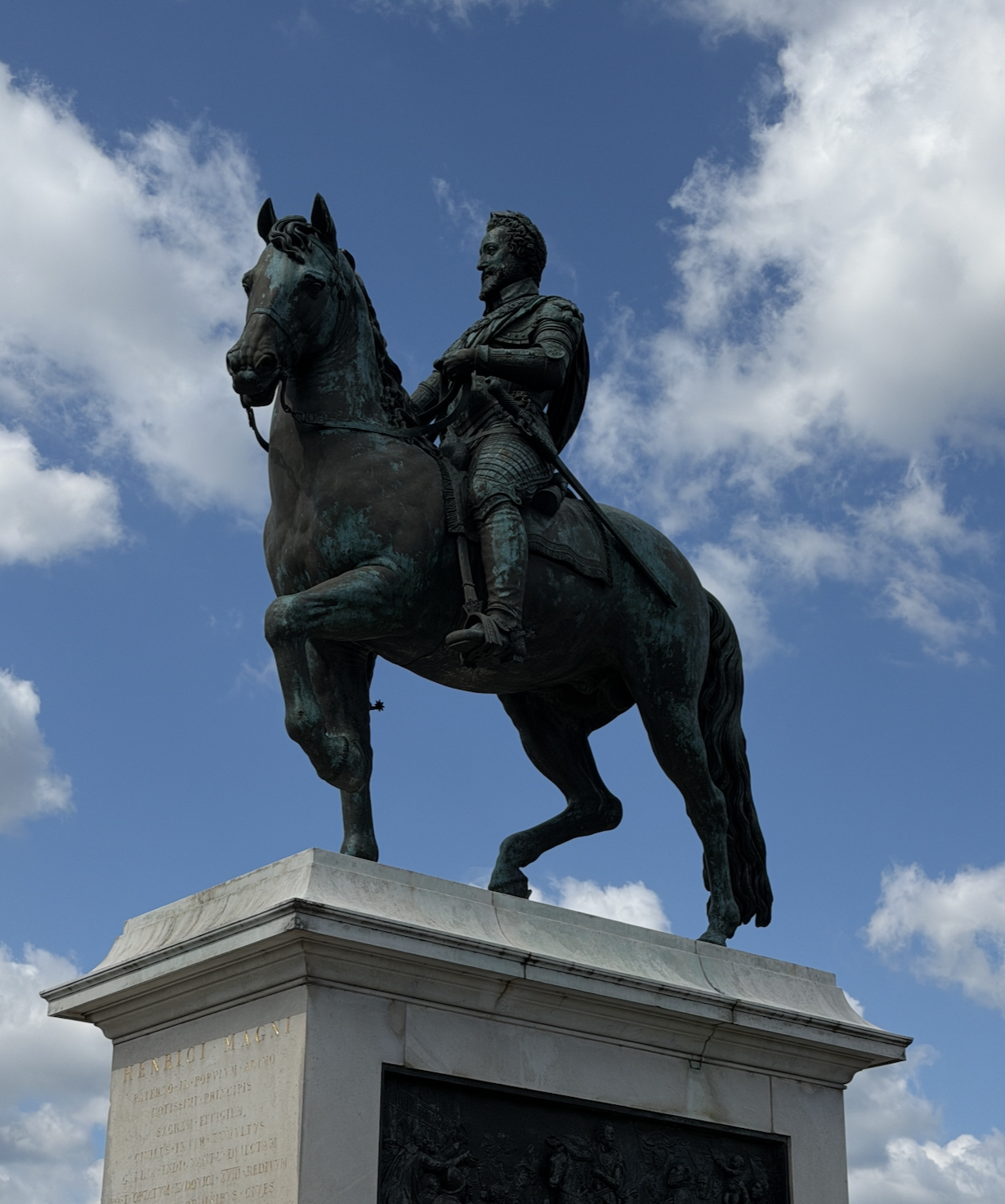
In the center of the city, one of the best depictions of the king is on the Pont Neuf
Henri III laid the first stone in 1578, but due to wars and other factors, construction stalled until Henri IV resumed building in 1599. Finally finished in 1606, it was the widest bridge in Paris, allowing traffic and pedestrians to walk on the city's first sidewalks. It was also the first bridge to be built without houses, so that whoever crossed it would also have a view of the Louvre and the Grand Galerie, which he had built. The equestrian statue of Henri IV was built under the orders of his wife, Marie de Médicis, but his untimely murder would come before the statue was finished. Completed in Italy and set out from the port of Genoa to Paris, the ship was attacked by pirates and sank off the coast of Sardinia.
Many months later, in 1614, the wreckage was discovered, and the statue finally rode to Paris on a barge from Le Havre, down the Seine, and was placed on the Pont Neuf. Sitting on a pedestal, it was surrounded by the Four Captives statues that can now be seen in the Musée du Louvre in the Richelieu wing. Like many monuments in Paris, it would not survive the Revolution. Broken and melted, it was all but destroyed, but a few pieces of the statue survived and are now in the Carnavalet.
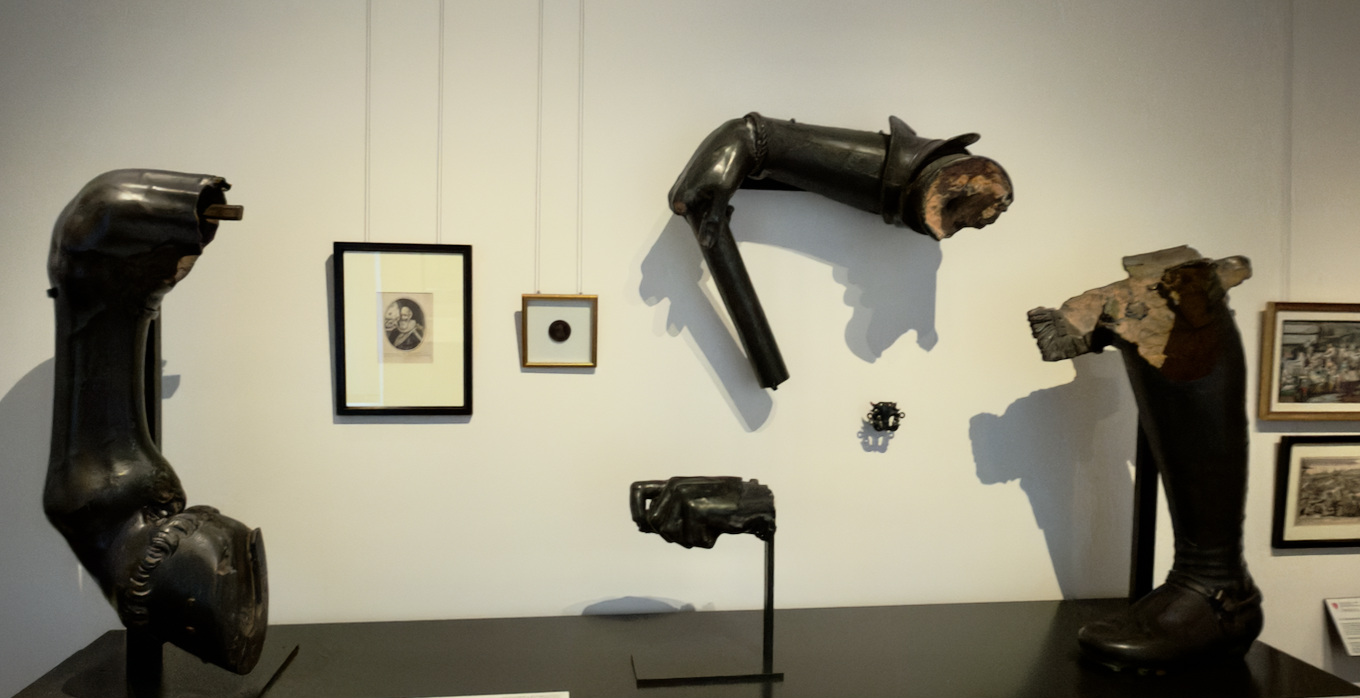
Many years later, during the Restoration, Louis XVIII ordered a replacement and returned it to the Pont Neuf. Henri would rise again in 1818 and be cast from the original mold using bronze from other statues in Paris. Inside the statue, a closely kept secret is hidden. A workman named Mesnel, a loyal Bonapartist, stuffed Henri with anti-royalist papers as he was being built. It was a myth until 2004, when it was restored, and metal cylinders were found hidden in his elbow and leg filled with the very papers. Before the restoration was finished, they returned the hidden treasures to the king.
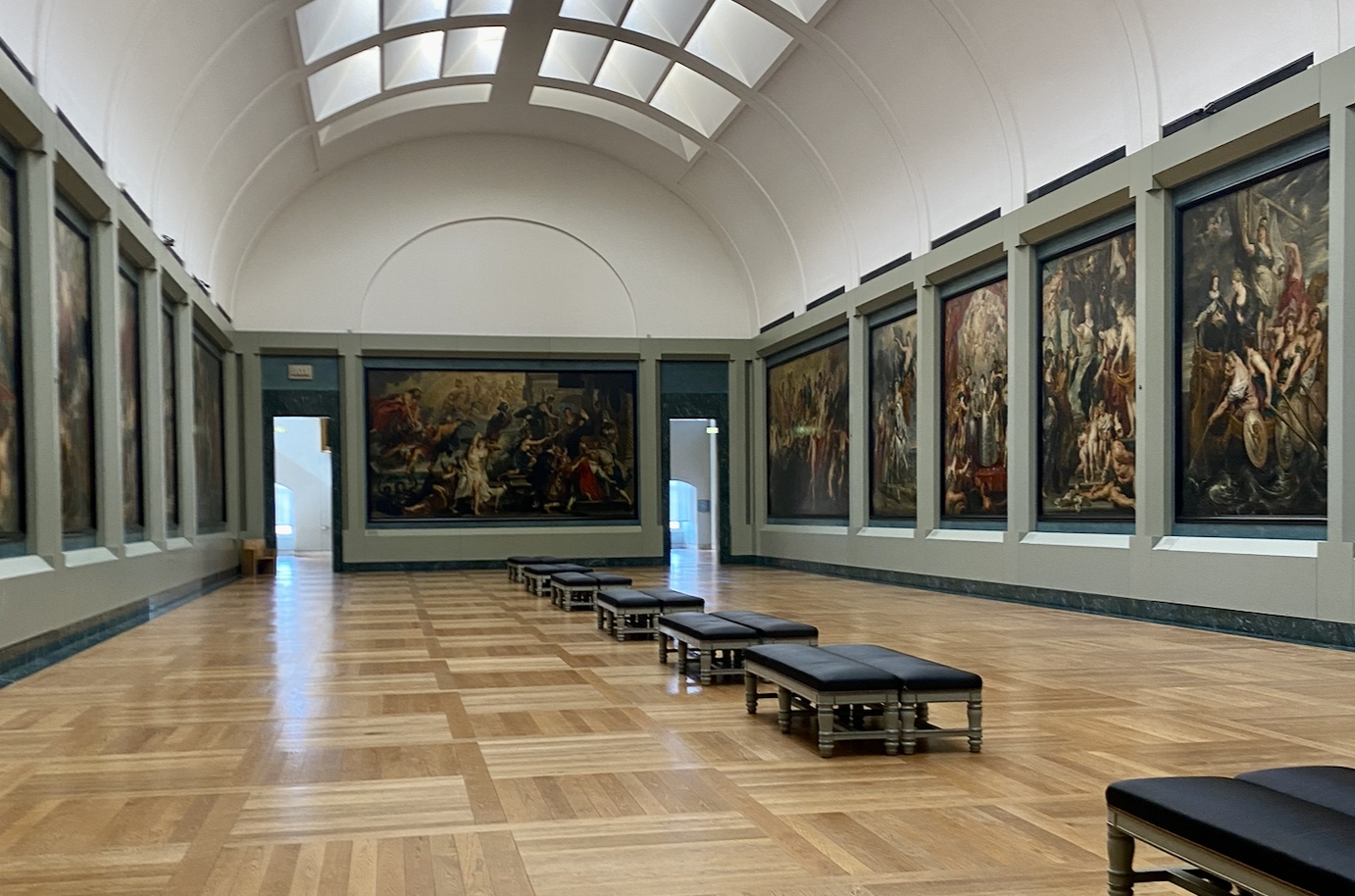
Medici cycle in the Musée du Louvre
In 1621, Marie de Medicis commissioned Peter Paul Rubens to create four paintings telling the story of her life to fill the walls of her palace in the Jardin du Luxembourg. She loved the first four so much that she asked him to create twenty more based on major moments of her life. Rubens wanted to please his royal patron, so he redesigned her life a bit, and some of the less-than-lovely events were given a new rosy outlook. Filling the paintings with allegories, royal icons, and adding the color red to direct your attention, it is an amazing walk through her life.
Inaugurated on May 11, 1625, in the Palais du Luxembourg, Marie wanted Rubens to also paint 24 paintings dedicated to the life of Henri IV. They would never come to fruition, sadly. I would have died to see that, but a few of Marie’s, of course, include Henri.
Henri first appears in the seventh painting, “The Presentation of the Portrait”. Henri IV, dressed in armor, is presented with the actual portrait that was sent to the king in 1599 of his future wife by Cupid and Hymen. Behind the king, an allegory of France whispers her approval.
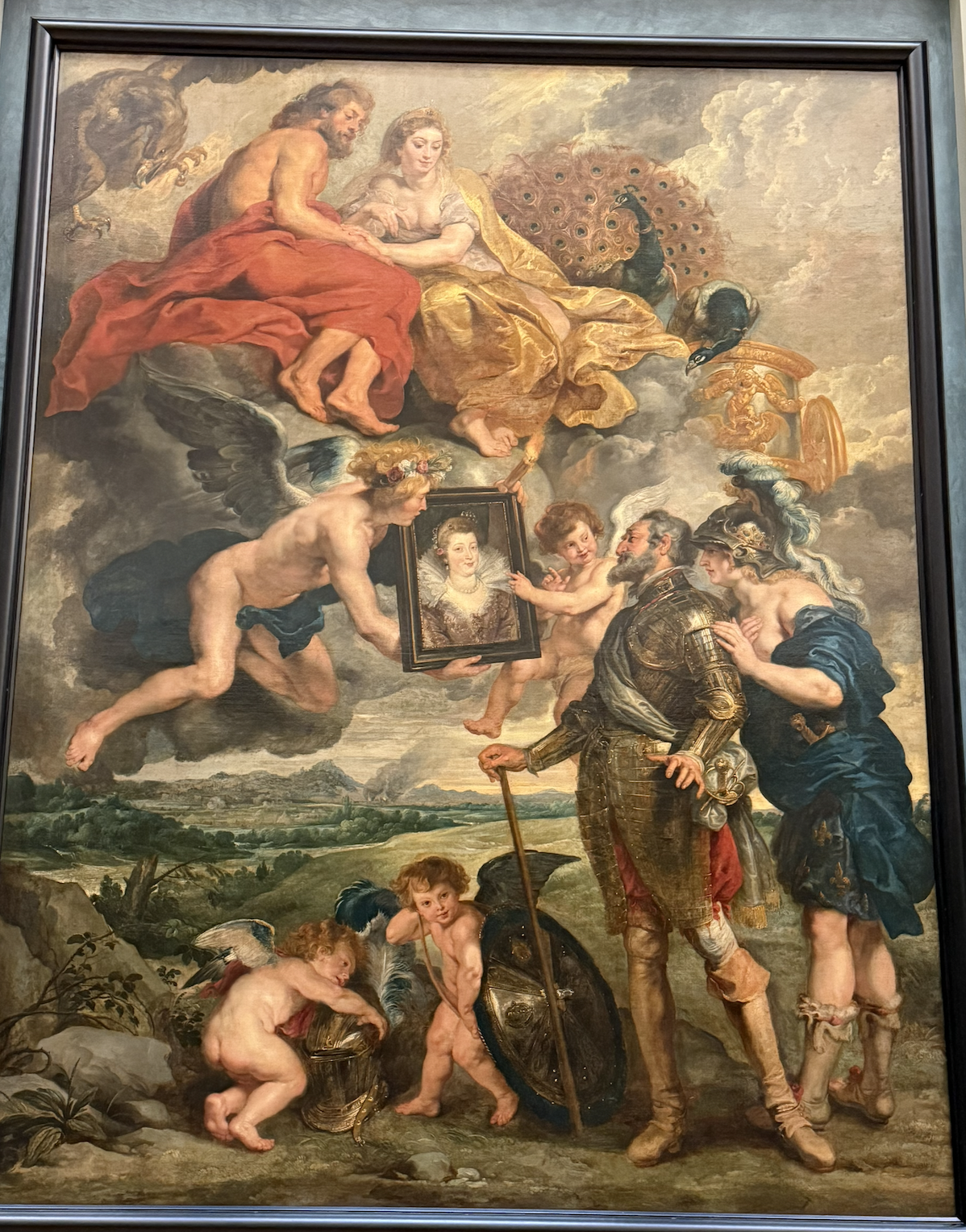
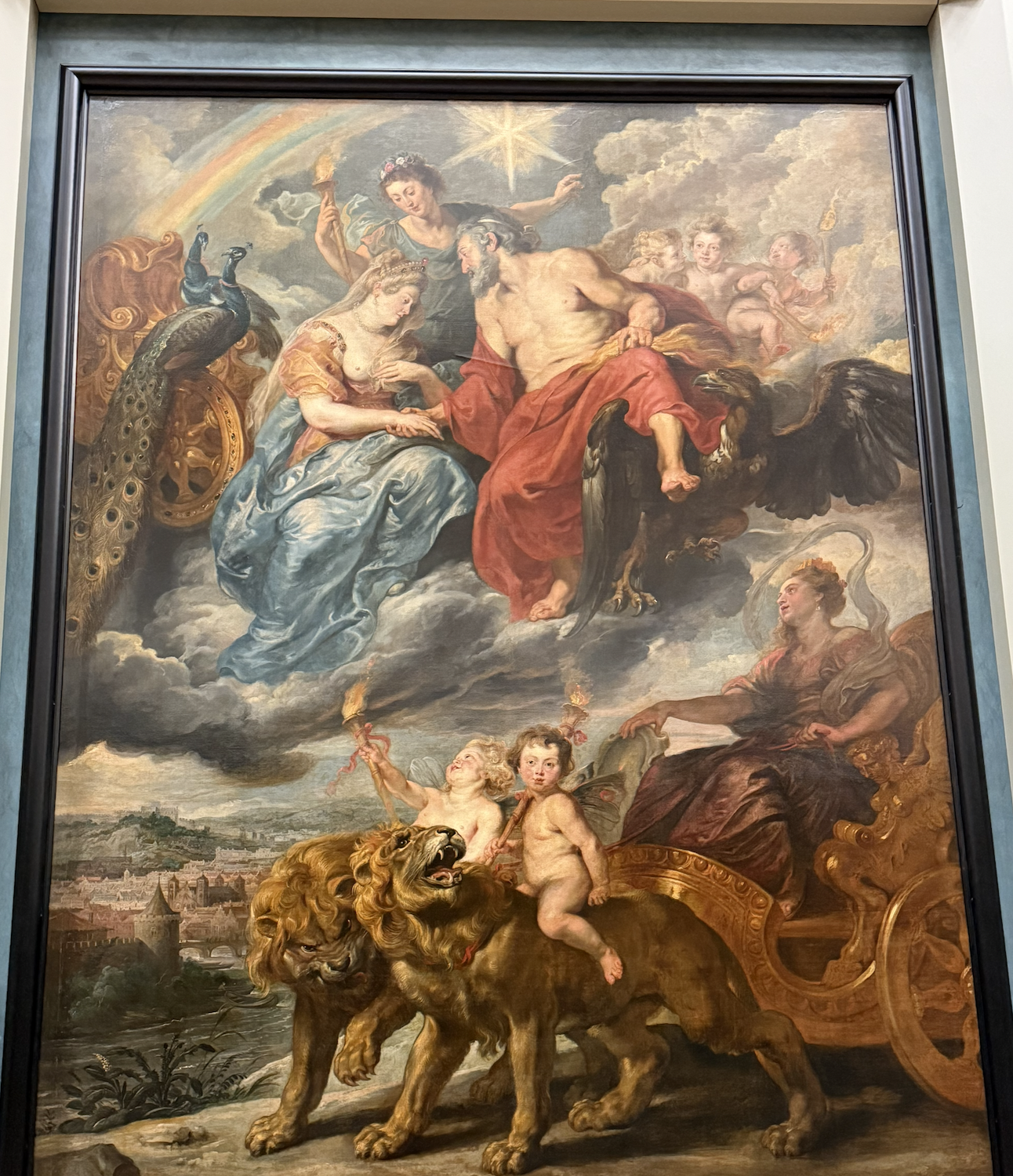
Henri reappears in painting number 10, depicting their final meeting in Lyon on November 9, 1600. Married by proxy on October 5, 1600, in Florence, with her uncle standing in for Henri. Marrie arrived in Lyon, but had to wait a week to meet her new husband as he was busy with one of his many mistresses. In the painting, Rubens added the Roman gods, Jupiter and Juno, who represent marriage, this time with the faces of Henri and Marie.
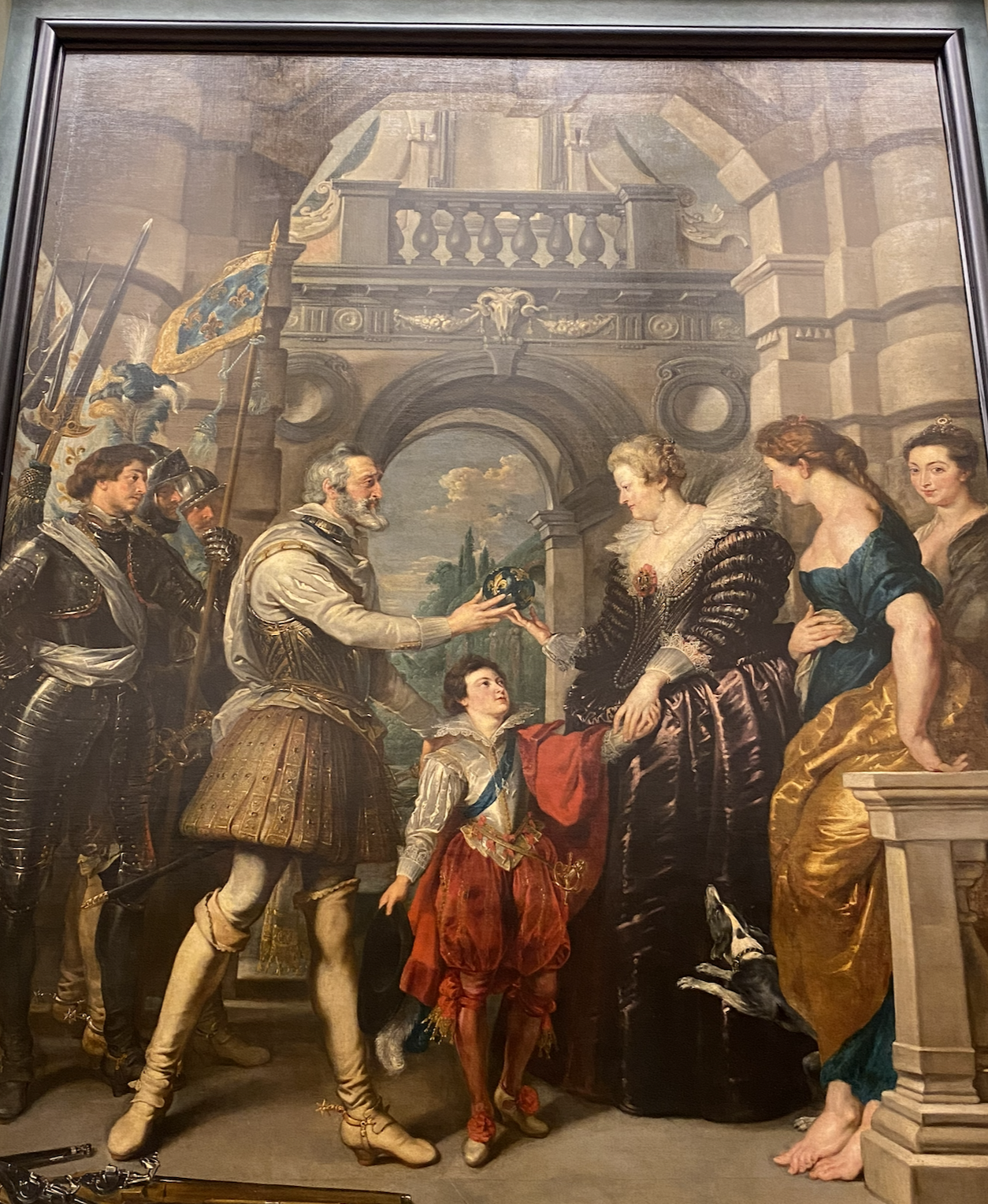
Number 12 showcases his legs in The Preparation for the War, also known as the Regency of the Queen. The episode took place on March 12, 1610, a very important date, as it would be the reason she was named regent two months later after his death.
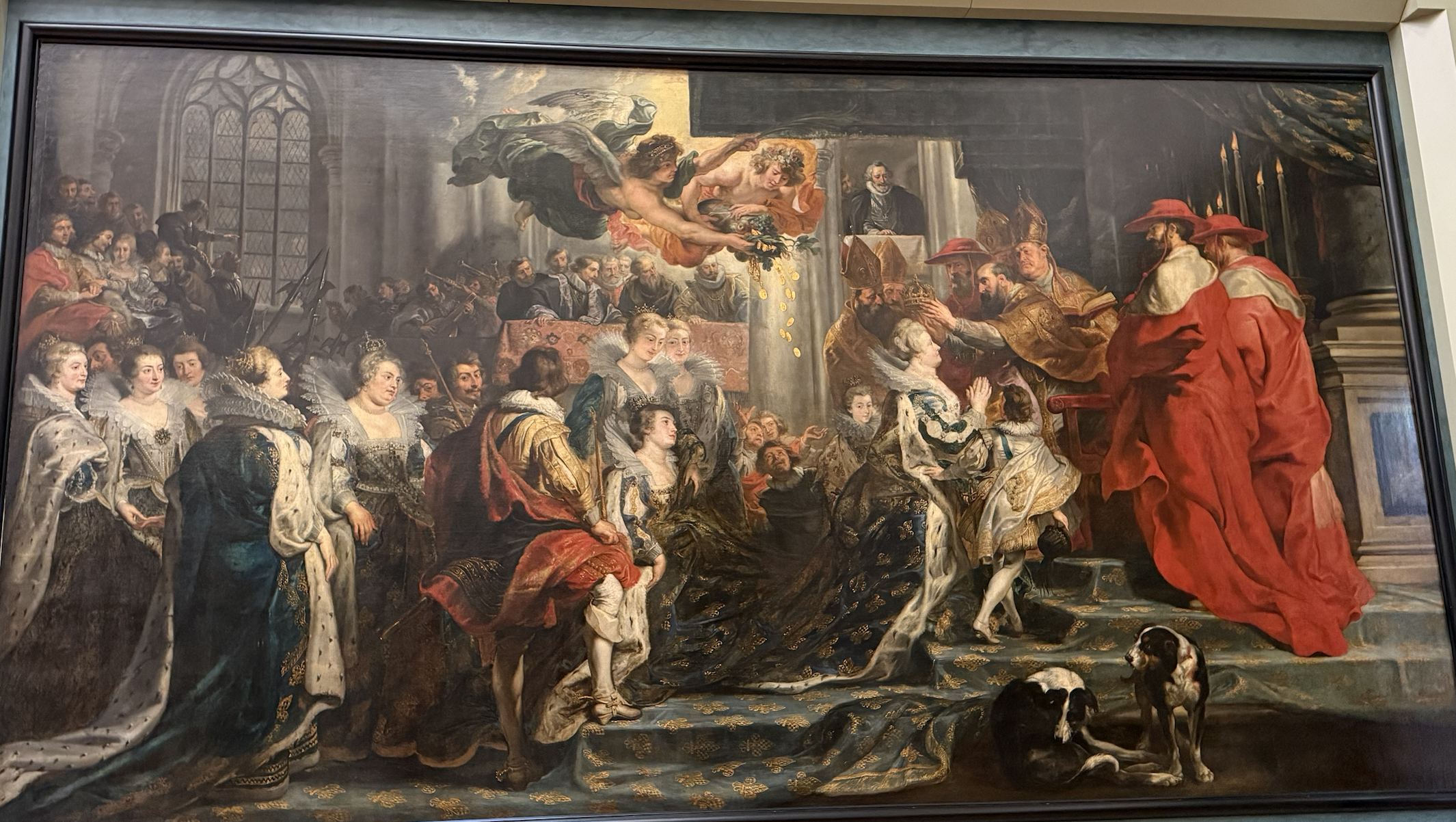
Number 13 takes place on May 13, 1610, in the Basilique Saint Denis, the coronation of the queen. Marie sits center stage, while the king looks down from above.
The last painting that includes our man Henri is no 14, titled the Apotheosis of Henri IV. On the left, Henri, dressed in armor and wearing a laurel wreath representing immortality, is lifted to the heavens by Jupiter, his eagle, and Time. Above the gods, including Hercules, Mercury, and Venus with Cupid in her arms, looking towards the next painting, and at the top, Juno looking down at Marie.
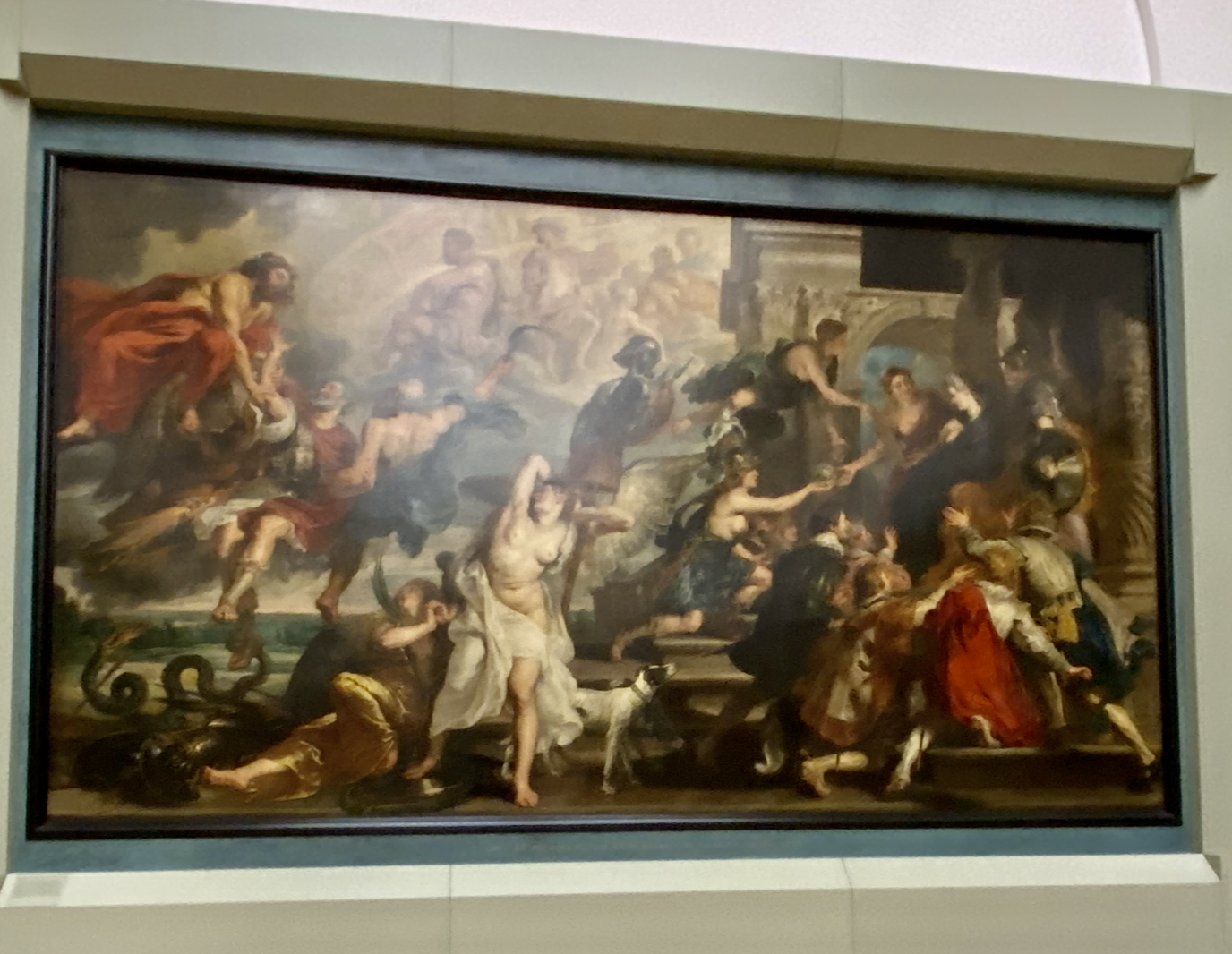
We will go deeper into the full cycle of the paintings over the next few months, before they disappear for five years of restoration in the fall.
Oh, how I wish they had 24 paintings of Henri IV's life. It would be interesting to see how his love life would be depicted.
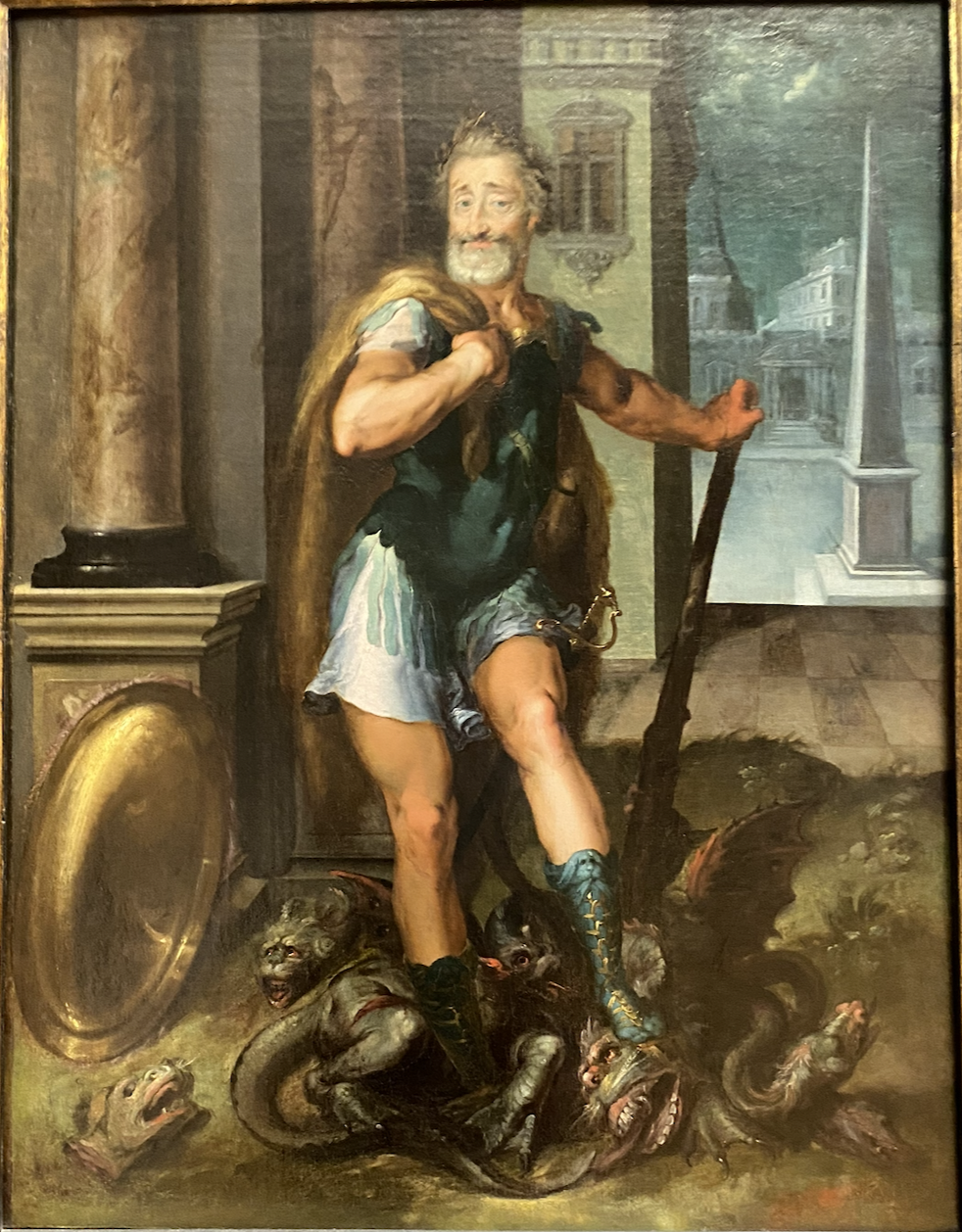
Now, I would be very remiss if I didn’t mention one of my very, very favorite paintings of Hot Legs Henri, as I affectionately call him.
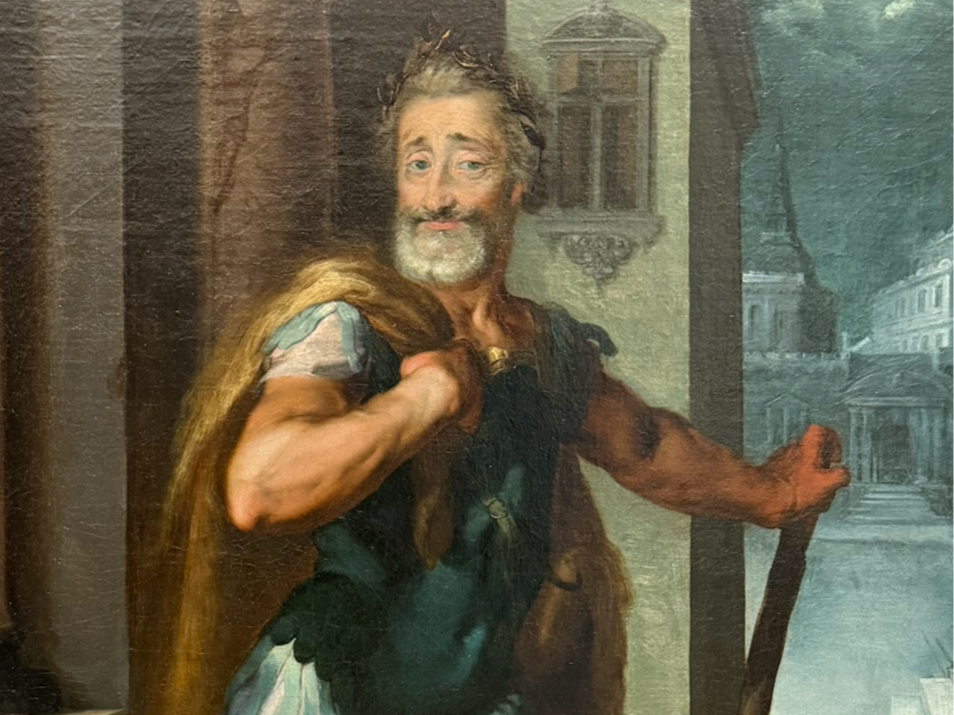
Le Bon Roi Henri as Hercules with some rather lovely legs. Henry IV is Hercules crushing the Hydra of Lerne (lairen) by the Entourage de Toussaint Dubreuil in 1600, depicting the king as the mythological hero known for his strength and often associated with the Bourbon kings. He is seen with the pelt of a lion over his shoulders, a slight smile on his face, and holding a club in his hand.
The King stands triumphantly over the slain l’hydre de lerne, which symbolizes the Catholic League, which had major problems with the one-time Huguenot king. However, what stands out about this painting is his legs. I mean, really, oh la la Henri la Grande, the little flick of the hip on his kicky little silvery blue satin shorts really adds to his pose, and it is easy to see why he may have had so many mistresses. After all, he wasn’t nicknamed the Vert Galant for nothing.
Today, a marble plaque marks the spot on the Rue de la Ferronnerie where the king was killed. Complete with the coat of arms of Navarre, featuring chains, and the Fleur de Lis of France. A few doors down, a white plaque above the passage also remembers the tragic event and even names his killer.