
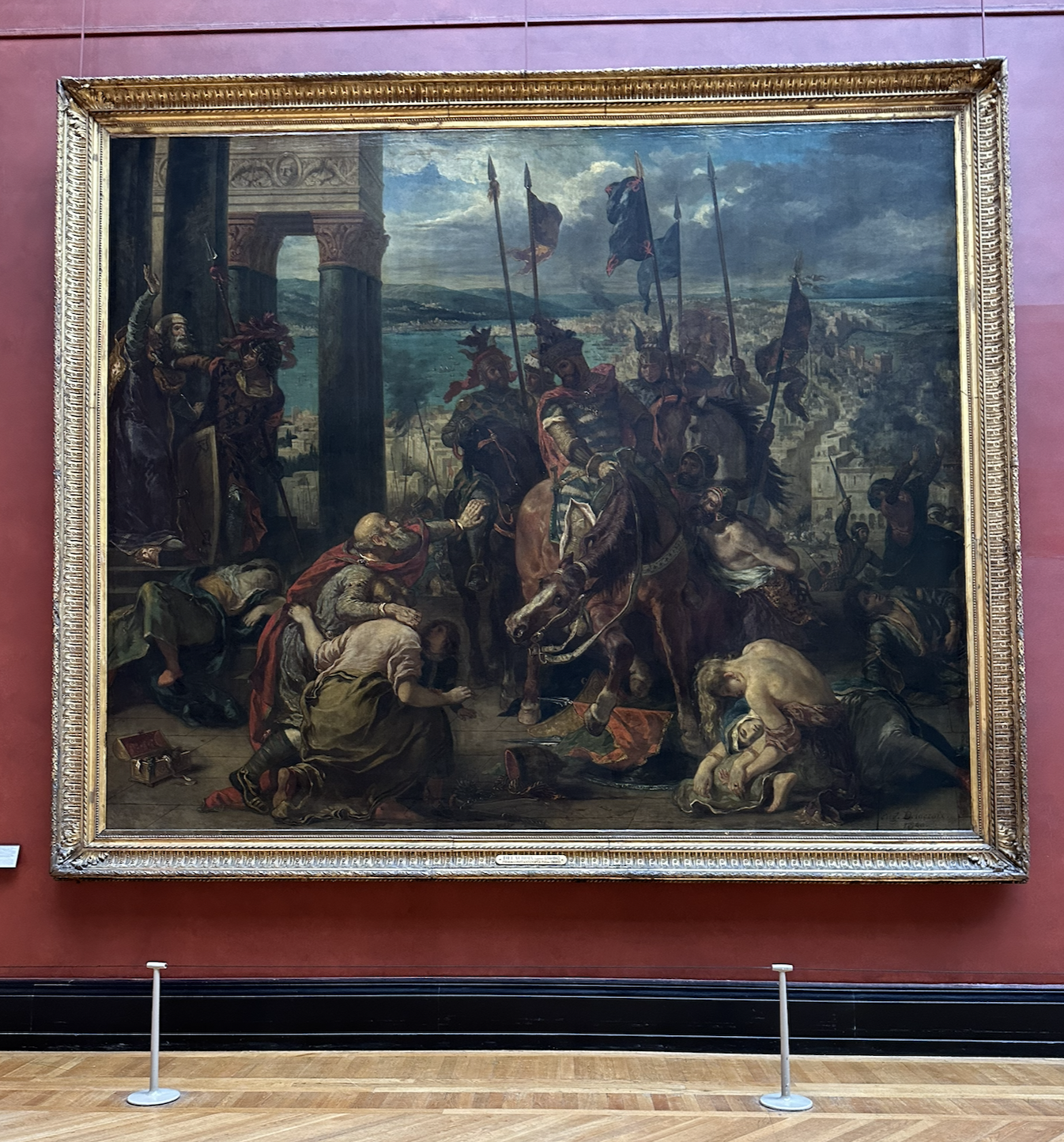
Over the last seven years, the Louvre has undertaken the massive restoration of five of Eugène Delacroix’s large paintings, many of which hang side by side in the Salle Mollien.
On May 20th, the last of the restored large-format paintings was unveiled, revealing a masterpiece hidden beneath layers of varnish. The Capture of Constantinople by the Crusaders might be unknown to most people, and quite frankly, it is usually ignored in the Mollien as people gather in front of the Liberty Leading the People instead. Hopefully, with its refreshing facelift, it will garner a bit more attention.
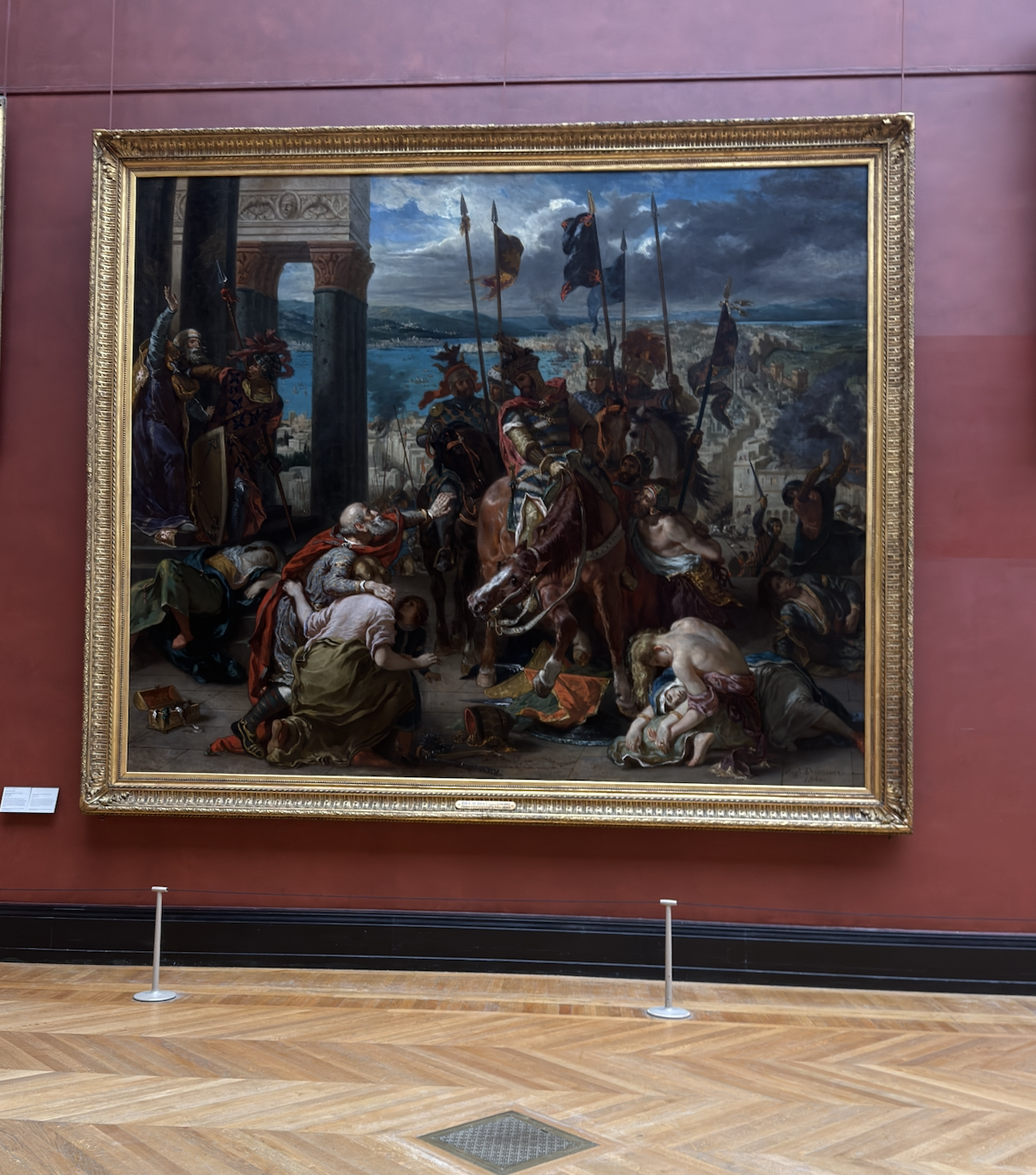
Before, taken May 4, 2024
In the spring of 2018, the Louvre held a retrospective exhibit dedicated to the Romantic master, and at that point, they realized many of his paintings were in desperate need of restoration. Most paintings need a bit of love every 80 to 100 years, but as you can imagine, for the Louvre that isn’t a very easy schedule to keep or to fund, for that matter.
The vast majority of the 20th century was consumed by world wars in its first half. The 80s and 90s were dominated by the Grand Louvre project, which gave us the Pyramid and the Richelieu wing, taking all the focus away from restorations, though that might have been a good thing.
Restoration is an art form in itself. Over time, the focus of restoration has changed many times. We can look back at the “restoration” of the Mona Lisa in the early 1600s. Artists Jean de Hoey and his son Claude were in charge of the Royal Collection of Louis XIV and decided to cover the painting with a thick layer of varnish. This was done without cleaning the Renaissance masterpiece painted on wood that had spent two decades of her life in a bathroom. This has left the world's most famous painting in a precarious position. She desperately needs cleaning, and the varnish continues to darken to this day.
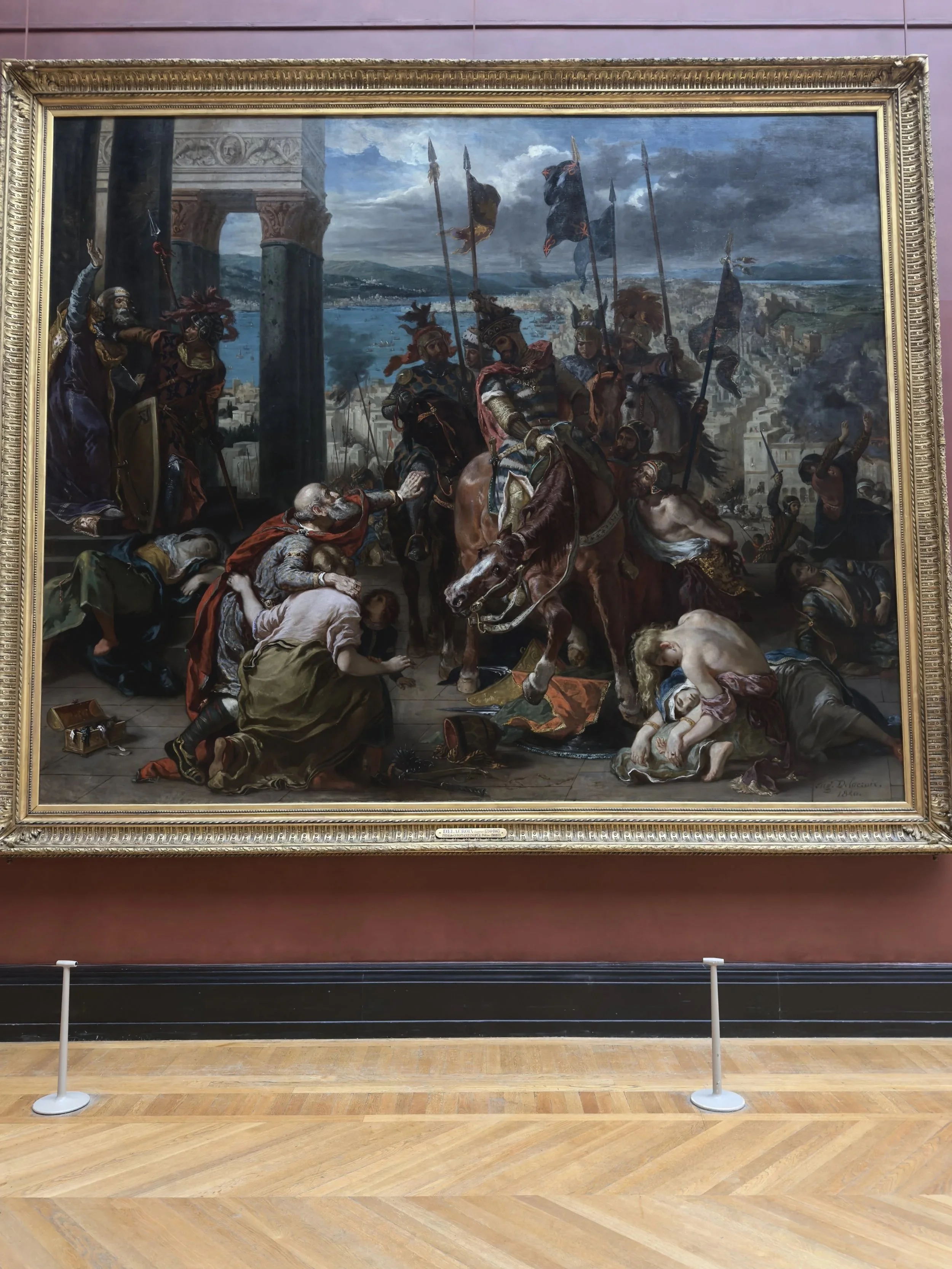
After Restoration, May 20, 2026
Restorations today involve multiple X-rays, testing of the substances they will use, and even an inspection of the multiple sheets of canvas below the pictorial layer we see. Their role is to return the painting to the artist's intent, removing the varnish that dulls the colors and repairing any spots damaged by time. By abiding by the ultimate rule for whatever they do, they must be able to reverse it in the future if needed.
In the process, restorers have found paintings that have been altered, with elements added that were never the artist's intent, and at times added hundreds of years later. They can be removed without a trace. There are some incredible examples that I will share in an upcoming episode. I would love to spend a day with these talented individuals, although they may be tired of my questions after 20 minutes.
Eugéne Delacroix was the king of the Romantic movement. His use of color was inspired by Rubens, and he would later inspire the Impressionists and Picasso. He was the perfect subject of the large project that began in 2019. These projects come at a very high cost, with restoration of just one painting costing up to a million euros.
The Salle Mollien, just a few steps from the Mona Lisa, was created under Napoleon III. Between 1852 and 1870, he doubled the size of the Palais du Louvre for his government, while the Grande Galerie served as the museum. The room originally held the French masters of the 17th and 18th centuries, as attested by the names inscribed on the walls above. Today, the same room painted in Pompei red houses the paintings of Delacroix and the Romantic period, which were placed here in 1995.
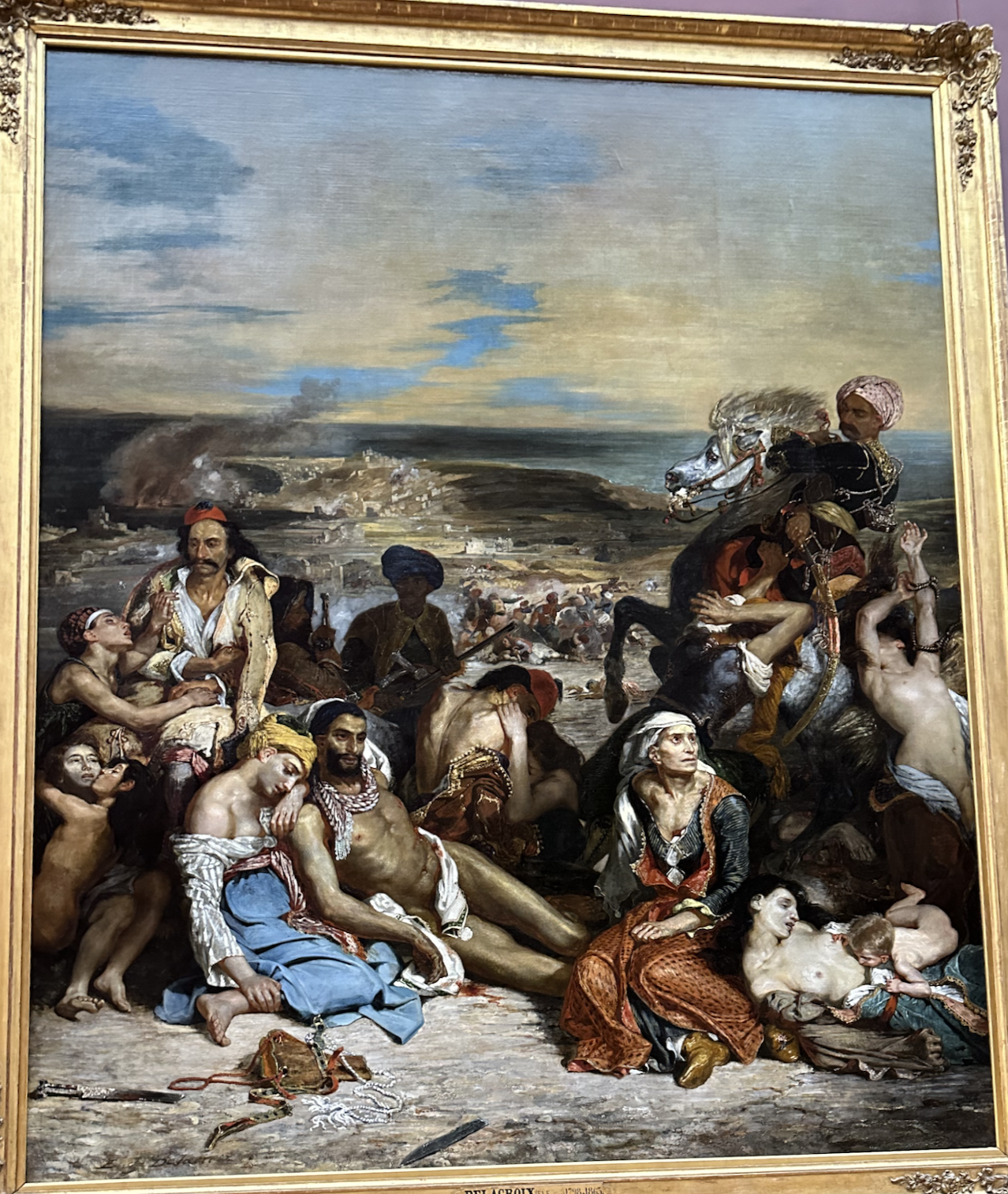
One by one, five of Delacroix's paintings have been restored. Starting with the Scenes from the Massacre at Scio, painted in 1824, depicting the destruction by the Ottoman Empire of the people on the Greek island of Scio in 1822,
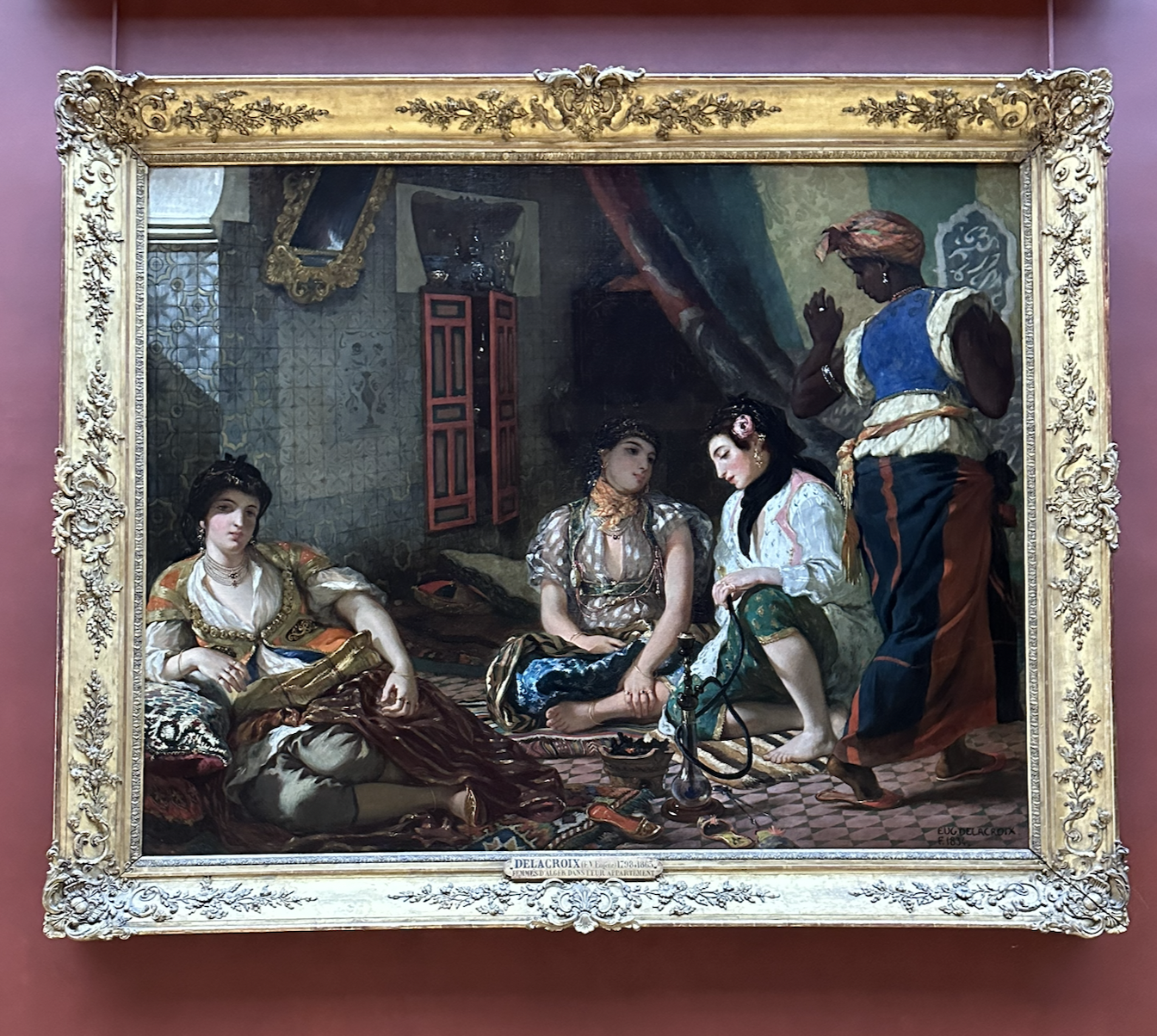
In 2021, a painting that also inspired Picasso to copy many times, The Women from Algiers in their Apartment, was painted in 1834. The colors in the women's clothes came to life after the restoration.
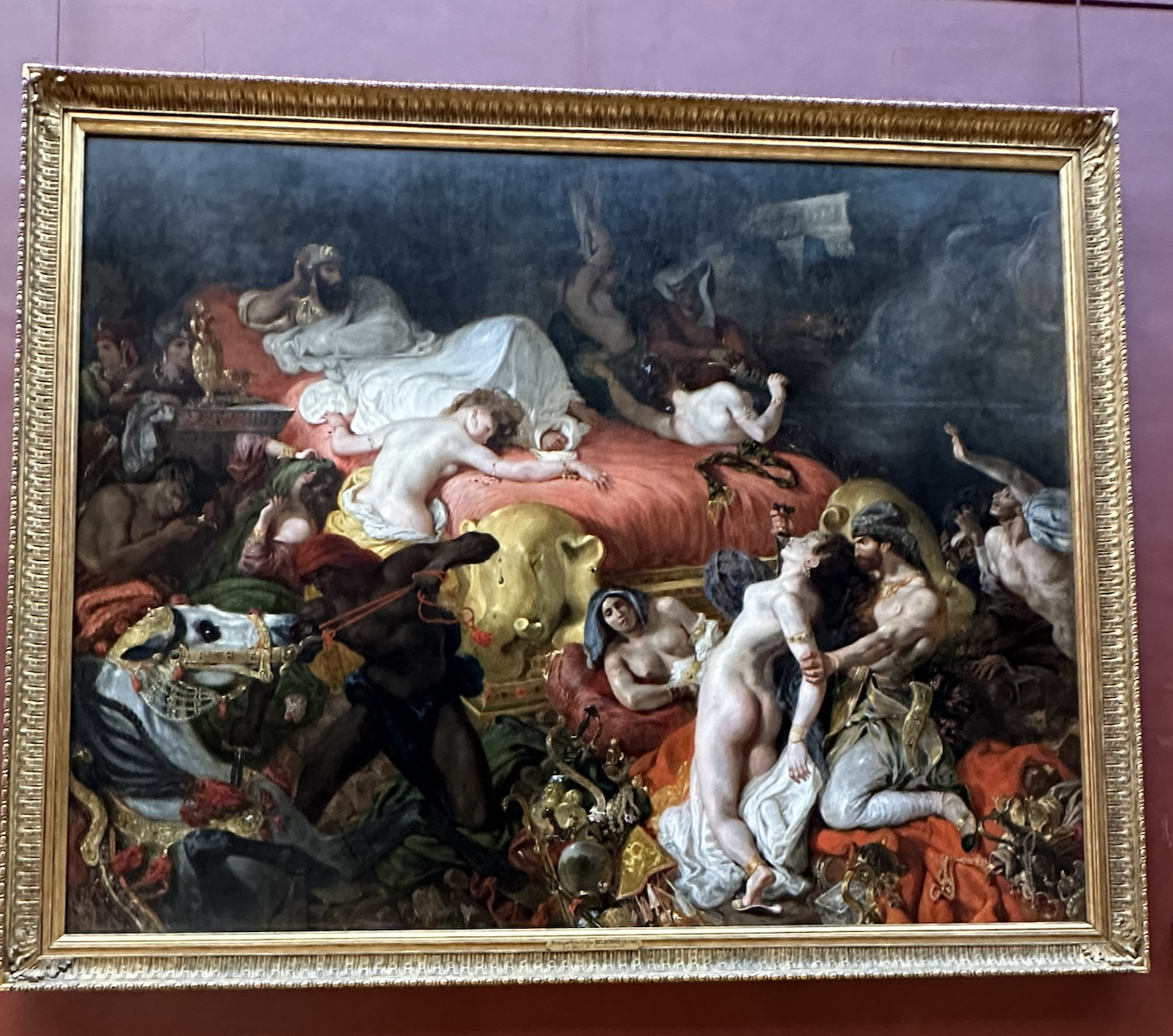
Delacroix liked to push the envelope with his paintings and the themes he chose. The Death of Sardanapalus, painted in 1827 for the 1828 Salon, drew a crowd, but most were shocked by the theme of the mythical Assyrian king surrounded by all his favorite things just before his death.
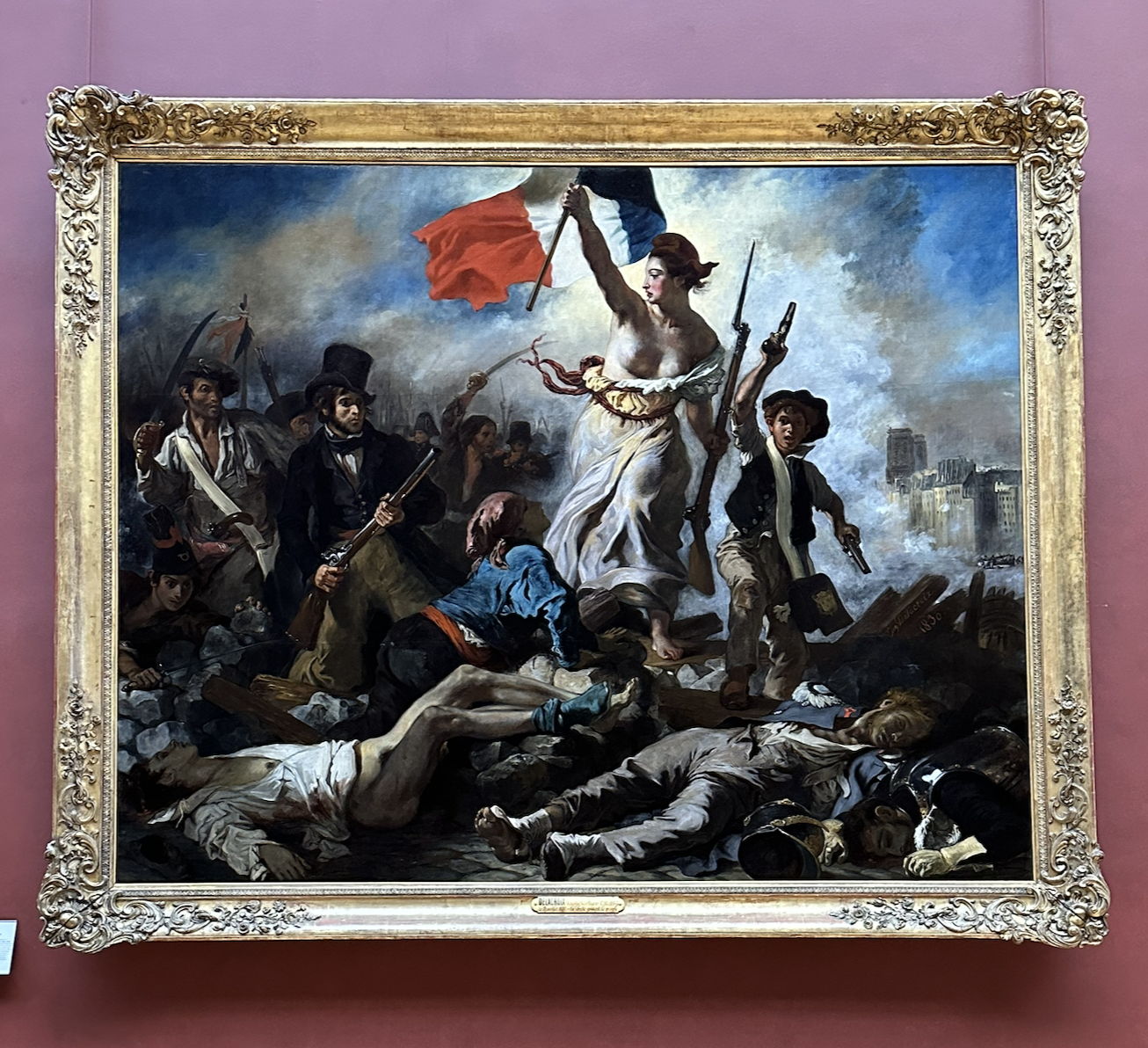
You can’t restore the tableaux of Delacroix without touching his most famous, Liberty Leading the People, in 2023. It was completed in time for the 2024 Olympics. More on that in July.
Last week, on May 20th, the fifth and final from the master of color was revealed. The Capture of Constantinople by the Crusaders, April 12, 1204. Before the restoration, the painting was very dark. The architectural background of the city and the Bosphorus Straight had almost disappeared under multiple layers of varnish.
The restoration was sponsored and paid for by Madame Isabelle Ealet Corbani. She also supported the cleaning of the Death of Sardanapalus and is helping with the Rubens Medici project.
Constantinople was last restored in 1948 by Paul Maridat & Edgar Aillet. The newest restoration included strengthening the canvas and its edges, and the full cleaning of the pictorial layer. Led by the amazing restorers Bénédicte Trémolières, Laurence Mugniot, Alice Aurand, and Alice Panhard, who cleaned, reintegrated, and added a new clear layer of varnish to once again bring out its colorful glory. The support, backing canvas, and frame were restored by Jean-Pascal Viala and Luc Harter. The project lasted 11 months from May 2025 to April 2026. I have been fortunate enough to attend a few lectures given by Bénédicte and Laurence, two fascinating and talented women.
A special space was created steps away under the Salon Denon after the gift shop was removed in 2025. Complete with a window that was added so we could watch the restoration process. That never happened, and the window was never opened. Would have been amazing to watch.
Louis Philippe rose to power after the Three Glorious Days Revolution of July 1830, another event that Delacroix captured. Louis Philippe set himself apart from his predecessors by calling himself the King of the French, a real man of the people. After a few Napoleons and Bourbons who did their best to alter the pages of history, it would be Louis Philippe who would do all he could to restore them. We already talked about his goal of reuniting the banks of the Seine with Napoleon Bonaparte in 1840 in episode 17.
The King OF the French didn’t stop there. At the Chateau de Versailles, Louis Philippe created a museum dedicated to the glories of France, filling its walls with works by the greatest French artists, as well as many battles and scenes from French history.
On April 30, 1838, Eugene Delacroix was commissioned for 10,000 francs by Alphonse de Cailleux, Director of the Beaux Arts and later director of the Musée du Louvre. It would be his third and last creation for Versailles.
From the mid 1830s to his death in 1863, Delacroix focused more on public- and government-commissioned pieces. At the time, Paris had the Musée du Louvre and the Musée du Luxembourg. When it came to large art centers, there were very few. He believed that to be remembered, he should dedicate his time and energy to these large-scale installations that could be seen for generations to come, and tried to encourage his fellow artists to do the same. Little did he know what the museum and gallery landscape would be today.
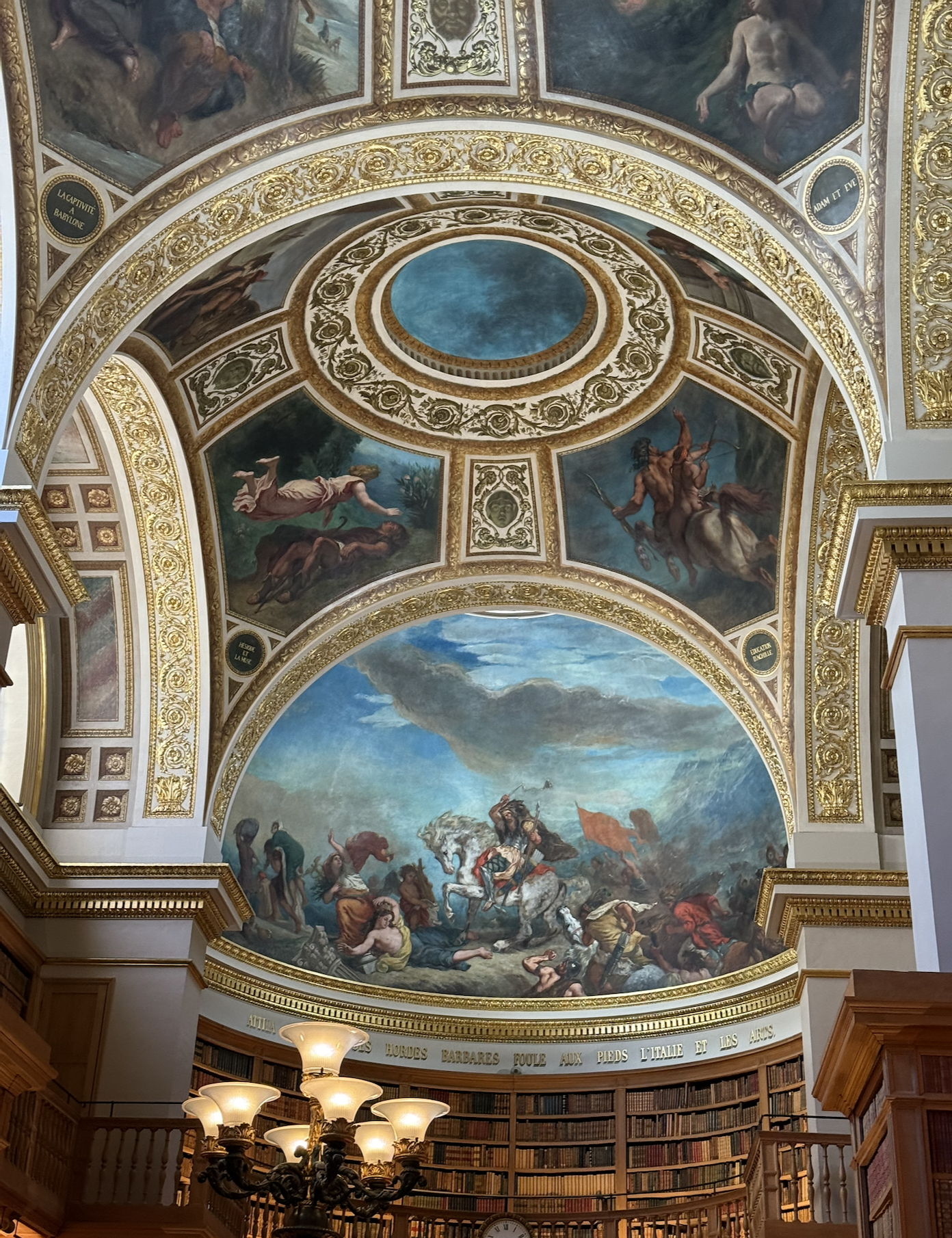
At the time of his commission in 1838, he was also working in the Chamber of Deputies in the Palais Bourbon of the National Assembly. Before Constantinople was finished, he also took on the major project for the library of the Chamber of Peers in the Senate of the Palais du Luxembourg, multiple salon paintings, and the Eglise Saint Denys du Saint-Sacrement.
In February of 1840, Delacroix sent a letter to his friend and head of the Beaux Arts, Cailleux, asking for a meeting. It is thought that this was when he presented the sketch held at the Château de Chantilly and in the collection of the Duc d’Aumale, which, sadly, was not on display when I was last there. There are more characters in this version that didn’t make it into the final piece, and a slightly more chaotic-looking scene.
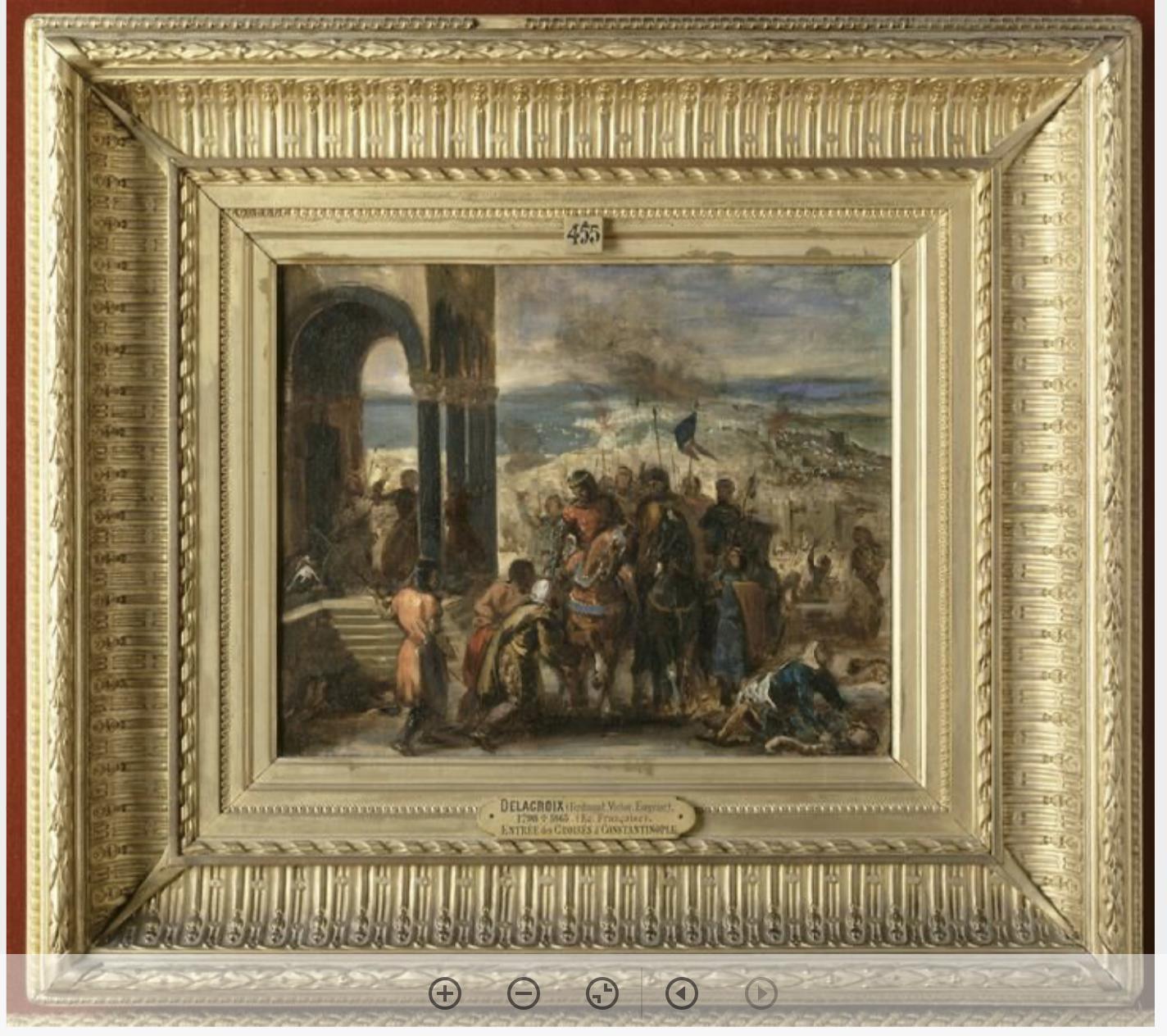
With this commission, Cailleux told him that Louis-Philippe wanted the painting to be less in the style of Delacroix. After hearing that, he made the figures more prominent, dwarfing the surrounding architectural elements.
The view reimagined by Delacroix, over six hundred thirty years after the crusade, is likely near the Blachernai palace, with the Golden Horn and the Bosphorus Strait below
The fourth siege of Constantinople was first spearheaded by Pope Innocent III, who was elected in 1198. Although the Byzantine capital was not in the plans. The Pope wanted to return Jerusalem to Christianity and out of the hands of the Muslims. Led by Baldwin I of Flanders and Boniface of Montferrat, who decided to fight for the cross and the return of Christianity.
Without a massive army of their own, the Pope asked the Venetian Doge Enrico Dandolo to assist. Launching the crusade in 1202 with the help of the Venetian ships and the army of Baldwin and Boniface, they were supposed to go to Egypt, but things didn’t go as planned.
The Byzantine throne had been anything less than solid for quite some time. Family fights between brothers and sons led Alexios IV, son of Emperor Isaac II to offer the crusaders 200,000 silver marks, supplies, and even the island of Crete if they helped to rescue his father from prison and return him to the throne.
The ships made a hard turn and headed for the Byzantine capital, which was also one of the most powerful and richest, and held many of the most priceless relics and treasures.
When word reached the Pope, he was enraged and later excommunicated all of the soldiers involved. On July 19, 1203, Isaac II regained his throne once more, although not in his finest form. He had been imprisoned by his brother, Alexios III, and had his eyes gouged out. However, Isaac’s son, Alexios IV, hadn’t followed through on his promises to the Venetians, and they took matters into their own hands.
From April 8 to 13, 1204, the Byzantine capital of Constantinople and the head of the Eastern Roman Empire would be attacked and changed forever.
Soldiers used the masts of their ships to reach the top of the wall, while those below, armed with pick axes, bored through and crawled in to terrorize the citizens. The first days were a mess of looting, attacking, raping, and killing. On the 12th, the same day captured by Delacroix, they began a far more organized looting.
In the aftermath of the siege, the country would be split into four parts, and Constantinople would fall under the new Latin Empire, naming Baldwin of Flanders the first Latin Emperor on May 9, 1204.
Delacroix was no stranger to controversy or shocking subjects. He was commissioned to paint this subject specifically for the Hall of Crusades in Louis Philippe’s museum.
At some point in the 1830s, Delacroix was walking down the Champs Élysées and was struck by a scene he saw on the scaffolding on the north side of the street. The sun covered one of the workers while the others were in the shadows. It was something he would beautifully incorporate into this painting, putting the attention on the victims and not the attackers.
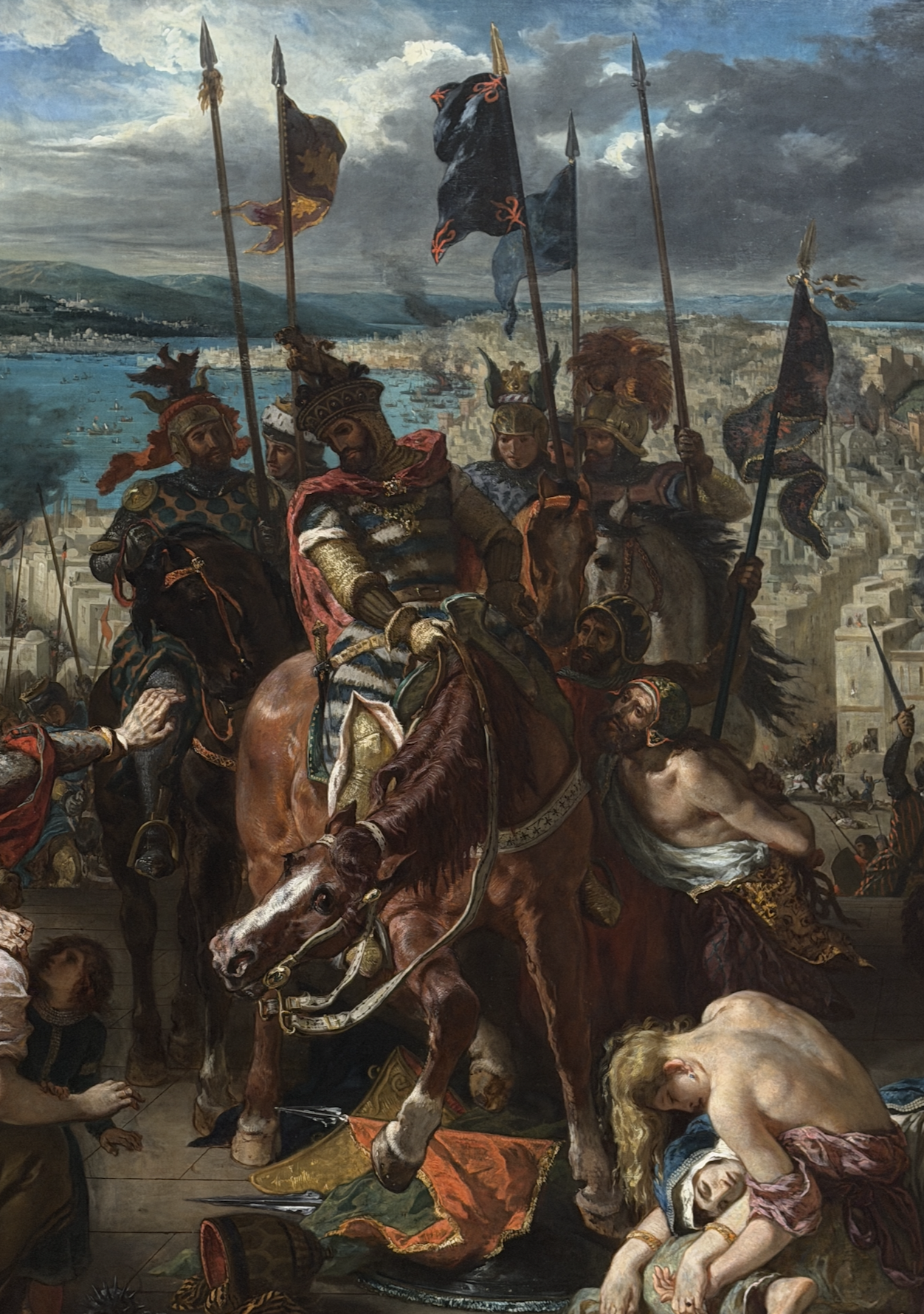
The center of the tableaux is dominated by the soldiers on horseback dressed in armor and helmets. Baldwin, the Count of Flanders, led the French soldiers in an attack through the city's streets. Sits high on his horse and looks down at the man begging for his clemency.
Behind Baldwin on the left, the head of Venetian doge Enrico Dandolo, who controlled the siege through the port, can be barely spotted between the staffs of the banners. Boniface I, the Marquis of Montferrat as well as Louis I of Blois, are also represented on horseback. Louis I wasn’t actually there that day as he had been ill, but was involved in the lead-up and aftermath.
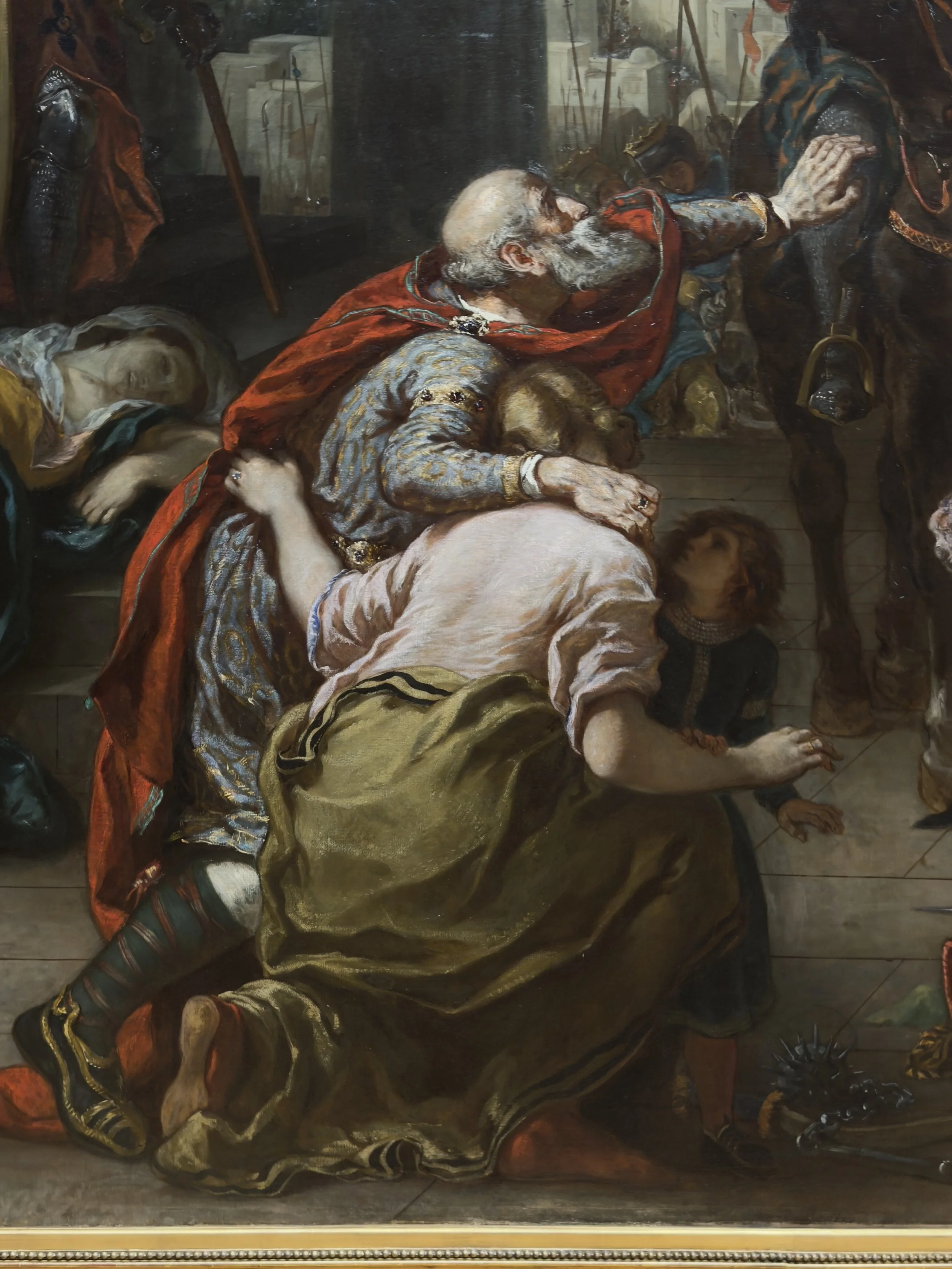
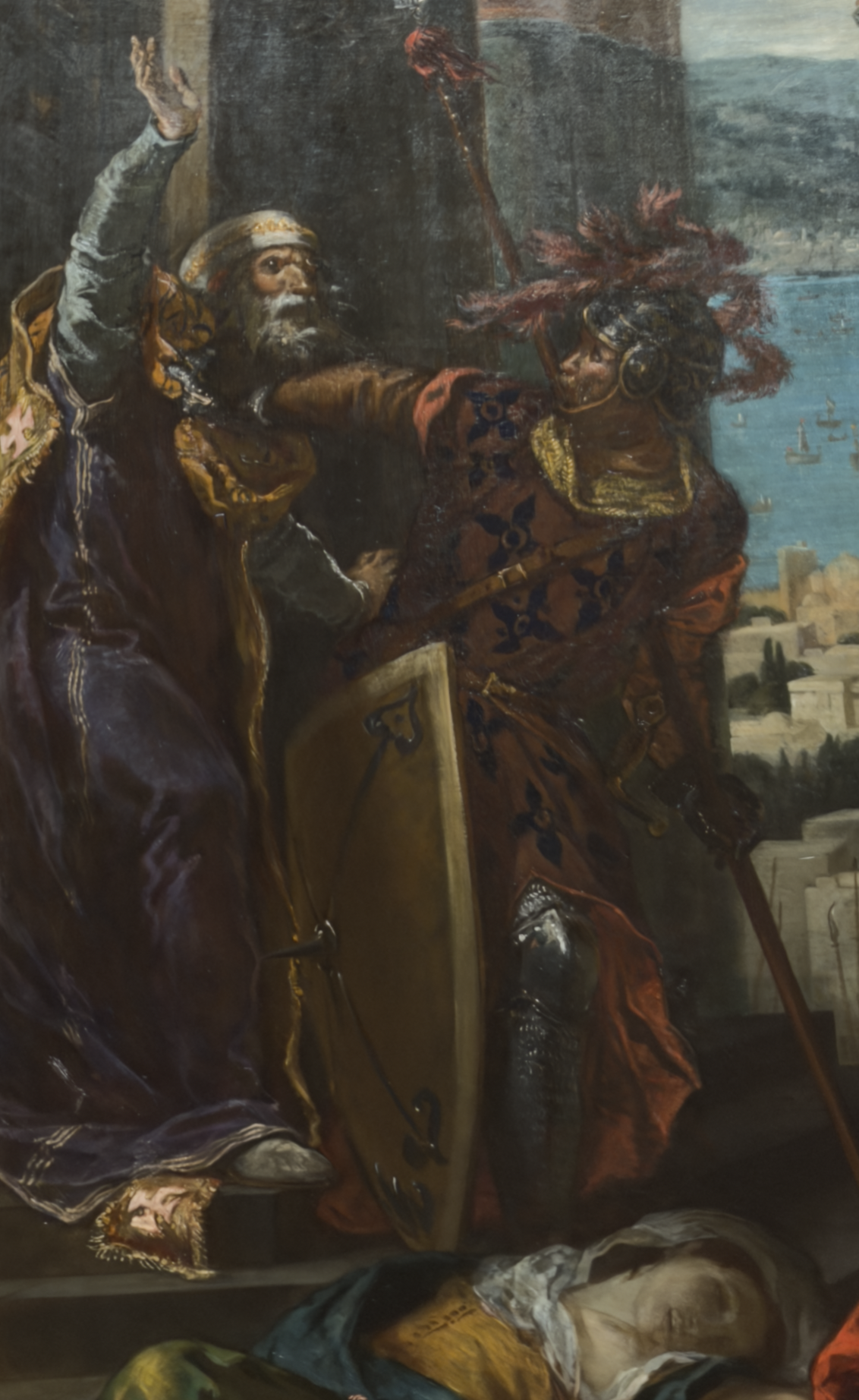
The older man reaches up to Baldwin, imploring him to stop the attacks. His hand shows his age, while the young lady, her face turned toward his chest, has hands that are young and smooth. Painting hands and feet is quite difficult. Gericault had such a hard time with the foot of one of the men on the Raft of the Medusa that he finally gave up and covered it with a sock. Da Vinci, Ingres, and Delacroix excelled at capturing hands and featuring them prominently in many of their pieces.
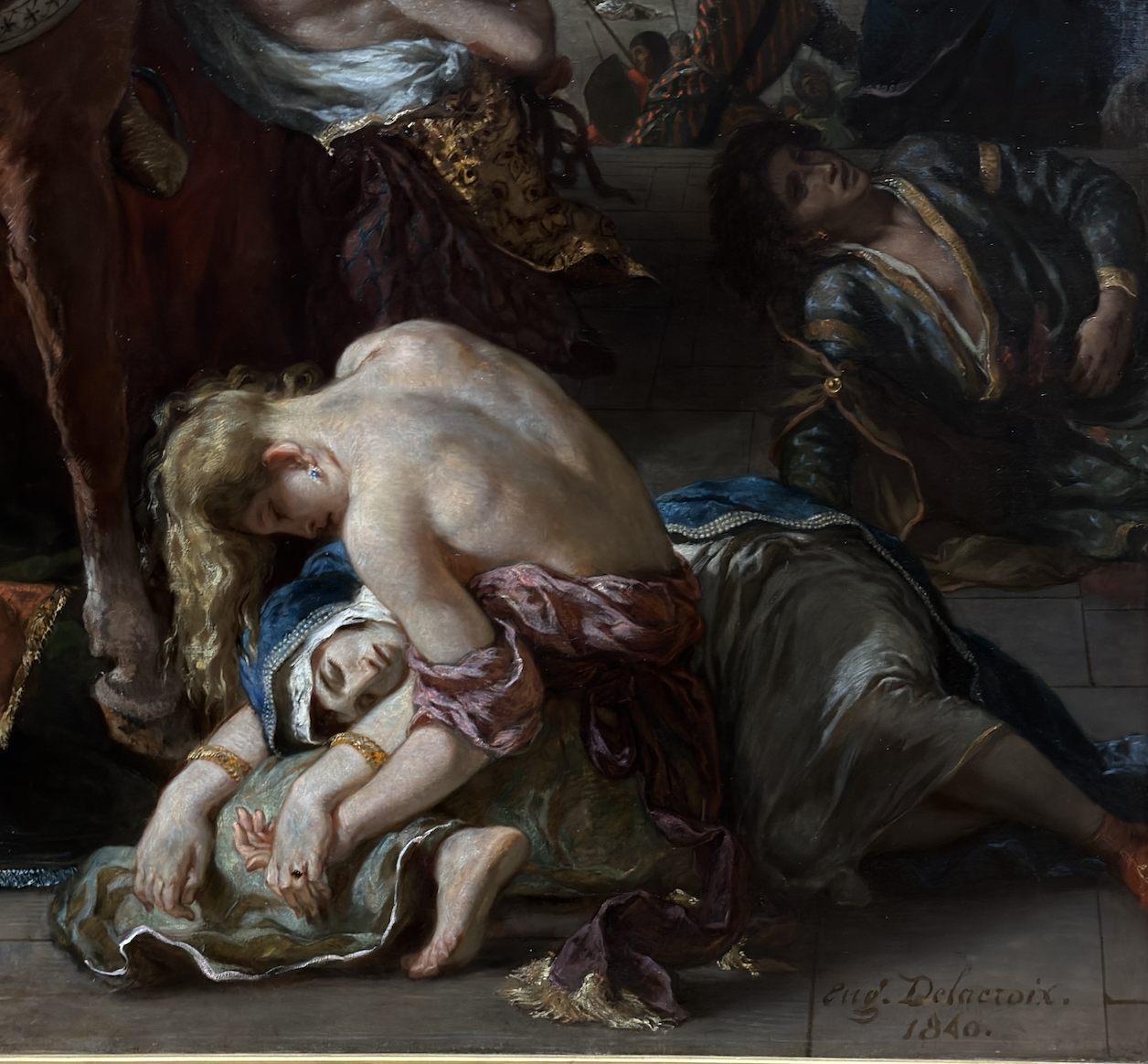
After Restoration
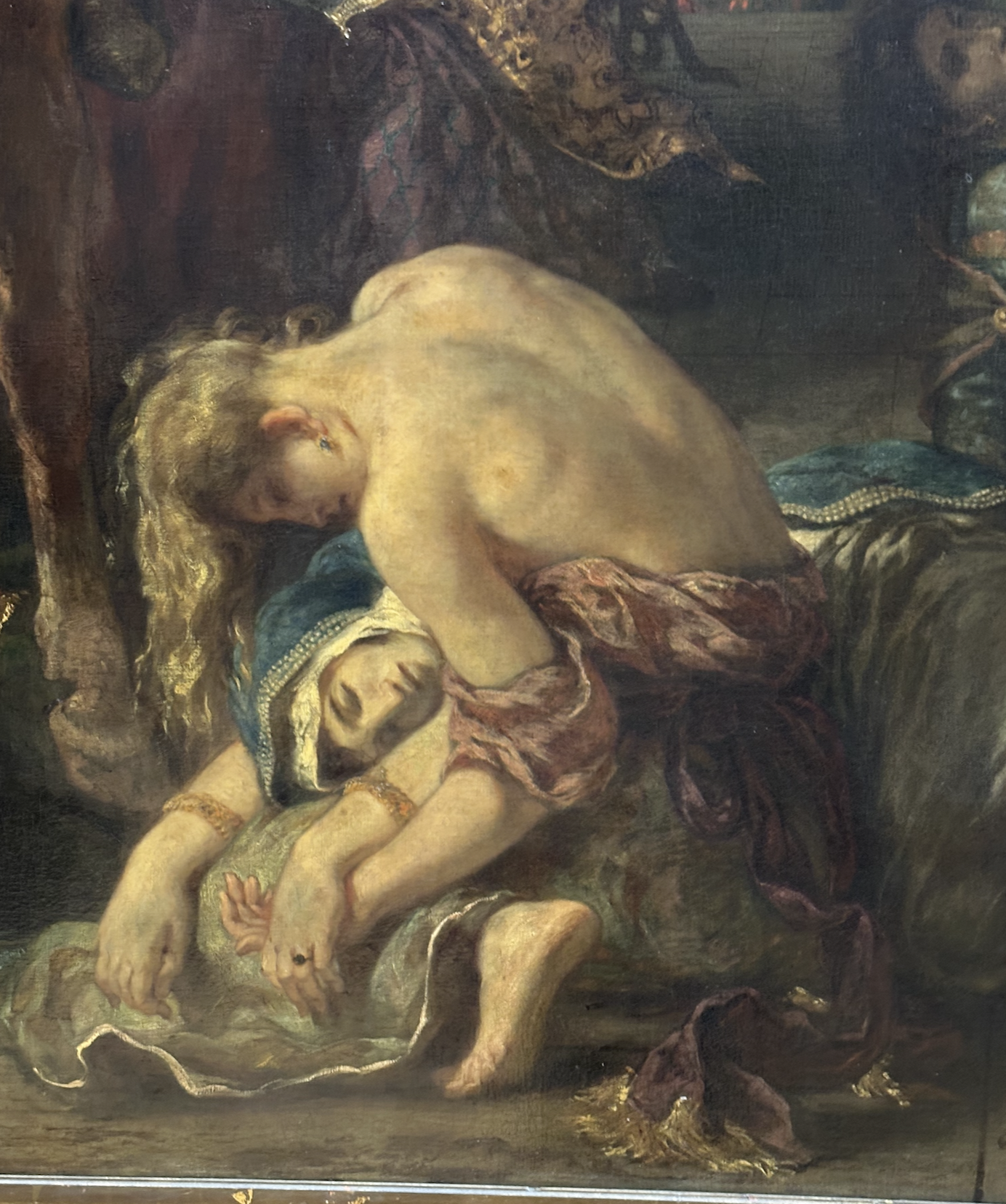
Quite possibly the greatest part of the painting is the group of two women at the lower right edge. Possibly a mother and daughter, the younger woman in a pink-and-grey dress that has fallen, revealing her entire back, leans forward, her blonde hair hanging over the other woman, who lies in her arms. Grieving the loss of the woman, she appears clearly upset, even without being able to see her face. The woman in her arms, wearing a blue and grey dress and a blue veil covering her head, with her skin tinged the slightest shade of blue, tells us she has died.
Before
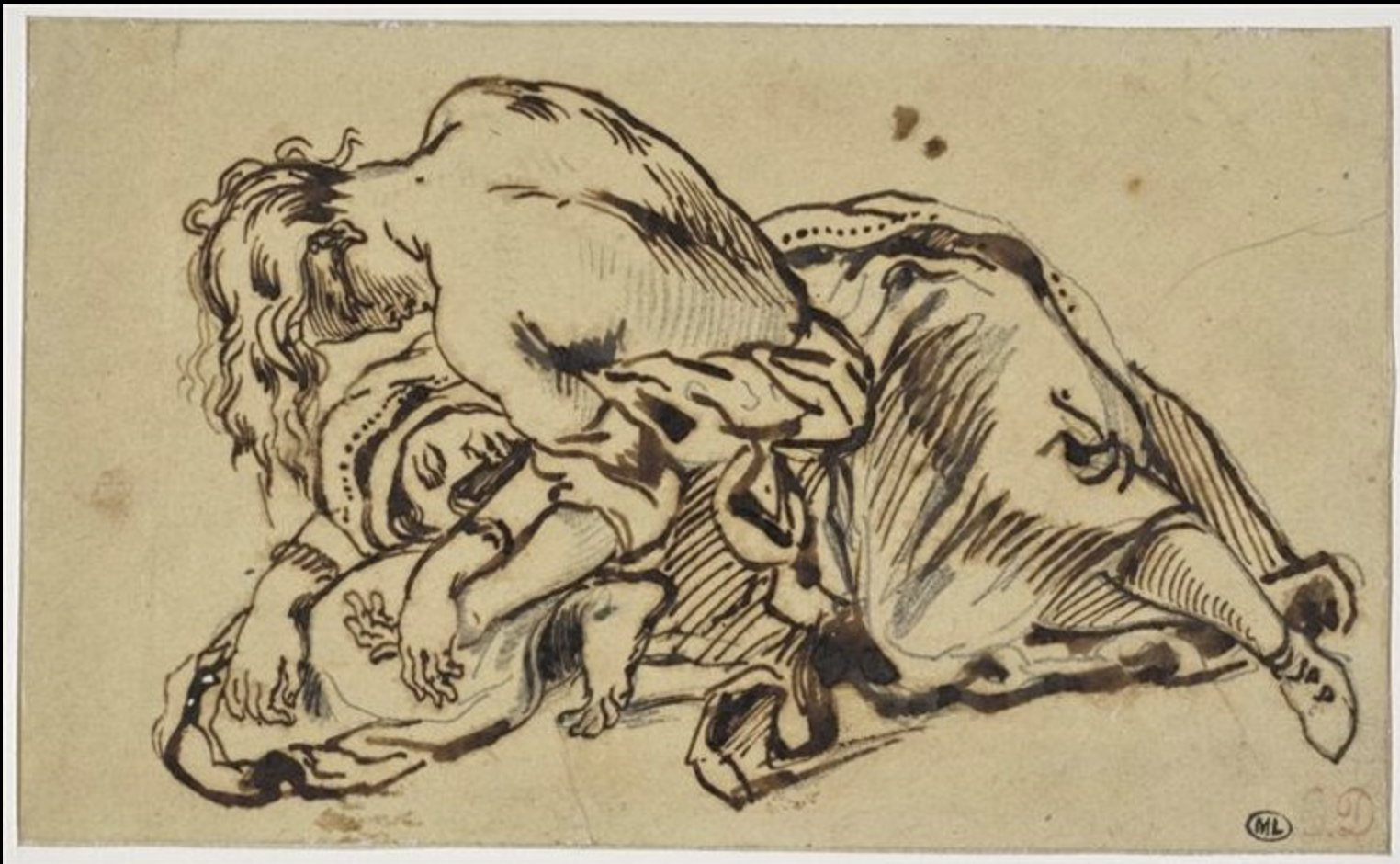
Above, the horse of Baldwin appears to come to a running stop as it pulls his head away from the women, giving us a bit of compassion that wasn’t there in the actual moments of the siege of 1204. Delacroix sketched many elements of the painting, but by far the most stunning and complete is that of the two women.
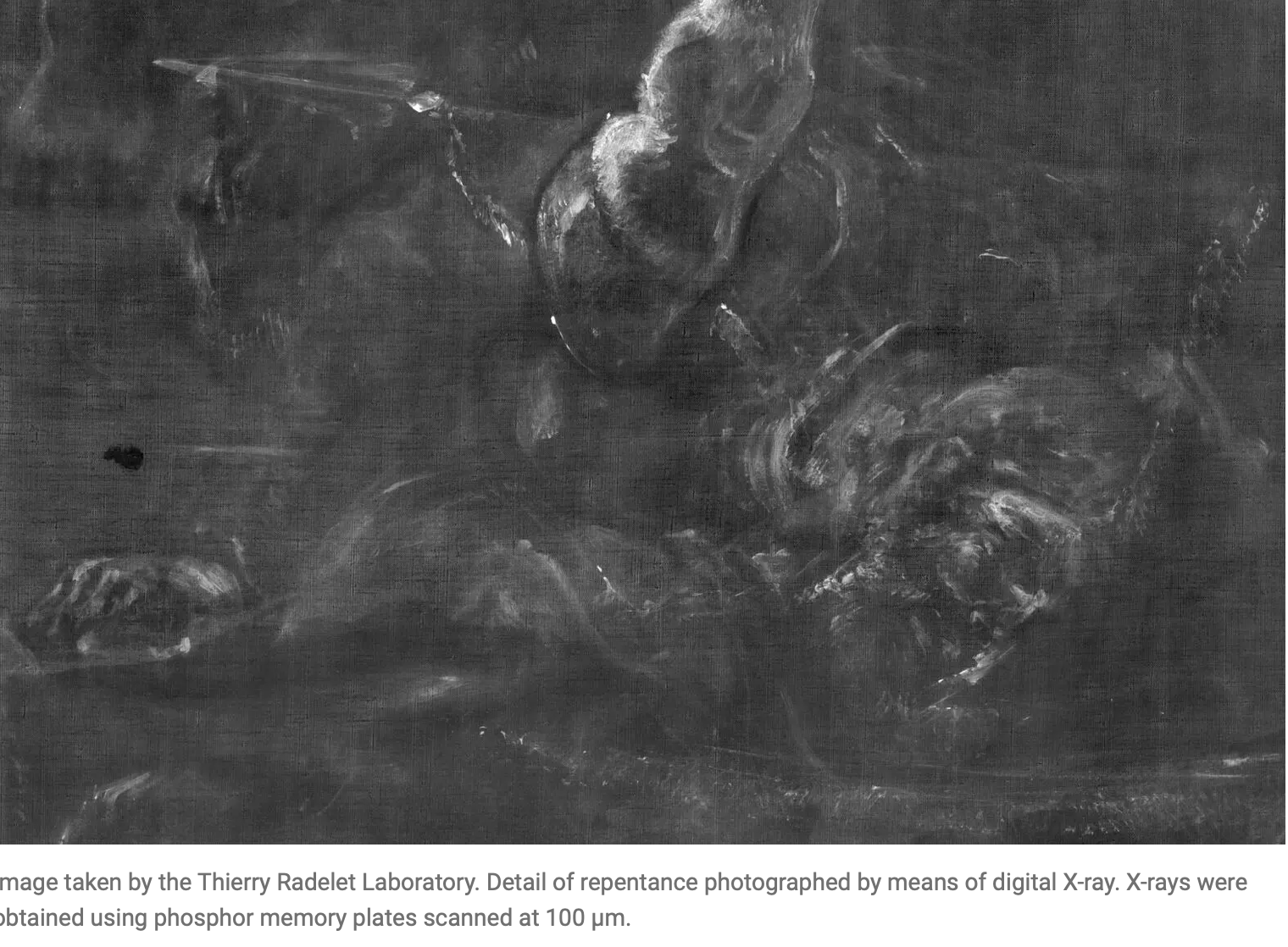
The horse of Baldwin steps over a banner, helmet, quiver, and other weapons of war. During the restoration process, X-rays revealed that Delacroix had painted the body of a soldier. At some point, he changed his mind and covered the soldier with the banners. It would have changed the idea of the horse halting to avoid the soldier instead of the woman.
In the far left of the painting, a priest under the porch of his church is grabbed by the throat by a soldier who attempts to stop the man's quick actions to charge towards Baldwin and his men. Below, his daughter was left to die after soldiers had taken advantage of her.
The mix of all walks of life was something Delacroix excelled at. With his use of shadows, he placed the important elements, the people in the glow of light, and the attackers and soldiers in the dark.
The architectural elements are now thought to be designed by friend Louis Boulangé. Below, smoke begins to form as the soldiers destroy the city in their wake
The painting was finished and first displayed in the 1841 Salon in the Salon Carré of the Musée du Louvre. Opening on March 15, 1841, it received a mixed reaction. Listed as no 509, the official description was "Baldwin, Count of Flanders, commanded the French who had launched the assault from the landward side, and the old Doge Dandolo, at the head of the Venetians, and on the ships, had attacked the port. The principal leaders travel through the various districts of the city, and the grieving families come along their route to plead for their mercy."
Louis Peisse reviewed the piece in the Revue des Deux Mondes in 1841.
“Delacroix conceives everything, sees everything, and renders everything with the eyes of a painter and for the eyes of a painter. Everything in the conception and execution of his works is subordinated to the effect of painting itself, abstracting from the objects represented. He is less concerned with representing a fact or expressing an idea than with painting a canvas. The subject is less an end in itself than a pretext for him. And this is what so greatly confounds the public, who, understanding and judging a painting only from a literary point of view, want above all to find in it what they seek in a novel or a poem: a dramatic or historical meaning.
In 1855, it was exhibited again at the Universal Exposition to a more favorable response. Charles Baudelaire was a big fan of Delacroix and had to speak out after seeing the masterpiece.
"But the painting of the Crusaders is so profoundly penetrating, quite apart from the subject matter, by its stormy and somber harmony! What a sky and what a sea! Everything is tumultuous and tranquil, like the aftermath of a great event. The city, spread out behind the Crusaders who have just crossed it, stretches out with a prestigious realism. And always those shimmering, undulating flags, their luminous folds unfurling and snapping in the transparent atmosphere!"
Transferred to the Louvre at the start of May 1885 for its exquisite quality and hung in the Salle des États. It remained until September of 1939, when it was rolled up and evacuated to the Château de Louvigny, then to the Château de Sourches, and was safely returned to the Louvre on May 31, 1946, almost exactly 80 years ago.
The painting was copied by Henri Charles de Serres in 1883 and is still in place at Versailles to this day.
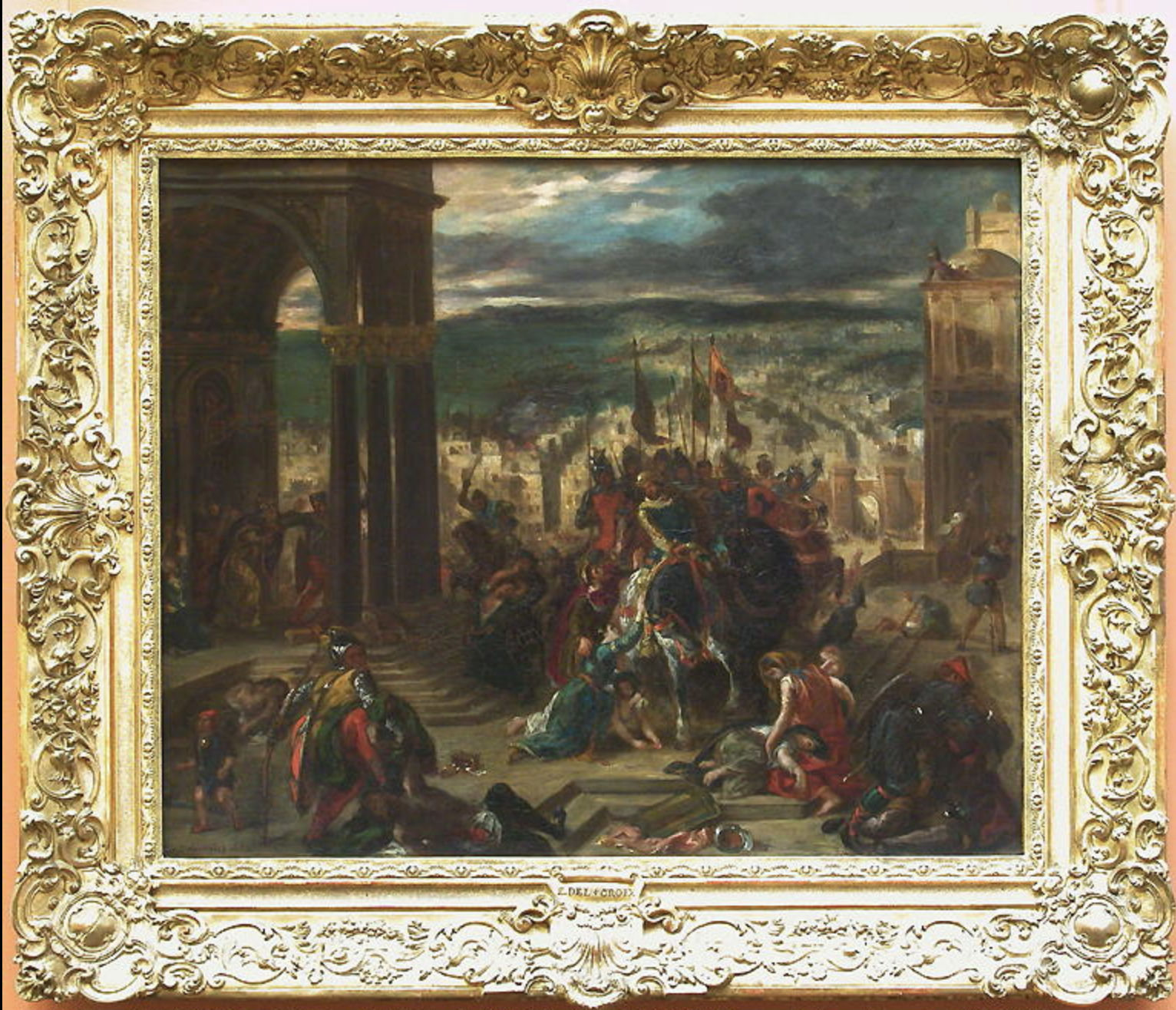
In 1852, Delacroix returned to the same theme. This time, pulling away from the scene a bit and increasing the architectural perspective. The characters are smaller, dwarfed in the majestic scenery. Given the constraints placed on him in 1840, he later wrote that this smaller version was more to his liking.
In the 2nd floor of the Sully wing in salle 950, the collection of Etienne Moreau-Nelaton. One of my favorite collectors was the third generation in his family to amass many of the greatest paintings of Corot, Delacroix, and the Impressionists. This version was purchased by his grandfather, Adolph Moreau, for 3,350 francs on February 19, 1853. It would be passed down to Etienne and donated to the Louvre in 1906. A donation that would change the acceptance of Impressionism. More on that another day.
The painting was also copied by Fantin-Latour in September 1854 and Degas in 1860.
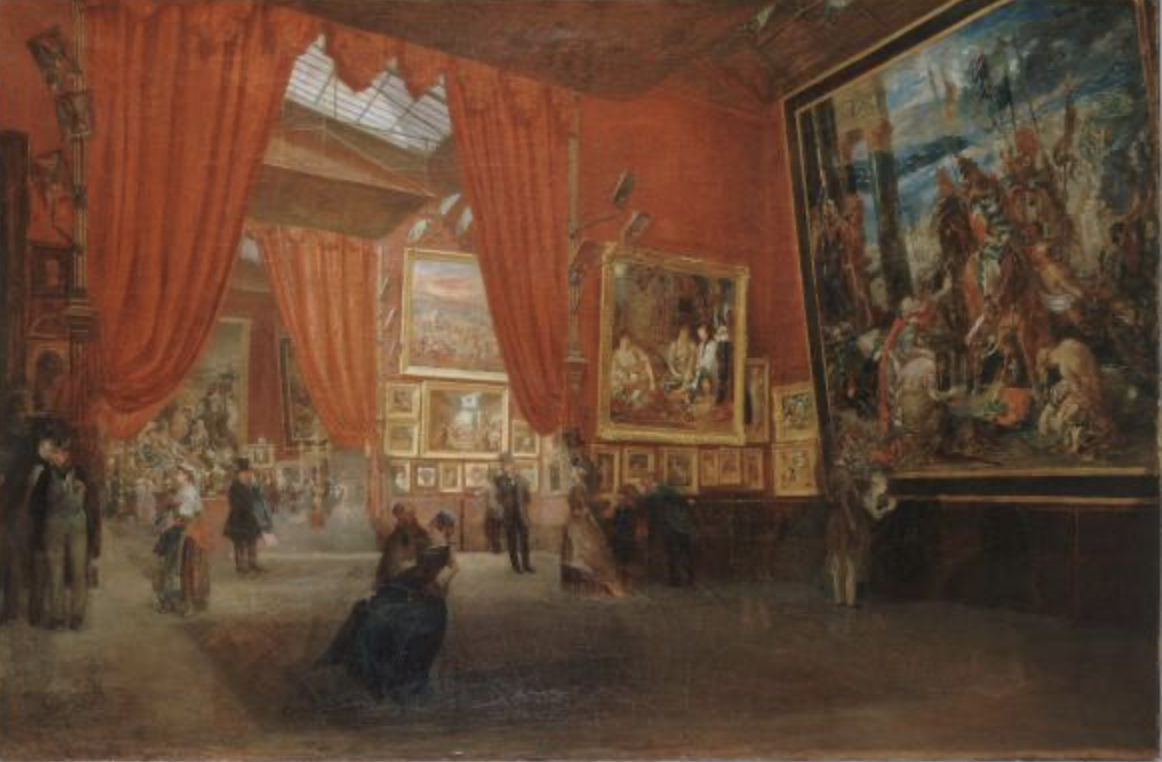
E Albertine painted a scene of the Delacroix exhibit organized after his death in 1864, held at the Galerie Martinet at 26 Boulevard des Italiens. Painting held in the Carnavalet (reserves)