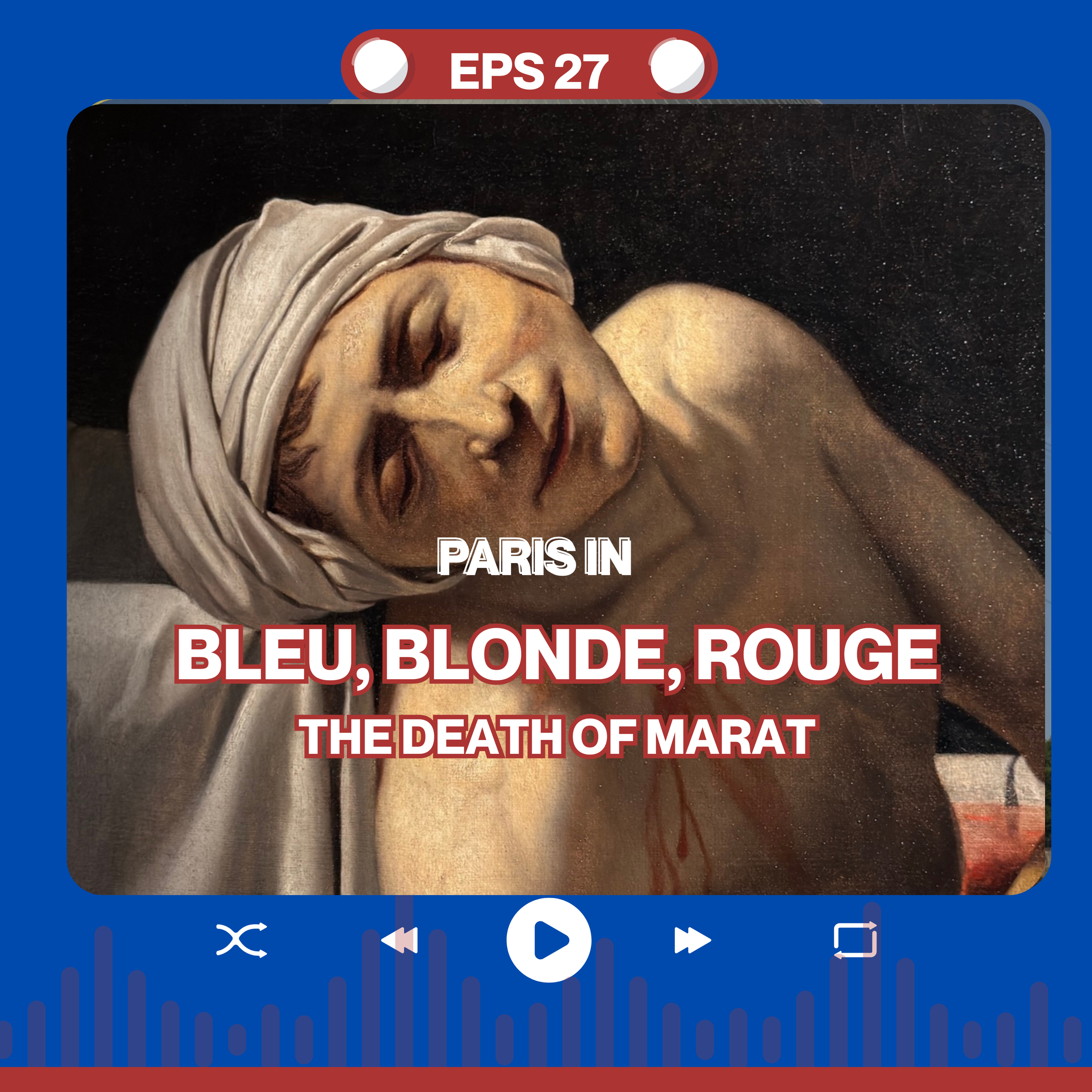
On July 13, 1793, Charlotte Corday talked her way into the apartment of writer Jean-Paul Marat and plunged a knife into his chest while he soaked in the bath, killing the Voice of the People within seconds.
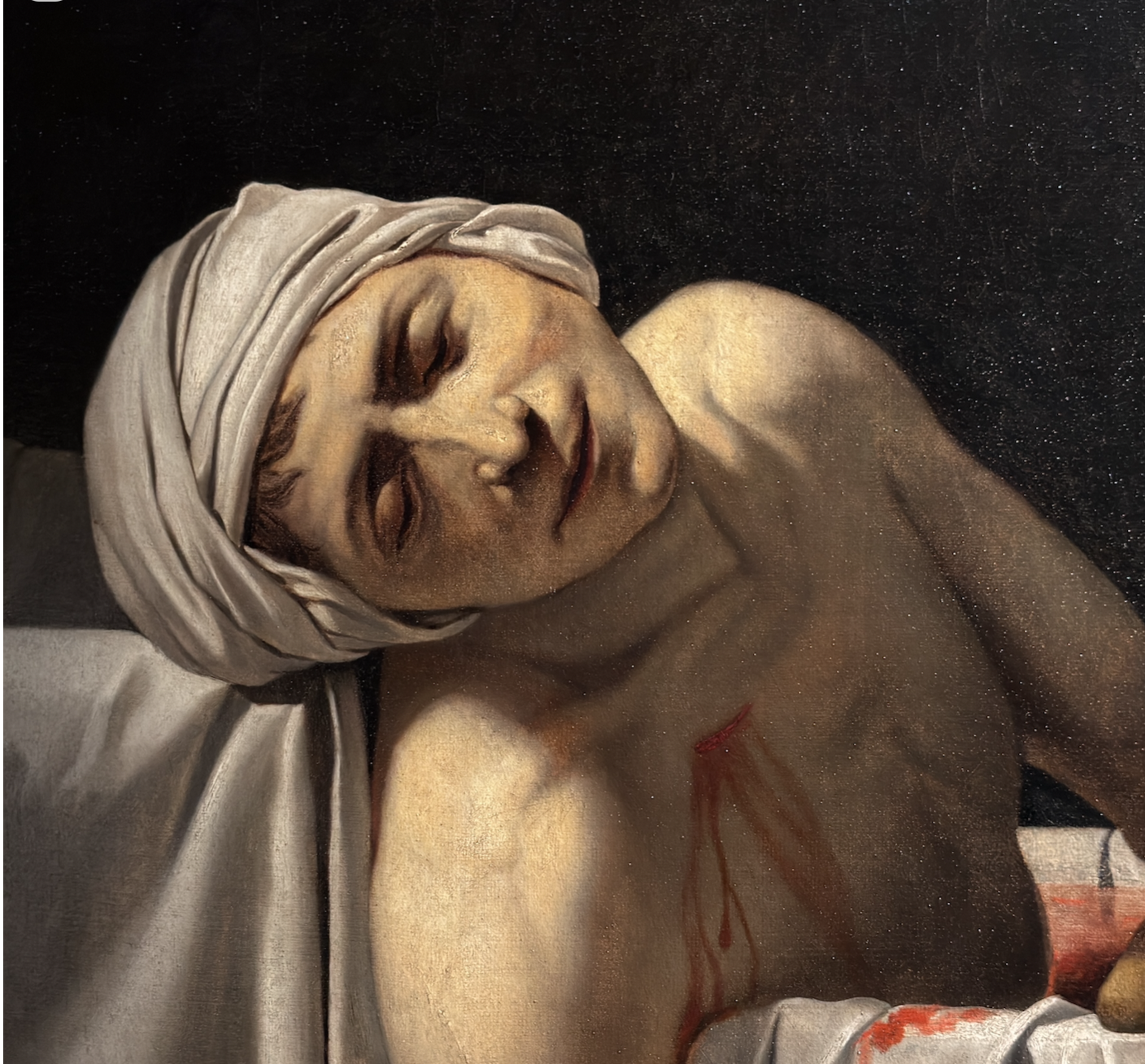
It was a pivotal moment in the French Revolution and was made famous by the painting by Jacques Louis David. A copy by his atelier hangs in the Musée du Louvre steps from the Coronation of Napoleon, while the original resides at the Royal Museum of Fine Arts in Belgium. A few other copies created under his watchful eye are scattered around France, and in the fall of 2025, three, including the original, were brought together for the first time in the Louvre’s exhibit dedicated to David, which was incredible.
A painting that is as much propaganda as it is historical and has become the very definition of the event. If you say the “Death of Marat” to anyone, they don’t think of the event itself, they think of this painting, but few know of the actual details of the crime.
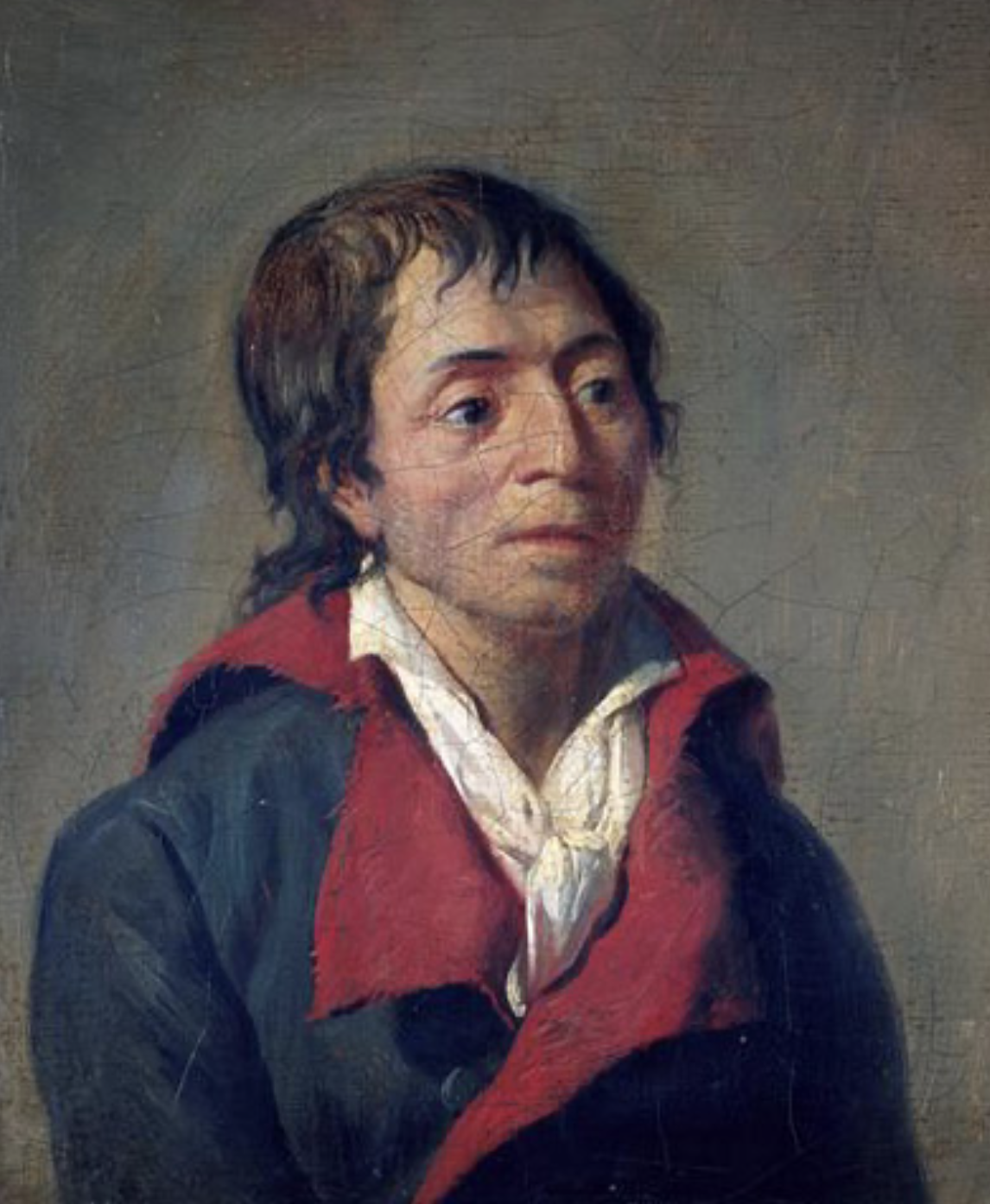
Portrait of Marat by Jean-François Garneray
You could say that 1793 saw some of the most notable deaths in France. The year began with the death of Louis XVI on January 21, an event in which Marat was directly involved. On October 16, the blade fell on Marie Antoinette, ending the once-ruling monarchy.
Jean Paul Marat, the voice of the people, was born on May 24, 1743, in Boudry, Switzerland, and moved through Paris and England as a doctor and writer, and even treated the future King Charles X.
In the 1780s, his attention began to turn to politics and speaking out. By the end of the decade, on September 12, 1789, he published the first issue of L’Ami du Peuple, the Friend of the People, from his office in Odéon. Less than a month later, the royal family would be forced to leave Versailles and settle into the Palais des Tuileries, and the French Revolution, as we know it picked up speed.
Through it, Marat became increasingly outspoken and poured all his feelings into writing. Often calling for the death of officials and the king, and gaining the support of the people to stand against them, he became one of the most feared men in Paris. Think of pamphlets as the 18th century newspaper, and more than 6,000 of each issue were printed, handed out on the streets, and pasted to the walls.
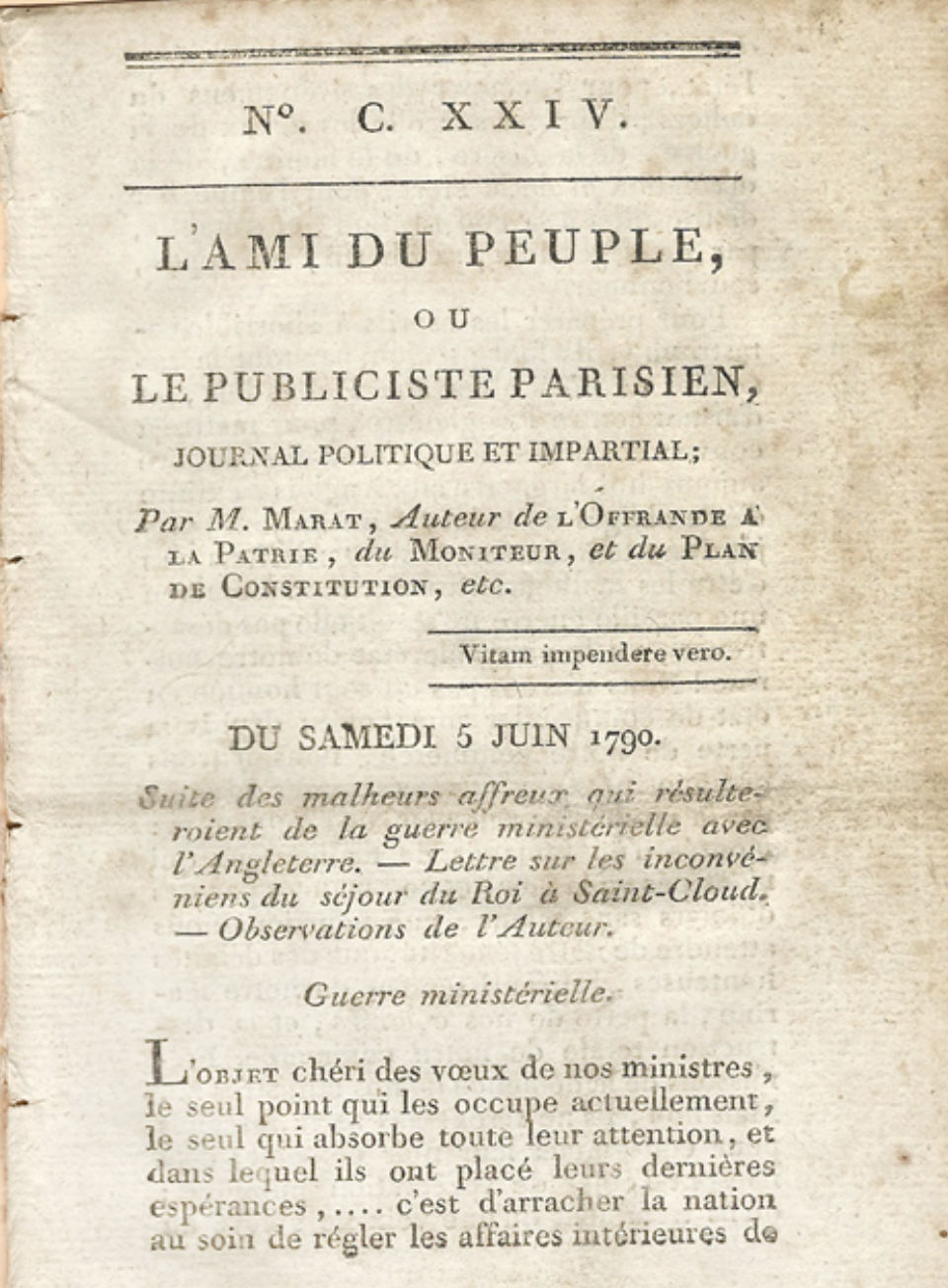
He was frequently threatened, brought before the court, hid in the sewers, and even fled France on one occasion, but it was more because he had an affair with his printer's wife.
Serving in the National Assembly, he voted for the death of King Louis XVI on January 20, 1793, and aligned himself with Robespierre and the artist Jacques-Louis David. The last Issue, no 685 of L’Ami du Peuple was published on September 21, 1792, but had already riled up a young lady living in Normandy. You can find most of the issues in French online at the national library website
Marie Anne Charlotte de Corday d’Armont was born on July 27, 1768, in Normandy to a noble but broke family. Educated under the nuns at the Abbey aux Dames in Caen, she was introduced to the French philosophers and an entirely new view of the world that differed from her family's. Her brothers had fought for the king, and her parents and grandparents were anti-revolutionists.
She believed Marat was inciting violence and must be stopped. The September massacres of 1792, which Marat’s writing fanned the flames of violence calling for the death of thousands. While tensions escalated in Paris, many Girondin members fled to Calvados and Caen, falling into the lap of Charlotte. Just a few doors down from her home, the outspoken members held meetings that she attended, and she was able to learn even about what was happening in Paris. Marat became enemy number one and the reason for all the strife, and must die.
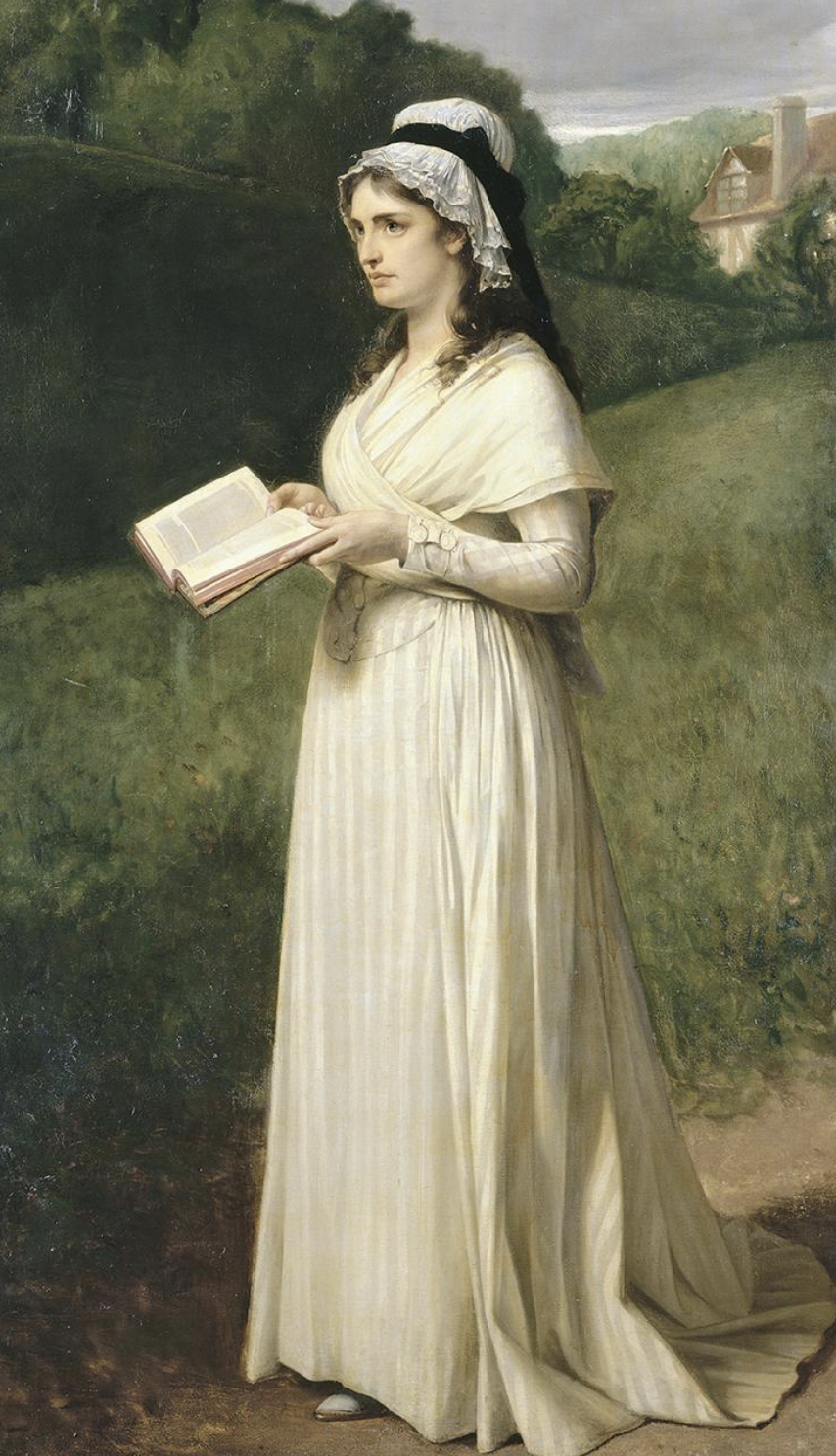
Charlotte Corday by Tony Robert-Fleury
Charlotte left Caen on July 9, 1793, and traveled to Paris. She was told that Marat would be at the National Convention on the 11th and would be easy to approach. Just before noon on Thursday, July 11, she arrived in Paris at the (28) Rue Notre Dame des Victoires and stayed at the Hotel de la Providence, a few blocks away, at 19 rue des Vieux Augustins (today Rue Hérold).
The next day, she takes care of a few things her new Girondins friends asked her to do and then writes a bit of a manifesto to the “French friends of laws & peace”
Waking up early on Saturday, July 13, she walked the very quiet streets of Paris to the Palais Royal just blocks from her hotel. Then known as the Palais Egalité, she found the Badin cutlery store open at 8 am at no 177 in the Galerie de Valois. (a few doors down from another event tied to the artist David) For 40 sols, she purchases a 6-inch black-handled kitchen knife and sheath and slides it into her bodice.
After she buys a newspaper, she sits down for a coffee. The headline of the paper calls for the execution of the leaders of the Girodins; it was all she needed to erase any doubt she might have had.
At 9 am, it was time, but she wasn’t sure where Marat lived. Asking a carriage driver, he offered to take her there, to the Rue des Cordeliers. Through the right bank, past the Louvre and over the Pont Neuf to Marat’s building, but she hadn’t quite planned how she would get inside. Knocking on the door, she meets the concierge, Marie-Barbe Pain, who acknowledges that Marat lives on the first floor but refuses to let her in.
A few hours later, she returns and is able to enter and reach the first floor. She gets as far as Simone Évrard, Marat’s wife, who turns her away. Frustrated, Charlotte travels back across the river to the right bank and her hotel, where she writes and sends a letter to Marat. The letter states that she arrived at his home earlier in the day and was refused, and she has important information for him regarding those who stand against the Convention, and begs for his help.
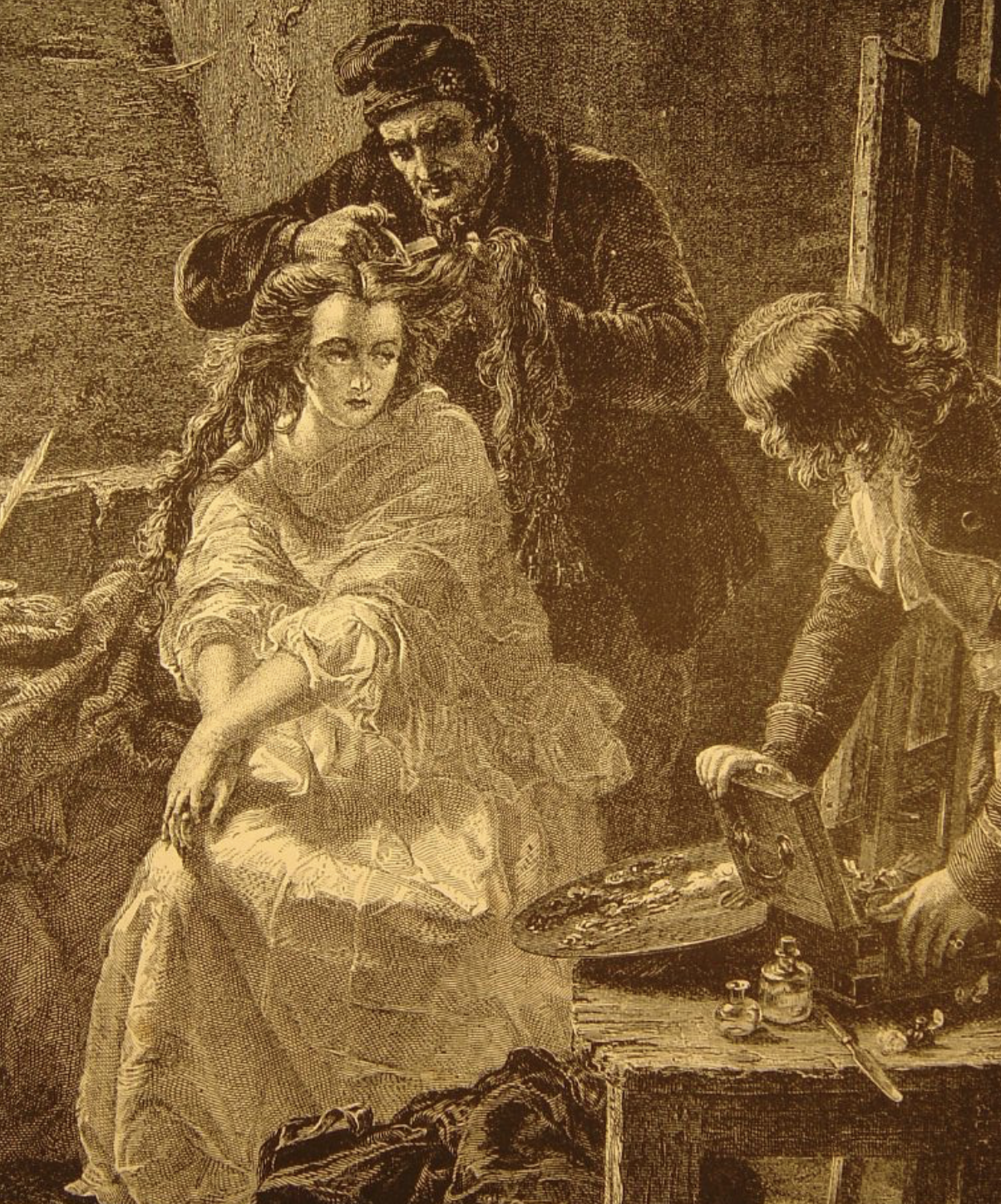
Charlotte Corday, la dernière toilette by Mathieu Ward
Waiting at the hotel for an answer, she had a little spa time and had her hair curled and styled, a girl's got to take care of herself. She puts on a brown and pink dress and a black hat with a green ribbon, then slides the knife into her bodice once again. Marat didn’t answer her letter, and now she must finish her mission. She also takes her baptismal papers with her in case her body needs to be identified later.
It's now just after 7 pm on a hot July 13, 1793, and Charlotte is not taking no for an answer. She arrives at the door, and Simone tries to turn her away. Charlotte raises her voice, and from the bathtub, Marat calls to let her in. She gives him her second letter, and they speak for fifteen minutes, when suddenly, Charlotte lunges forward with the knife and stabs Marat in the chest, on his right side, and the blade cuts through the aorta, heart, and pierces his lung. He dies within minutes.
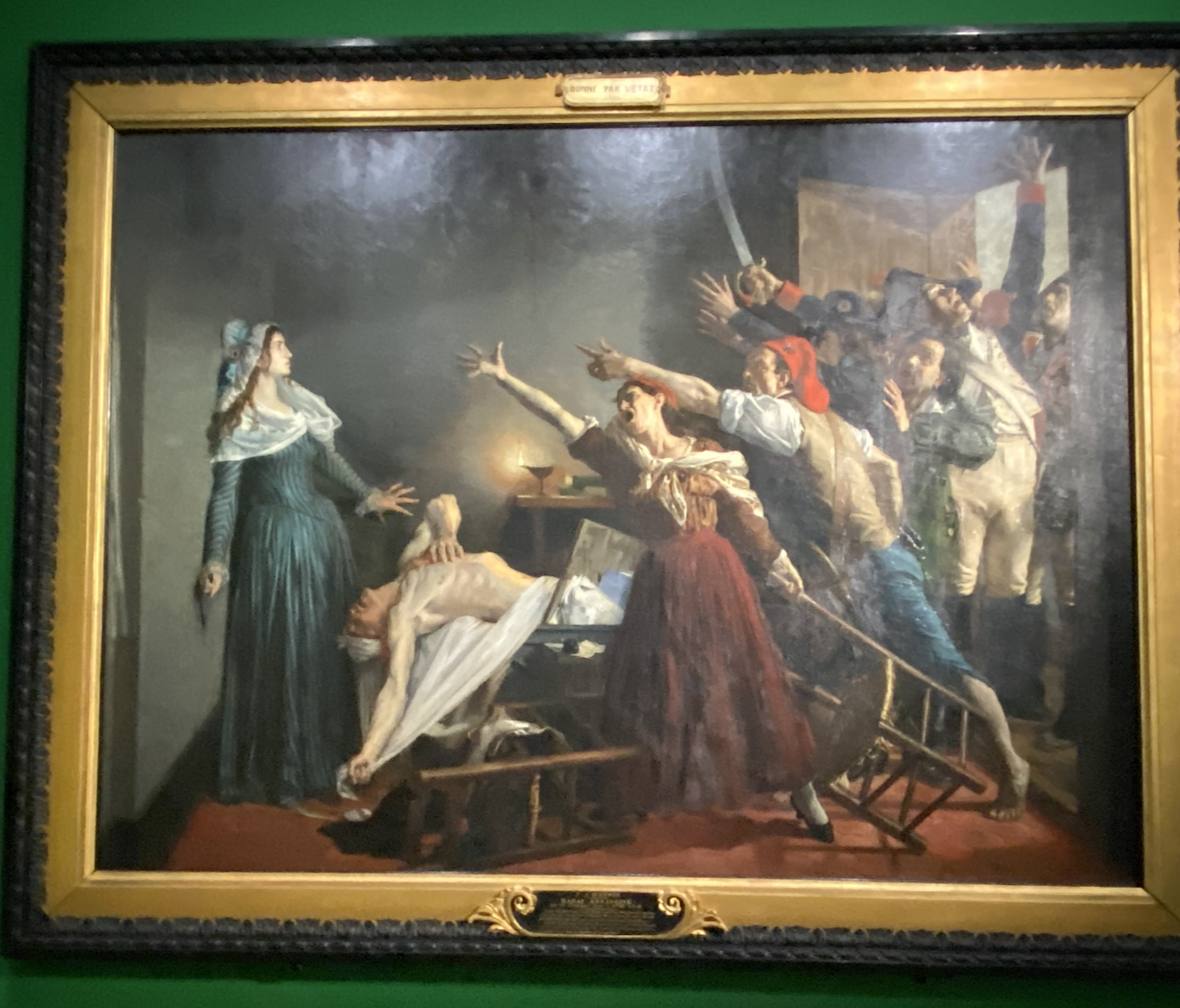
Marat assassiné ! by Jean-Joseph Weerts 1880
Simone lunges and attacks Charlotte and forces her to the ground with the help of Laurent Bras, who works with Marat. The neighbor across the way saw a chair being held in the air and attacking a woman, and rushed over to hold Charlotte down as Simone tried to tend to Marat, but it was too late.
Word of his death spreads quickly on the streets below. The police arrive and interview everyone in the apartment. The two were alone at the time of the killing, unlike many depictions in drawings and paintings, but Charlotte truthfully tells the facts and even why she did it. Quickly removed from the scene and taken to the police station, and by the end of the day, she sat in the Abbey prison down the street where Boulevard Saint Germain and Rue de Four cross.
Two days later, on July 15, Charlotte Corday was moved to the Conciergerie, better known as the Antichamber of death. In a few weeks, Marie Antoinette would also arrive. Charlotte’s trial was held on July 16. Earlier that morning, she wrote a letter to her father admitting to the entire crime, and with this one death, she would save “hundreds of thousands of citizens”. It was intercepted and used against her at her trial.
Court cases of this kind back then were a bit of a joke; they all ended the same way: at the guillotine. On Wednesday, July 17, at 8 am, Corday was sentenced to death, and the execution would happen in a matter of hours. Around 5 p.m., executioner Henri Nicolas Charles Sanson entered her cell to take her on the same walk he would do with Marie Antoinette almost exactly three months later.
At 5:30 pm, she was led up the stairs and into the Cour du May beside the courthouse, wearing the red shirt of a murderer. The streets are filled with angry people who want to see the killer for themselves. The less than two mile route took almost two hours; it’s basically a test run for the path the queen would also take to the Place de la Révolution (Place de la Concorde).
At 7:30 pm, the blade dropped, and the life of Charlotte Corday was over. Immediately following her death, an autopsy was ordered on her body, but not for the reasons you might think. The same officials who tried her in court couldn’t believe that a woman would pull off such a crime on their own and had to have been spurred on by a man or at least driven mad by one. So they called for a doctor to see if she was still a virgin or not. She was
On July 18th, Charlotte’s body and head were laid to rest at the Madeleine cemetery in pit number 5. Today, this is the Chapelle Expiatoire, noted for the final resting place of Louis XVI and Marie Antoinette following their own beheading and built after they were moved to the Basilique Saint Denis. The location of Charlotte’s pit is essentially where the chapel stairs are today. Charlotte’s bones are now mixed with the thousands of other Parisians in the Catacombs, but her skull has had another life and many different versions of who may have it or where it is.
In the hours after the death of Marat, Jacques Louis David was contacted to create a portrait to elevate the writer to that of a martyr. David had successfully done that at the start of the year for another man who would become the image of the Revolutionists.
Louis Michel Lepeletier de Saint Fargeau was a lawyer and served in the National Assembly. On January 20, he voted for the death of Louis XVI, and his own would come the same day. Later that evening, while dining in the Février restaurant in the Northeastern corner of the Palais Royal, Philippe Nicolas Marie de Paris, a former guard of the king, walked in and stabbed and killed Lepeletier for his vote against Louis XVI.
David had talked with Lepeletier the day before his death and was shaken by the death, and also worried for his own life. David wasn’t just an artist; he became a politician and an event planner as well. Not only was he crafting the image of the Revolution, but he also had to design the events that surrounded it.
On January 24, three days after his death, Lepeletier was placed high on a pedestal in the center of Place des Piques, today's Place Vendome, and draped with his bloody shirt. David created a portrait of the newest martyr of the Revolution shortly after his death, titled The Last Moments of Michel Lepeltier. Using the same general pose as Hector in his 1783 painting of the Sorrow of Andromache, which hangs in the Louvre. Following the viewing and funeral, he was interred into the Pantheon but removed in February 1795.
David had visited Marat the day before his death, just as Lepeltier had. I would imagine that with that fact, nobody invited David over for dinner ever again
The reaction to his death brought out high emotions, resulting in protests and marches throughout France. Fearing for their own lives, the members of the National Assembly called for a quick funeral and burial. Due to the heat and his skin condition, Marat’s body was rapidly decomposing, making the need for a speedy burial even more important.
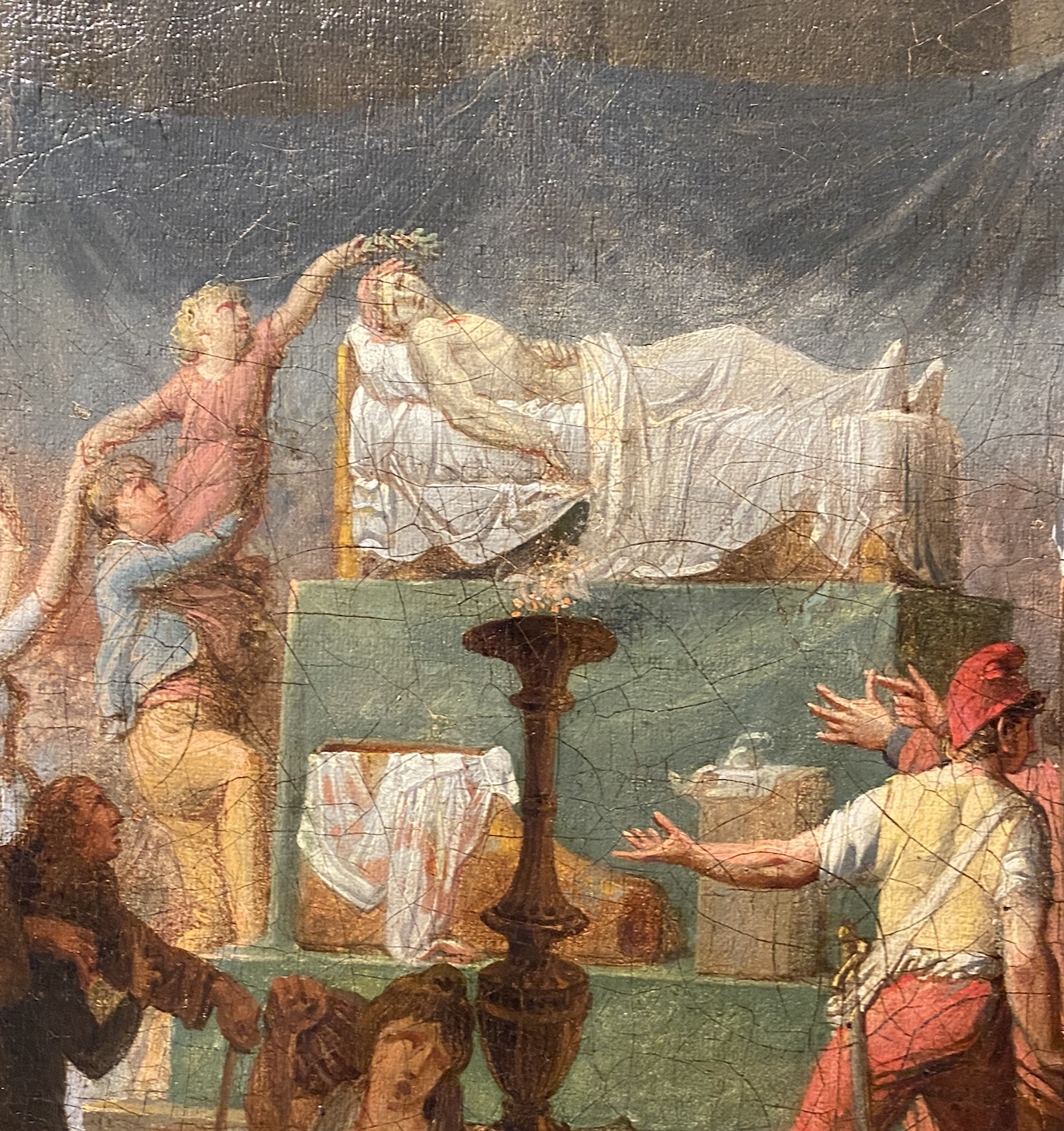
His funeral was planned for July 16 and designed by David. On July 15, his body was placed in the convent of the Cordeliers, steps from his front door. His body was in such a state that they covered it with a cloth, exposing only the knife wound. On the evening of the 16th, his body was surrounded by incense burners. It was still very hot in Paris, and they tried to mask the aroma from his body. Thousands of people lined the streets to see the body of the Friend of the People one last time. Just before the funeral parade was to start, the skies turned dark, and a lightning and thunder storm raged overhead, without a drop of rain.
On September 21, 1794, Marat was given the honor of Pantheonization and interred into the new final resting place of the great men of France. It wouldn’t last long. After the fall of Robespierre and the end of the Terror, the Convention wanted to erase any of the reminders of this period and the men who were elevated in death to its glory. On February 26, 1795, his body and that of Lepelletier were removed in the dark of night and placed in the cemetery of Saint Etienne de Mont.
While David began painting Lepeltier immediately, he waited two months before even starting Marat. This also allowed the gravity of the event and the painting's eventual meaning to settle, which can be seen as both good and bad. The political climate was so charged at the time, with the people on one side fearing for their own lives and political careers, and the other wanting to elevate Marat to sainthood.
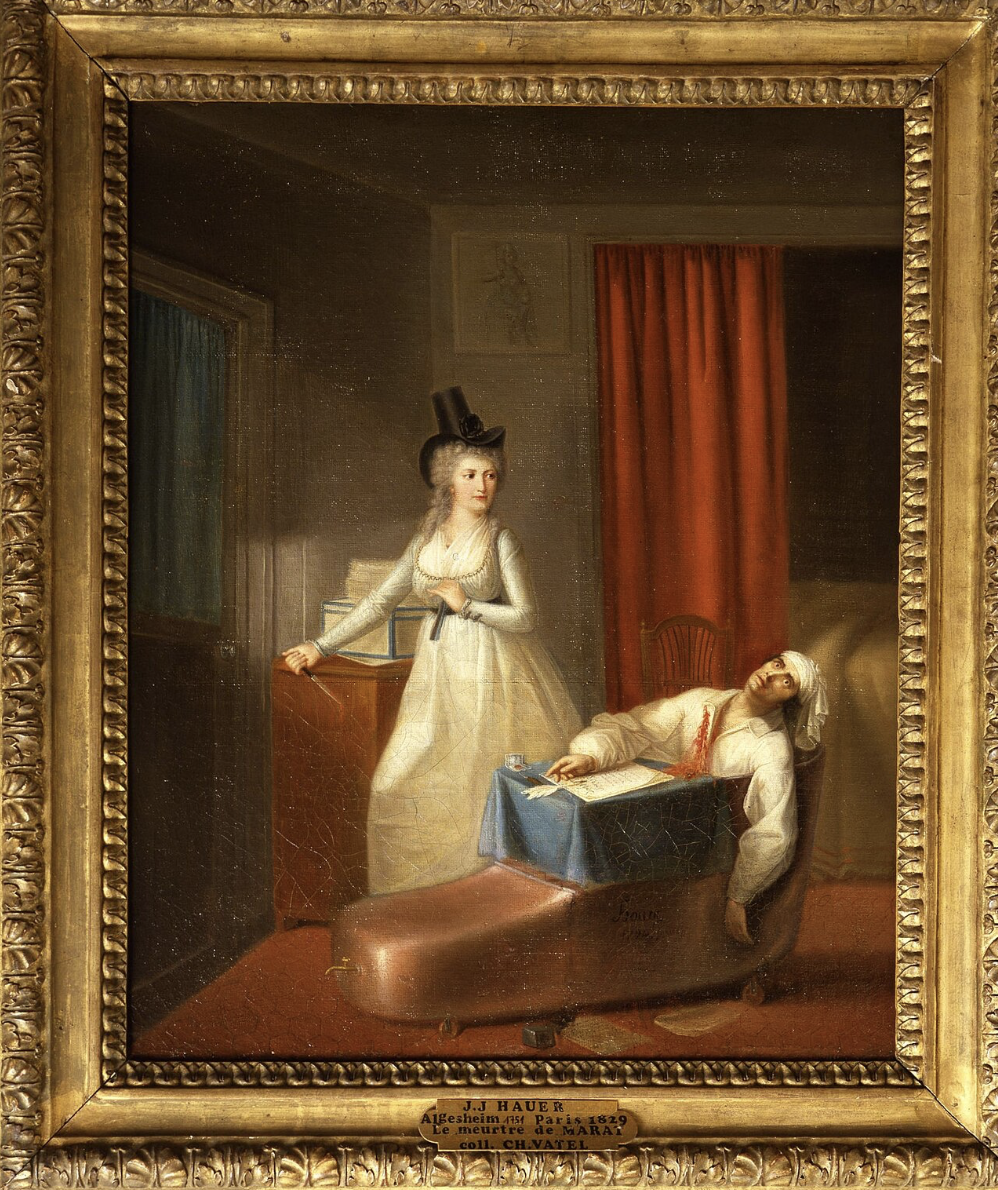
The first depiction of the murder was done by Jean Jacques Hauer and is held today in the Musée Lambinet in the city of Versailles. It was presented on August 10, 1793, in the newly opened museum that would come to be known as the Louvre. Although the victim and the assailant were in the room alone at the time of the murder, Charlotte is depicted as capturing the moments just after she strikes and kills.
In the months after his death, many artists depicted the murder, but only one artist had been to the home of Marat and saw his body in the hours after his death.
Taking his time, he finally completed the painting on October 14, 1793. A painting that is as much propaganda as it is historical and has become the very definition of the event.
David chose a simple scene, one that may seem unfinished but was also his way of letting the few elements speak for themselves.
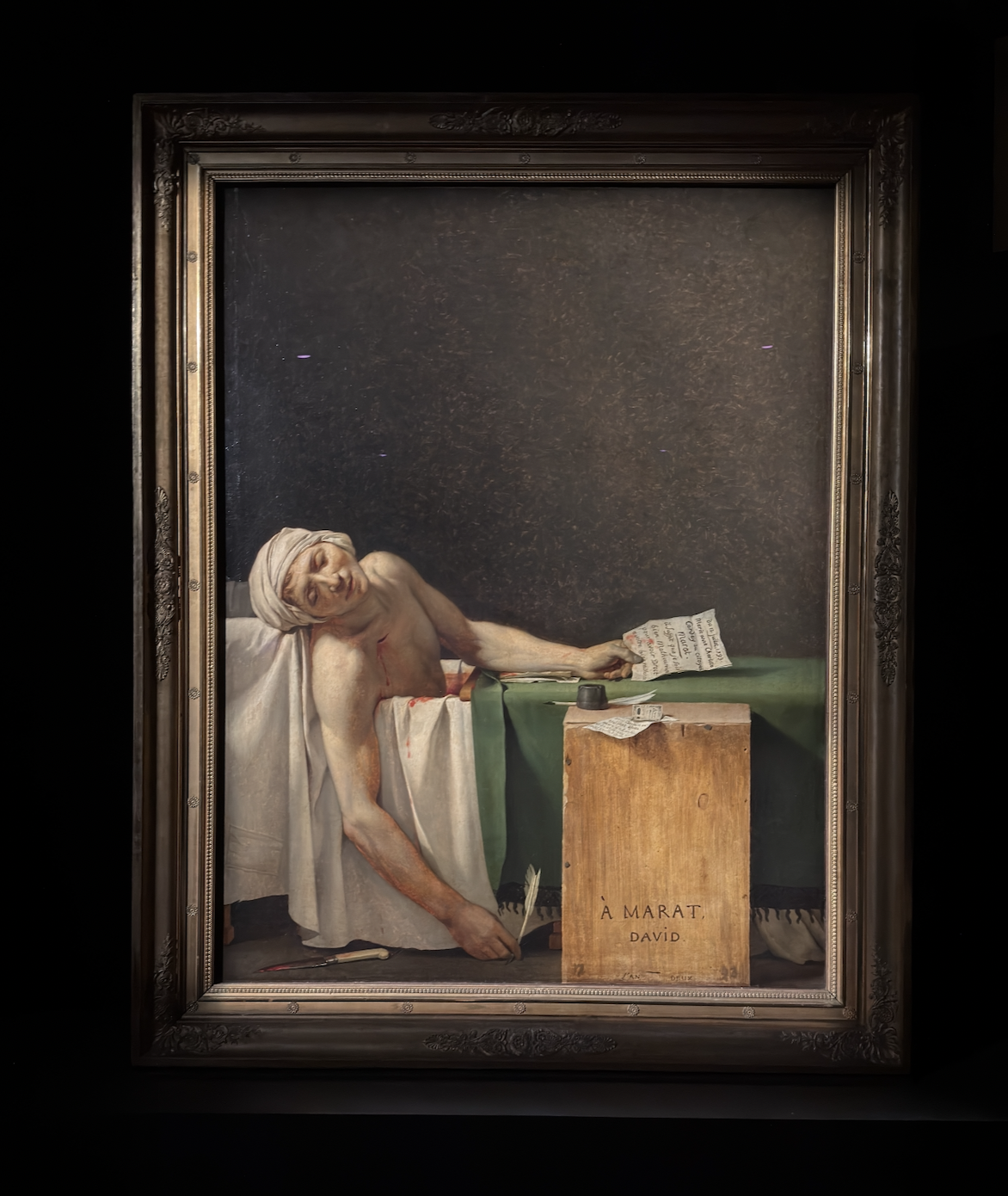
Marat is placed in his tub, soaking in his sulfur water to help alleviate the pain of his skin condition. Once thought to be syphilis, in recent years, they have been able to test the blood left on the letter he had at his desk. Marat suffered from a combination of atopic dermatitis, severe acneiform, and dandruff, but together they left horrible lesions and flaking skin.
A desk was created with a flat board and a small box to hold his inkwell and extra quills alongside. He would spend the majority of his days since the start of June in this bath and wrap his head in a cloth soaked in vinegar to help with migraine headaches.
David drew on religious imagery to depict the fallen martyr. The white turban becomes a halo, the white sheet on which he rests a shroud, and his arm dangling from the tub, a version of the pieta of Christ. The wound resembles the one Christ bore, which was touched by Saint Thomas. All subtle nods to something that then aligns this theme with something greater than just the political message.
David was cutting his teeth for what would come in a few short years with Napoleon.
The artist left Charlotte out in the painting, but she is still there, in a way. The knife rests on the floor, although David painted it with a white pearl handle rather than the black one it had. The green fabric was the color of the counterrevolutionists, the same color she wore in her hat, and the letter he clutches in his left hand was based on the one she presented to him that morning, or at least represented it and bore her name.
The painting was unveiled for the first time on October 16, 1793, and placed in the courtyard of the Louvre. In the center, a wooden pyramid was erected, and on either side, the painting of Marat and Lepeltier was displayed for anyone in Paris to see. That same day, a block away, Marie Antoinette would pass by, sitting on a box upon a flat board placed on wheels and pulled by horses. A symbolic choice of days to display the paintings, although these two men would later be seen as villains, not heroes.
A month later, on November 14, 1793, it was presented for the first time to the Convention and would remain in the presidential gallery until July 1794. With this painting, David captured a moment that would be carved in stone in the history of France.
The painting was turned into an engraving, and thousands of copies were made and sent to every corner of France to hang in government buildings. Four copies within the workshop of David were created under his watchful eye to be used as cartoons at the Gobelins to be turned into tapestries. (I have yet to find any of the tapestries online or in museums and none exist in the Gobelins collection)
In 1795, both paintings were returned to David, and he kept them until his death. The painting of Lepeltier was purchased by Lepeletier’s daughter, Suzanne, who had become the first orphan of the state in 1793. In 1826, she destroyed the painting and any other versions of it. All that remains today is a sketch by Anatole Devosge, created when he saw the original painting in David’s atelier.
After David’s death in 1825, friend and artist Antoine Jean Gros kept the Death of Marat and covered it with a layer of canvas, then sealed it with white lead to hide it. It wasn’t seen again until 1846. In 1886, after the death of JL David’s grandson Jules David Chassagnol, the original was donated to the Royal Museum of Belgium, where it remains today.
However, luckily, you can see the copies made in his atelier by his students to be used to create tapestries, in multiple museums in France, including the Musée du Louvre. Versions stay very faithful to the original, with only a few slight changes noticeable when all are together. At the Musée des Beaux-Arts in Reims, the box is inscribed with “unable to corrupt me, they killed me”. At the Musée des Beaux-Arts in Dijon, the box is blank, as is the one held in Versailles, but rarely on view. While the original in Belgium is simply marked with A Marat, David, and at the bottom L’an deux and 17 93 that has been smudged away.
Since then, Charlotte has been viewed more as a heroine and Marat as the villain. She is often depicted as a beautiful and strong woman, a 19th-century Jeanne d’Arc. It's a subject that still captures artists today.
I recently saw a version by Bernard Buffet done in 1977. In 1907, Edvard Munch depicted the two as lovers with Marat lying in a bed and a nude Charlotte standing in front holding a knife. And even Picasso gave it his own reimagined existence.
History is interesting, and art plays such a large role in how it is told. It is exactly why I love the Louvre so much and discovering all the stories held inside a painting. It is also interesting how time can alter the view of the event. At the time this was painted, Marat was raised to the highest realm of a saintly martyr, only to come crashing down within two years.
Time gives us the opportunity to see it from many sides and gain a better understanding of it. Today it is more important than ever to really look into these things the old-fashioned way, with reading and research and not AI.
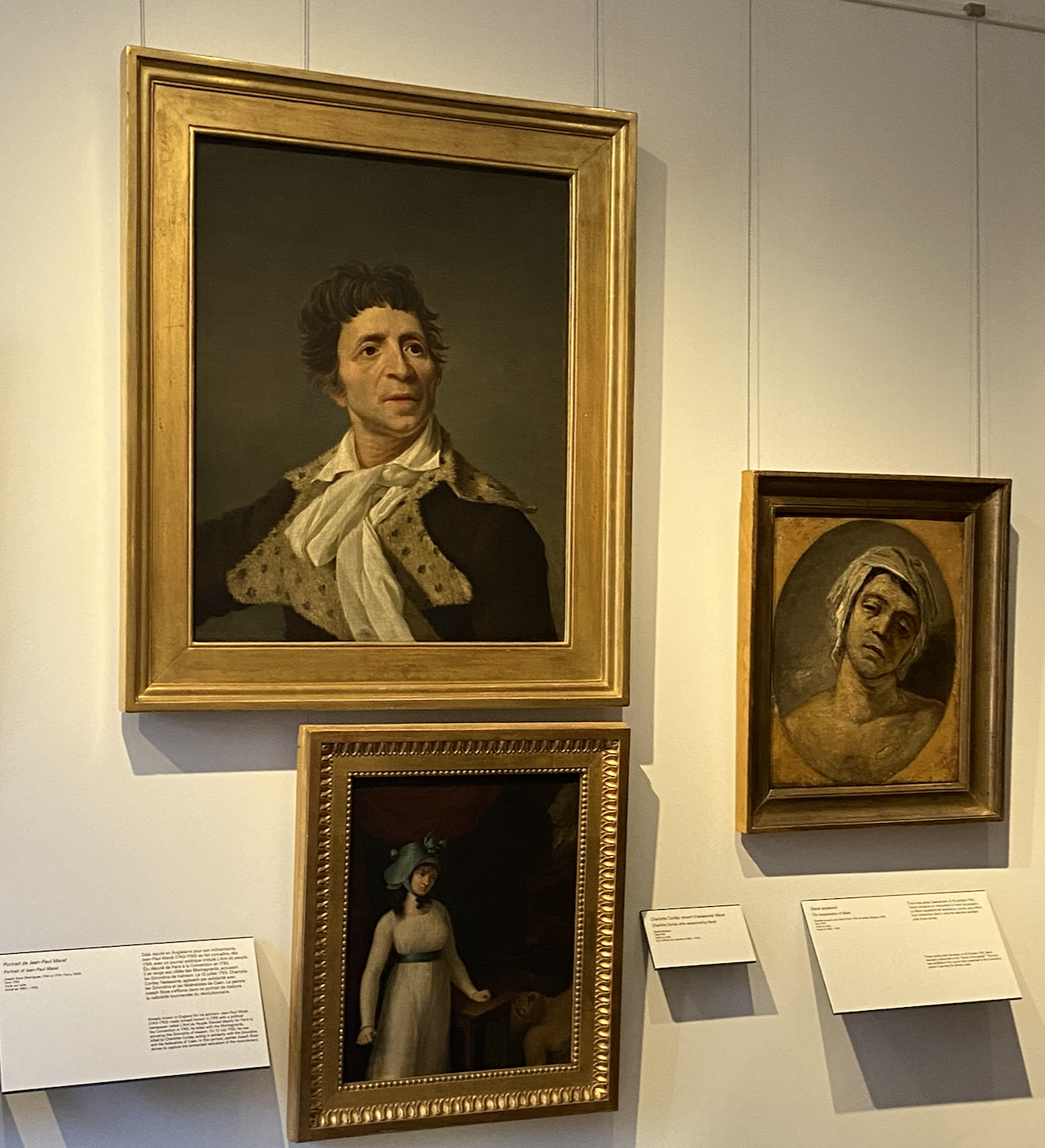
Musée Carnavalet
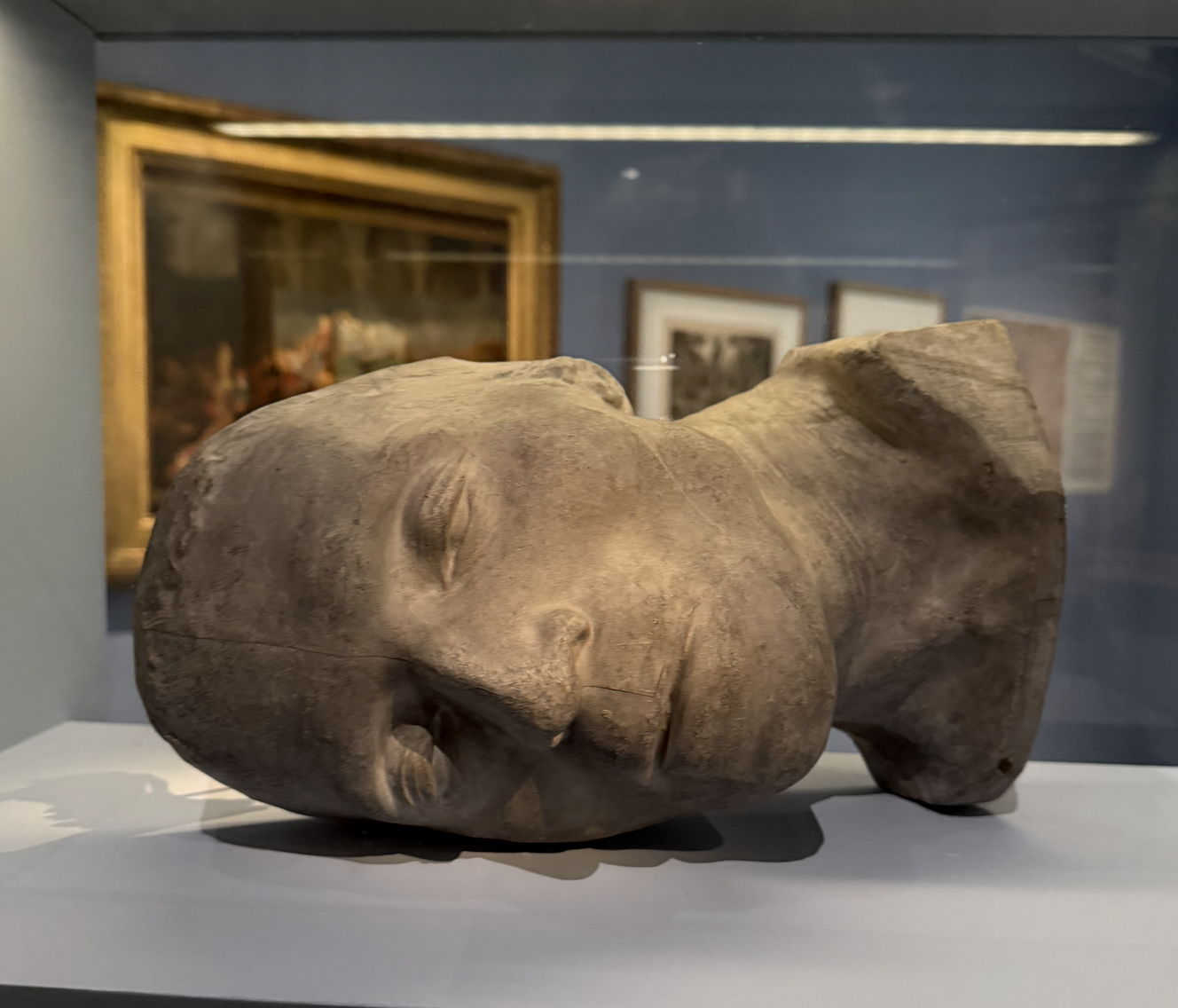
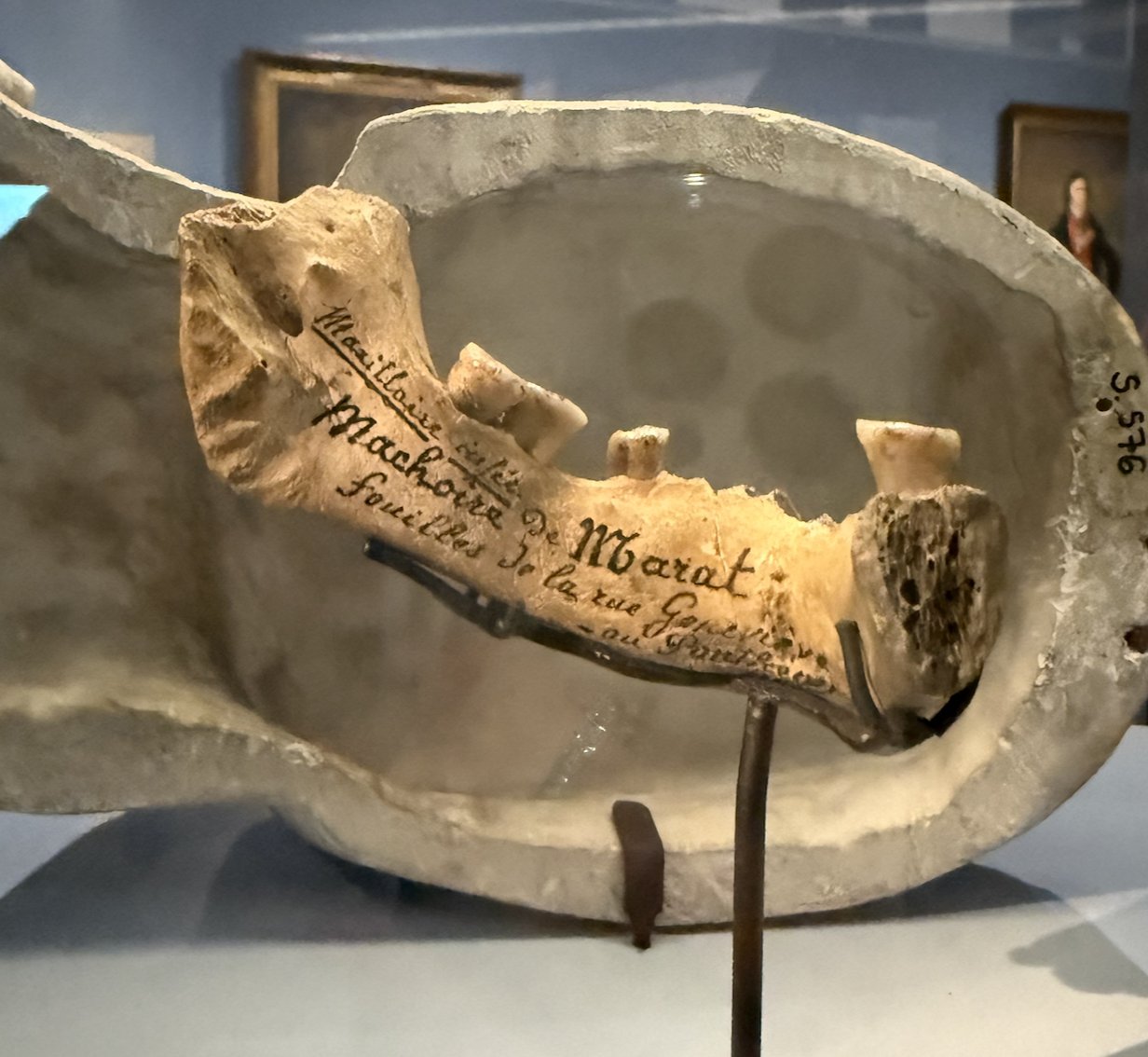
In Paris, you can find more on Marat and Charlotte Corday in the Musée Carnavalet, which also holds a copy of his death mask and even part of his jaw.
There are many reminders in the streets of Paris, especially in Saint Germain. Book a walking tour with me to uncover it all and relive the history on the very streets where it happened.
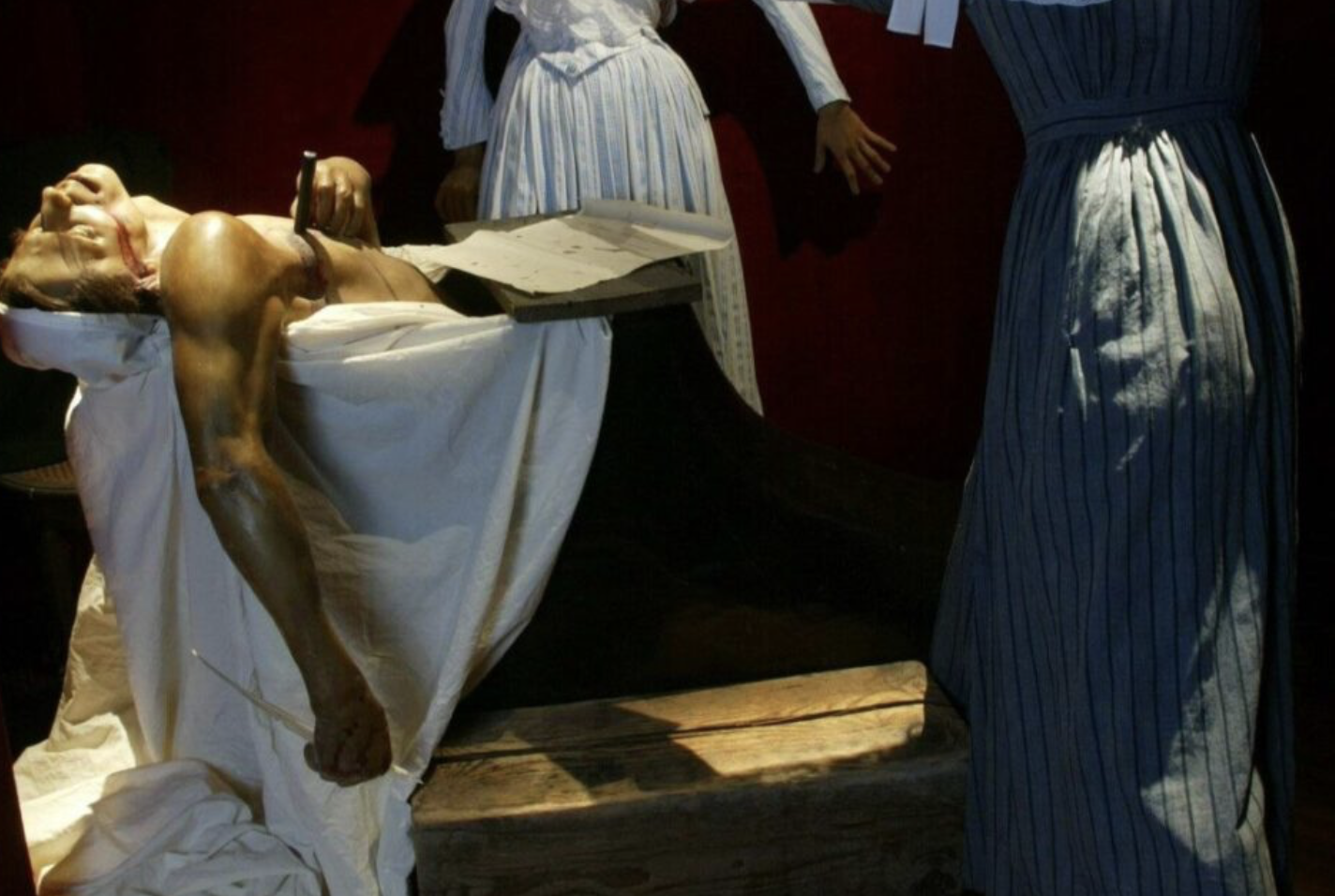
The bathtub Marat died in was later sold by his wife and remained missing until 1804, when it was purchased by André Augustin Capriol de Saint Hilaire in Paris from a scrap metal dealer. Capriol took it with him when he moved to Taverny, north of Paris. After his death, his daughter Marie Adelaide left it to the Abbé Joseph Rio upon her death in 1861. It was then passed to Abbé Le Cosse of the bishopric of Vannes and eventually made its way to the tiny island of Île aux Moines. Le Cosse liked to show it off to people, and word eventually spread, reaching the pages of Le Figaro on July 15, 1885. A year later, it was auctioned off and purchased by the Musée Grévin in Paris, where it is on display to this day.