Listen to the newest episode out now
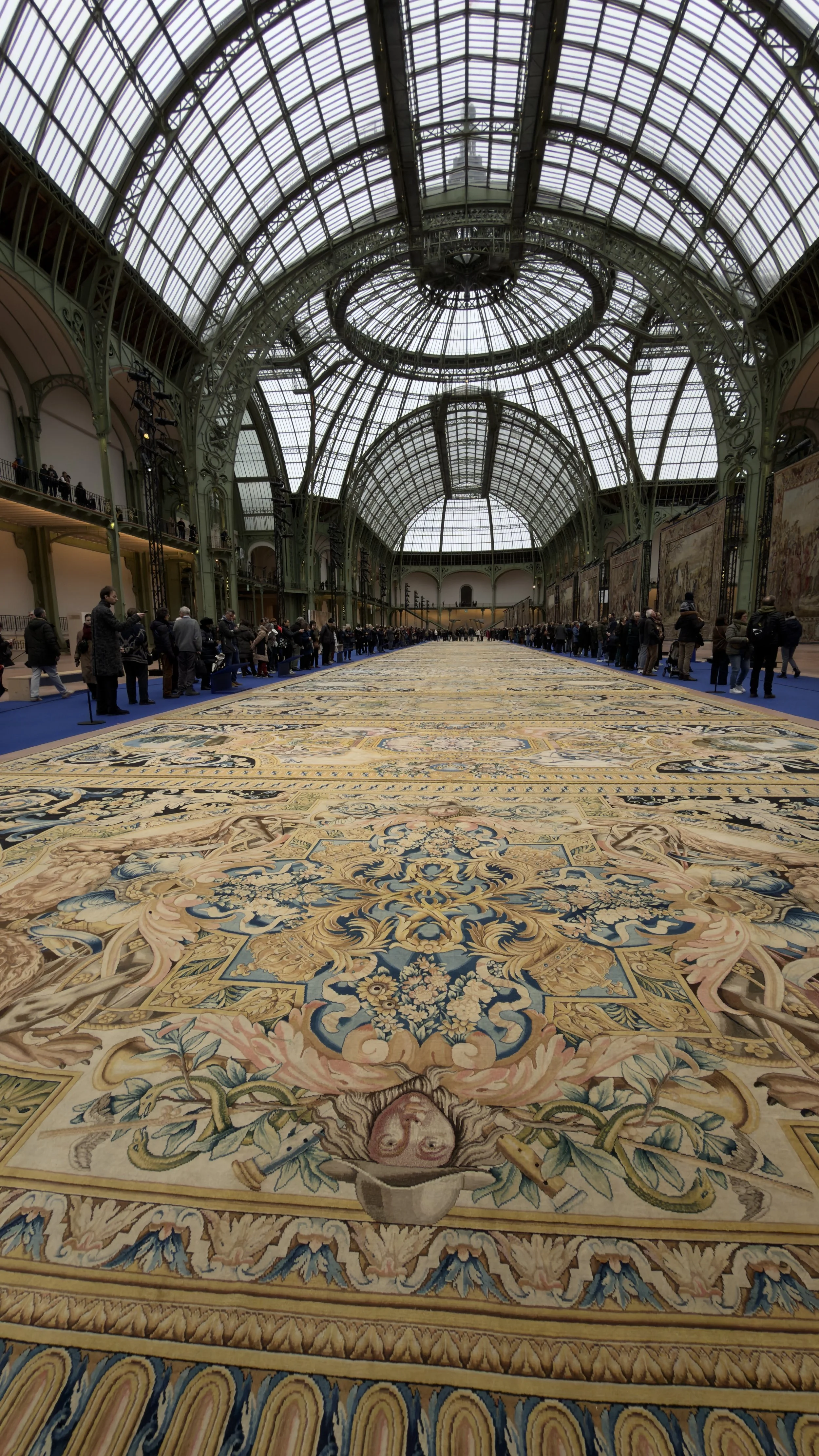
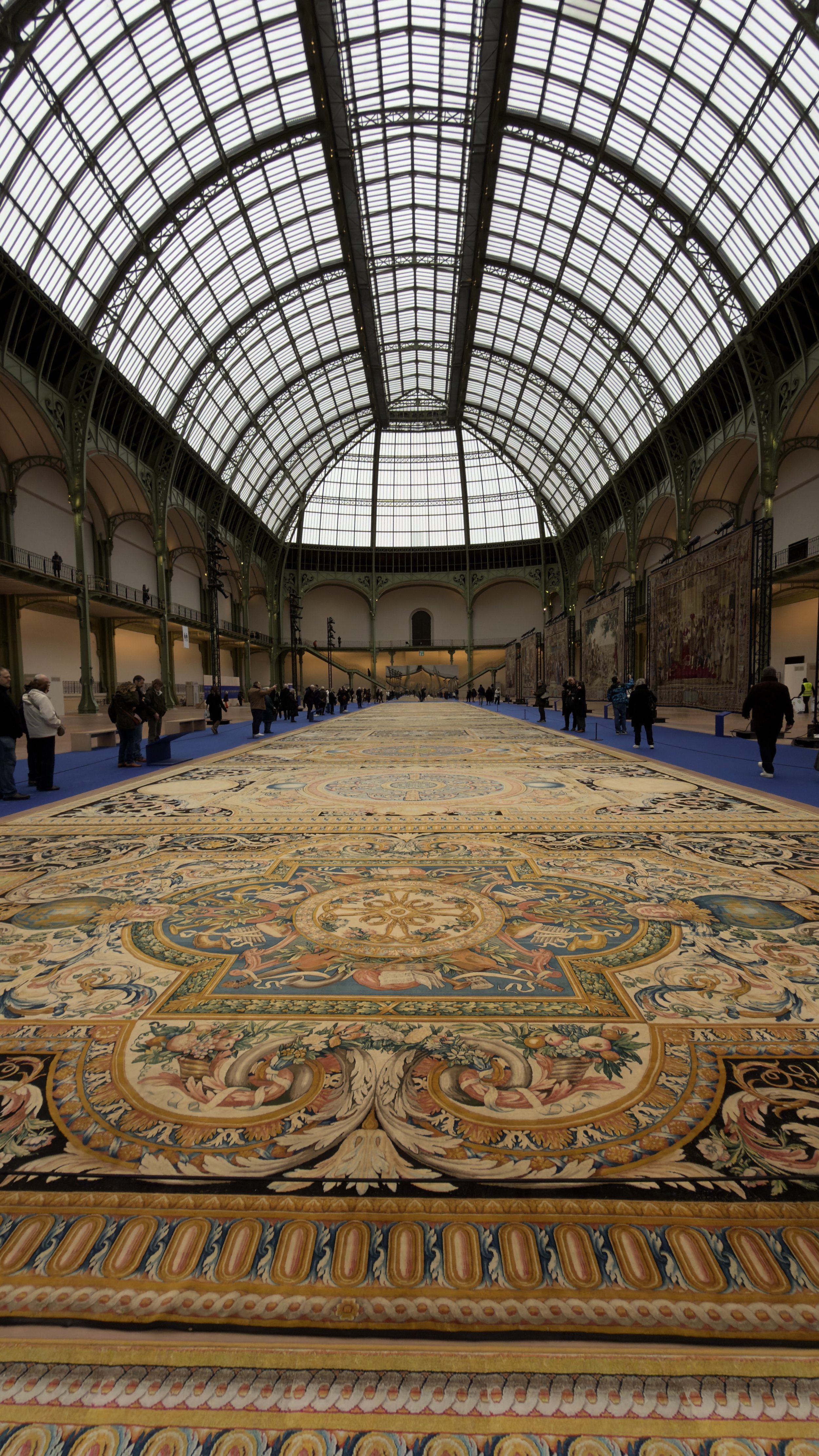
For just seven days, under the beautiful glass-and-iron roof of the Grand Palais, there is a sight that hasn’t ever been seen since they were created in the 17th century. Stretched out across the over 650-foot-long nave, thirty-one of the 93 carpets intended for the Palais du Louvre and created by Charles le Brun under Louis XIV are a sight to behold.
Louis XII died on May 14, 1643, the same date as his father, Henri IV, in 1610. Louis XIV was just four years old and unable to rule until he turned 13. In 1661, his coronation was held in Reims, a sight we will also see depicted in another special collection today. Raised with a taste of the good life, Louis wanted to be surrounded by beauty everywhere he went.
After his father's death, he grew up in the Palais Cardinal, today’s Palais Royal, which was far more contemporary than the dilapidated Louvre. After the Fronde and escape from Paris, he returned to restore the Louvre to the palace it deserved to be.
The Louvre in the 17th century was much smaller than it is today. The Middle Ages' fortress and palace were demolished by Francois I, and the current Louvre began to take shape under his son, Henri II, in the 16th century. Since then, each king or emperor added a bit here and there. Louis XIV was no different and added the rest of the Salon Carrée wing and Colonnade, although he fled Paris without putting a roof on it, but that’s a story for another day.
Inside, he had the lavish summer apartments created for his mother, Anne of Austria, and the Apollo gallery above it. The Adjoining Palais des Tuileries was also largely enhanced by Louis XIV, and the route to it from the Louvre needed its own little glow-up.
The Galerie du Bord de l’Eau, as it was originally known, was added by Henri IV to link the two palaces so the royal family and court could avoid the weather as they walked between them. It stretches above the Seine, covering 457 meters (1,500 feet) and is over a quarter of a mile long.
Henri IV began building it in 1595 and finally completed it in 1610, just before his death. Henri wanted the walls covered with landscape paintings of the French countryside by Jacques Fouquieres, but that would never come to fruition.
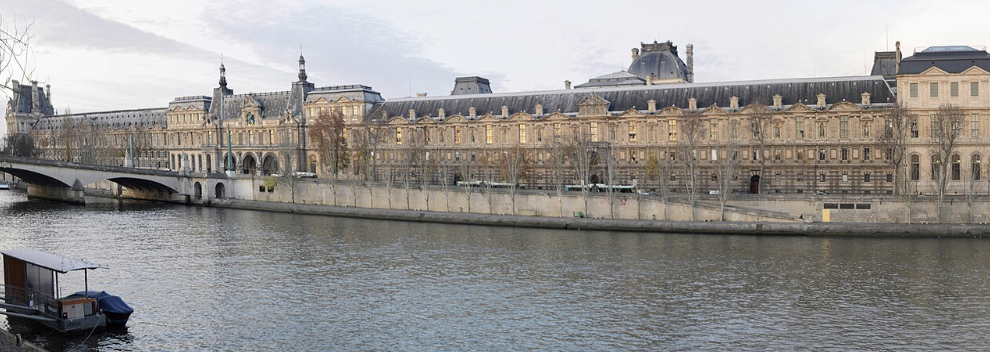
As a child, Henri’s son, Louis XIII, learned to hunt in the long gallery where they brought in a horse, dogs, and foxes, and at one point, a camel was found galloping through the never-ending corridor. On rainy days, he tied a small carriage to his dogs that raced him to the Tuileries.
In 1641, the corridor ceiling was to be embellished by French artist Nicolas Poussin and architect Jacques Lemercier with scenes from the life of Hercules, a figure who plays an important role in the history of the Bourbon kings. Poussin ran into one hurdle after another, many self-inflicted, and returned to Rome, and the project was abandoned.
Twenty-one years later, in 1662 Jean- Baptiste Colbert sent a sealed and private request to the Ministry of the Marine asking for a very large carpet. Specifically, a Turkish-style, hand-knotted carpet. The Turkish rugs were more durable and made with wool and linen, and a bit more plush than the Persian style. Colbert never received his carpet, so he had to create his own. An initial order placed in August 1662 for thirteen carpets to fill the floor of the Petite Galerie was just the beginning.
The following year, in 1663, Louis XIV established the Garde Meuble and appointed Gedéon Barbier du Metz as its guardian. This action, in turn, put a greater importance on all the treasures of the crown. The furnishing of the many chateaux and palaces, furniture, tapestries, and even the crown jewels all fell into this important category. It was then that the Palais du Louvre moved to the top of the list and needed revitalization.
In 1668, Louis XIV resumed the project his father had abandoned to recreate and restore sections damaged during the Fronde and the 1661 fire. Architect Louis Le Vau used Poussin's designs, added his own touches, and handed over the work to a team of sculptors and artists to embellish the ceilings and walls of the Bord de l’Eau.
In 1668, the most ambitious project was intended to cover the entire length with carpets. Jean Baptiste Colbert orchestrated the king's project and offered his own vision, and commissioned the largest single carpet project in Europe. Colbert dictated the size of the carpets but left the rest to painter and decorator Charles Le Brun. Le Brun conceived the concept and instructed multiple artists to design each of the over 80 carpets; a few were duplicated.
Baudrin Yvart and Francois Francart developed the overall designs and theme under Le Brun's instruction. Other artists, including Nicasius Bernaerts, Jean Lemoyne, aka Le Lorrain, Jean Baptiste Monnoyer, and Pieter Boe,l worked on the animals, fruit, and flowers. Abraham Genoels painted each landscape.
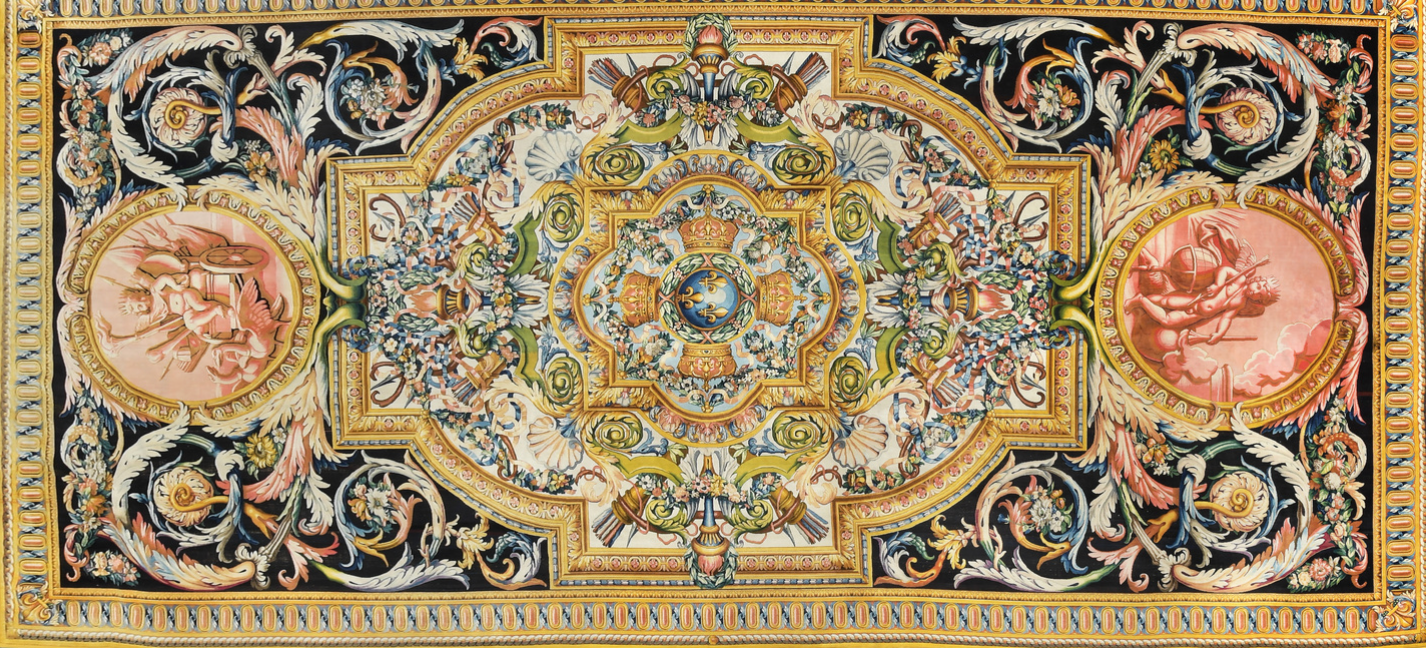
Each carpet features a large central compartment with an architectural border and, on either end, a cartouche depicting either a landscape scene or a bas-relief cameo of an allegory in light pink, ochre, or pale blue.
Virtues of the king, including authority, tolerance, fortune, vigilance, and peace, are all depicted by allegories. Religious virtues as well as love, hope, and generosity. The four elements are air, wind, earth, and fire.
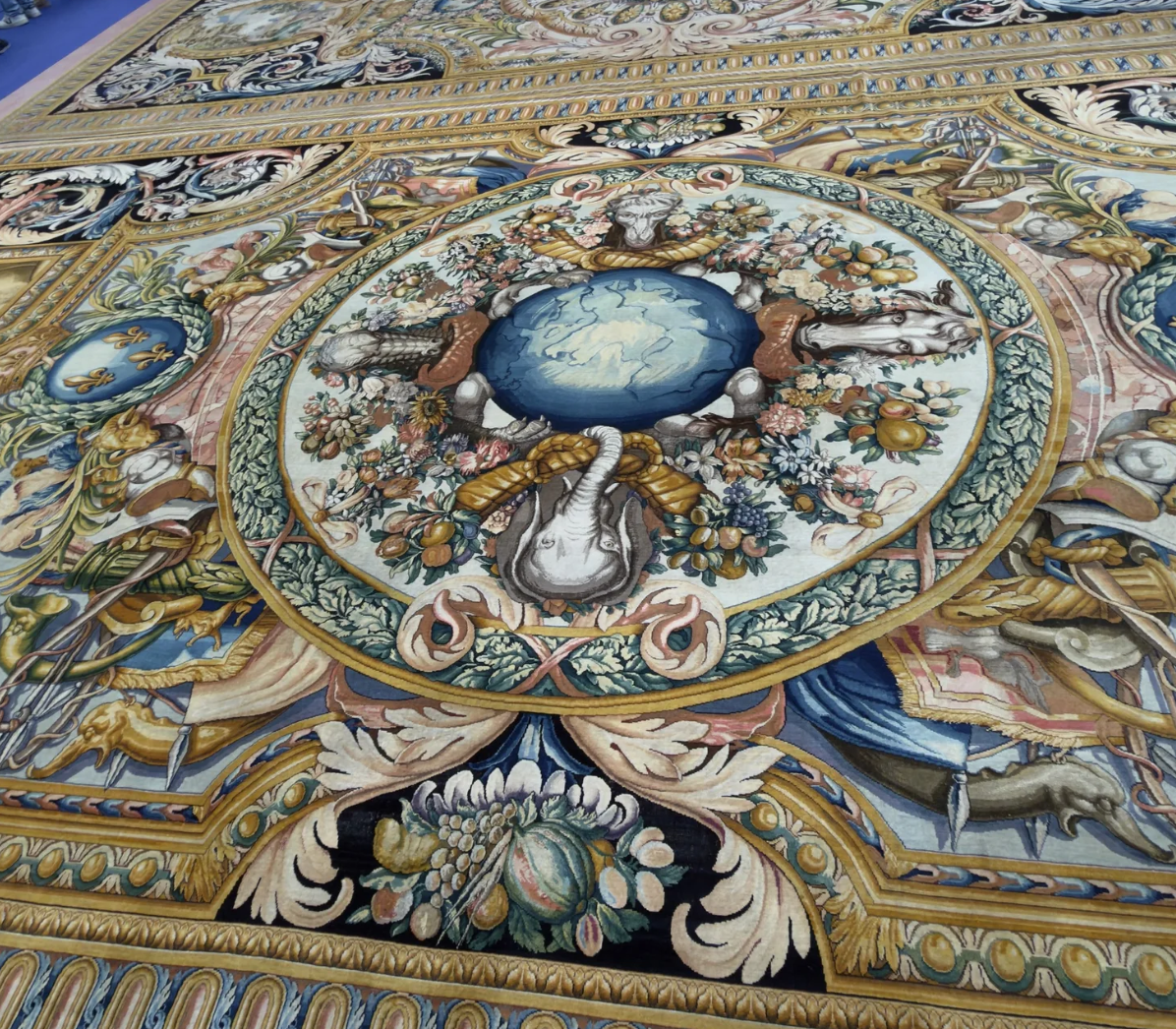
Carpet number 46, Earth is my favorite with the four corners of the world. In the center, a globe is surrounded by animals that represent the four parts of the world. A horse for Europe, a camel for Asia, a crocodile for the Americas, and an elephant for Africa. On either end, Ceres, the goddess of agriculture, on one side, and Bacchus, the god of wine, on the other. However, this one holds a hidden treasure that none of the others do.
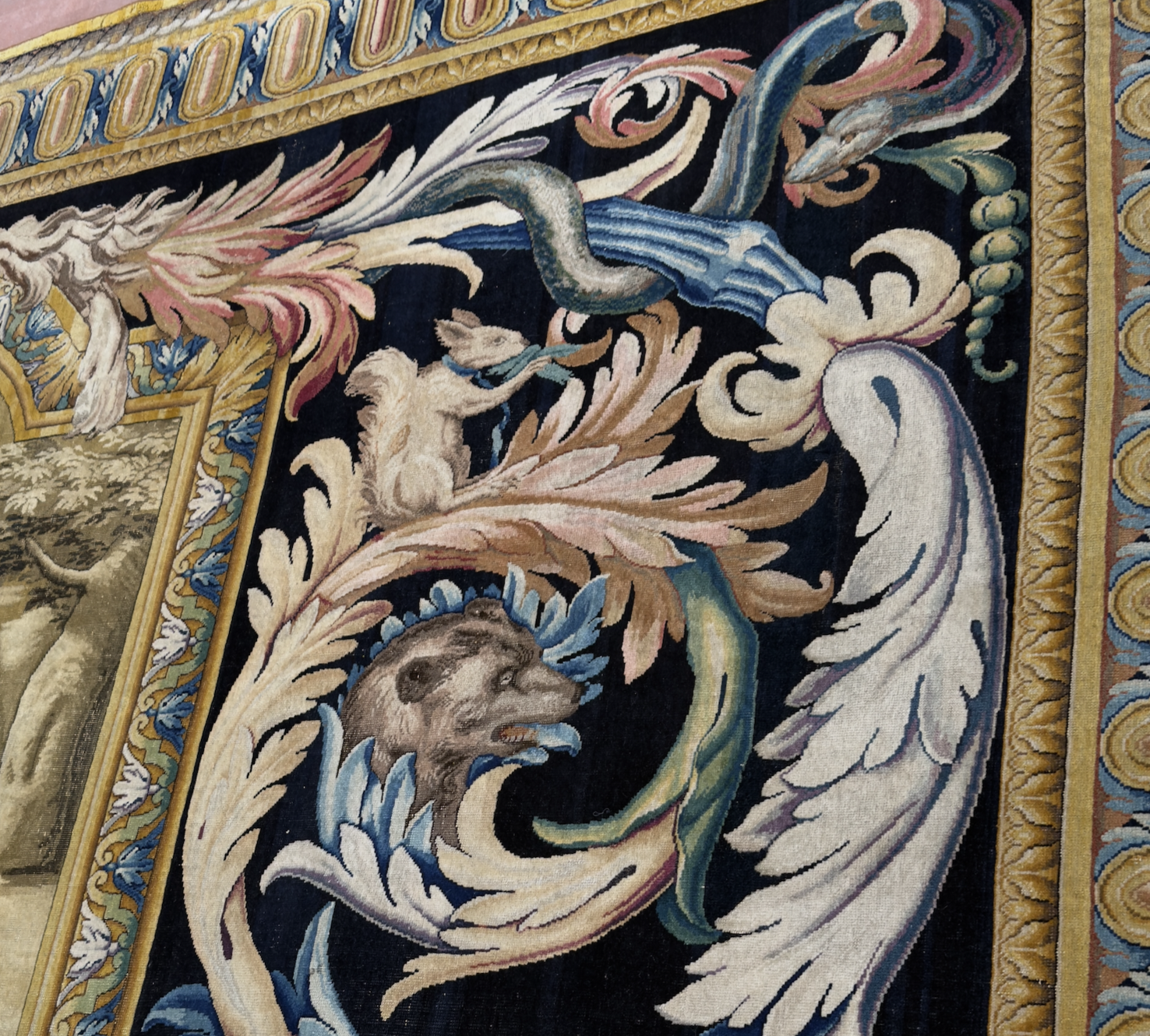
In each corner, the artist added a snake that is winding its way around the acanthus leaves, ready to attack the sweet little squirrel.
Nicolas Fouquet, the Superintendent of Finances, was the richest man in France; he even had more money than the king. He married well twice and amassed vast fortunes, as well as his own family's money. On August 17, 1661, Fouquet threw a little soiree at his newly built chateau Vaux le Vicomte and invited the boss, Louis XIV, to attend. Louis arrived with more than six hundred people as well as Jean Baptiste Colbert.
Fouquet wanted to impress the king and pulled out all the stops, including fireworks, fountains, and the finest cuisine of the day by François Vatel. Moliere presented his play Les Fâcheux for the first time ,and Jean de la Fontaine read his many fables.
The beautiful chateau was designed by architect Louis Le Vau, painted by Charles Le Brun, and the gardens by Andre Le Nôtre. Colbert was so distraught that he started to lay the suspicion on the king that the only way he could afford this had to have been from stealing from the royal coffers.
On September 5, 1661, the king's birthday, Colbert had Fouquet arrested and all his property seized. He even took his artists who designed his home. It’s no small coincidence that the plans for the Chateau de Versailles exploded at this point and became far more elaborate.
The coat of arms of the Fouquet family is of a single squirrel, Fouquet meaning squirrel in old French. And you guessed it, the coat of arms of Jean-Baptiste Colbert was that of a snake. Colbert had that added into the carpet that sat in the very center of the Grande Galerie.
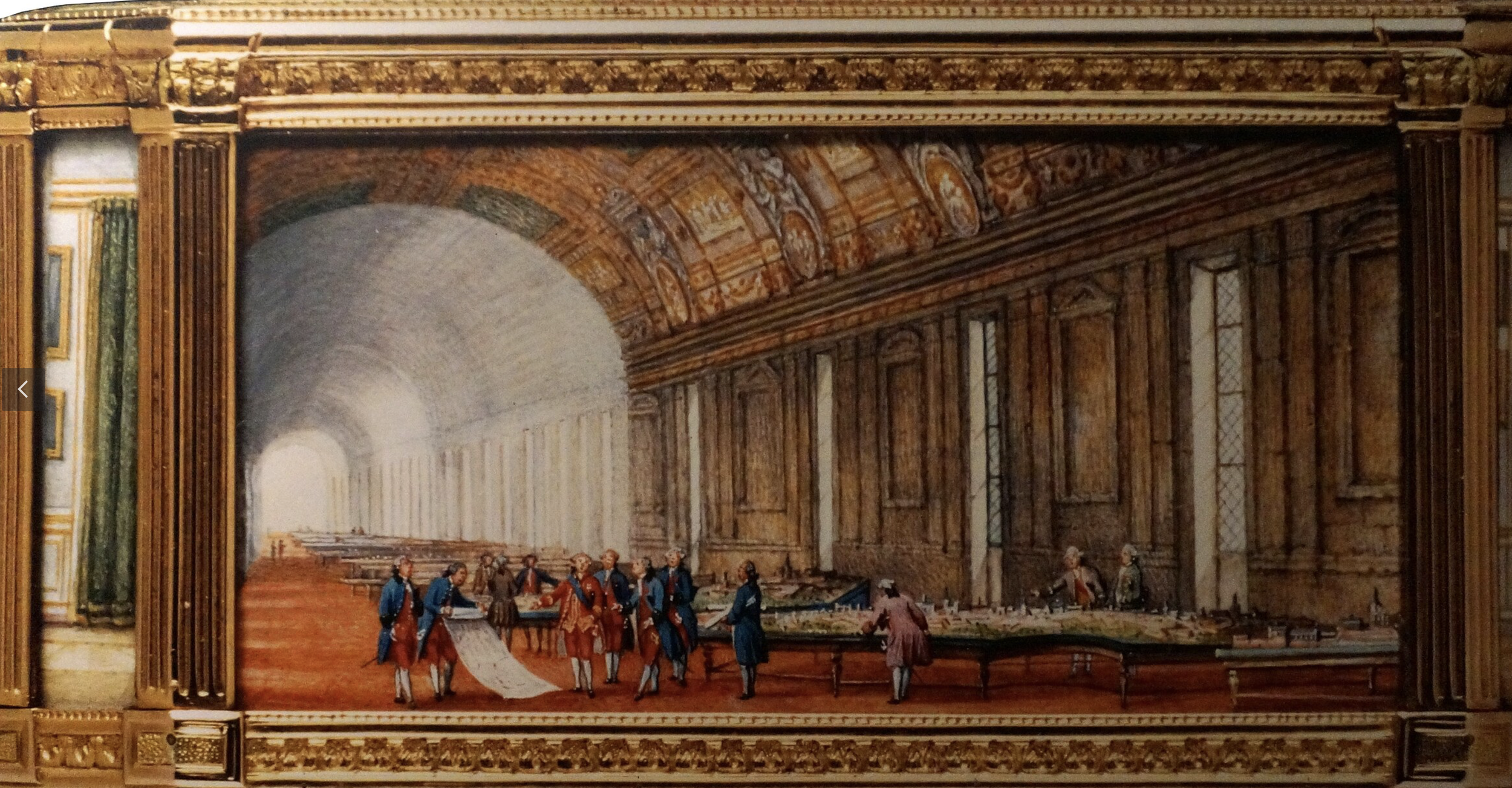
For the landscapes, no details on exactly what each one represents were also brought in. At the time, the Grand Galerie stood on its own and stretched above the Seine with windows lining the entire corridor. Under Napoleon III, sections were added, including the one where the Mona Lisa is now. In the 17th century, the only source of light was from the windows on either side. The windows above us today were not added until the 19th century.
The intention was that the royal court could stroll down the galerie, taking in the sights along the way. The Seine below, and what was actually many homes on the courtyard side. However, if Henri IV had his wish, the walls would have been covered in the landscapes of France.
Once the designs were complete, it was time to begin construction of this monumental project.
The process is inspired by the Turkish and eastern weaving techniques. On a vertical upright loom, two massive fir trees held the yarn for two layers of wool warp threads that went top to bottom. Each row of knots is secured wth the colored weft linen thread that goes horizontally. They are then compacted together to create a tight, secure design and cut with angled scissors to form the dense pile.
It was under Hot Legs Henri, as I affectionately call him, that the art of weaving tapestries and carpets arrived in Paris. Seeing the success in Italy and in Lyon, he wished to establish the art of silks, furniture making, and tapestries in Paris. First, he designated the eastern part of the Marais for factory construction, but few factories were built. Next, he set out to find artisans he could bring in to build the craft at his feet.
In 1608, Pierre Dupont, who claimed he was trained in the art of making Turkish and Levantine style of rugs, was named “carpet maker to the king”. His atelier was established on the ground floor of the Louvre, just below the Grande Galerie itself. Henri loved his designs so much that he kept them all for himself and requested more than Pierre could keep up with.
Teaching his craft to students, an exceptionally adaptable young man, Simon Lourdet showed a talent for weaving. Members of the court would visit their atelier and marvel at the designs, thinking they were looking at a painting.
Dupont and Lourdet continued working in the atelier after the king's death. Marie de Medicis, now regent for her young son Louis XIII, wanted to establish and grow the industry. In 162,6 Marie named Simon Lourdet as her official carpet maker and set up a large atelier for him in the former soap factory along the Seine, a short walk from the Louvre.
Dupont was enraged and took it as a betrayal. Fights, public disputes, and lawsuits continued until the two died, and then the battles continued through their sons, who took over each atelier.
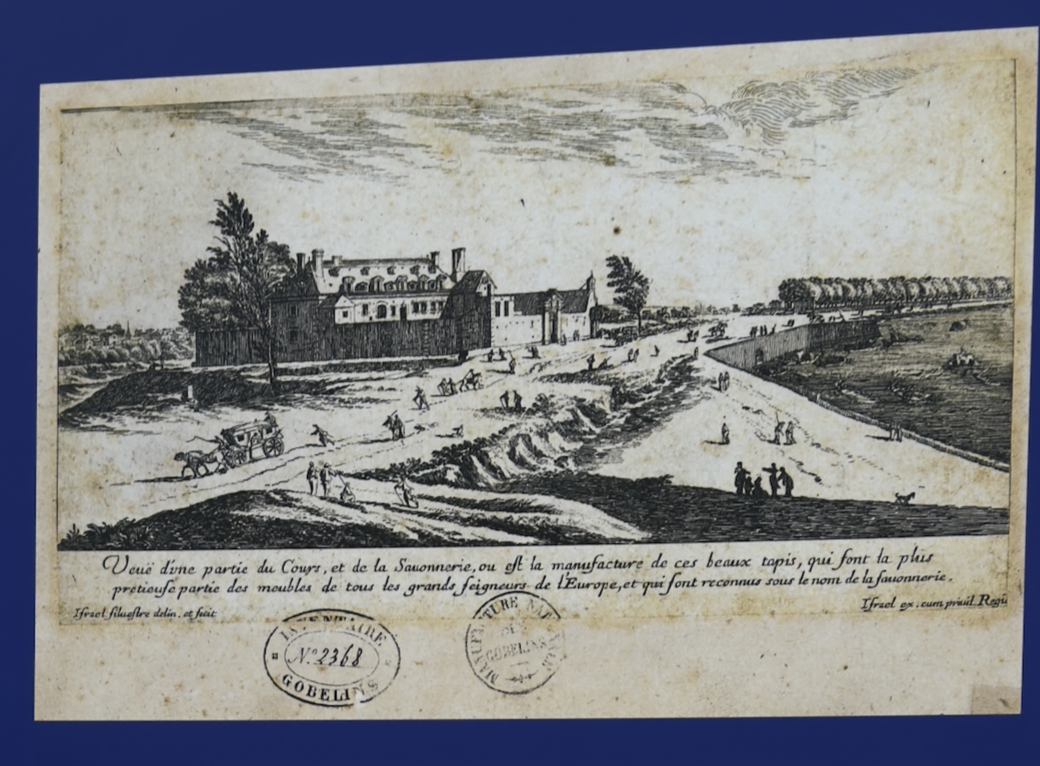
The Manufacture Savonniere, established in 1628, moved into the former soap factory on the hill of Chaillot, where the Palais du Tokyo and the Modern Art museum are today. Under Marie de Medici, it had been turned into an orphanage after the soap factory, and when a larger space was needed for the Lourdet atelier, it was a perfect location, with a built in work force.
There are a few times when I'm doing research and getting very deep into it that I find things I wish I hadn’t known. The real and unvarnished lives of Chanel, Gertrude Stein, and Simon de Beauvoir, to name a few, and my dislike for them runs deep. And now we can add this little gem of a fact about Marie de Medicis. I covered her in the old podcast many years ago and will update her story again soon, but let’s just say she wasn’t known for being a wonderful woman or loving mother, and now we can add another layer.
To bring these massive tapestries to life, many hands were needed. Shall we say little hands? Supplied by the Hopital Général, orphans aged 9 to 13 worked and trained as apprentices in exchange for housing, food, and clothing. Marie thought it was a good way to keep the orphaned children from entering a life of begging or crime.
At any point over the twenty years it took to fulfill the order of the 93 carpets of the Grande Galerie, as well as the 13 for the Galerie d’Apollon, more than fifty weavers worked at one time. A later report established in 1713 looked at the same period of 1664-1673, which covered part of the creation of the carpets; 283 children escaped or died.
In 1671, with both the Dupont and Lourdet descendants now in charge of each of the ateliers and the family war over, the two joined together in the Savonniere to continue work on the grande galerie carpets.
After the death of Simon Laurdet, his son Philippe had taken the helm, and after his death in 1719, his wife Jeanne Haffrey Laurdet led the way, and under her leadership, 65 of the 93 carpets were created, and a majority of what you see in this very special exhibit.
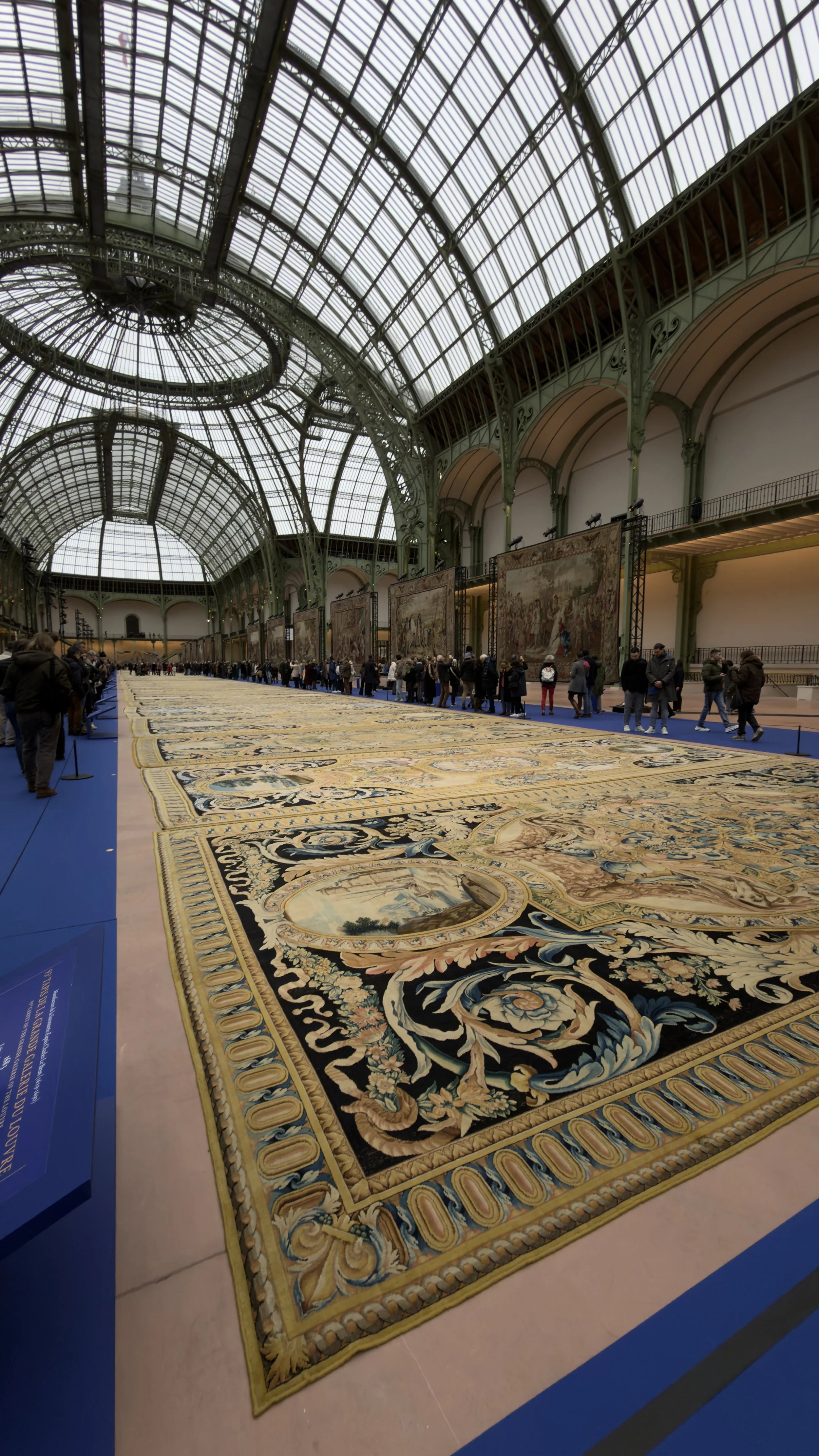
It took over twenty years to finish this monumental task in1689. Louis XIV left Paris in 1682, moving his entire court to Versailles. The carpets were all but forgotten and no longer needed. They never arrived at the Louvre or rolled out into the Grande Galerie. Louis XIV and, later, his grandson, Louis XV, used them as diplomatic gifts, distributing them across Europe and Asia.
In 1789, during the Revolution, many were sold, given away, cut up or just forgotten and lost.
Napoleon revitalised the Gobelins and sought to restore French grandeur. While few could afford to have large tapestries and carpets made, the Emperor kept the looms moving with new orders and restoration of the many carpets of the Sun King he found and purchased, where they could return home, at least to France if not the Grande Galerie.
Over time, they have been used in the Elysees Palace in the private and public spaces, multiple French embassies around Europe, and other government offices.
Today, the Manufacturers National has 41 in its collection, including eight fragments. Carpets that big need a very large space to spread out, and when they were gifted or sold, many were sadly cut to fit smaller rooms.
Carpets today are scattered around the world in museums and private collections. The Musée Camondo has #50, representing Air, one of the four elements. The center includes four winds blowing trumpets, and on either end are the bas-reliefs of Juno and Aeolus, god of the wind.
Since 2023, the tapestries have undergone an intense study to look at their iconography, provenance, and current state for restoration. `
If you miss this once-in-a-lifetime exhibit this week ,you can see two within the Louvre. Both should return to display after the exhibit. You can find them in salle 602 and 603 on the first floor of the Sully wing.
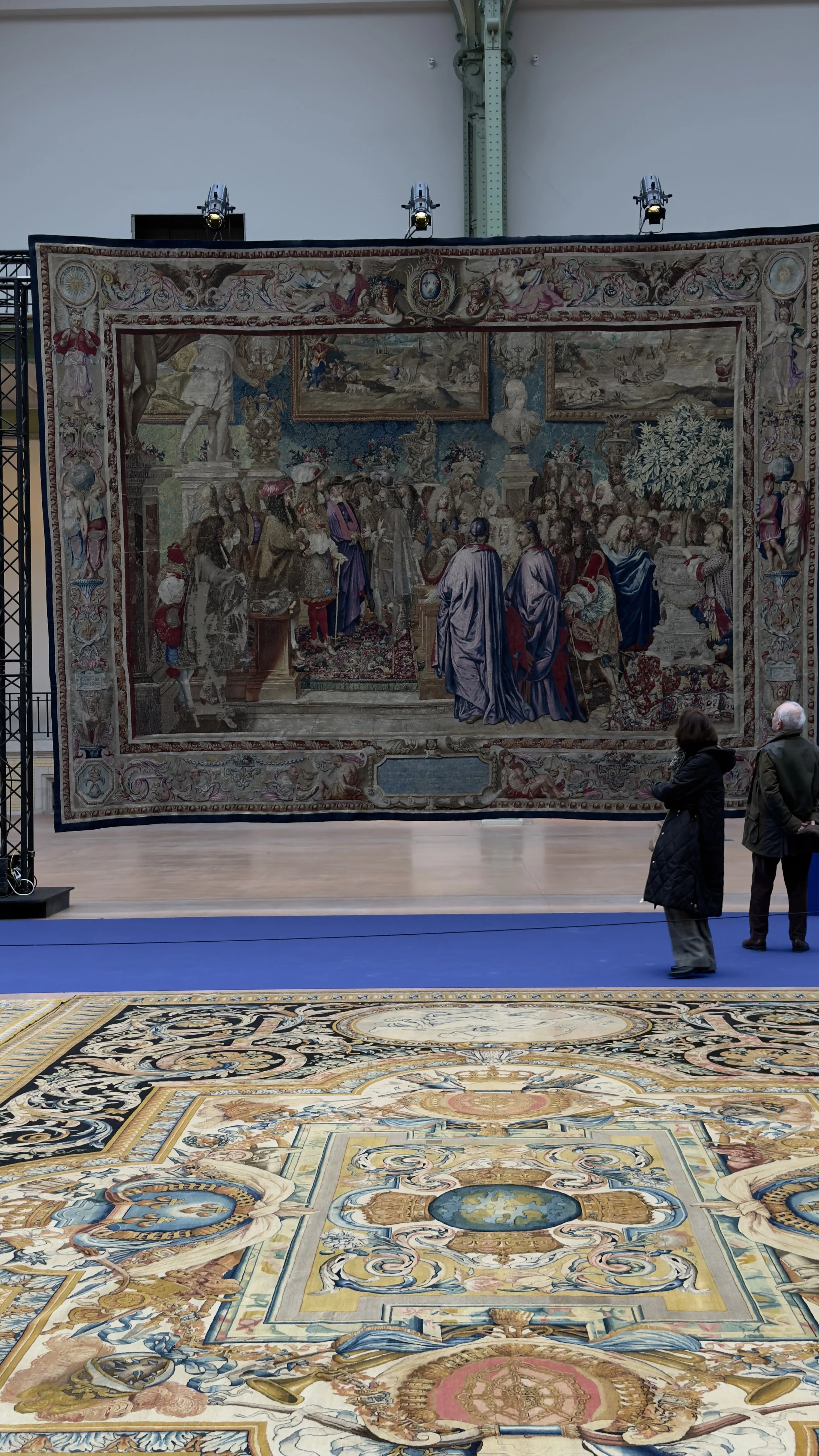
Also on display were 14 tapestries of the life of the sun king, created, and one of the carpets of the Apollo gallery. More next week
The exhibit runs until February 8th and is free, but a ticket is required. Open every day from 10 am to 7:30 pm on Tuesday, Wednesday, Thursday, and Saturday, and until Midnight on Friday, the 6th, and until 4 pm on Sunday, the 8th.