
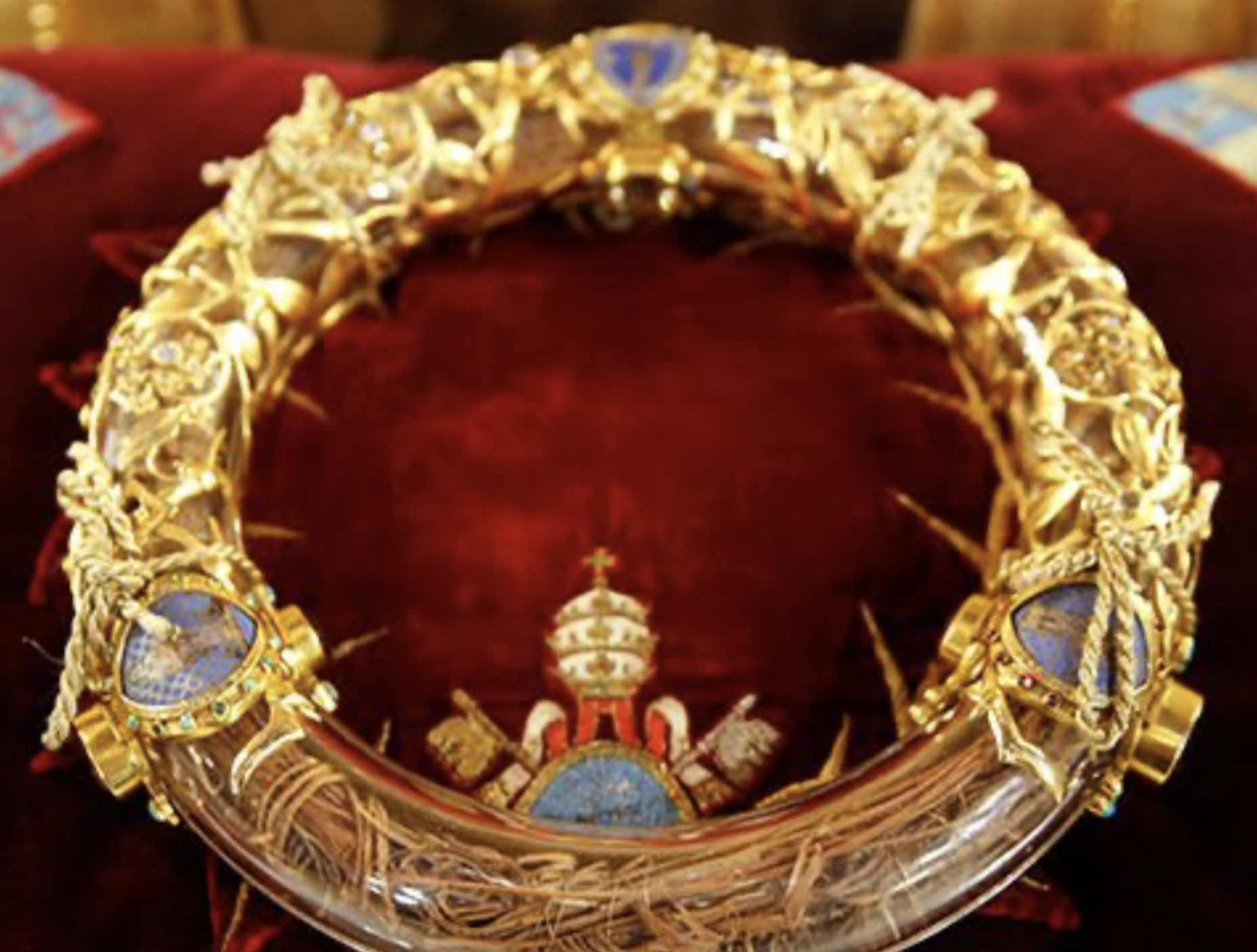
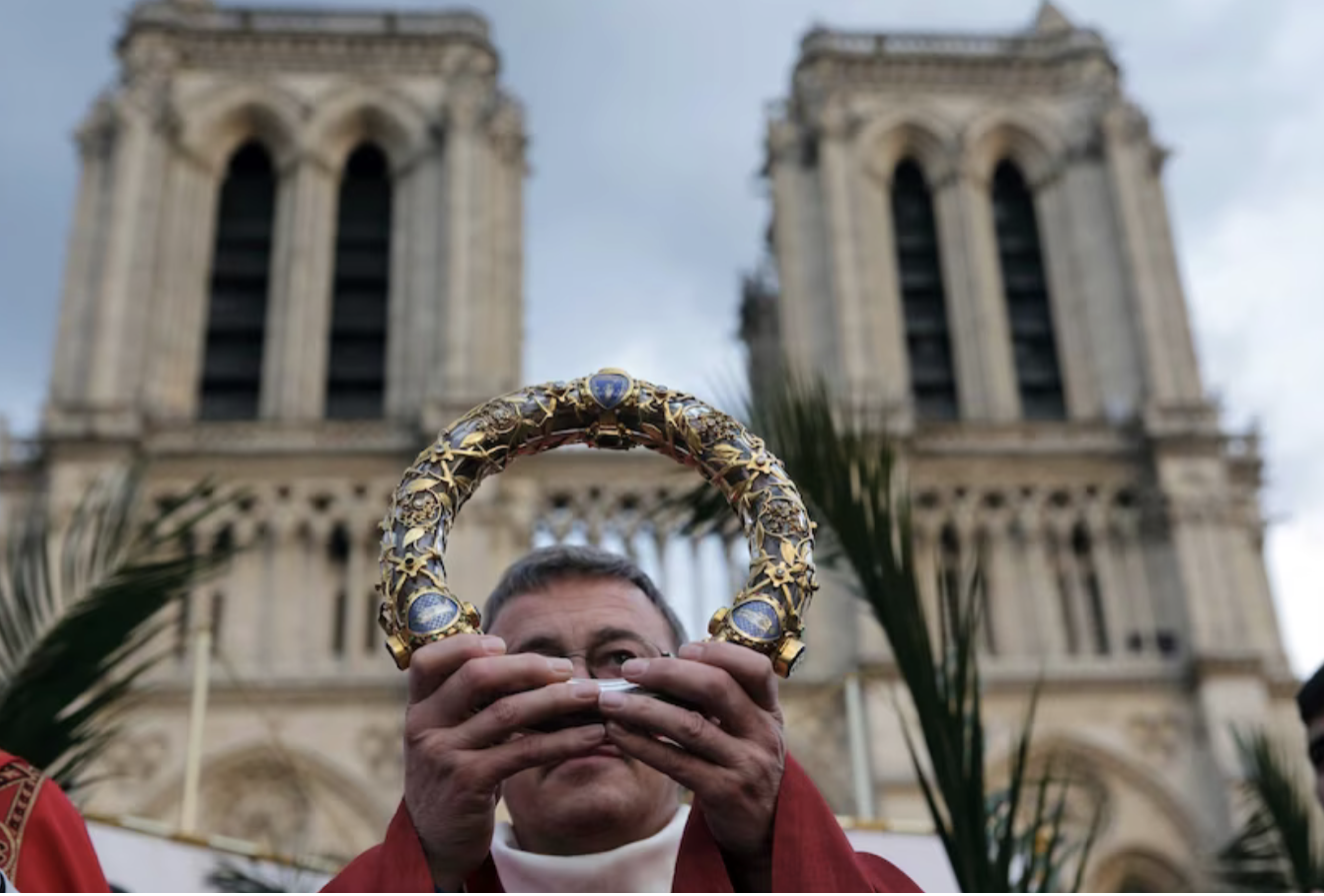
Each Friday afternoon, the most important relic in the world makes an appearance for the faithful to see once again at the Cathedral Notre Dame de Paris. After the fire on April 15, 2019, the Crown of Thorns had been safely hidden away at the Louvre and displayed during Lent and Holy Week at the Eglise Saint Germain l’Auxerrois. In January 2025, the famed crown returned once again to Notre Dame.
But why is it in Paris, you ask? The Crown of Thorns and other instruments of the Passion were purchased in 1238 by King Louis IX, later known as Saint Louis. However, let’s back up a little further.
The crown, of course, is deeply rooted in Christianity, but it is also an important piece of history. I have had many people scoff, laugh, and ask if it is the “real” crown of thorns, and I always reply, “That is for you to decide, and that is what faith is.” As a historian, I love sharing the story behind an object, a piece of art, or a historic building, and the people who make each of these subjects so interesting.
After the Romans arrested the man being called the new king, they created a “crown” of woven branches covered in thorns and placed it onto his head with the large 2 to 3 inch thorns drawing blood as they dug into his skin. A red cloth representing a royal mantle was tossed around his shoulders, and a reed for a scepter was mockingly placed in his bound hands. The crown remained on his head until his mother, Mary, removed it after he was taken down from the cross. The story is recalled in the New Testament by Mark, Matthew, and John.
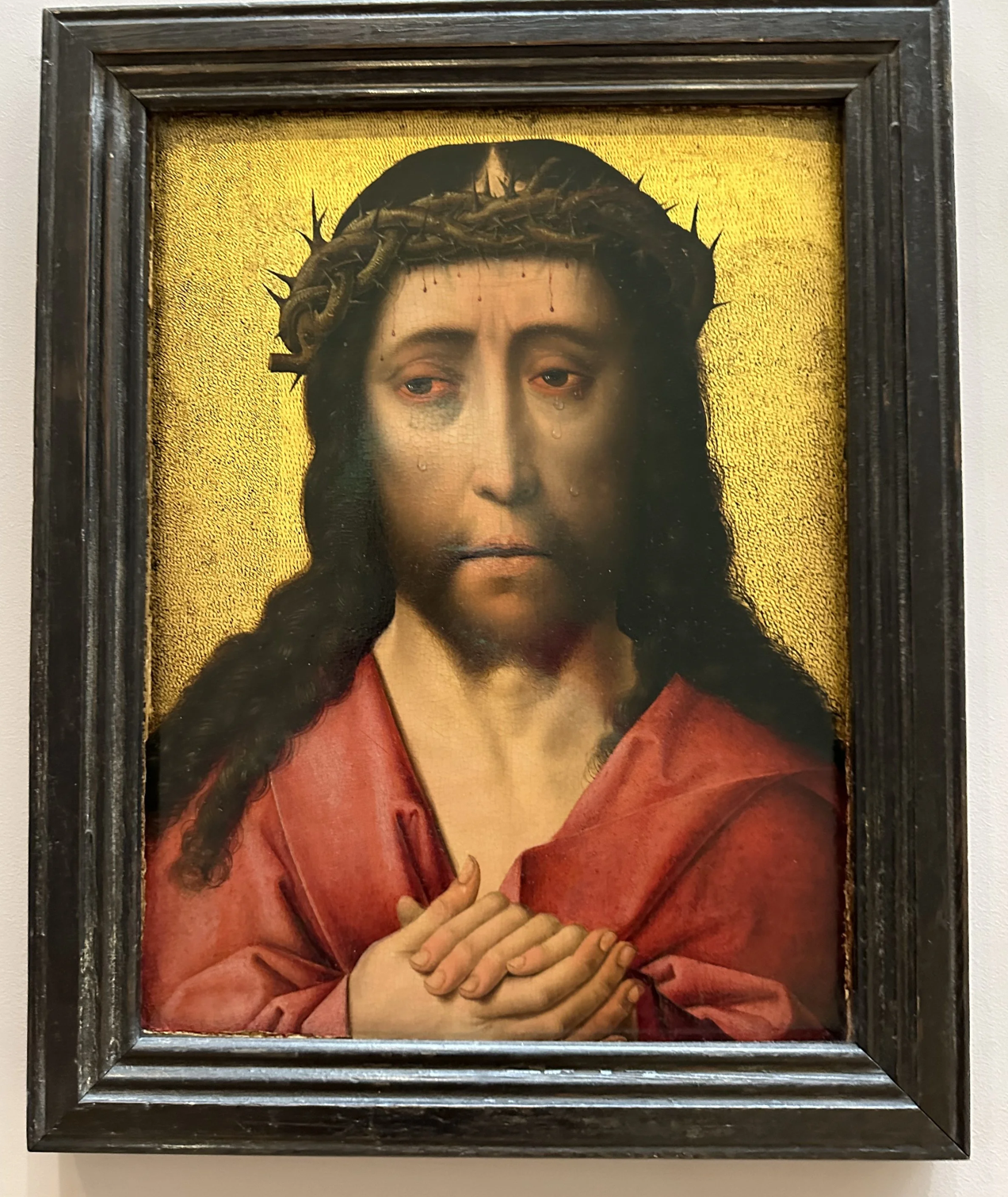
What the crown is made of has always been a matter of debate, with a few possible answers. It is two separate plants: a reed that is braided into a crown, and a thorny branch wrapped around and bent inwards. The thorny branch is thought to be from a Judea buckthorn shrub found in Jerusalem. It could also be Hawthorne, a Mediterranean shrub dotted with thorns.
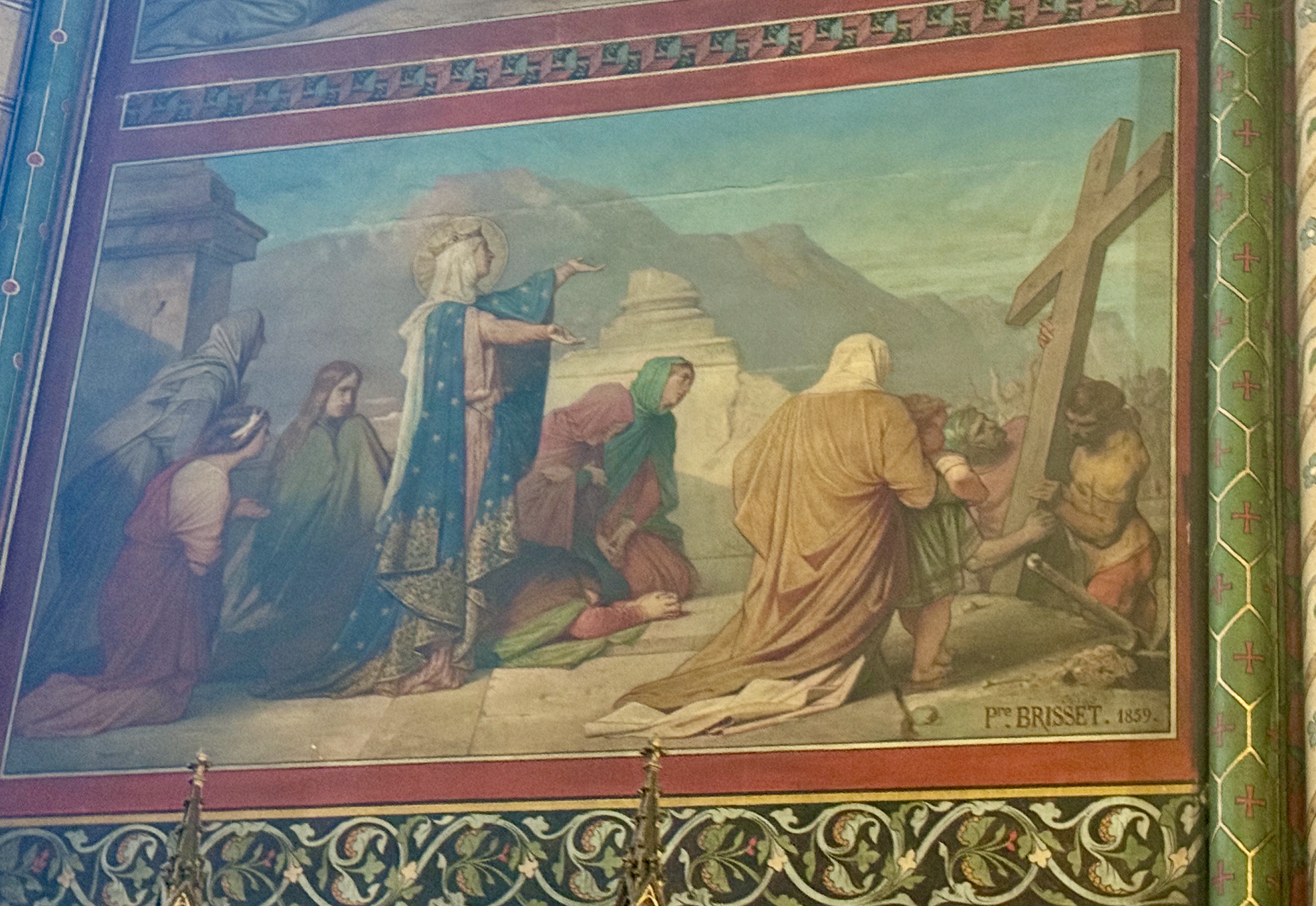
The crown was said to have been discovered in the 4th century after Emperor Constantine ordered the search of the Holy Land for the tomb of Christ. His mother, Sainte Hélène, led the expedition, and the legend tells us that she was looking on as the True Cross was uncovered along with the Crown of Thorns and Nails, all part of the Instruments of the Passion.
The first mention of the Crown being venerated dates to 409 in Jerusalem, when witnessed by bishop Paulinos of Nola in Campania in a letter sent to bishop Macarius. Between 530 and 560, the Crown was safely kept in the basilica of Mount Zion. Visitors and historians report that the vines would turn green and even grow at times. There are also reports of the thorns still held today, which have turned green or even bled. There isn’t any scientific evidence of that.
Between 614 and 637, when the city of Jerusalem was captured, the relics began their voyage to Constantinople. Dating the exact moment the Crown arrived is a bit harder. Frequent mentions of the thorns themselves date to the 7th century, but many had already been cut off in Jerusalem and obtained by leaders throughout Europe. We can be sure it arrived in the city of Byzantium by the end of the 10th century and was housed in the Palatine Chapel of the Pharos. The Sainte Chapelle, the Holy Chapel built in the palace of the Byzantine Emperors, held many holy relics, including items from the Passion.
For centuries, they remained until the Byzantine city was conquered at the beginning of the 13th century and pawned to the Latin Emperor in hopes that it would protect the now fractured capital.
Cousin to Saint Louis, Baldwin II, Emperor of Constantinople, came to France in 1236, asking him to help with a massive debt he had incurred by borrowing from the Venetians and giving the crown as collateral. From November 10, 1238, to February 1239, the Crown resided in Venice at Saint Mark’s Cathedral. Baldwin II, in return for his help, would give Louis and France the Crown of Thorns.
In December 1238, a letter was sent to Quirino stating that the French were sending a delegation to cover the debt of Constantinople and, in return, would receive the Crown. Brothers Jaques and André de Longjumeau of the Order of the Preachers were sent to Venice on behalf of King Louis IX, with Nicolas de Sorello. André had resided in the Dominican convent of Constantinople and had seen the Crown many years before, a fact that will come in handy later in the authentication of the relic. The man later known as Saint Louis and his devotion to the church played a big part in the agreement to settle the debt. When the option of also obtaining the Crown of Thorns came up, he had to do all he could to protect and care for it.
This wasn’t an easy transaction; the Venetian barons were in desperate need of money they borrowed against the relics and sped up the clock. The French envoy had to race to Venice to retrieve them in time. The deadline was June 18 and the Feast of Saint Gervais and Protais. if not purchased by that day, it would forever be the property of Venice.
Jacques and André arrived a day before on June 17, 1238, and were met with a new challenge and price tag.
King Louis IX, who was 24 years old at the time, had already paid 21,000 pounds to free the Crown, but as Jacques and André arrived, they were given a new bill for 137,000 pounds! It was half the French monarchy's budget, but Louis would pay and agreed to allow the Venetians to hold onto the Crown for the faithful to see one last time in Saint Mark's.
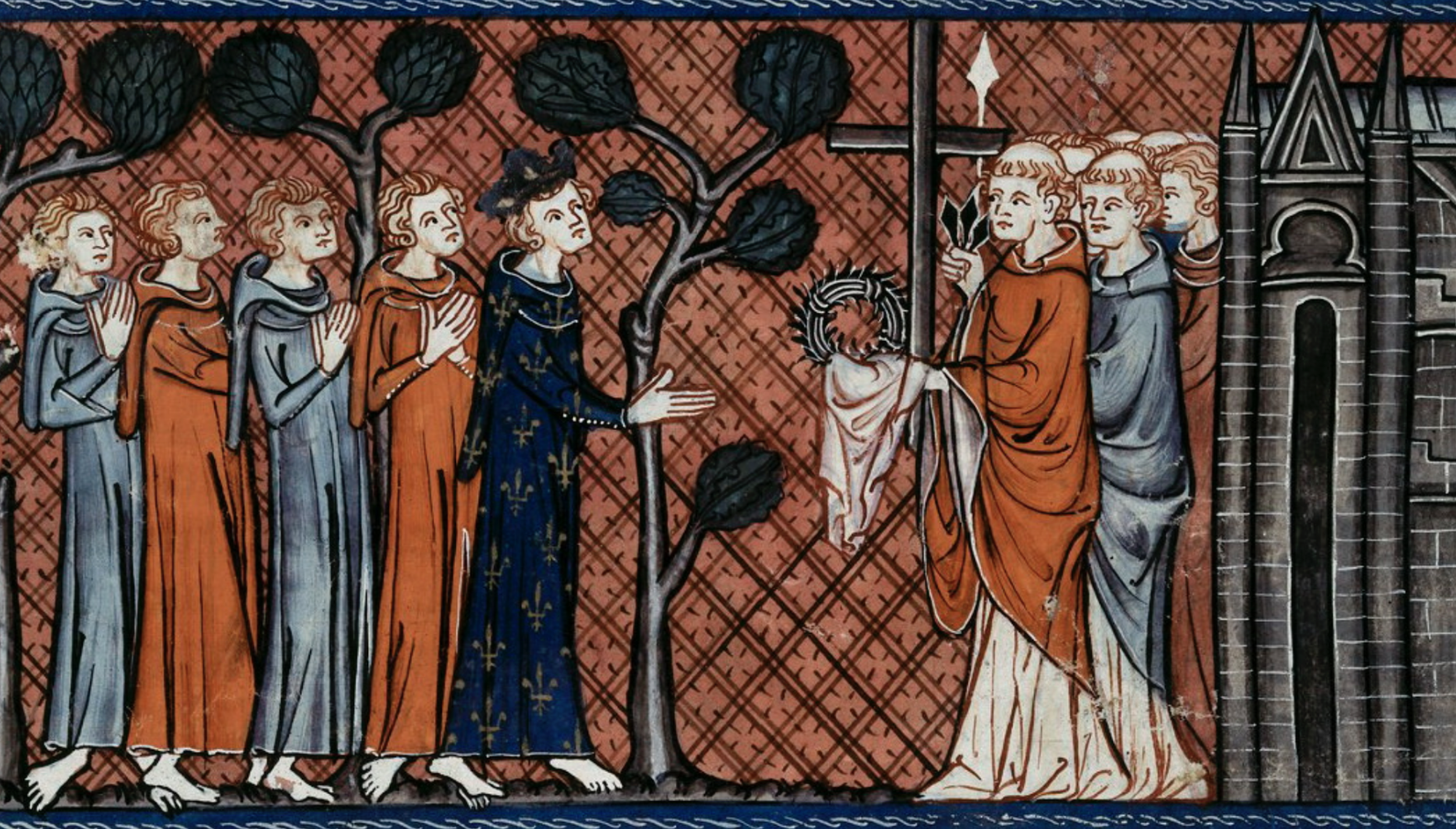
Negotiations took six months, and in January 1239, the Crown finally made its way through Italy and Germany to reach France. Due to the relic's fame and fragility, it had to be protected at every step. Before it travled Louis IX sent a letter to Emperor Frederick II of Germany asking for his help in protecting the soldiers, relic, and housing the men along the way.
The relic first arrived in the medeival city of Troyes, then was taken to the Maulny-le-Repos manor, close to the small town of Villeneuve-l’Archeveque. The manor is no longer there, but a cross and a plaque mark the spot of the historic event.
Jacques and André de Longjumeau carried the relic and a sealed letter from Baldwin authenticating the crown. On August 10, 1239, Louis IX arrived, and Archbishop Gauthier Cornout placed the Crown of Thorns into his hands.
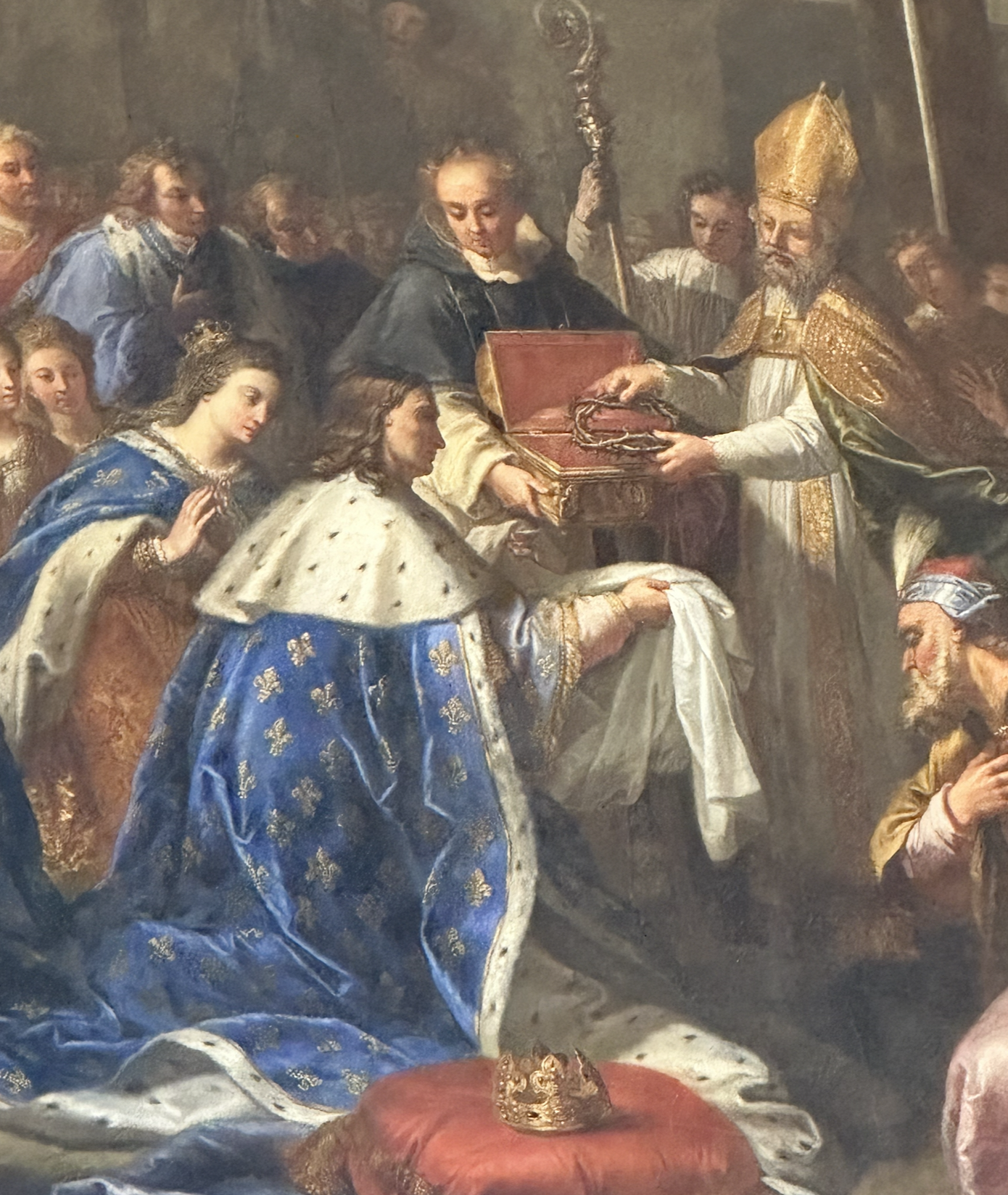
The scene is depicted in a painting by Jean André and is housed at the Eglise Saint-Thomas-d’Aquin in Paris. André, also known as Brother André of Saint Dominic at the Jacobin convent on Rue de Bac. Painted around 1710 for the convent he was a member of. Seized during the Revolution and sold in 1798. In 2010, the friends of St. Thomas ' Church purchased the painting.
The next day, Saint Louis, his mother, Blanche de Castille, and his brother, Robert d’Artois, walked to the nearby town of Sens. Louis and Robert carried the crown on their shoulders into the abbey of Saint Pierre-le-Vif. The entire town lined the streets and filled the abbey for a glimpse of the relic and the king.
On August 11, the crown and its guardians traveled by boat on the Yonne and Seine to Paris. Stopping along the way in Melun and Montereau, they finally arrived in Vincennes a week later. Louis stepped out of the boat with the bishops of France, who waited with the nuns, priests, and clerics for a glimpse of the precious item.
On August 18, Louis, in a simple tunic and barefoot, walked the Crown into Paris. The path was lined with thousands of the faithful holding torches to light the way. Upon arrival, a mass was held at Notre Dame before taking the Crown to the Palais de la Cité and placing it in the Chapel de St Nicolas on August 19 until a suitable reliquary could be created.
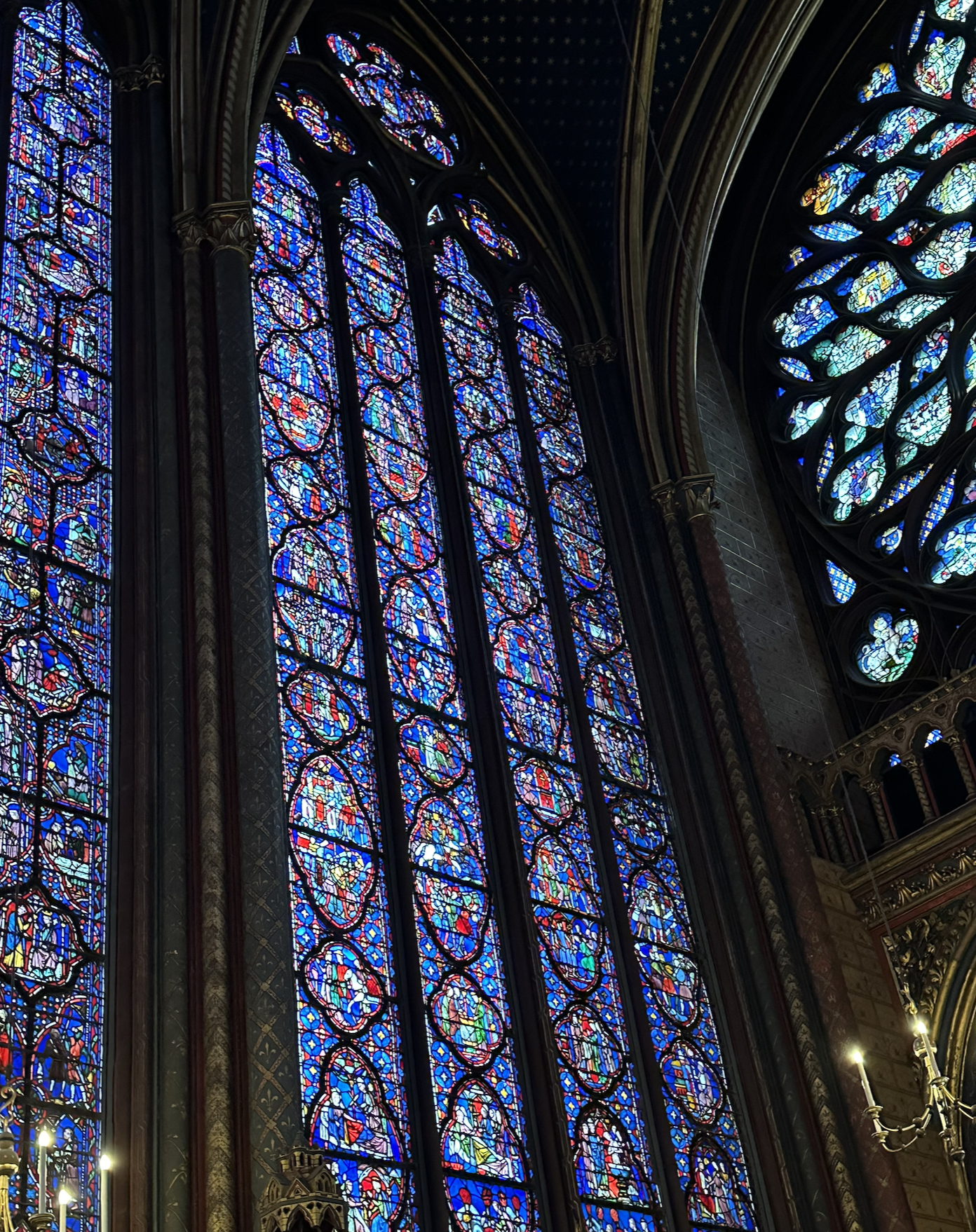
Not just any building would do for one of the most important relics in the world. Two years later, in the autumn of 1241, the construction of the Sainte Chapelle began. The same year, Louis acquired a large piece of the Holy Cross, a vial of the Holy Blood, and the Tombstone. The following year, the Holy Sponge and Spear came into his possession and were all placed in Sainte Chapelle after it was finished and consecrated on April 26, 1248. The cost to build the chapel was a third of what was spent to obtain the crown.
They would remain in the Jewel Box Church until March 1789. In 1791, the Conseil d’État suppressed the church and sequestered the relics; on March 12, they were removed for safekeeping and placed in a cardboard box at the Abbey of Saint-Denis. They were the property of the crown until 1791.
In the dark of night between November 11 & 12, 1793, the relics were taken to the mint, melted down, and destroyed. Only the Crown, a piece of the True Cross, and a nail survived. On April 25, 1794, which also happened to be the birthday of Saint Louis, the crown was moved to the Bibliothèque Nationale, or at least one piece was there. During the Revolution, in order to protect the crown, it was cut into three pieces and separated for safekeeping. Thankfully, all three pieces are united today
On December 6, 1804, just four days after his coronation, Napoleon had the relics transferred to Notre Dame, and on August 10, 1806, they would be seen by the public for the first time in more than five hundred years.
On July 29, 1830. During the Three Glorious Days, Archbishop Hyacinthe Louis de Quélen fled the church with the relics under his arm while an angry mob broke into the Cathedral. The Archbishop fled to Normandy, where the relics were safely hidden in a chateau until 1843. Many of the cathedral's relics were stolen, melted down, or thrown into the Seine. In 1855, the Crown, nail, and piece of the True Cross were safely back in Notre Dame.
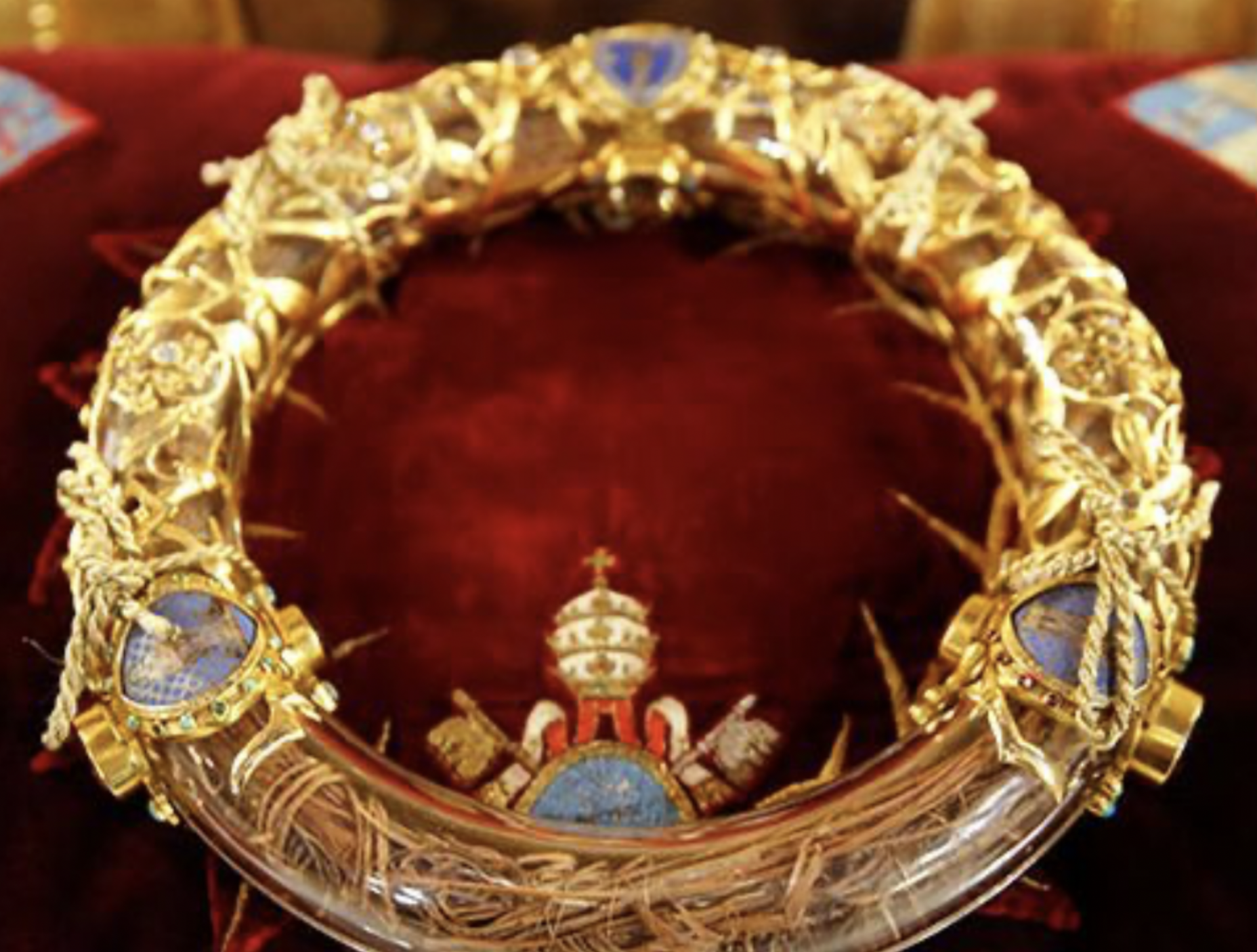
The current reliquary that surrounds the crown was made by goldsmith Maurice Poussielgue-Rusand and placed inside on March 20, 1896, from a design by architect Jules-Godefroy Astruc. Maurice’s father, Placide, created the former reliquary. The crown is enclosed in a hollow rock crystal tube, encased in a gold garland of flowers, leaves, fruits, and thorns on two of the three sections. They are joined with a gold clasp and topped with enamel plaques. On the front, the seals are of Saint Denis, Sainte Genevieve, and the Virgin Mary. On the back are the crests of Saint Louis, Paris, and an effigy of Christ being crowned in thorns.
On the night of the fire in April 2019, after we watched the spire and the rooster fall from the sky, the next fear was the relics of the Sacristy and the Crown. The very tight security around the crown made it difficult in that high-pressure moment. Tucked away into the floor of the chapel was a series of combination key locks that required two keys. The keys are normally never together. That night, in a state of panic, the two key holders had to fight through the crowd to reach Notre Dame. The keys were handed to the chaplain of the Pompiers de Paris, Jean-Marc Fournie, who put his life on the line and rushed into the cathedral to save the Crown of Thorns.
Many of the bishops of Paris have left their mark on Notre Dame, not always for the better, and many want to wipe out Viollet-le-Duc's influence. In 2005, Cardinal Lustiger reached out to architect and artist Sylvain Dubuisson to create a new reliquary to hold the Crown of Thorns. The Cardinal passed away less than two years later, and the project died with him. In 2023, the current bishop, Ulrich, called Dubuisson out of the blue and asked the artist to pick up where he left off.
Dubuisson happily accepted this great honor and continued his research into the history of the Crown. From its origin to its Byzantine journey to the reliquary church of Sainte Chapelle, created for it.
The wall is made of cedar to emulate the True Cross; cut into the wall are three hundred sixty openings, each holding a gilded bronze thorn. The gilded gold is reminiscent of the Byzantine churches where the Crown of Thorns was kept until the 13th century.
The openings are more significant at the top than at the bottom, allowing natural light to stream in. In the center are 396 glass cabochons, each etched with a cross and backed with 24-karat gold. When on view, they surround the Crown of Thorns, which hangs over the Klein blue center, which frames and glows in the light.
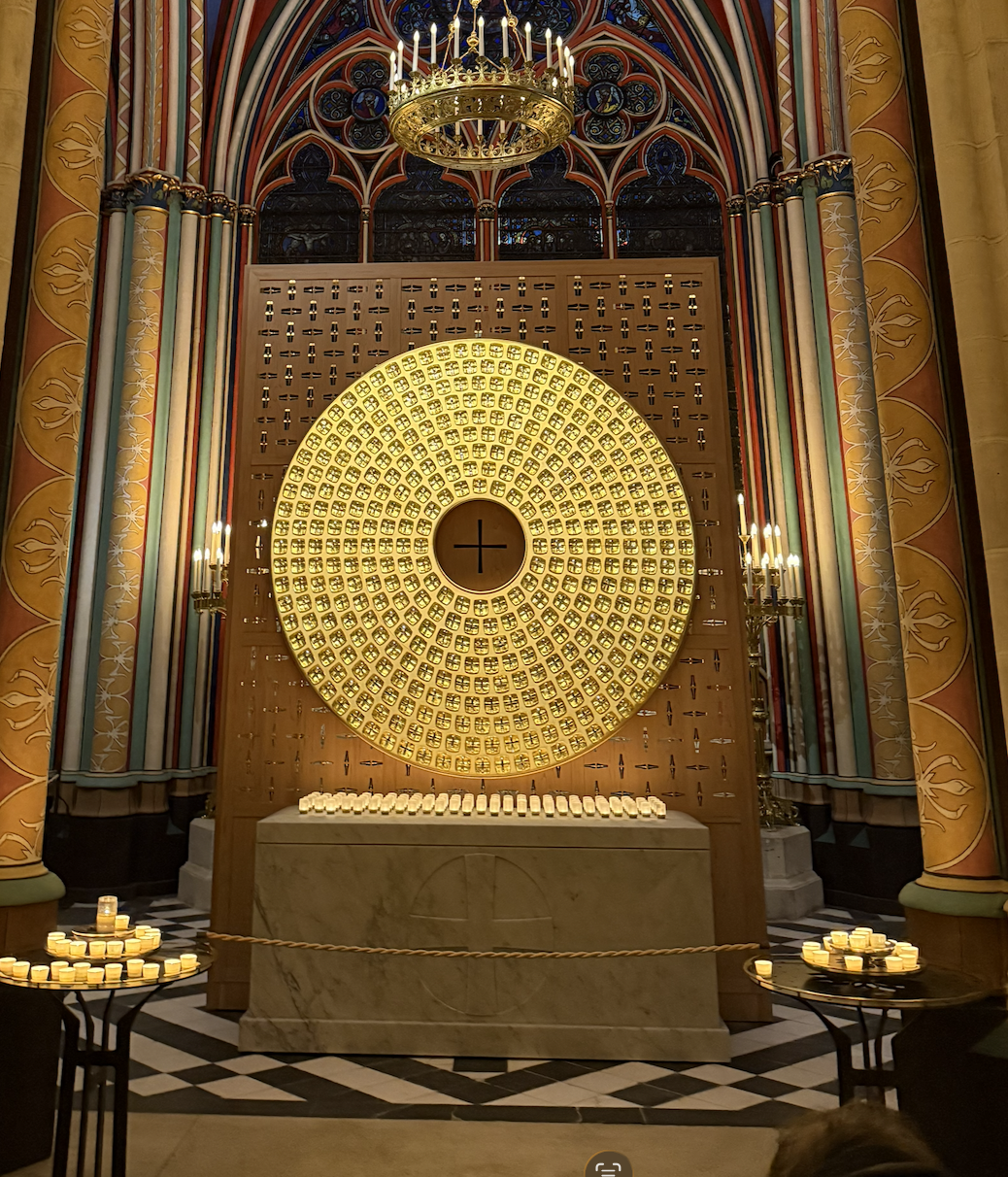
Standing just over 11 feet tall, the center was placed above eye level for viewing from every angle. The three-ton sculpture sits on a Carrera marble base that holds a safe where the Crown lies when not on display, and it is topped with 100 LED “candles.”
Dubuisson worked with the Atelier Saint Jacques, Fonderie de Coubertin, Glassmaker Olivier Juteau, Light Sculptor Patrick Rimoux, and the Atelier de Rocou for the gilding. The entire team worked simultaneously, and the project took over 4700 hours to complete.
Upon the reopening of the Cathedral, the crown was moved to the central chapel of the axial. The Chapel of the Order of the Holy Sepulchre of Jerusalem places it in a direct line from the baptistry at the entrance to the altar, the tabernacle of the host on the high altar, the pietà, and then the holy relics.
I have to admit that in the original renderings, I wasn’t in love with it, but seeing it up close, I changed my tune. It radiates a beautiful golden glow and pulls together centuries of history. It’s gorgeous even without the most significant relic in the world hanging from it.
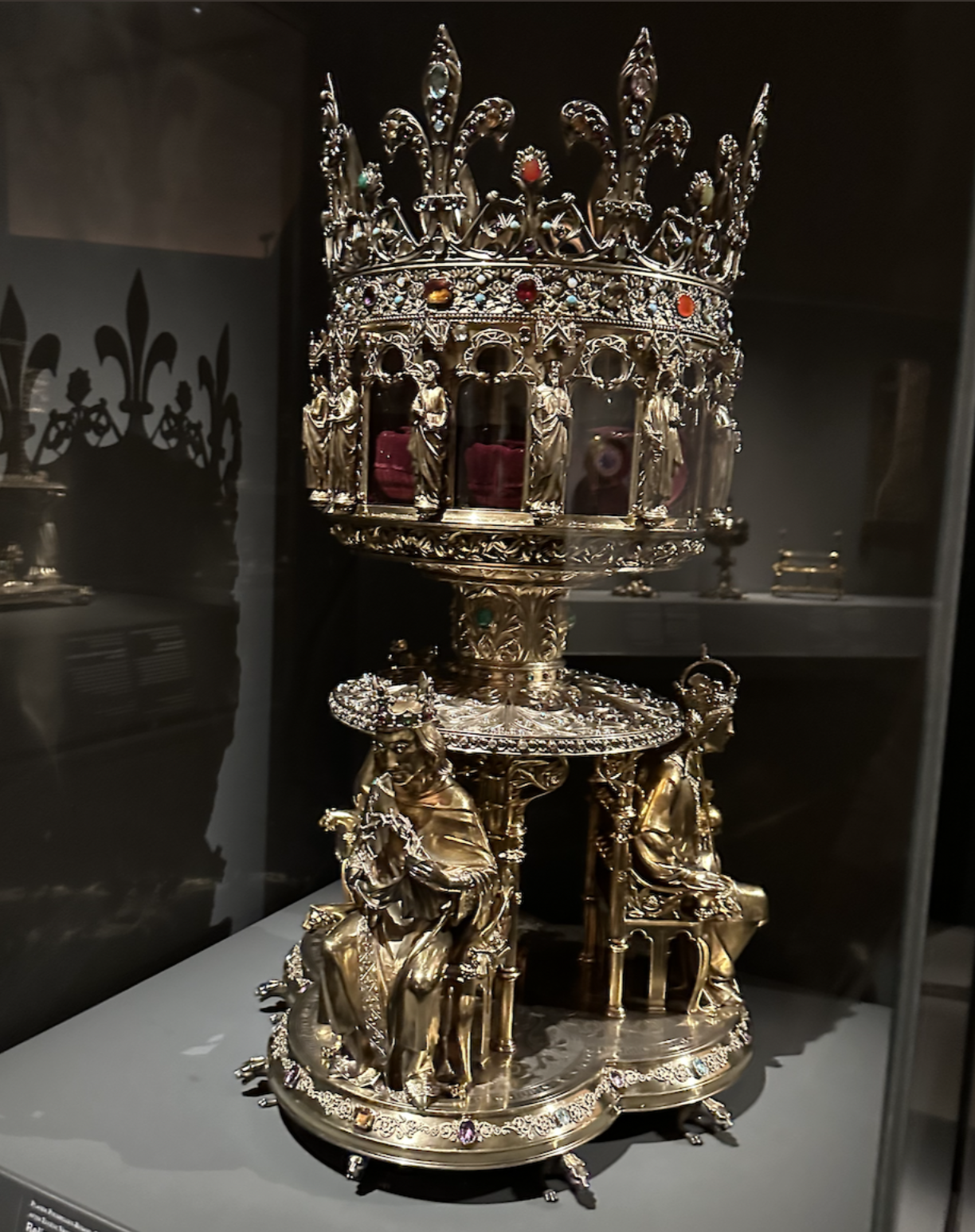
The previous reliquary created by Viollet-le-Duc is a real showstopper. In 1862, Viollet produced with goldsmith Placide Poussielgue-Rosand and sculptor of Notre Dame Adolphe-Victor Geoffroy-Dechaume.
First used on Palm Sunday, March 29, 1863, and used in processions prior to the fire. Surrounding the top are the French Fleur-de-lis and the twelve apostles. Below are the three figures that played a role in the journey of the Crown. Baldwin II, Saint Hélèna, and Saint Louis is seen holding the crown. You can see the Reliquary in the Treasury of Notre Dame.
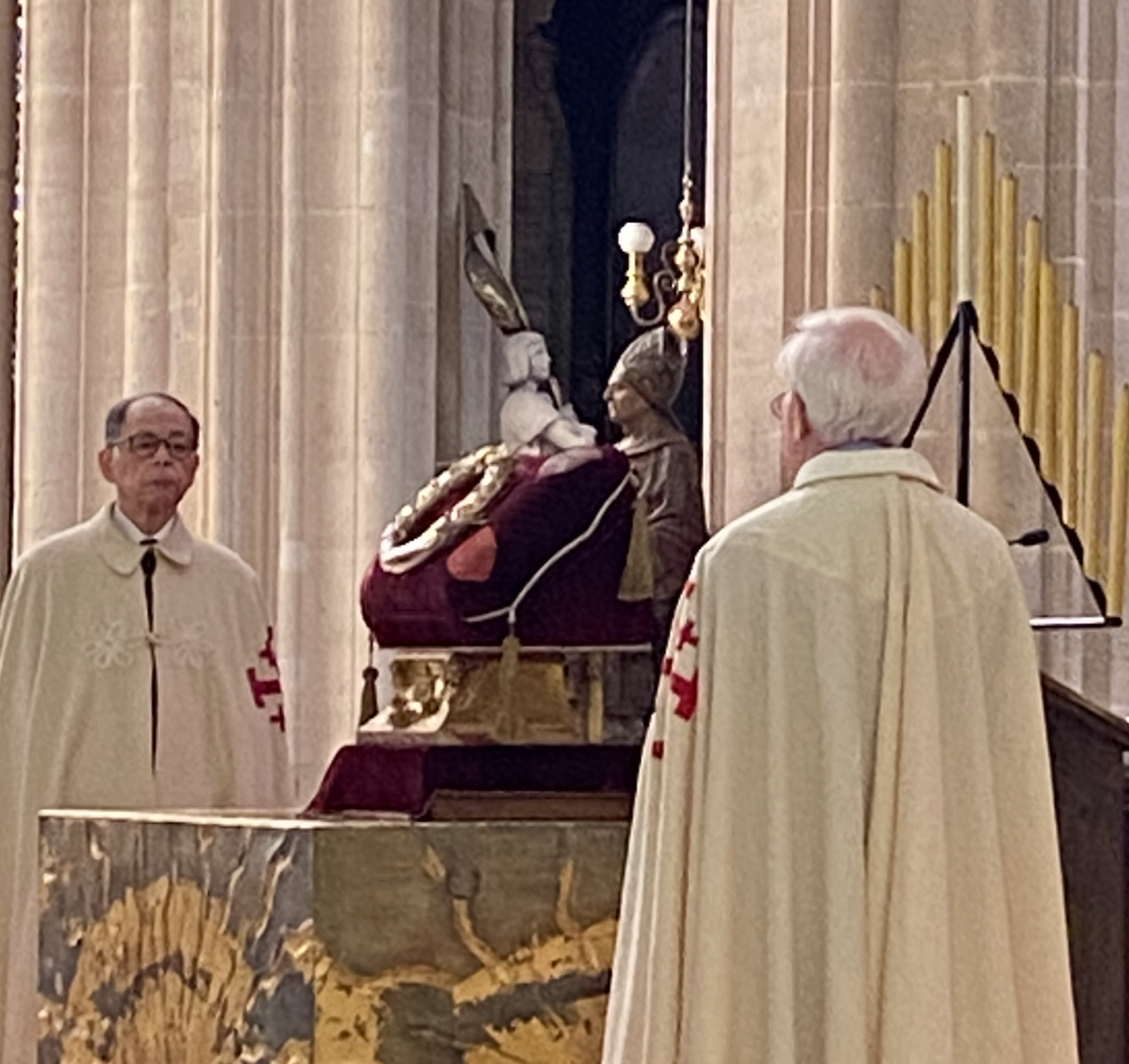
Prior to the fire, the Crown came out on the first Friday of each month and each Friday of Lent. The veneration ceremony for the Crown of Thorns was designed by Saint Louis himself, not the Catholic Church. The very specific ceremony and the showing of the relic can only happen during Easter, as established over 785 years ago to celebrate the resurrection. Since its return to Notre Dame, due to the high demand of visitors, the Crown is now brought out every Friday of the year, with the veneration on the first Friday of each month from 3 pm to 5 pm, and displayed each Friday from 3 pm to 6:30 pm
August 11 was chosen by Louis for the annual feast day in celebration of the date the Crown was first placed in his hands.
Open to the faithful, historians, and anyone who wants to see the priceless relic. Standing nearby are the Knights of the Holy Sepulcher of Jerusalem, who guard the crown and honor the wishes first established in the 13th century.
You can visit Sainte Chapelle today; it is no longer an active church, and none of the relics remain, but it's a must-see for the 1,113 stained glass scenes, including the last set on the south side. The 171 windows of the last section cover the discovery of the relics with Sainte Helene, Saint Louis in adoration of the Crown, at the very top.
The former reliquaries, including my favorite with figures of Louis, Baldwin, and Hélène, as well as other reliquaries attached to the Crown, thorns, and even a few that once held pieces of the True Cross, can be found in the Treasury of Notre Dame. The Tunic worn by Saint Louis that survived the Revolution and was held in the treasury of Charles VI in 1418. A sleeve and some of the fabric is missing that was cut away, and a parchment note that was attached authenticating the item to have belonged to Saint Louis. Was this the one worn when he carried the Crown? We don’t know, but he always wore a simple tunic when he prayed before the relic.
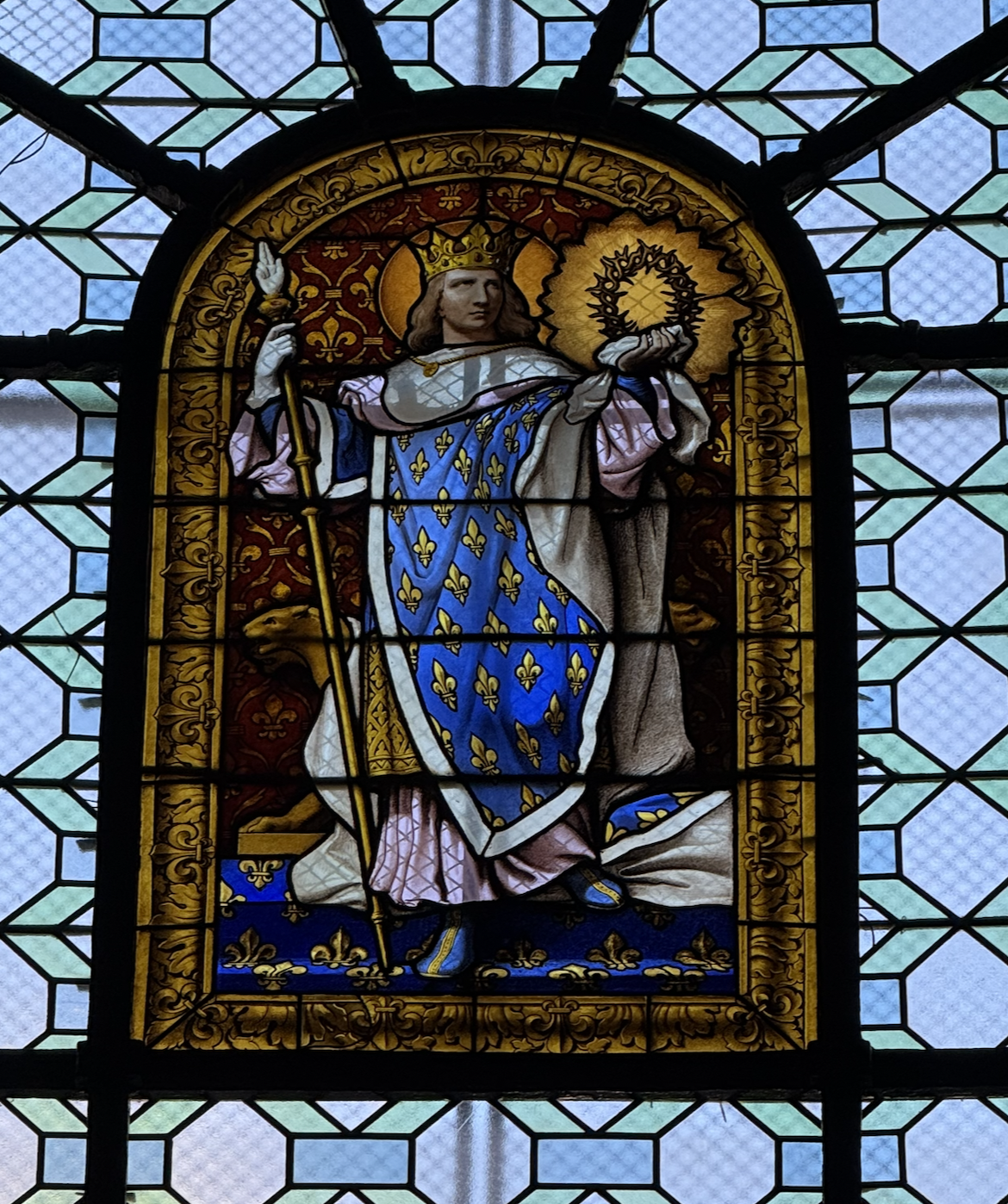
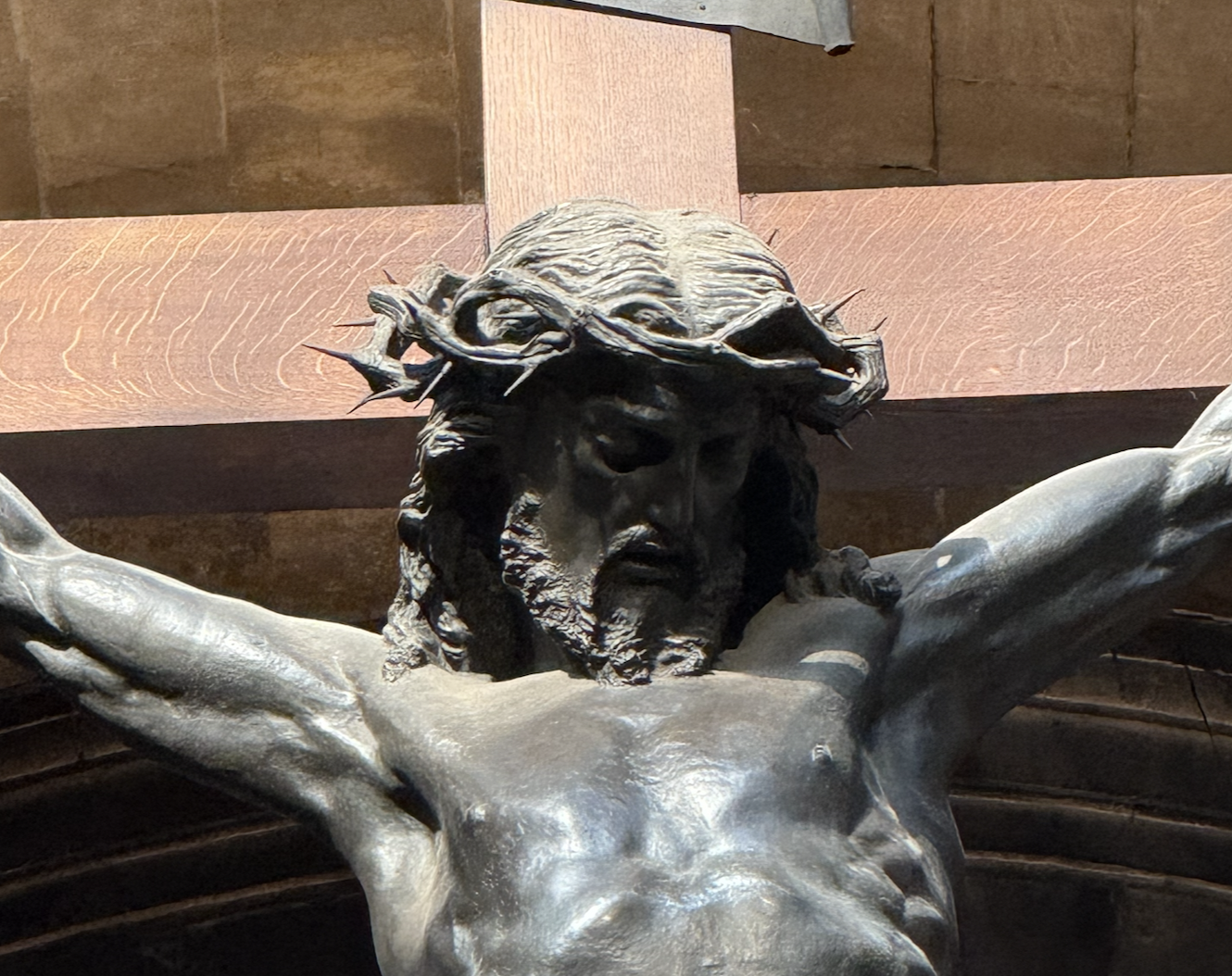
The Crown can be spotted throughout Paris, in many churches and, of course, the Musée du Louvre. From the Italian masters in the Grande Gallerie to the French painting floor in the Sully wing. I love finding paintings and sculptures that include the crown.
Inside the Basilica Sainte Clotilde, in the 7th, in the Chapel of the Sacred Heart, the fresco on the right by François-Édouard Picot depicts Helene’s discovery of the True Cross. The next chapel over at Saint Louis tells his story through the crown in the stained-glass window and the fresco.
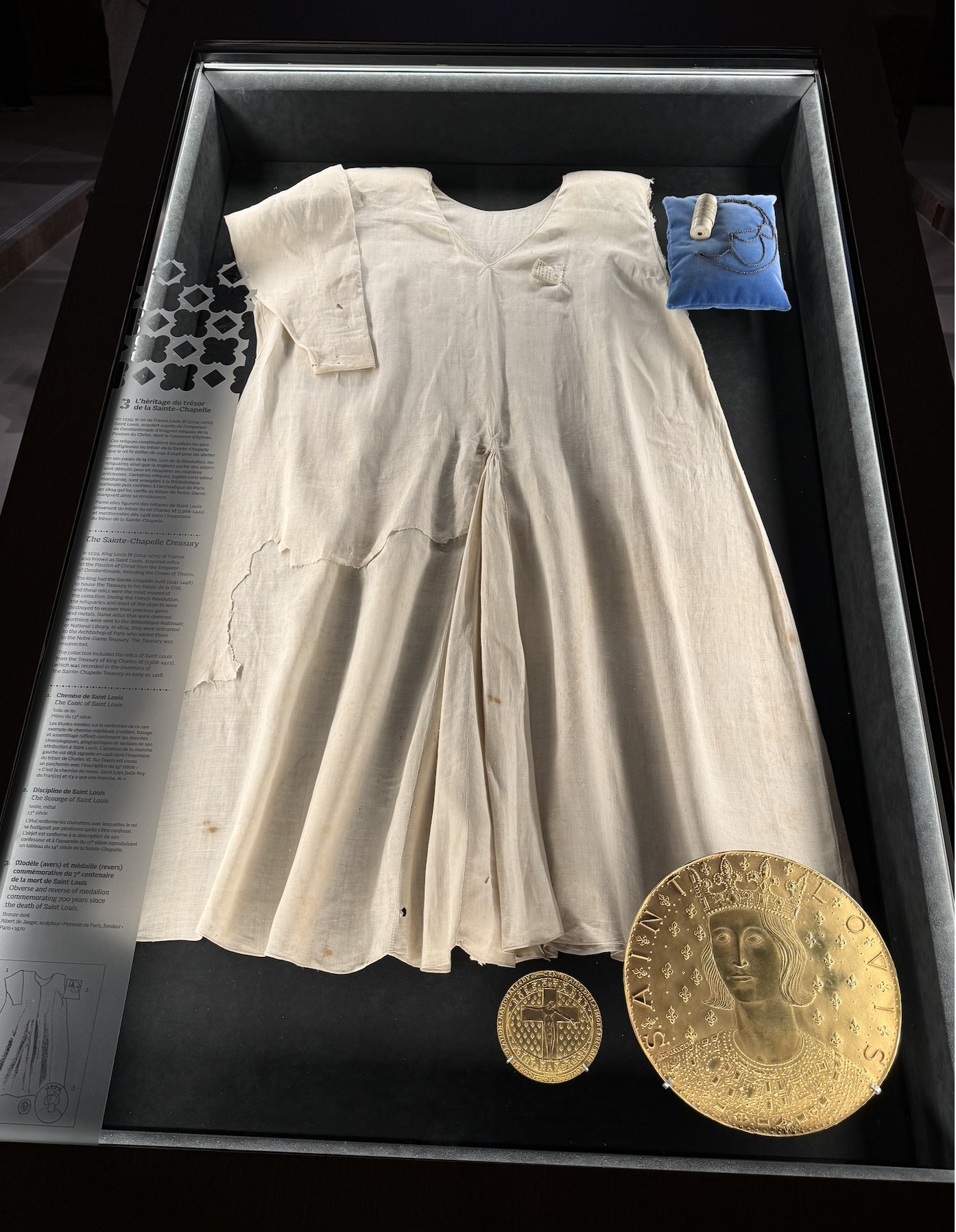
The small Saint Louis-en-l’Île on Île Saint-Louis, dedicated to the saintly king of France, has many reminders of the Crown, including a wonderful bronze statue as you enter.
Many of the churches of Paris include a chapel of Saint Louis, such as Saint Sulpice, with a fantastic central stained-glass window of the king holding the crown.