
The city of Paris is filled with thousands of stone buildings that line its historic streets and boulevards. In the mid-19th century, under Emperor Napoleon III and Baron Haussmann, the city was transformed. Streets were widened, buildings adopted a unifying design aesthetic, and every neighborhood would have a green oasis in the shadows of its limestone facades.
The once-large Hotel Particulares, owned by a singular family, would become multiple apartments, some very small with little space to gather and relax. In Napoleon III's plan, he wanted a park within a ten-minute walk of every neighborhood. Some are quite small with a singular bench, like the Jardin Alice Saunier Seïté on the Rue Visconti, the smallest in Paris. Then there are the larger parks: the Jardin des Tuileries, the Bois de Boulogne, and, most beautiful of all, the Jardin du Luxembourg.
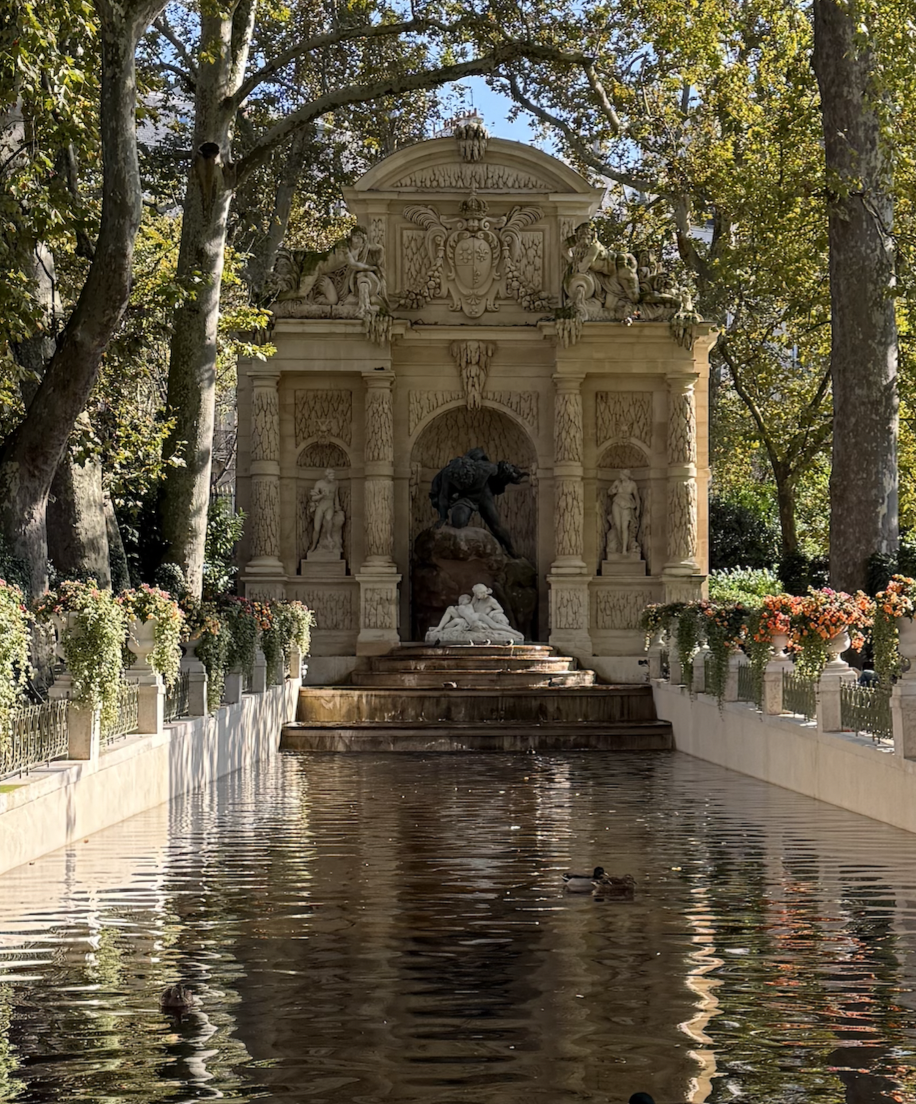
I first discovered the Left Bank garden on my first trip to Paris a decade ago. With a few of the photos my grandfather took in the 1970s and 80s, I would walk through the garden looking for the same thing he captured on those early spring and autumn mornings. It was September 20, 2016, that I first discovered and sat under the historic plane trees of the Fontaine Medici, taking in the ivy swags, cascading water, and the dotted sunlight through the leaves. At that very moment, I knew I had to return and, dare I dream, live in Paris.
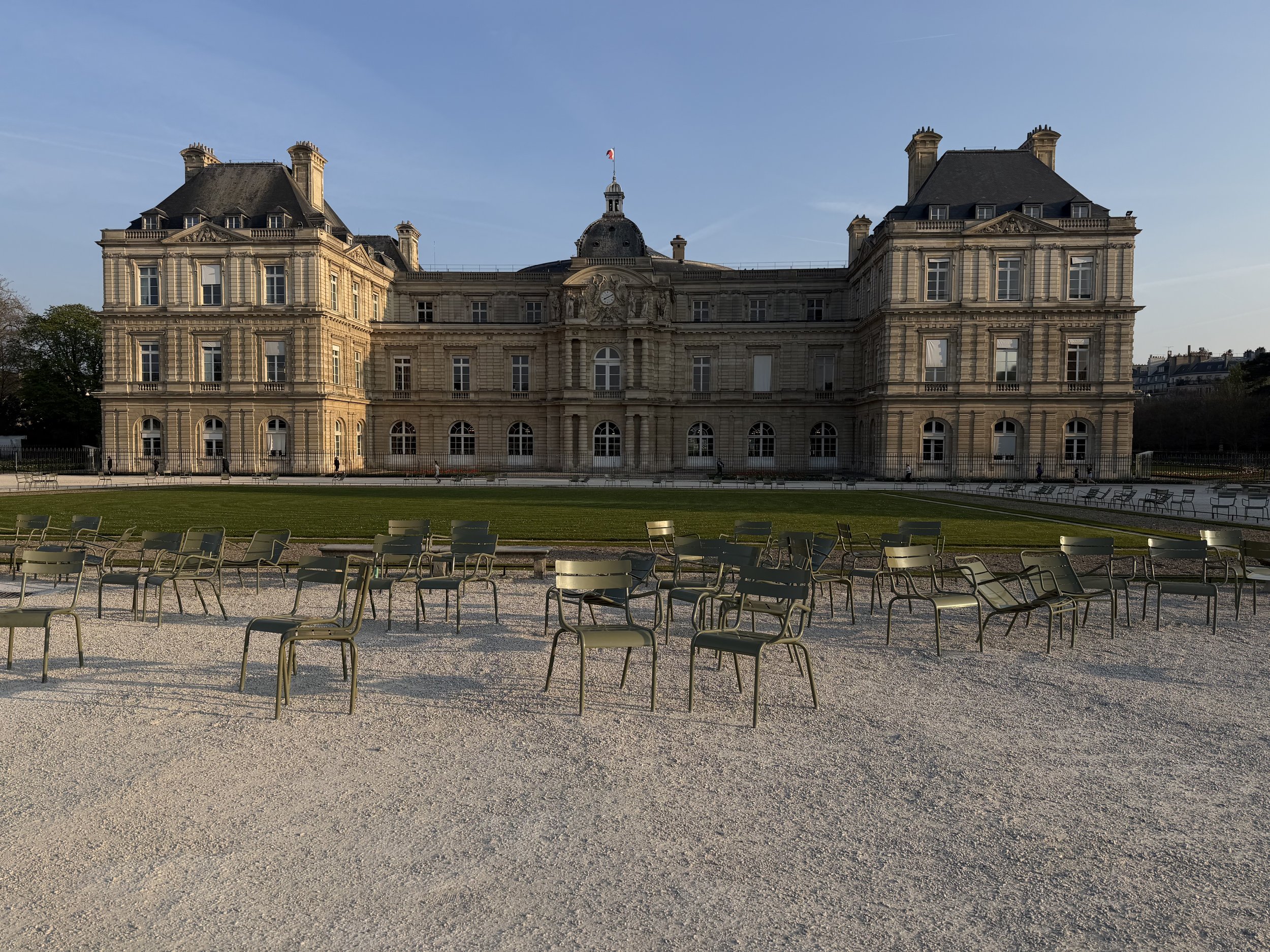
The Jardin du Luxembourg was created under Marie de Medici, the Florentine wife of King Henri IV. After his death on May 14, 1610, she wanted to create a home that reminded her of her childhood in Florence, at the Medici Palazzo Pitti and its Boboli Gardens.
Purchasing the land in 1611, once owned by the Duc de Luxembourg, which seemed far from the walls of the Palais du Louvre, Marie first asked Italian architects to create a palace reminiscent of the Pitti. Serving as the Regent of France while Louis XIII was too young to rule, her advisors recommended that it wasn’t the best idea for the head of France to use foreign designers.
In turn, she sent French architects to Florence to soak up everything they could, then returned to Paris to bring her vision to life. The palace would take quite some time, and Marie never saw it fully finished, as she was often sent away from Paris because she was constantly at odds with her son, Louis XIII, and plotting to end Richelieu's power over him. In the end, she lost when Louis sent her away on “vacation,” which really was an exile. She died in Cologne on July 3, 1642, ten months before Louis XIII died.
The garden came to life in 1612 under Jacques Boyceau, gardener to Henri IV and Marie, who would have a great influence on the early work of Andre Le Nôtre, who often gets credit for the great gardens of Paris and Versailles. Keeping with the classic French style of very deliberate placement and adding low, boxed shrubs to create spaces for colorful flowers.
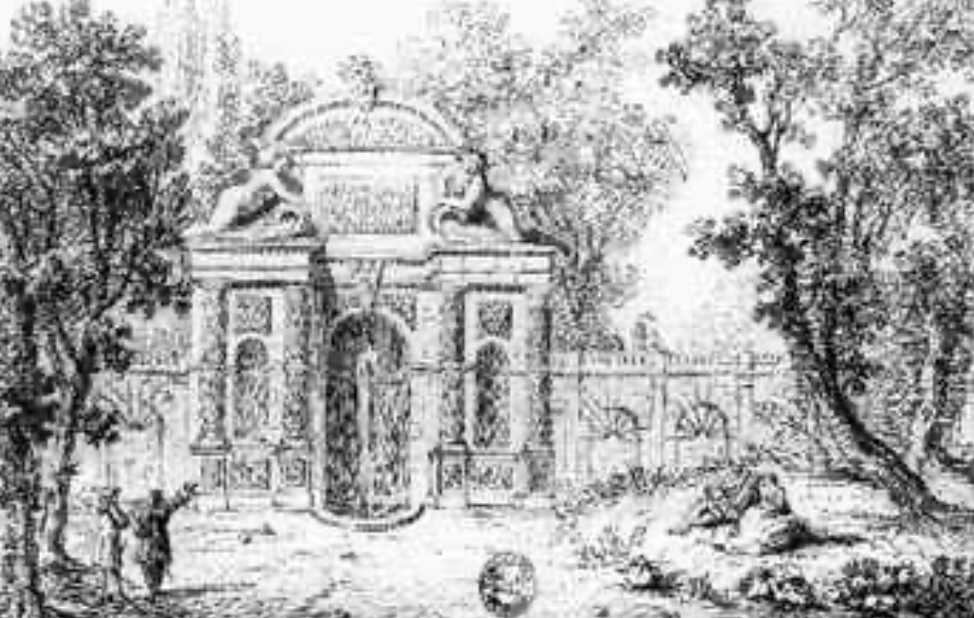
While the garden, even today, is heavily influenced on French design, one aspect is very Italian: the fountain or its first intention, the grotto of Marie de Medici, just east of the palace.
In the 16th and 17th centuries, running water for decorative fountains, or even for water fountains, wasn’t a high priority. While the city was born in the center of the Seine, capturing the water was a different story. Under Henri IV, the Samaritan pump was built at the Pont Neuf to bring water to the Louvre and the right bank, but it didn’t have the power to reach Marie’s garden.
In 1612, the project for what would go by many names, including the Medici Acqueduct, began in the Val-de-Marne region. Louis XIII laid the first stone on July 17, 1613, but it would take fifteen years for the water to flow into the Jardin du Luxembourg. This is partially why the beautiful oasis we call the Fontaine Medici today was once just an Italian grotto, and the basin we know today was only created in the 1860’s.
Marie’s distant cousin, the former Queen Catherine de Medici, commissioned the Palais des Tuileries in 1564 after the death of her husband, Henri II, on July 10, 1559. The palace, once considered outside Paris, included a large garden and a grotto created by Bernard Palissy, a great naturalist and ceramist of the 16th century, whose work remains relevant today.
Not to be outdone, the next Florentine Medici wanted her own country estate and grotto, although with her own taste. Marie was able to skirt the rules a bit when asking Florentine garden designer and engineer Tommaso Francini to create a fountain for her. Once the designer to her uncle Ferdinand I de Medici, he was brought to Paris by Henri IV in 1599, a year before he ever intended to marry a Medici himself. Francini and his two brothers moved to France and became French citizens, and worked on Saint Germain-en-Laye, Fontainebleau, Saint Cloud, and the Luxembourg, where his engineering of water came in handy.
The original fountain sat against a wall that formed the eastern edge of the garden, about 98 feet from its current location. It was aligned with the southern edge of the palace and stretched to what is today Boulevard Saint Michel. It was much wider, with niches that extended on either side of the current configuration we know, and topped with decorative urns and fire pots that weren’t able to survive the 18th-century Revolution.
Francini worked with Solomon de Brosse, often identified as Jacques, who carried out the work and added the most Italianate moniker of the “frosting” or dripping water to just about every surface of the grotto. Tuscan columns that are a bit larger on the bottom than at the top, while banded columns were reserved for the palace itself.
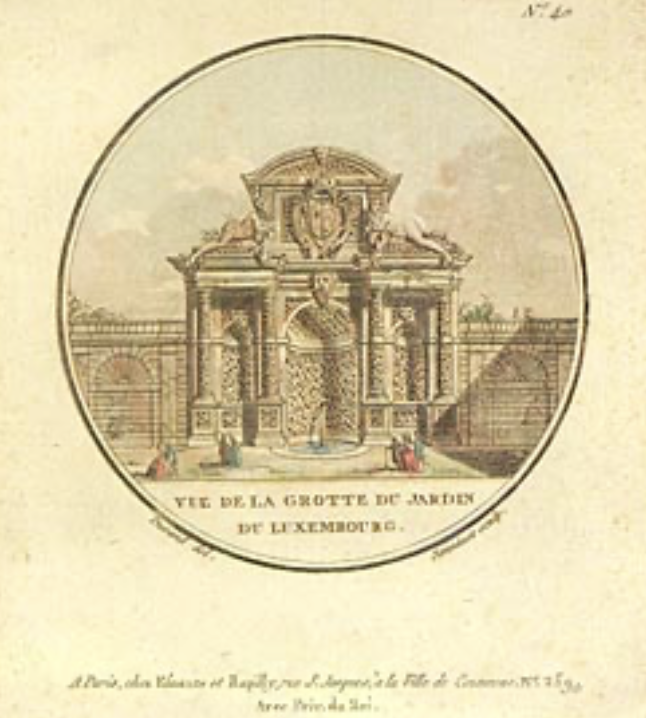
In the very center above the niche, the personal arms of Marie de Medici were added. The left holding the dots or coins of the Medici family, and the right holding the fleur-de-lis reserved for the royal Bourbons. Normally, the Medici side also has large banned stripes, and it’s unknown if the original relief held that or not, since it was destroyed in the Revolution.
On either side are allegories of the Seine and Rhone, specifically chosen by Marie. On the left, a water nymph representing the Seine, and on the right, a water god of the Rhone with a cornucopia of produce found along its banks. Both by Pierre II Biard.
Marie never saw her fountain filled with water, and after her exile, it was given to her other son, Gaston, the Grand Monsieur. It then passed to his daughter Anne-Marie Montpensier, the Grande Mademoiselle, who was once the richest woman in Europe. It then went to her younger sister, Elisabeth, who, in turn, gave it to Louis XIV. It remained under the crown until the Revolution, when, in 1799, it became the seat of the Senate of France and remains so to this day.
During the Revolution, the fountain wall was attacked and the royal markings removed, and the statues of the Seine and Rhone were badly damaged. The palace itself had been used as a prison during the Terror and held Jacques Louis David behind its lavish walls. At the start of the 19th century, Napoleon ordered the palace and gardens restored.
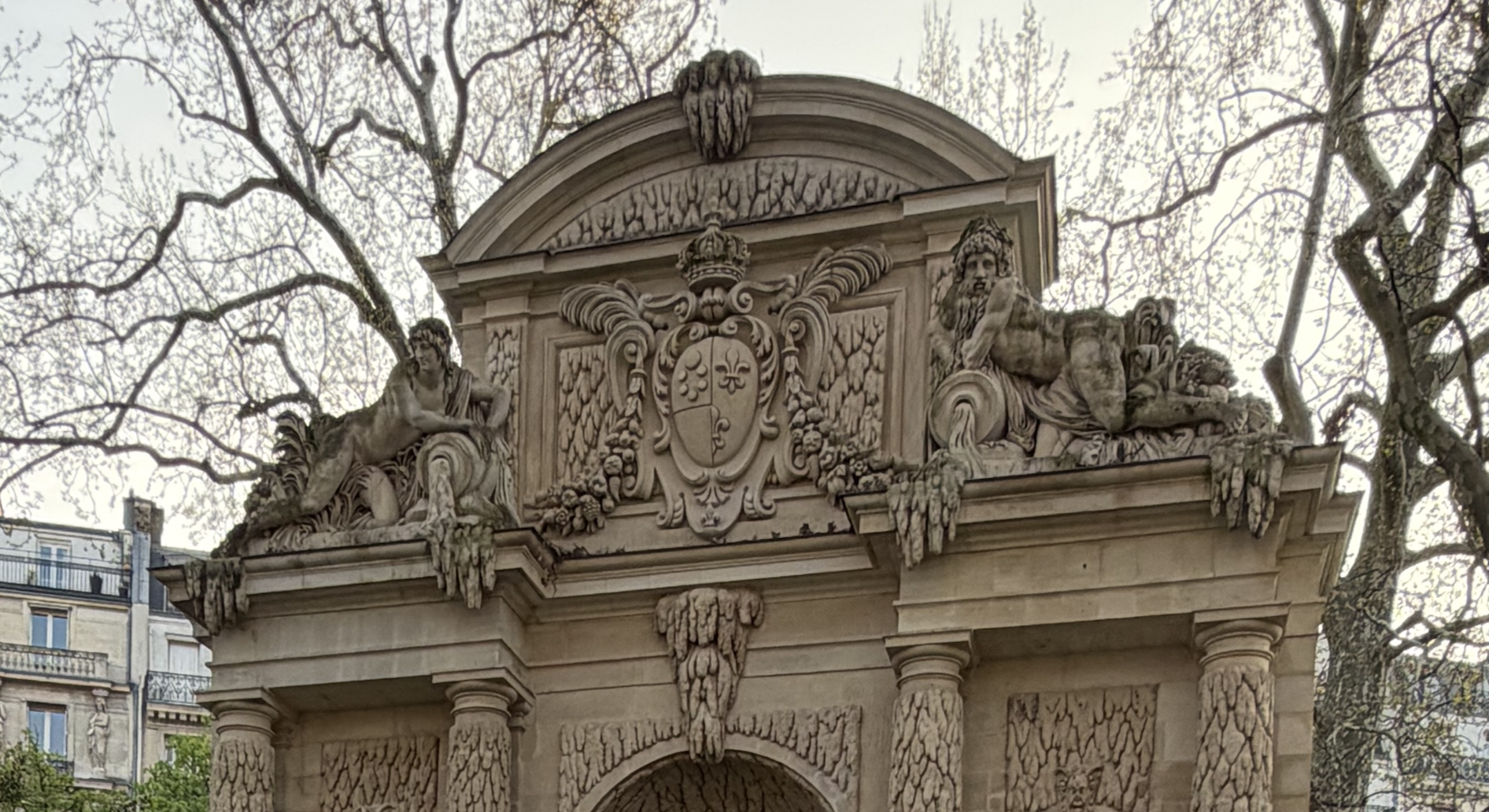
Architect Jean-Francois Chalgrin restored the damaged elements with sculptor Claude Ramey bringing the Seine water nymph back to life, and Francisque Duret was tasked with the Rhone. They opted not to recreate the arms of Marie de Medici and added a statue of Venus into the central niche.
The largest transformation would take place between 1860 and 1862, under Haussmann and Napoleon III. As they carved through the city, widening the streets, the fountain was directly in the crosshairs. The plan was to destroy it, but a few thousand Parisians took offense and stood their ground. A tense few years of fighting resulted in the entire fountain being taken apart stone by stone and moved. The adjoining walls would not be so lucky or the building it stood against, but I think we won in the end.
Architect Alphonse de Gisors led the project as well as the restoration of the palace, Theatre l’Odeon, and the Observatory. You can say this entire area around the garden looks the way it does because of Gisors.
Once the fountain was reconstructed in its new location, the one we know today, de Gisors returned the arms of Marie de Medici, as well as topping it with the Bourbon crown. It was at this time that the fountain’s wildest dreams came true, and water flowed from the base into the large basin before it.
While the elements dating to Marie returned, new additions were added, rounding out the decoration of the facade.
It’s hard to miss the center statuary of Polyphemus Surprising Galetea in the arms of Acis”. Depicting the mythological story of the cyclops giant Polyphemus, who is in love with the marine nymph Galatea, whose heart belongs to the Sicilian shepherd Acis. The story has been told in Ovid’s Metamorphoses and in countless plays and operas.
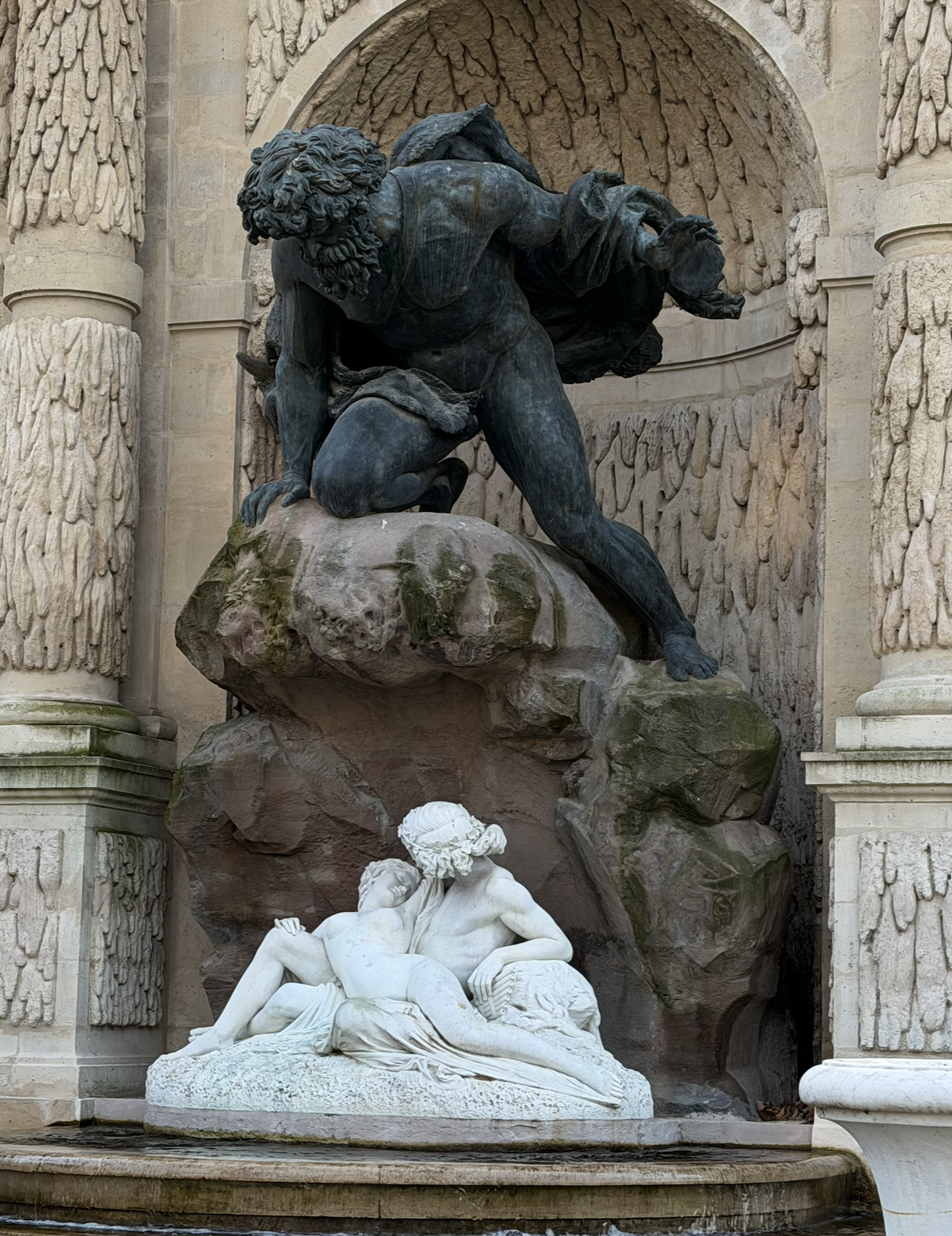
In white Carrara marble, Galatea lies in the arms of Acis, who has his left hand on his panpipes; perhaps he is about to play her a little tune. Above Polyphemus in bronze looks down on the lovers. His left hand is reaching out to what we can imagine to be a large stone he will remove from Mount Etna and strike the young shepherd, killing him in his fit of jealousy, or maybe a reaction to his pan pipe.
The beautiful Galatea is devastated and cries and screams out to the gods. Neptune and other water nymphs arrive and bring Acis back to life, but as a river running red at the base of Mount Etna. Acis would be immortal, and Galatea would visit and lie by the water every day for the rest of her life. The river would be named Acis, and its modern name is Jaci, although it no longer runs red.
The story became quite popular and was performed at Versailles at the court of Louis XV, with the beautiful Madame de Pompadour playing the lovely Galatea.
The piece was created by Auguste Louis Marie Ottin in 1866, and the two figures were added on either side. On the left, Faunus, god of the forest and father of Acis, holds a pan flute and looks on at the nude couple. On the right, Diane, the goddess of hunting and of the moon,is one of my favorites.
Today, it’s hard to imagine the fountain without them, but when the finished fountain was revealed in 1867, the naked marble couple offended many, causing one outraged gentleman to throw a bottle of black ink, striking and covering them in ink.
When you visit Paris, be sure to walk around to the back of this lovely, lush garden and fountain.
The Medici Fountain wasn’t the only one on the brink of destruction at the start of the 1860s. Thousands of homes, structures, and fountains were under the wrecking ball of Haussmann, including a small fountain not far from the Jardin du Luxembourg.
During the reign of Marie de Médicis, an aqueduct was extended to the southern bank of Paris. Napoleon Bonaparte brought water to the people. On May 2, 1806 ,he signed a decree that water should flow day and night at the fountains of Paris. He also had more than twenty fountains added, including the Fountain of the Rue de Regard. The fountain was built in 1636 and fed from the same aqueduct as the Medici fountain, and was demolished in 1792.
Napoleon ordered a new fountain in 1806, and sculptor Achille Valois was chosen to create a bas-relief design for the small structure. Vallois had his idea for the budget he needed, and the city official had their own idea, which included a smaller number, almost half of what the artist wanted.
Negotiations went on for over a year, and Valois only backed down when he was threatened with rescinding the entire commission and choosing another artist. Vallois had already started on the project and gave in, making the 5375 francs work instead of the 8742 francs he had asked for.
Vallois was heavily influenced by the Renaissance master Jean Goujon, who created the Fontaine des Innocents as well as the Louvre of Henri II, and incorporated the same feeling into his bas-relief.
Leda and the Swan, from Greek mythology, was a couple adored by many artists since the Renaissance, especially sculptors. At times, the scene can be quite risque and not for the younger viewers, but this one keeps it pretty low-key until you know the story.
Léda was a beautiful mortal Spartan queen whom Zeus saw and wanted. The Greek gods couldn’t appear before a mortal in their god-like form, so he had to transform himself into a creature. Zeus chose the elegant swan and appeared before the lovely Léda, who was lying on the banks of the Eurotas River.
She was clearly taken by the sultry swan, and the two had a romantic encounter. Later that same day, she also slept with her husband. The story continues on many months later when the lovely Léda gives birth to two large eggs. One of which has a set of twins of Zeus, Helen and Pollux, and the other a set of twins of her husband, King Tyndareus, Castor and Clytemnestra.
Zeus’ daughter, Helen, later known as Helen of Troy, was considered one of the most beautiful women in the world. Often a subject of art, Jacques-Louis David captures her in his painting, "Helen & Paris," at the Louvre. Her brother Polydeuces, more often known as Pollux, and his half-brother Castor are also the Gemini twins, stars in the sky, and once the namesakes of the two elephants at the Jardin des Plantes, which didn’t have a very storybook ending during the Commune of 1871.
Castor, the son of King Tyndareus and his sister Clytemnestra, was remembered for having two husbands and a penchant for ending the lives of men, who were both mortal but raised with their half-mortal siblings.
A few years ago, Léda was making the rounds of the outraged on the internet when they wanted to “cancel” the story of the woman attacked by a man. However, I think we need to keep the entire story in mind and remember that it included a swan and gave birth to two large eggs with two different fathers.
Everyone from Leonard da Vinci to Cézanne has reimagined the scene, and she has even taken to the runways of Paris in the 2021 Dior show.
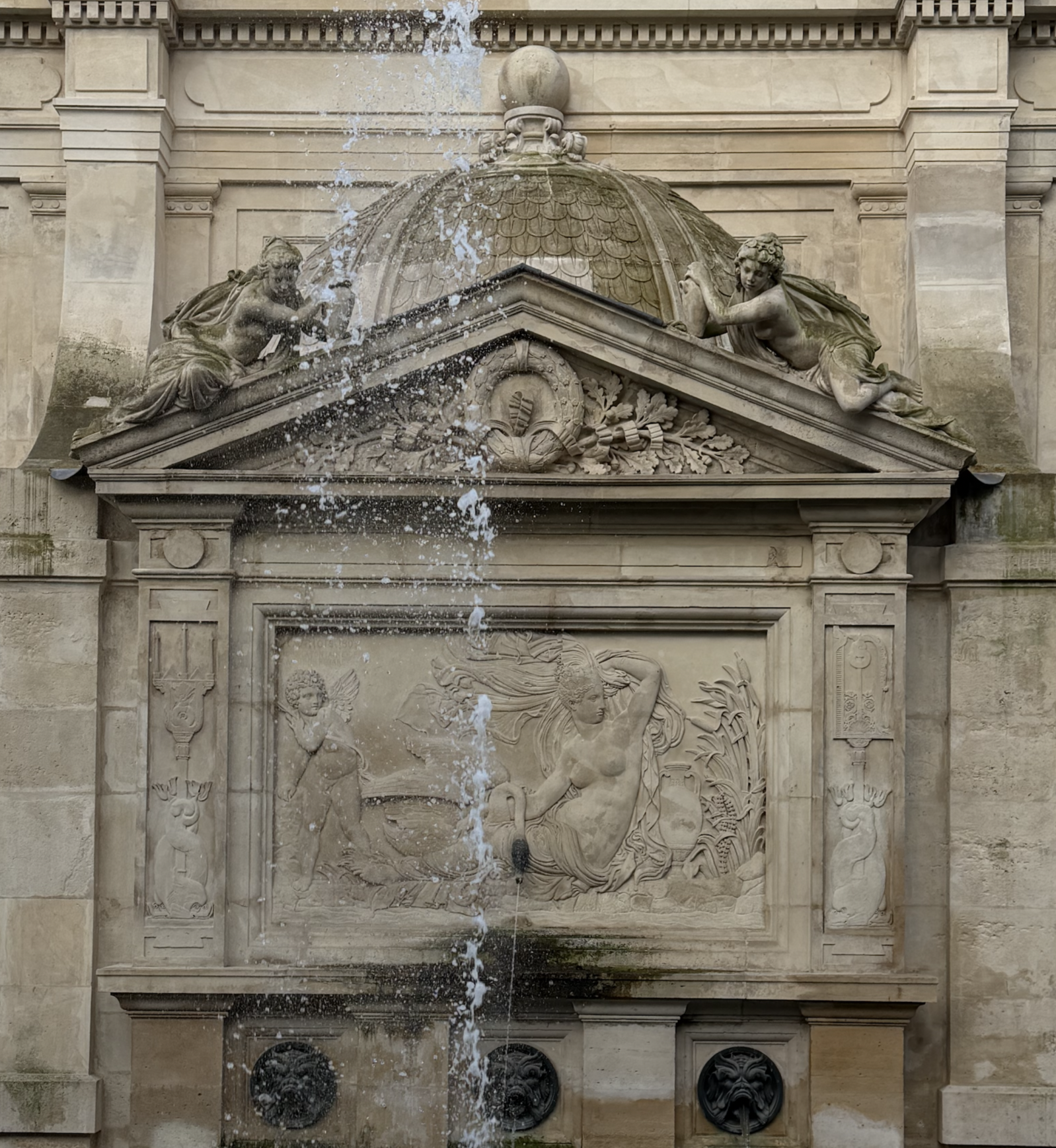
In the Vallois version, the beautiful Léda is depicted within the reeds and tall grasses of the river Eurotas, and Zeus, as the swan, lies on her lap, his neck and beak pointing down into the basin below the fountain. The two lovers aren’t alone. On the left edge, Cupid appears to be leaving the scene and putting his arrow back into his quiver, as he is clearly not needed at this time.
Even the somewhat erotic story of Léda couldn’t keep her from her impending destruction by Haussmann. Thankfully saved by the quick thinking of Gabriel Davioud, who had the bas relief set aside for another use.
In 1862, when the Medici fountain was moved to its new spot, it no longer sat against a wall, and suddenly, the perfect spot for Léda was created.
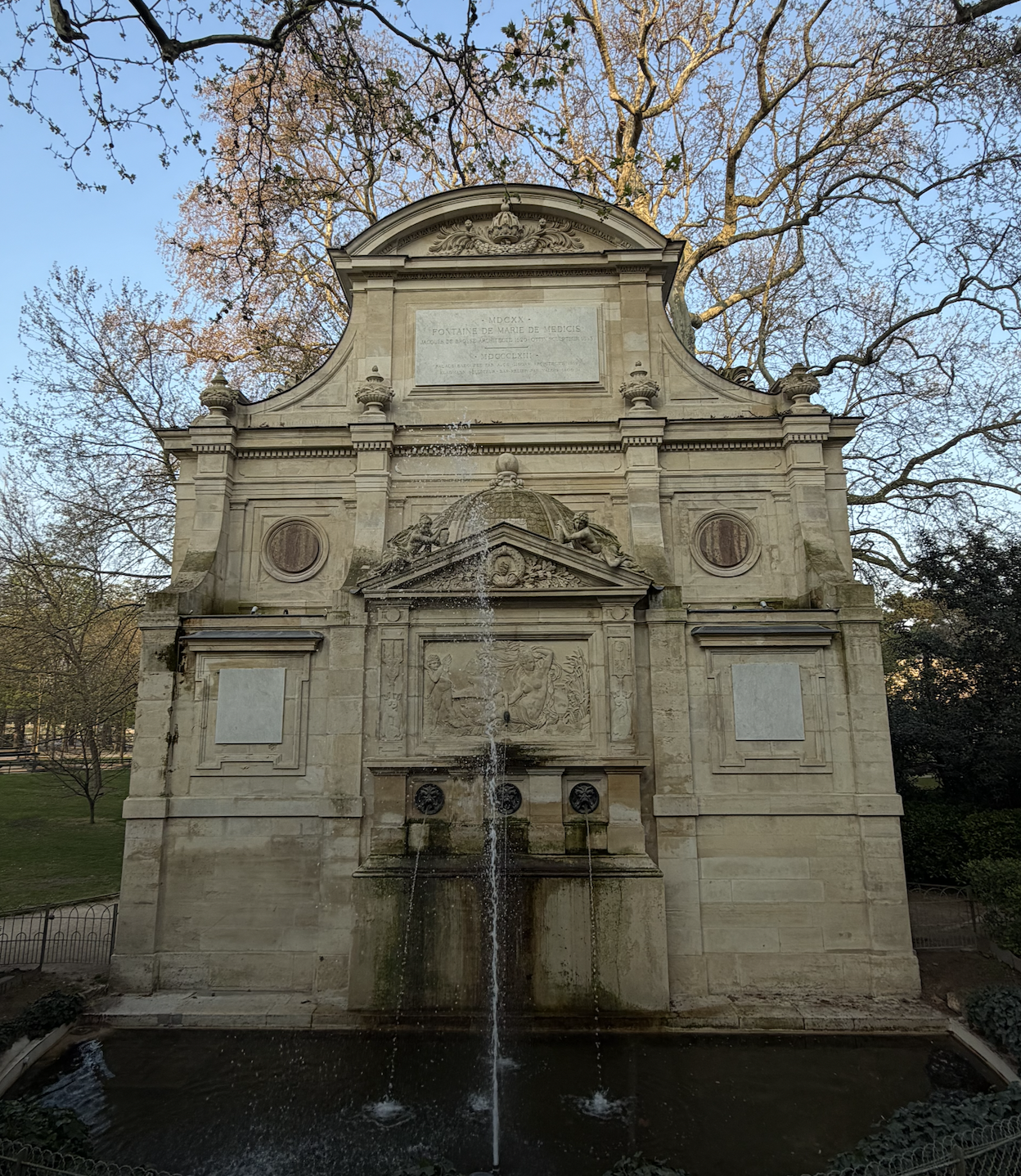
Much smaller than the Medici fountain, it sits on the back side that was mostly hidden from view until two years ago. Executed by Alphonse de Gisors with the help of sculptor Jean Baptiste Klagmann. The bas relief of Léda is bordered on either side with a triton and dolphins on the left and an oar with dolphins on the right.
Added at the top is a pediment with a laurel wreath and oak leaves, and two water nymphs by Klagmann looking down onto the sexy scene.
At the very top, the crown of Marie de Medici is over a plaque marking the two major stages of the fountain in its 1620 creation and 1863 renaissance, and the artists who brought it to life.
The size of the garden has changed over time since the 17th century. Marie's garden was sliced and died, and changed many times. Under Louis Philippe, the garden grew to what we see today, except for the eastern corner, altered by Haussmann.
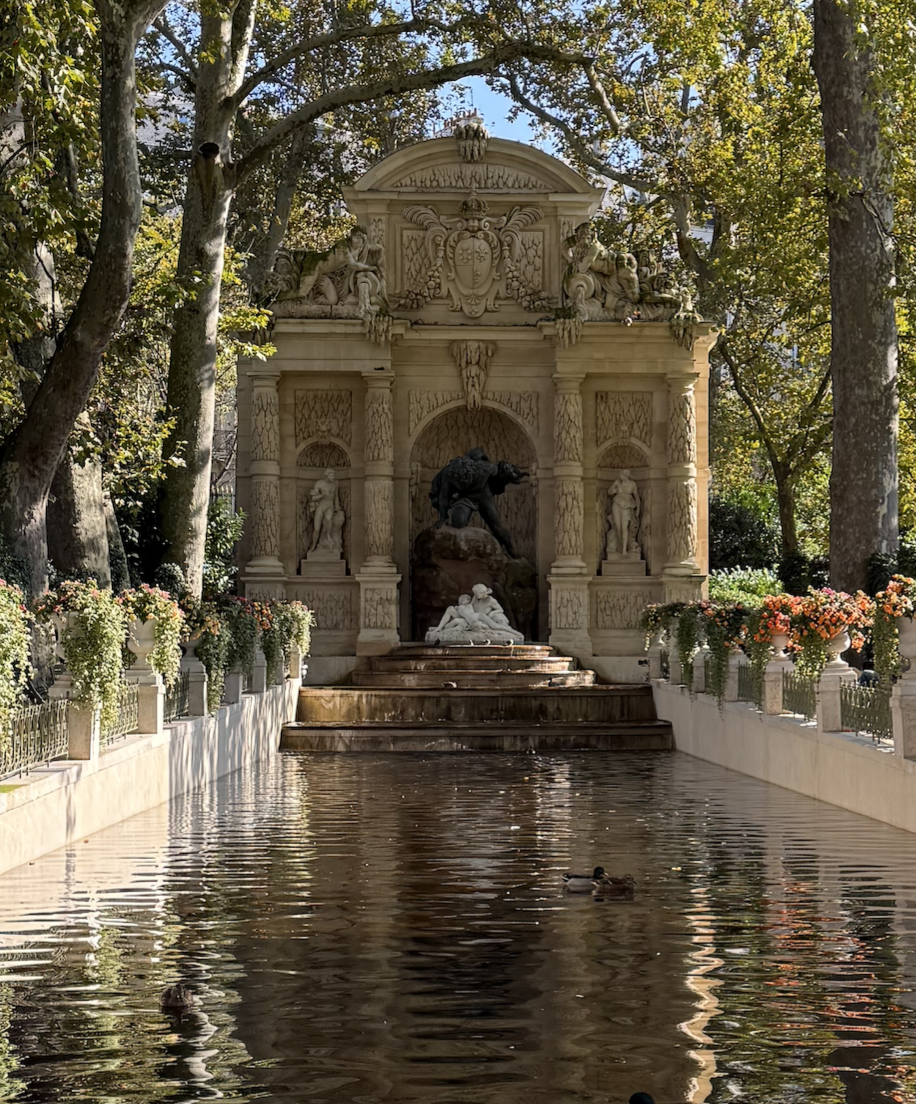
Either way, it's one of the greatest spots in all of Paris to sit, and it's even been voted one of the most beautiful gardens in the world.
Visit on an early Sunday morning, just after it opens, and walk the beautiful park completely alone. Grab a croissant and a coffee and sit in one of the iconic Luxembourg green chairs under the plane trees of the garden and transport yourself back in time.
However, keep an eye out for any randy-looking swans.