It’s hard to do anything these days that can impress the masses and capture attention for more than 20 seconds. Companies, restaurants, and museums all want that viral moment that spreads within hours but then is forgotten just as fast.
Paris is a bit different. Are they endlessly annoying influencers telling you a cafe covered with fake flowers is the one to go to, or just take photos at? However, there is another entirely different side of Paris. One that is tied to its deep history, running through the streets like an ancient vein of cobblestones. The French love their history and their heritage. Each September, one weekend is dedicated to the many historic buildings that open for just two days.
So when something new appears in Paris, it will first be met with a whole lot of distrust and hatred, but if you tie it to a historic moment or idea, you have a good chance the skeptical Parisians will like it or eventually come around to saying it's at least ok.
For the 2024 Paris Olympics, organizers had a lot of work ahead of them and, of course, very lofty goals, starting with the opening ceremonies. We aren’t going to get into the entire ceremony or the ridiculous opinions that came from it, but there was one moment at the very end that did what few things can. Capture attention and keep it, returning to it each year.
With each Olympics, every host city wants to do its best at showcasing how unique and beautiful its city truly is. Sadly, for anyone who comes after the Paris Summer Games, you are out of luck. It will be hard to top Paris's venues and skyline. The Chateau de Versailles, as the background for the equestrian competitions, even swimming in the Seine, was pretty magical with the Eiffel Tower above.
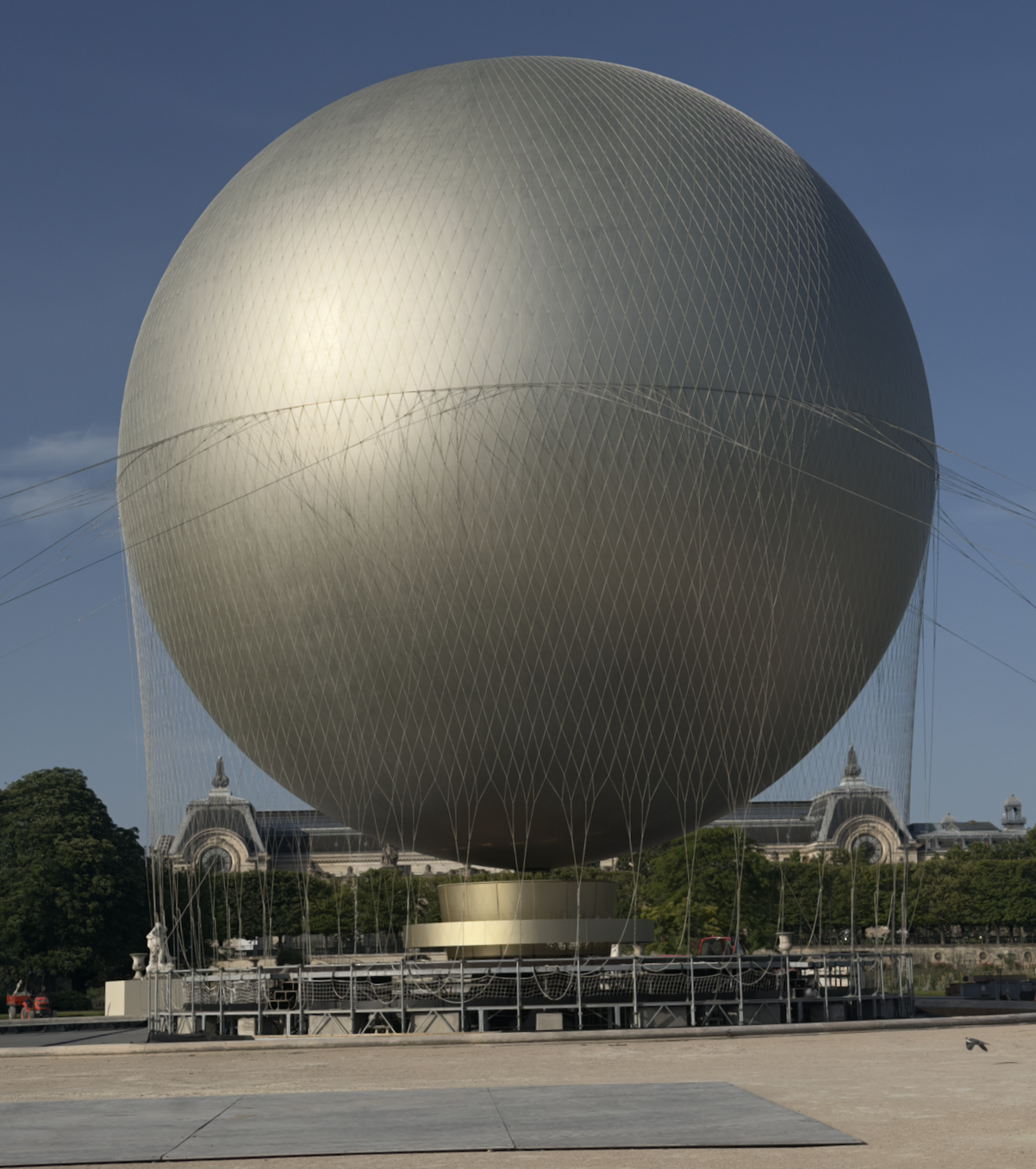
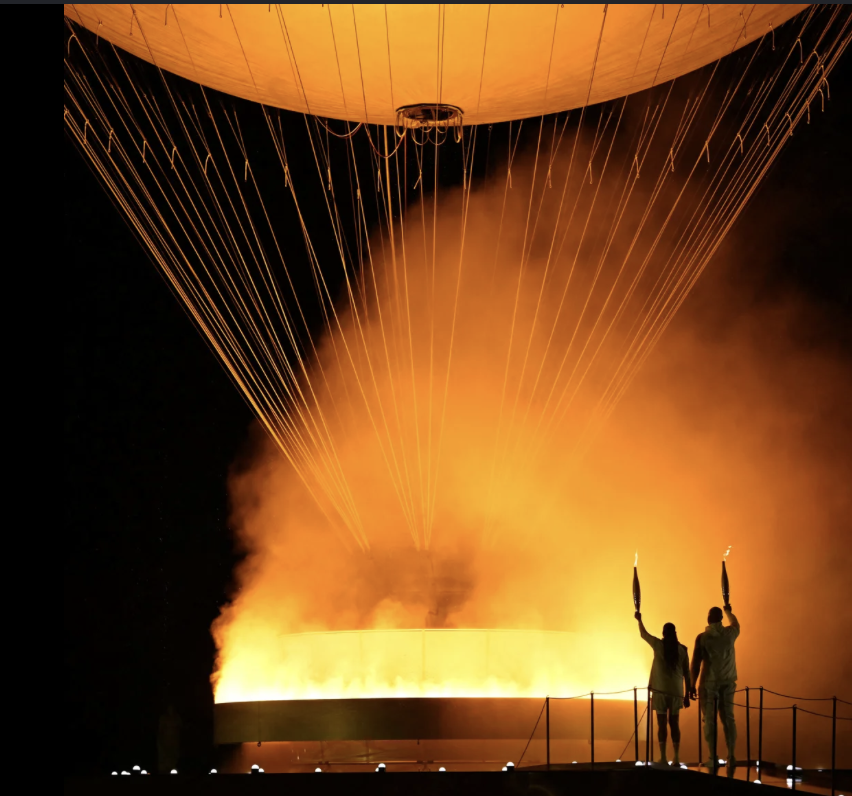
A few months before the opening ceremonies, we heard that the Olympic cauldron would be placed in the Jardin des Tuileries, and one day a silver balloon appeared. We didn’t know how it would all tie together until we learned, at the same time as the rest of the world, that the cauldron was lit and lifted from the center of the basin and up into the air.
During the Olympics and the Paralympics, each night after the sun set, the balloon would rise into the air. During the day, the lucky few who were able to grab tickets fast enough got close to it, but it was still just as easy to see from anywhere in the garden, the surrounding streets, and even the terrace of the Louvre.
The balloon was seen as such a huge success that it would be brought back each summer until the 2028 Summer Olympics in LA. Lucky for those in Paris, for the next few months, you can once again see the large silver balloon and cauldron rise from its base each night, and each day, you can walk around the base without a ticket.
What was this amazing sorcery, and how is the flame not setting the helium-filled balloon on fire, and furthermore, why a balloon?
French designer Mathieu Lehanneur designed the torch that carried the flame from Greece through nearly every corner of France and even to French territories in the middle of the ocean, ending in Paris on July 26, 2024.
The 51-year-old designer opened his own atelier in 2001 and has added his creations to museums, including lighting in the Café Mollien in the Louvre, which has since been removed. His contemporary lighting and furniture with rounded corners give each piece a playful quality.
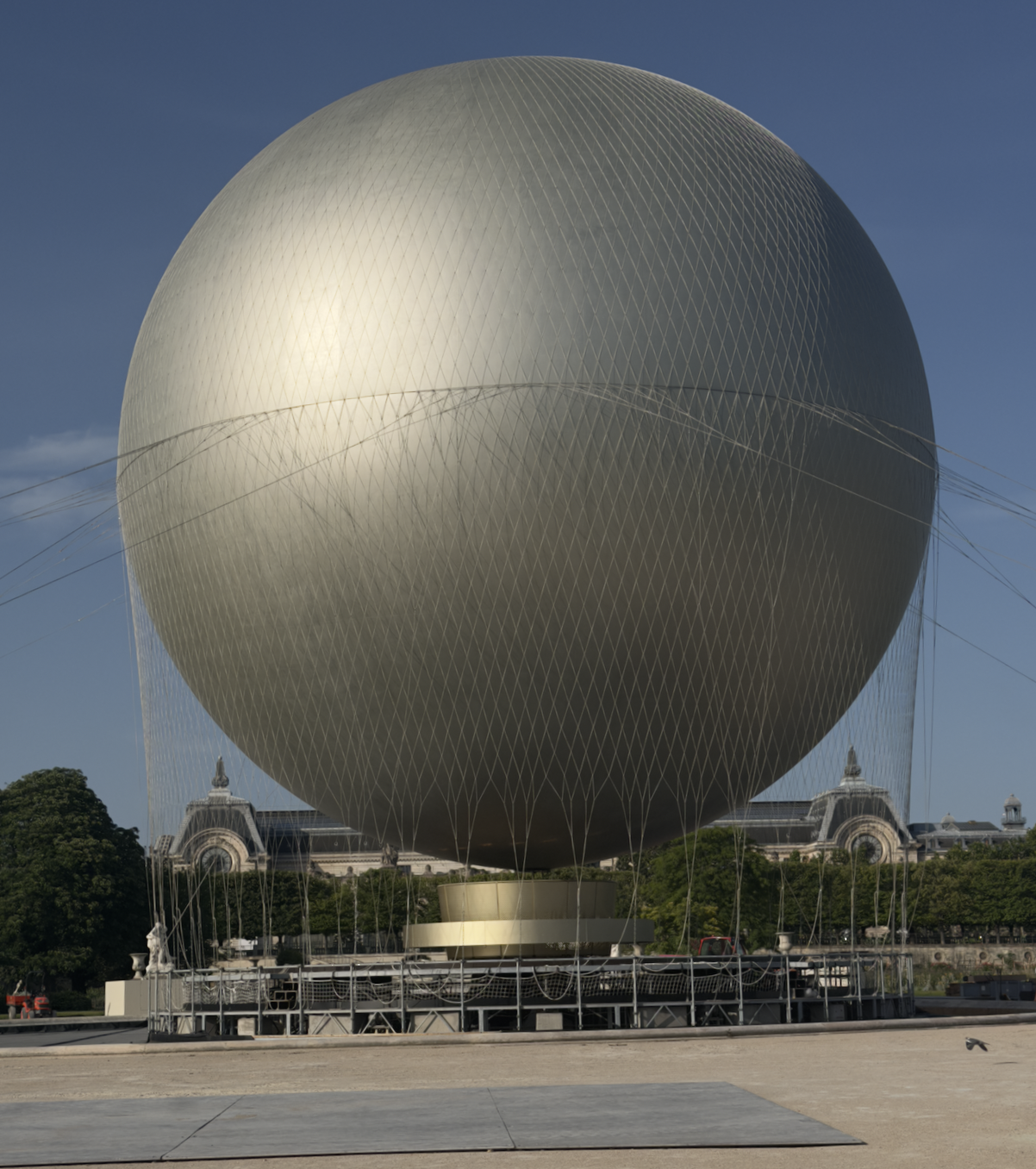
Lehanneur designed a large helium balloon at over 75 feet in diameter, with a very special nod to history, which sits above a 23-foot-diameter ring of fire. However, it wasn’t the actual flame that encircled the ring, and couldn’t be each year after the Olympics had concluded. It was created by EDF, the French energy company, and consists of LED light beams and a water mist, making it 100% renewable and with no environmental impact. Pretty cool, huh?
Why a balloon, you ask? Well, this is Paris, and nothing happens by chance. The heritage is taken very seriously here, and the balloon is a nod to an event that happened on December 1, 1793, in this very same spot.
But first, we need to talk about the first balloon launch that took place in front of Marie Antoinette herself.
Picture this: it's Thursday, September 19, 1783, and just after 1 pm in the courtyard of the Chateau de Versailles, a duck, a rooster, and a sheep are loaded into and tied to a basket that hangs from the balloon. Louis XVI had heard about a new invention that could rise from the earth and into the sky, and had to see this for himself.
The Montgolfier brothers were born into a large family of 16 kids. Their father headed up a paper and stationery company that had been in the family since the 14th century. With a bevy of siblings, Etienne and Joseph headed off to Paris to follow their own passions.
Etienne studied architecture and called Jacques Germain Soufflot the architect of the Pantheon, a mentor. Joseph was interested in chemistry and set up a lab in Paris until 1772, when their brother Raymond died, and the siblings were all called home to work in the family business.
In 1782, the brothers, combining all their interests and a moment of good fortune, created the first hot-air balloon. One day, Joseph had tossed a piece of paper into the fire and watched it lift into the air above the flames. This led Joseph to create a cubed frame covered in silk, place it in his fireplace, and watch it rise up his chimney; Eureka!
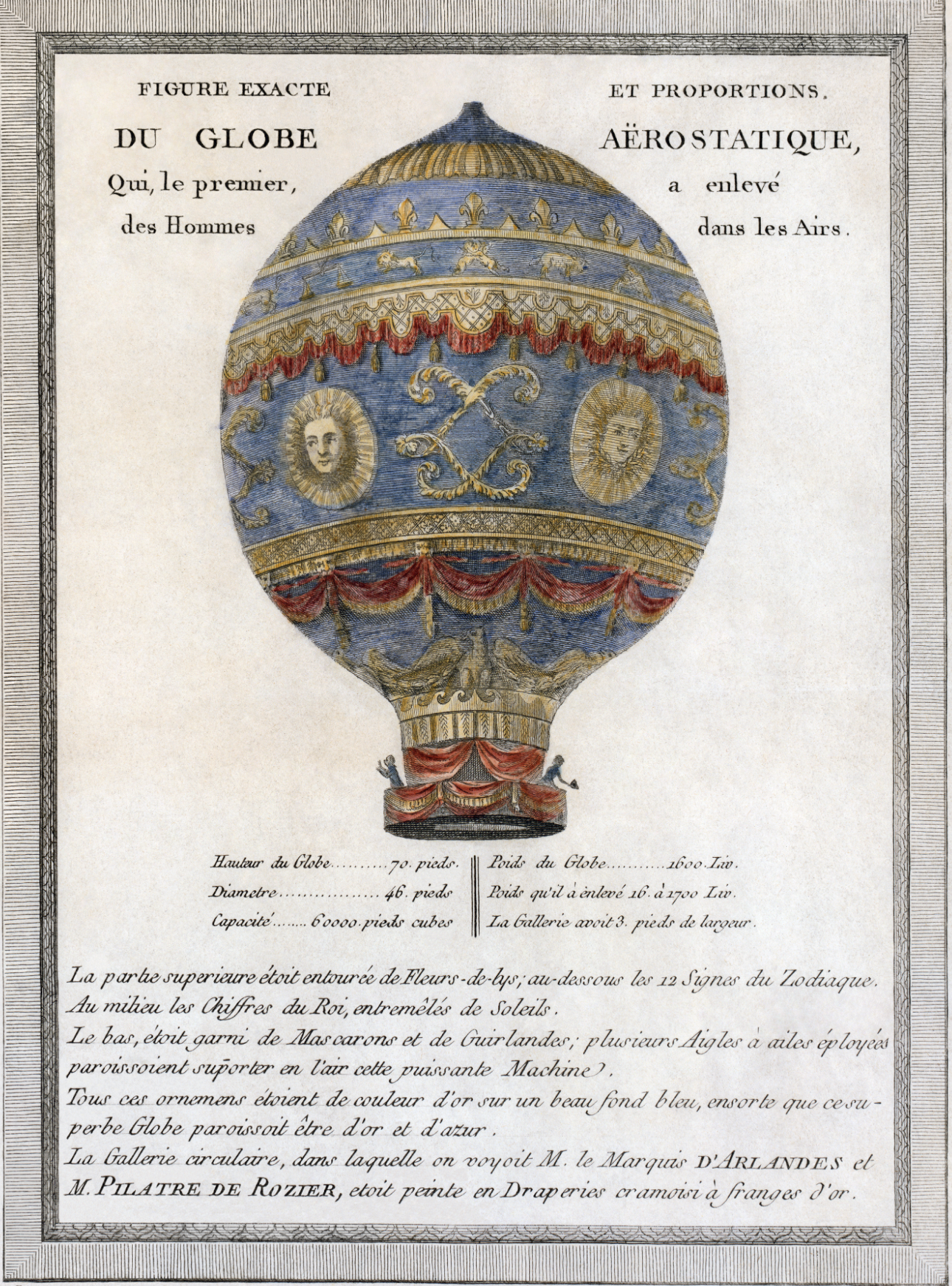
By the end of the year, the two brothers had put their heads together, and by December 1782, the first steps toward flight had begun. Various fabrics from silk to wool and paper, combined with every kind of fire fueled by manure, leather, or raw meat.
On April 25, 1783, they hit the jackpot. A 105-cubic-foot balloon, constructed of canvas and strengthened with paper from the family biz, weighing just under 500 pounds, lifts into the air and travels 1300 feet, much to the amazement of the small crowd below.
Night and day, they worked to perfect their design, and on June 4, 1783, a bigger balloon was flown and stayed aloft for 10 minutes, traveling a mile and a half. Word spread quickly throughout the scientific community and reached Versailles and the attention of the king himself.
Louis XVI might have been the one man in the royal lineage who never wanted to take the throne. Louis was happiest taking clocks apart, looking at large maps, plotting navigational routes, and playing with locks and keys. He was a bit of a nerd, and I mean that as a compliment. When word reached Louis of this amazing feat of flying, he needed to see it for himself.
Much to the delight of the Montgolfier brothers, who needed funding to take their project even higher, no pun intended. The two were invited to Versailles to present the flying balloon to the king himself.
Of course, the brothers decided they needed to create a new, larger balloon. With this, the shape of the hot air balloon we know today was created. The brothers called upon their friend Jean-Baptiste Réveillion, the owner of the Royal Manufacture of Wallpaper, to assist in creating the new, larger balloon.
Over 1000 m3, it was tested on September 11, a week before their date with the king. It was a success, but not so fast; the rain had other ideas. Much like the same thing that happened 243 years later on the Pont Neuf to the JR structure, the wind and rain ripped apart the balloon.
A date was set with the king for September 19; a new balloon had to be created in less than a week; the previous one had taken two months. This was also the perfect time to go even bigger on the balloon at 1400 m3.
The big day arrived. There in the courtyard of the Chateau de Versailles before Louis XVI, Marie Antoinette, and a few thousand of their friends, the Montgolfier brothers watched their balloon lift into history.
On September 19, 1783, at 1:11 pm, with the precious cargo tied into a basket, the balloon lifted and traveled almost 2000 feet, and in eight minutes, traveled north 3 ½ kilometers to the carrefour de Maréchal in the nearby Bois de Vaucresson. A rip in the balloon brought the trio down, and to the surprise of everyone, completely unharmed, for the most part.
The world's first astronauts were given a hero's return to the chateau and placed in the royal menagerie, where they lived out a very lavish life. Although some bystanders said the duck’s beak was broken from the sheep sitting on it.
Physician Jean-François Pilâtre de Rozier was on hand that day and was the first to see the three thriving animals for himself. The next step was to fly a human, and the physician was the first to raise his hand.
A larger balloon was designed, and this time they covered it with wallpaper decorated with a motif fit for Versailles. On a blue background, gold intertwined L’s, the cipher of the Bourbon Louis’s, as well as the symbols of the zodiac, eagles, and of course, the sun of Louis XIV.
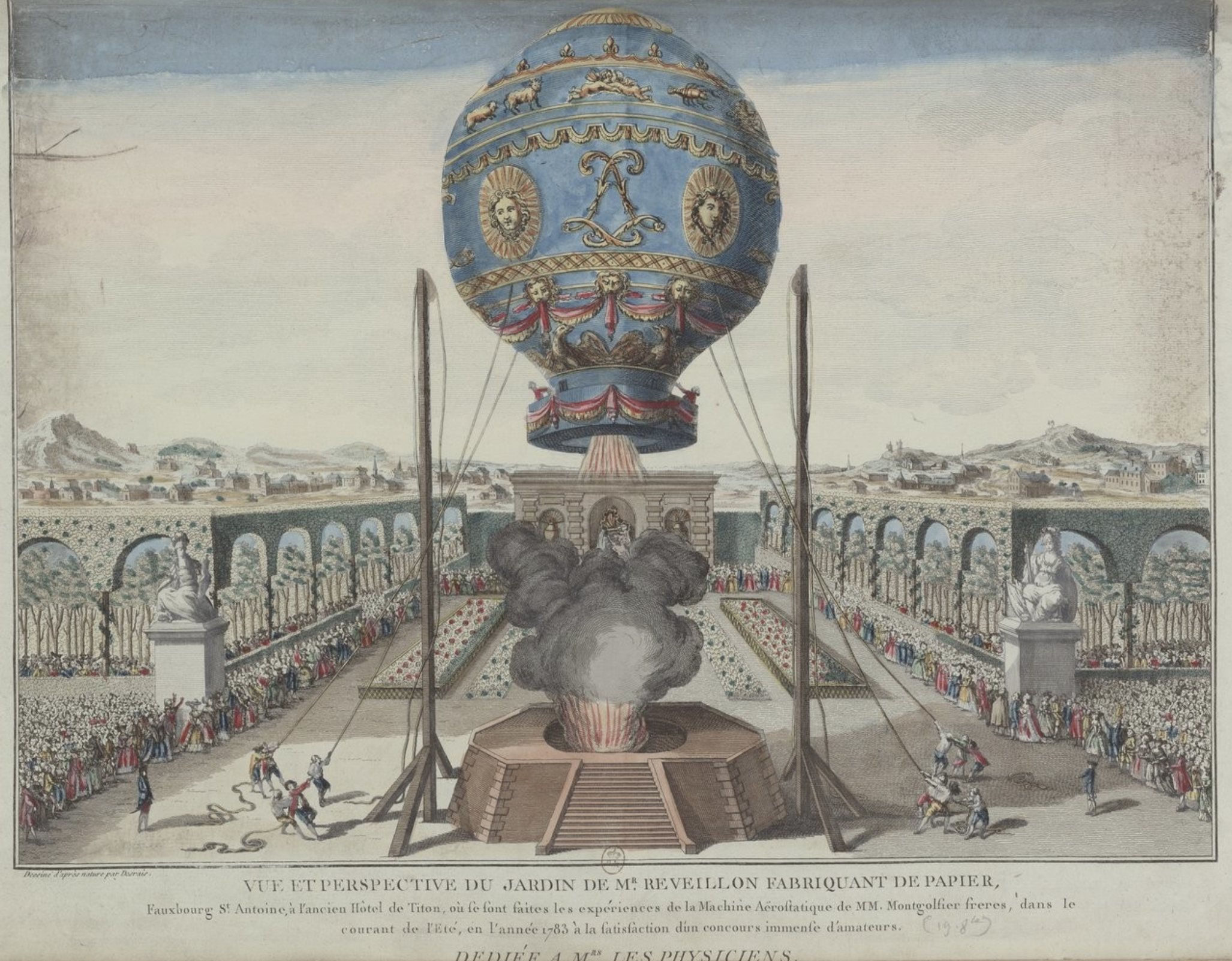
The first test was held on October 15th, rising 85 feet and remaining aloft for over 4 minutes.
On October 19, on the Rue de Montreuil in the Folie Titon park of the Révillon manufactory, the first human, Pilâtre de Rozier, was launched 266 feet from the ground, this time tethered. Later that same day, André Giroud de Villette joined the good doctor and remained aloft for almost 10 minutes.
After final approval from Louis XVI himself, the first non-tethered launch took place on November 21, 1783, from the Château de la Muette outside Paris. The king wanted to use convicted criminals for the first flight in case it ended in death, but was convinced by his advisors that it would be safe.
The balloon not only stayed in the air, but it also quietly traveled over the Jardin des Tuileries and the city itself. Can you imagine the surprise people below would have if they were unaware of the event? For 5 ½ miles, it crossed Paris, landing SE of Paris in Butte-aux-Cailles.
The Montgolfier Brothers would cement their place in history and science, so much so that Montgolfière is the French word for Hot Air Balloon. Joseph would live until 1810 and be awarded the Legion of Honor by Napoleon and named to the Academy of Science. Sadly, Etienne died in 1799, but would have been given the same honors had he lived long enough. What would these two fellows think now?
As for the first man to travel into the air, Jean-François Pilâtre de Rozier, he became obsessed. On June 23, 1784, Rozier returned to Versailles to fly in an even larger balloon christened La Marie Antoinette. Alongside chemist Joseph Louis Proust and in front of Marie Antoinette, Louis XVI, and guest King Gustavus III of Sweden, the two took to the sky. This time, they reached beyond the clouds, 9800 feet above the earth, and disappeared from view. In less than an hour, they traveled 32 miles before running out of fuel and dropping near the forest of Chantilly.
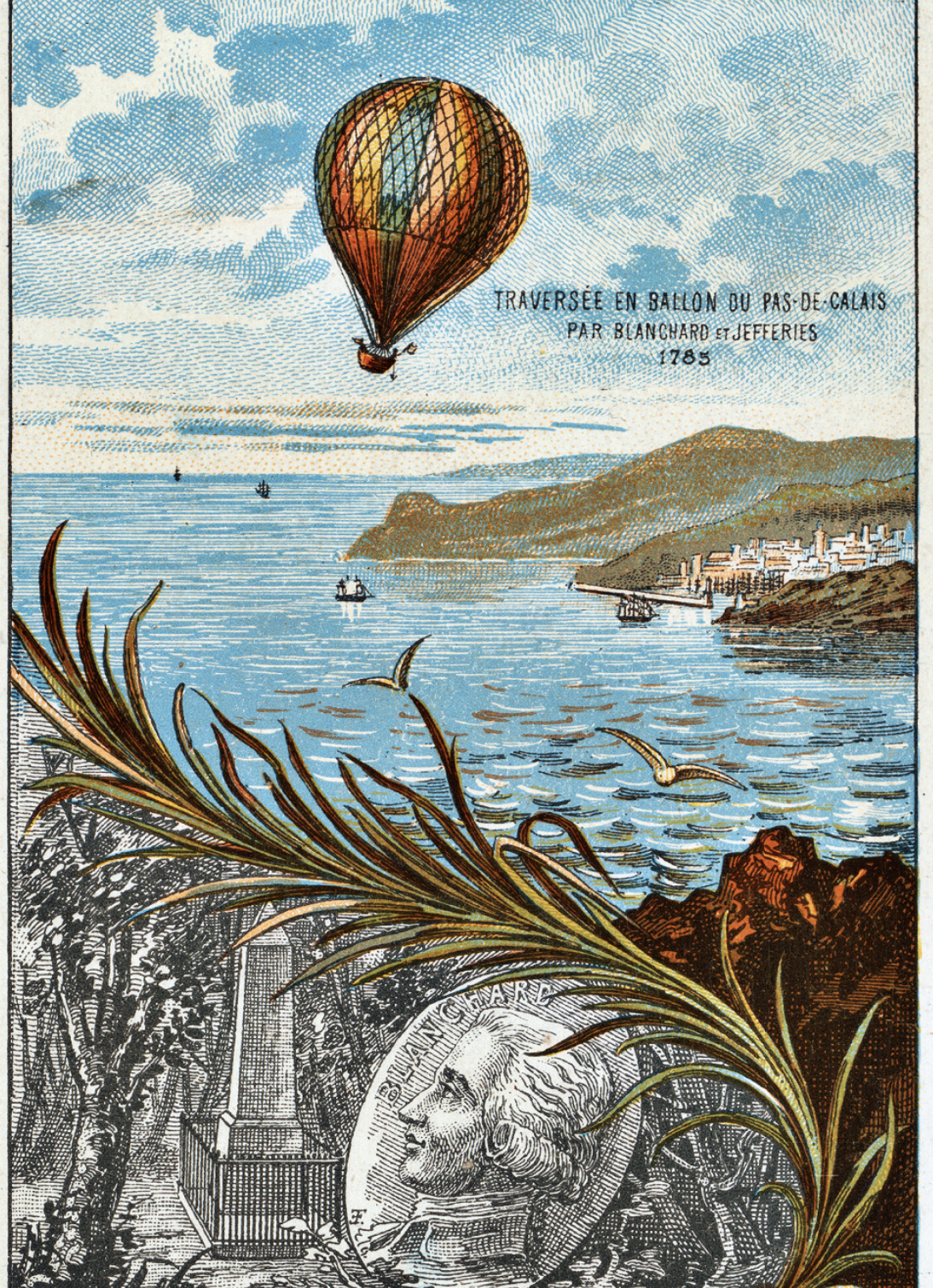
Rozier’s need for speed or height would be his undoing. Bolstered by successful launches, he now wanted to cross the English Channel. On June 15, 1785, with physicist Pierre-Ange Romain, in a specially designed balloon that sat on a column to hold enough fuel for the crossing. Shortly after takeoff, strong winds blew them back over land, and the balloon lost its air and crashed to the earth. The first man to travel into the air was also the first man to die in the pursuit of flight.
While the Montgolfier brothers were presenting their creations before the king and queen of France, two other brothers were nipping at their heels.
Physicist Jacques Charles created the first hydrogen-filled balloon, which is fourteen times lighter than air. Working with brothers Ann-Jean & Nicolas Robert, a silk balloon coated in rubber was constructed in the Place des Victoires. On December 1, 1783, from close to the very spot where we find the Olympic Vasque today, Jacques Charles and Nicolas Robert took off and floated 27 miles while more than 400,000 people watched, including Benjamin Franklin.
The 2024 Olympics, held in Paris, did a beautiful job of melding the games with the city's backdrop and a heavy dose of history. In Paris, you are constantly rubbing shoulders with history, even if you aren’t paying attention. Marble plaques attached to buildings share the story of a past figure that lived there, or a historic moment that occurred, or even mark the spot where someone died in the fight to free Paris during the Liberation of 1944.
Everything in Paris has a story; it’s what gets me out of bed every morning hours before the sun rises. I love to find those deep connections between what we see today and how it came to be.
This is the same as what can be found in the story of the balloon in the Tuileries, but it doesn’t end with the first balloon flights that occurred from and over the garden; it is also in the exact spot at which the balloon vasque sits today.
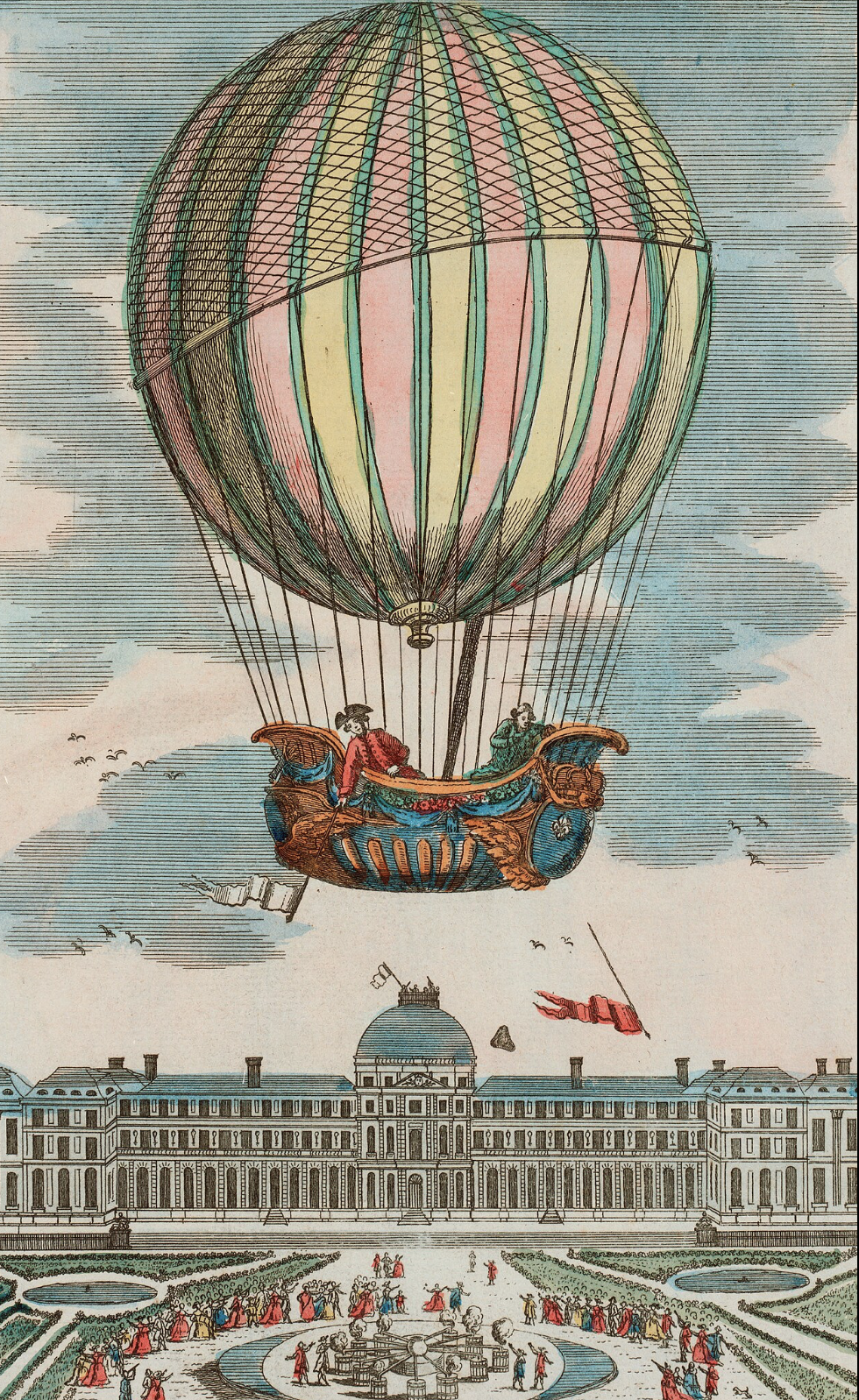
The balloon is situated over the round eastern basin of the Tuileries, which sits on the invisible line that runs through Paris, known as the Axe Historique. The Jardin des Tuileries was created under Catherine de Medici in the 16th century and attached to her palace, which once stood at the end of the Louvre. Garden architect Pierre le Nôtre was tasked with designing a garden that would include a grotto, vegetables, and endless beds of flowers, all for her enjoyment.
The garden would evolve in the 17th century under Louis XIV and Pierre’s grandson, André Le Nôtre, who would add the quintessential French design of geometric lines.
As the king liked to escape to the countryside to his place of birth in Saint-Germain-en-Laye, he asked Le Nôtre to extend the view from the Palais du Louvre through the garden and to the top of the hill. We know it as the Champs-Élysées.
While the axis dates to the 17th century, it was in the 19th century that monuments were added along the line, linking history forever, and finally anchored in 1989.
Today, the axis begins at the Musée du Louvre. Off-center from the Pyramid of IM Pei (listen to episode 16 for more) is a statue originally designed by Bernini for Louis XIV and finished in 1684. Louis hated it and hid it in the farthest corner of Versailles until he had François Girardon redesign the Sun King into a Roman hero.
While IM Pei was finishing the Pyramid and the Cour Napoléon, a copy of the redesigned statue was created in lead as the original was too fragile to move. Upon arrival, IM Pei placed it SW of the Pyramid, which may look a bit odd, until you realize it is the beginning of the Axis line.
Louis XIV rides his trusty steed and looks as if he is ready to head out for the weekend to one of his many countryside estates. From this spot on a clear day, or better yet, from the window of the former bedroom of Henri II on the first floor of the Louvre look west to the outskirts of Paris.
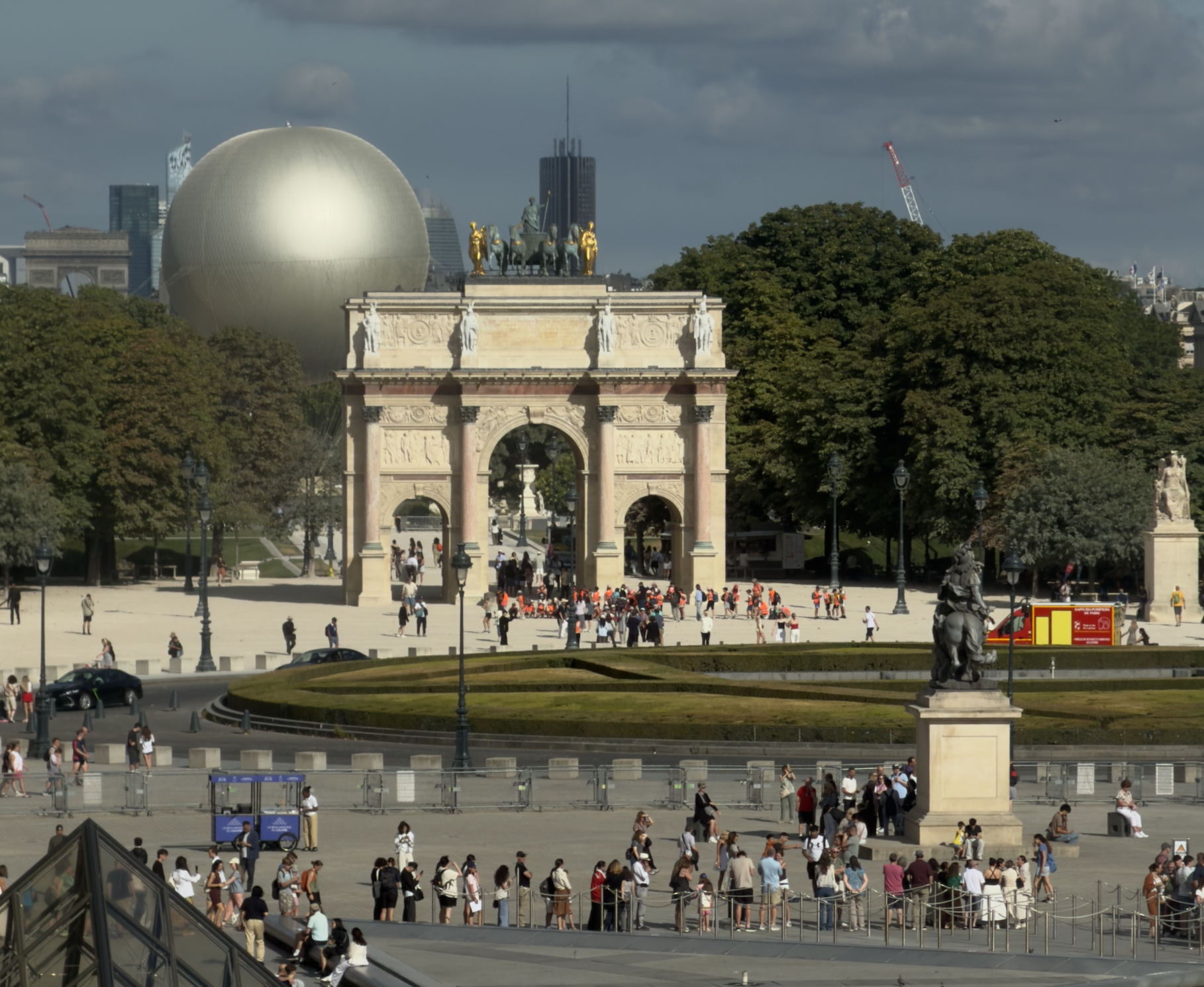
From Louis, we see the Arc du Triomphe du Carrousel, commissioned by Napoleon and built in 1808. More on that soon. The line runs through the central path of the Arc's garden and to the Olympic balloon, cementing its place in history, even if only temporarily.
Continuing through the Tuileries, the Place de la Concorde, and the 13th-century Luxor Obelisk, a gift from Egypt to France in 1830, and erected in 1836. The golden triangle on the top of the obelisk is easy to spot over the trees of the garden from inside the Louvre.
Continue down the Avenue des Champs-Élysées to the crowning monument of the Arc de Triomphe. The big brother of the Carrousel was imagined by Napoleon, but he never saw it completed. Finished by Louis-Philippe in 1836 and is still dedicated to the glory of the great soldiers of France, many of whom had given their lives for the country.
From there, the line extends along Avenue Charles de Gaulle and ends outside Paris, in the business district of La Défense, at the Arc de la Défense. Inaugurated in 1989.
As for the Cauldron, it returned this summer and will return one more time in 2027. Maybe it will return in the future; it is a rather beloved addition to Paris's skyline.
The Jardin des Tuileries opens to the public each morning at 7 am, but it can easily be seen without entering the garden.
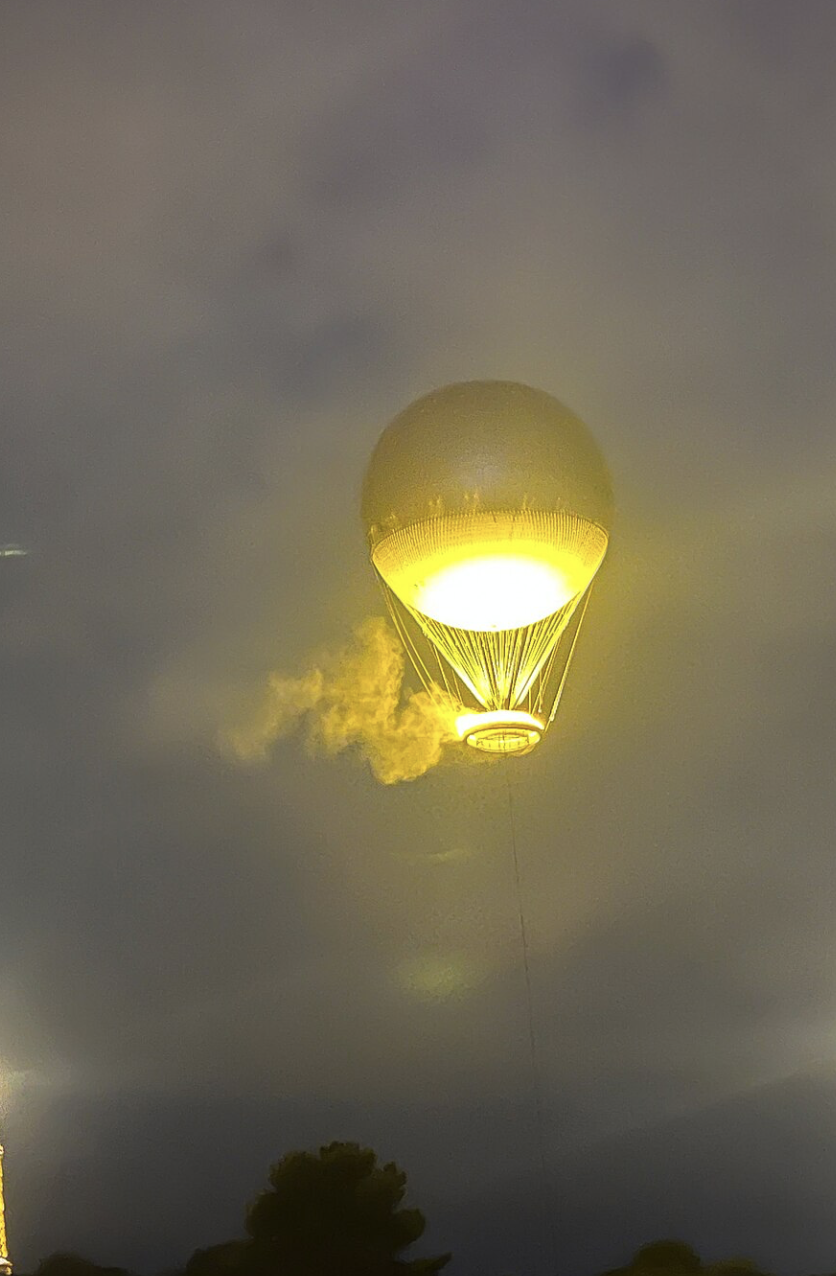
You can watch it rise again each night at sunset, and it stays high above the city until 2 am. It will rise 197 feet into the air until September 14th.
Hours through July 31, garden closes at 9:30 pm, vasque rises at 10:30 pm
August: garden closes at 8:30 pm, vasque rises at 9:30 pm
September 1-14, the garden closes at 7:30 pm, and Vasque rises at 8:30 pm
Unfortunately, the Vasque isn’t designed for people or sheep, but you can travel by air for a fantastic view of Paris.

In the Parc André Citron in the 15th near the Seine and not far past the Eiffel Tower is the Ballon Generali that offers tethered visits 150 meters into the Parisian sky for 16 to 20 euros