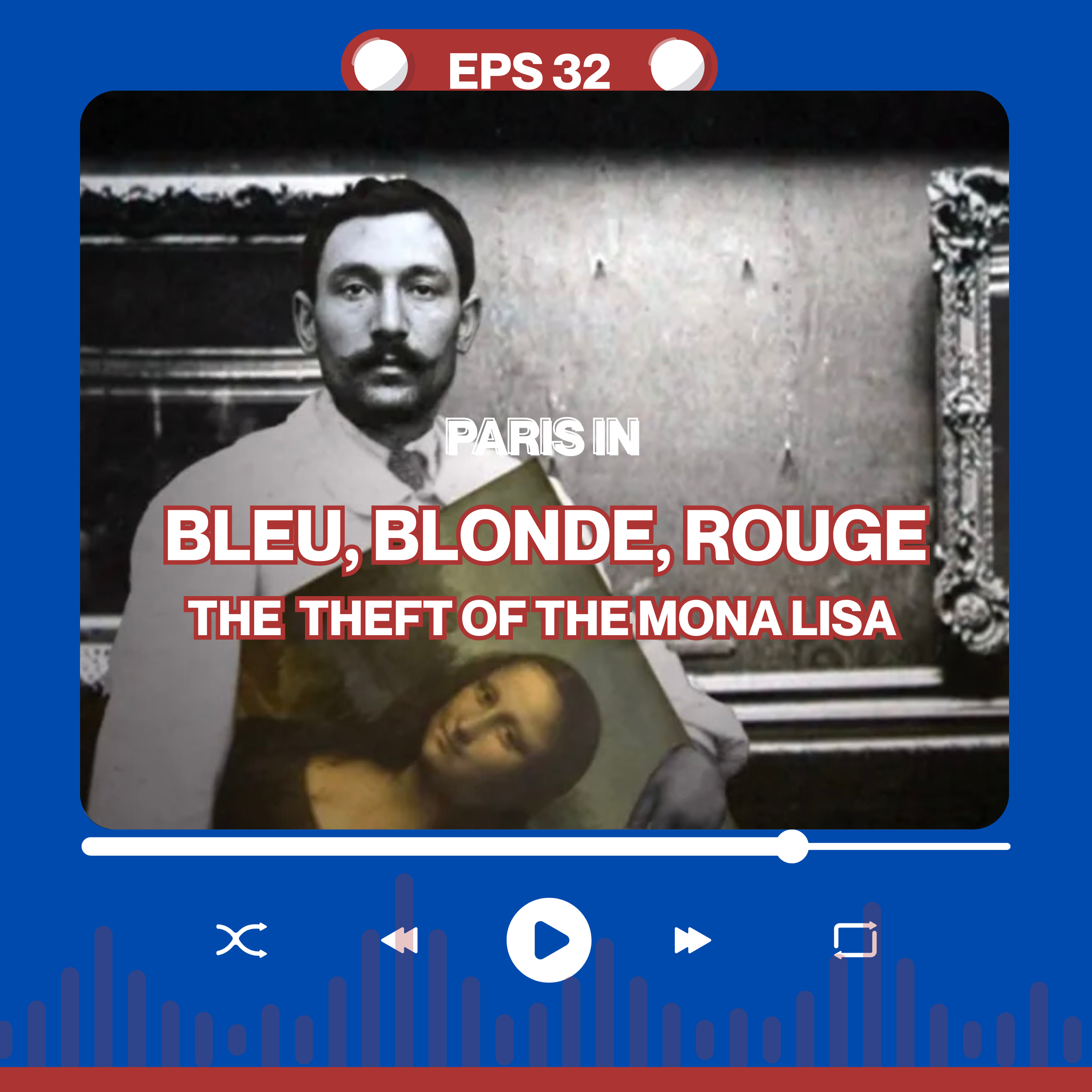
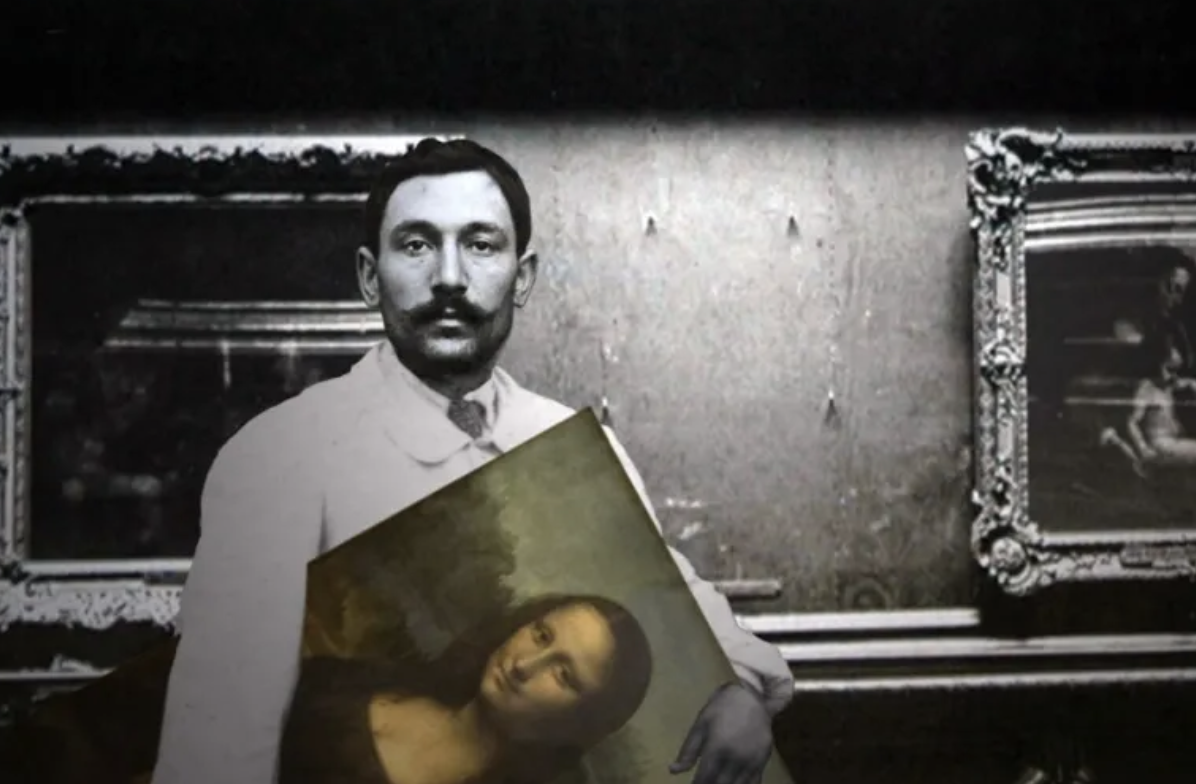
Six days a week, for 115 years since her theft, more than 30,000 people a day push and shove to snap a photo or selfie with the Mona Lisa, and most have no idea why they even do it.
On a hot Sunday, August 20, 1911, at around 4 pm. Vincenzo Peruggia entered the Musée du Louvre just like any other visitor. In the final moments, as the museum closed and guards ushered people out, Peruggia slipped into a storage closet between the Galerie d’Apollon and the Salon Carré. With a chunk of cheese, a small bottle of wine, and a baguette, he waited until the dark of night to emerge to begin the heist of the 20th century.
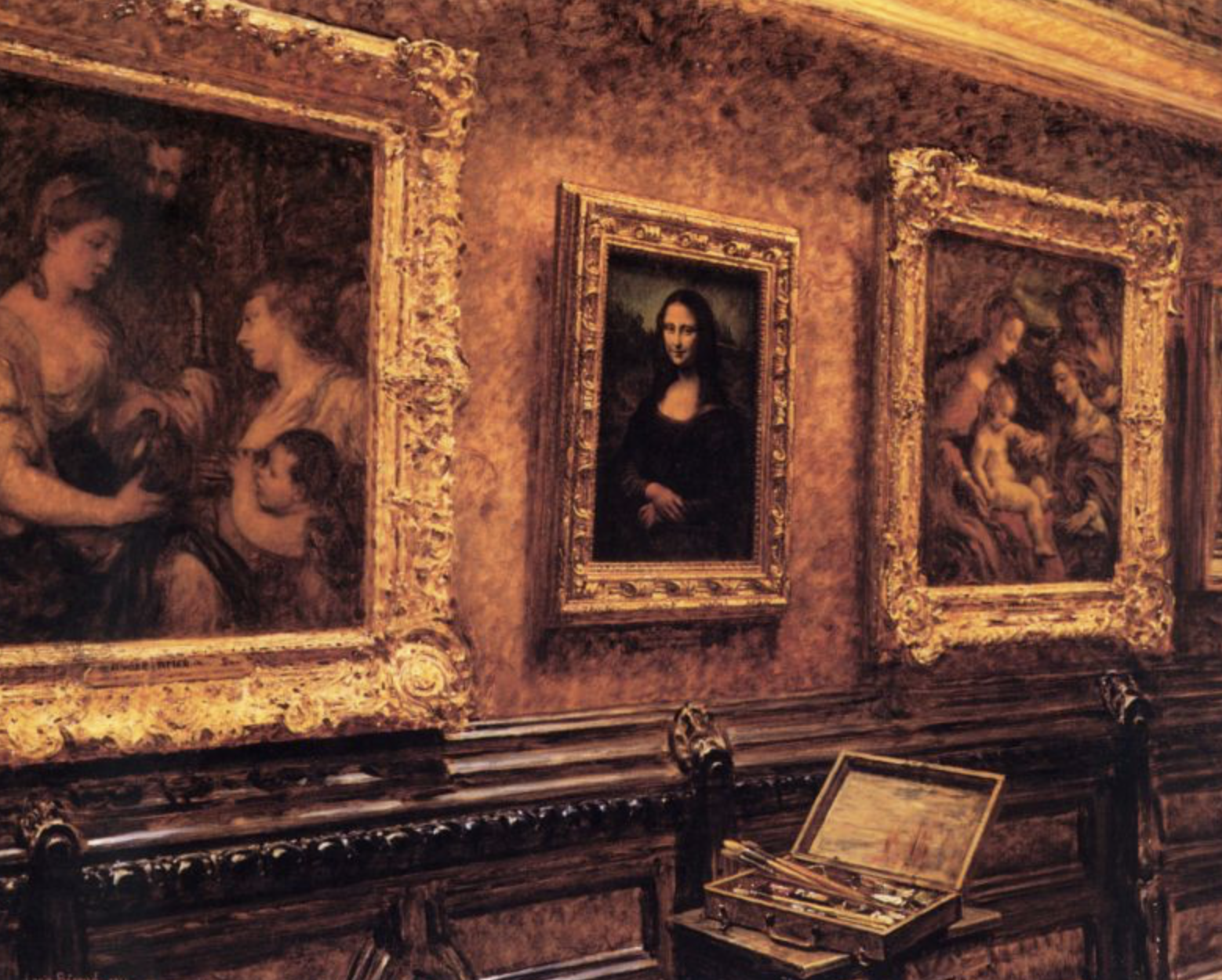
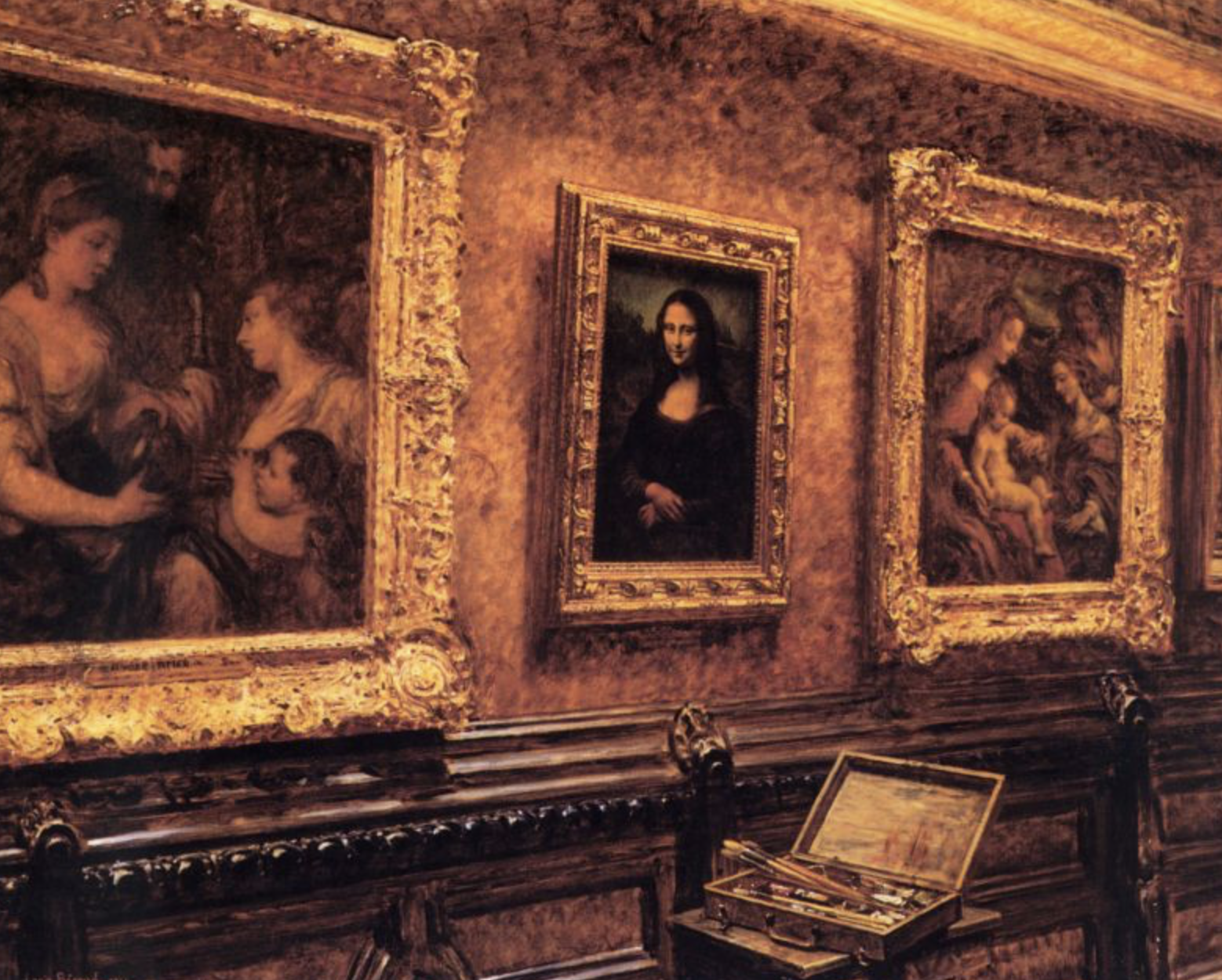
The portrait of a Florentine woman, painted by a Renaissance master, hung on the north wall of the Salon Carré. She had been placed within a new double frame with glass just weeks before by the man who was about to steal her.
This was long before the days of cameras and alarm systems, and one could easily hide in the Louvre overnight and wander around; how dreamy.
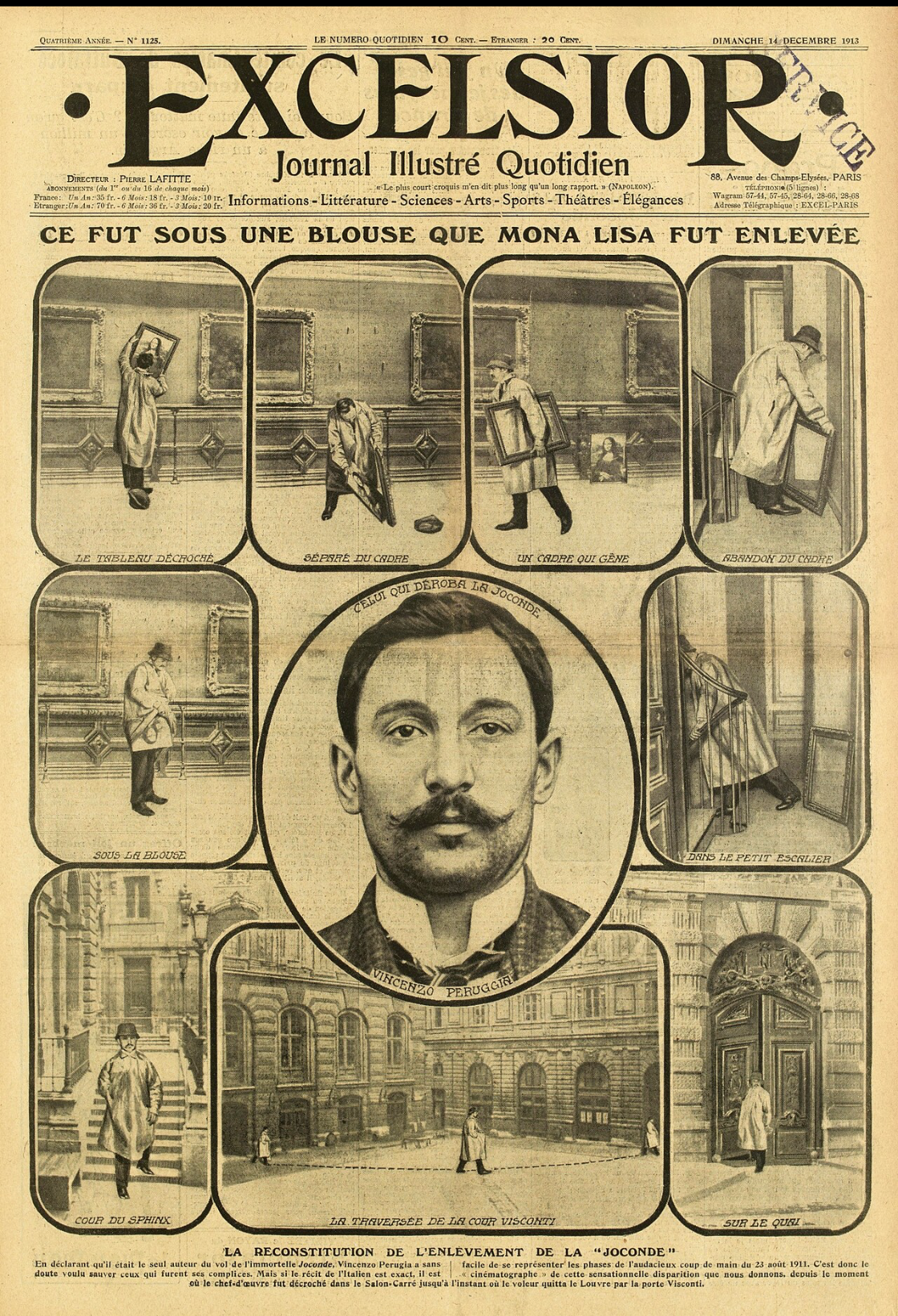
The sun rose on Monday, August 21, as our thief prepared for his escape. At 7:30 am, Peruggia emerged from his hiding place in his white Louvre coat, walked past the wall where his stolen loot once hung, took a few steps through the Grande Galerie, and made a quick turn into the Salle des Sept Mètres. On the right, a door still there today and heavily alarmed hid a small staircase only used on Mondays. Through the door, spinning down to the Cour de Sphinx, only to be met with a locked door. Using the screwdriver he brought to unleash our lovely lady from the tomb he created for her, he removed the doorknob, but it only made matters worse.
It was August, and Paris was quiet as Parisians had fled to the coast and to the south. The remaining employees of the Louvre had just begun to move around for the day. Around 8 a.m., plumber Jules Sauve heard knocking from a door as he walked by. With a wrench, Sauve opened the door and let the man who would become the most wanted thief in the world out, along with the priceless painting. A quick bonjour et merci, and Perrugia walked out of the Cour Visconti with Mona under his arm; he tossed the doorknob into the Jardin de l’Infante and jumped onto a bus.
The rest of that Monday within the Louvre was business as usual. Floors were cleaned, and paintings and statues were dusted, and nobody noticed anything out of the ordinary. One of the greatest crimes of the 20th century had happened, and nobody noticed.
On Tuesday, August 21, around 9:30 am, the museum guards began arriving and heading to their posts. At the time, only former military and police officers served as guides in the Louvre, not so much now. Brigadier Maximilien Alphonse Pauparin (Poh-pour-anne), a guard in the Salon Carré, had served in the French military but had no idea what he was about to face on the morning of August 21, 1911.
At 10 am, the Musée du Louvre opened its doors. There were no long lines of tourists waiting to get in, just a few loyal visitors and artists coming to wander the Grande Galerie.
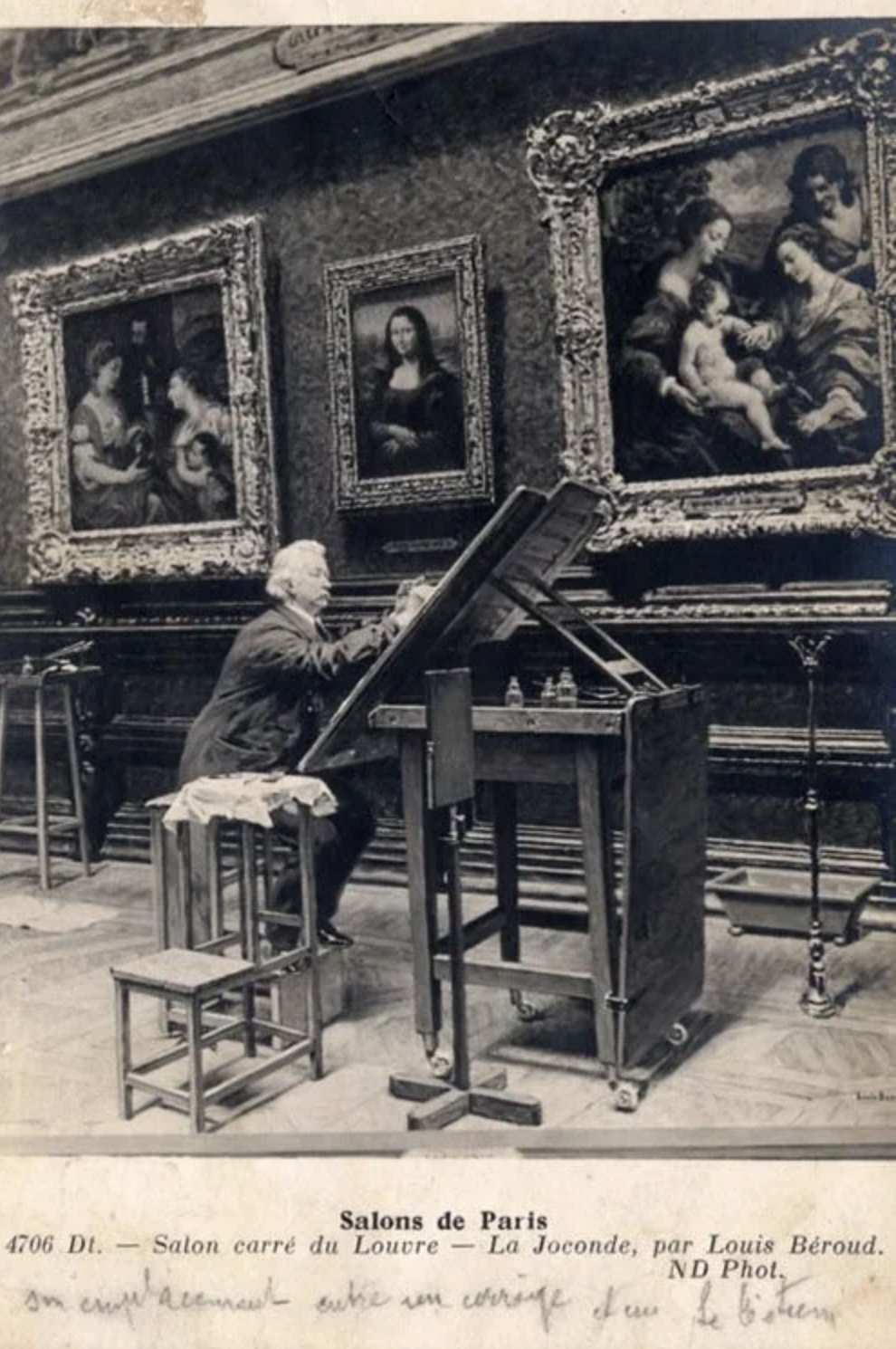
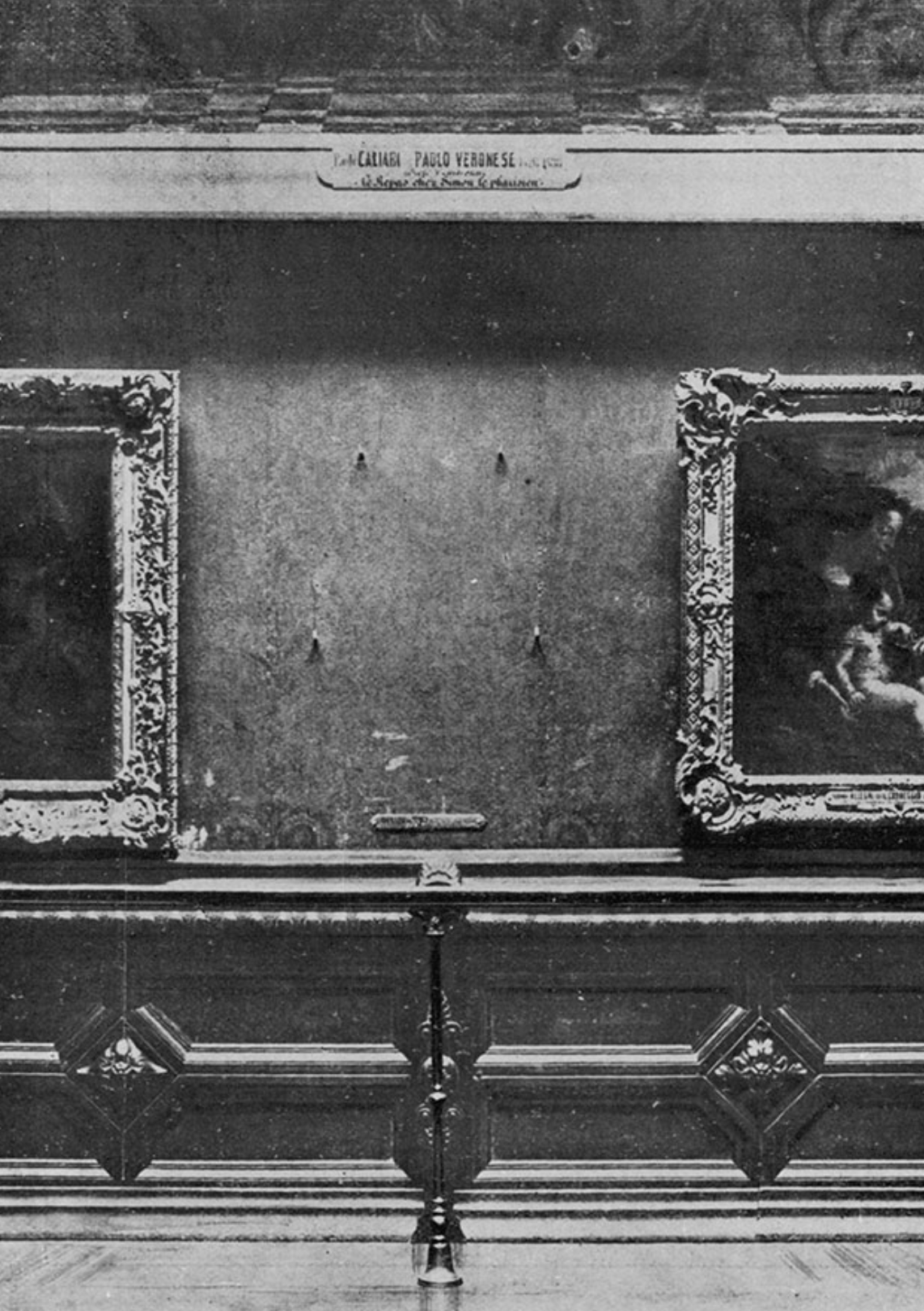
Artist Louis Béroud arrived just after the Louvre opened and carried his easel up the Escalier Daru, giving a little wink to Winged Victory and to the Salon Carré. Béroud, a copyist, was commissioned to paint a portrait of a woman looking at what would become the most famous painting in the world. As he walked to the wall, he noticed a large hole. Between Titian’s Allegorie Conjugale and Correggio’s Mystic Marriage, and below Veronese’s Wedding Feast at Cana.
In 1911, the paintings in the Salon Carré hung within inches of each other on the wall, much closer than they are now, so a large hole should have been pretty easy to spot.
Béroud walked over to Pauparin and asked where the portrait was. The brigadier scoffed and said it had to be in the photo studio, as they removed paintings all the time without alerting anyone, and in the middle of the day.
Without any sense of urgency, Pauparin said he would head down and check. On the way, he stopped for a long cigarette break before popping in.
In the photography workshop tucked away deep in the basement, Pauparin walked in and asked, “Où est La Joconde?” She’s not here," they responded, “but maybe she was moved to another room.” Pauparin asked a few more people, then panic set in. It was noon on August 22, and the Portrait of Mona Lisa by Leonard da Vinci had been gone for over 29 hours; they just didn’t know it yet.
The doors of the galleries of the Louvre slammed shut, and the few visitors in attendance were ushered out the door. The staff was told a water pipe had broken and there was no need to panic. Pauparin, on the other hand, was experiencing a panic attack.
At the time, Director of the Louvre, Jean Théophile Homolle, was on the Yucatan peninsula on an archeological expedition, leaving Georges Bénédite (ben-ah-deet), curator of the Egyptian department, in charge. At 12:30 pm, two and a half hours after the museum had opened, Bénédite was beside himself and wondered why this had to happen on his watch. Phone calls ran through a switchboard, and to keep the incident on the QT, Bénédite ran from the Louvre to the Palais de Justice on the Ile de la Cité.
Out of breath, Bénédite alerted the police to the unimaginable. Immediately, Louis Lepine, head of police, arrived at the now-closed Louvre to investigate. The theft was kept very quiet, but the rumors began to spread.
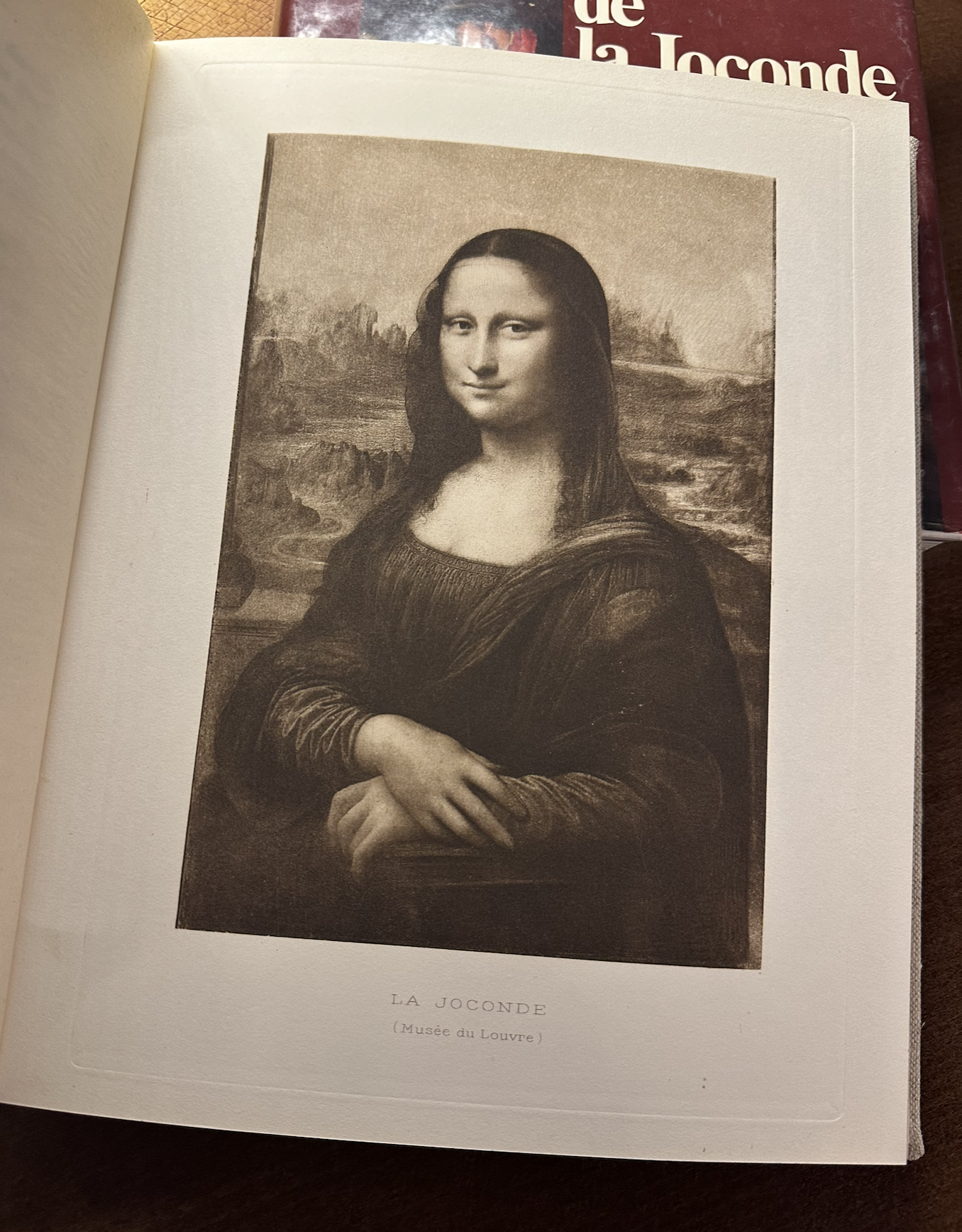
At the same time, the police were told a Louvre official sent a letter to the Beaux Arts museum in Quimper requesting their copy of the Mona Lisa be sent to Paris immediately. Painted in Leonardo's atelier by an unknown student, it is thought to be the best copy and the closest to the original portrait we have today. The Louvre thought they could keep the theft quiet and also force the thief to make a mistake, and make it easier to nab. The museum didn’t send the painting and still has the letter in its archives.
Lepine arrived at the door of the Louvre with dozens of police officers in tow. Passersby knew it was much more than a water leak. Investigators fanned out to every corner of the Louvre, which was much smaller than it is today. When they found the two frames that once held her in the stairwell, they knew the unimaginable had happened.
The national gendarmerie, the ministers of culture and the interior, and the president of France, Armand Fallières, were alerted. The train stations were closed, and the borders of France were alerted; however, none of that would help find the Mona Lisa.
One of the first to be questioned by police was a very upset Brigadier Maximilien Pauparin. About to have a nervous breakdown under the pressure, he was asked about the woman he saw every day. He said, “Mon Dieu, she was there Sunday night when the museum closed.”
In his years at his post, he saw many things. Lovelorn men brought her flowers and letters pledging their undying love to her, and one man was even said to have killed himself in front of her. I haven’t found any info to back that up, but it does make for an interesting little addition.
One young German man was so devoted to her that his story spread around the world. There is even rumors that she has her own mailbox at the Louvre, still to this day.
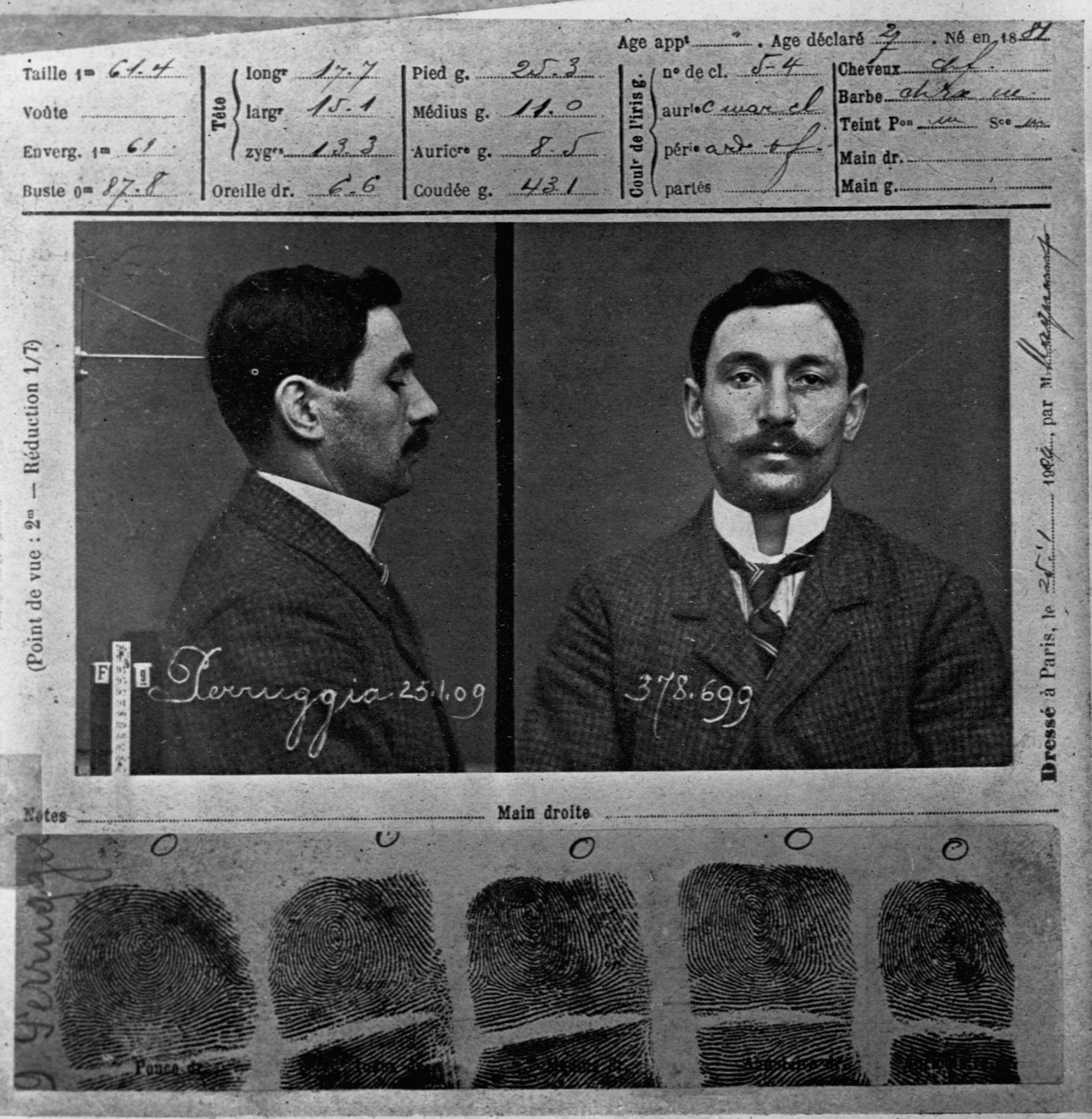
The police searched high and low for more evidence. They found a partial print of the left hand on the frame casing, but at the time, they had only been taking prints from the right hand. With little to go on, the Louvre thought she might be gone forever.
In searching the Louvre, and finding the newly created security frame discarded in the stairs that was only used for staff on Mondays, Lepine believed the thief had to have had knowledge of the Louvre and had worked there. Lepine interrogated the staff, and a plumber named Jules Sauve gave the only clue they had.
Lepine brought in Alphonse Bertillon, who served as the chief of judicial identity and had been working on a new way to identify people through fingerprints and profiling. The entire staff was called in, and fingerprints on the right hand were taken, but one man didn’t show up.
Meanwhile, the last to know of the theft was the Louvre director Jean Théophile Homolle, who was deep in the Yucatan forest. Once asked if the Mona Lisa could be stolen, he laughed and said it would be like someone stealing the towers of Notre Dame, impossible. He was on the first ship back to France.
It was impossible to keep the news out of the press. On the evening of August 22, the story appeared in Le Temps newspaper, and from there it went around the world.
To understand why this theft and specifically this painting captured the attention of the world, you have to understand what was happening in that moment in time. Today, this story would have spread online in a matter of seconds, and it did back then, in a way. This was the period known as the Belle Epoque, the beautiful era. Since the end of the Siege of Paris and the Commune of 1871, Paris had fully entered a new age. Each day, Paris had more than 35 different journals, selling an astonishing two million copies, and that was just in France.
Newspaper and printing presses could now add photos and drawings, and with the expanded train travel as well as wire services, the news and, even more importantly, images could spread quickly and across the ocean.
In 1858, Luigi Calamatta created the first copper engraving of the Mona Lisa, which was heralded as the best representation of the painting. It was the image that spread around the world, and it's why everyone suddenly knew the face of this mysterious woman from Florence.
The Louvre closed its doors for a week while the investigation hit one dead end after another. The government called for its own investigation into how this could have happened. In an all-too-familiar scene, played out exactly 10 months ago, all parties involved began pointing fingers at each other.
Security at the Musée du Louvre had been pretty laughable for quite some time. Reporters hid in a sarcophagus overnight to test the security and even stole small pieces to see if they could get away with it, and they did.
One week later, on Monday, August 28, the search of the Louvre was finished, and the museum would reopen the next day. It would also be the day director Homelle returned to the Louvre.
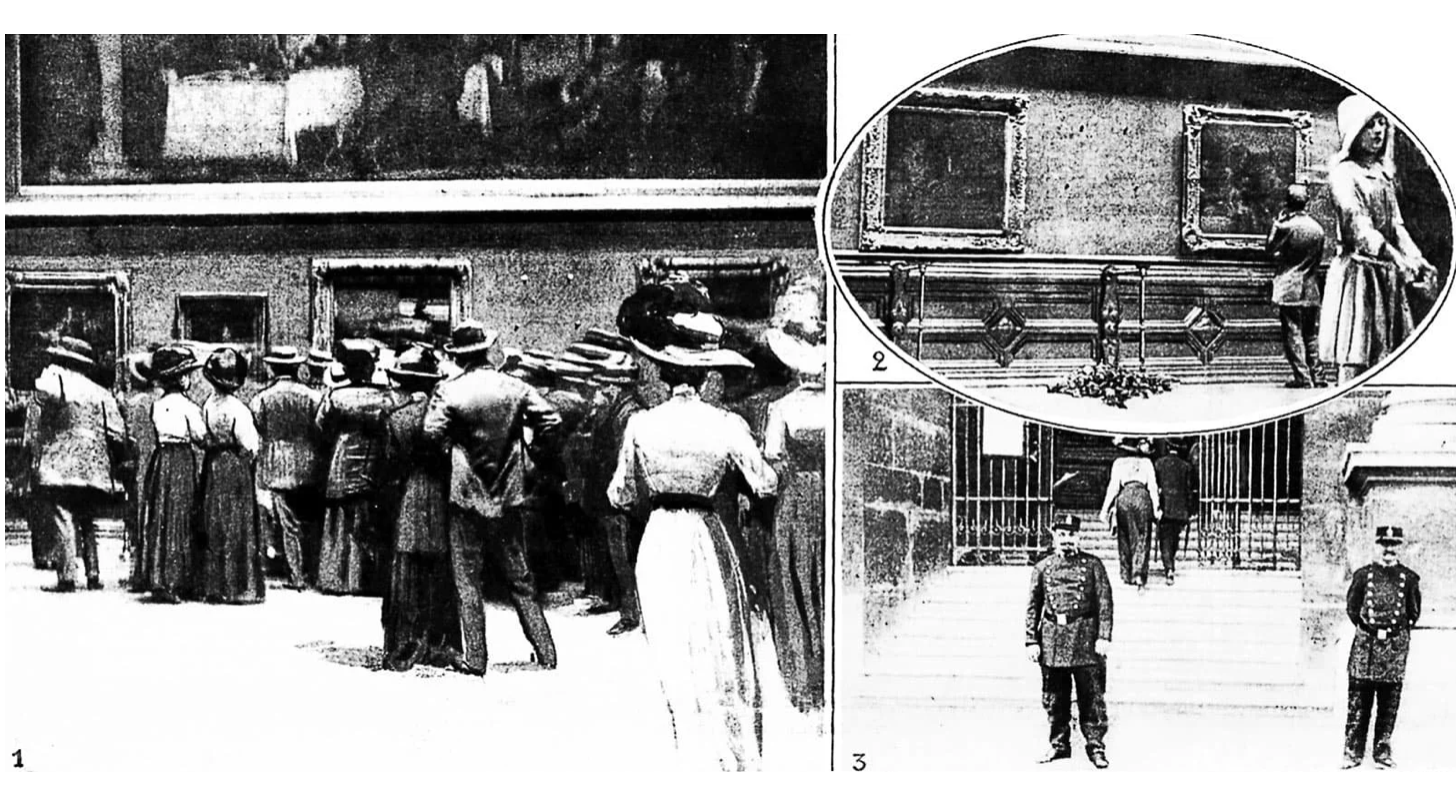
On Tuesday, August 29, 1911, at 10 am, the Musée du Louvre opened its doors to thousands waiting in a two-hour line to enter for a glimpse of the wall where the Lady of the Louvre once hung. Four policemen and six museum guards surrounded the now-empty wall, along with many undercover agents in the crowd, hoping the thief might return. Of the thousands of people who came, many brought notes and flowers to leave on the distinctive parquet floor. Outside the doors, trinket sellers peddled anything they could with her image on it, and even some entrepreneurial prostitutes hid in the shadows waiting for clients.
Visitors were also greeted by two very angry dogs, Jack and Milord, and a slew of security guards roaming the galleries.
On August 31, the ministers of interior and culture called an emergency meeting, and Homelle was removed from his position; Pierre Eugéne Pujalet, who had a background in security and police work, was appointed interim director.
While the news of the theft spread around the world, poet and art critic Guillaume Apollinaire & Pablo Picasso read the headlines in the paper just like everyone else.
On September 5, Apollinaire visited the Paris Journal to say he might know who stole the Mona Lisa and turned in the stolen objects. He confessed that a friend, using the fictional name Baron Ignace d’Ormesan, would steal small sculptures from the Louvre. Guillaume and Picasso benefited from his stolen loot and thought they would do the right thing and tell the authorities.
The two friends panicked and tried to rid themselves of the objects from the Louvre. At midnight on September 5, the two men packed the pieces into a suitcase, worried they would be captured riding the metro or a bus, and walked from his studio in Montmartre to the Seine River. Once there, they feared being seen and decided to walk back up to Montmartre with the heavy suitcase in tow.
On September 6, the front page of the Paris Journal ran “L’Affaire des Statuettes,” which also alerted the police, who visited Apollinaire and brought him in for questioning. The thief’s real name was Honoré Joseph Géry Pieret-Belgien, who also worked as a secretary for the writer. That same morning, police visited the Boulevard de Clichy and Picasso's apartment.
When questioned, he said he never heard of Apollinaire and was released later that day. Apollinaire wasn’t as lucky and was held for a week. It would be the only lead and arrest the French police had in the theft of the Mona Lisa, and it was a dead end. The incident would ruin the friendship of the artist and writer and would be one of Picasso’s few regrets in his life.
In February 1912, the spot that had been left empty was a makeshift shrine until officials decided to move Raphael’s Baldassare de Castiglione into her place. Close in size and, more importantly, in pose, the subject was arranged much like Lisa. Raphael had briefly seen the painting while Leonardo worked on it.
In January 1913, the Louvre released its updated catalog, and Leonardo’s Mona Lisa wasn’t part of it. The trail had run cold, and the case had been closed. They believed she would never return home again.
But what did happen to the Mona Lisa, you ask?
Let’s go back to the morning of August 21, 1911.
Born October 8, 1881, in Dumenza in northern Italy, Vincenzo Perugia was the oldest of five children and began working at twelve as a house painter in Milan. In 1908, Vincenzo moved to Paris, where he became very sick and was hospitalized for lead poisoning, a nugget that will come into play later. He moved away from the painting business and got a job with Maison Gobier, which had worked on the glass and windows of the Musée du Louvre since 1832.
In 1911, two paintings were slashed, and the Louvre knew its most important pieces needed protection behind glass in new security frames. The Maison Gobier company was replacing windows in the Louvre and was tasked with protecting the paintings. It consisted of French workers and one Italian, Vincenzo Peruggia. His French coworkers made fun of him and called him Macaroni.
Each day for a year, Peruggia was up close and personal with each of the Italian paintings that had once belonged to the kings of France. After the Raphael paintings were completed, Vincenzo tackled the Leonardo da Vincis and, of course, the Mona Lisa. This gave him an in-depth knowledge of the future star of the Louvre, although he hadn’t decided to steal her quite yet.
For days on end, he worked in the Salon Carré and Grande Galerie, removing paintings from the wall as visitors filed past him. As his coworkers' teasing increased, so did his anger. Vincenzo believed Napoleon had stolen everything in the Louvre had been stolen by Napoleon from Italy. It had been close to 100 years since that was rectified (listen to episode 28 for more)
Peruggia had an idea, and he was going to take a painting back to where it belonged: his native Italy. On these long days, he overheard a lot of people talking about. A painting that nobody lines up and pushes to get a selfie with, but does hang on the wall opposite the other Da Vincis.
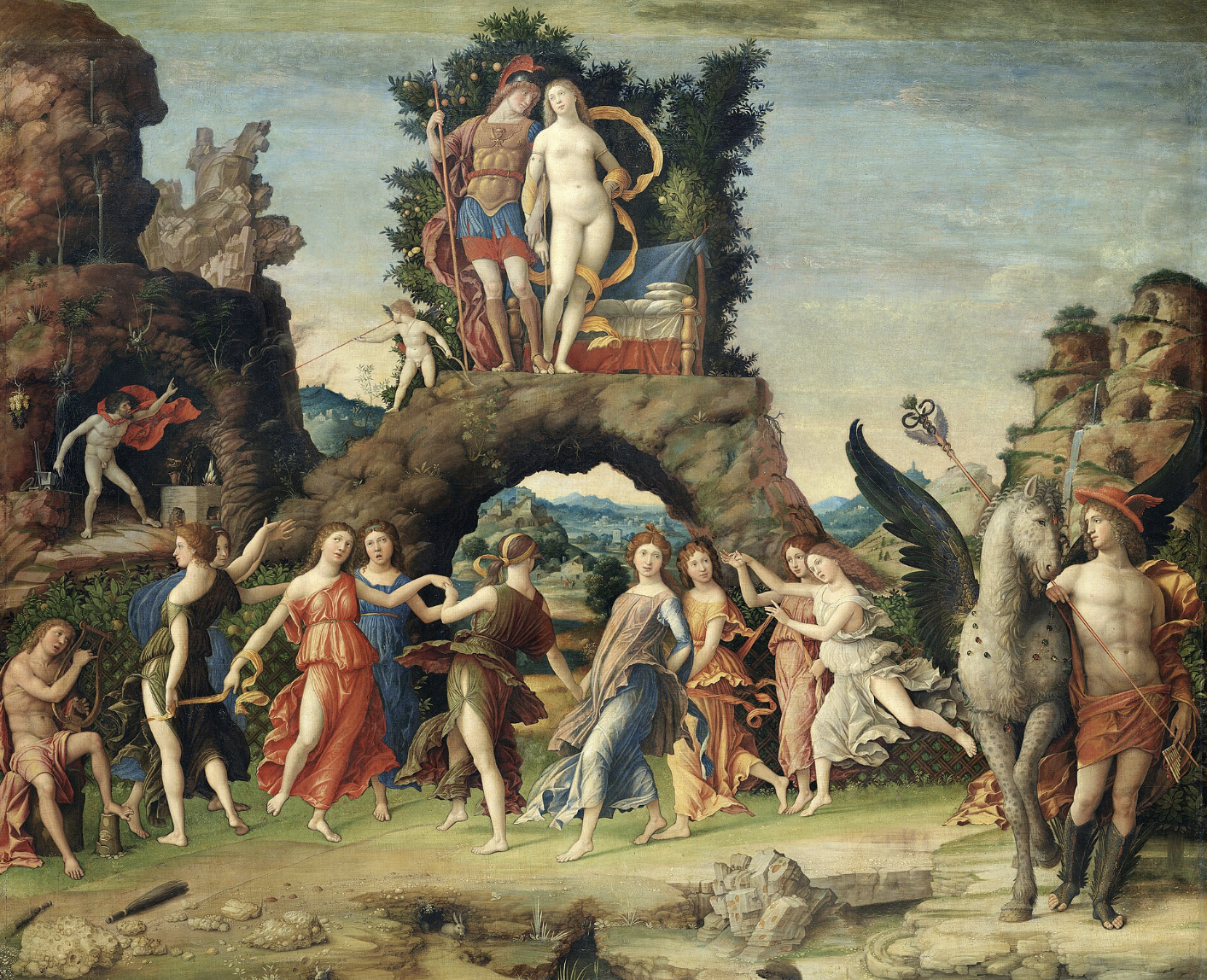
Andrea Mantegna’s Mars & Venus was painted in 1496 for Isabelle d'Este. It entered the Louvre’s collection through Cardinal Richelieu, not Napoleon. The painting is 6 x 5 feet and some change, and had it been stolen, he most likely would not have gotten very far.
Peruggia realized that the Mona Lisa was a safer bet. It was smaller, he knew how to remove it from the frame, and she was a Da Vinci after all.
On the morning of August 21, with the Mona Lisa, measuring 2.6 feet by 3.3 feet in tow, he jumped on a bus and headed home. Vincenzo stayed in his small top-floor apartment at 5 Rue de l’Hopital Saint Louis overnight and into the next day. On the morning of August 21, when it was discovered she was gone, Vincenzo stayed home with the grand lady in his closet.
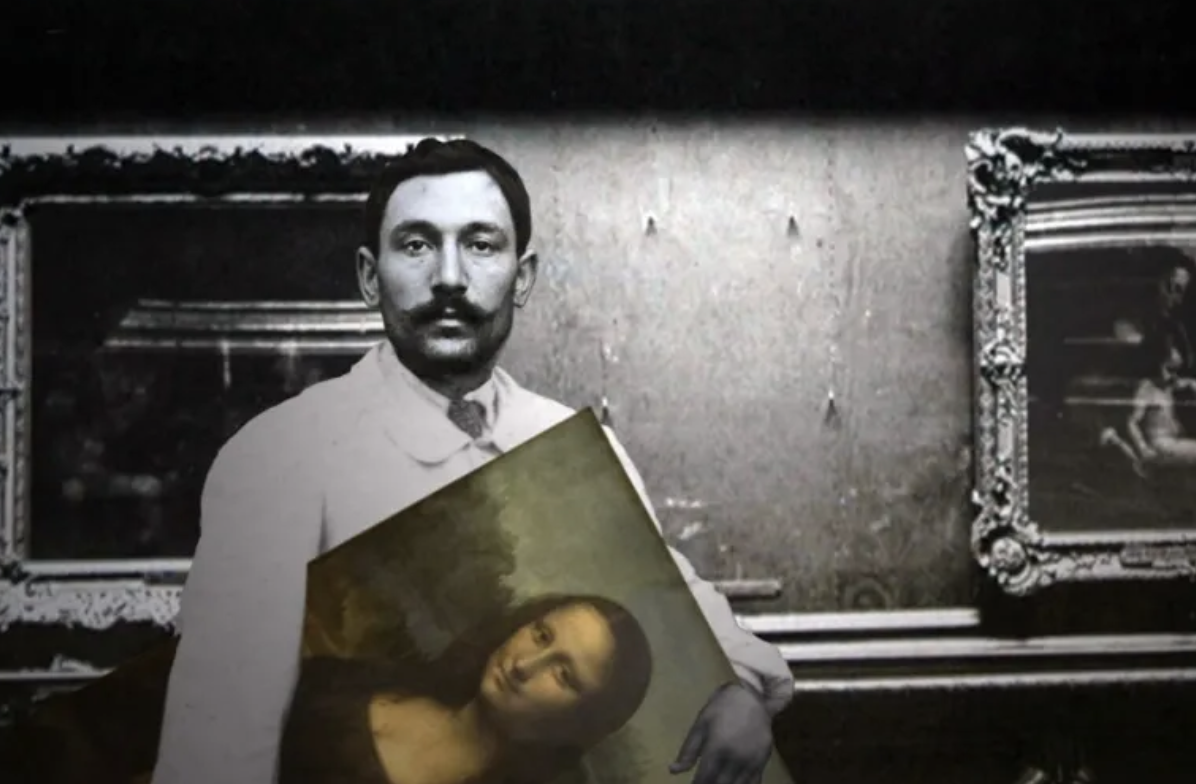
When the entire staff of the Louvre was called in to be interviewed and fingerprinted, Vincenzo did not show up. The police and Lepine arrived at his small apartment to question the thief, who let them in and slowly answered their questions. Meanwhile, the Mona Lisa was turned around and propped up in his closet. Lepine never looked around and left without a bit of suspicion.
Worried he would return, Peruggia left his apartment with Lisa in a case and checked into the Hotel Rive Gauche on Rue Saint Peres in Saint Germain and requested a top-floor room in case he needed to make a quick escape to the rooftops. Hiding in room 603 for three days, he waited for news of the theft to spread through Paris.
Today it is the Hotel Da Vinci, and you can stay in the room where Vincenzo and his Florentine lady once stayed, with your own copy of Lisa hanging on the wall.
On Wednesday, August 23, the headline was International news, but not even a whisper of a suspect. Peruggia felt he was in the clear and returned to his tiny apartment on rue de l’Hopital Saint Louis, where the Mona Lisa had stayed and would remain for the next 28 months.
For two years, the Mona Lisa returned to her early days, stuffed into a closet without the adoration of thousands, though this time it was a tiny apartment near the Canal Saint Martin.
In the winter of 1912, Peruggia left Lisa in his apartment, but this time in a box he slid under his stove. A quick trip to London to see art dealer Joseph Duveen, who is hailed as the individual to broker more European art to wealthy Americans than anyone else. When the short, 5-foot-3-inch Vincenzo walked in, Duveen immediately laughed him out of his gallery. Peruggia returned to Paris and Lisa to her tomb under the stove and waited another year before his final act.
For all of 1912 and into 1913, Vincenzo went on with his life, although he did not return to his job and stayed quiet and close to home while the world wondered where the Mona Lisa was.
On November 29, 1913, Vincenzo once again appeared. This time, in a letter sent to Alfredo Geri, an antique dealer in Florence. It stated that the “Stolen work of Leonardo is in my possession. It seems to belong to Italy as the painter was an Italian. My dream is to give back this masterpiece to the land from which it came.” Signed Leonard
Geri was skeptical at best, but contacted Giovanni Poggi, curator, and Corrado Ricci, director of fine arts of the Uffizi.
Deciding they had nothing to lose, Geri responded and set up a meeting for December 22 in Milan. “Leonard” decided he didn’t want to wait any longer and arrived in Florence on Wednesday, December 12, 1913. Walking into Geri’s shop on the Via Borgo Ognissanti, “Leonard Vincenzo” introduced himself and asked the owner if he was interested in seeing the painting.
Two hours later, Geri and Poggi were in Peruggia’s tiny hotel room on the 3rd floor of the Albergo Tripoli-Italia. When they turned the painting over and saw the Louvre inventory code MR 316, they knew they were looking at what was now the most famous painting in the world. The thief brought her back to Italy in a large custom-made crate with a false bottom topped with clothes, tools, and a mandolin. The director was shocked to see what was lying on top of her.
Vincenzo said he wanted 500,000 lira for her (today that is worth 2.2 million dollars). The two agreed and told the thief they wanted it checked at the Uffizi before they paid. As the three men walked out of the hotel, a front desk staff member stopped them. The clerk thought they were stealing a painting from the hotel room, much tighter security than at the Louvre. Once the painting was verified, Geri and Poggi told Peruggia to go back to the hotel, and they would bring the money over. Vincenzo must have walked back to the hotel lighter than air, thinking all his dreams were about to come true. Instead, the police were called and arrived as Vincenzo lay down to nap and was quickly arrested.