
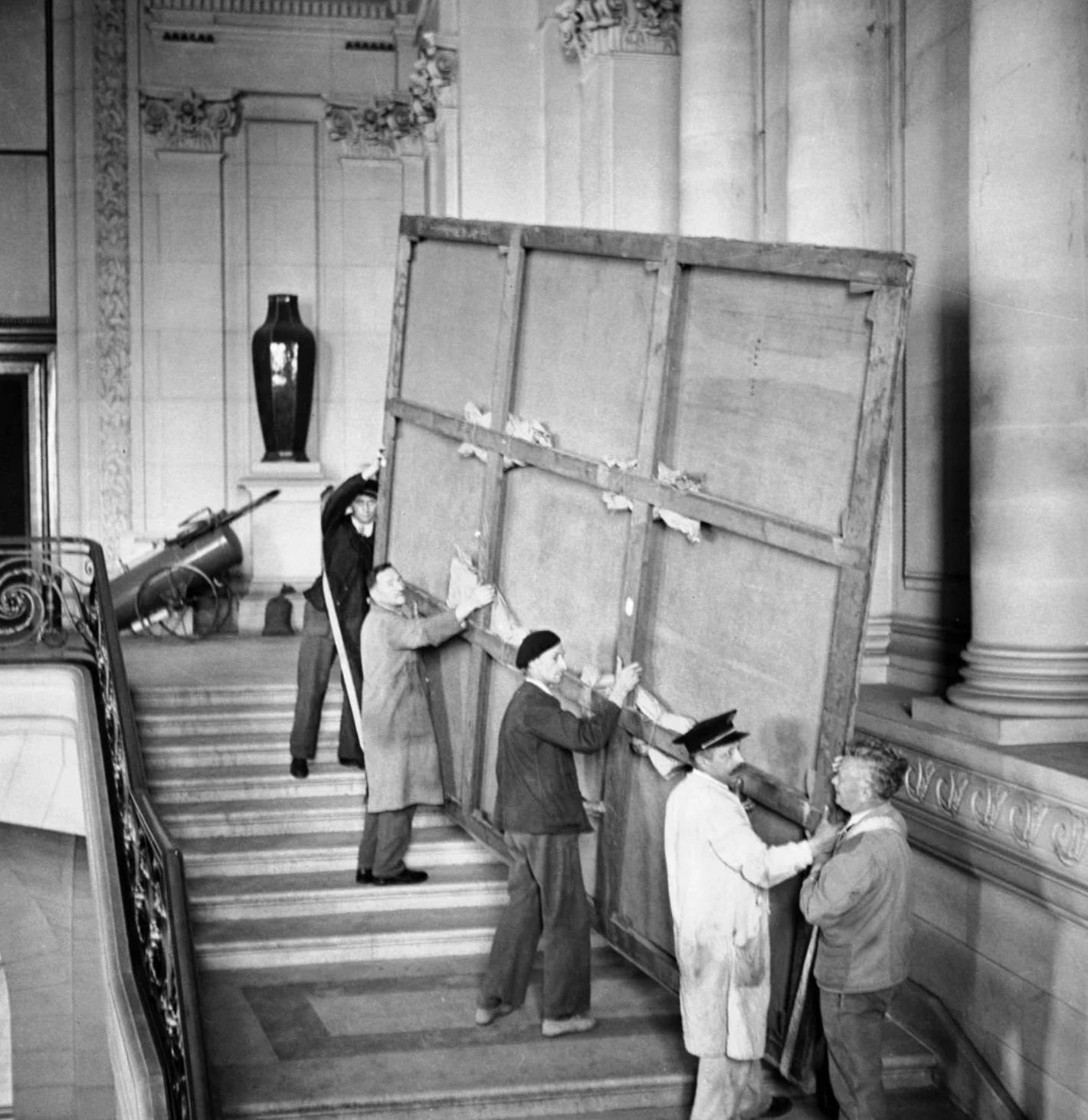
On August 25, 1939, Hitler came knocking on the door of France, and the keepers of the great art of Paris sprang into action. Jacques Jaujard, director of France’s National Museum, and René Huyghé saved the art of the Louvre and planned it for over a year. This is the evacuation that many have heard about, but it wasn’t the first.
In July 1830, the famous Revolution captured by Eugène Delacroix put the Louvre in trouble for the first time. The Louvre opened in 1793 in the midst of the Revolution and survived unscathed since it was given to the people. On those three Glorious Days in July 1830, Vicomte de Cailleux, a 93-year-old security guard, began removing the paintings from the walls of the Grande Galerie, which hung floor to ceiling. Working through the night, it took dozens of people on tall ladders to move them away from the wall of the Seine.
Cailleux created a quick sign “Respect the National Property”. As the rioters entered and fired their way through door locks, they didn’t touch a thing. Five months later, on December 21, they pushed their way in again but left the Louvre as it was. In February 1848, as the next king woke the Revolutionists again, another sign was placed at the entrance, and the Louvre was bypassed.
In 1870, the Louvre came the closest to disaster. On July 18, Napoleon III declared war on Prussia. As troops moved closer to Paris, the first evacuation of the Louvre began, setting the stage for what followed. On August 30, 1870, they worked quickly for 4 days to pack the most precious pieces and send them to a military fortification in Brest. On September 1, the Mona Lisa and Wedding Feast at Cana left the Louvre. Over the next two weeks, 123 crates of paintings, sculptures, and objets d’art would join them.
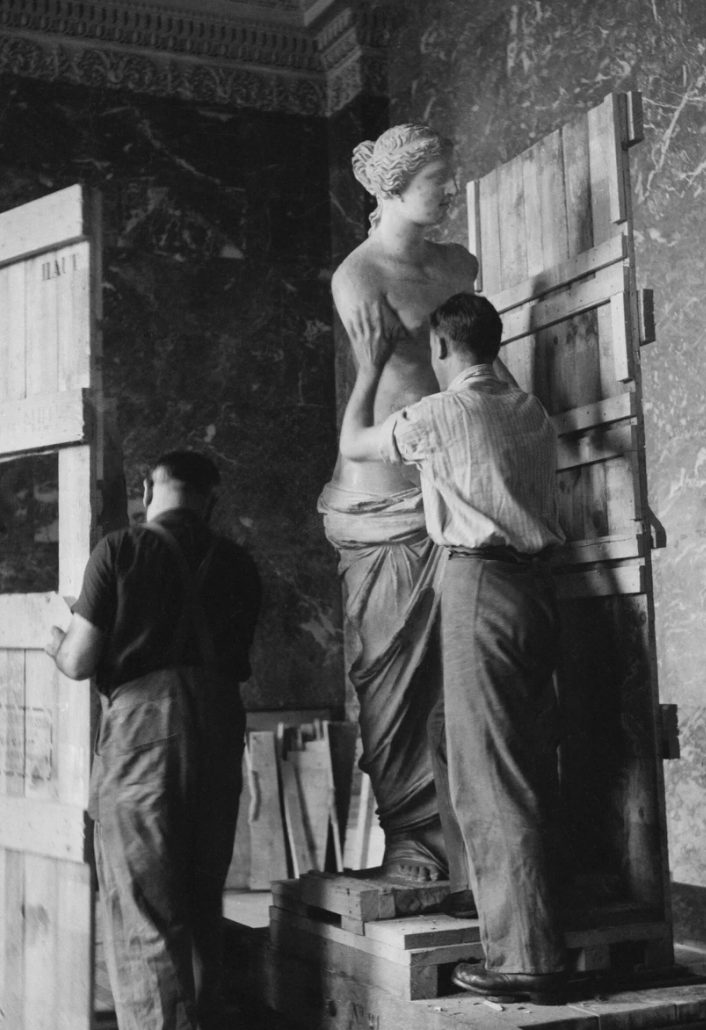
On January 6, 1871, the Venus de Milo was moved to a nearby Prefecture on the Ile de la Cité, hidden behind a brick wall, and covered with sandbags. The Prefecture was destroyed, but Venus survived with just a bit of damage to the cement and glue placed between her torso and her hips. A month later, after a treaty was signed, the end was in sight, or so they thought. In the coming months, it was the Revolution within the country again, and one that would destroy many of the historic buildings of Paris.
In May, for two straight days in 1871, the Palais des Tuileries burned. Flames ravaged through each historic wall, painting, and piece of furniture. Connected to what we now know as the Musée du Louvre, flames threatened to travel through the Grand Gallery and the national art collection. However, there was a group of men who would do all they could to save what we now hold so dear. Henri Babet de Jouy was a curator of the national museum and would later become curator of the Louvre. Buckets of oil were thrown from the Pavillon de Flore to the Pavillon de Marsan, and across the entire Palais des Tuileries in between. Jouy, with help from Antoine Heron de Villefosse, curator of antiquities, and administrator Leon Morand, did all they could to save the collections on the nights of 23 and 24 May 1871.
The Louvre curators were aided by the other real hero of the moment. Martian de Bernardy de Sigoyer, commander of the 26th Battaillon de Chasseurs à Pied, was called to the Tuileries on the night of 24 May. As the flames grew closer, he ordered his men to do everything they could to save the Louvre and the art it held. Using whatever weapons they had, they began breaking down doors and windows, and even the roof, to cut holes for the flames to escape. With his men, he would save the Louvre but his own life would be lost that night.
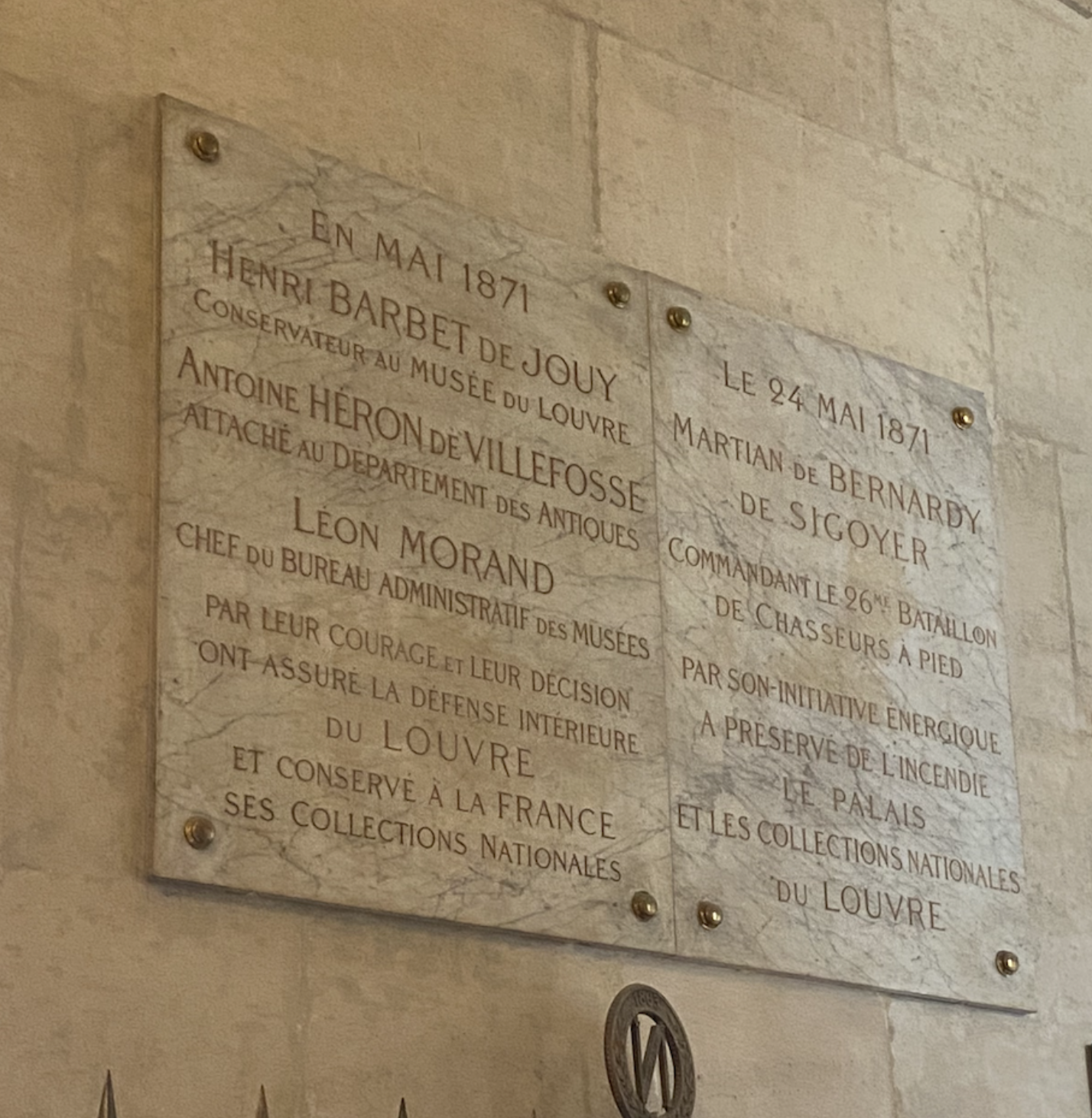
Today, a plaque hangs on the wall above the stairs leading to the Daru Gallery, commemorating these great men. Jouy is buried in Père Lachaise, and with Sigoyer they will forever be known as the saviors of the Louvre. Most people walk right past and never even notice or know their story.
The next challenge would come in 1914. On August 1, a few weeks after World War I began, items in the Louvre were moved again. In the afternoon of August 24, the Germans began to advance, and by noon the next day, August 25, which would be a significant day 25 years later, the curators were told to quickly bring down the art. In those days, the art was attached to hooks in order for a quick exit. Three days later, they were told to pick up the pace. They removed large paintings like David’s Sacre de Napoleon from their frames and rolled them onto large cylinders. Along with Venus, many of the treasures were put on a train in the dark of night and sent to Toulouse. The largest painting in the Louvre, Vernonese’s Wedding Feast at Cana, remained, and a faux wall was created to cover it.
Wooden crates became scarce, and worried curators packed the paintings directly onto the back of trucks and covered them with a tarp. They removed 720 paintings, along with a handful of objets d’art and sculptures. Over the next four years, more and more art was evacuated, but the Louvre remained open to the public, although only a few rooms in the Denon wing. At the end of November 1918, five weeks after the war, the art slowly returned to Paris, and by mid-February 1919 the Louvre was back to normal, although only for the next twenty years.
The end of the War to End All Wars also left curators and museum officials on edge, and they began to plan for what to do if it ever happened again. Members of the National Museum, including Deputy Director Jacques Jaujard, considered the worst-case scenario: a full evacuation of the museums of Paris.
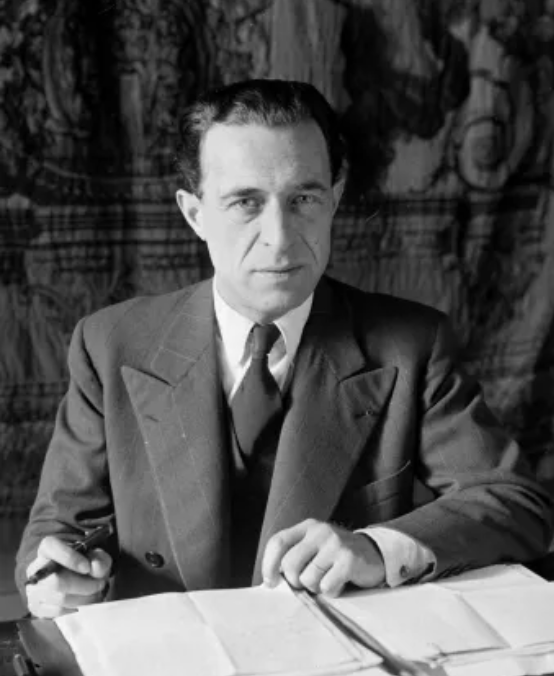
Jacques Jaujard
Jacques Jaujard was born on December 3, 1895, and served in WWI for one year before he had to leave the war due to tuberculosis. After the war, he became a journalist, then a secretary to Paul Painlevé, and eventually worked at the Ministry of War, which brought him to the attention of the National Museum in 1925.
In 1938, the Spanish Civil War raged in Madrid, and the Prado Museum and a committee of high-ranking officials asked Jaujard to help save its art. Seventy-one trucks packed with crates of the Prado collection traveled to Switzerland for safekeeping. It was the perfect trial run that Jaujard didn’t know he would need.
In August 1938, the Musée National leased two very large vaults at the Banque de France headquarters and began looking at other places in France they could use to store art. The State owned a few châteaux, but they needed many more. Each needed to be secluded but also close to the water in case of fire, and they would shortly learn they also needed to be outside the Occupied zone.
Hitler had taken power, and his plans were beginning to emerge. The frustrated artist who wasn’t allowed into art school coveted the best pieces in Europe. He brought in the best art experts, who compiled large books filled with pages of art by country to decide what he should take. A few of these books remain, and his path through Europe can be traced through each page.
On September 22, Hitler took Sudetenland, and the plan was moved to the top of the pile. On Monday, September 26, the Louvre received its official order. The next morning at 6 am, several trucks left the Louvre for Chambord, carrying the most important paintings, the crown jewels, and the Rubens Medici cycle. For the next four days, more pieces left until September 30, when the Munich Agreement was signed, and everyone took a breath. The war was over, or at least they thought it was. Quickly, the trucks returned to Paris. The Mona Lisa found her home again on the wall, and things were calm for almost 11 months.
On August 23, 1939, Germany and Russia signed a non-aggression pact. On August 24, the museums of London closed, and on August 25 the Louvre began its biggest evacuation yet.
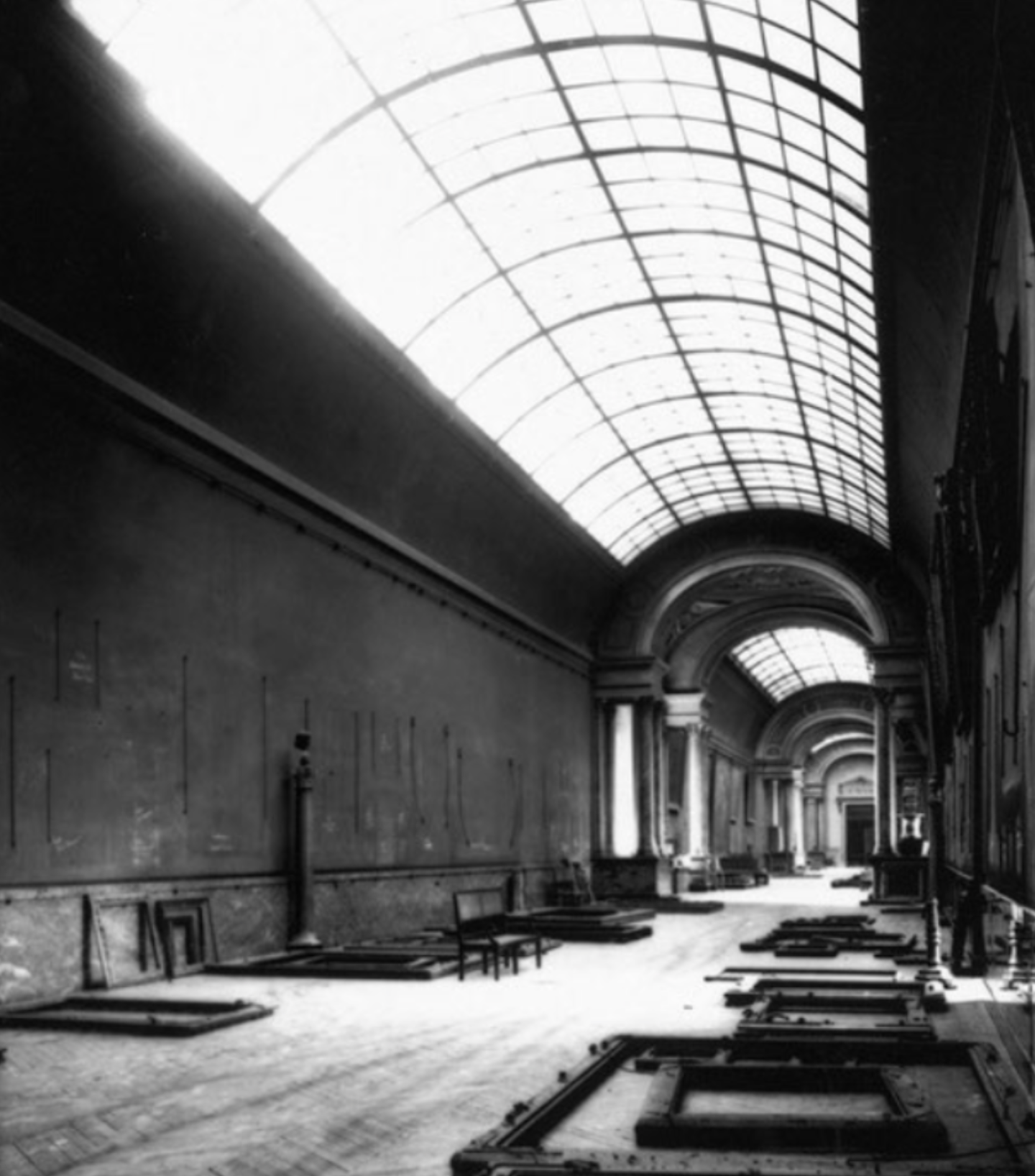
On August 25, the Louvre was closed for “cleaning” for three days. However, what really happened during those three days would alter the dictator's plans and his greedy looting. On those three days, the staff of the Louvre, volunteers, and students worked around the clock removing paintings from their frames, rolled and placed in crates.
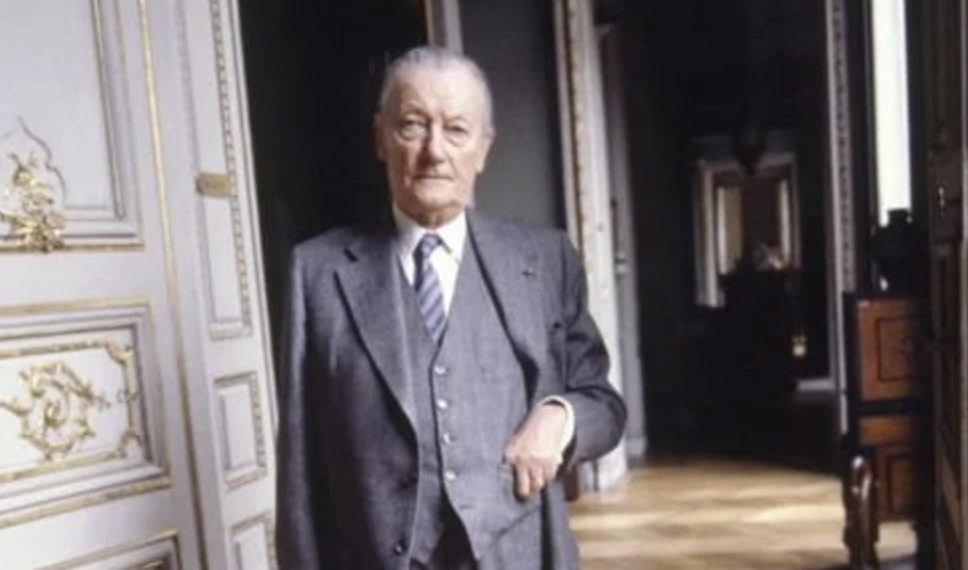
René Huyghe
Jacques Jaujard worked closely with René Huyghe, the curator of paintings. Huyghe was a French writer, art historian, and curator of the Musée du Louvre. Born on May 3, 1906, he studied philosophy at the Sorbonne before attending the École du Louvre. He may not be a household name, but he was part of one of the greatest moments in the history of the Musée du Louvre. Named the curator of paintings in the 1930s and a professor at the École du Louvre, Huyghe’s life was all about art.
On August 26 at 1 am the 50 most important paintings were in crates once again. Jaujard and Hughé needed more help, and students from the École du Louvre and theater employees were called in. Gabriel Cognacq, nephew of Marie-Louis Jay-Cognacq and owner of the Samaritaine, also served on the national museum council and brought in all his trucks, crates, and employees to assist.
Early Sunday morning on August 27, the Cour Carrée closed after an endless stream of trucks arrived in the dark hours.
When the art was packed, a system of codes and stickers was utilized. For the national collection, MN, Huyghé’s painting department LP, and antiquities LR. Red stickers were added to the top-priority pieces. Two red dots for the most important, green for the most significant, and yellow for the lowest significance. For the most famous painting, Madame Lisa was given three stickers, and her crate was labeled MN. She was then strapped to a gurney and rolled into a truck labeled 2162RM2 that Jacques would then write ahead to the depot to know what to look for.
On August 28, 1939, at 6 a.m., when all of Paris was asleep, out of the Cour Carrée and onto the Quai were the first 8 trucks, including the Mona Lisa, Seated Scribe, the Crown Jewels again, and 225 other crates. The entire Quai along the Louvre was lined with trucks and drivers waiting for their loads. That same day at 2 p.m., six more crates were left.
On August 29, the next 23 trucks left. As soon as they reached their destination, they quickly returned to Paris for more precious cargo. Twice a day until September 2, two convoys a day of 9 trucks left the Louvre. Each driver put his life in danger with each mile.
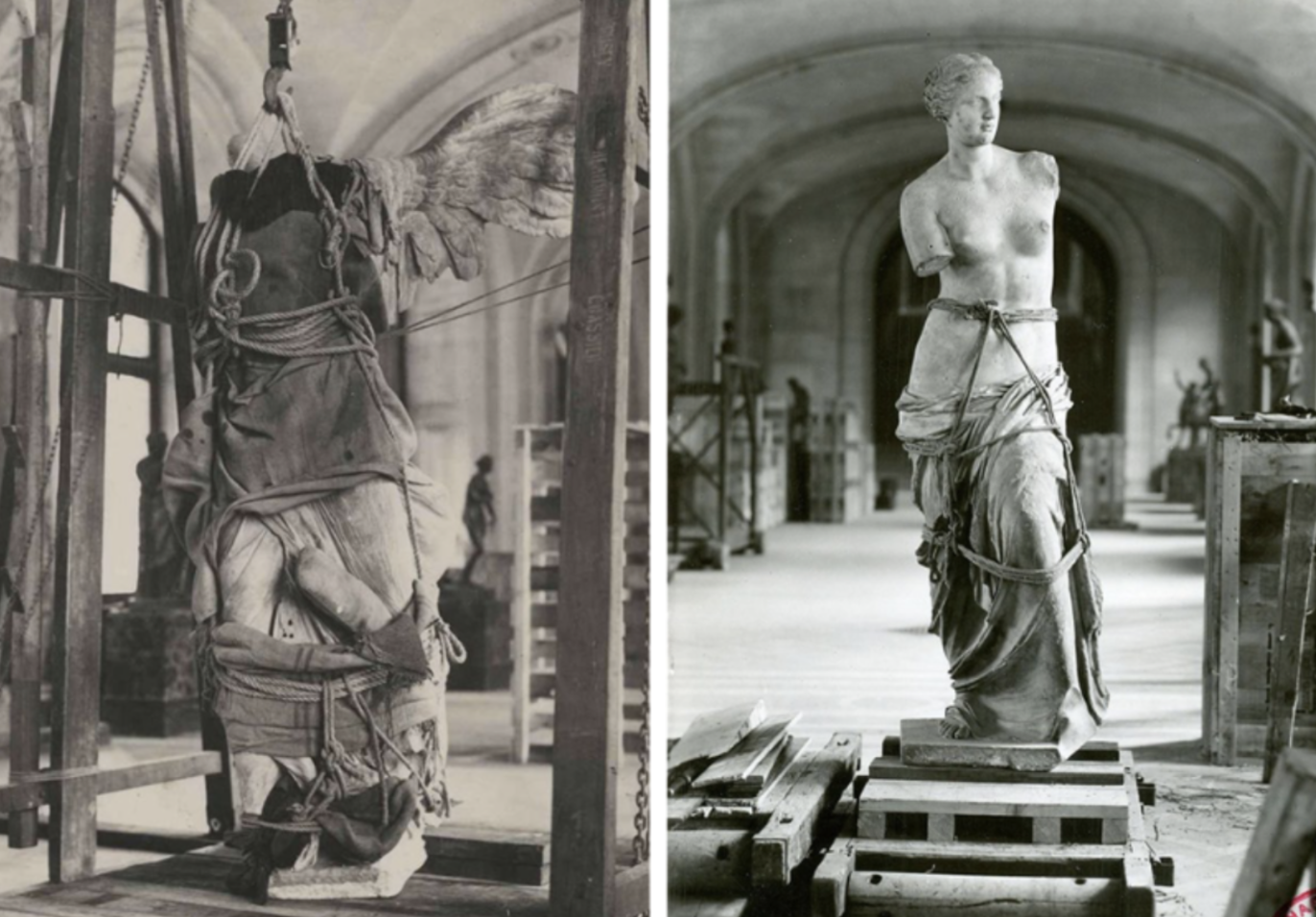
At first, many pieces were considered too fragile to move. Pastel paintings by Boucher and Degas found their way to the vaults of the Banque de France. Winged Victory, Venus, Diane de Versailles, and Michel-Ange’s Slaves stayed in the Louvre under arches and piled with sandbags.
At the start of September, the Germans moved into Poland, and the workers were told to move faster. This time, they needed to remove The Wedding Feast at Cana. Taken out of its frame and off its backing, the immense canvas was rolled onto a large oak log, longer than the 20-foot-tall painting. David’s Sacre was rolled once more, but the huge paintings wouldn’t fit in any of the trucks they had on hand. The Comédie Française came to the rescue with large scenery-moving trucks.
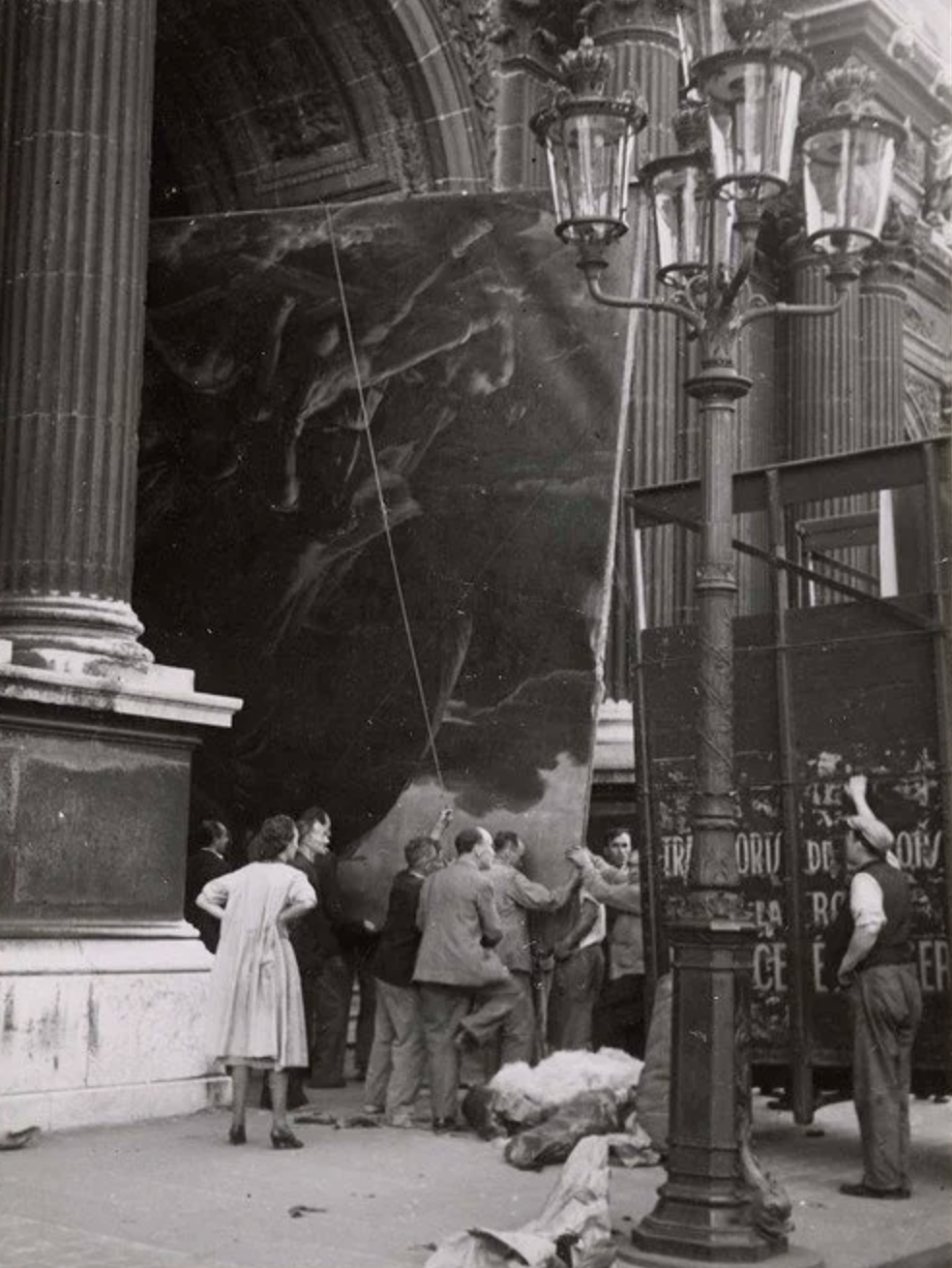
The next issue was Gericault’s Raft of the Medusa. Theodore Gericault used Bitumen, the tarry substance added to paint to deepen dark colors, but since it never fully dries, Huyghé was worried the painting would be ruined if rolled. The painting was left on its stretcher, carried out of the Louvre and placed on a truck along with a few other large works. Slowly making its way through the streets a large pole was used to lift wires so the paintings could easily move through
Once the caravan reached Versailles, they forgot the trolley lines that are fixed in place. As the painting slid through, a loud crack was heard, and sparks flew. The truck was moved sideways, and the electricity to the entire city was cut, causing many to panic that the Germans had arrived. Magdeleine Hours, a curator at the Louvre rushed to the Château and banged on the door until a pajama-clad curator found the door in the dark. The Raft and the other pieces were left at Versailles for a few days before they checked the rest of the route.
On September 1, 1939, World War II began, and the rest of the art deemed too fragile in the Louvre needed better protection.
The most precious and beautiful, Winged Victory of Samothrace, stands at the top of the Daru staircase. Her 9-foot figure, which weighed 3 and a half tons, was the biggest challenge. On September 2, she was tied up inside an open crate with a system of pulleys, chains, and ropes and was slowly lowered down the 53 steps covered with a few boards as everyone stood by holding their breath. That same day, 95 trucks of 120 crates left, but Victory, Venus, and the Slaves remained.
On September 3, 1939, England delivered an order to Hitler to stop and leave Poland within two hours. At 5 pm France declared war on Germany. By September 3, 90% of the Louvre was empty, and things quickly stopped. Officials worried the Germans would be on the cobblestones of Paris in days, but by the 6th, when nothing had happened, the project resumed, and convoys continued to move. At the end of the month, Jaujard decided the remaining art wasn’t safe and needed to be removed.
It took until the end of October, on the 29th, when Victory, Venus, and the Slaves left in a convoy of 29 trucks to the Château de Valencay in the Loire. Delacroix’s ceiling in the Galerie d’Apollon was rolled and just behind Victory on its way to safety.
In just over 5 weeks, 2000 crates in more than 200 truckloads left the Louvre filled with 3,691 paintings and thousands of objects, furniture, and sculptures from not only the Louvre but the Cluny and Carnavalet as well as some high-value personal collections given to the Louvre for safekeeping. 599 crates from Versailles, 1400 from the Musée des Arts Décoratifs, and 6000 crates of private collections.
The Château de Chambord dates back to 1519 when Francois I wanted a hunting lodge on the edge of the forest. He intended to live there, but in the end, he only spent 42 days in 35 years. Its immense size, the largest in the Loire, played a key role in the evacuation of the Louvre. As the art left the Louvre, all convoys stopped at Chambord to be inventoried and then transferred to their final destination.
Chambord had drawbacks because of its size. It was highly visible from above, and its double staircase, designed by Leonardo da Vinci, made it difficult to move crates of art. The doorways were also quite low, and many were damaged in the process. Delacroix's Apollo ceiling remained, along with the department of drawing collection and the prints given by Edmond de Rothschild. Archivist Lucie Mazauric brought along thousands of books and files from the archive collection, many of which I still benefit from today.
The Musée de l’Armée houses models of French cities, many created under Louis XIV, also found protection in Chambord.
Other châteaux include Fougères-sur-Bievre, Chevrnay, Valencay, Louvigny, Courtalain, Chereperrine, Le Pelice, and Ailleres. They thought everything through. Curators and guards traveled with the caravan. When the first convoy rolled through the small towns, the tarped-covered trucks got lots of looks. Many thought the circus was coming to town; little did they know it was the Winged Victory flying through.
The painting department consisted of 3,691 pieces and had to be split out into multiple locations. They needed to be near each other so curators and restorers could travel quickly as they worked. At the Abbaye de La Pelice and the Château de Louvigny, most paintings were hidden away. Louvigny also had the other large framed paintings. The Château de Chèreperrine held the large rolled paintings, including the Sacre de Napoleon, Wedding Feast at Cana, and Gros’ Napoleon in Jaffa.
The Raft of the Medusa had to stay in Versailles a bit longer until they were sure they could make the trip safely to Chambord. On the back of an open scenery truck, it garnered attention wherever it went. While the other trucks in the convoy traveled to Chambord, they did so in the dark without lights. Upon arriving at the chateau, they realized a truck was missing, filled with Watteau paintings. They found it the next morning as the sun came up on the banks of the river Loire. The driver mistook the lights on a bicycle for another truck.
When they packed the Mona Lisa, they wrapped her in special paper to absorb humidity and placed her in a red, silk-lined box. When she left Paris, she left in a hermetically sealed truck. When she arrived in Chambord, National Museum officer Pierre Schommer passed out due to a lack of air but was thankfully revived. She moved on to the Château de Louvigny along with curator Andre Chamsen. Chamsen was the assistant curator at Versailles just before the war began. Born on June 6, 1900, in Nîmes, he began his job at the Louvre just weeks before the war was a whisper.
Chamsen met Lucie Mazauric, and the two married on July 26, 1924. When the art moved, so did they, along with their daughter Frederique. As an archivist, her collection and job were just as important as the art that hung on the walls and what they held in their armoire, the most important piece in the Louvre collection.
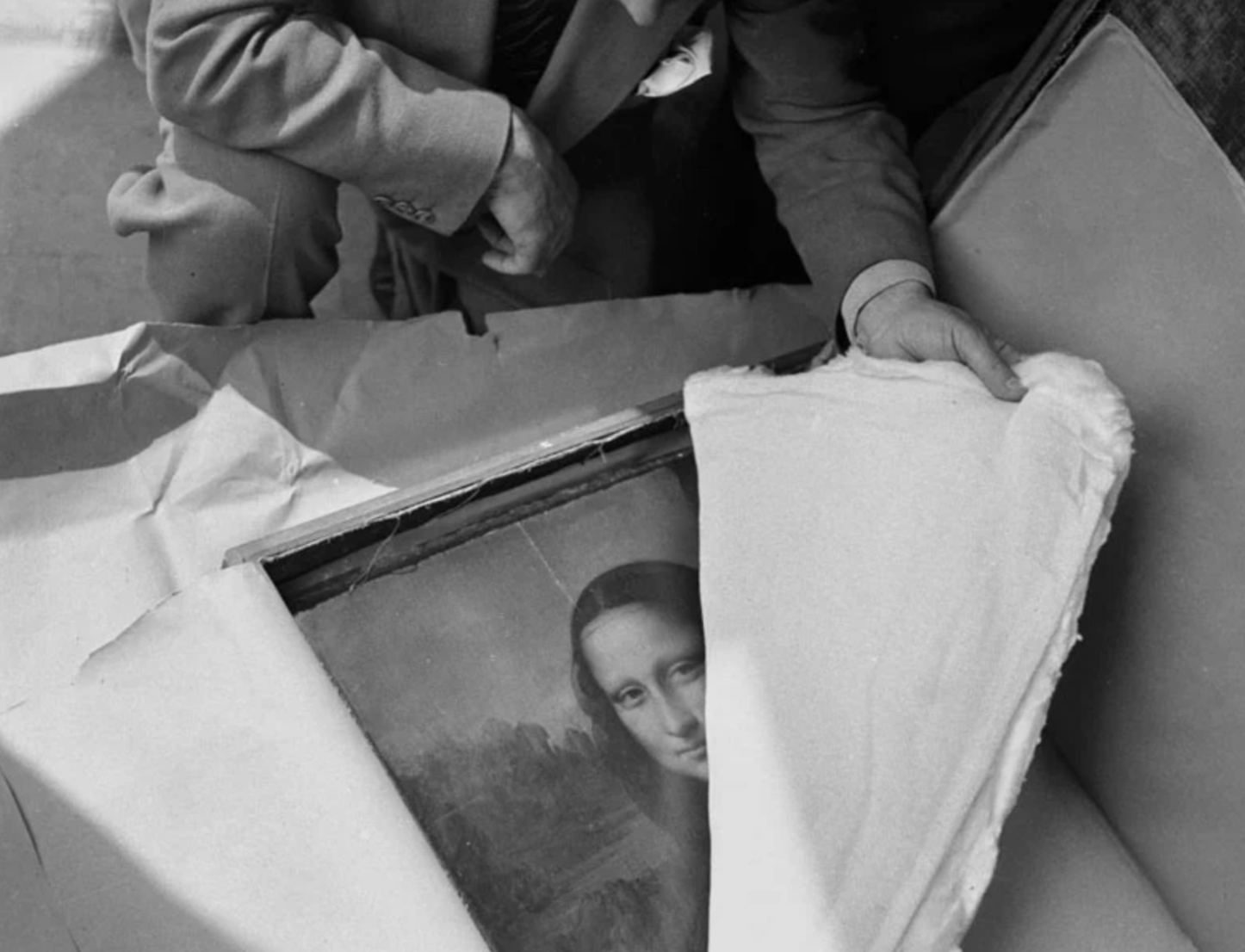
In the Petit Salon of the Château de Louvigny, La Joconde was hidden away and brought out every week to check for any moisture. Daughter Frederique said in the amazing documentary, and what started me on my own journey, The Rape of Europa, that she remembered her father opening it and pulling back the red silk.
As the war raged on, the locations of the art hung in the balance, and decisions along the way had to be made. In the spring of 1940, the Germans closed in, getting closer and closer. On May 16, 1940, a large plume of smoke could be seen from the Ministry of Foreign Affairs on the Quai d’Orsay as they tossed archives out the window into a burning pile to destroy before the Germans arrived. Jaujard knew the art wasn’t safe and needed to be moved. The isolated Abbaye de Loc-Dieu was chosen as it was 80 miles NE of Toulouse and farther into the country. The threat of being seen moving was far greater than the first time. There also were fewer staff, trucks, fuel, and time to make the move.
Four paintings were excluded from the move. The Wedding Feast at Cana, Sacre de Napoleon, Napoleon visiting Jaffa, and the Battle of Eylau. It was thought that three paintings depicting Napoleon and the Wedding Feast, being the one he stole, may have a high value to Hitler and the Germans. The one place Hitler had to visit on his one day in Paris was the tomb of Napoleon.
On May 29, 1940, Jaujaurd and Germain Bazin, assistant curators, built a timeline for moving all the art. A few curators refused to take part, as it was a dangerous undertaking. Once the move began, it took three days because of the busy, horrible roads, but everything arrived on time.
Over the next 5 years, much of the art moved three times before it finally returned to Paris. The Mona Lisa moved six times, with her caretaker and family moving right along with her. At each location, she had her own room and guards
On December 26, 1944, the last German bomb was dropped on France, but the art stayed put. On April 30, 1945, Hitler killed himself, and a week later, on May 7, the Germans surrendered to the Allies.
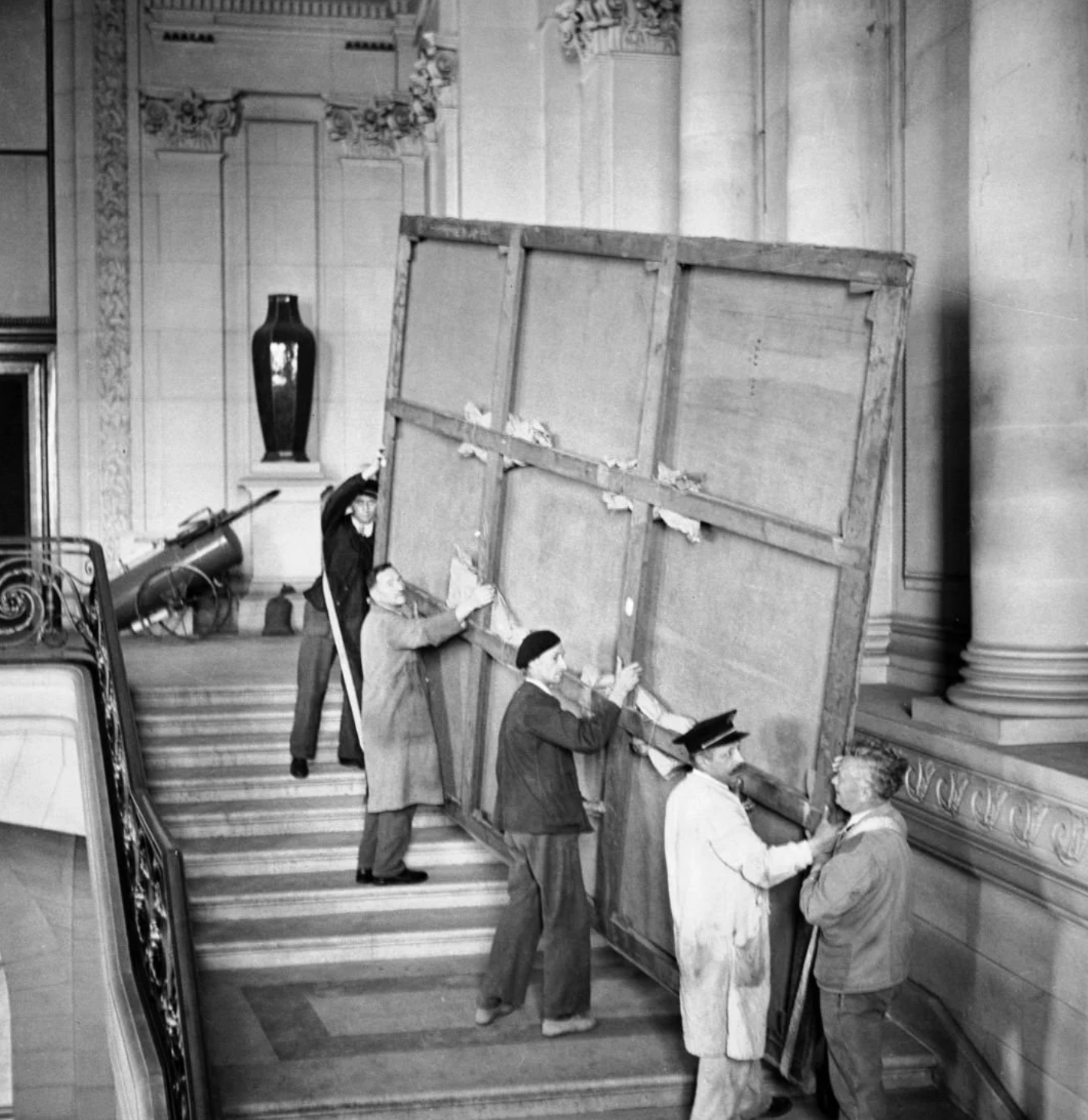
Now curators faced a new obstacle. The cold and lack of coal in Paris made it almost impossible to heat the large galleries. The cold and rising visitor temperatures caused humidity, one of the worst enemies of art.
On June 15, 1945, at 5 am the first convoy of art left the Château de Montal. Two hours later, all 3 and a half tons of Winged Victory left for Paris on a truck provided by the British army. It took 9 hours to go the 150 miles back to Paris.
The next day, Delacroix’s Liberty Leading the People, as well as Boucher and Watteau paintings. At the time of the war, there was no Musée d’Orsay. The collection you see in the Orsay today was once in the Louvre. Along with the French and Italian masters, the Louvre evacuation also included van Gogh, Manet, Monet, Renoir, Cézanne, and all the Impressionists.
On June 21, Winged Victory was back at the base of the Daru Staircase. The entire staff of the Louvre stood by to watch her make the slow push up the steps that would take over two hours. Of course, they stopped for lunch for 90 minutes before completing her move, and she was once again sitting atop her ship.
On June 30, Venus and Michel Ange’s Slaves returned. It had been 6 years since they had last seen the inside of the Louvre. In the following weeks, the rest of the art, antiquities, crown jewels, furniture, and more returned to Paris. Since the Louvre wasn’t ready yet, they held a special exhibition in the smaller rooms off of Winged Victory beginning on July 10, 1945, where 83 paintings, including the Mona Lisa, could finally be seen again.
While the art was gone, curators worked to restore and conserve many of the most important pieces, although the Mona Lisa was never touched.
The larger paintings didn’t return until February 1946, and the Belle Allemande joined the Louvre collection after Gorring “traded” for her. Today she is down on the ground level in a side room just off the Cour Leuffel without a mention of her travels
One of the last pieces to return was the one that made the greatest exit. Gericault’s Raft of the Medus, which had such a sparkling start, finally returned on July 9, 1946, from the Château de Sourches with 8 other large paintings.
On October 17, 1947, after 8 years, the Louvre was finally fully open to the public.
While it was closed, they also developed a new strategy for hanging the art. Before the war, the paintings were much closer together and stacked on top of each other. Now, after the remaining workers inventoried the frames and the chalk marks on the wall, they planned the new, more spacious layout we see today.
For more, watch the fantastic documentary The Rape of Europa
And read one of my favorite books, Saving the Mona Lisa by Gerri Chanel
I have listed many great books on my website on the subject as well as on the history of Paris, check them out here