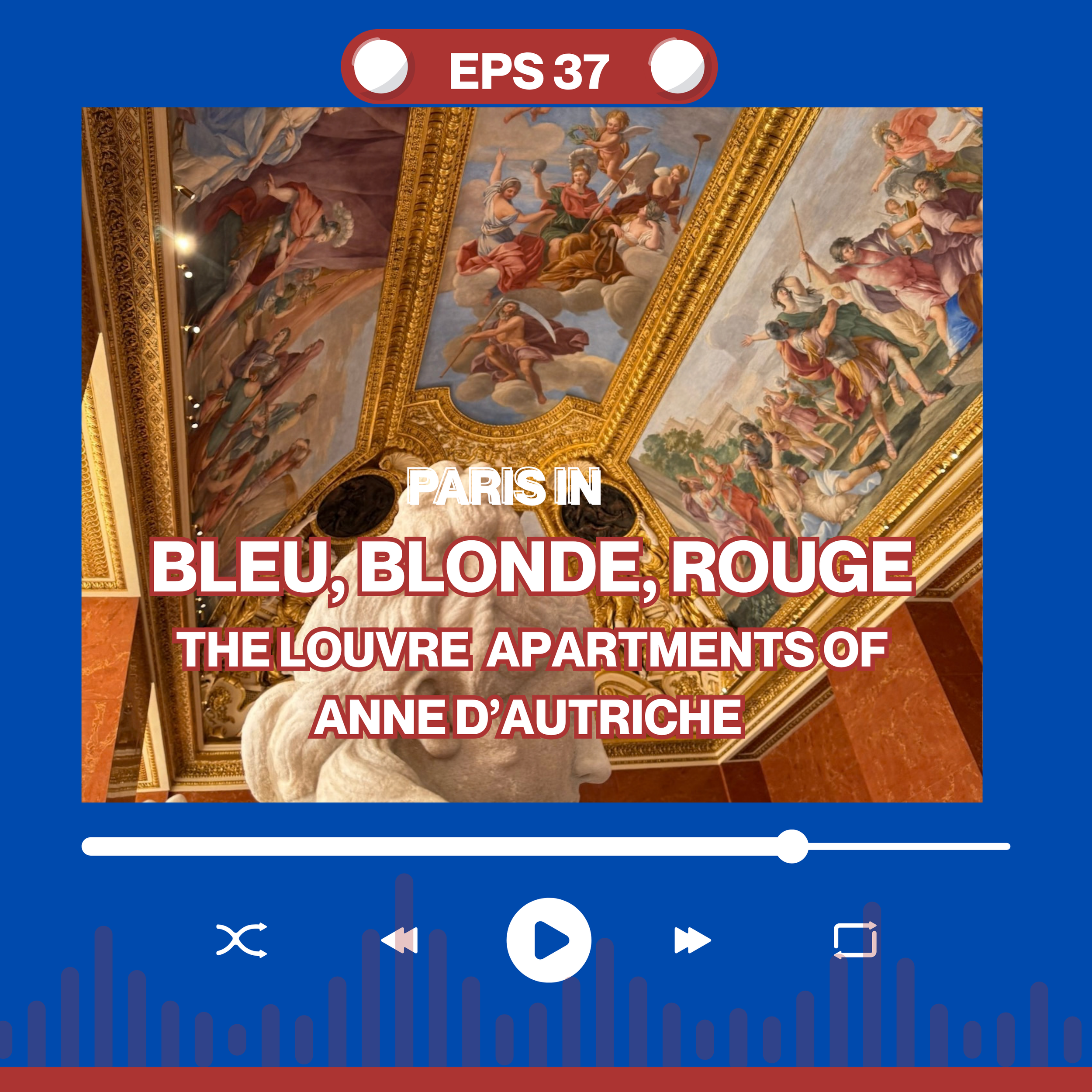
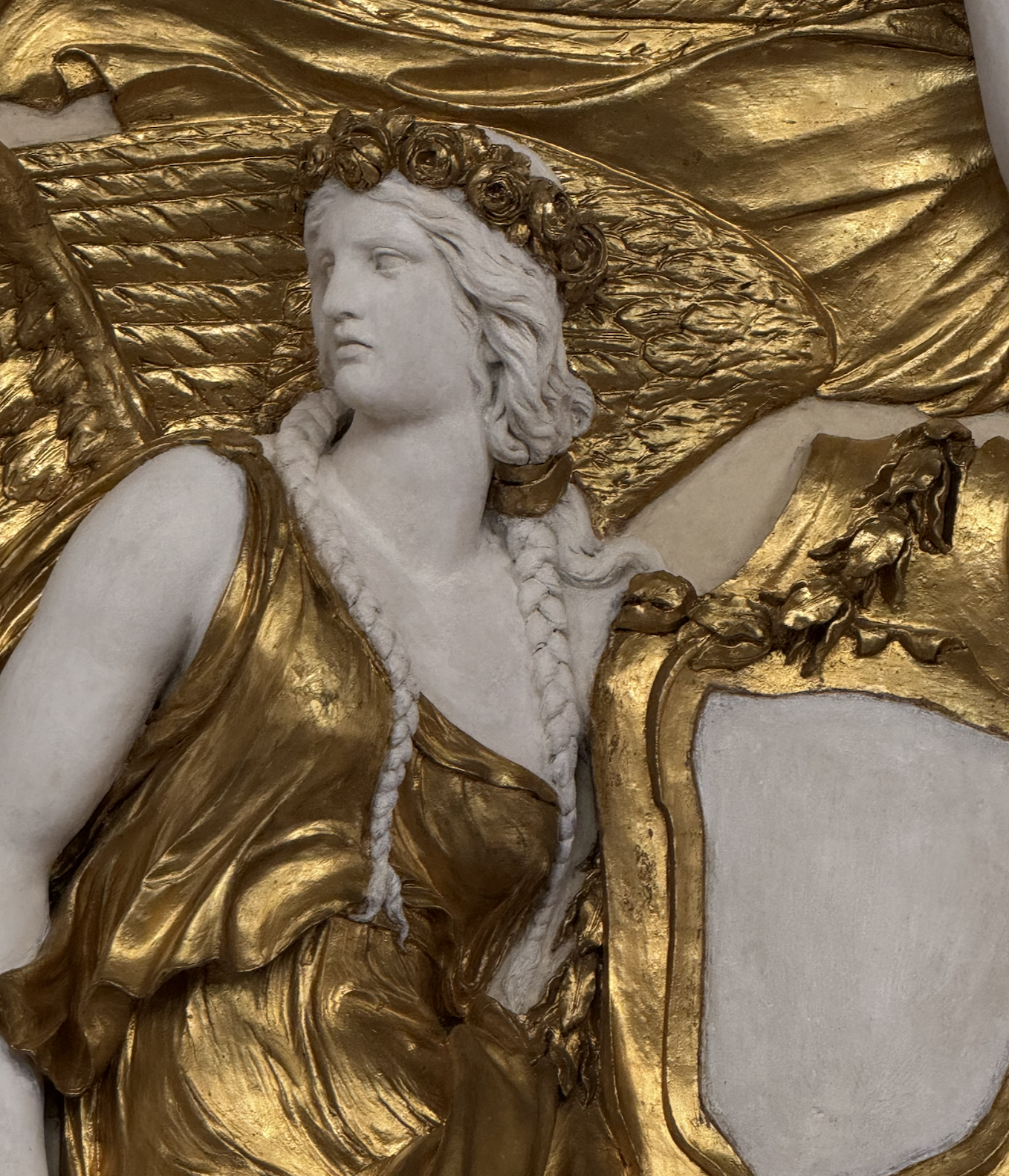
Before the Louvre housed one of the most significant art collections in the world, it was home to the kings and queens of France. In 1528, Francois I began the palace we see today, removing the former fortress and palace. His son Henri II continued his vision, and Henri IV marked the start of the Grande Louvre project, which would still be respected by Napoleon III in 1857. Then there was the modernization of François Mitterrand, announced on September 24, 1981, that would bring the Pyramid to fruition.
When you think about the palaces of the kings of France, the golden opulence comes to mind. We can trace that back to the 16th century and the Sun King, Louis XIV. For most, the Chateau de Versailles comes to mind when thinking about the endless gilded halls, but one came first and even inspired Versailles: the Palais du Louvre.
Anne of Austria, the Infanta of Spain and eldest daughter of King Philip II of Spain and Marguerite d'Autriche, a branch of the House of Habsburg, was raised in a very religious chateau. At eleven years old, she was betrothed to Louis XIII, and the two married when she was fourteen. Their wedding night included his mother, Marie de Medicis, standing over the bed waiting for them to consummate the wedding, but it wouldn’t happen for quite some time. Miscarriages and stillbirths followed and drew Anne to the church.
In 1634, she commissioned the building of the Val-de-Grace abbey and a church dedicated to the Virgin. Then, she came with a prayer that she would finally give birth to an heir. On September 5, 1638, Louis XIV, after a rather stormy night in Paris in December 1637. However, some historians argue that the true father is Cardinal Mazarin. (link the Vow of Louis XIII)
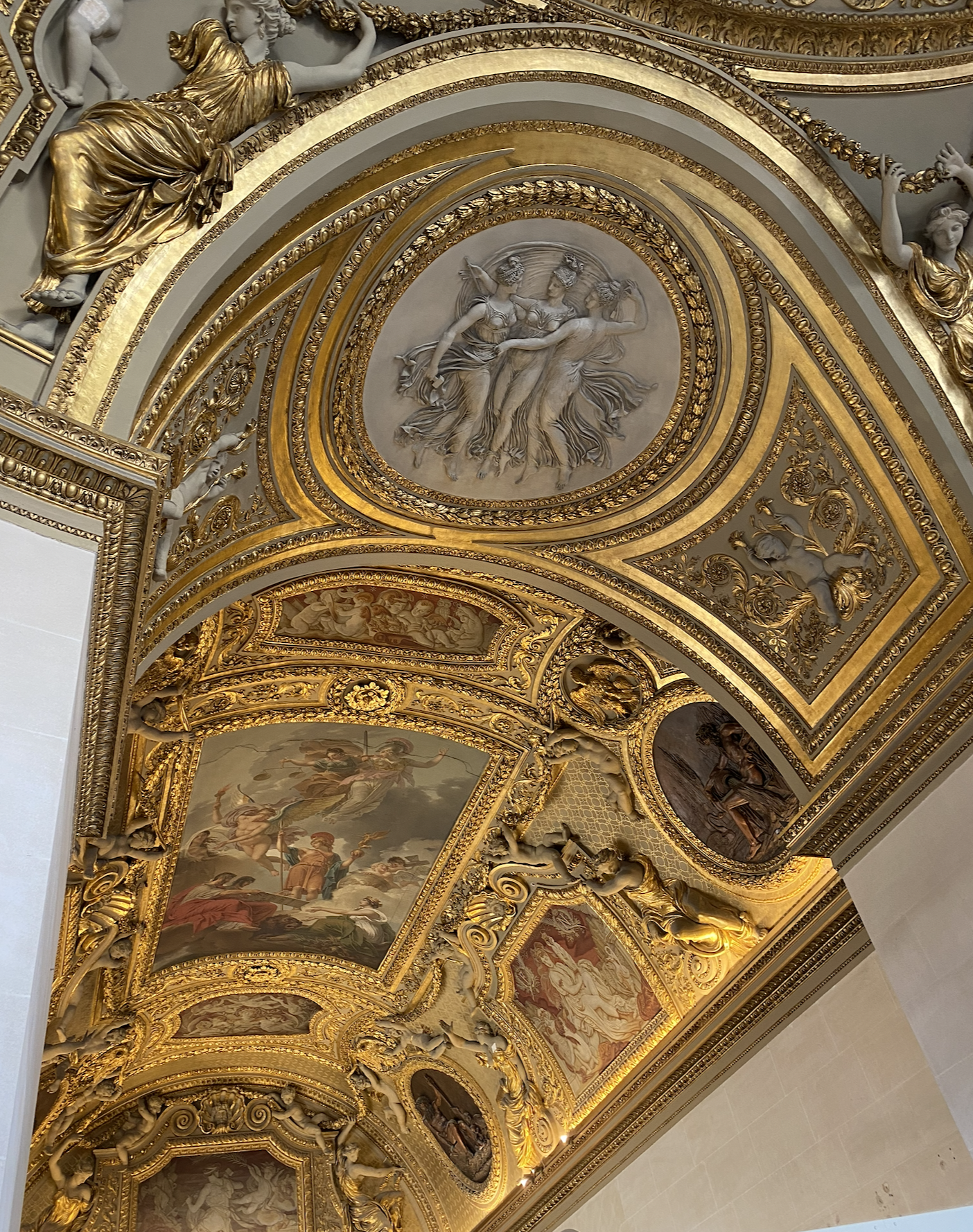
Since 1547, the king and queen’s apartments shifted a few times within the Louvre, and Louis XIV and his mother Anne d’Autriche preferred the more modern Palais Cardinal across the street, today’s Palais Royal. On October 13, 1653, Louis XIV ordered the construction of the apartments for the holding of the Council in the Louvre in the new Lemarcier wing by the Pavillon de l’Horloge and the need to create new rooms for his mother, Anne d’Autriche. Ever the devoted son and original French mama’s boy, Louis was happy to do anything for her.
The Louvre had been abandoned for 9 years and desperately needed restoration. The king’s architect, Louis Le Vau, was tasked with the project, with Louis XIV having complete design control. The Queen Mother’s winter apartments were on the ground level of the Sully wing, where you will find the Venus de Milo today, but lacked any cool air in the hot summer months. So, as one does, a new suite of rooms specifically for the summer months was created just a few steps away, below the Petite Galerie.
With a window and balcony looking out to the Seine, a room that opens onto the garden on one side, and a courtyard on the other, it was perfect for the long, hot summer days. Over the next four years, Le Vau worked closely with artist Francesco Romanelli and sculptor Michel Anguier for every aspect of the ceilings of Anne d’Autriche.
Romanelli, a student of Pierre de Cortone in Italy, arrived in Paris after Pope Urban VIII recommended him to Cardinal Mazarin to paint the ceiling of his palace. Impressed by his work, still on view in the nearby Bibliothèque Nationale, Mazarin recommended Romanelli to the king.
Sculptor Michel Anguier and his brother Francois studied in Rome and created funerary monuments for the titled and elite. Michel’s success at Nicolas Fouquet’s Vaux le Vicomte led him to Anne of Austria’s Val de Grace, which would give him the advantage of being selected for the rooms of the Louvre.
The two artists seamlessly blended each room’s stories and expressed the queen mother’s vision and qualities.
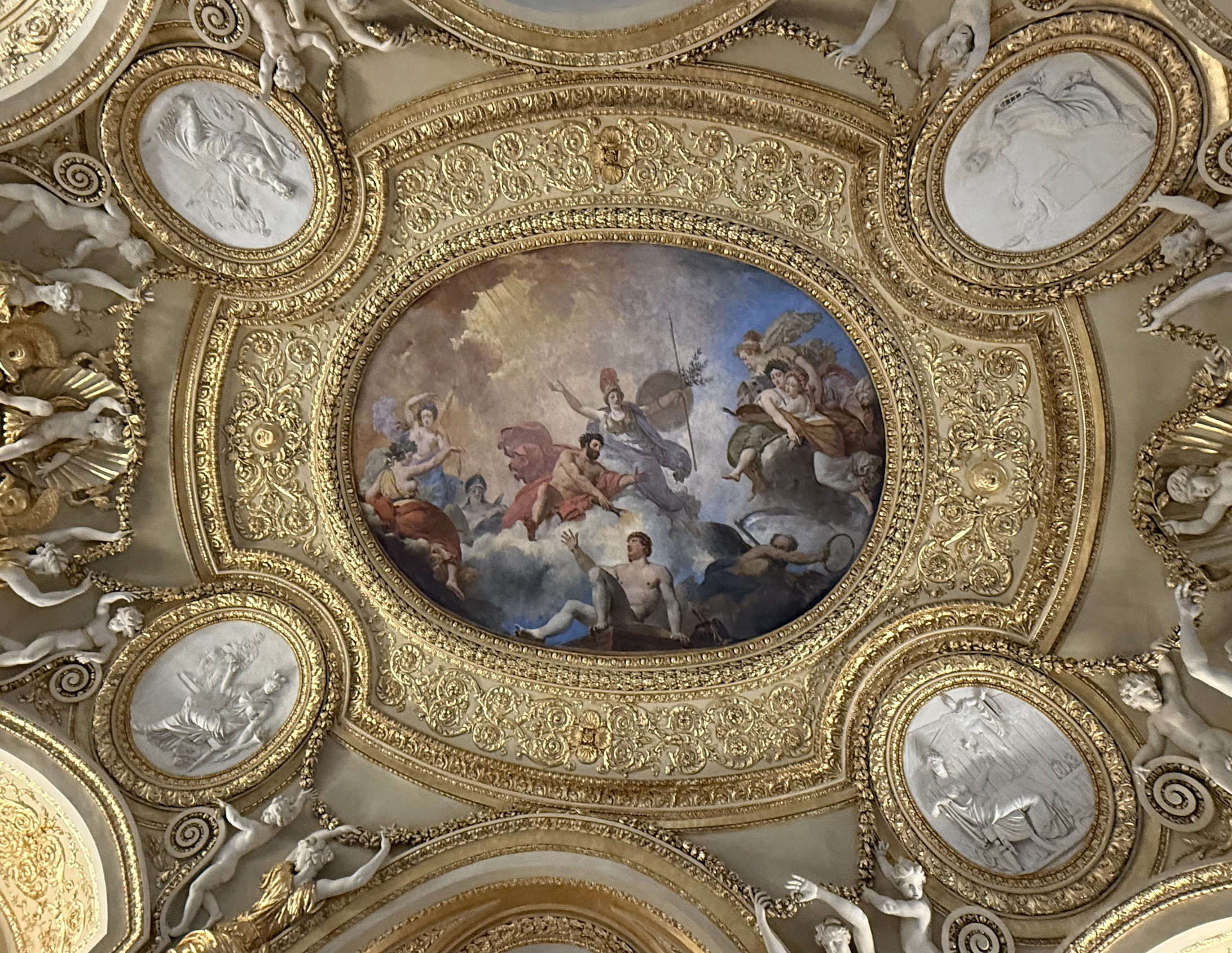
The suite of rooms today begins at the Rotunde, which once served as the entrance to the Musée Central des Arts, the first name of the Louvre in 1793. The ceiling's decor was added seventy years after Anne’s death, but the theme still follows that of her apartments.
The center of the ceiling is crowned by the painting of Man Formed by Prometheus and Animated by Minerva, first completed by Jean-Simon Barthelemy in 1801. The Goddess of wisdom, Minerva, holds an olive branch, spear, and shield above Prometheus, draped in red fabric, keeping the fire he had taken from Jupiter. Below him, the first human reaches up toward the sky.
To the right is Time, always depicted as an older gentleman pulling away from Man, the snake that bites its tail, the symbol of eternity, knowing that Man would be the end of them in time. Above Time are allegories of the three arts: painting, sculpture, and architecture, each holding its respective tool.
On the left side of the painting are the three fates or Parques. The three sisters and daughters of Zeus and Hera can measure the span of life. Depicted with a gold thread, Clotho, the oldest sister, unrolls the thread. Lachésis pulls the thread, and Atropos holds the scissors to cut it while she looks at the human.
In 1825, water damage from the upper floor severely damaged the ceiling. The original artist, Barthelemy, passed away in 1811, and Jean-Baptiste Mauzaisse was asked to replicate the entire piece. By 1826, Mauzaisse had completed the full recreation in the style and details of the original.
The stucco reliefs created by Jean-François Lorta surround the central painting on four corners. They nod slightly at the Salle des Antiquitès entrance, which Napoleon placed in these rooms in 1800.
Each corner features a notable work by an artist representing one of four countries. On the upper left of the painting, we begin with France and Pierre Puget’s Milon de Crotone, which can also be found in the Cour Puget. Below France, in the lower left corner, is Italy, represented by Michel-Ange and his statue of Moses, created for the tomb of Pope Julius II.
In the upper right, Egypt is represented by the Colossi of Memnon, quartzite sandstone dating to 1350 BC. Finally, just below is Greece with the Apollo Belvedere, which briefly lived in these rooms after Napoleon Bonaparte took the statue from the Vatican in 1796 and lived at the Louvre until 1815.
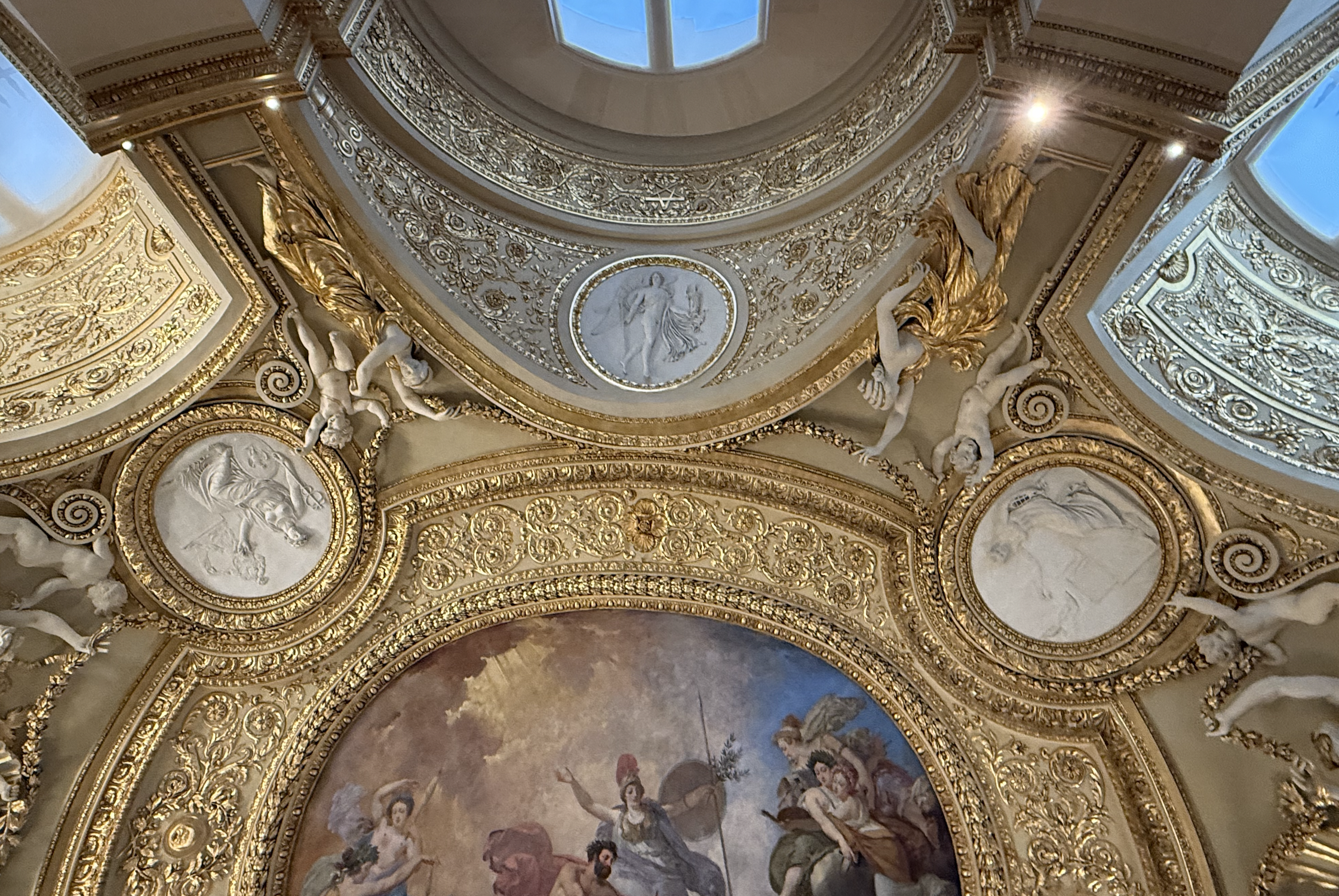
On the north, over the former entrance, is the Genius of the Arts, and the Union of the Three Arts on the south.
Let’s step into the first room, the salon, which served as the entrance to the apartments. The decor dates back to the start of the 19th century. At the center of the ceiling, by Charles Meynier, is The Land Receiving from Emperors Hadrian & Justinian, the code of Roman Laws Dictated by Nature, Justice & Wisdom. In the lower left, the Roman emperors Hadrian (76-138) and Justinian (482-565) hand a tablet to the allegory of the Earth surrounded by a lion and a cornucopia with the Earth’s bounty.
The allegory of Rome dominates the center with a spear and globe topped with a winged victory next to a shield of Rome and two putti. On the left side is a genius with a torch lighting up Nature, with a few extra breasts. At the top, we find Minerva again with a sword and Thémis, the goddess of Justice, with scales, the two principles of Roman law.
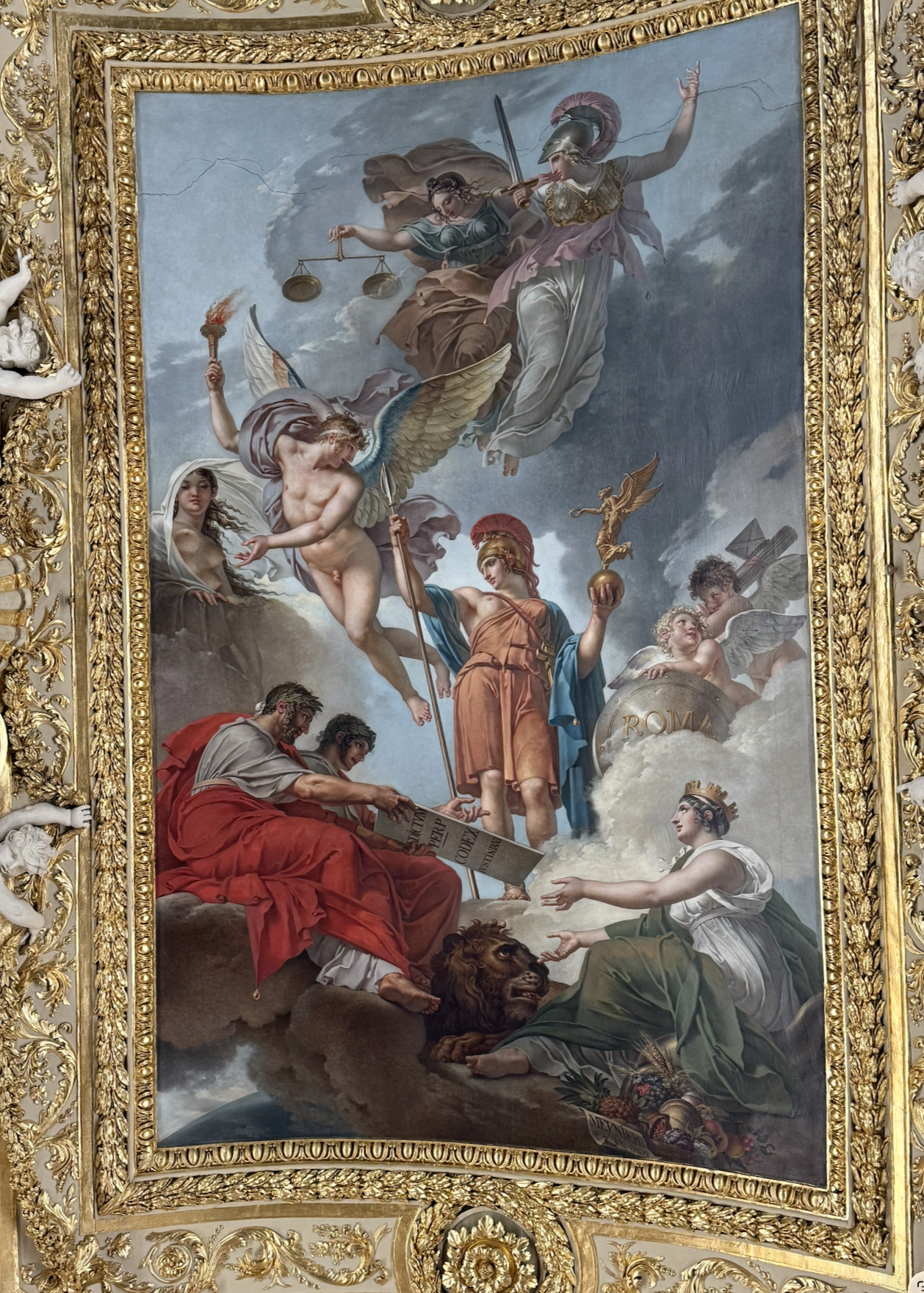
Painted onto the ceiling in 1802 and 1803, it, along with the rest of the ceilings in these rooms, was fully restored in 2023, although a rather large crack is spotted across the top of the painting.
Below the painting are trompe l’oeil cameos by Victor Francois Biennourry. He was commissioned in 1865 and asked to create a few others in the suite of rooms and the Grande Salon of the Apartments Napoleon III. Two more minor cameos representing Science and Study are on either side of the painting.
Each painted to appear as a fine agate cameo, the top trompe l’oeil in the cornice represents France, Rome, and Greece, each holding a few fantastic little treasures. On the east side, the allegory of Greece is in the center, with a statue of Zeus at Olympia by Phidias in front of the Acropolis and on the right of the allegory, the Parthenon.
On the south side, above the entrance to the apartments, the allegory of Rome has her back turned with sculpting tools in hand. The Titus arch, the Pyramid of Cestius, and the Roman Forum can be seen in the lower right.
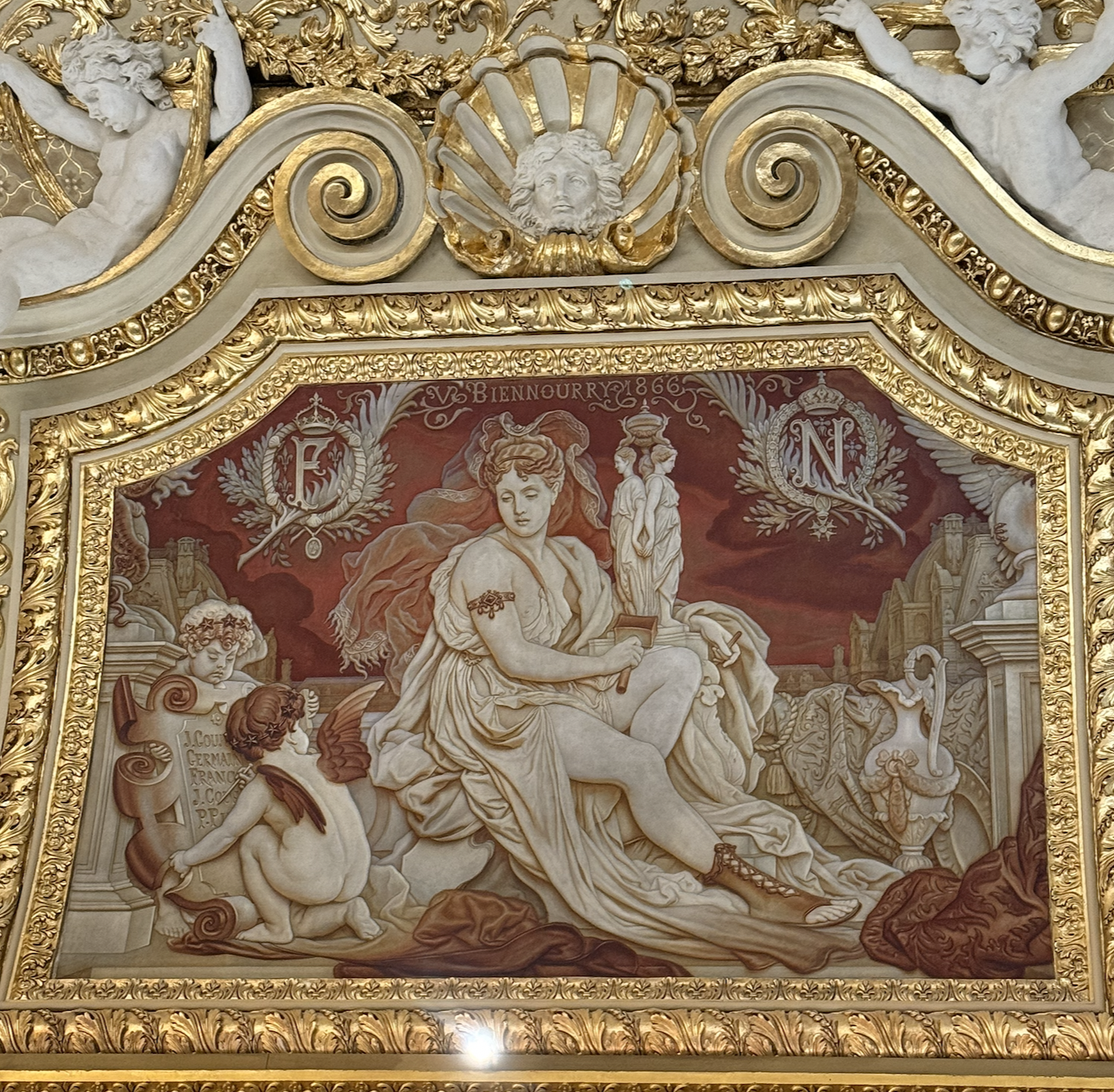
Of course, saving the best for last on the west side is the allegory of France, which holds the monument to Henri II, created by Germain Pilon and can also be found in the Louvre. At the top are two initials. F for Francois I was surrounded by the Order of Saint Michel and the N of Napoleon III with the Order of the Legion of Honor. Below, geniuses inscribe the top French sculptors, Goujon, Pilon, Cousin, and Puget, on a tablet. On either edge of the cameo are the roofs of the Louvre and the Palais des Tuileries
These rooms are closed off as they begin the construction of the new area dedicated to the Byzantine art that should be finished sometime in 2028. The Rotonde is open, and you can see the ceiling of the first room over the temporary wall. For the rest of the ceilings, be sure to check my website as well as Youtube where I have complete videos of the space.
The second room, the Salle des Saisons, could be one of the most important ceilings in all of France. It served as the grand antechamber where people would wait to see the queen’s mother. Romanelli incorporated this idea into the ceiling theme.
In the center of the ceiling, Romaneli painted Diane, goddess of the moon, Apollo, god of the sun, and the children of Zeus. Stories of the gods can also be found in the center above each wall. On the west wall, Diane has arrived and comes across a handsome sleeping Endymion. Diane touches him and wakes him from what he thought was a dream. Endymion, a mortal, was an astronomer and the first human to see the moon. It was love at first sight for Diane, who asked Zeus to give Endymion eternal life. Zeus, in turn, gave him eternal sleep, but Diane would visit him every month, and on that night, the moon disappeared from the sky.
Above the south cornice, Diane is surprised by Actaeon in her bath. The mortal hunter Actaeon finds the huntress bathing in a spring. In a rage, she splashes him with water and causes him to turn into a stag. Romanelli paints the scene with the antlers just beginning to grow from his head.
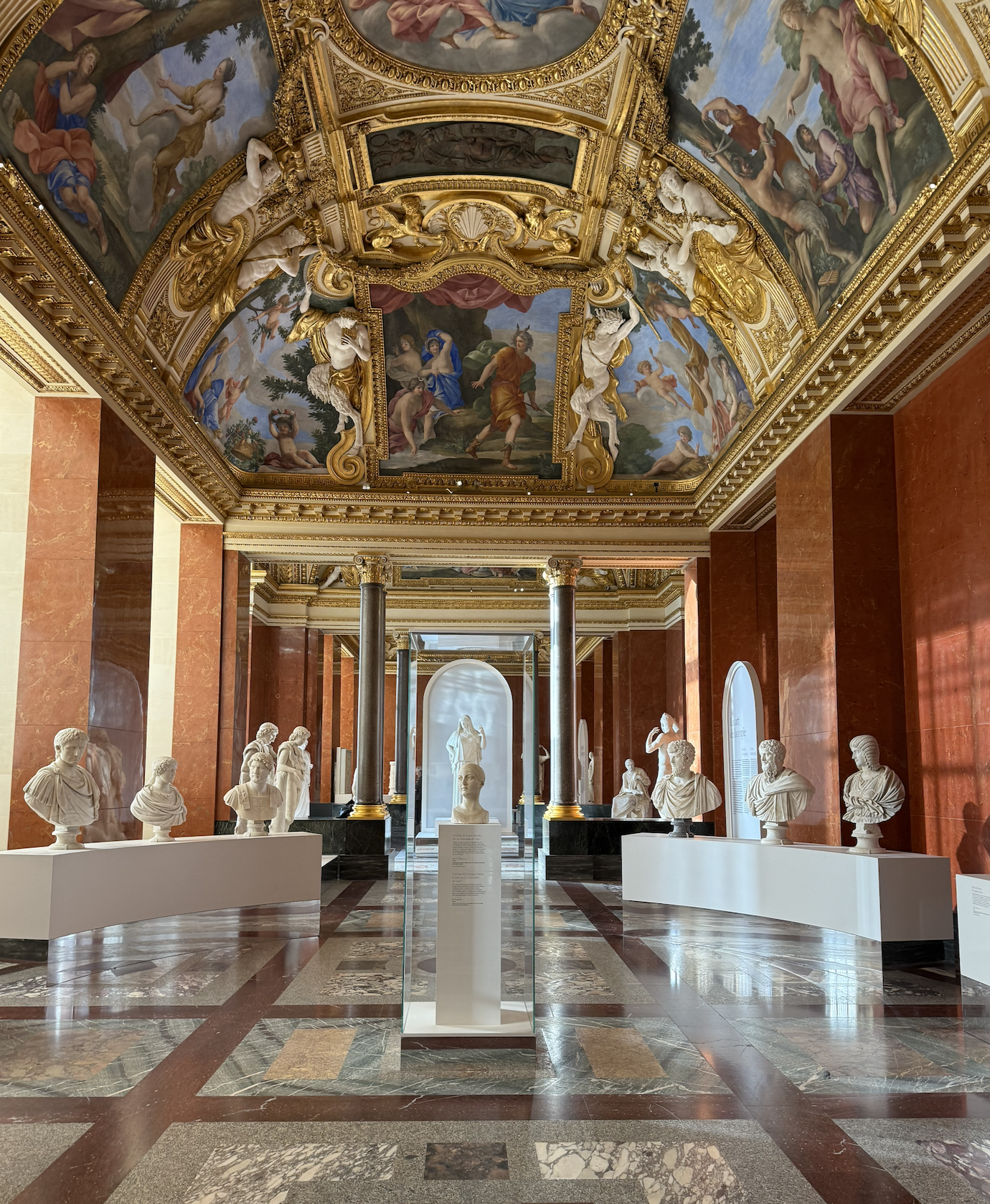
The east and north cornices are dedicated to the life of Apollo; on the east, Apollo challenges Marsyas. Marsyas, an expert at the Aulous, a double-reed instrument, is challenged to a contest by the god of music, Apollo. Marysa plays first, and the crowd erupts in dance. Apollo then plays his lyre, and the crowd is moved to tears. The contest continues, and Marysas loses and chooses death by being skinned alive. Mythology is filled with a few horrible scenes.
On the north cornice, Apollo is crowning one of Zeus’s muses, although the first one in the lower center of the painting is seen holding a canvas and paintbrushes. Of the nine muses and daughters of Zeus dedicated to poetry, tragedy, dance, and even astronomy, there isn’t a muse of the arts. Romanelli decided to add his little touch, and I love it, although Kyra, from Xanadu, is by far the greatest of all muses.
The paintings for each season are in each corner, beginning in the southwest corner with spring and ending in the northwest corner with winter. Dancing fauns surround the paintings on the east and west walls and caryatids on the north and south.
On either side of the center painting of Apollo and Diane are two reliefs in stucco painted to look like bronze and reflect the theme of time. To the north, two genies of time, one holding an hourglass and one a clock representing the times of the day, and on the south, a genie holding a ribbon of the zodiac signs representing the year.
The importance of this room in the history of the decor of the palaces of Louis XIV and beyond is not one to take lightly. This ceiling, inspired by Charles Le Brun in 1661 when it was time to rebuild the Petite Galerie just above the apartments. We now know that room as the Galerie d’Apollon. When Louis XIV abruptly left Paris and focused on the small hunting lodge in the forest of Versailles and visions of grandeur for his future home, he whispered to Charles Le Brun and said, remember what you did in the Louvre in the Galerie d’Apollon? Well, let’s go there; today you can see how that first small antechamber inspired the Galerie des Glaces at the Château de Versailles.
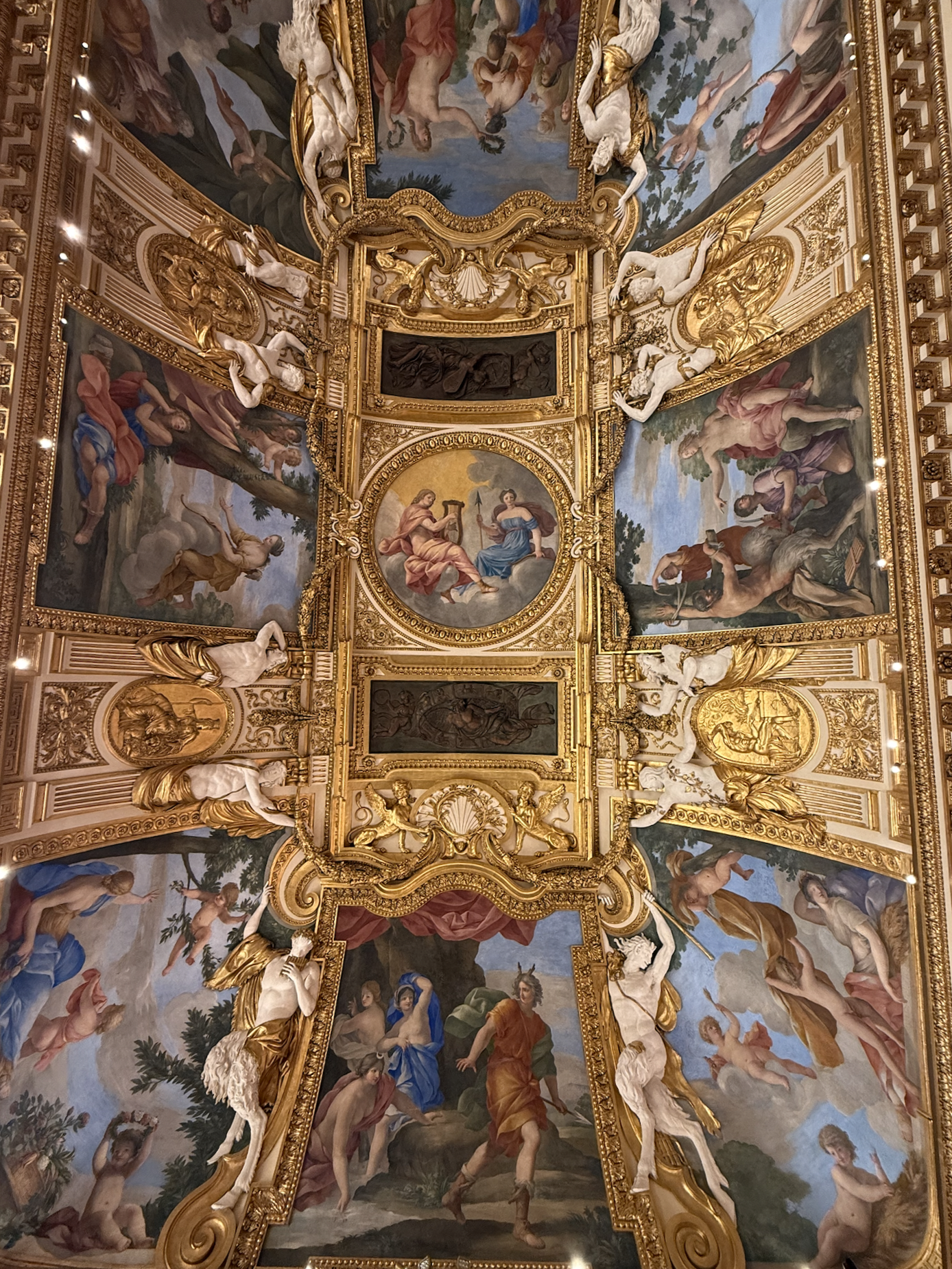
Golden medallions
SW Earth Cybele, seated on her lion
SE Fire, Vulcan forging lightening
NE Air Juno peacock
NW water Neptune and Sea Horse
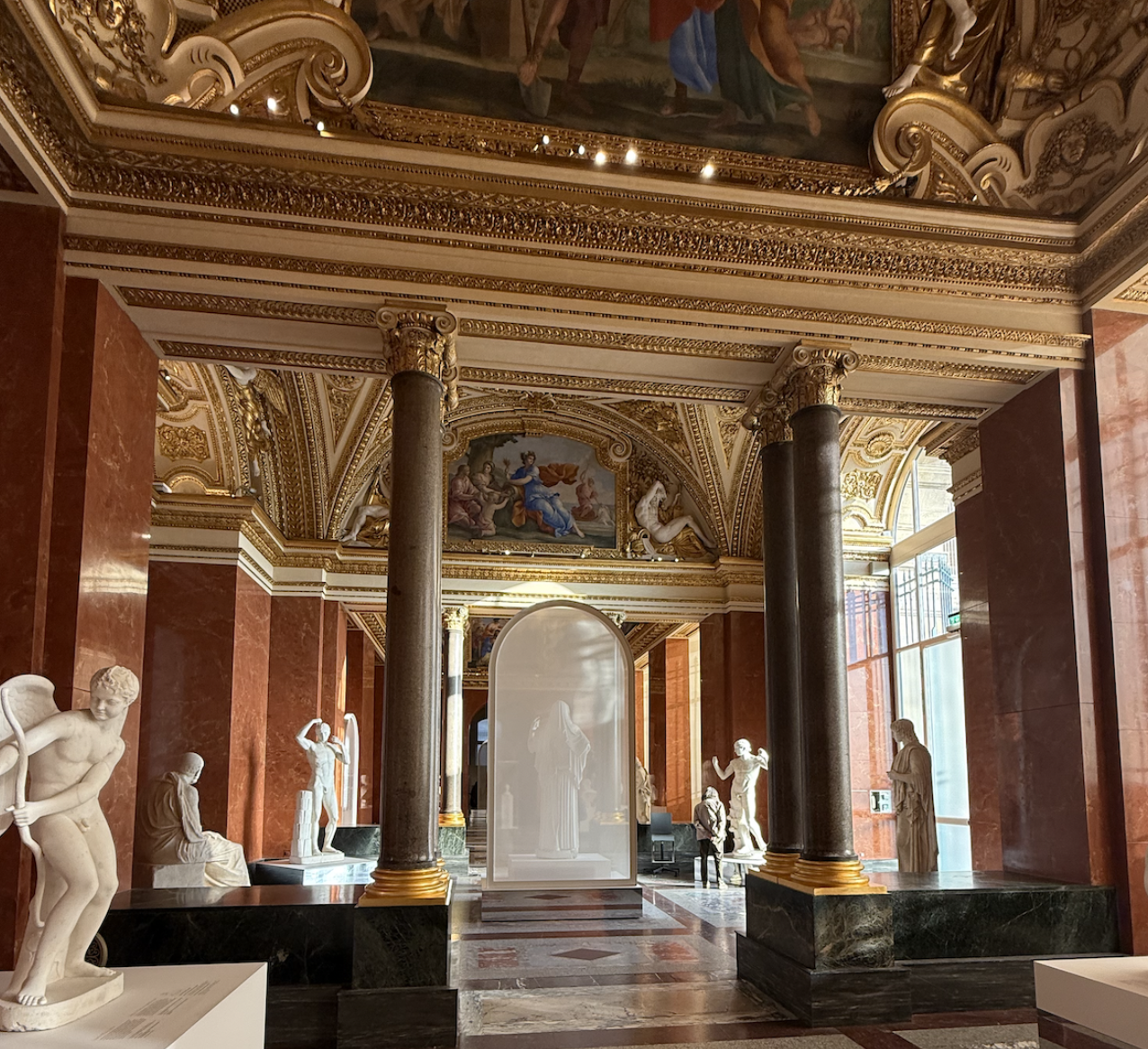
The next room in the series of the summer apartments is dedicated to the Paix des Pyrenees. The Vestibule de Paix marks the ending of the Franco-Spanish war that began in 1635 with the signing of the treaty on November 7, 1659, which included the marriage of her son, Louis XIV. Of the 124 articles, no 105 - 124 were dedicated to the joining of France and Spain through the marriage of Louis XIV with the infanta of Spain, Marie-Therese of Austria, daughter of Philip IV and niece of Anne of Austria, making her a double first cousin to the king. C’est normal, as they say.
The idea made its way onto the ceiling of the vestibule, which opened onto the queen’s garden, which would later be named after another young princess.
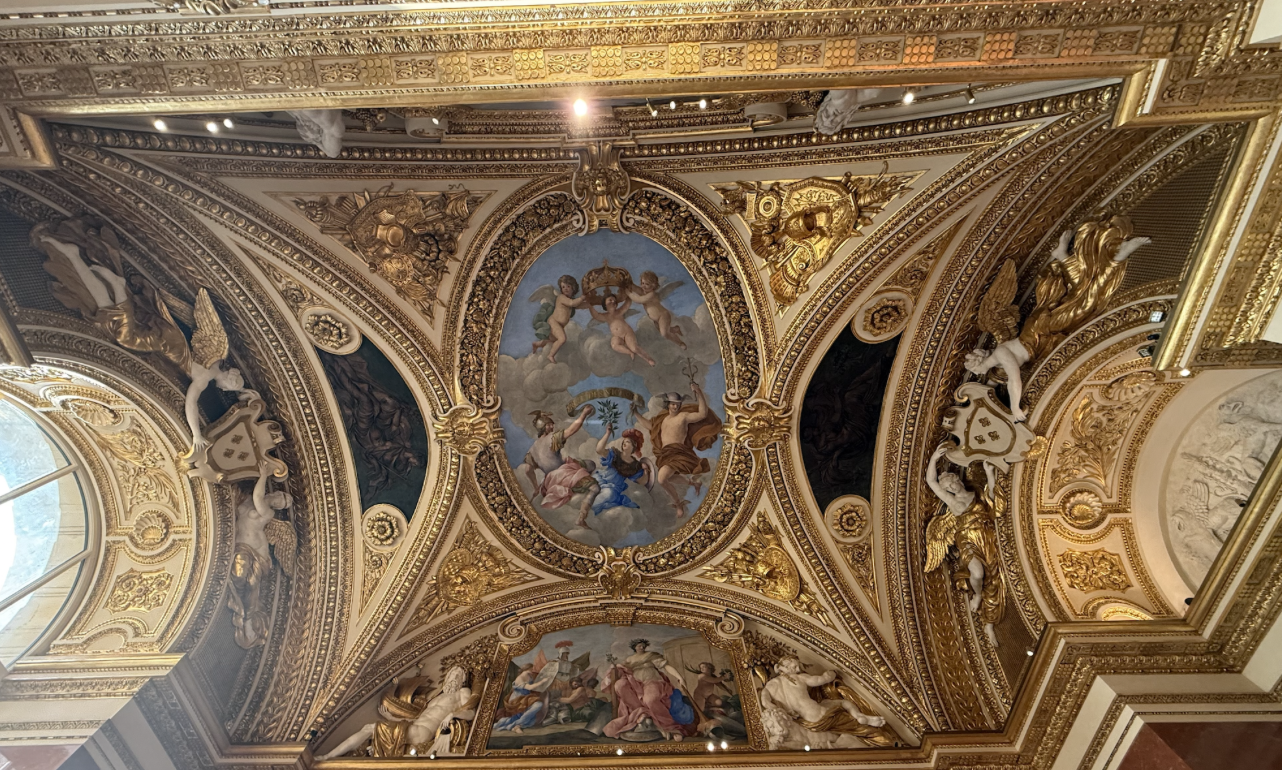
The center of the ceiling features Romanelli’s Allegory of the Pyrenees, also known as the Peace, Fruit of the War. In the center, three Roman gods represent the ideals of peace. Mars, on the left with a spear behind him and wearing a helmet topped with a dragon as the god of war and warriors, holds one side of the banner that reads the Fruits of Victory. In the center, Minerva, the goddess of wisdom, has an olive branch, although that was not her original offering. Romanelli originally painted her holding a lily, symbolizing the Bourbon family. During the Revolution, it was decreed to remove all reminders of the monarchy, including the fleur de lys and the elements of the Louvre were not exempt, and every lily they could find was repainted or chiseled away.
On the right, holding the other end of the banner, is Mercury, the messenger god. He has his caduceus in his other hand while wearing his signature winged sandals and helmet. Above the trio of guards are three genies holding a Bourbon crown, which survived the Revolution.
The theme of peace continues in the paintings in the north and south cornices. On the north side, the Goddess of Abundance rests on her cornucopia and distributes the earth’s bounty. She looks toward the sea and Neptune, representing maritime trade, holding his trident in his chariot pulled by seahorses.
On the south cornice, Peace sets fire to a pile of armor and weapons and holds an olive branch in her other hand. Behind her is the allegory of history inscribing “of the war of peace” while soldiers are held captive next to her.
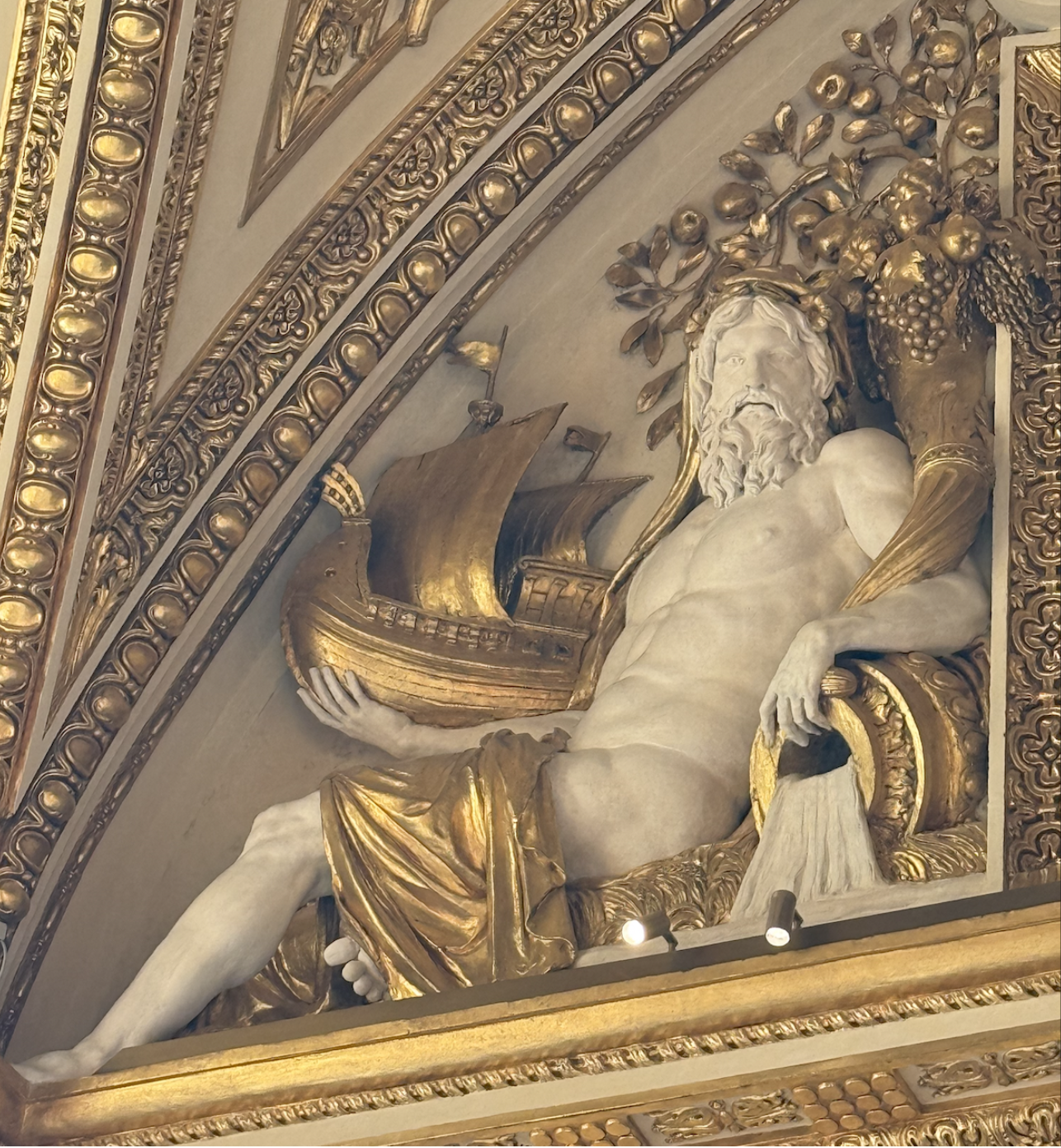
On either side of the paintings are four stucco allegories by Michel Anguier, representing the great rivers of France. Looking towards the north, on the left, the Loire, with its long beard and oar with grape vines over its head, represents the region’s excellent wine. On the right, the Garonne of the SW of France, with pears and grapes beside it, is shown.
On the south side, looking to the right, is the Rhône, which sits on a lion representing the city of Lyon and a cornucopia of fruits above. On the left, the easiest of the four to spot is the Seine, holding a boat representing Paris and an apple tree for Normandy. On the east and west sides are Anguier’s angels holding a seal with fleur-de-lis recreated after the Revolution.
Under Napoleon in 1799, the Anne of Austria rooms were added to the Musée Napoléon to hold many items he “picked up” on his travels. A few of the apartments’ walls and doors were removed, making a lovely vista to the back end of the suite of rooms, and the Laocoön statue was taken from the Vatican.
The opening of the rooms allowed the addition of eight very special columns. At the same time, Napoleon had lofty ideas about aligning himself with the great Holy Roman Emperor Charlemagne, who died in 814. In 1798, on a visit to Aachen Cathedral in Germany, where the first emperor of France was buried, Napoleon took a few of the marble columns from the upper gallery. The forty columns Charlemagne had initially taken from the Église Saint Géréon in Cologne would then make their way to Paris and into the Louvre. In 1815, after the fall of Napoleon, most of them were returned, except the eight that can be seen in the Vestibule of Peace.
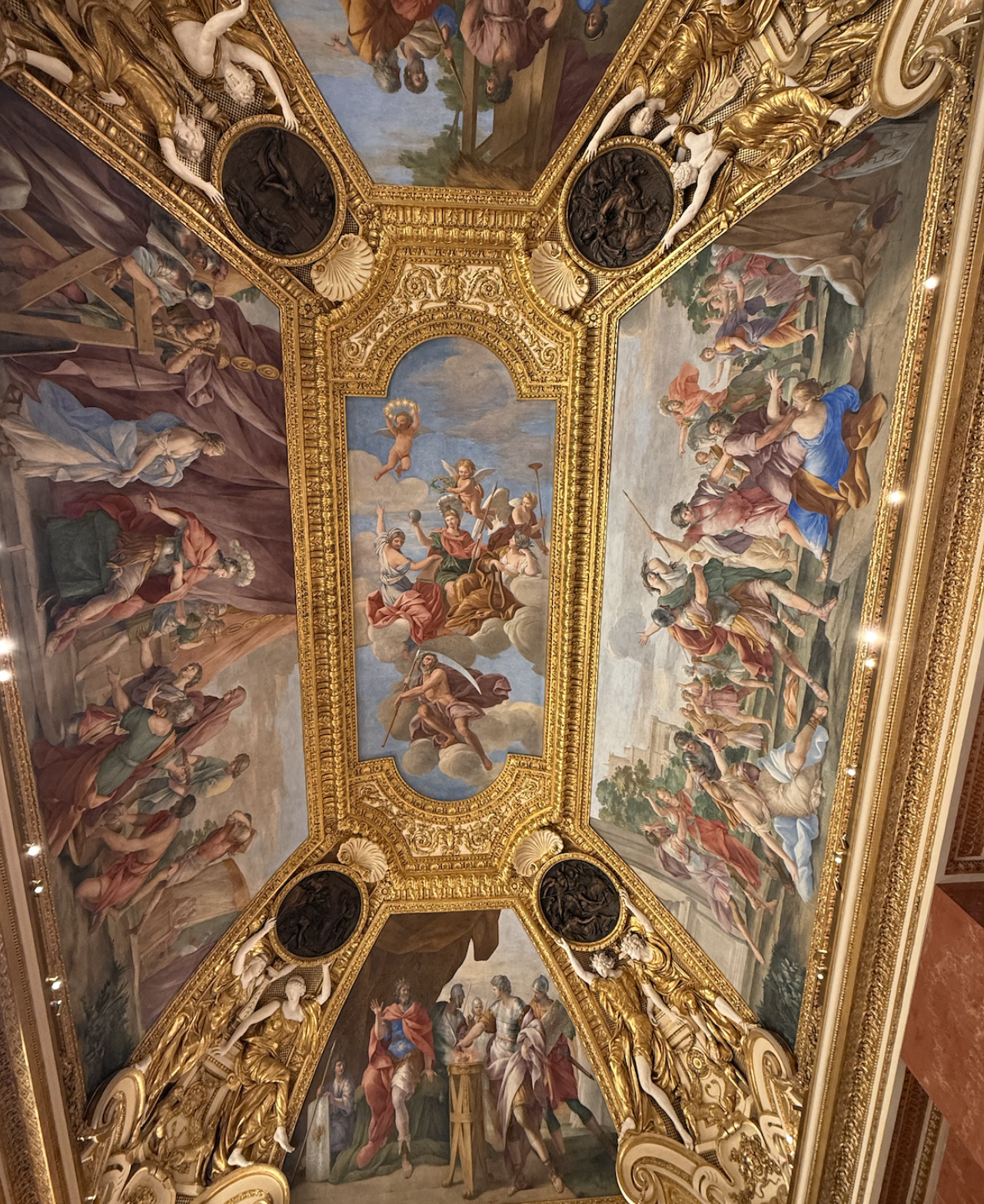
The fourth room was the queen’s grand cabinet, and the first of two rooms was her private oasis. Romanelli and Anguier continued their vision on the ceilings, which featured the ancient stories of Rome.
In the center, Poetry and History Celebrating the Exploits of Rome, you may now recognize a few figures from the earlier ceilings. In the center
History sits on the left and holds a book on her lap while looking towards Time in the lower part of the painting. In the center of the grouping, an allegory of Rome has the orb of the world, while Poetry looks up at her. Fame, with her trumpet, is ready to announce Rome’s greatness. Finally, Rome is being crowned by the Genius of Glory. The beautiful blue sky surrounding the ceiling gives it a lightness that ties in all the stories below.
Four paintings within the cornice give us a deeper look into Roman history. Starting on the west side, the Abduction of the Sabines tells the story of a scene from the 8th century BC Rome. Romulus was worried that the population of Rome was stalled and decided they needed more women. Visiting the nearby towns, the Roman soldiers pleaded with the leaders for the women to be allowed to marry them, but every city turned down the offer. So what did the Romans do? They threw a party dedicated to Neptune and invited all the local townspeople. Romulus would give a signal, and at that moment, his soldiers knew to grab all the Sabine women. A popular theme told through many paintings and sculptures, and often titled the Rape of the Sabines, which means kidnapping, not assault. Jacques-Louis David depicts the scene and held upstairs alongside the Coronation of Napoleon.
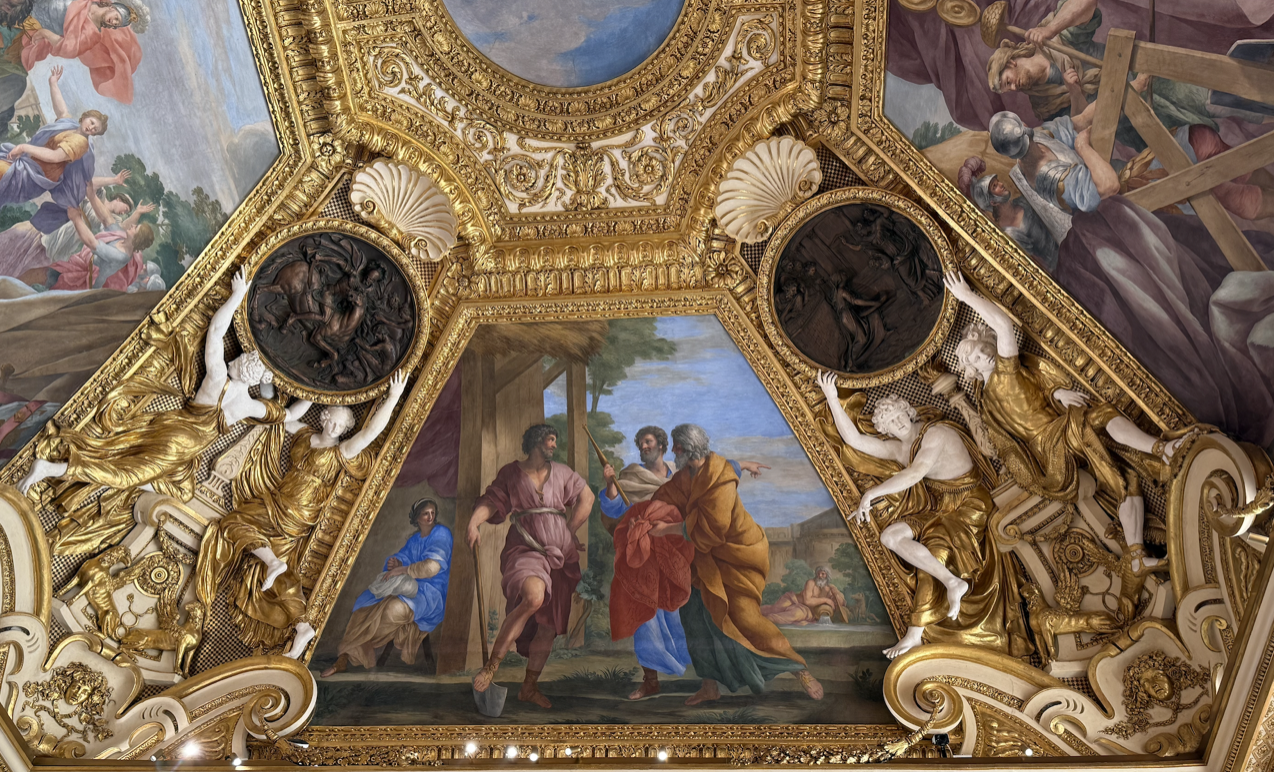
On the east wall, the Continence of Scipio occurred in the 3rd century BC during Scipio's campaign in Spain during the Second Punic War. Scipio Africanus, a powerful Roman general, also had a way with the ladies and often had them delivered to him. Scipio refused to accept a ransom for a young female prisoner when he learned that she was already engaged to another man. He immediately summoned her fiancé and her parents and happily returned her to them. Romanelli shows the young woman in blue behind Scipio with her father and fiancé kneeling in appreciation for her release.
The north and south paintings are more miniature but just as impactful. In the north, we see former politician Lucius Cincinnatus leaning on his shovel. Serving from 460 BC, he decided to retire and live out his life on his farm. Two senators visited him one day, brought his robe, and asked him to return to lead the state. He agreed, returned, and quickly defeated the enemy in sixteen days. He then stepped down and returned to his farm.
Above the south wall, Mucius Scaevola places his hand on the fire before the Etruscan king. In a tale from the 6th century BC, the young Mucius snuck into a camp to kill Porsena, King of the Etruscans. He came across two men dressed the same, and he chose the wrong one and destroyed the scribe. Captured, he declared he was a Roman man, unafraid of anything, and placed his left hand in the fire. Amazed by his bravery, he was released.
Anguier stucco sculptures of warriors and young women hold up medallions in each corner, representing more episodes of Roman history, including the Innocence of the Vestal Tuccia, the Devotion of Curtius throwing himself into the Chasa for the Salvation of the Romans, Romulus, and Remus.
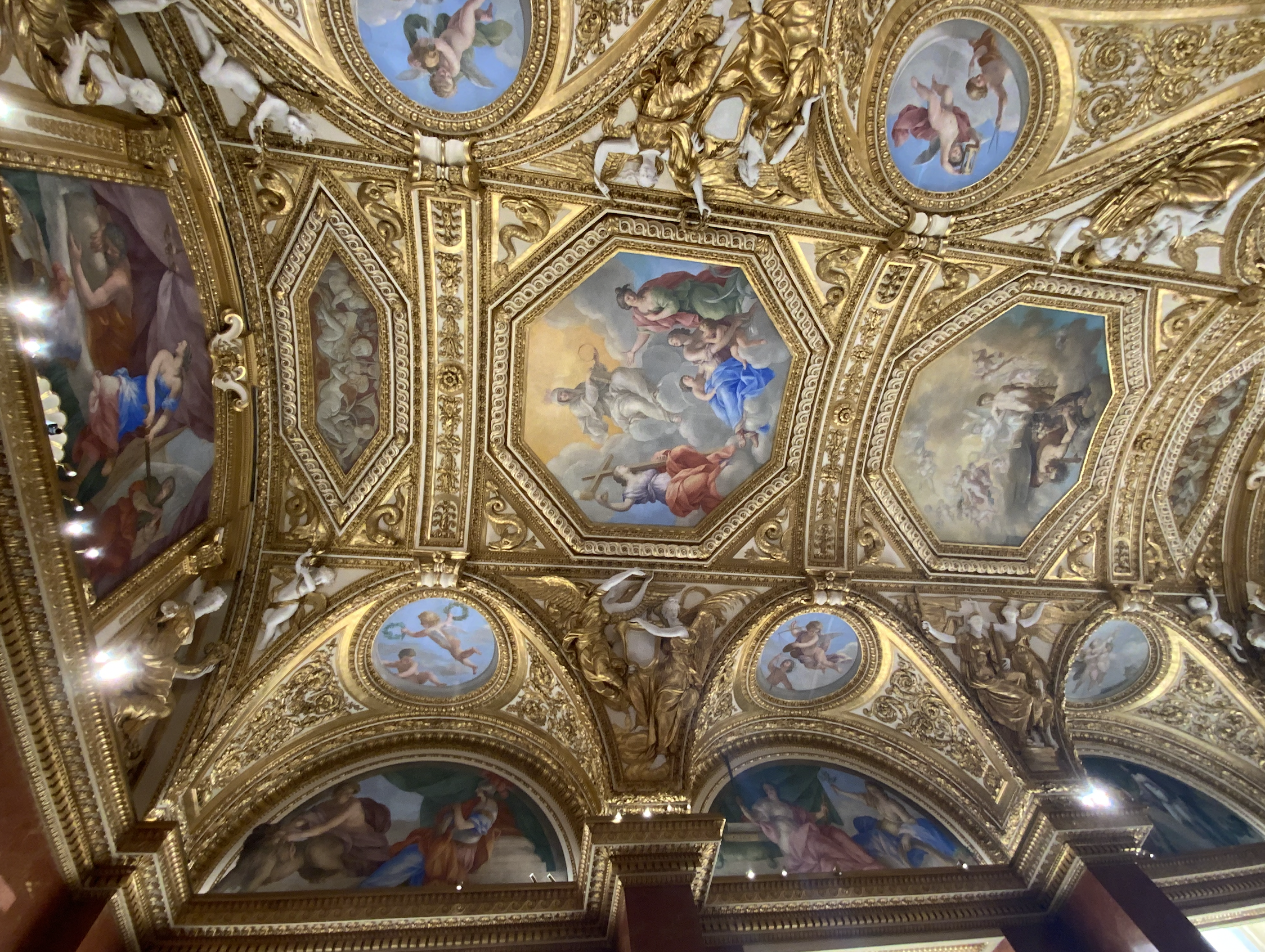
The final room of Anne of Austria’s summer apartment suite originally consisted of two rooms. The private Grande Chambre, reserved for the queen mother, included a small room called the Petit Cabinet sur l’Eau on the southern side of the room. In this small room, the queen’s mother stored her jewelry and had a small sitting area leading to her private view over the Seine.
The ceiling, designed by Romanelli and Anguier, was the most personal to the queen and dedicated to her virtues. Anne was very religious and devout, and each painting reflects that.
Starting in the center, Religion and Theological Virtues. The three theological virtues sit at the bottom, looking up at Religion. Faith is holding a cross from left to right, and the elements of the Eucharist, bread, and wine are in her right hand. In the center, Charity is seen breastfeeding a child, and on the right, Esperance or Hope with an anchor of the soul. The theological virtues were also Anne’s virtues, which she held close to her and remembered each morning when she opened her eyes.
Like the first rooms, Biennourry’s agate cameos are seen again in the Profane History on the north side and Sacred History on the south.
Romanelli has ten other paintings on the ceiling, dating from 1625 to 1650. Over the north door, Judith and Holopherne from the Book of Judith depict the story of the young widow Judith, who goes to the Assyrian king, Holopherne, to gain his trust. Although she was angry, they did little to protect the people from foreign armies. One night, she enters the tent of the drunken king and chops his head off. Romanelli depicts the moment just before she chops his head off; it is best not to wake up every morning to a scene of beheading.
Above the south wall, Romanelli’s Esther et Assuérus is the story of a beautiful young Jewish woman sent to marry the Persian King Assuerus. Hiding her faith until she learned that the minister Haman was ordering the death of the Jews. Begging her to stop the order, her husband has the minister killed, and because of Esther’s bravery, she convinces the king to allow the Jews the right to defend themselves and fight back.
Romanelli painted the northern and central semicircles and small round paintings on the east and west walls.
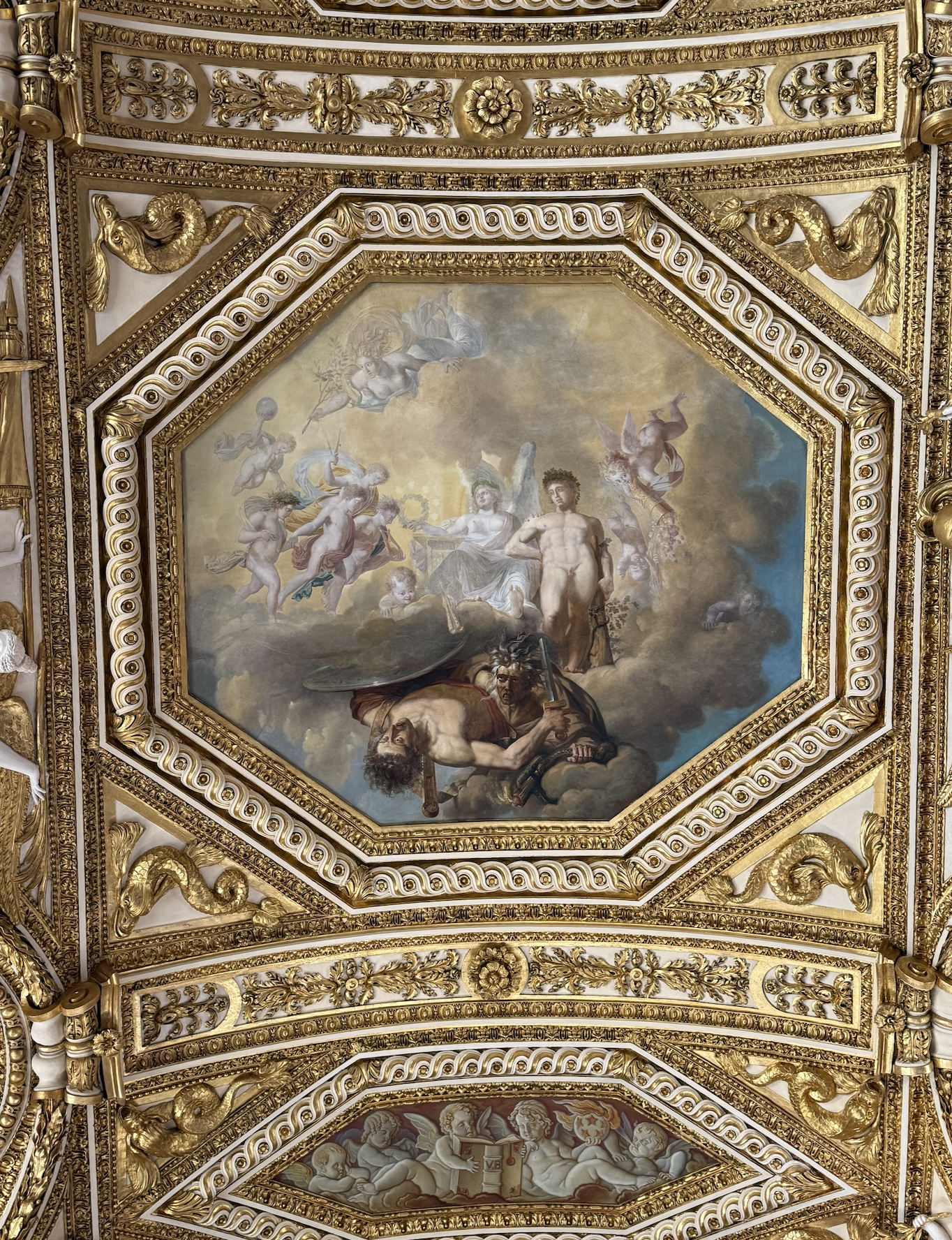
Each painting represents more of the queen’s virtues, and a few are also the Cardinal virtues. Temperance holds back a lion on the eastern wall, while Peace, as war, rests on an olive tree. In the center, Justice has a stack of books, including a codex, and Abundance has her overflowing cornucopia just below.
On the western wall, Prudence and Prévoyance. Prudence holds a snake representing caution, and Prévoyance, or foresight, holds a mirror. In the center, Continence is frightened by the young Cupid, while Virtue, holding a lily and a stick, chases him off. Considering it took Anne 23 years to get pregnant, I feel this one rings true for her.
Above each are smaller round paintings of Génies, which are small children with wings. Often mistaken for Cupids, the génies are used in art to represent a divine nature and characteristic. The six paintings represent more of the queen’s virtues.
On the eastern side of the ceiling, there are the Génies of Glory with two laurel wreaths in the NE, Justice with his scales in the center, and closest to the Seine, the Génius of Immortality.
On the Western side are the Génies of Water, pouring water from an ewer; the Génies of Temps with a compass and hourglass in the center; and the Génies of Engineering to the south.
Jean-Armand Raymond, architect of the Louvre, removed the wall of the Petit cabinet sur de l’eau without harming any frescos. Permitted to move the Romanelli of Esther & Assuérus at 10 am on October 28, 1798. The stuccos of Michel Augier & ornaments of Pietro Sasso were removed where the wall once stood.
Anne d’Autriche died on January 20, 1666, leaving her beloved son a bit lost. Louis XIV celebrated his 40th birthday on September 5, 1678, by kissing the Louvre goodbye and heading to the small Château de Versailles, and we know what came next.
While the Louvre was now suddenly empty, the Sun King allowed the Academies of letters, arts, science, and more to move into the beautifully decorated rooms where the king and court once slept, but at first, it was hands off his mama’s rooms. With the academies also came the artists.
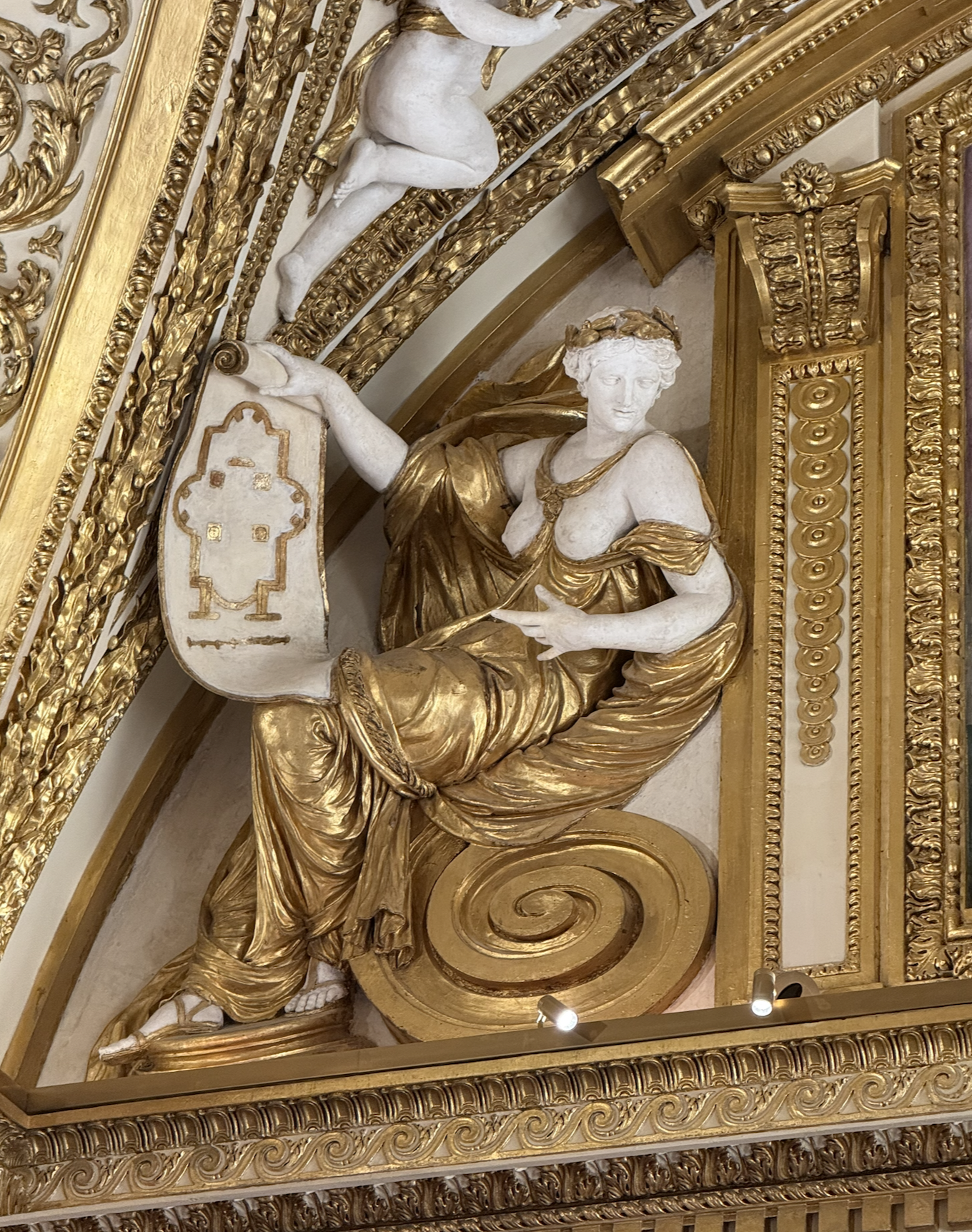
This is yet another subject I am obsessed with, and not the easiest subject to research, but I push on.
Louis XIV finally eased his grip on his mother's rooms in 1712 when he allowed the Academy of Painting to move in. The academy that was under the control of Louis XIV, Charles Le Brun, and his other artists was a coveted group to be a part of. If artists were accepted, they could get coveted commissions for the royal palaces, chateaux, and churches, including the many paintings hanging in Notre Dame.
On July 30, 1712, artist Antoine Watteau walked into the office under the ceiling that was once the bedroom of Anne d’Autriche. Invited to create a piece that would then be judged by a committee, which would decide whether he would be given the royal title of the Royal Académie. Artists were given a brief period of time to complete their painting or sculpture, and they also had to create it within the walls of the academy.
Two years went by, then another year, and in 1715 he was given a new and much shorter deadline of six months. That one also passed by, and in 1717 he finally created his submission, under the ceiling of Romanelli. The Embarquement Pour Cythère, his stunning depiction of the Vert Galant gathering on the island where Venus was born.
In March 1721, six years after the death of Louis XIV, the Regent planned a double marriage that would seal the deal of peace with Spain (third time the charm)
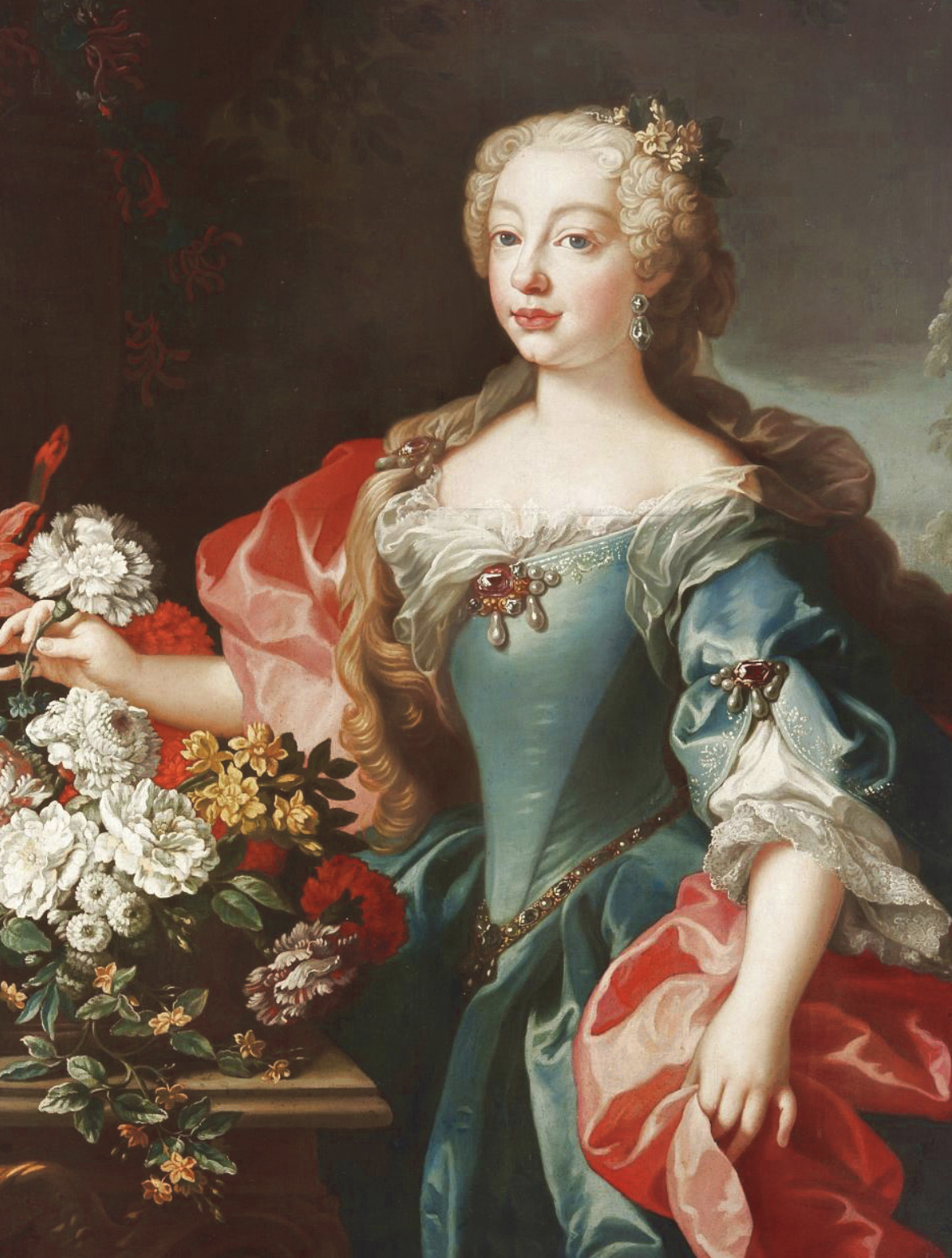
Louise Elisabeth Orleans, daughter of the Regent and the Infanta Marie-Anne-Victoire, married 11-year-old Louis XV. The infanta was 4 years old. The exchange took place in 1722, and she moved into the rooms of Anne of Austria. Her arrival was slated for March, and a massive update began quickly; the Salle des Emperors was changed into a chapel. Woodwork and plaster sculpture by Claude Audran and gilding by Paul Chéron,
Crimson damask furniture, silver and engraved crystal with the Bourbon fleur de lys and the arms of France and Spain.
The two met in Bourg-la-Reine, 9 km south of Paris, and then went to the Louvre on March 2, 1722. The streets were lined with thousands of people.
Her first week involved visits from the other members of the royal family, foreign ministers, and parliament. The second week included a ball in the Hotel de Ville, the Opera, and a Te Deum at Notre Dame de Paris,
On June 15, 1722, Louis XV and the court moved to Versailles because the cost of guards and staff in the Louvre for the princess was too high.
March 11, 1725, it was decided to return her to Spain and call off the marriage. She left Versailles April 5, 1725
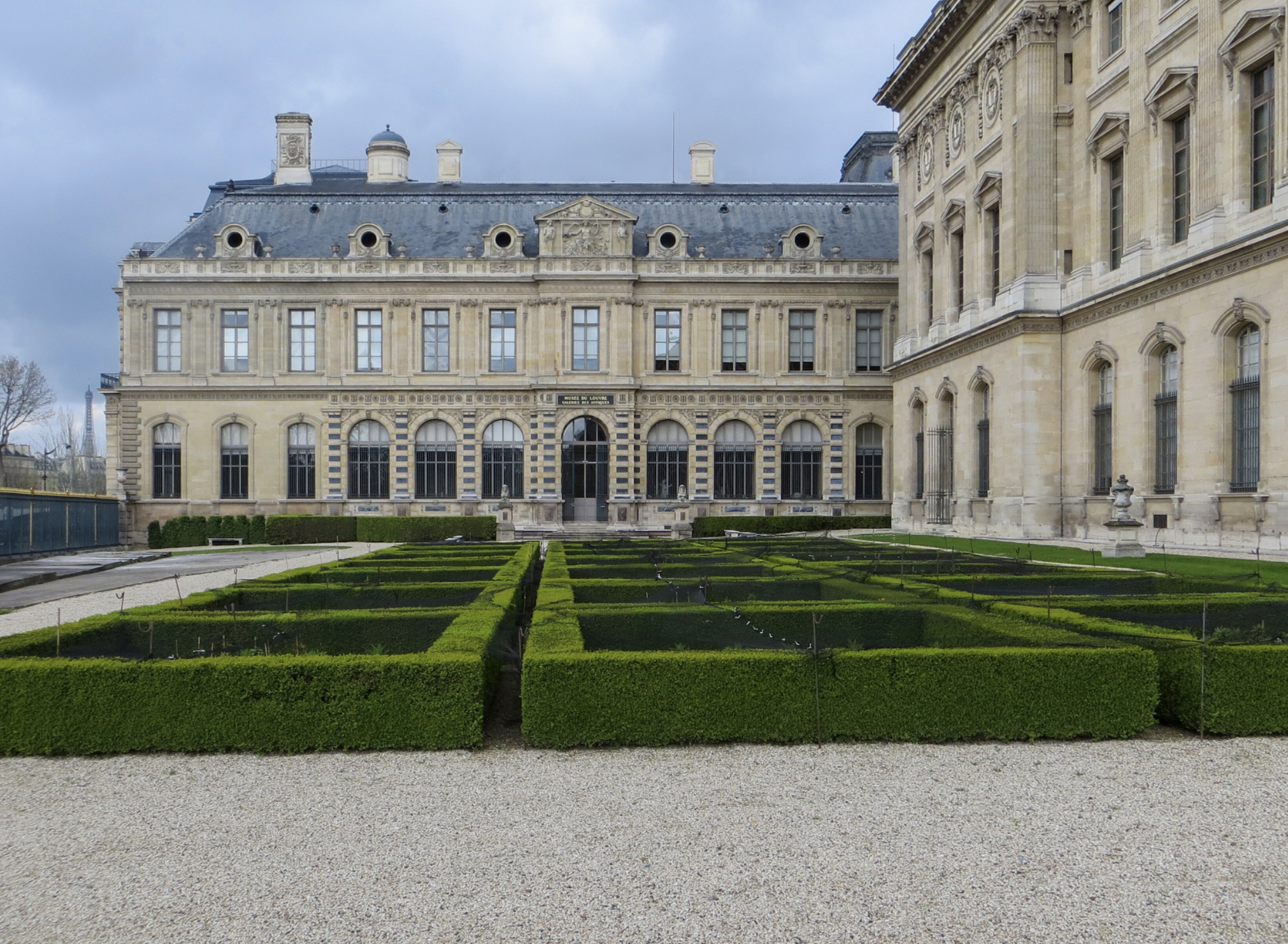
Little remains regarding the young princess, but the garden, which is just outside the Anne of Austria rooms, is named in homage to her, le jardin l’enfant. Today, it is a staging area for the massive construction and has been far from a garden for many, many years.
The apartments would never be lived in again and would be returned to the academies. The Salle des Seasons was used by Citizen Jean-Joseph & Eugene Sue, Father and son, who were also surgeons and taught anatomy to the artists living in the Louvre and members of the Royal Academy before it was dissolved on August 8, 1793.
Even the Bourse, the stock exchange, moved in for a few months.
During the Revolution
The lavish decor was now out of favor. The walls of the apartments were stripped of their decoration, and only the ceilings remained. Royal monickers and paintings of the kings and queens were removed, and the rooms were given over to the Les Musée des Antiques, which had been moved from the Salle des Caryatids under Louis XV.
On September 16, 1792, the Assemblée Législative founded the Musée Central des Arts and inaugurated it on August 10, 1793, in a fraction of the Grande Galerie.
At first, the salon of the former apartments was used to hold paintings, including Rubens Medici cycle and Giorgione’s Concert Champêtre. On November 23, 1793, it was decided that the rooms would hold bronze and metal statues
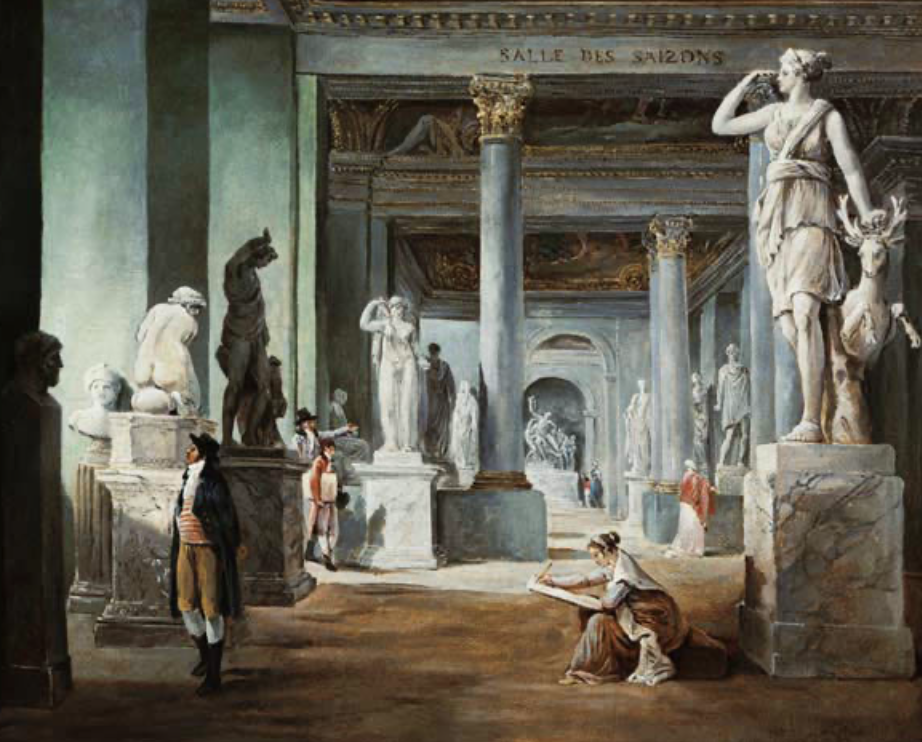
When Napoleon began to send back his looted bounty, the statuary was delivered to the garden, where structures were added to protect and display pieces that the public was allowed to walk among
Since then, the rooms have been dedicated to the statuary of Roman antiquity, but they have not been on display since 2019. It will be a few more years before they return to view.
Until then, check out my YouTube channel for the video walk-through of the rooms and all the descriptions of the decor.
When you come to Paris, book a walking tour and make sure you follow my YouTube channel, as I am going to bring back the deep history walking videos of the streets of Paris.