Four times a year, at exactly true noon, you can witness a scientific and, quite frankly, a little slice of magic right here in Paris.
On the first day of each season, the sun enters the south side of the Église Saint Sulpice through a small hole in the stained glass high above the transept, and at the exact moment of solar or true noon, the sun marks a designated spot within the church.
For years and one spring, summer, autumn and winter after another, I have tried to see this magic moment. There have been cloudy, rainy days and funerals in front of the altar, but this past spring and again last week on this first day of autumn, the sky was clear, as was the altar, and with fellow nerdy folks I stood on the steps looking down at the brass marker, and at 1:41 pm the sun began to crawl across the marble to its bullseye.
Some may know of the meridian line from The Da Vinci Code, one of my favorites as it includes the Louvre and Saint Sulpice. However, Dan Brown’s reference to the “Rose Line” or Paris Meridian is that of a writer's imagination when it comes to the church.
Ever since The Da Vinci Code in 2003, and the movie that came shortly after in 2006, a growing interest in the church wasn’t exactly welcomed by the Catholic diocese of Paris. Although they have come around, there is now a banner referring to Dan Brown and the book that made the church so popular with the tourists.
But why is this in Saint Sulpice, you ask? It goes back almost three hundred years, to 1727, when the parish priest Jean Baptiste Languet de Gergy wanted to ensure the exactitude of the ecclesiastical calendar, particularly Easter and the exact moment the bells should ring, as well as synchronizing the bells across Paris.
Easter is the Sunday after the full moon, following the spring equinox.
Jean Baptiste Languet de Cergy was the priest of Saint Sulpice in the first half of the 18th century. Anne of Austria may have commissioned the church, but it was Laurent de Gergy who is the father of the church we see today. During his tenure between 1714 and 1748, he began many projects, including work on the Chapel of the Assumption and, of course, the gnomon.
In 1721, Gergy, with the approval of the Regent, Philippe d’Orléans, created a fundraising effort for Saint Sulpice to help parish members and restore the church itself.
Today, we take for granted how easy it is to check the time of day. Either on a watch or phone, in 2026 we rarely even need to change the time manually each spring and fall.
It wasn’t that long ago that the time in your car, the microwave, the TV, and the alarm clock by your bed all varied by a minute or two. Now think back to the 18th century and the thousands of years before that. In the 18th century, they marked solar time, but it could differ city by city, even by minutes.
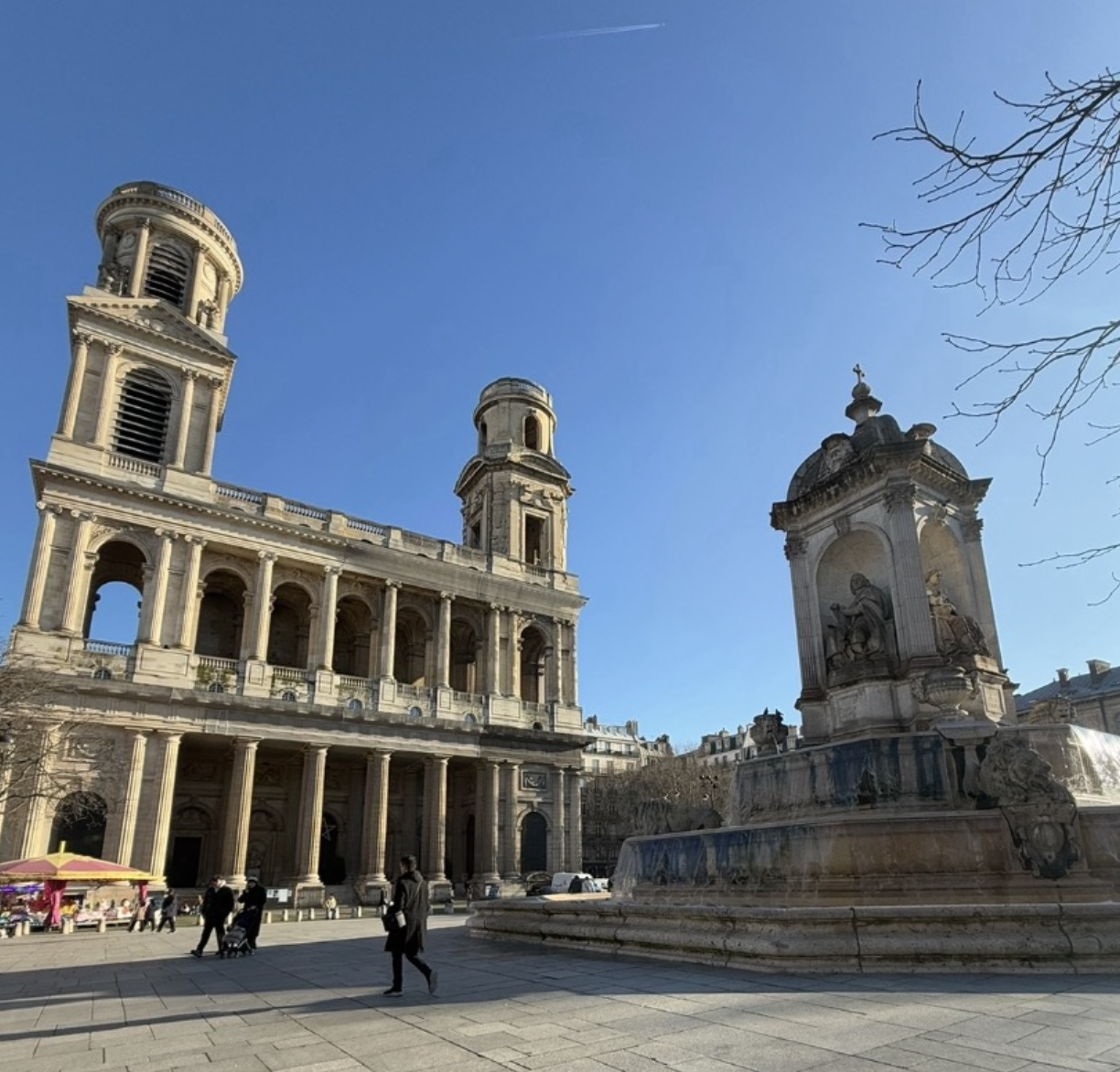
Saint Sulpice is the second-largest church in Paris after Notre Dame. Saint Sulpice's transept is thirty feet wider than Notre Dame's, making it an ideal location for the meridian and gnomon; it also lacked rose windows in its transept, which was a plus.
Churches normally face west, with the sun rising at the apse and setting on the facade. This can differ greatly depending on how close other buildings are to the church and whether they block direct sunlight. Saint Germain des Prés, a short walk from Saint Sulpice, has amazing afternoon light through its south windows that casts a colorful glow on the stones from the stained glass.
Saint Sulpice was chosen not only for its grand size, but also for its location. The left bank has long been the center of education, creativity, and scientific life in Paris. Not far from the lower edge of the Jardin du Luxembourg stands the Paris Observatory, dating back to Louis XIV in 1667. It’s also from where the Paris Meridian begins and is today traced through the Arago markers.
Saint Sulpice actually holds two meridians, and neither is the one referred to in the Da Vinci Code. One is named for its creator, Henri de Sully, and the other leads to the gnomon.
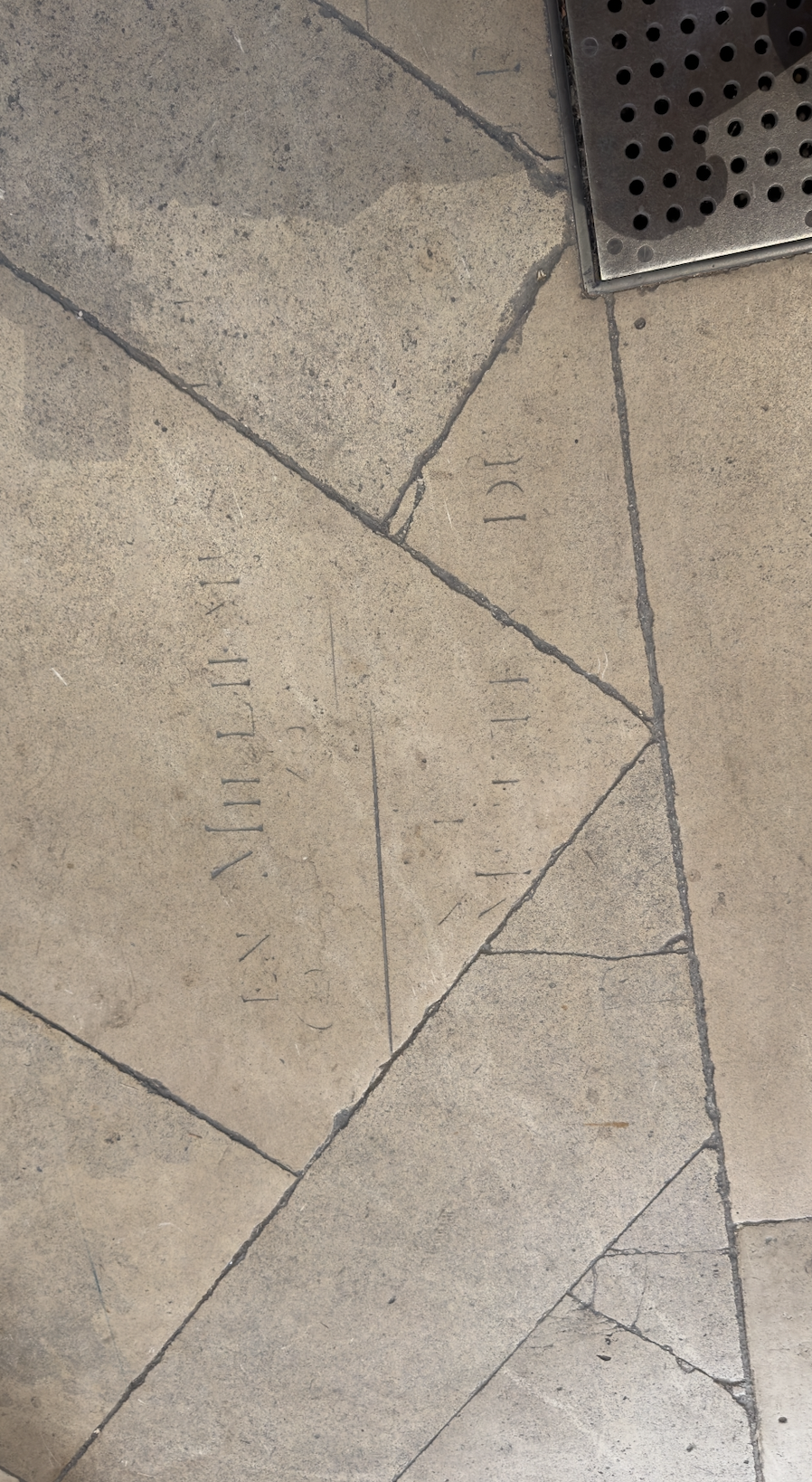
Englishman Henry Sully was a master watchmaker who created a timepiece for ships, using a gimbeled base to absorb wave motion. Garnering the attention of Philippe d’Orléans, Regent to Louis XV, he moved to Versailles and set up his own atelier in 1718.
In 1727, Sully began installing his meridian, which you may not notice or even walk over. Under the inner south portal, Sully engraved markings in the stone that also correspond to those in the Paris Observatory. “Division de la ligne en millèmes parties de la hauteur verticale” = Division of the line into thousandths of the vertical height, inscribed at the top. Below the line, “degré et minutes de la distance du zénith au tropique du Cancer” = degrees and minutes of the distance from the zenith to the Tropic of Cancer, also inscribed with the numbers of the distance.
Sully died on October 14, 1728, and was not able to complete his meridian. He was only 48 years old, but he left detailed plans for completing the project. After his death, he was buried in the church on the south side of the upper entrance to the choir, opposite the sacristy, steps from his meridian.
The project was put on hold after Sully's death until 1742. Pierre Charles le Monnier picked up the mantle and brought the idea to fruition. Le Monnier added a few of his own scientific ideas about the Earth's axis to the initial plan.
Le Monnier had astronomy in his blood. His father, Pierre, was also an astronomer and teacher who immersed young Pierre Charles in the stars. With the backing of Regent Philippe d’Orléans and Languet de Gergy, Le Monnier continued the project, bringing it to life and shaping what we still see today.
Between 1743 and 1745, Le Monnier began installing the elements while calculating the measurements for each solstice and equinox. I know how many years it took me to finally see this; I wonder what poor Le Monnier did if the equinox or solstice he had waited three months for occurred on a cloudy day?
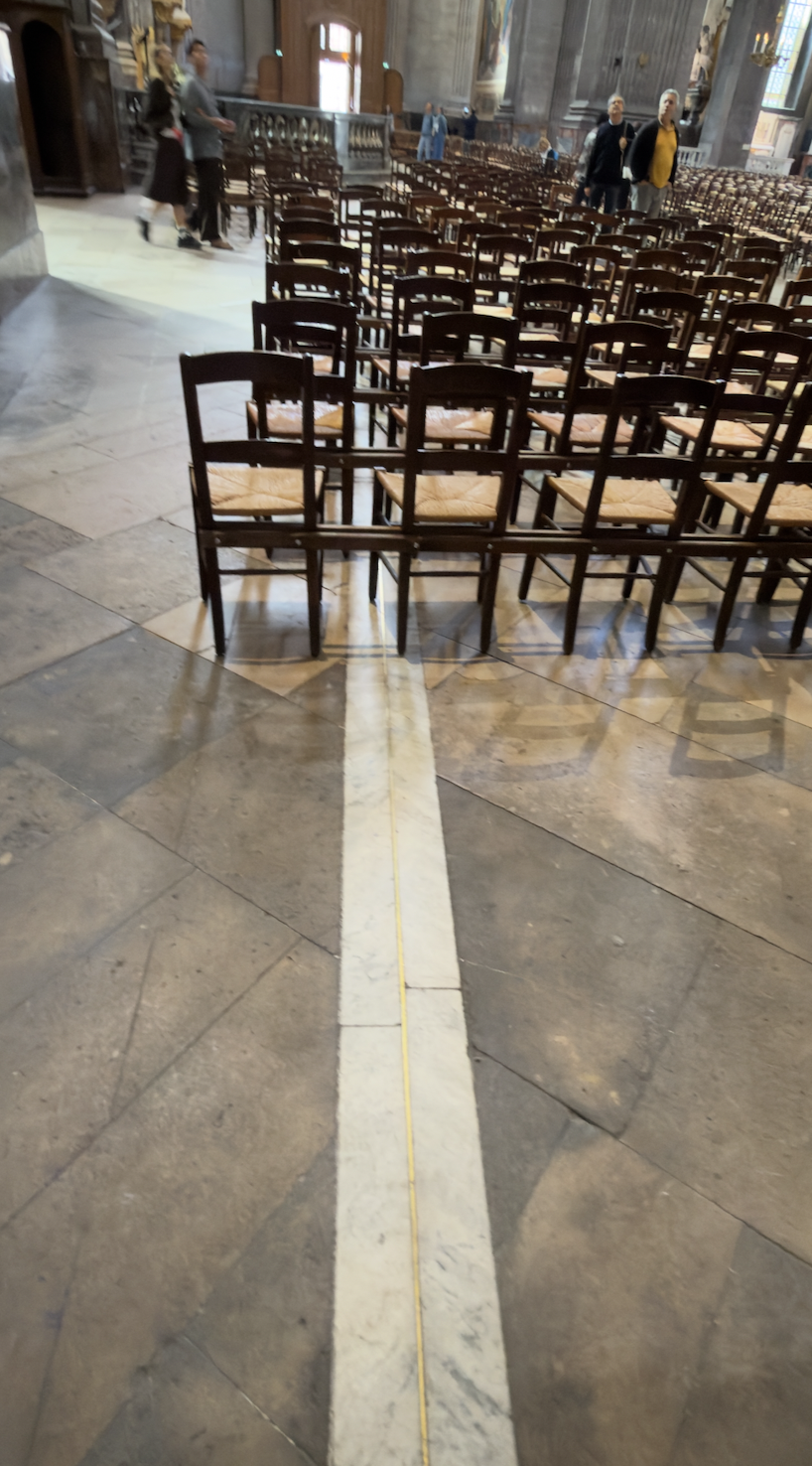
If you look up at the south transept window on the right-hand edge, you will notice three rectangular plates. Each has a small hole with a glass aperture and an 80-foot focus lens through which, at the exact moment when the skies are clear, the sun flows and hits a designated spot within the church. On the winter solstice, the bullseye is on the marble gnomon on the wall of the north transept, and on the summer solstice on the brass plate below the window. For the summer solstice, it should reach the stone-and-brass square plaque below the window. This past summer the frescoes of the transept were being restored, and scaffolding blocked the beam of light.
Le Monnier originally installed three plaques with lenses on the right edge of the window that are still there today, as you can see, but the lower two have been covered. The top, still-active lens is at 24.53 meters, or 90.48 feet, from the ground. While Le Monnier was checking the measurements, he installed the middle lens at 23.92 meters, or 78.48 feet, to measure the summer solstice. The lowest at 21.25 meters, or 69.72 feet; a little trial and error as he went.
The width of the transept of Saint Sulpice was ideal for the project, but even then it was a bit too narrow. The brass meridian line runs at an angle, bearing right from the south to the north, and runs up the obelisk of the gnomon, extending the line that would have been cut off by the width of the church. The word gnomon means knowledge, and the original creation was a pole, much like a sundial, that used a shadow to track the sun's movement, creating a shadow along lines that marked the times of day.
Le Monnier also asked engineer Claude Langlois to join the project to create the brass pieces that form the actual line, as well as markers for the equinox and summer solstice. Langlois was born at the start of the 18th century and became one of the most sought-after creators of scientific instruments. Establishing his workshop on the Île de la Cité until 1735, when he moved into the Louvre and set up his atelier. There, in the Grande Galerie, Langlois created the brass line measuring 40.25 meters (132 feet) and the oval disk that marks the Le Monnier meridian line.
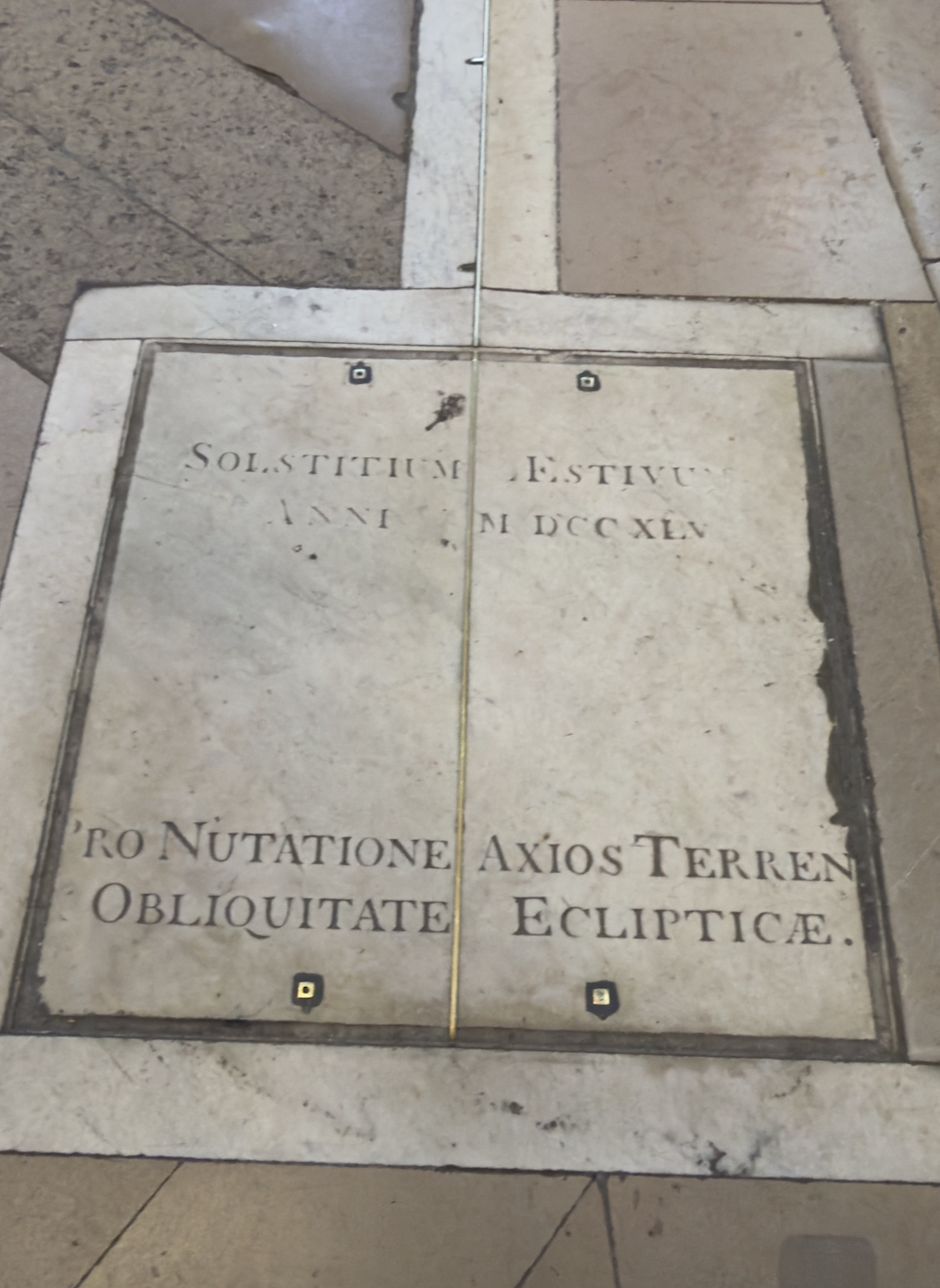
In the center of the south portal, the faint reminders of Henry Sully’s meridian remain. A few steps further is the brass square that starts the Le Monnier meridian and the location the June 21 summer solstice should hit. Carved in stone in Latin and Roman numerals and partially worn away is: Summer solstice, year 1745 for nutation, the Earth's axis, the obliquity of the ecliptic. A brass plaque marked the spot the sun would target on the solstice, but it suffered wear and tear from visitors and was removed in 1959.
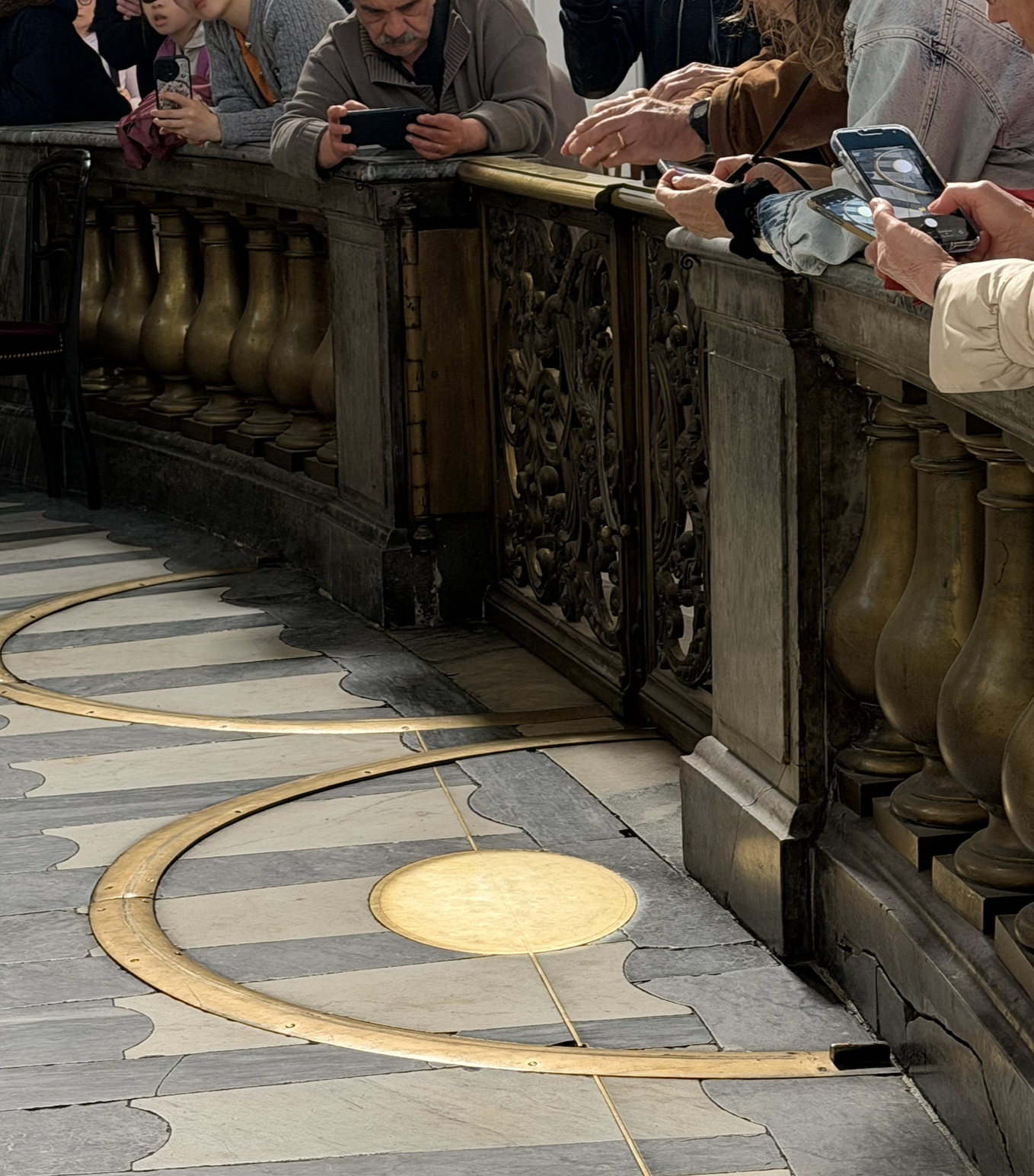
It’s interesting that the obelisk was created as such a major focal point of the meridian when, in fact, the entire objective was to find the moment of Easter, which is in fact one of the two equinoxes. On each of the spring and autumn equinoxes, the sun marks its bullseye just inside the entrance to the altar and choir.
A brass oval plate 10.5 inches long x 9.5 inches wide sits just inside the left gate inside the balustrade. Now that I have been lucky enough to witness both equinoxes this year, it was interesting to see that the sun perfectly covered every inch of the disk. Last week it was offset about an inch.
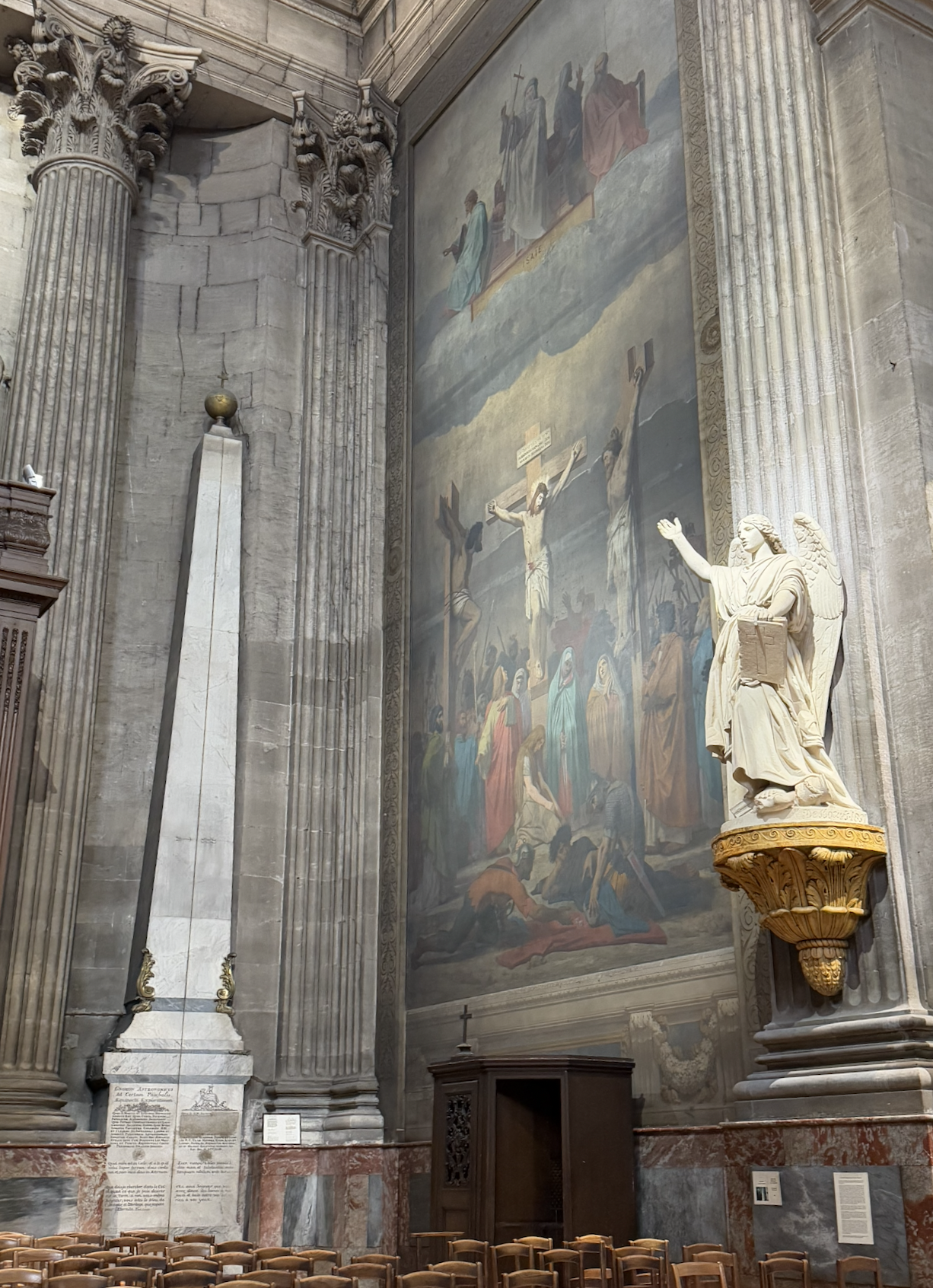
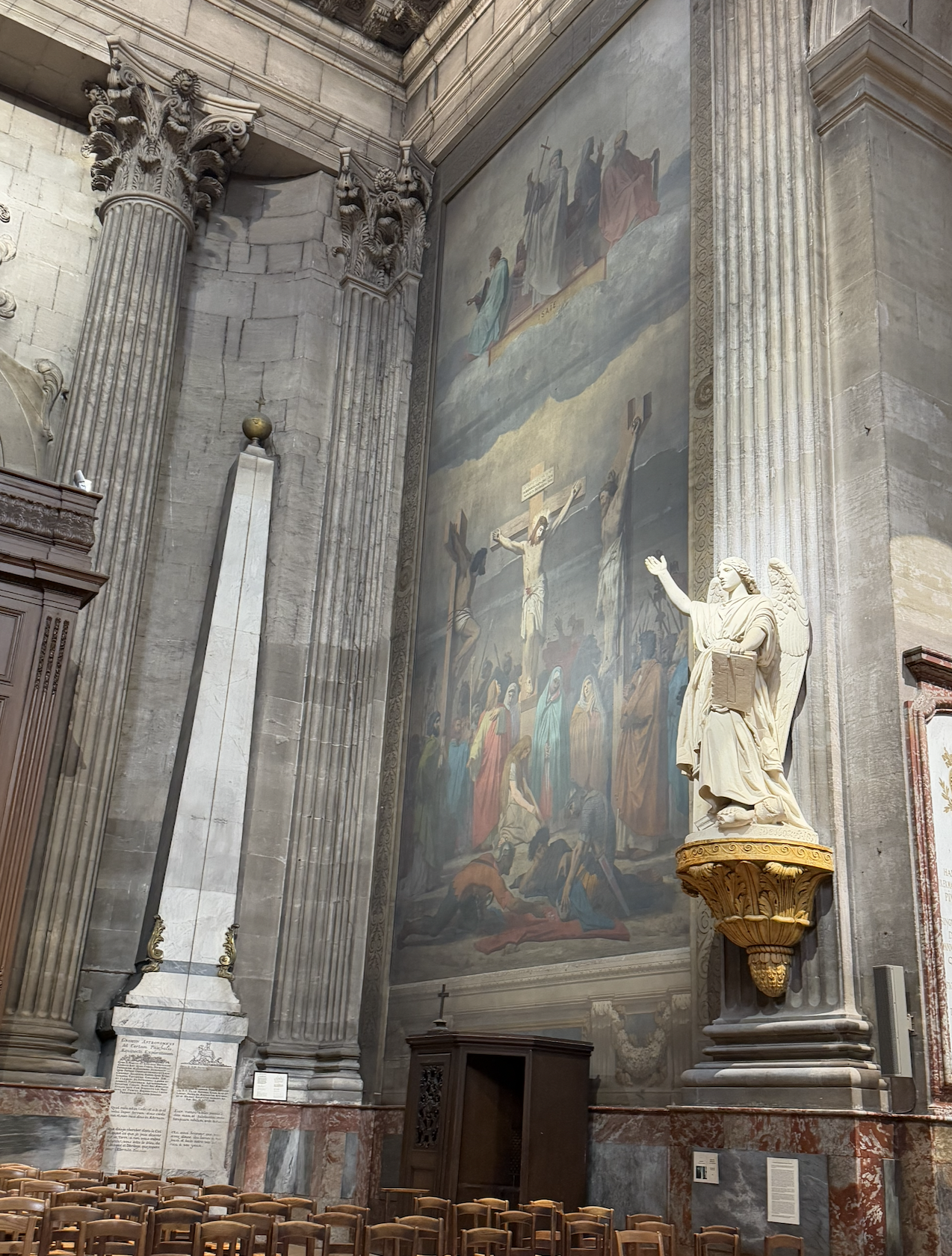
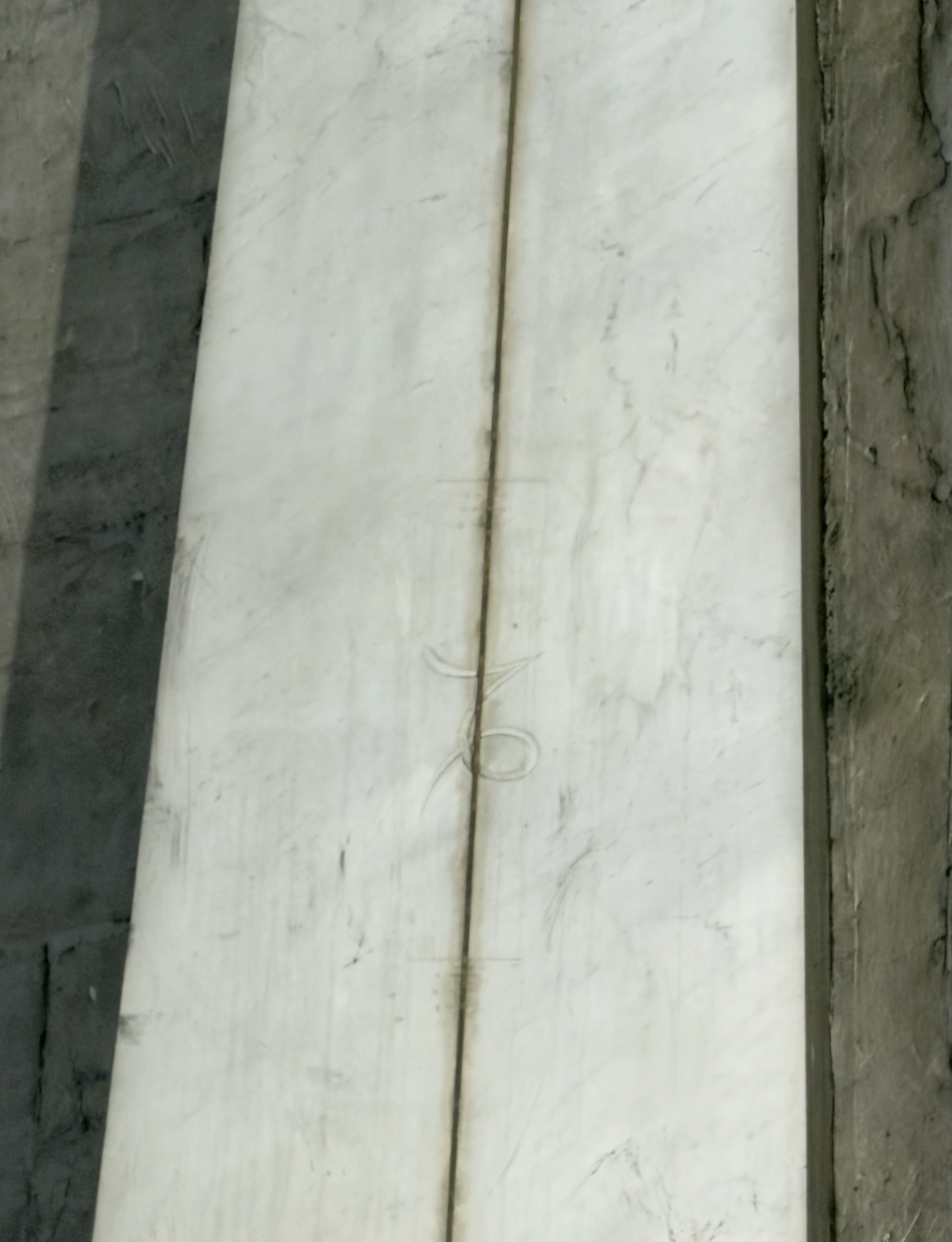
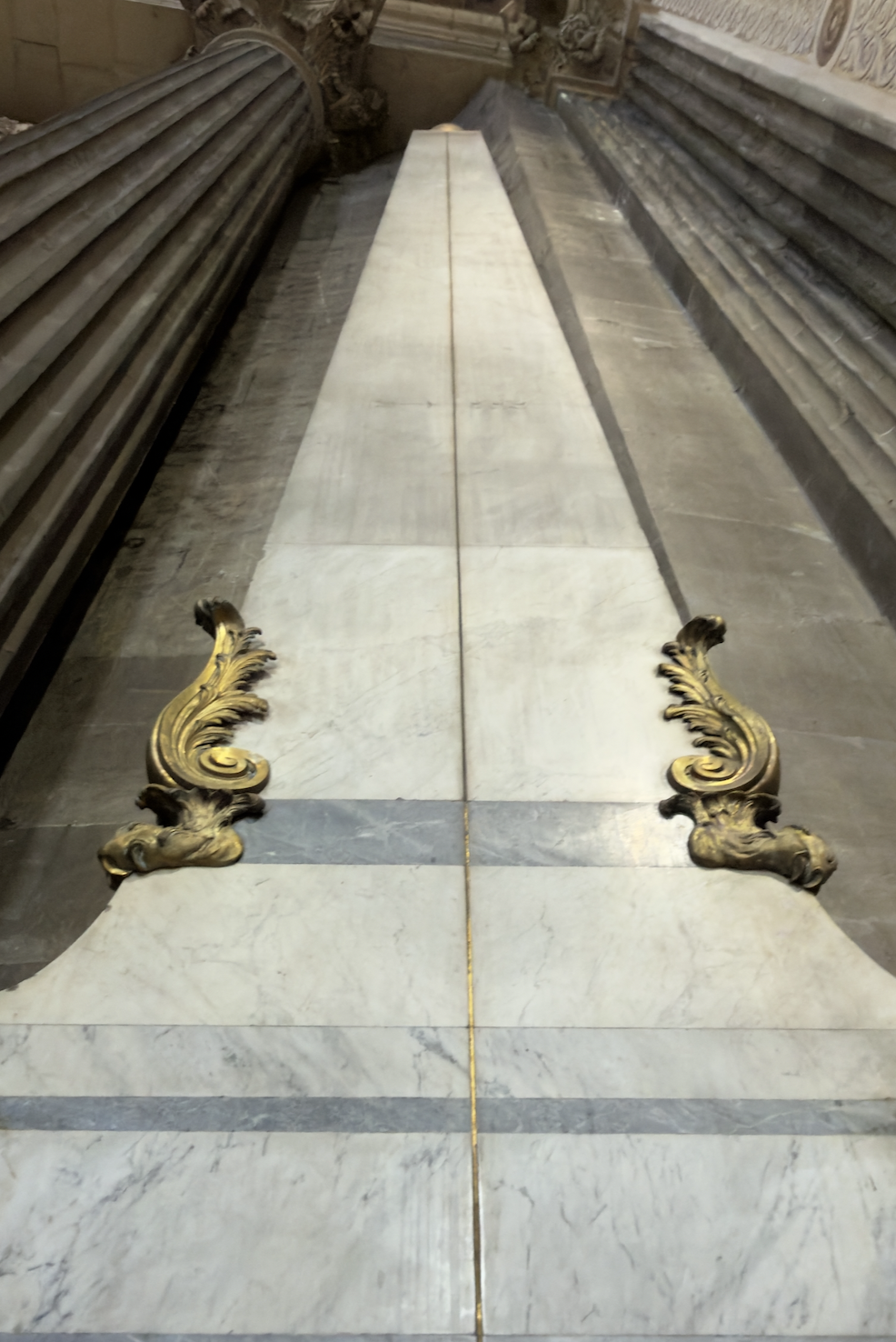
The white marble obelisk stands 10.72 meters, or 35.17 feet, high and was created under Langlois's direction. Placed at a bit of an angle against the wall to capture the light when the sun is at its lowest for the Winter Solstice. The face of the obelisk is straight instead of at a sloping angle. The top is crowned with a brass orb and cross, destroyed during the Revolution and replaced in the mid-19th century.
On the obelisk, around 3 feet from the top, is the faint symbol of Capricorn, the sign of December 21 and where the sun should shine at true noon on the winter solstice. Difficult to spot from the ground, but check out my photos on my website.
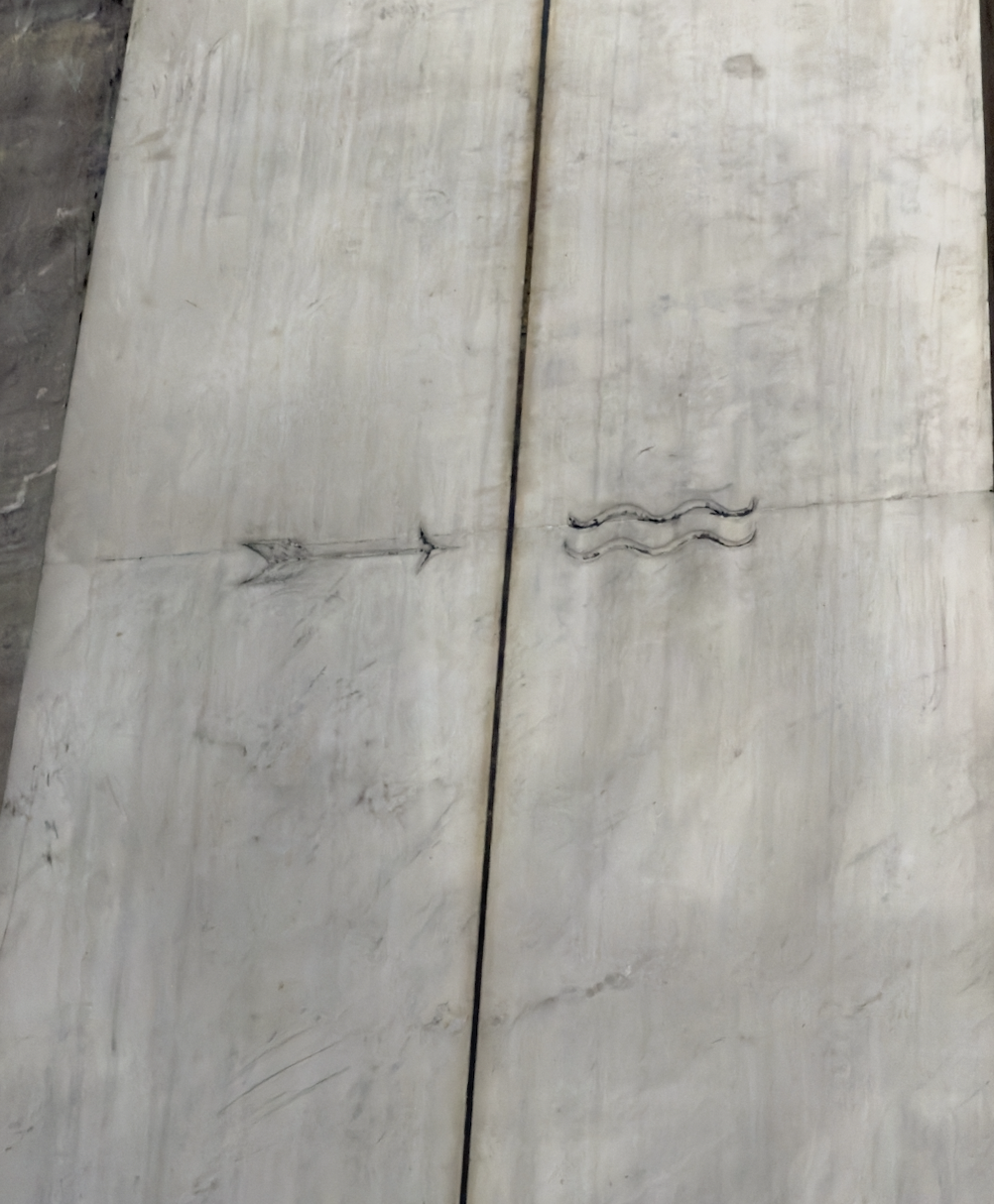
Further down and easier to see are the symbols of Sagittarius and Aquarius. On the left, the arrow for Sagittarius where the sun should hit on November 23, and just to the right, two wavy lines of water for Aquarius. I now have a new mission to visit on each of these dates to see if we can spot the sun.
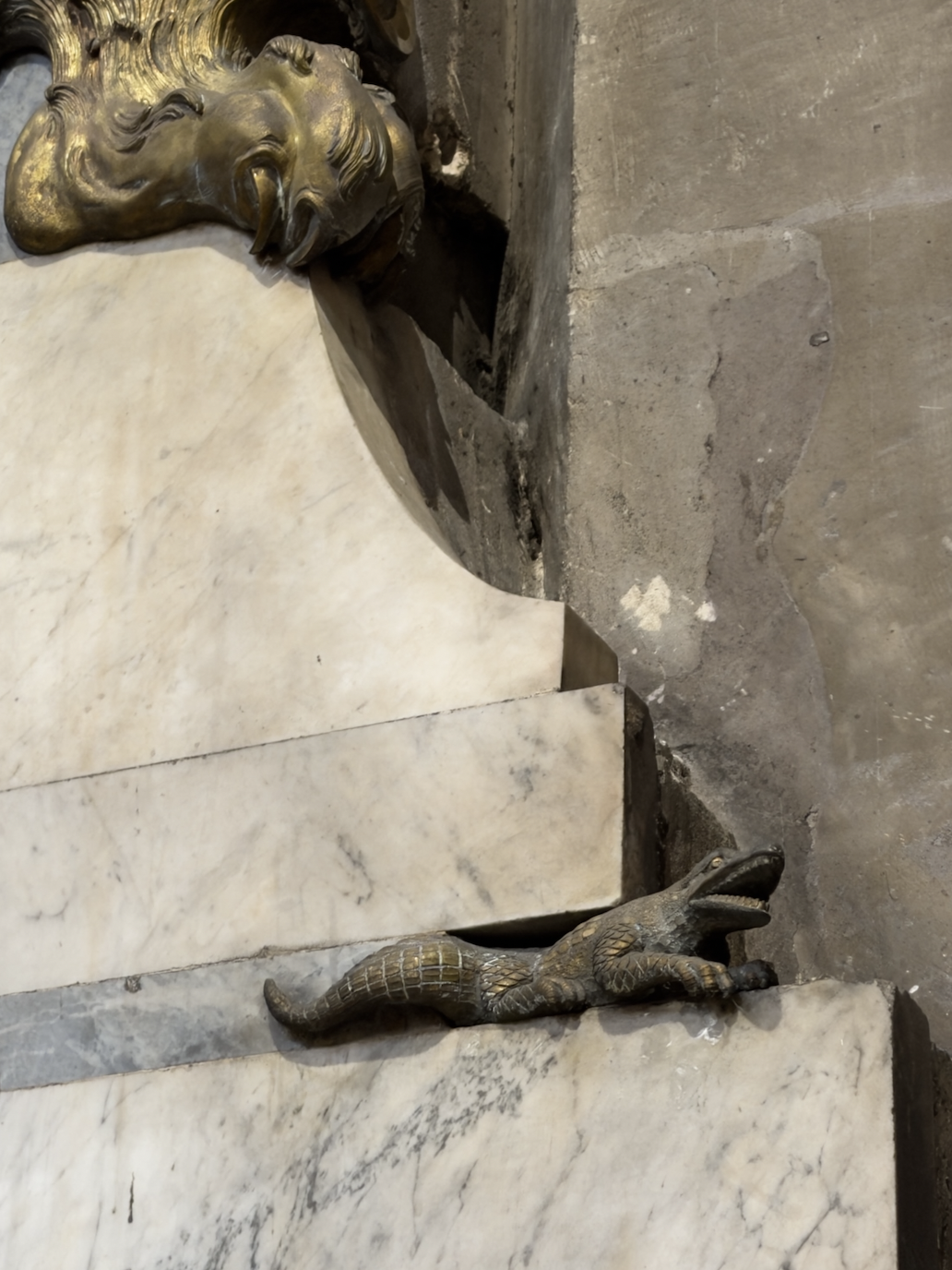
Other brass elements include the lovely flourishes on the corners, and just below where the obelisk meets the base are two brass lizards. The lizards represent the passing of the seasons and regeneration.
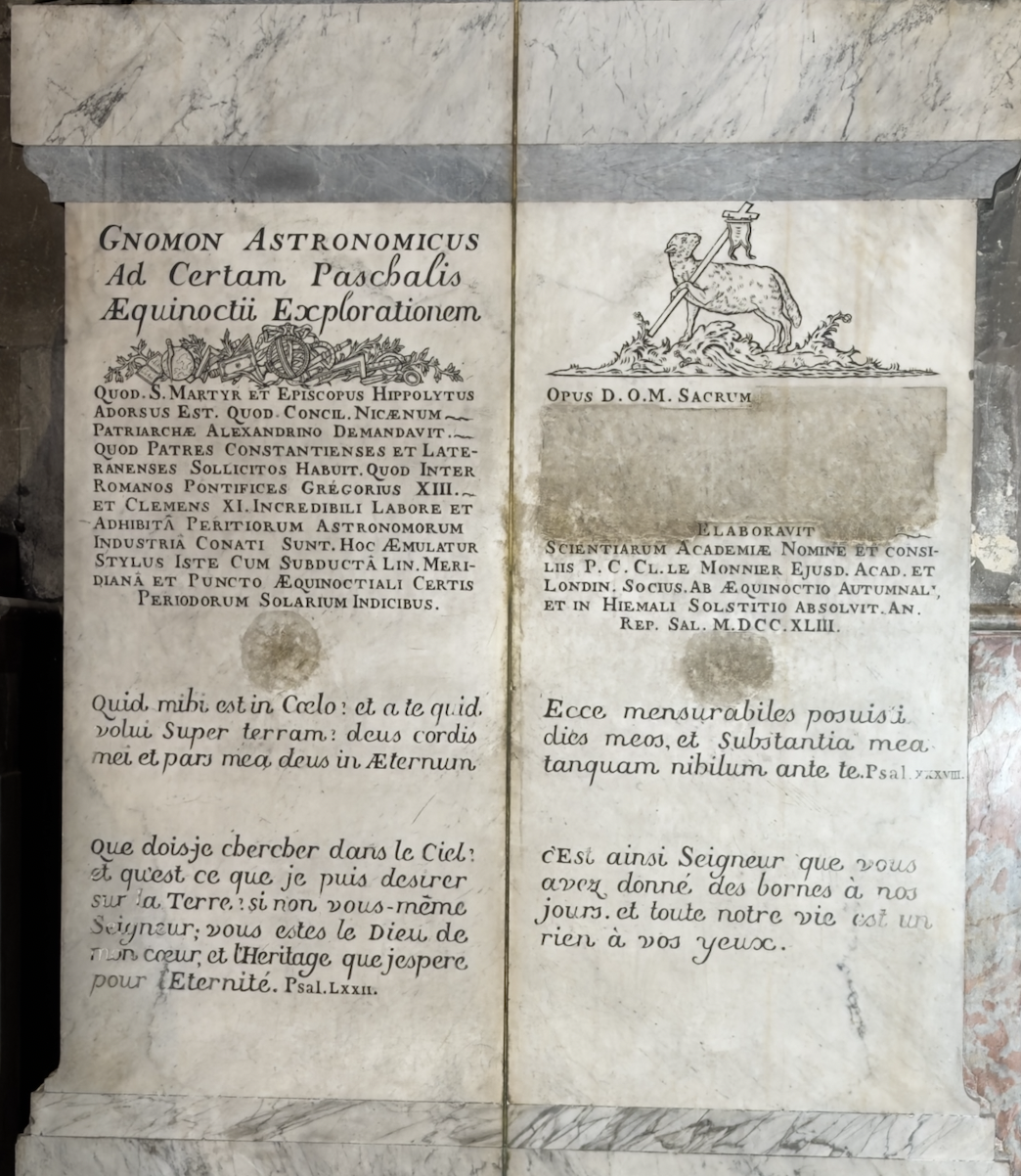
The base itself was inscribed in Latin and French at the time of its installation.
On the left
Astronomical gnomon
For a reliable study of the Easter equinox
With a border of inscribed scientific tools, a few designed by Langlois himself and held in the collection of the Louvre.
Below that in Latin:
This is the task that the holy martyr and bishop Hippolytus undertook; that the Council of Nicaea entrusted to the Patriarch of Alexandria; and that occupied the attention of the Fathers at the Councils of Constance and the Lateran. It is also the task that the Roman Pontiffs Gregory XIII and Clement XI strove to accomplish with incredible labor and the diligent assistance of expert astronomers. This system achieves that goal by means of the calculated meridian line and the equinoctial point, using precise indicators derived from solar cycles.
The symbol for Virgo was carved in at the time of creation, then destroyed in the Revolution.
Below in French,
What have I in heaven? And what have I desired on earth? God of my heart and my portion, God forever.
What should I seek in heaven, and what could I desire on earth, if not You?
Lord, You are the God of my heart and the heritage I hope for
for eternity. Psalm 73.
The right side is topped with the Pascal lamb with cross and banner. The section just below was destroyed during the Revolution, as it referred to the king. Until last year, the church had a framed description with the original markings that has since been removed. All of the chapels have new fancy plaques added in 2024, but since I take pictures of everything, I have a few.
A work dedicated to God, the Best and Greatest, executed in a manner worthy of the Crown under the auspices of Louis XV—a generous benefactor to this basilica—and with the support and patronage of J. Fred. Philippeaux, Count de Maurepas, Minister of State and principal patron of the church's endowment, as well as of Philip Orri, Minister of State and Superintendent-General of Royal Buildings. It was carried out in the name and under the counsel of the Royal Academy of Sciences by P. C. Cl. Le Monnier—a fellow of that Academy and of the Royal Society of London—commencing at the autumnal equinox and concluding at the winter solstice. Year of Salvation 1743.
Another symbol, possibly for Gemini but unknown.
Behold, you have made my days and my substance measurable. as nothing before thee. Psalm 38
Thus, O Lord, You have set limits to our days, and our entire life is as nothing in Your eyes.
While the base of the obelisk was damaged in the Revolution, the rest of the meridian line and balustrade were saved by two quick-thinking pharmacists. Duchatel and Charras stood watch in front of the blue turquin marble balustrade and convinced the angry Revolutionists that the meridian line was based on science, not religion, and should be saved; thankfully, it was. The high altar itself couldn’t be saved
Want to see it for yourself? Make sure you are in Paris for the equinoxes and solstices, but be sure to check the actual dates for Paris, as they do differ from the US at times. True noon, or solar noon, is the moment the sun is at its highest point. The exact time can change depending on location, day, and even the year.
The Winter solstice is next on December 21 at 12:48 pm
The Spring equinox is on March 20 at 12:58 pm
The Summer solstice is on June 21 at 1:52 pm
And the Autumn equinox is on September 23 at 1:43 pm
The parish priest behind this idea, Languet de Gergy, served until November 19, 1748, finally seeing the completion of the meridian and gnomon. In the final two years of his life, he served as an abbot at the Notre Dame de Bernay in Normandy, where he died on October 11, 1750.
In the chapel of Saint Jean le Baptiste, on the west side of the south transept, the parish created a grand monument for the priest after his death. Languet de Gergy rededicated the chapel to Jean le Baptiste in 1724 and made him his patron saint. The church and parish commissioned the large cenotaph as a gift for the man who gave so much to the church.
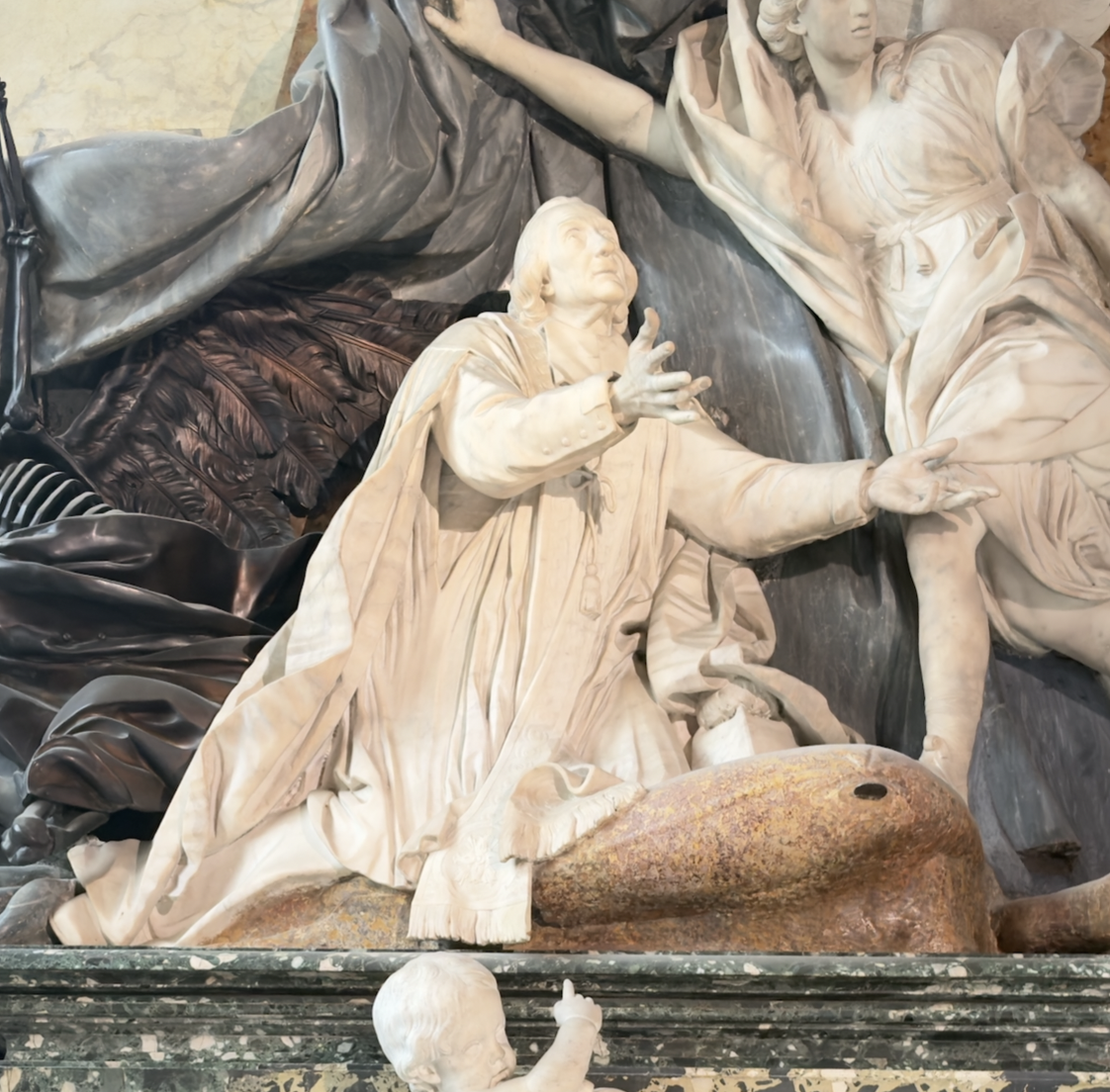
French sculptor Michel Ange Slodtz submitted his ideas a month after the priest's death for a fitting memorial. The priest is depicted in white marble on his knees, with his arms outstretched toward the altar and the gnomon. Above, the angel of Immortality lifts the veil in the same blue turquin marble of the balustrade of death, announcing his resurrection. Before the Revolutions, she also held the plans of the church drawn in gold on a bronze plaque.
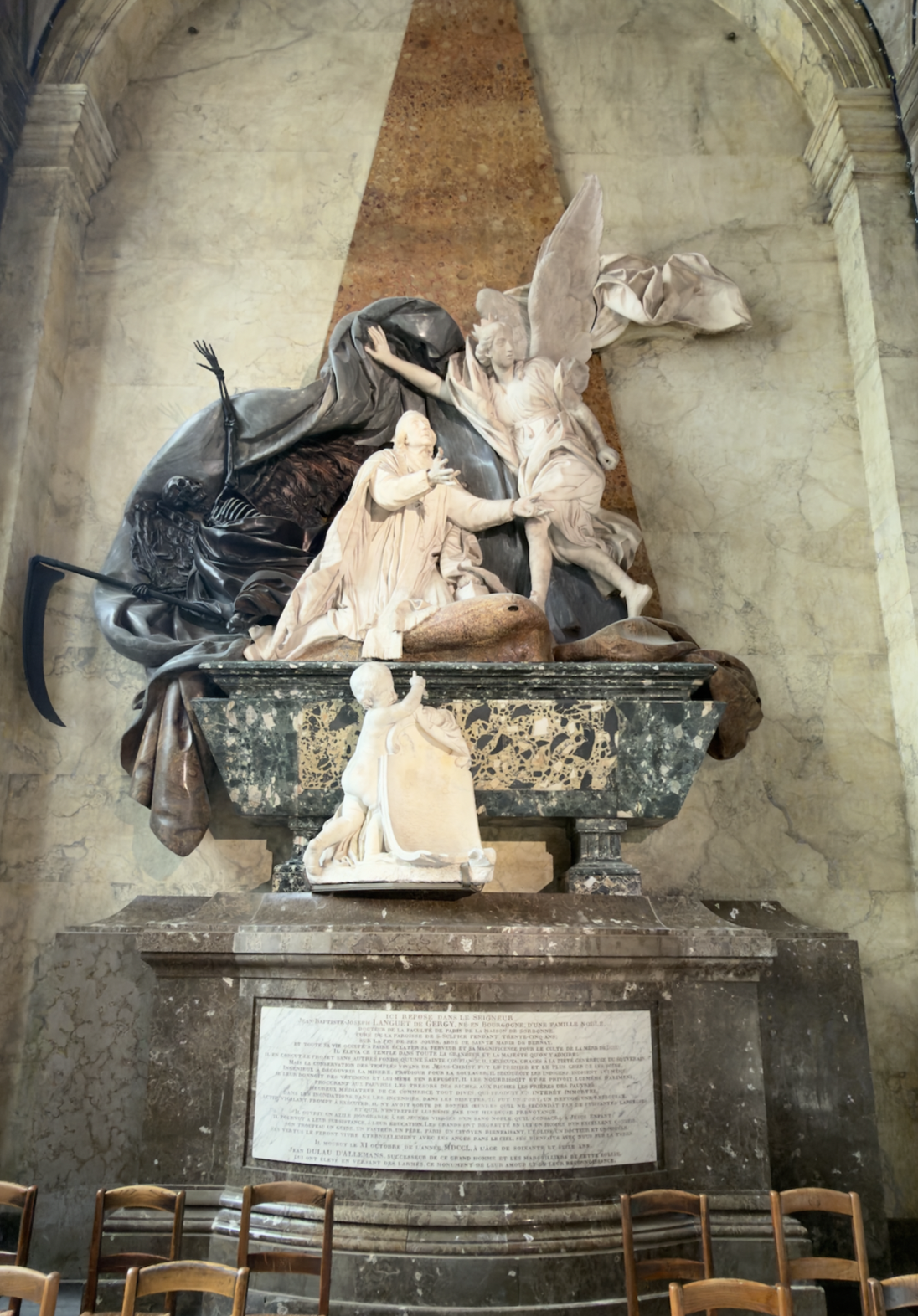
On the right, death lies under his large veil of marble. Sculpted in bronze, the skeletal figure holds his scythe as he turns to leave. The bronze feathers of his wings are incredible. The scene is carried out on the top of a large black marble tomb sitting on a red Languedoc base with a carved inscription dedicated to the beloved priest.
When created, Slodtz included two marble genies attached to the red marble base. Representing Religion holding the arms of Gergy and Charity, who once held a cornucopia overflowing with fruit. The entire scene plays out in front of a pink marble obelisk lying flat against the wall.
During the Revolution, Alexandre le Notre saved the monument and moved it to the Petits Saint Augustins. It did not see its return to the chapel until September 1821. The bronze plans of the church, laurel branch, and genii of charity were lost and never returned.
The red marble base was built in 1810.
Here Rests In The Lord Jean-Baptiste-Joseph Languet De Gergy, Born In Burgundy Of A Noble Family, Doctor Of The Faculty Of Paris (Sorbonne), Parish Priest Of Saint-Sulpice For Thirty-Five Years; Toward The End Of His Life, Abbot Of Sainte-Marie De Bernay;
Throughout His Life, He Devoted Himself To Displaying His Fervor And Magnificence In The Worship Of The Mother Of God.
He Erected This Temple With All The Grandeur And Majesty One Admires Today:
He Conceived The Project With No Funds Other Than Holy Trust; He Carried It Out Thanks To The Sovereign's Generous Piety. Yet The Preservation Of The Living Temples Of Jesus Christ Was His Foremost And Dearest Concern; Ever Ingenious In Discovering Misery And Lavish In Relieving It, He Succored The Destitute While Being Destitute Himself;
He Gave Them Clothing While Denying It To Himself; He Fed Them While Depriving Himself Of Food; Providing The Poor With The Treasures Of Almsgiving, And The Rich With The Prayers Of The Poor—A Blessed Mediator Of This Wholly Divine Exchange That Yields Immortal Interest.
Amidst Floods, Fires, And Famines, He Was A Haven, A Refuge, And A Source Of Aid. Active, Vigilant, And Prompt To Act, There Was No Form Of Good Work He Did Not Support With Generous Bounty,
Nor Any He Did Not Himself Undertake With Blessed Foresight.
He Opened An Honorable Sanctuary To Young Women Of Noble Birth, Consecrating Them To The Child Jesus; He Provided For Their Sustenance And Their Education. The Great Mourned In Him A Man Of Excellent Counsel;His Flock, A Guide, A Shepherd, And A Father; Paris, A Beneficent Citizen; The Church, A Teacher And A Model. His Virtues Shall Cause Him To Live Eternally With The Angels In Heaven; His Good Deeds, With Us On Earth. He Died On The 11th Of October In The Year 1750, At The Age Of Seventy-Six. Jean Dulau D'allemans, Successor To This Great Man, And The Churchwardens Of This Church,
Have Erected This Monument Of Their Love And Gratitude, Shedding Tears As They Did So.
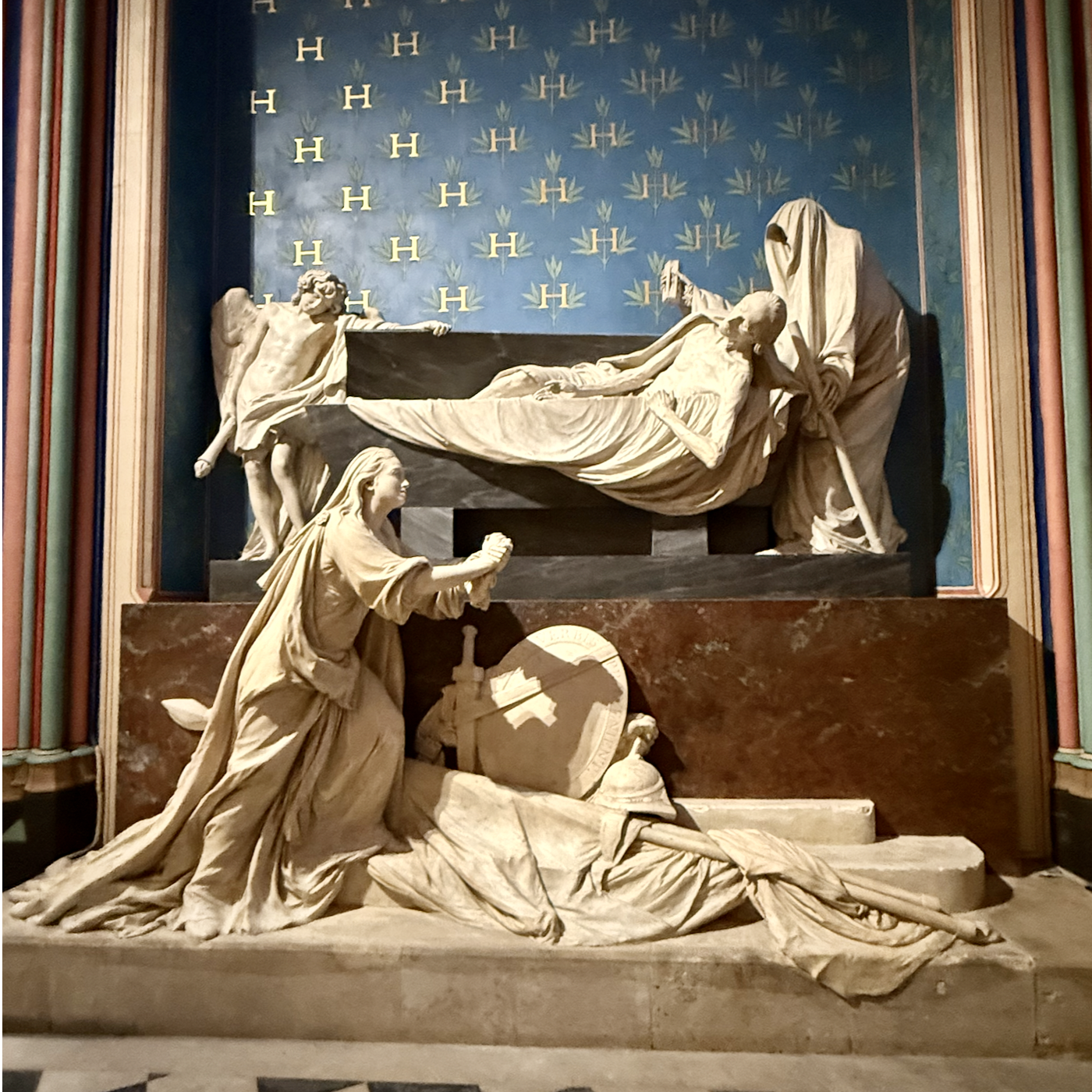
It might remind you of a cenotaph you will find in Notre Dame dedicated to Claude Henri, le Comte d’Harcourt, created in 1776 by Jean Baptiste Pigalle.
Claude Henry Comte d'Harcourt served as a lieutenant general in the army of Louis XV and died on December 5, 1769. On July 1, 1771, the widow Harcourt commissioned Pigalle to create a theatrical piece titled the “Conjugal Reunion”. She had very specific instructions for how it would look, which came to her in a dream. At the end of the sarcophagus will be the guardian angel of the lord. In one hand, he holds the torch of their marriage, while the other opens the tomb. Seeing this, the Count pulls himself from his tomb and reaches for his wife, who is on her knees below in prayer. Standing behind is Death, holding an hourglass showing that her time has come. The Count also closely resembles the statue of Voltaire that Pigalle created in the Louvre.
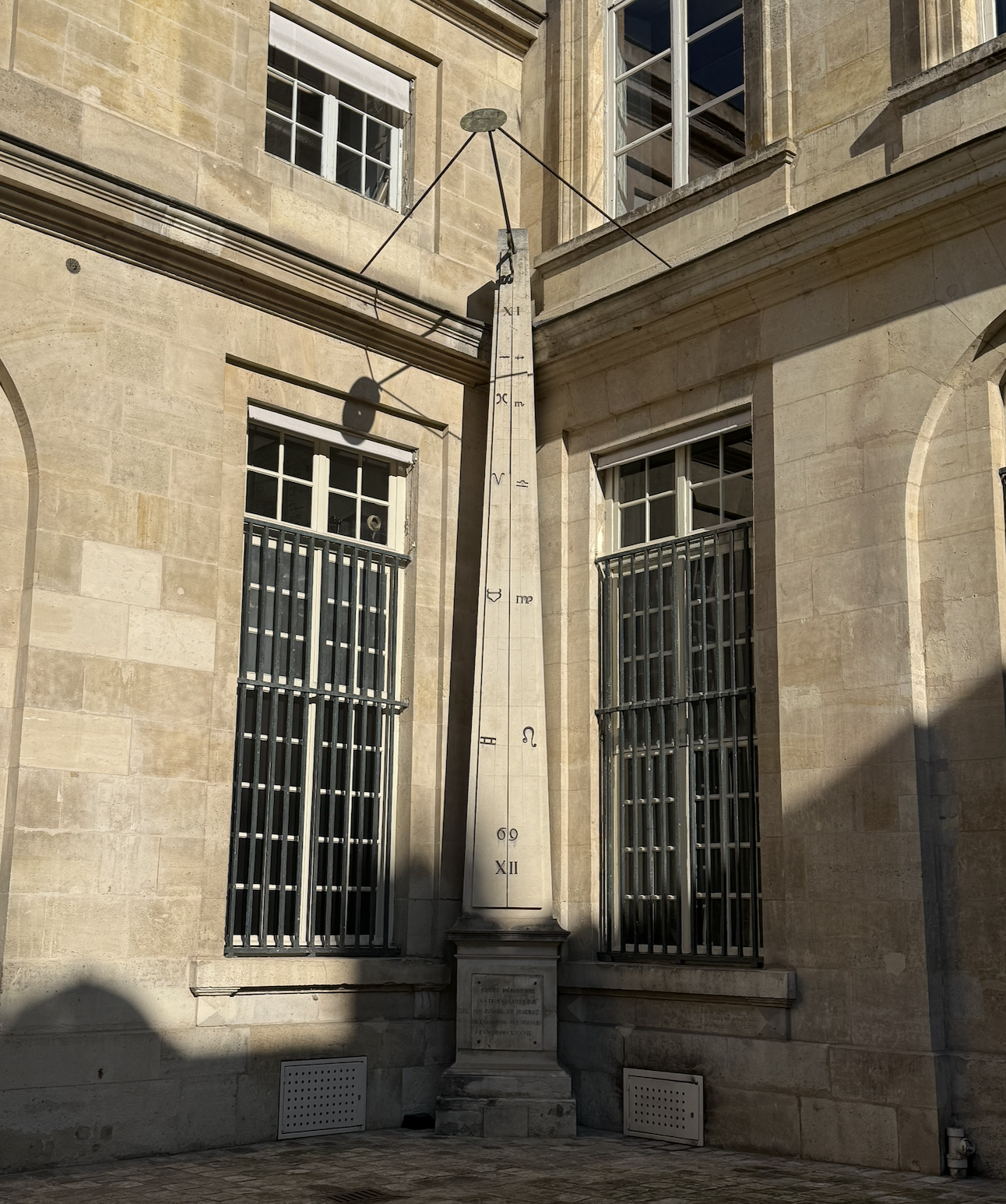
Paris is filled with hundreds of sundials and past reminders of how they once calculated the time of day.
The Cour de la Meridian of the Monnaie sundial also includes an obelisk and holds the symbols of the zodiac.
Within the Palais Royal, a small cannon once fired every day at noon, set off by the sun hitting a magnifying glass that burned a horsehair firing the cannon. Installed in 1786 by Sieur Rousseau to also publicize his watchmaking business. It originally sat on the meridian line itself; you can find many of the Arago markers within the entrance to the Palais Royal from the Place Colette. It was moved to its current location in 1990. The original was stolen in 1998 and never recovered, and replaced in 2002 with an exact replica.
It still fires on occasion during Heritage weekend and the anniversary of the Liberation of Paris. According to the website, it will also fire on Monday, October 19, and Friday, December 4, at Noon
Another notable example is the Dali Sundial
Head down Rue Soufflot and take a right onto Rue Saint-Jacques. The Rue Saint-Jacques was once the cardo of Roman Lutetia, long before Paris became Paris. The north-south road led to the Chemin de St-Jacques and Santiago de Compostela. At 27 Rue Saint-Jacques, look up at the corner; one of the 120 sundials that can be found around Paris resides on the corner. This isn’t your normal sundial; it is by artist Salvador Dali. Dali created it on 15 November 1966 for a friend who owned the shop beneath it. The sundial is a woman’s face on a scallop shell, a nod to the Saint-Jacques de Compostelle. Her blue eyes shine beneath her eyebrows, set aflame like the sun. Her hair cascades down, forming the recognizable mustache of her creator. Dali’s signature appears in the lower right-hand corner, but don’t set your watch to it; the surrealist artist never designed it to work.